PRIVACY-PRESERVING MULTI-KEYWORD RANKED SEARCH 
OVER ENCRYPTED CLOUD DATA 
Presented by: 
LansA Informatics Pvt Ltd
ABSTRACT: 
• With the advent of cloud computing, data owners are motivated to outsource their complex data 
management systems from local sites to the commercial public cloud for great flexibility and 
economic savings. 
• But for protecting data privacy, sensitive data have to be encrypted before outsourcing, which 
obsoletes traditional data utilization based on plaintext keyword search. Thus, enabling an 
encrypted cloud data search service is of paramount importance. Considering the large number 
of data users and documents in the cloud, it is necessary to allow multiple keywords in the 
search request and return documents in the order of their relevance to these keywords. 
• Related works on searchable encryption focus on single keyword search or Boolean keyword 
search, and rarely sort the search results. In this paper, for the first time, we define and solve 
the challenging problem of privacy-preserving multi keyword ranked search over encrypted data 
in cloud computing (MRSE).
ABSTRACT: 
• We establish a set of strict privacy requirements for such a secure cloud data 
utilization system. Among various multi-keyword semantics, we choose the efficient 
similarity measure of “coordinate matching,” i.e., as many matches as possible, to 
capture the relevance of data documents to the search query. 
• We further use “inner product similarity” to quantitatively evaluate such similarity 
measure. We first propose a basic idea for the MRSE based on secure inner product 
computation, and then give two significantly improved MRSE schemes to achieve 
various stringent privacy requirements in two different threat models. 
• To improve search experience of the data search service, we further extend these 
two schemes to support more search semantics. Thorough analysis investigating 
privacy and efficiency guarantees of proposed schemes is given. Experiments on the 
real-world data set further show proposed schemes indeed introduce low overhead 
on computation and communication.
EXISTING SYSTEM: 
• To meet the effective data retrieval need, the large amount of documents demand the 
cloud server to perform result relevance ranking, instead of returning undifferentiated 
results. Such ranked search system enables data users to find the most relevant 
information quickly, rather than burdensomely sorting through every match in the 
content collection . 
• Ranked search can also elegantly eliminate unnecessary network traffic by sending 
back only the most relevant data, which is highly desirable in the “pay-as-you-use” 
cloud paradigm. For privacy protection, such ranking operation, however, should not 
leak any keyword related information. 
• On the other hand, to improve the search result accuracy as well as to enhance the 
user searching experience, it is also necessary for such ranking system to support 
multiple keywords search, as single keyword search often yields far too coarse 
results. As a common practice indicated by today’s web search engines (e.g., Google 
search), data users may tend to provide a set of keywords instead of only one as the 
indicator of their search interest to retrieve the most relevant data. And each keyword 
in the search request is able to help narrow down the search result further. 
“Coordinate matching” [6], i.e., as many matches as possible, is an efficient similarity 
measure among such multi-keyword semantics to refine the result relevance, and has 
been widely used in the plaintext information retrieval (IR) community.
DISADVANTAGES OF 
EXISTING SYSTEM: 
• It still not adequate to provide users with acceptable result ranking 
functionality. 
• It cannot accommodate such high service-level requirements like system 
usability, user searching experience, and easy information discovery. 
• Shared data will not be secure.
PROPOSED SYSTEM: 
• In this paper, for the first time, we define and solve the problem of multi-keyword 
ranked search over encrypted cloud data (MRSE) while preserving strict systemwise 
privacy in the cloud computing paradigm. 
• Among various multi-keyword semantics, we choose the efficient similarity measure 
of “coordinate matching,” i.e., as many matches as possible, to capture the relevance 
of data documents to the search query. Specifically, we use “inner product similarity”, 
i.e., the number of query keywords appearing in a document, to quantitatively 
evaluate such similarity measure of that document to the search query. 
• During the index construction, each document is associated with a binary vector as a 
subindex where each bit represents whether corresponding keyword is contained in 
the document. The search query is also described as a binary vector where each bit 
means whether corresponding keyword appears in this search request, so the 
similarity could be exactly measured by the inner product of the query vector with the 
data vector. 
• However, directly outsourcing the data vector or the query vector will violate the index 
privacy or the search privacy. To meet the challenge of supporting such multikeyword 
semantic without privacy breaches, we propose a basic idea for the MRSE using 
secure inner product computation, which is adapted from a secure k-nearest neighbor 
(kNN) technique, and then give two significantly improved MRSE schemes in a step-by- 
step manner to achieve various stringent privacy requirements in two threat 
models with increased attack capabilities.
ADVANTAGES OF 
PROPOSED SYSTEM: 
• It proposed schemes indeed introduce low overhead on computation and 
communication. 
• It uses ranked search mechanism to support more search semantics and dynamic 
data operations. 
• It is more secure and efficient.
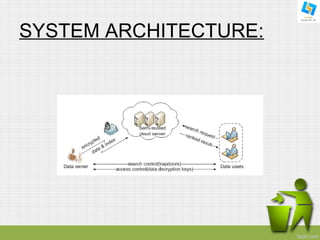
SYSTEM ARCHITECTURE:
SYSTEM CONFIGURATION:- 
HARDWARE REQUIREMENTS:- 
• Processor - Pentium –IV 
• Speed - 1.1 Ghz 
• RAM - 512 MB(min) 
• Hard Disk - 40 GB 
• Key Board - Standard Windows Keyboard 
• Mouse - Two or Three Button Mouse 
• Monitor - LCD/LED 
• 
SOFTWARE REQUIREMENTS: 
• Operating system : Windows XP 
• Coding Language : C# .net 
• Data Base : MSSQLSERVER2005 
• Tool : VISUAL STUDIO 2008
REFERENCE: 
• Ning Cao, Cong Wang, Ming Li, Kui Ren and Wenjing Lou, “Privacy-Preserving 
Multi-Keyword Ranked Search over Encrypted Cloud Data” IEEE 
TRANSACTIONS ON PARALLEL AND DISTRIBUTED SYSTEMS, VOL. 25, NO. 1, 
JANUARY 2014.
JOIN US! 
OFFICE ADDRESS: 
LansA Informatics Pvt ltd 
No 165, 5th Street, 
Crosscut Road, 
Gandhipuram, 
Coimbatore - 641 012 
OTHER MODE OF CONTACT: 
Landline: 0422 – 4204373 
Mobile : +91 90 953 953 33 
+91 91 591 159 69 
Email ID: 
studentscdc@lansainformatics.com 
web: www.lansainformatics.com 
Blog: www.lansastudentscdc.blogspot.com 
Facebook: 
www.facebook.com/lansainformatics 
Twitter: www.twitter.com/lansainformatic

Privacy preserving multi-keyword ranked search over encrypted cloud data

  • 1.
    PRIVACY-PRESERVING MULTI-KEYWORD RANKEDSEARCH OVER ENCRYPTED CLOUD DATA Presented by: LansA Informatics Pvt Ltd
  • 2.
    ABSTRACT: • Withthe advent of cloud computing, data owners are motivated to outsource their complex data management systems from local sites to the commercial public cloud for great flexibility and economic savings. • But for protecting data privacy, sensitive data have to be encrypted before outsourcing, which obsoletes traditional data utilization based on plaintext keyword search. Thus, enabling an encrypted cloud data search service is of paramount importance. Considering the large number of data users and documents in the cloud, it is necessary to allow multiple keywords in the search request and return documents in the order of their relevance to these keywords. • Related works on searchable encryption focus on single keyword search or Boolean keyword search, and rarely sort the search results. In this paper, for the first time, we define and solve the challenging problem of privacy-preserving multi keyword ranked search over encrypted data in cloud computing (MRSE).
  • 3.
    ABSTRACT: • Weestablish a set of strict privacy requirements for such a secure cloud data utilization system. Among various multi-keyword semantics, we choose the efficient similarity measure of “coordinate matching,” i.e., as many matches as possible, to capture the relevance of data documents to the search query. • We further use “inner product similarity” to quantitatively evaluate such similarity measure. We first propose a basic idea for the MRSE based on secure inner product computation, and then give two significantly improved MRSE schemes to achieve various stringent privacy requirements in two different threat models. • To improve search experience of the data search service, we further extend these two schemes to support more search semantics. Thorough analysis investigating privacy and efficiency guarantees of proposed schemes is given. Experiments on the real-world data set further show proposed schemes indeed introduce low overhead on computation and communication.
  • 4.
    EXISTING SYSTEM: •To meet the effective data retrieval need, the large amount of documents demand the cloud server to perform result relevance ranking, instead of returning undifferentiated results. Such ranked search system enables data users to find the most relevant information quickly, rather than burdensomely sorting through every match in the content collection . • Ranked search can also elegantly eliminate unnecessary network traffic by sending back only the most relevant data, which is highly desirable in the “pay-as-you-use” cloud paradigm. For privacy protection, such ranking operation, however, should not leak any keyword related information. • On the other hand, to improve the search result accuracy as well as to enhance the user searching experience, it is also necessary for such ranking system to support multiple keywords search, as single keyword search often yields far too coarse results. As a common practice indicated by today’s web search engines (e.g., Google search), data users may tend to provide a set of keywords instead of only one as the indicator of their search interest to retrieve the most relevant data. And each keyword in the search request is able to help narrow down the search result further. “Coordinate matching” [6], i.e., as many matches as possible, is an efficient similarity measure among such multi-keyword semantics to refine the result relevance, and has been widely used in the plaintext information retrieval (IR) community.
  • 5.
    DISADVANTAGES OF EXISTINGSYSTEM: • It still not adequate to provide users with acceptable result ranking functionality. • It cannot accommodate such high service-level requirements like system usability, user searching experience, and easy information discovery. • Shared data will not be secure.
  • 6.
    PROPOSED SYSTEM: •In this paper, for the first time, we define and solve the problem of multi-keyword ranked search over encrypted cloud data (MRSE) while preserving strict systemwise privacy in the cloud computing paradigm. • Among various multi-keyword semantics, we choose the efficient similarity measure of “coordinate matching,” i.e., as many matches as possible, to capture the relevance of data documents to the search query. Specifically, we use “inner product similarity”, i.e., the number of query keywords appearing in a document, to quantitatively evaluate such similarity measure of that document to the search query. • During the index construction, each document is associated with a binary vector as a subindex where each bit represents whether corresponding keyword is contained in the document. The search query is also described as a binary vector where each bit means whether corresponding keyword appears in this search request, so the similarity could be exactly measured by the inner product of the query vector with the data vector. • However, directly outsourcing the data vector or the query vector will violate the index privacy or the search privacy. To meet the challenge of supporting such multikeyword semantic without privacy breaches, we propose a basic idea for the MRSE using secure inner product computation, which is adapted from a secure k-nearest neighbor (kNN) technique, and then give two significantly improved MRSE schemes in a step-by- step manner to achieve various stringent privacy requirements in two threat models with increased attack capabilities.
  • 7.
    ADVANTAGES OF PROPOSEDSYSTEM: • It proposed schemes indeed introduce low overhead on computation and communication. • It uses ranked search mechanism to support more search semantics and dynamic data operations. • It is more secure and efficient.
  • 8.
  • 9.
    SYSTEM CONFIGURATION:- HARDWAREREQUIREMENTS:- • Processor - Pentium –IV • Speed - 1.1 Ghz • RAM - 512 MB(min) • Hard Disk - 40 GB • Key Board - Standard Windows Keyboard • Mouse - Two or Three Button Mouse • Monitor - LCD/LED • SOFTWARE REQUIREMENTS: • Operating system : Windows XP • Coding Language : C# .net • Data Base : MSSQLSERVER2005 • Tool : VISUAL STUDIO 2008
  • 10.
    REFERENCE: • NingCao, Cong Wang, Ming Li, Kui Ren and Wenjing Lou, “Privacy-Preserving Multi-Keyword Ranked Search over Encrypted Cloud Data” IEEE TRANSACTIONS ON PARALLEL AND DISTRIBUTED SYSTEMS, VOL. 25, NO. 1, JANUARY 2014.
  • 11.
    JOIN US! OFFICEADDRESS: LansA Informatics Pvt ltd No 165, 5th Street, Crosscut Road, Gandhipuram, Coimbatore - 641 012 OTHER MODE OF CONTACT: Landline: 0422 – 4204373 Mobile : +91 90 953 953 33 +91 91 591 159 69 Email ID: studentscdc@lansainformatics.com web: www.lansainformatics.com Blog: www.lansastudentscdc.blogspot.com Facebook: www.facebook.com/lansainformatics Twitter: www.twitter.com/lansainformatic