Privacy: why we should care?
Shushan Harutyunyan
October 2013
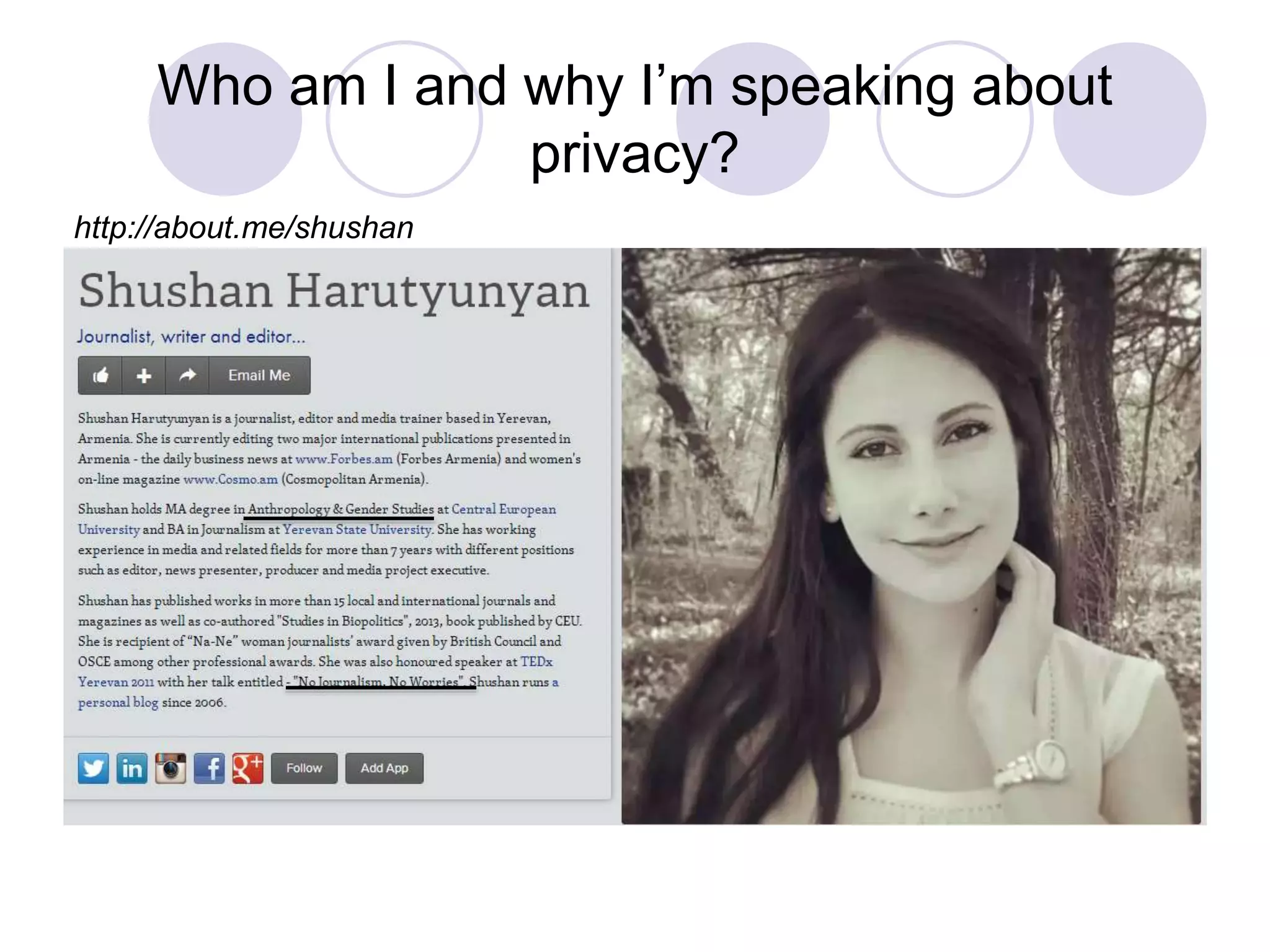
Who am I and why I’m speaking about
privacy?
http://about.me/shushan
What is Privacy?
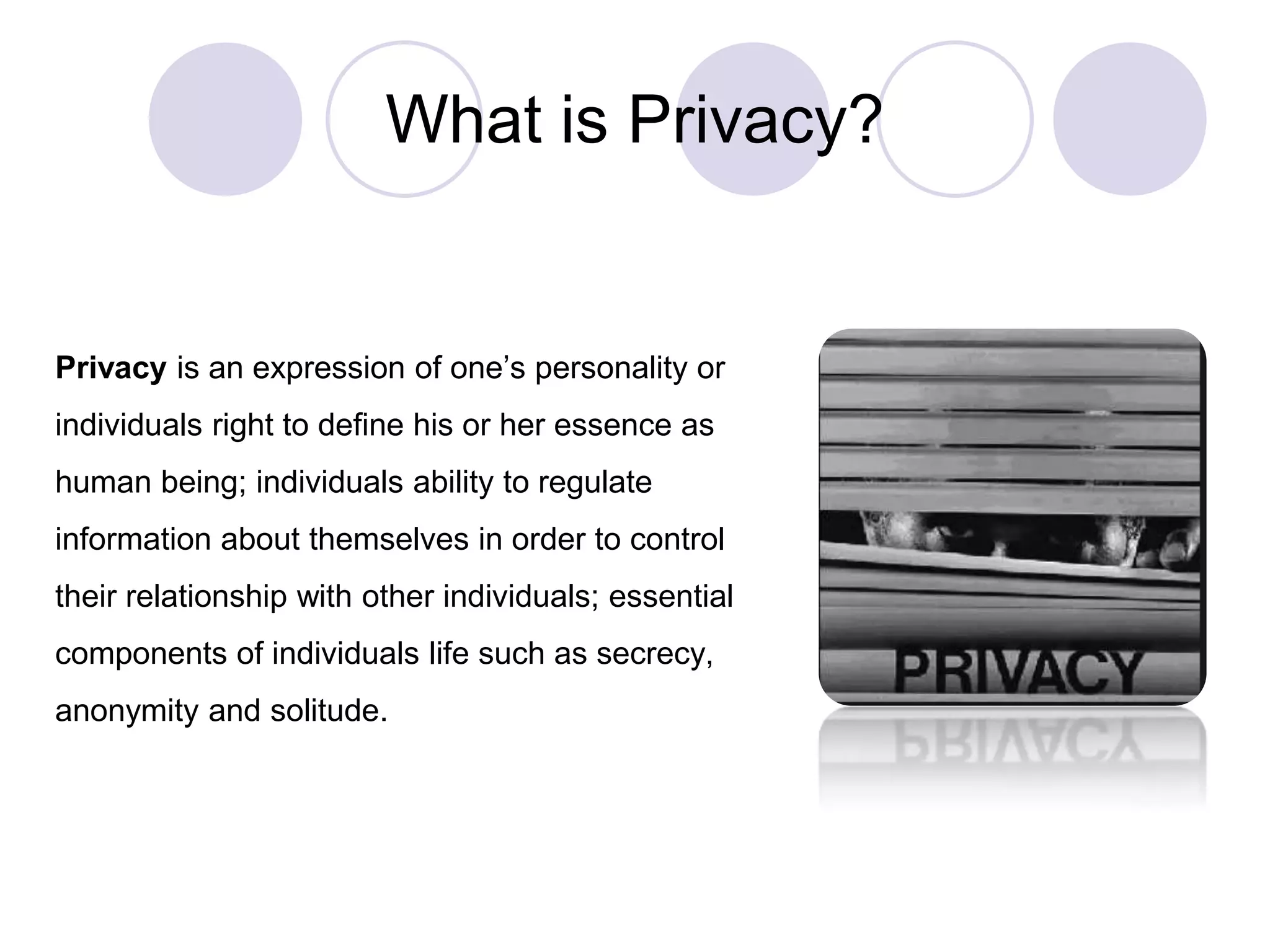
Privacy is an expression of one’s personality or
individuals right to define his or her essence as
human being; individuals ability to regulate
information about themselves in order to control
their relationship with other individuals; essential
components of individuals life such as secrecy,
anonymity and solitude.
How we came to the idea of Privacy? Architecture!
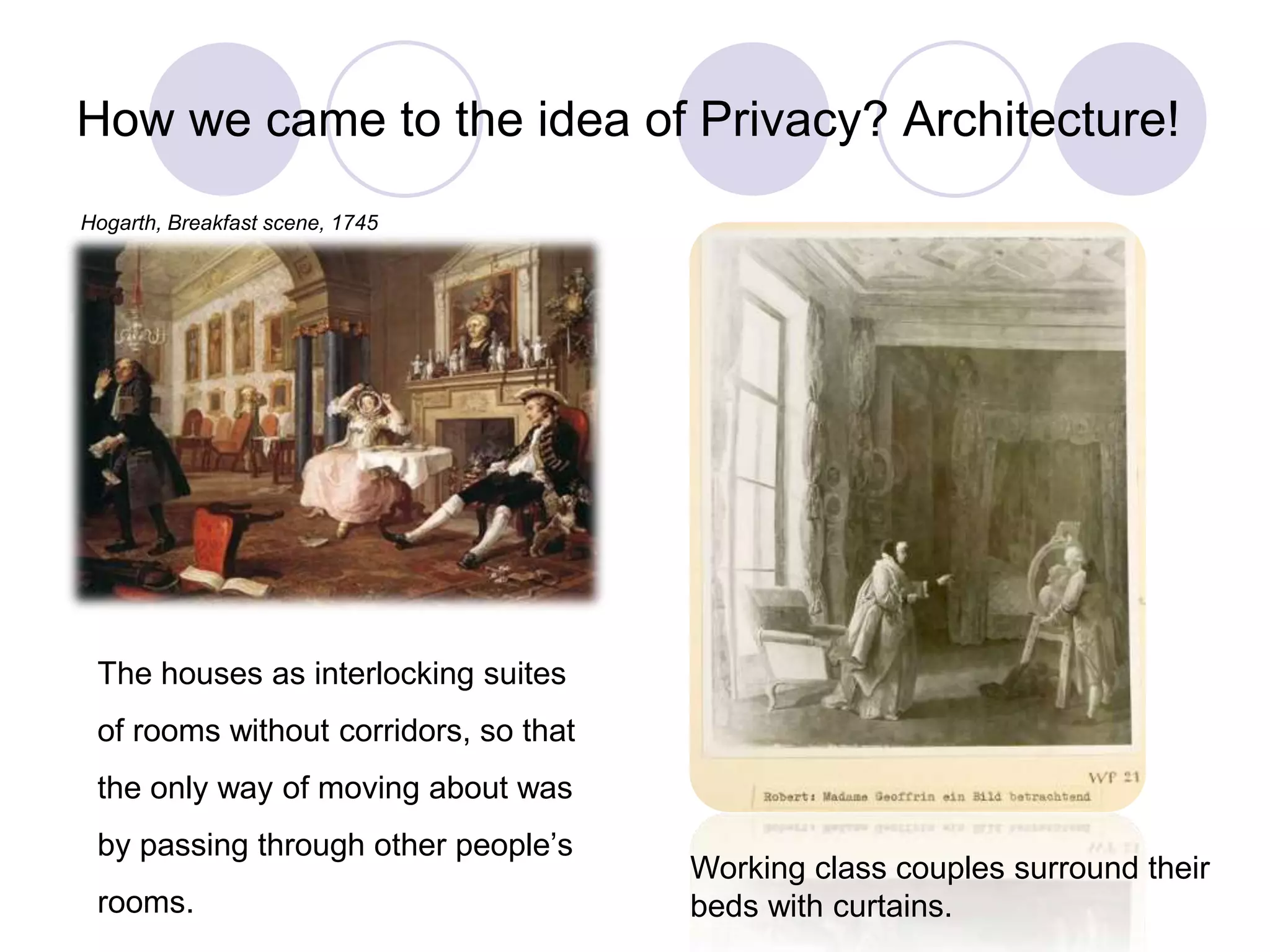
The houses as interlocking suites
of rooms without corridors, so that
the only way of moving about was
by passing through other people’s
rooms.
Hogarth, Breakfast scene, 1745
Working class couples surround their
beds with curtains.
How we came to the idea of Privacy? “Morality”
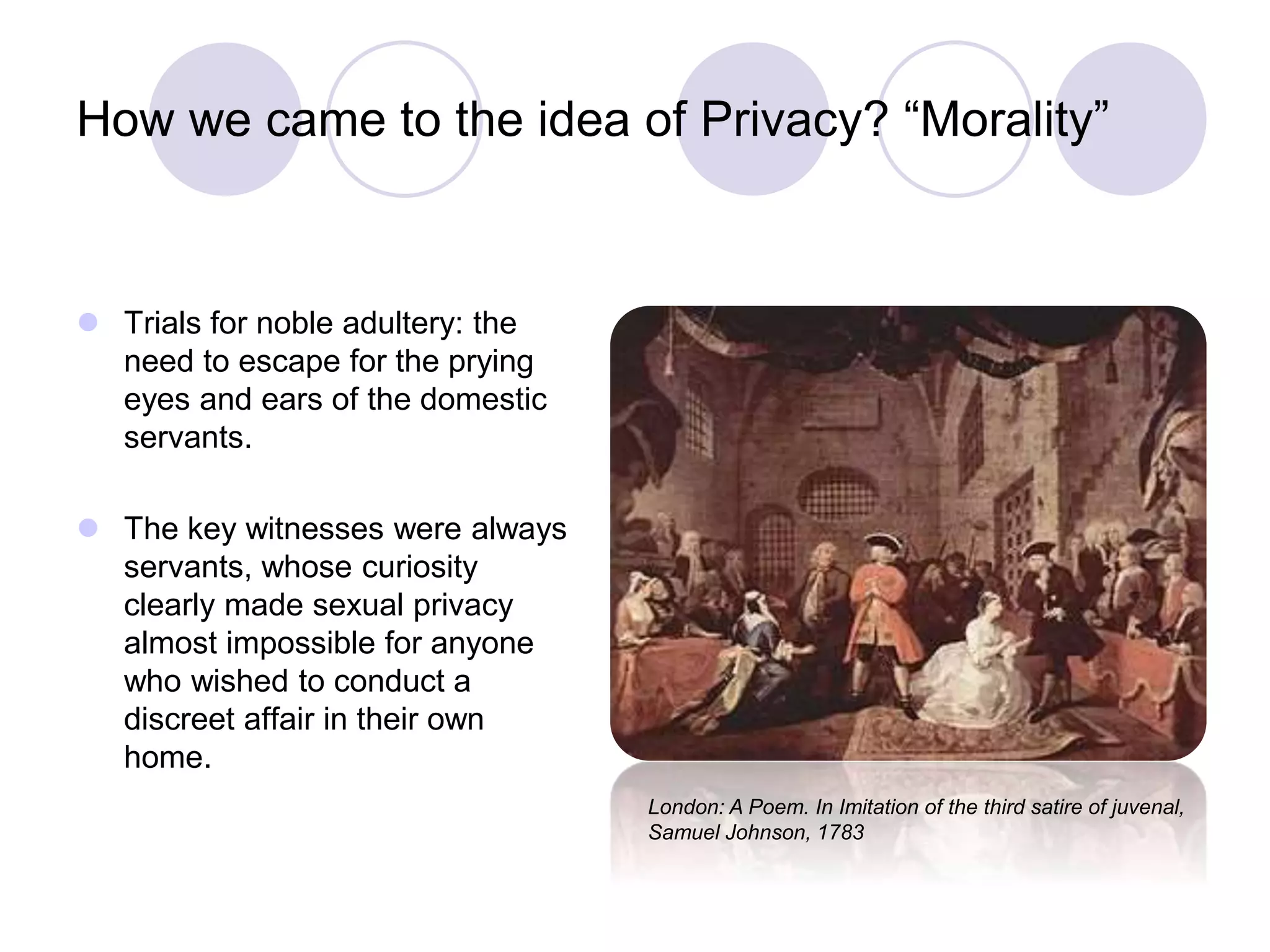
 Trials for noble adultery: the
need to escape for the prying
eyes and ears of the domestic
servants.
 The key witnesses were always
servants, whose curiosity
clearly made sexual privacy
almost impossible for anyone
who wished to conduct a
discreet affair in their own
home.
London: A Poem. In Imitation of the third satire of juvenal,
Samuel Johnson, 1783
Why people need privacy?
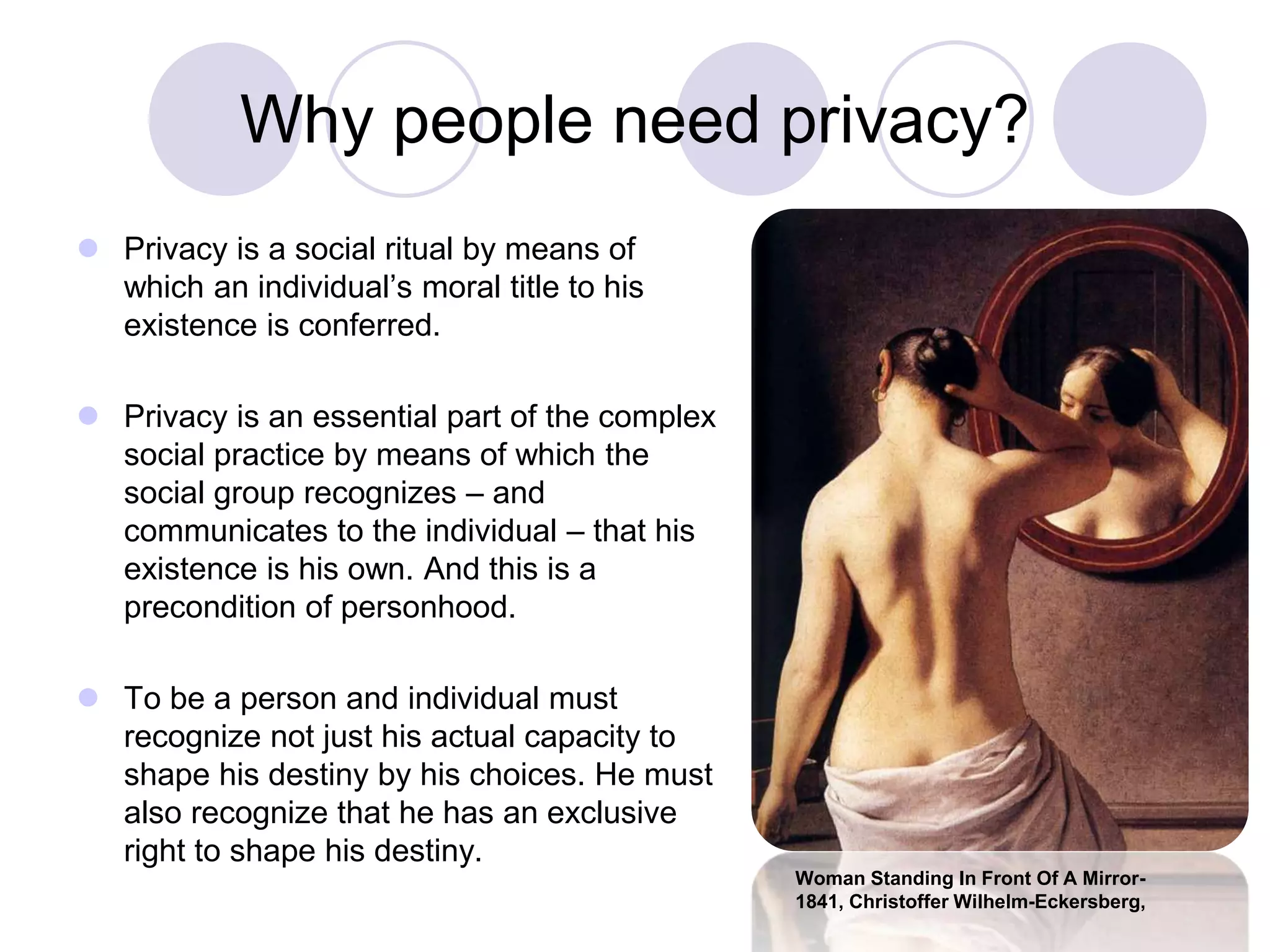
 Privacy is a social ritual by means of
which an individual’s moral title to his
existence is conferred.
 Privacy is an essential part of the complex
social practice by means of which the
social group recognizes – and
communicates to the individual – that his
existence is his own. And this is a
precondition of personhood.
 To be a person and individual must
recognize not just his actual capacity to
shape his destiny by his choices. He must
also recognize that he has an exclusive
right to shape his destiny.
Woman Standing In Front Of A Mirror-
1841, Christoffer Wilhelm-Eckersberg,
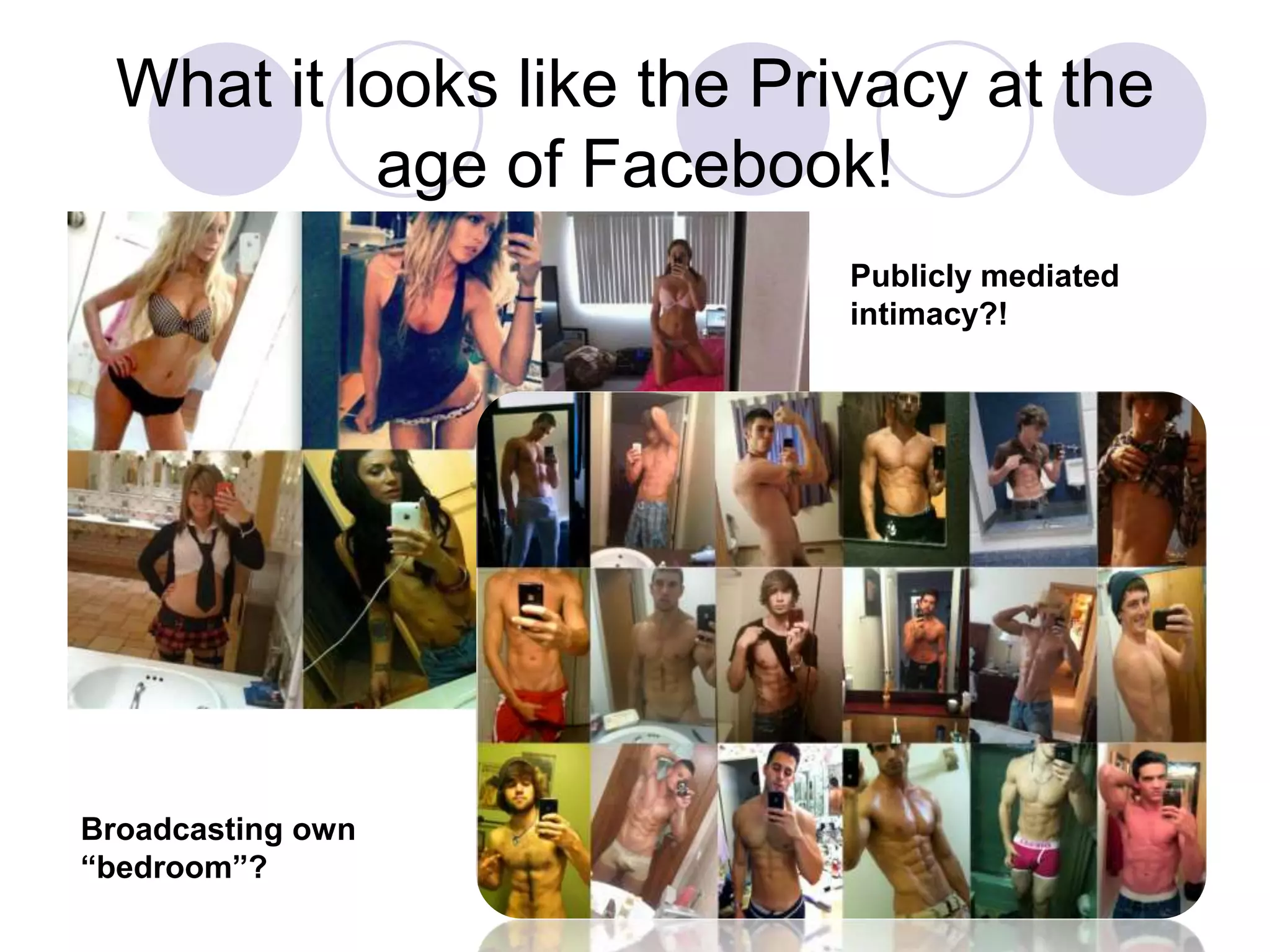
What it looks like the Privacy at the
age of Facebook!
Publicly mediated
intimacy?!
Broadcasting own
“bedroom”?
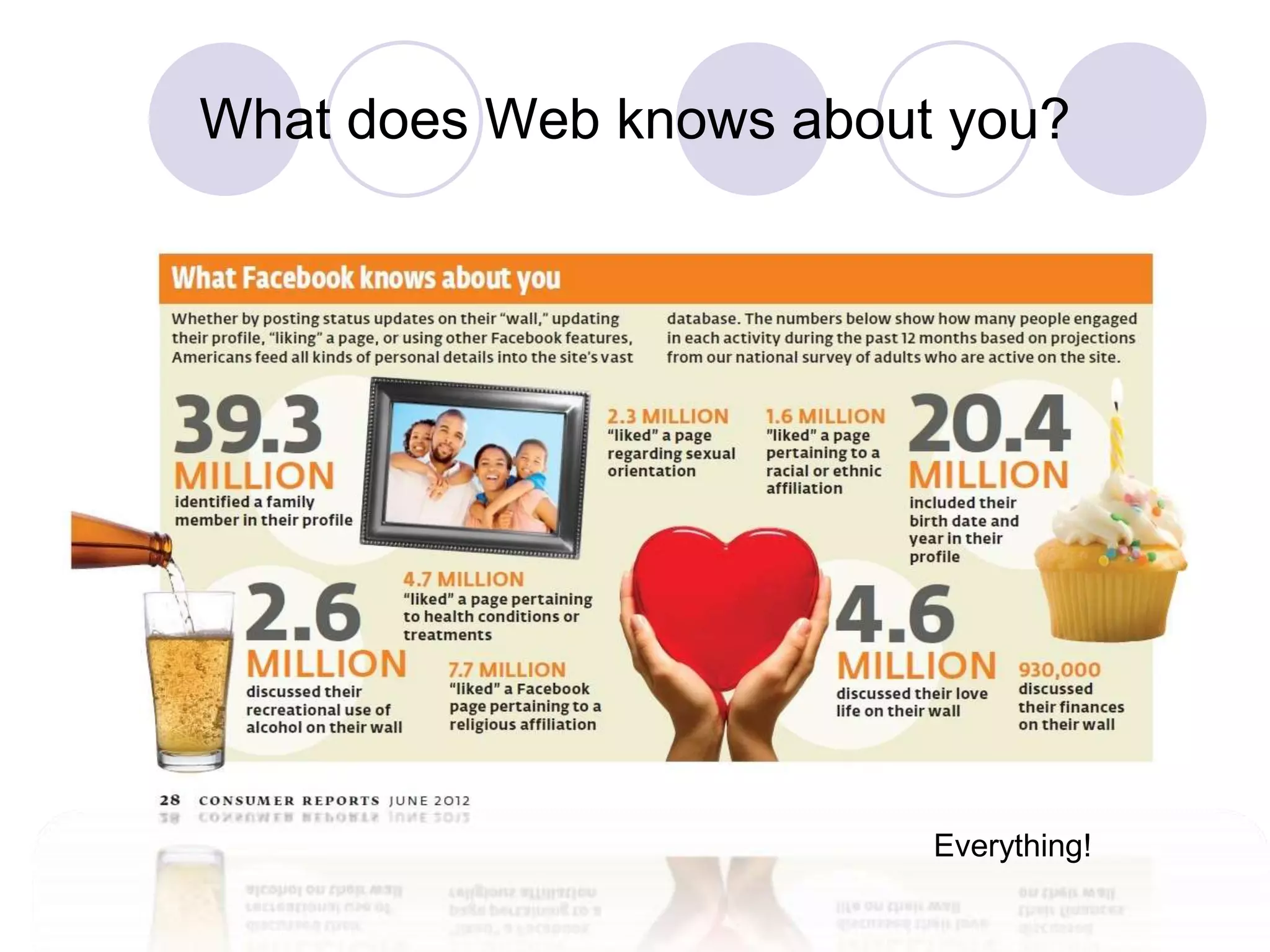
What does Web knows about you?
Everything!
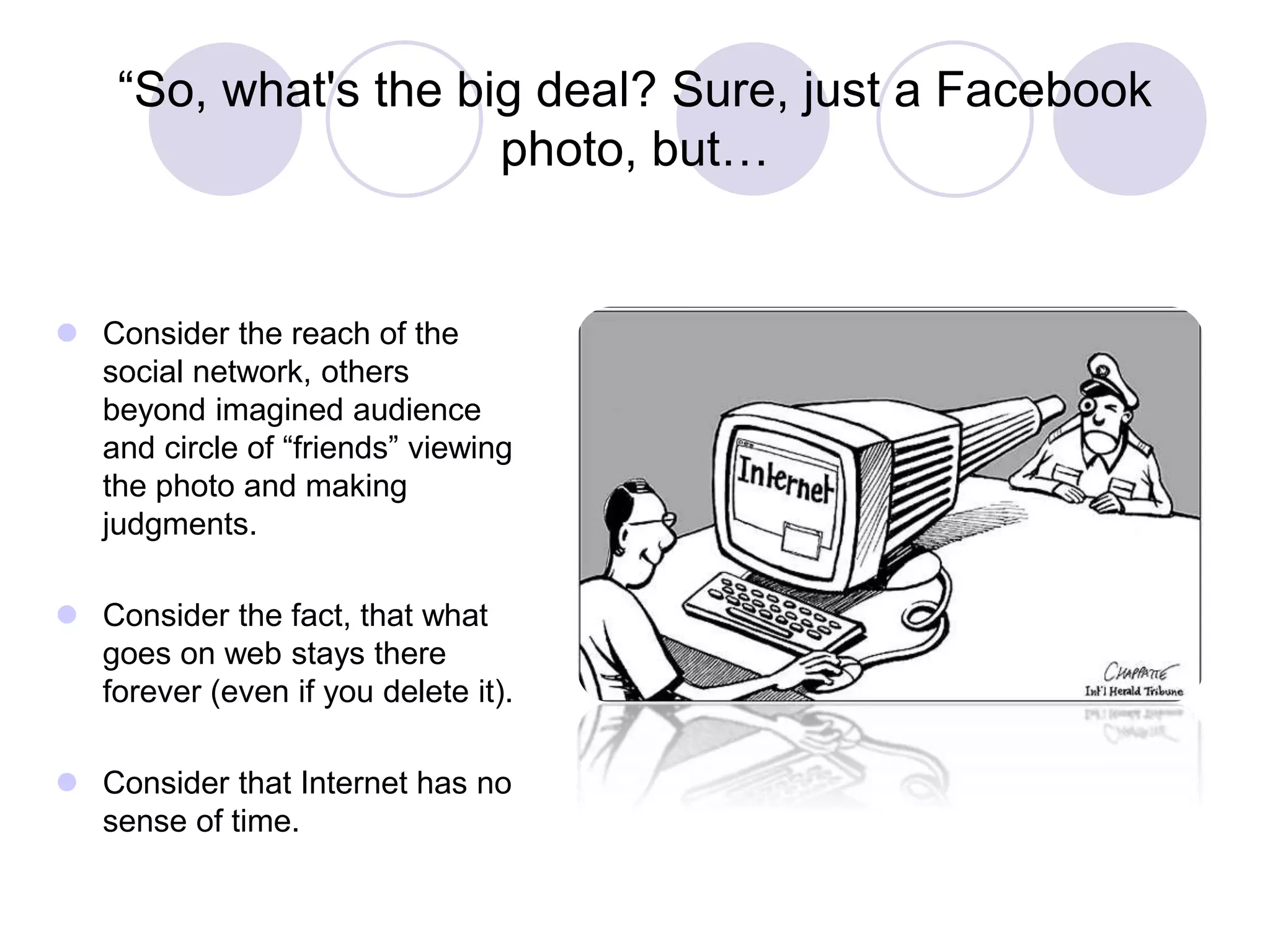
“So, what's the big deal? Sure, just a Facebook
photo, but…
 Consider the reach of the
social network, others
beyond imagined audience
and circle of “friends” viewing
the photo and making
judgments.
 Consider the fact, that what
goes on web stays there
forever (even if you delete it).
 Consider that Internet has no
sense of time.
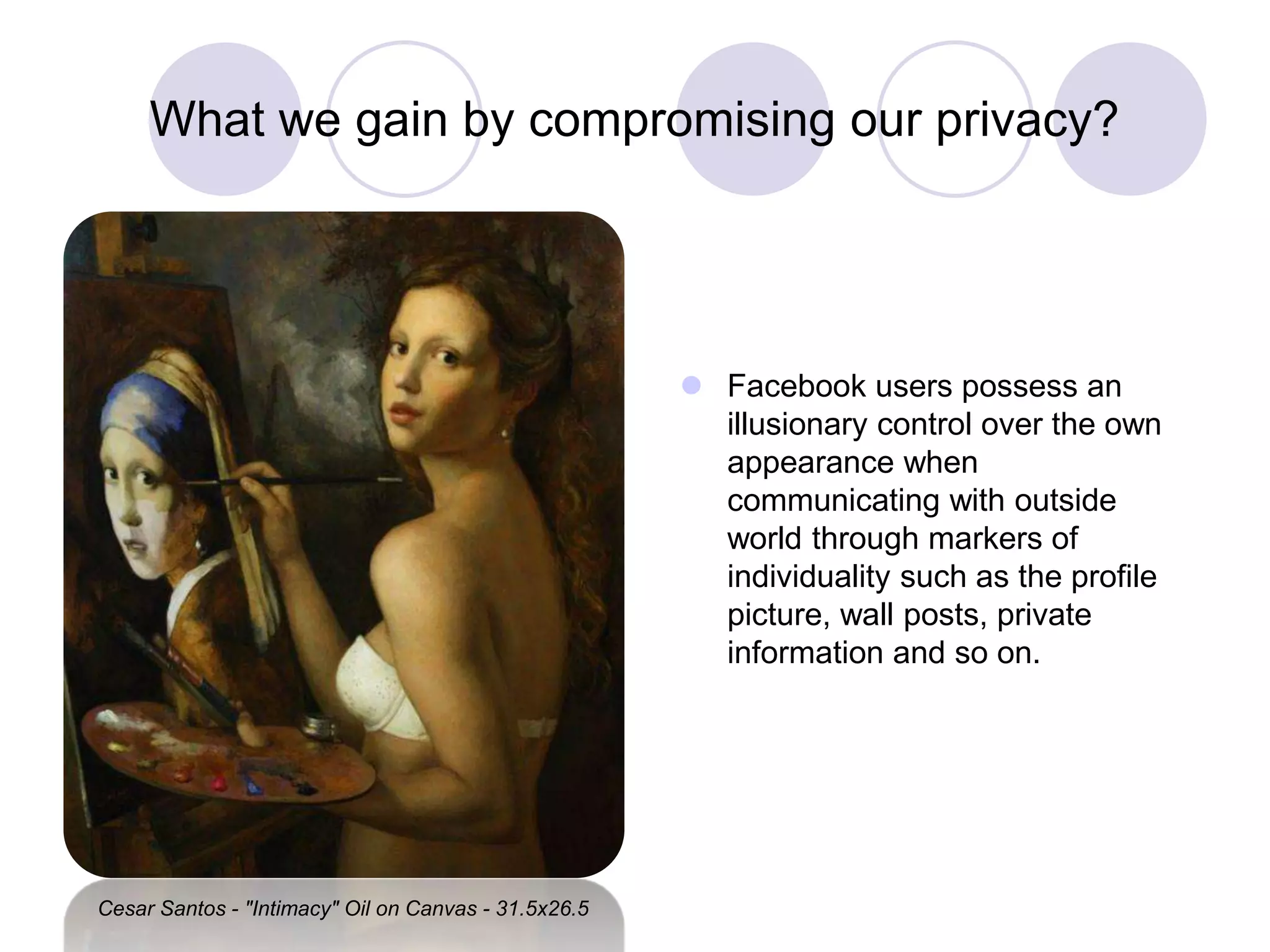
What we gain by compromising our privacy?
 Facebook users possess an
illusionary control over the own
appearance when
communicating with outside
world through markers of
individuality such as the profile
picture, wall posts, private
information and so on.
Cesar Santos - "Intimacy" Oil on Canvas - 31.5x26.5
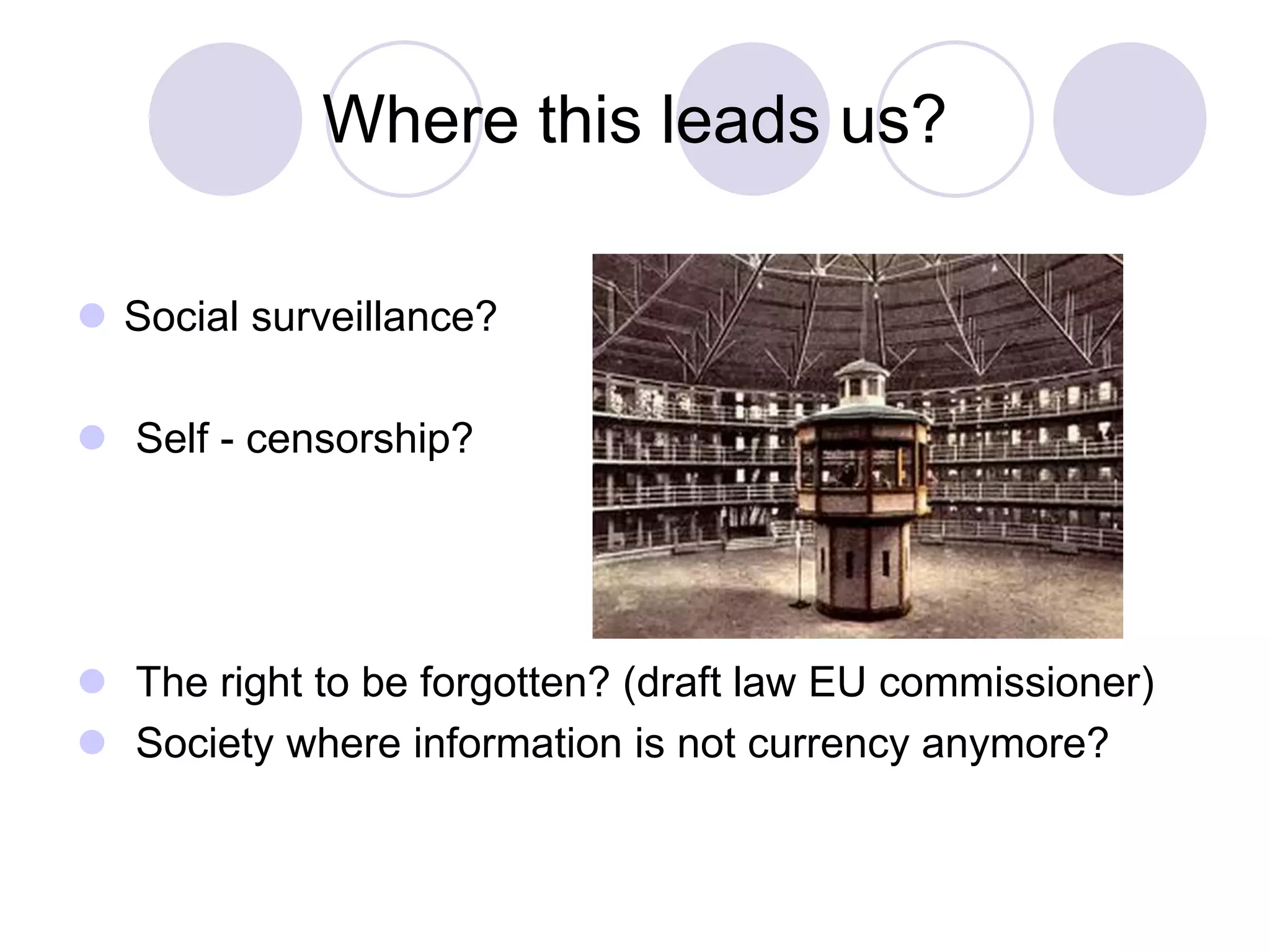
Where this leads us?
 Social surveillance?
 Self - censorship?
 The right to be forgotten? (draft law EU commissioner)
 Society where information is not currency anymore?
What I want you to take home today!
 Think about the control over your self-presentation online!
 Than check your Facebook profile, Google your name, think about
the sensitive messages you keep in your email.
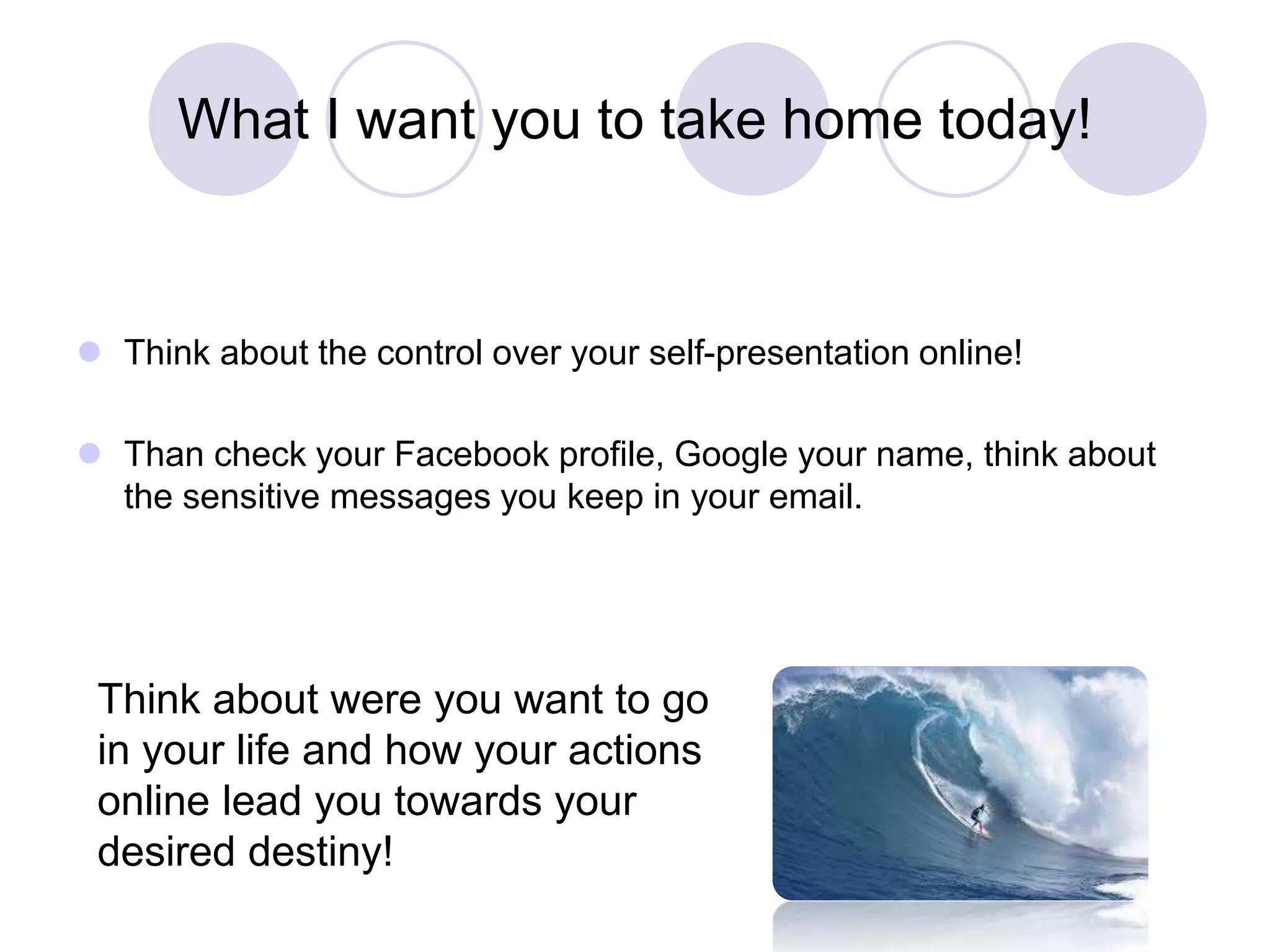
Think about were you want to go
in your life and how your actions
online lead you towards your
desired destiny!
Sources and references
1. “A global Sense of Place”, Doreen Massey, 1994
2. We Media, How audiences are shaping the future of news and information, Shayne Bowman, Chris Willis and The Media Center at The American Press
Institute, 2003
3. Tim Berners-Lee (World Wide Web inventor) about Web 2.0, Wikipedia, 2012 http://en.wikipedia.org/wiki/Web_2.0
4. Facebook Statistics due to October 4, 2012, Official Facebook Newsroom http://newsroom.fb.com/Timeline
5. The Revolution Will be Networked. The Influence of Social Networking Sites on Political Attitudes and Behavior, Weiwu Zhang, Thomas J. Johnson,
Trent Seltzer,Shannon L. Bichard , Texas Tech University, 2009
6. Do social networks improve e-commerce?: a study on social marketplaces, Gayatri Swamynathan, Christo Wilson, Bryce Boe, Kevin Almeroth, Ben Y.
Zhao 2008, University of California at Santa Barbara, Santa Barbara, CA, USA
7. Social media changes the role of the journalist, Sonja Balci, 2012 http://sciencenordic.com/social-media-changes-role-journalist
8. Living online: The end of privacy? Alison George, 2006, New Scientist magazine
9. Examining priming and gender as a means to reduce risk in a social networking context: Can stories change disclosure and privacy setting use when
personal profiles are constructed? Amanda Nosko, Eileen Wood, Miranda Kenney, Karin Archer, Domenica De Pasquale, Seija Molema, Lucia
Zivcakova, "Computers in Human Behavior" Journal, 2012
10. “The History of Family, Sex and Marriage in x-1900 England”, Lawrence Stone, 1979
11. Privacy refers to the moral right of individuals to avoid intrusion into their personal affairs by third parties”(Chaffey 2009, p. 139).
12. Facebook & your privacy. Who sees your data on the biggest social network? Consumer Reports magazine: June 2012
http://www.consumerreports.org/cro/magazine/2012/06/facebook-your-privacy/index.htm
13. Social Networking and Online Privacy: Facebook Users’ Perceptions DEIRDRE O’BRIEN* AND ANN M. TORRES, Irish Journal of Management, 2012
14. How Much Data is Created Every Minute? Neil Spencer, 2012, Visual News http://www.visualnews.com/2012/06/19/how-much-data-created-every-
minute/
15. Effects of self-disclosure on relational intimacy in Facebook, Namkee Park, Borae Jin, Seung-A Annie Jin; 2011, Computers in Human Behavior
16. Exploring Privacy Management on Facebook: Motivations and Perceived Consequences of Voluntary Disclosure, Susan Waters - Department of
Communication and Journalism, Auburn University; James Ackerman - Department of Communication, Ozarks Technical Community College, 2011,
Journal of Computer-Mediated Communication
17. Facebook Sells More Access to Members, By Geofrey A. Fowler, 2012
http://online.wsj.com/article/SB10000872396390443862604578029450918199258.html
18. Facebook Help Center, Ads & Sponsored Stories, 2012 http://www.facebook.com/help/131834970288134/
19. Your Facebook Deactivated Friend or a Cloaked Spy, Shah Mahmood and Yvo Desmedt, 2012, University College London
20. What Your Facebook Photo Says About You... and Facebook, Margaret Rock, 2012, Mobiledia http://www.mobiledia.com/news/163978.html
21. Self-presentation and belonging on Facebook: How personality influences social media use and motivations, Gwendolyn Seidman, Psychology
Department, Albright College, 2012, Personality and Individual Differences Journal
THANK YOU
http://about.me/shushan

Privacy: why we should care

  • 1.
    Privacy: why weshould care? Shushan Harutyunyan October 2013
  • 2.
    Who am Iand why I’m speaking about privacy? http://about.me/shushan
  • 3.
    What is Privacy? Privacyis an expression of one’s personality or individuals right to define his or her essence as human being; individuals ability to regulate information about themselves in order to control their relationship with other individuals; essential components of individuals life such as secrecy, anonymity and solitude.
  • 4.
    How we cameto the idea of Privacy? Architecture! The houses as interlocking suites of rooms without corridors, so that the only way of moving about was by passing through other people’s rooms. Hogarth, Breakfast scene, 1745 Working class couples surround their beds with curtains.
  • 5.
    How we cameto the idea of Privacy? “Morality”  Trials for noble adultery: the need to escape for the prying eyes and ears of the domestic servants.  The key witnesses were always servants, whose curiosity clearly made sexual privacy almost impossible for anyone who wished to conduct a discreet affair in their own home. London: A Poem. In Imitation of the third satire of juvenal, Samuel Johnson, 1783
  • 6.
    Why people needprivacy?  Privacy is a social ritual by means of which an individual’s moral title to his existence is conferred.  Privacy is an essential part of the complex social practice by means of which the social group recognizes – and communicates to the individual – that his existence is his own. And this is a precondition of personhood.  To be a person and individual must recognize not just his actual capacity to shape his destiny by his choices. He must also recognize that he has an exclusive right to shape his destiny. Woman Standing In Front Of A Mirror- 1841, Christoffer Wilhelm-Eckersberg,
  • 7.
    What it lookslike the Privacy at the age of Facebook! Publicly mediated intimacy?! Broadcasting own “bedroom”?
  • 8.
    What does Webknows about you? Everything!
  • 9.
    “So, what's thebig deal? Sure, just a Facebook photo, but…  Consider the reach of the social network, others beyond imagined audience and circle of “friends” viewing the photo and making judgments.  Consider the fact, that what goes on web stays there forever (even if you delete it).  Consider that Internet has no sense of time.
  • 10.
    What we gainby compromising our privacy?  Facebook users possess an illusionary control over the own appearance when communicating with outside world through markers of individuality such as the profile picture, wall posts, private information and so on. Cesar Santos - "Intimacy" Oil on Canvas - 31.5x26.5
  • 11.
    Where this leadsus?  Social surveillance?  Self - censorship?  The right to be forgotten? (draft law EU commissioner)  Society where information is not currency anymore?
  • 12.
    What I wantyou to take home today!  Think about the control over your self-presentation online!  Than check your Facebook profile, Google your name, think about the sensitive messages you keep in your email. Think about were you want to go in your life and how your actions online lead you towards your desired destiny!
  • 13.
    Sources and references 1.“A global Sense of Place”, Doreen Massey, 1994 2. We Media, How audiences are shaping the future of news and information, Shayne Bowman, Chris Willis and The Media Center at The American Press Institute, 2003 3. Tim Berners-Lee (World Wide Web inventor) about Web 2.0, Wikipedia, 2012 http://en.wikipedia.org/wiki/Web_2.0 4. Facebook Statistics due to October 4, 2012, Official Facebook Newsroom http://newsroom.fb.com/Timeline 5. The Revolution Will be Networked. The Influence of Social Networking Sites on Political Attitudes and Behavior, Weiwu Zhang, Thomas J. Johnson, Trent Seltzer,Shannon L. Bichard , Texas Tech University, 2009 6. Do social networks improve e-commerce?: a study on social marketplaces, Gayatri Swamynathan, Christo Wilson, Bryce Boe, Kevin Almeroth, Ben Y. Zhao 2008, University of California at Santa Barbara, Santa Barbara, CA, USA 7. Social media changes the role of the journalist, Sonja Balci, 2012 http://sciencenordic.com/social-media-changes-role-journalist 8. Living online: The end of privacy? Alison George, 2006, New Scientist magazine 9. Examining priming and gender as a means to reduce risk in a social networking context: Can stories change disclosure and privacy setting use when personal profiles are constructed? Amanda Nosko, Eileen Wood, Miranda Kenney, Karin Archer, Domenica De Pasquale, Seija Molema, Lucia Zivcakova, "Computers in Human Behavior" Journal, 2012 10. “The History of Family, Sex and Marriage in x-1900 England”, Lawrence Stone, 1979 11. Privacy refers to the moral right of individuals to avoid intrusion into their personal affairs by third parties”(Chaffey 2009, p. 139). 12. Facebook & your privacy. Who sees your data on the biggest social network? Consumer Reports magazine: June 2012 http://www.consumerreports.org/cro/magazine/2012/06/facebook-your-privacy/index.htm 13. Social Networking and Online Privacy: Facebook Users’ Perceptions DEIRDRE O’BRIEN* AND ANN M. TORRES, Irish Journal of Management, 2012 14. How Much Data is Created Every Minute? Neil Spencer, 2012, Visual News http://www.visualnews.com/2012/06/19/how-much-data-created-every- minute/ 15. Effects of self-disclosure on relational intimacy in Facebook, Namkee Park, Borae Jin, Seung-A Annie Jin; 2011, Computers in Human Behavior 16. Exploring Privacy Management on Facebook: Motivations and Perceived Consequences of Voluntary Disclosure, Susan Waters - Department of Communication and Journalism, Auburn University; James Ackerman - Department of Communication, Ozarks Technical Community College, 2011, Journal of Computer-Mediated Communication 17. Facebook Sells More Access to Members, By Geofrey A. Fowler, 2012 http://online.wsj.com/article/SB10000872396390443862604578029450918199258.html 18. Facebook Help Center, Ads & Sponsored Stories, 2012 http://www.facebook.com/help/131834970288134/ 19. Your Facebook Deactivated Friend or a Cloaked Spy, Shah Mahmood and Yvo Desmedt, 2012, University College London 20. What Your Facebook Photo Says About You... and Facebook, Margaret Rock, 2012, Mobiledia http://www.mobiledia.com/news/163978.html 21. Self-presentation and belonging on Facebook: How personality influences social media use and motivations, Gwendolyn Seidman, Psychology Department, Albright College, 2012, Personality and Individual Differences Journal
  • 14.

Editor's Notes

  • #4 privacy is not an absolute, but rather contextual and subjective, and the right to privacy is based on wide array of socially and culturally salient understandings of private spheres (Jeffrey H. Reiman, "Privacy, Intimacy and Personhood", Philosophy and Public Affairs 6 (1):26-44, 1976 )
  • #5 The houses of sixteenth century were constructed as interlocking suites of rooms without corridors, so that the only way of moving about was by passing through other people’s rooms. And only in the late seventeenth century house plans did allocate space to corridors, which now allowed access without intruding upon privacy. (Stone 1979, p 169). “The History of Family, Sex and Marriage in x-1900 England” Living space had begun to grow less crowded and private. Single beds were adopted in monasteries and hospitals as a sanitary precaution; (cholera epidemic in Londin,1832) Working class couples little by little secured their privacy by surrounding their bed with curtains.
  • #6 According to Reiman , privacy is a social ritual by means of which an individual’s moral title to his existence is conferred. Privacy is an essential part of the complex social practice by means of which the social group recognizes – and communicates to the individual – that his existence is his own. And this is a precondition of personhood. To be a person and individual must recognize not just his actual capacity to shape his destiny by his choices. He must also recognize that he has an exclusive right to shape his destiny.
  • #7 a private space, individuals naming and self-portrait could construct and maintain identity after which individuals could deliberately divulge something personal to another in public communication, and this is how the idea of privacy as a right was developed.
  • #11 Every minute 684,478 Facebook users share pieces of content, and it is commonly known that photos, wallposts, comments are not a random snapshot of the reality of someone's life. The ability to portray a self and the possession of self-images, which social network makes possible, is nothing but deliberately arranged presentation of how one would like to be remembered, how individual’s sense of his own importance would like to be maintained.