WHAT IS COMMUNICATION?
a process by which information is exchanged
between individuals through a common
system of symbols, signs, or behavior
MERRIAM- WEBSTER
OVERVIEW:
•WHAT ARE THE VERBAL AND WRITTEN
COMMUNICATION STRATEGIES?
•WHAT ARE THE PRINCIPLES OF NONVERBAL
COMMUNICATIONS?
FOUR TYPES OF COMMUNICATIONS
OCCUR WITHIN A COMPANY
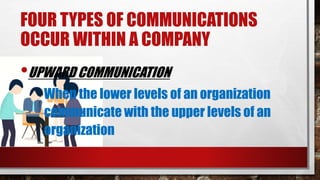
•UPWARD COMMUNICATION
When the lower levels of an organization
communicate with the upper levels of an
organization
• DOWNWARD COMMUNICATION
THE OPPOSITE OF UPWARD COMMUNICATION,
IN THAT THE COMMUNICATION OCCURS FROM
THE UPPER LEVELS OF AN ORGANIZATION
DOWN TO THE LOWER LEVELS OF THE
ORGANIZATIONS.
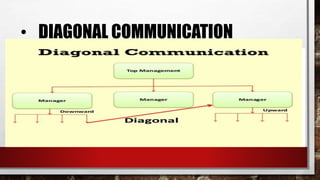
• DIAGONAL COMMUNICATION
Interdepartmental
communication occurring at
various levels of the
organization.
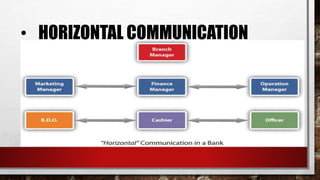
• HORIZONTAL COMMUNICATION
When people at the
same level in the
organization
communicate.
OTHER MEANS OF COMMUNICATION THAT
COMPANIES ARE USING:
•Microblogs
•Social networking sites
•Intranets
COMMUNICATION STYLES
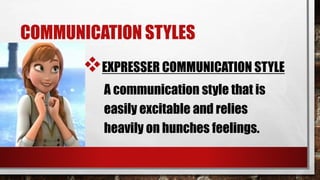
EXPRESSER COMMUNICATION STYLE
A communication style that is
easily excitable and relies
heavily on hunches feelings.
DRIVER STYLE
A communication style
in which a person likes
to have his or her own
way and be decisive.
RELATER STYLE
A communication style by
someone who prefers to
be warmly regarded and
have positive attention.
 ANALYTICAL COMMUNICATION STYLE
A communication style in
which a person tends to
ask a lot of questions and
behave methodically.
TABLE 4.1 WHICH ONE OF THESE
COMMUNICATION STYLES DO YOU TEND TO USE?
EXAMPLE OF HOW THESE
COMMUNICATION STYLES MIGHT
INTERACT
Turn to page
3 STYLES OF COMMUNICATOR
A communication style in
which a person puts the
rights of others over his or
her own.
 PASSIVE COMMUNICATOR
AGGRESSIVE COMMUNICATOR
The style of a person who
stands up for his or her
rights but possibly
violates the rights of
others.
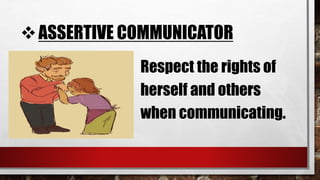
ASSERTIVE COMMUNICATOR
Respect the rights of
herself and others
when communicating.
TURN PAGE
LISTENING
What is listening?
http://www.bbc.co.uk/skillswise/factsheet/en34type-l1-f-what-is-listening
3 MAIN TYPES OF LISTENING…..
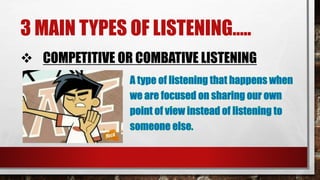
 COMPETITIVE OR COMBATIVE LISTENING
PASSIVE LISTENING
ACTIVE LISTENING
ACTIVE LISTENING INVOLVES FOUR PHASES.
Source: Steil, L., Barker, L., & Watson, K. (n.d.). SIER hierarchy of active listening.
Provenmodels, accessed August 1, 2011,http://www.provenmodels.com/554
WRITTEN COMMUNICATION
Bonner, William H., and Lillian H. Chaney. Communicating
Effectively in an Information Age. Second Edition, Dame Publishing,
2003.
Murphy, Herta A., and Herbert W. Hildebrandt.
Effective Business Communications. Seventh Edition.
McGraw-Hill, 1997.
4 C’s in Written Communication
WE WANT TO MAKE SURE
THAT ALL THE FACT ARE
INCLUDED IN THE E-MAIL.
1. COMPLETE
2. CONCISE
TRY TO MAKE AN E-
MAIL AS CONCISE AS
POSSIBLE.
3. CORRECT
CHECK YOUR E-MAIL :
•GRAMMAR
•SPELLING
•GREETING
•BODY
•CLOSING
TURN TO PAGE
wayForward
Published on 12 Oct 2016 https://www.youtube.com/watch?v=I6IAhXM-vps
NONVERBAL
COMMUNICATION
Amanda Guzman
Published on 10 Apr 2016 https://www.youtube.com/watch?v=SKhsavlvuao
NONVERBAL COMMUNICATION
The process of
conveying a message
without the use of
words.
NONVERBAL COMMUNICATION
•NONVERBAL COMMUNICATION IS FAST
•NONVERBAL COMMUNICATION CAN ADD TO OR
REPLACE VERBAL COMMUNICATION
•NONVERBAL COMMUNICATION IS UNIVERSAL
NONVERBAL COMMUNICATION
•NONVERBAL COMMUNICATION IS CONFUSING AND
CONTEXTUAL
•NONVERBAL COMMUNICATION CAN BE
INTENTIONAL OR UNINTENTIONAL
NONVERBAL COMMUNICATION
•NONVERBAL MESSAGES COMMUNICATE FEELINGS
AND ATTITUDES
•WE BELIEVE NONVERBAL COMMUNICATION MORE
THAN VERBAL
Communicate effectively:Verbal & Written Communication/Nonverbal Communication

Communicate effectively:Verbal & Written Communication/Nonverbal Communication