CMC, Diffusion, and Social
Theories
By:Salimah, Irys, Rocky
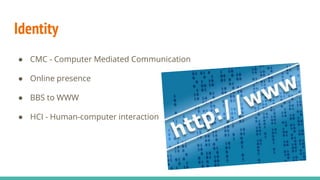
Identity
● CMC - Computer Mediated Communication
● Online presence
● BBS to WWW
● HCI - Human-computer interaction
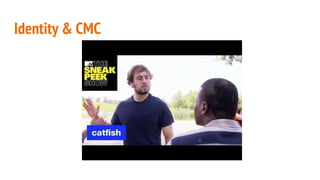
Identity & CMC
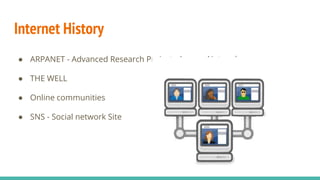
Internet History
● ARPANET - Advanced Research Projects Agency Network
● THE WELL
● Online communities
● SNS - Social network Site
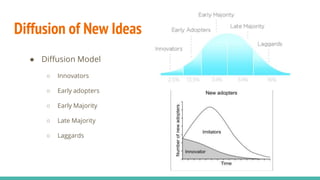
Diffusion of New Ideas
● Diffusion Model
○ Innovators
○ Early adopters
○ Early Majority
○ Late Majority
○ Laggards
Social network site definitions
● Constructs public or semipublic
profile within a bounded system
● list of other users with whom
they share a connection
● View and transverse their list of
connections and those made by
others within the system
Social network site definitions
● Avoids networking in deff : which
implies meeting strangers through
online interaction
● Activating pre-existing social ties
● Ofc meet new people/connections
but tend to reflect nearby mutual
associations
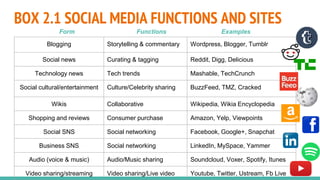
BOX 2.1 SOCIAL MEDIA FUNCTIONS AND SITES
Blogging Storytelling & commentary Wordpress, Blogger, Tumblr
Social news Curating & tagging Reddit, Digg, Delicious
Technology news Tech trends Mashable, TechCrunch
Social cultural/entertainment Culture/Celebrity sharing BuzzFeed, TMZ, Cracked
Wikis Collaborative Wikipedia, Wikia Encyclopedia
Shopping and reviews Consumer purchase Amazon, Yelp, Viewpoints
Social SNS Social networking Facebook, Google+, Snapchat
Business SNS Social networking LinkedIn, MySpace, Yammer
Audio (voice & music) Audio/Music sharing Soundcloud, Voxer, Spotify, Itunes
Video sharing/streaming Video sharing/Live video Youtube, Twitter, Ustream, Fb Live
Form Functions Examples
COMMUNITY
● Emerges from the development of individual social identities and
realistic relationships between people
● Those spending time online share common characteristics that
separate them from those less likely to participate.
● Platforms create symbolic environments
○ metaphors such as FB wall & Pinterest “board”
○ Shared meaning and understanding
● Interpersonal communication
○ Develops when online communication functions as it would in a face-to-face
environment
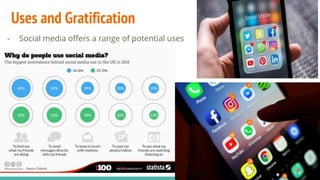
Uses and Gratification
- Social media offers a range of potential uses
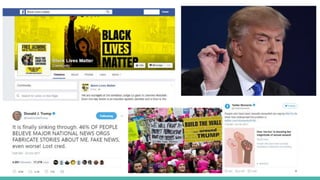
Online Culture and Power
- Social media communication happens within a cultural
context of values, ritual, and even chaos
- Some use social media in an effort to maintain existing
power
- Others use it to try to grab new power
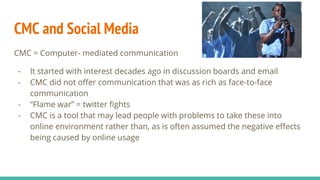
CMC and Social Media
CMC = Computer- mediated communication
- It started with interest decades ago in discussion boards and email
- CMC did not offer communication that was as rich as face-to-face
communication
- “Flame war” = twitter fights
- CMC is a tool that may lead people with problems to take these into
online environment rather than, as is often assumed the negative effects
being caused by online usage
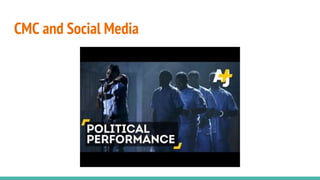
CMC and Social Media
DISCUSSION QUESTIONS
1. CMC has influenced the way we form relationships in the sense
that we have the capability to form relationships with people
across the country/globe within seconds. We have the ability to
communicate at any time of the day no matter where the other
person is without having to wait. It does make it hard because
even though the communication is more frequent - it doesn’t
mean we actually know the person the way we think we do.
DISCUSSION QUESTIONS
2. More of my media use consists of sharing things I find funny or interesting. I
don’t necessarily use it to maintain relationships. The Cmc relationships that I
have are weak in that sense. If anything the use of Facetime has helped my
relationships. Communication patterns based off of my social media involve
sharing videos/memes with friends and looking at pictures and images shared
through social media. I also use snapchat pretty often but only to send videos
of myself being silly. This would not be the best to use to influence future
online behavior because based off of my social media use, communication
through social media seems to be dying down in the sense of its purpose
being to maintain relationships. People will only share more videos and
images rather than build and maintain relationships.
DISCUSSION QUESTIONS
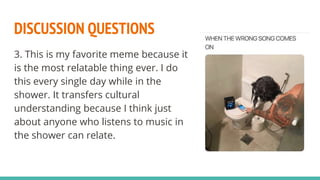
3. This is my favorite meme because it
is the most relatable thing ever. I do
this every single day while in the
shower. It transfers cultural
understanding because I think just
about anyone who listens to music in
the shower can relate.
Audience Engagement
Go to www.kahoot.it and enter pin number :)

Social media Group Presentation

  • 1.
    CMC, Diffusion, andSocial Theories By:Salimah, Irys, Rocky
  • 2.
    Identity ● CMC -Computer Mediated Communication ● Online presence ● BBS to WWW ● HCI - Human-computer interaction
  • 3.
  • 4.
    Internet History ● ARPANET- Advanced Research Projects Agency Network ● THE WELL ● Online communities ● SNS - Social network Site
  • 5.
    Diffusion of NewIdeas ● Diffusion Model ○ Innovators ○ Early adopters ○ Early Majority ○ Late Majority ○ Laggards
  • 6.
    Social network sitedefinitions ● Constructs public or semipublic profile within a bounded system ● list of other users with whom they share a connection ● View and transverse their list of connections and those made by others within the system
  • 7.
    Social network sitedefinitions ● Avoids networking in deff : which implies meeting strangers through online interaction ● Activating pre-existing social ties ● Ofc meet new people/connections but tend to reflect nearby mutual associations
  • 8.
    BOX 2.1 SOCIALMEDIA FUNCTIONS AND SITES Blogging Storytelling & commentary Wordpress, Blogger, Tumblr Social news Curating & tagging Reddit, Digg, Delicious Technology news Tech trends Mashable, TechCrunch Social cultural/entertainment Culture/Celebrity sharing BuzzFeed, TMZ, Cracked Wikis Collaborative Wikipedia, Wikia Encyclopedia Shopping and reviews Consumer purchase Amazon, Yelp, Viewpoints Social SNS Social networking Facebook, Google+, Snapchat Business SNS Social networking LinkedIn, MySpace, Yammer Audio (voice & music) Audio/Music sharing Soundcloud, Voxer, Spotify, Itunes Video sharing/streaming Video sharing/Live video Youtube, Twitter, Ustream, Fb Live Form Functions Examples
  • 9.
    COMMUNITY ● Emerges fromthe development of individual social identities and realistic relationships between people ● Those spending time online share common characteristics that separate them from those less likely to participate. ● Platforms create symbolic environments ○ metaphors such as FB wall & Pinterest “board” ○ Shared meaning and understanding ● Interpersonal communication ○ Develops when online communication functions as it would in a face-to-face environment
  • 10.
    Uses and Gratification -Social media offers a range of potential uses
  • 11.
    Online Culture andPower - Social media communication happens within a cultural context of values, ritual, and even chaos - Some use social media in an effort to maintain existing power - Others use it to try to grab new power
  • 13.
    CMC and SocialMedia CMC = Computer- mediated communication - It started with interest decades ago in discussion boards and email - CMC did not offer communication that was as rich as face-to-face communication - “Flame war” = twitter fights - CMC is a tool that may lead people with problems to take these into online environment rather than, as is often assumed the negative effects being caused by online usage
  • 14.
  • 15.
    DISCUSSION QUESTIONS 1. CMChas influenced the way we form relationships in the sense that we have the capability to form relationships with people across the country/globe within seconds. We have the ability to communicate at any time of the day no matter where the other person is without having to wait. It does make it hard because even though the communication is more frequent - it doesn’t mean we actually know the person the way we think we do.
  • 16.
    DISCUSSION QUESTIONS 2. Moreof my media use consists of sharing things I find funny or interesting. I don’t necessarily use it to maintain relationships. The Cmc relationships that I have are weak in that sense. If anything the use of Facetime has helped my relationships. Communication patterns based off of my social media involve sharing videos/memes with friends and looking at pictures and images shared through social media. I also use snapchat pretty often but only to send videos of myself being silly. This would not be the best to use to influence future online behavior because based off of my social media use, communication through social media seems to be dying down in the sense of its purpose being to maintain relationships. People will only share more videos and images rather than build and maintain relationships.
  • 17.
    DISCUSSION QUESTIONS 3. Thisis my favorite meme because it is the most relatable thing ever. I do this every single day while in the shower. It transfers cultural understanding because I think just about anyone who listens to music in the shower can relate.
  • 18.
    Audience Engagement Go towww.kahoot.it and enter pin number :)

Editor's Notes

  • #3 CMC - computer mediated communication CMC addresses identity formation, presentation, distribution, and etc Online presence - we choose what to share about ourselves and others Continuous ongoing interaction CMC produces online communities CMC is apart of the development of the internet in which is spanned multiple communication tools BBS (bulletin board systems) to WWW (World wide web) HCI - human-computer interaction Email, web pages, & interactivity ‘supports message interest and involvement
  • #5 ARPANET - Advanced Research Projects Agency Network Connecting communication from east to west THE WELL - 1980/90s connection was telephone, chat rooms, info services and online gaming First online communities were MySpace LinkedIn classmates.com SNS - social network site Basic sites: Facebook, twitter, google+, pinterest More flexible fluid concepts are snapchat and instagram
  • #6 New ideas and technologies follow predictable patterns Much of the world is slow to adapt to these advances, Countries like USA, india, China Social media communication started on simple hoke computers which became less expensive overtime Diffusion Model Innovators - people experimenting with change (2.5)%) Early adopters - those swayed by innovators to jump on board with a new trend Early majority - first wave of mass appeal (34%) Late majority - last wave of mass appeal (34%) Laggards - remaining people who are slow to change/ resist it entirely (16%)
  • #11 Social media can be used for multiple things including networking, building/maintaining relationships, connecting with new people, raising awareness, and staying informed.