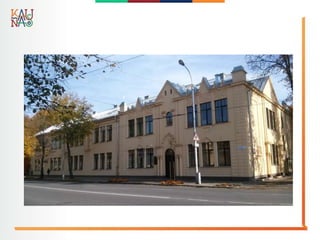
Kaunas Teacher
Training Centre
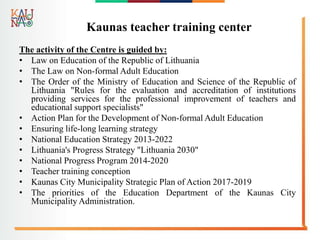
Kaunas teacher training center
The activity of the Centre is guided by:
• Law on Education of the Republic of Lithuania
• The Law on Non-formal Adult Education
• The Order of the Ministry of Education and Science of the Republic of
Lithuania "Rules for the evaluation and accreditation of institutions
providing services for the professional improvement of teachers and
educational support specialists"
• Action Plan for the Development of Non-formal Adult Education
• Ensuring life-long learning strategy
• National Education Strategy 2013-2022
• Lithuania's Progress Strategy "Lithuania 2030"
• National Progress Program 2014-2020
• Teacher training conception
• Kaunas City Municipality Strategic Plan of Action 2017-2019
• The priorities of the Education Department of the Kaunas City
Municipality Administration.
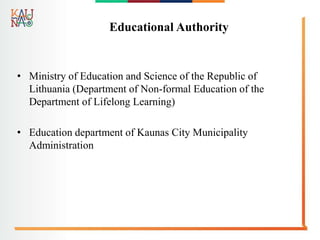
Educational Authority
• Ministry of Education and Science of the Republic of
Lithuania (Department of Non-formal Education of the
Department of Lifelong Learning)
• Education department of Kaunas City Municipality
Administration
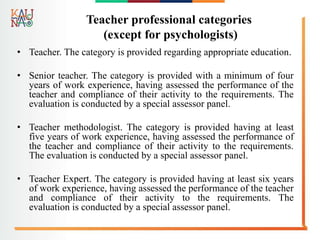
Teacher professional categories
(except for psychologists)
• Teacher. The category is provided regarding appropriate education.
• Senior teacher. The category is provided with a minimum of four
years of work experience, having assessed the performance of the
teacher and compliance of their activity to the requirements. The
evaluation is conducted by a special assessor panel.
• Teacher methodologist. The category is provided having at least
five years of work experience, having assessed the performance of
the teacher and compliance of their activity to the requirements.
The evaluation is conducted by a special assessor panel.
• Teacher Expert. The category is provided having at least six years
of work experience, having assessed the performance of the teacher
and compliance of their activity to the requirements. The
evaluation is conducted by a special assessor panel.
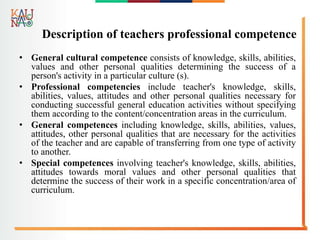
Description of teachers professional competence
• General cultural competence consists of knowledge, skills, abilities,
values and other personal qualities determining the success of a
person's activity in a particular culture (s).
• Professional competencies include teacher's knowledge, skills,
abilities, values, attitudes and other personal qualities necessary for
conducting successful general education activities without specifying
them according to the content/concentration areas in the curriculum.
• General competences including knowledge, skills, abilities, values,
attitudes, other personal qualities that are necessary for the activities
of the teacher and are capable of transferring from one type of activity
to another.
• Special competences involving teacher's knowledge, skills, abilities,
attitudes towards moral values and other personal qualities that
determine the success of their work in a specific concentration/area of
curriculum.
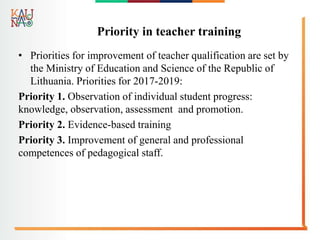
Priority in teacher training
• Priorities for improvement of teacher qualification are set by
the Ministry of Education and Science of the Republic of
Lithuania. Priorities for 2017-2019:
Priority 1. Observation of individual student progress:
knowledge, observation, assessment and promotion.
Priority 2. Evidence-based training
Priority 3. Improvement of general and professional
competences of pedagogical staff.
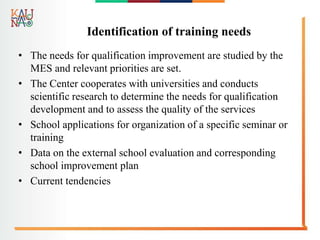
Identification of training needs
• The needs for qualification improvement are studied by the
MES and relevant priorities are set.
• The Center cooperates with universities and conducts
scientific research to determine the needs for qualification
development and to assess the quality of the services
• School applications for organization of a specific seminar or
training
• Data on the external school evaluation and corresponding
school improvement plan
• Current tendencies
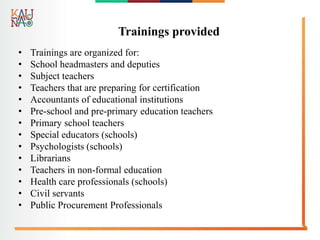
Trainings provided
• Trainings are organized for:
• School headmasters and deputies
• Subject teachers
• Teachers that are preparing for certification
• Accountants of educational institutions
• Pre-school and pre-primary education teachers
• Primary school teachers
• Special educators (schools)
• Psychologists (schools)
• Librarians
• Teachers in non-formal education
• Health care professionals (schools)
• Civil servants
• Public Procurement Professionals
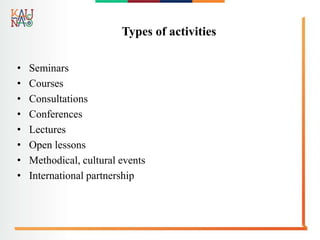
Types of activities
• Seminars
• Courses
• Consultations
• Conferences
• Lectures
• Open lessons
• Methodical, cultural events
• International partnership
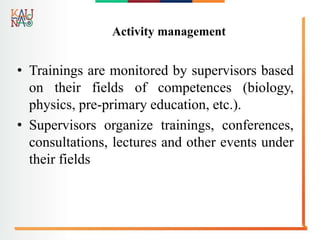
Activity management
• Trainings are monitored by supervisors based
on their fields of competences (biology,
physics, pre-primary education, etc.).
• Supervisors organize trainings, conferences,
consultations, lectures and other events under
their fields
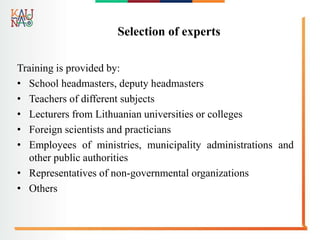
Selection of experts
Training is provided by:
• School headmasters, deputy headmasters
• Teachers of different subjects
• Lecturers from Lithuanian universities or colleges
• Foreign scientists and practicians
• Employees of ministries, municipality administrations and
other public authorities
• Representatives of non-governmental organizations
• Others
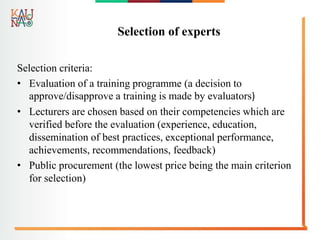
Selection of experts
Selection criteria:
• Evaluation of a training programme (a decision to
approve/disapprove a training is made by evaluators)
• Lecturers are chosen based on their competencies which are
verified before the evaluation (experience, education,
dissemination of best practices, exceptional performance,
achievements, recommendations, feedback)
• Public procurement (the lowest price being the main criterion
for selection)
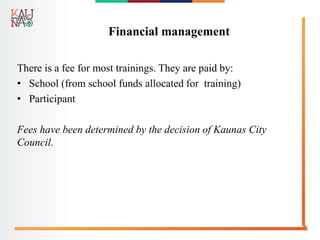
Financial management
There is a fee for most trainings. They are paid by:
• School (from school funds allocated for training)
• Participant
Fees have been determined by the decision of Kaunas City
Council.
Collaboration with institutions
• Kaunas city educational institutions. School dissemination
of best practices is an important factor in the takeover and
adaptation of specific school methodologies for improvement
of students' learning achievements.
• Cooperation with Kaunas city Education department.
Participation in external school evaluation, assistance
provided to schools.
• Organized a methodological hour session about children's
rights protection together with Kaunas city Municipality
administration Division of Children right’s protection .
• Partnerships with businesses (SWEDBANK). Business
innovators from Swedbank organize seminars free of charge.
Collaboration with institutions
• Organized free lectures for citizens and seniors of Kaunas
about public safety, welfare, prevention of criminal acts, bad
habits together with the Police.
• Museums (The Center for Civil Education) provides
opportunities to the city community to get acquainted with
the state history, democratic functioning of the state and its
institutions, to realize that citizens can and must participate in
state-building and governance, develop citizenship.
• Universities: trainings for teachers, heads of schools.
Resources
• Human:
The Centre has 25 employees: principal, 3
viceprincipals, 8 methodists (training specialists), 1
librarian, 1 IT specialsit, others – service staff.
• Financial:
Funds from Kaunas city budget
Funds collected from organized trainings
Project funds
Advisory models and types
Consultations are organized for school headmasters, teachers,
student support specialists on the following topics:
• Implementation of updated education content
• Actvity of headmasters, deputy headmasters and their
qualification categories
• Support provision to children
• Pre-school and pre-primary education
• ICT application in the educational process
• Activities of libraries
• External evaluation of quality in schools providing general
education
• Consultations for newly appointed heads of institutions
• Others
Advisory model and types
Consultations are provided by:
• School heads with a high qualification category
• Teachers practicians with years of experience, members of
teacher performance evaluation committees.
Dissemination of activities
• Centre website
• Information emailed to every educational institution in
Lithuania
• Facebook
Evaluation of training
Participants fill out questionnaires after trainings which
evaluate:
• Training effectiveness
• Teaching methods used in the training
• Lecturer competencies
• Participants provide suggestions regarding improvement or
topics of trainings
Lecturers fill out questionnaires which evaluate:
• Participant performance during the training
• Organizational process of the training
• His/her own performance
Certification
Participants of trainings are awarded certificates of qualification
improvement which includes acquired/improved competencies
(based on the list of competencies).
Participants who have not completed the training or certain tasks
of the training are not awarded a certificate.
Certificates are awarded for participation in:
• Seminars
• Courses
• Conferences
Certification
Certificates are awarded for participation in lectures, methodical
events, other trainings. Certificates include the fact of
participation, activities completed (e.g., pupils prepared for a
competition, methodological tools created), however,
competencies acquired/improved are not included.
Pristatymas   2018.01 eng

Pristatymas 2018.01 eng

  • 1.
  • 2.
    Kaunas teacher trainingcenter The activity of the Centre is guided by: • Law on Education of the Republic of Lithuania • The Law on Non-formal Adult Education • The Order of the Ministry of Education and Science of the Republic of Lithuania "Rules for the evaluation and accreditation of institutions providing services for the professional improvement of teachers and educational support specialists" • Action Plan for the Development of Non-formal Adult Education • Ensuring life-long learning strategy • National Education Strategy 2013-2022 • Lithuania's Progress Strategy "Lithuania 2030" • National Progress Program 2014-2020 • Teacher training conception • Kaunas City Municipality Strategic Plan of Action 2017-2019 • The priorities of the Education Department of the Kaunas City Municipality Administration.
  • 3.
    Educational Authority • Ministryof Education and Science of the Republic of Lithuania (Department of Non-formal Education of the Department of Lifelong Learning) • Education department of Kaunas City Municipality Administration
  • 4.
    Teacher professional categories (exceptfor psychologists) • Teacher. The category is provided regarding appropriate education. • Senior teacher. The category is provided with a minimum of four years of work experience, having assessed the performance of the teacher and compliance of their activity to the requirements. The evaluation is conducted by a special assessor panel. • Teacher methodologist. The category is provided having at least five years of work experience, having assessed the performance of the teacher and compliance of their activity to the requirements. The evaluation is conducted by a special assessor panel. • Teacher Expert. The category is provided having at least six years of work experience, having assessed the performance of the teacher and compliance of their activity to the requirements. The evaluation is conducted by a special assessor panel.
  • 5.
    Description of teachersprofessional competence • General cultural competence consists of knowledge, skills, abilities, values and other personal qualities determining the success of a person's activity in a particular culture (s). • Professional competencies include teacher's knowledge, skills, abilities, values, attitudes and other personal qualities necessary for conducting successful general education activities without specifying them according to the content/concentration areas in the curriculum. • General competences including knowledge, skills, abilities, values, attitudes, other personal qualities that are necessary for the activities of the teacher and are capable of transferring from one type of activity to another. • Special competences involving teacher's knowledge, skills, abilities, attitudes towards moral values and other personal qualities that determine the success of their work in a specific concentration/area of curriculum.
  • 6.
    Priority in teachertraining • Priorities for improvement of teacher qualification are set by the Ministry of Education and Science of the Republic of Lithuania. Priorities for 2017-2019: Priority 1. Observation of individual student progress: knowledge, observation, assessment and promotion. Priority 2. Evidence-based training Priority 3. Improvement of general and professional competences of pedagogical staff.
  • 7.
    Identification of trainingneeds • The needs for qualification improvement are studied by the MES and relevant priorities are set. • The Center cooperates with universities and conducts scientific research to determine the needs for qualification development and to assess the quality of the services • School applications for organization of a specific seminar or training • Data on the external school evaluation and corresponding school improvement plan • Current tendencies
  • 8.
    Trainings provided • Trainingsare organized for: • School headmasters and deputies • Subject teachers • Teachers that are preparing for certification • Accountants of educational institutions • Pre-school and pre-primary education teachers • Primary school teachers • Special educators (schools) • Psychologists (schools) • Librarians • Teachers in non-formal education • Health care professionals (schools) • Civil servants • Public Procurement Professionals
  • 9.
    Types of activities •Seminars • Courses • Consultations • Conferences • Lectures • Open lessons • Methodical, cultural events • International partnership
  • 10.
    Activity management • Trainingsare monitored by supervisors based on their fields of competences (biology, physics, pre-primary education, etc.). • Supervisors organize trainings, conferences, consultations, lectures and other events under their fields
  • 11.
    Selection of experts Trainingis provided by: • School headmasters, deputy headmasters • Teachers of different subjects • Lecturers from Lithuanian universities or colleges • Foreign scientists and practicians • Employees of ministries, municipality administrations and other public authorities • Representatives of non-governmental organizations • Others
  • 12.
    Selection of experts Selectioncriteria: • Evaluation of a training programme (a decision to approve/disapprove a training is made by evaluators) • Lecturers are chosen based on their competencies which are verified before the evaluation (experience, education, dissemination of best practices, exceptional performance, achievements, recommendations, feedback) • Public procurement (the lowest price being the main criterion for selection)
  • 13.
    Financial management There isa fee for most trainings. They are paid by: • School (from school funds allocated for training) • Participant Fees have been determined by the decision of Kaunas City Council.
  • 14.
    Collaboration with institutions •Kaunas city educational institutions. School dissemination of best practices is an important factor in the takeover and adaptation of specific school methodologies for improvement of students' learning achievements. • Cooperation with Kaunas city Education department. Participation in external school evaluation, assistance provided to schools. • Organized a methodological hour session about children's rights protection together with Kaunas city Municipality administration Division of Children right’s protection . • Partnerships with businesses (SWEDBANK). Business innovators from Swedbank organize seminars free of charge.
  • 15.
    Collaboration with institutions •Organized free lectures for citizens and seniors of Kaunas about public safety, welfare, prevention of criminal acts, bad habits together with the Police. • Museums (The Center for Civil Education) provides opportunities to the city community to get acquainted with the state history, democratic functioning of the state and its institutions, to realize that citizens can and must participate in state-building and governance, develop citizenship. • Universities: trainings for teachers, heads of schools.
  • 16.
    Resources • Human: The Centrehas 25 employees: principal, 3 viceprincipals, 8 methodists (training specialists), 1 librarian, 1 IT specialsit, others – service staff. • Financial: Funds from Kaunas city budget Funds collected from organized trainings Project funds
  • 17.
    Advisory models andtypes Consultations are organized for school headmasters, teachers, student support specialists on the following topics: • Implementation of updated education content • Actvity of headmasters, deputy headmasters and their qualification categories • Support provision to children • Pre-school and pre-primary education • ICT application in the educational process • Activities of libraries • External evaluation of quality in schools providing general education • Consultations for newly appointed heads of institutions • Others
  • 18.
    Advisory model andtypes Consultations are provided by: • School heads with a high qualification category • Teachers practicians with years of experience, members of teacher performance evaluation committees.
  • 19.
    Dissemination of activities •Centre website • Information emailed to every educational institution in Lithuania • Facebook
  • 20.
    Evaluation of training Participantsfill out questionnaires after trainings which evaluate: • Training effectiveness • Teaching methods used in the training • Lecturer competencies • Participants provide suggestions regarding improvement or topics of trainings Lecturers fill out questionnaires which evaluate: • Participant performance during the training • Organizational process of the training • His/her own performance
  • 21.
    Certification Participants of trainingsare awarded certificates of qualification improvement which includes acquired/improved competencies (based on the list of competencies). Participants who have not completed the training or certain tasks of the training are not awarded a certificate. Certificates are awarded for participation in: • Seminars • Courses • Conferences
  • 22.
    Certification Certificates are awardedfor participation in lectures, methodical events, other trainings. Certificates include the fact of participation, activities completed (e.g., pupils prepared for a competition, methodological tools created), however, competencies acquired/improved are not included.