Feature Prioritization Strategies
Afshin Ganjoo - LinkedIn
Categorization of Feature Prioritization Strategies
Feature prioritization strategies can be categorized in two ways:
• Priority-based vs. Score-based
• Priority-based strategies rank features based on some prioritization methodology, best used when
those providing input can or need to agree with each other. Generally leads to discussions about
features that help educate the team but requires conflict management.
• Score-based strategies rank features based on some scoring methodology, best used when those
providing input can’t agree with each other. These strategies avoid the need for conflict management
and are best used when those providing input have competing priorities.
• Internal Focus vs. External Focus
• Internally focussed strategies rank features based on internal metrics and concerns while externally
focussed strategies rank features based on customer metrics and concerns.
There are dozens of feature prioritization strategies, some very simple, others very complex, some very generic,
others very specific. What follows are six that I found most useful for what I have encountered.
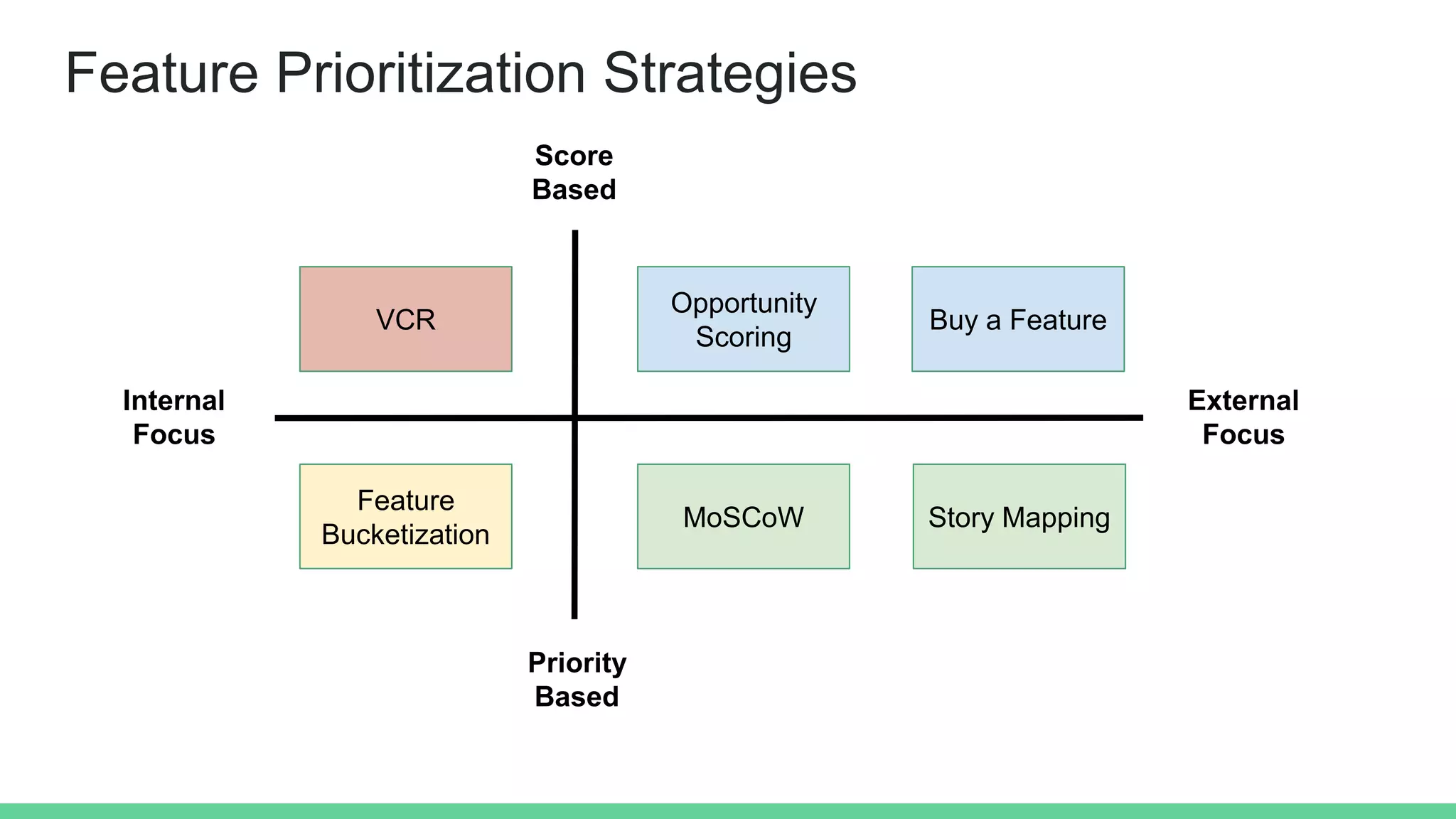
Feature Prioritization Strategies
Feature
Bucketization
VCR
MoSCoW
Opportunity
Scoring
Story Mapping
Buy a Feature
Internal
Focus
Priority
Based
Score
Based
External
Focus
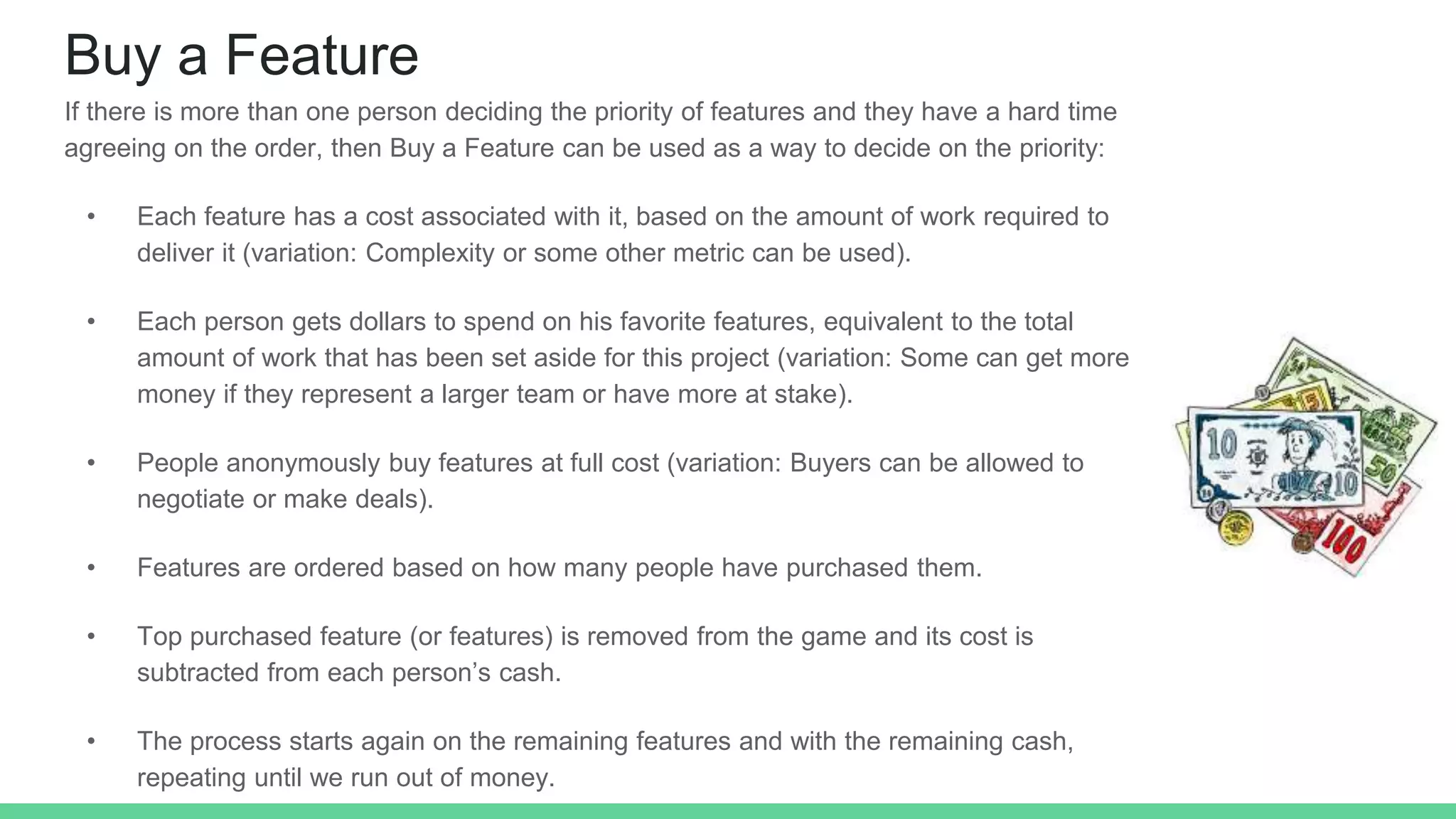
Buy a Feature
If there is more than one person deciding the priority of features and they have a hard time
agreeing on the order, then Buy a Feature can be used as a way to decide on the priority:
• Each feature has a cost associated with it, based on the amount of work required to
deliver it (variation: Complexity or some other metric can be used).
• Each person gets dollars to spend on his favorite features, equivalent to the total
amount of work that has been set aside for this project (variation: Some can get more
money if they represent a larger team or have more at stake).
• People anonymously buy features at full cost (variation: Buyers can be allowed to
negotiate or make deals).
• Features are ordered based on how many people have purchased them.
• Top purchased feature (or features) is removed from the game and its cost is
subtracted from each person’s cash.
• The process starts again on the remaining features and with the remaining cash,
repeating until we run out of money.
Buy a Feature - Exercise
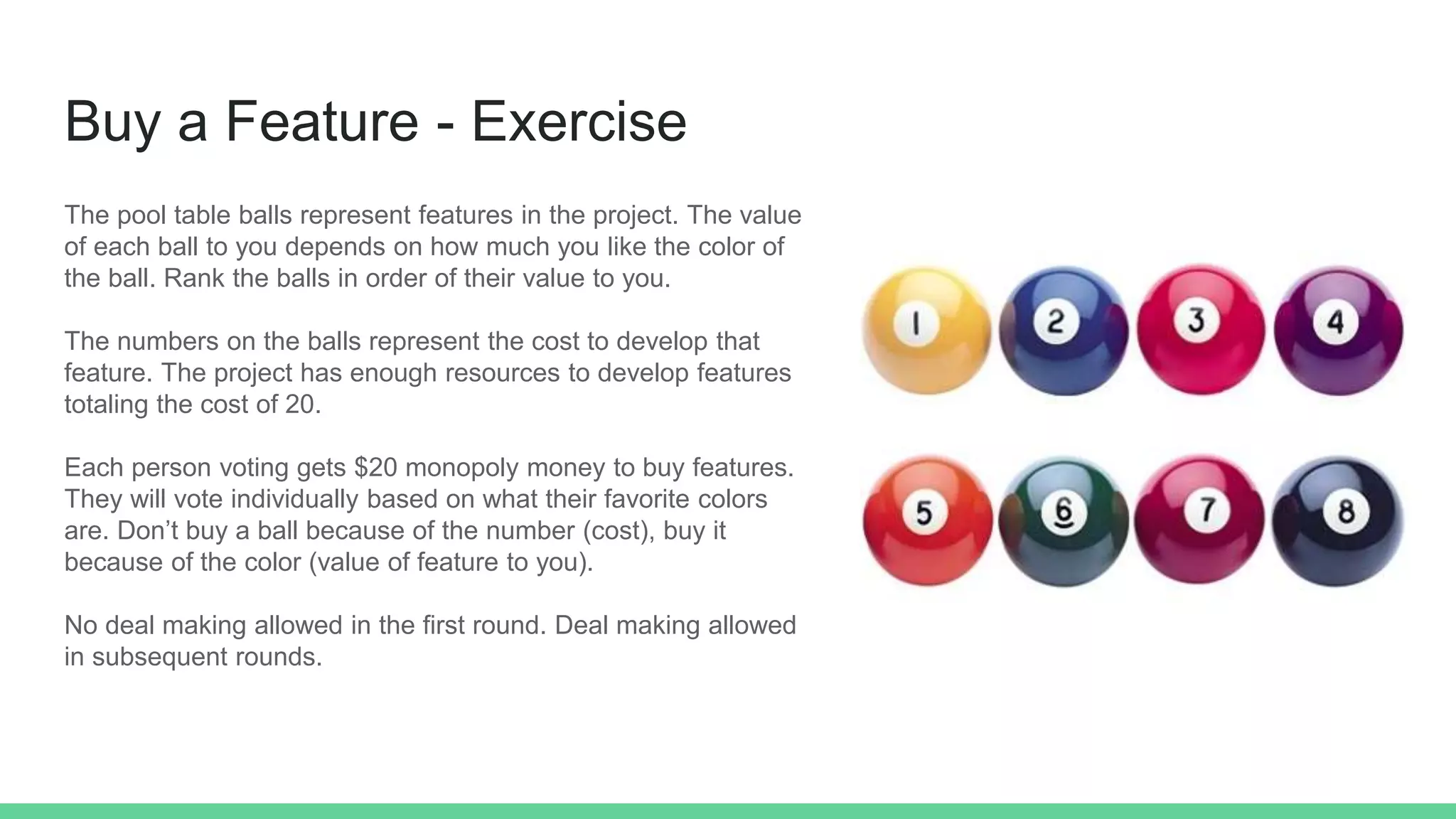
The pool table balls represent features in the project. The value
of each ball to you depends on how much you like the color of
the ball. Rank the balls in order of their value to you.
The numbers on the balls represent the cost to develop that
feature. The project has enough resources to develop features
totaling the cost of 20.
Each person voting gets $20 monopoly money to buy features.
They will vote individually based on what their favorite colors
are. Don’t buy a ball because of the number (cost), buy it
because of the color (value of feature to you).
No deal making allowed in the first round. Deal making allowed
in subsequent rounds.
Opportunity Scoring
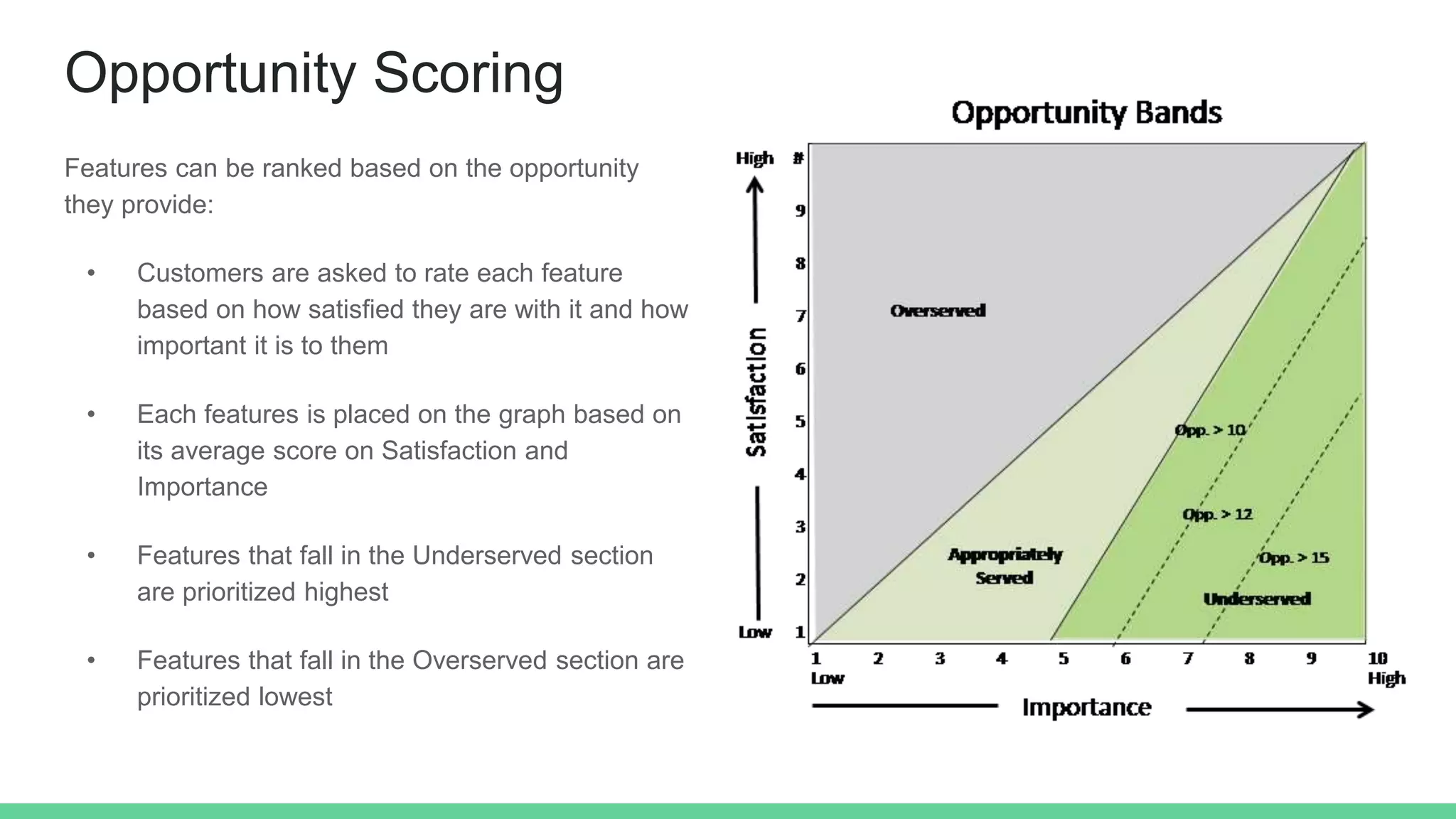
Features can be ranked based on the opportunity
they provide:
• Customers are asked to rate each feature
based on how satisfied they are with it and how
important it is to them
• Each features is placed on the graph based on
its average score on Satisfaction and
Importance
• Features that fall in the Underserved section
are prioritized highest
• Features that fall in the Overserved section are
prioritized lowest
Opportunity Scoring - Exercise
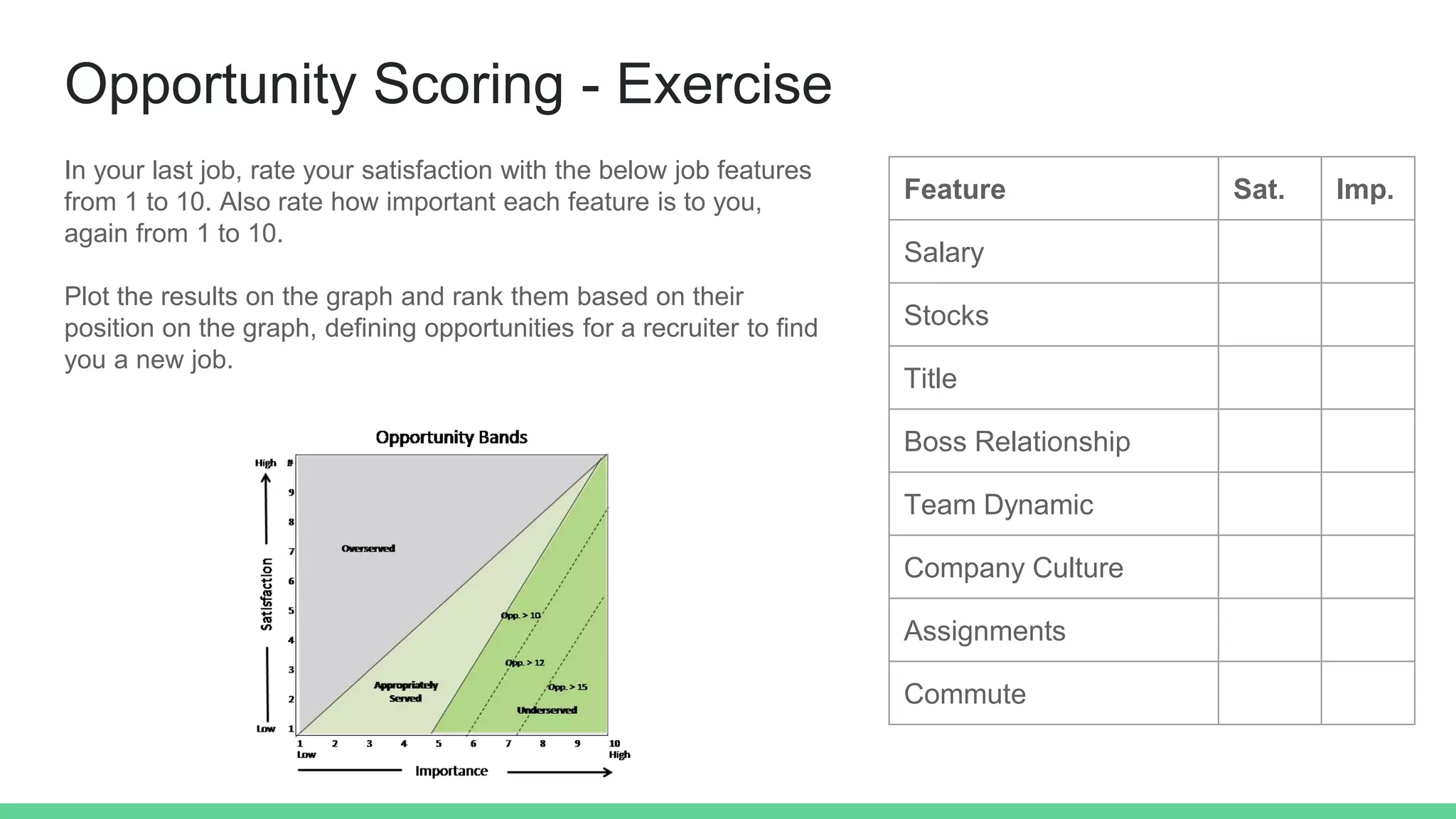
In your last job, rate your satisfaction with the below job features
from 1 to 10. Also rate how important each feature is to you,
again from 1 to 10.
Plot the results on the graph and rank them based on their
position on the graph, defining opportunities for a recruiter to find
you a new job.
Feature Sat. Imp.
Salary
Stocks
Title
Boss Relationship
Team Dynamic
Company Culture
Assignments
Commute
VCR
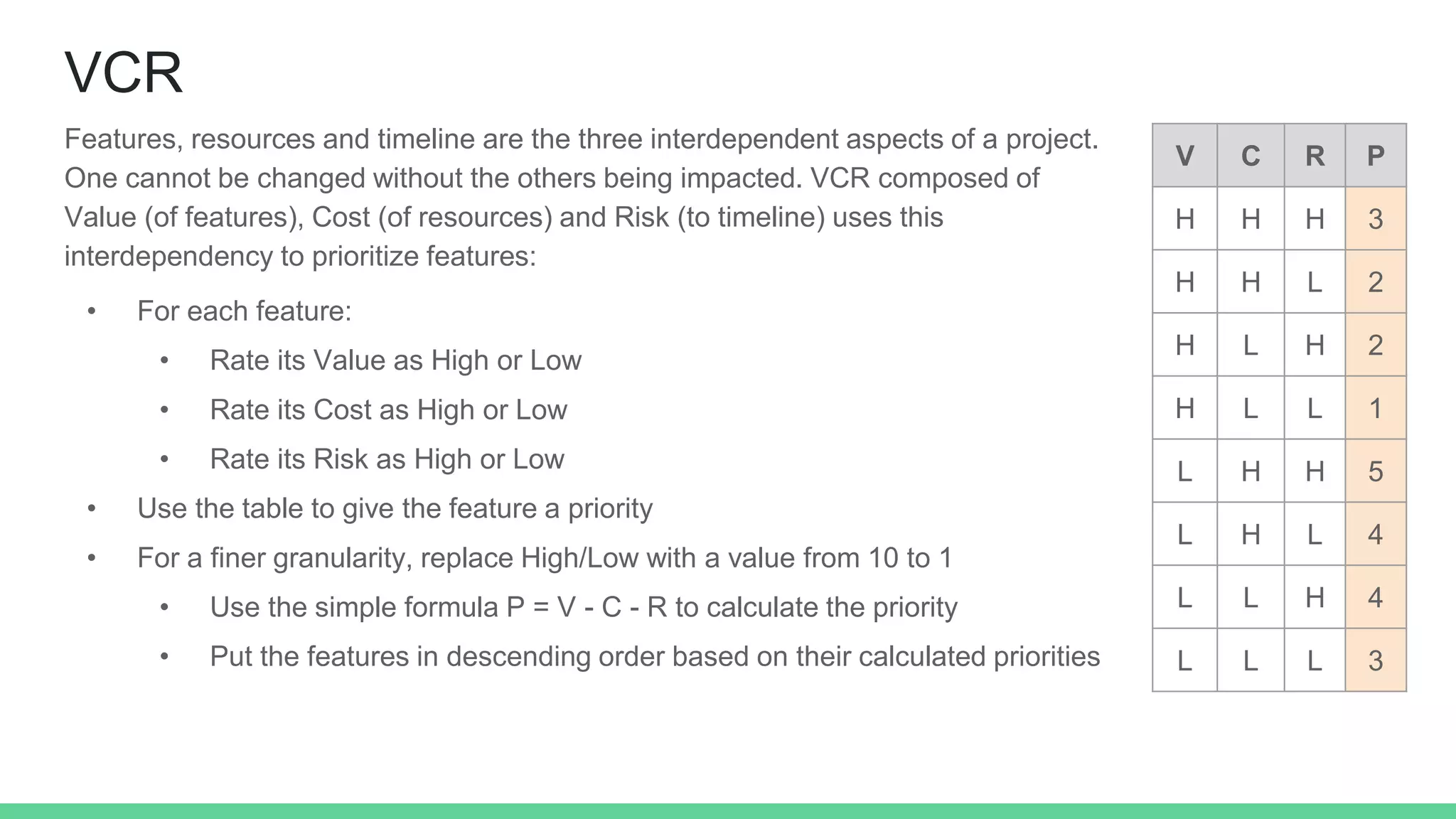
Features, resources and timeline are the three interdependent aspects of a project.
One cannot be changed without the others being impacted. VCR composed of
Value (of features), Cost (of resources) and Risk (to timeline) uses this
interdependency to prioritize features:
• For each feature:
• Rate its Value as High or Low
• Rate its Cost as High or Low
• Rate its Risk as High or Low
• Use the table to give the feature a priority
• For a finer granularity, replace High/Low with a value from 10 to 1
• Use the simple formula P = V - C - R to calculate the priority
• Put the features in descending order based on their calculated priorities
V C R P
H H H 3
H H L 2
H L H 2
H L L 1
L H H 5
L H L 4
L L H 4
L L L 3
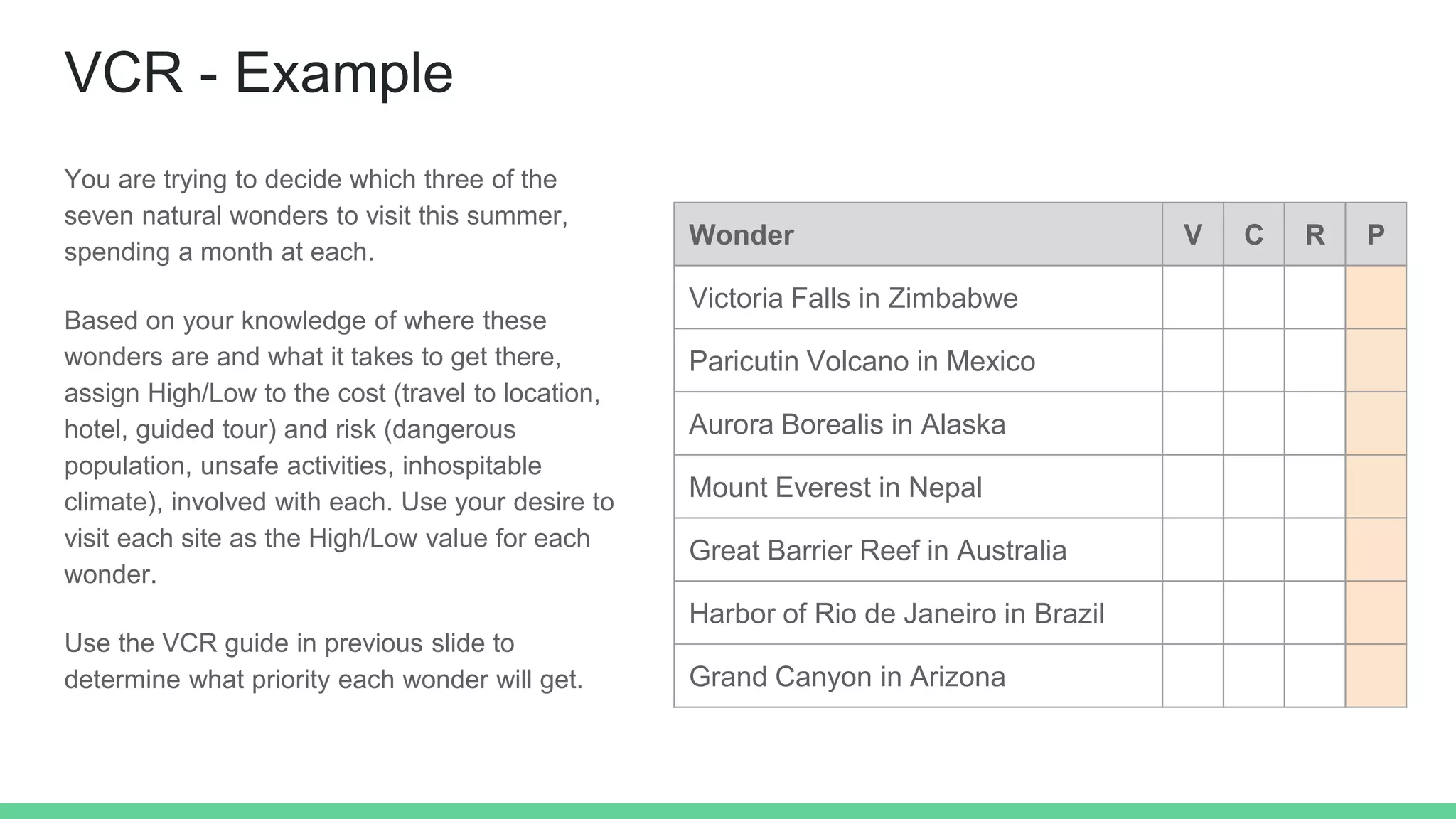
VCR - Example
You are trying to decide which three of the
seven natural wonders to visit this summer,
spending a month at each.
Based on your knowledge of where these
wonders are and what it takes to get there,
assign High/Low to the cost (travel to location,
hotel, guided tour) and risk (dangerous
population, unsafe activities, inhospitable
climate), involved with each. Use your desire to
visit each site as the High/Low value for each
wonder.
Use the VCR guide in previous slide to
determine what priority each wonder will get.
Wonder V C R P
Victoria Falls in Zimbabwe
Paricutin Volcano in Mexico
Aurora Borealis in Alaska
Mount Everest in Nepal
Great Barrier Reef in Australia
Harbor of Rio de Janeiro in Brazil
Grand Canyon in Arizona
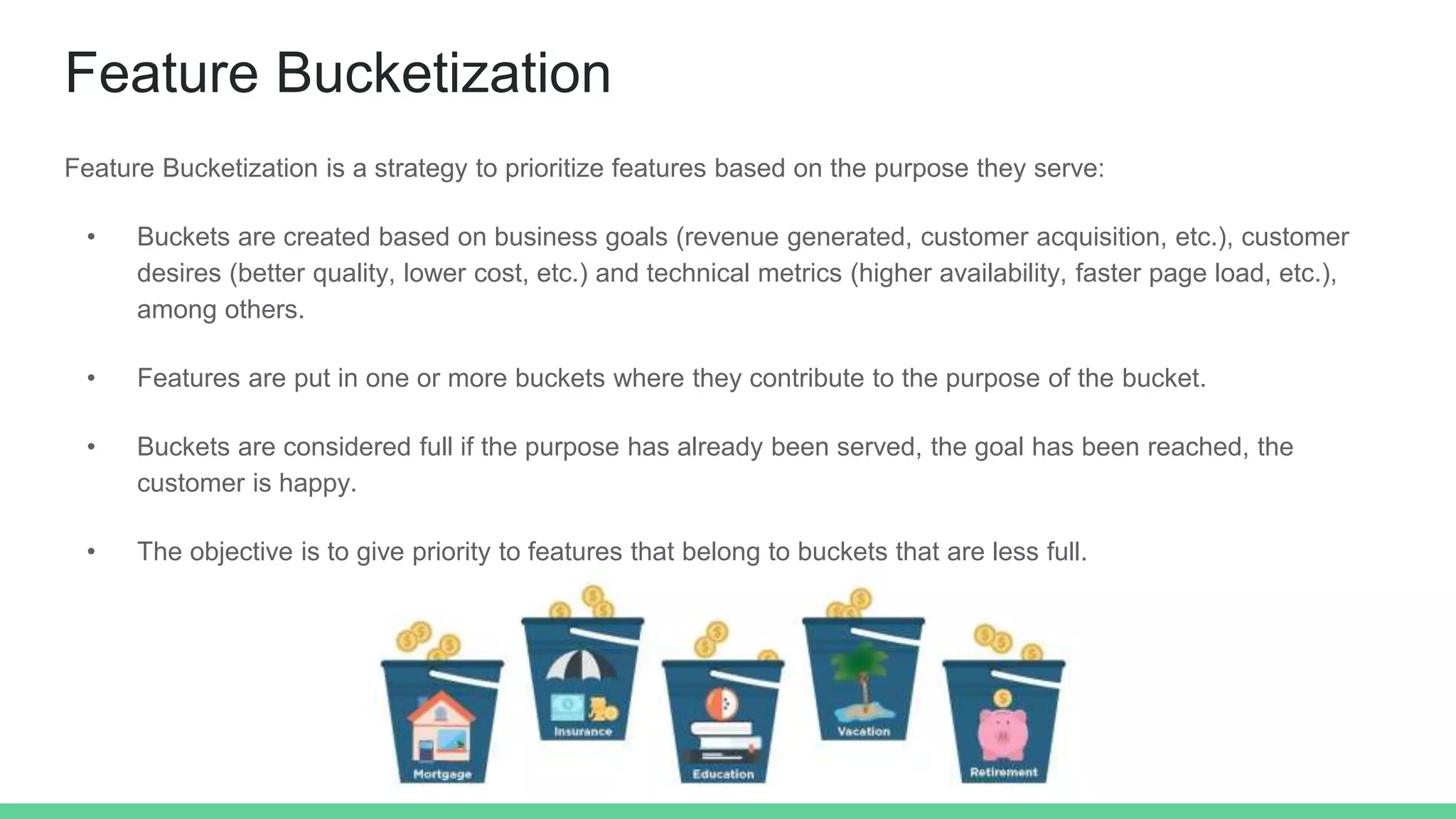
Feature Bucketization
Feature Bucketization is a strategy to prioritize features based on the purpose they serve:
• Buckets are created based on business goals (revenue generated, customer acquisition, etc.), customer
desires (better quality, lower cost, etc.) and technical metrics (higher availability, faster page load, etc.),
among others.
• Features are put in one or more buckets where they contribute to the purpose of the bucket.
• Buckets are considered full if the purpose has already been served, the goal has been reached, the
customer is happy.
• The objective is to give priority to features that belong to buckets that are less full.
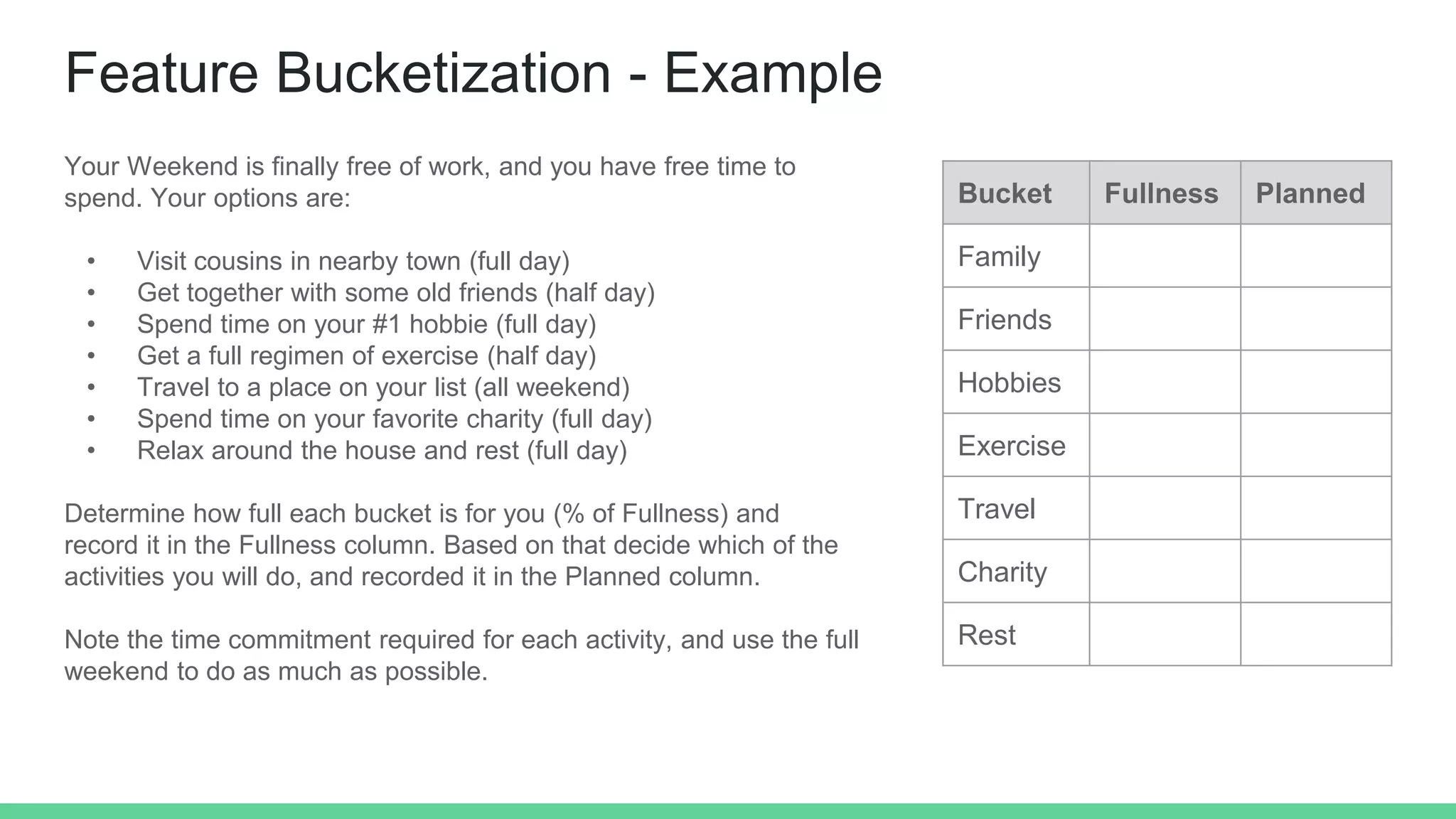
Feature Bucketization - Example
Your Weekend is finally free of work, and you have free time to
spend. Your options are:
• Visit cousins in nearby town (full day)
• Get together with some old friends (half day)
• Spend time on your #1 hobbie (full day)
• Get a full regimen of exercise (half day)
• Travel to a place on your list (all weekend)
• Spend time on your favorite charity (full day)
• Relax around the house and rest (full day)
Determine how full each bucket is for you (% of Fullness) and
record it in the Fullness column. Based on that decide which of the
activities you will do, and recorded it in the Planned column.
Note the time commitment required for each activity, and use the full
weekend to do as much as possible.
Bucket Fullness Planned
Family
Friends
Hobbies
Exercise
Travel
Charity
Rest
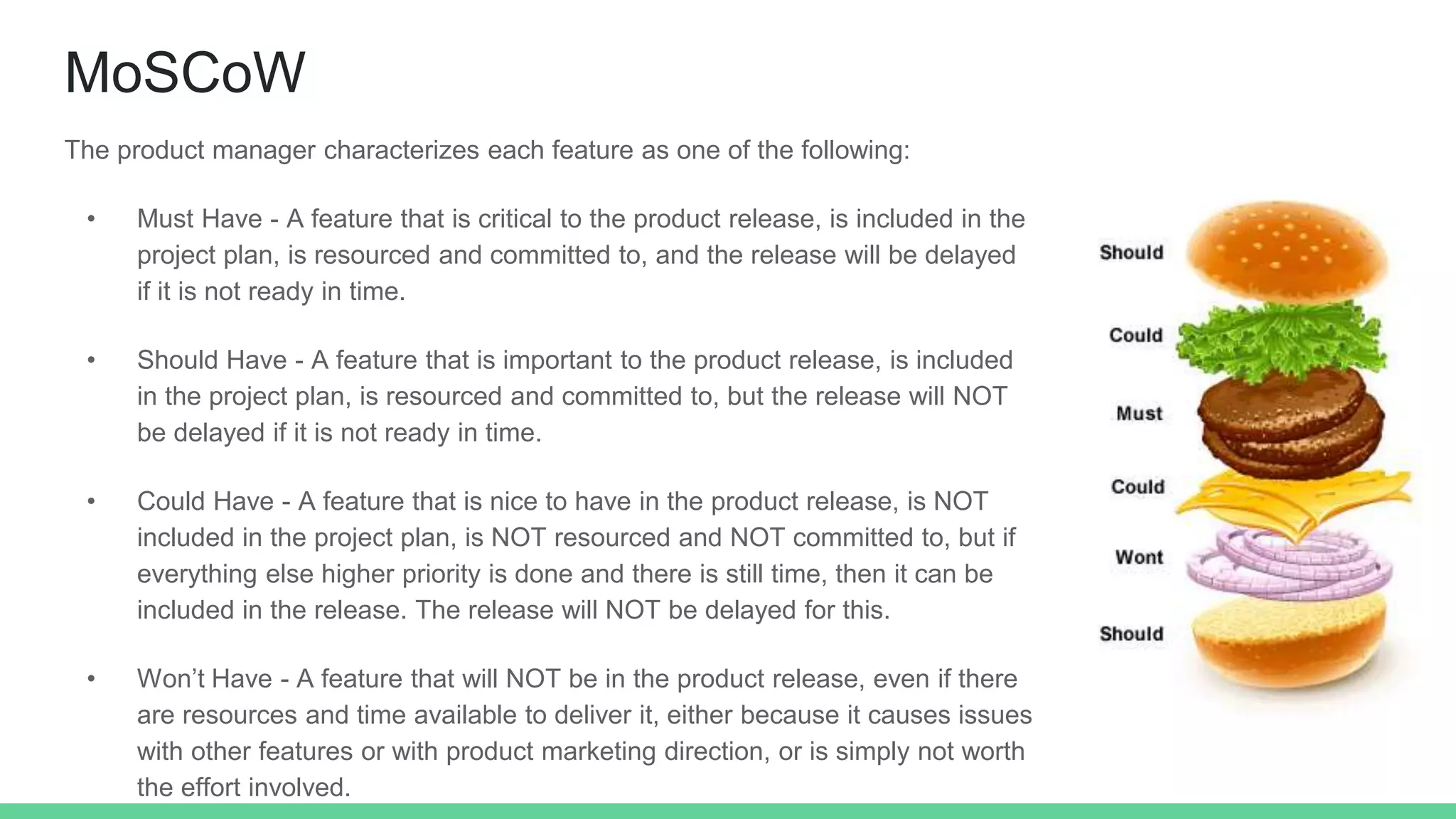
MoSCoW
The product manager characterizes each feature as one of the following:
• Must Have - A feature that is critical to the product release, is included in the
project plan, is resourced and committed to, and the release will be delayed
if it is not ready in time.
• Should Have - A feature that is important to the product release, is included
in the project plan, is resourced and committed to, but the release will NOT
be delayed if it is not ready in time.
• Could Have - A feature that is nice to have in the product release, is NOT
included in the project plan, is NOT resourced and NOT committed to, but if
everything else higher priority is done and there is still time, then it can be
included in the release. The release will NOT be delayed for this.
• Won’t Have - A feature that will NOT be in the product release, even if there
are resources and time available to deliver it, either because it causes issues
with other features or with product marketing direction, or is simply not worth
the effort involved.
MoSCoW - Exercise
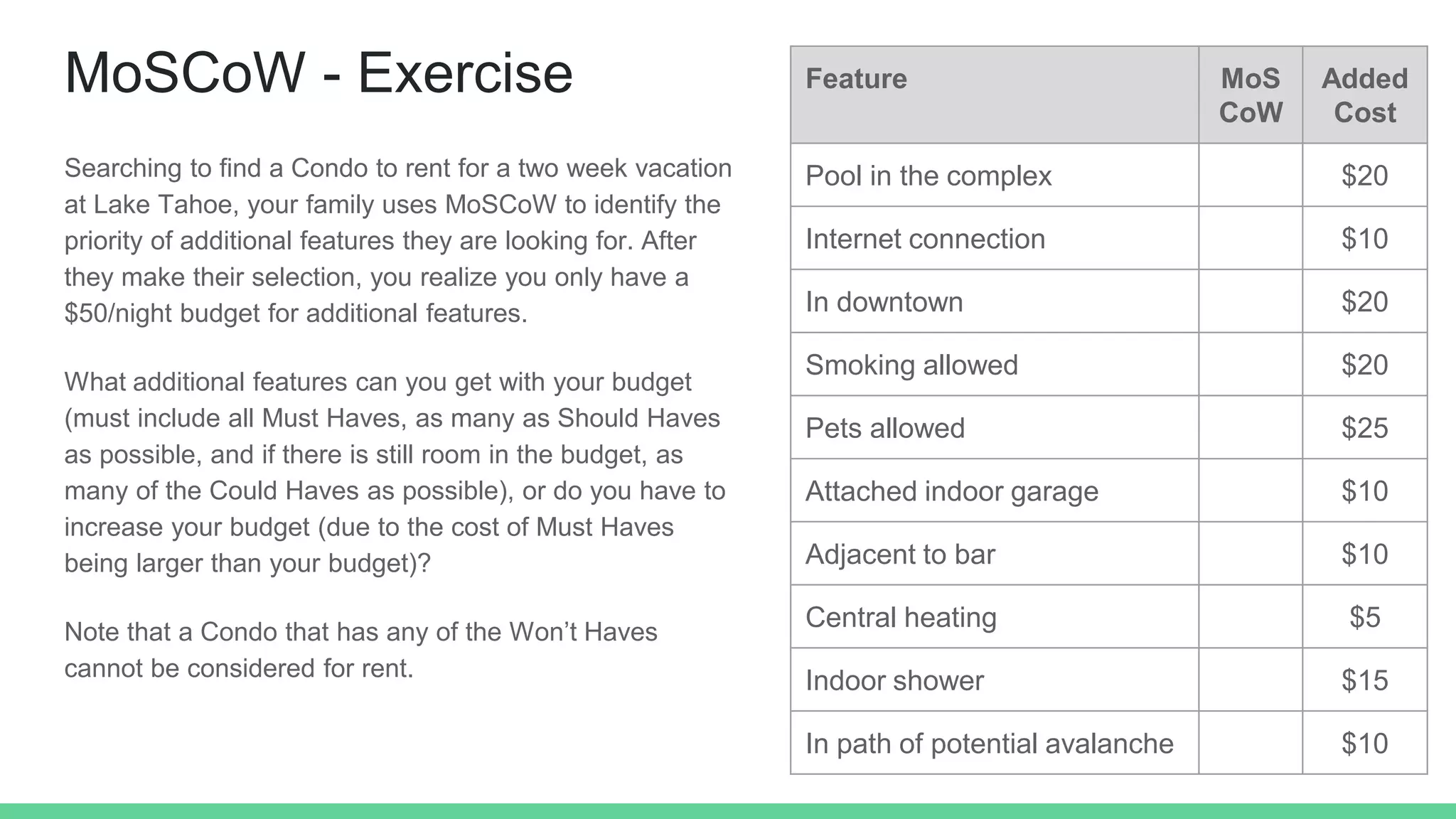
Searching to find a Condo to rent for a two week vacation
at Lake Tahoe, your family uses MoSCoW to identify the
priority of additional features they are looking for. After
they make their selection, you realize you only have a
$50/night budget for additional features.
What additional features can you get with your budget
(must include all Must Haves, as many as Should Haves
as possible, and if there is still room in the budget, as
many of the Could Haves as possible), or do you have to
increase your budget (due to the cost of Must Haves
being larger than your budget)?
Note that a Condo that has any of the Won’t Haves
cannot be considered for rent.
Feature MoS
CoW
Added
Cost
Pool in the complex $20
Internet connection $10
In downtown $20
Smoking allowed $20
Pets allowed $25
Attached indoor garage $10
Adjacent to bar $10
Central heating $5
Indoor shower $15
In path of potential avalanche $10
Story Mapping
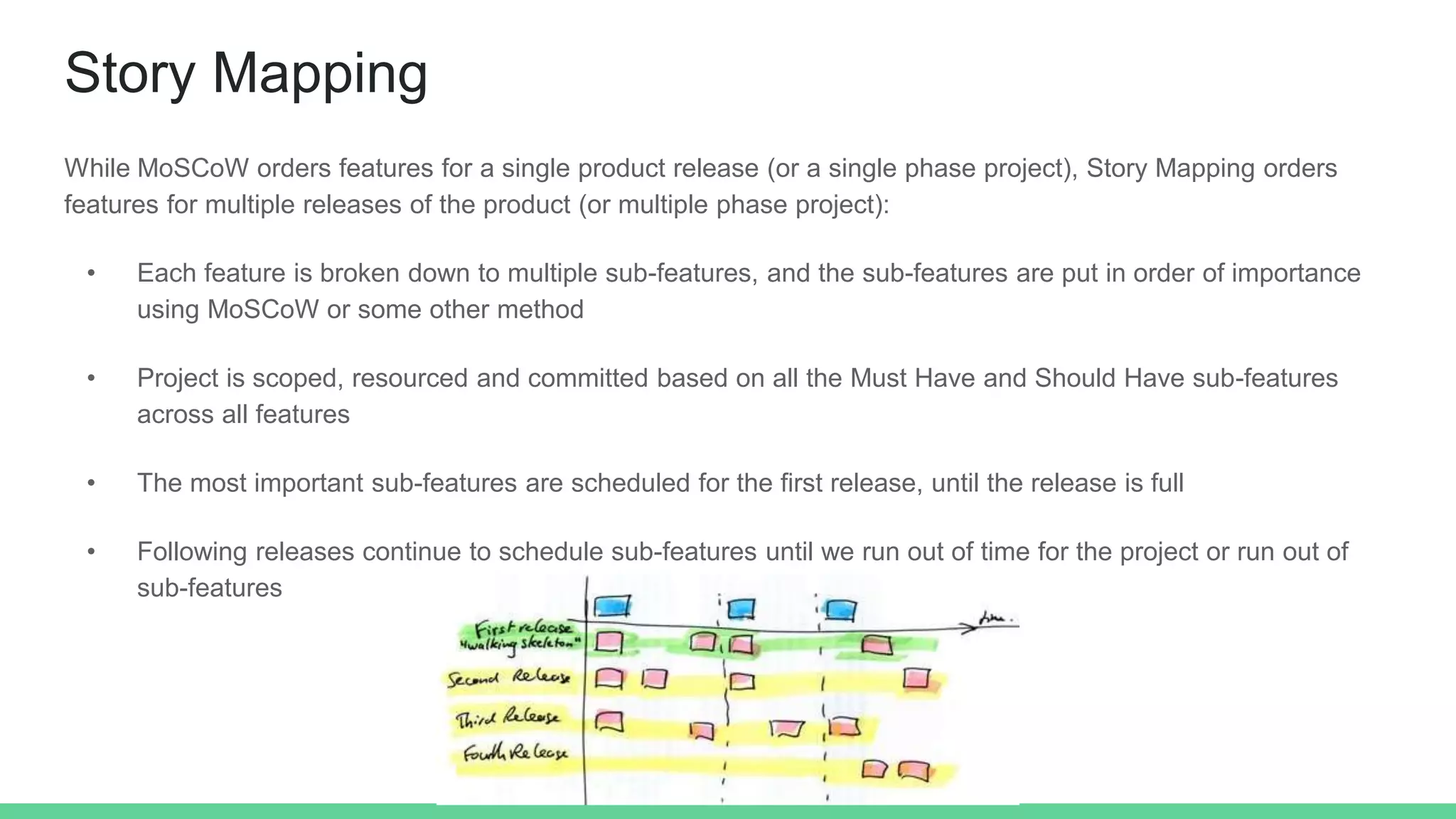
While MoSCoW orders features for a single product release (or a single phase project), Story Mapping orders
features for multiple releases of the product (or multiple phase project):
• Each feature is broken down to multiple sub-features, and the sub-features are put in order of importance
using MoSCoW or some other method
• Project is scoped, resourced and committed based on all the Must Have and Should Have sub-features
across all features
• The most important sub-features are scheduled for the first release, until the release is full
• Following releases continue to schedule sub-features until we run out of time for the project or run out of
sub-features
Story Mapping - Exercise
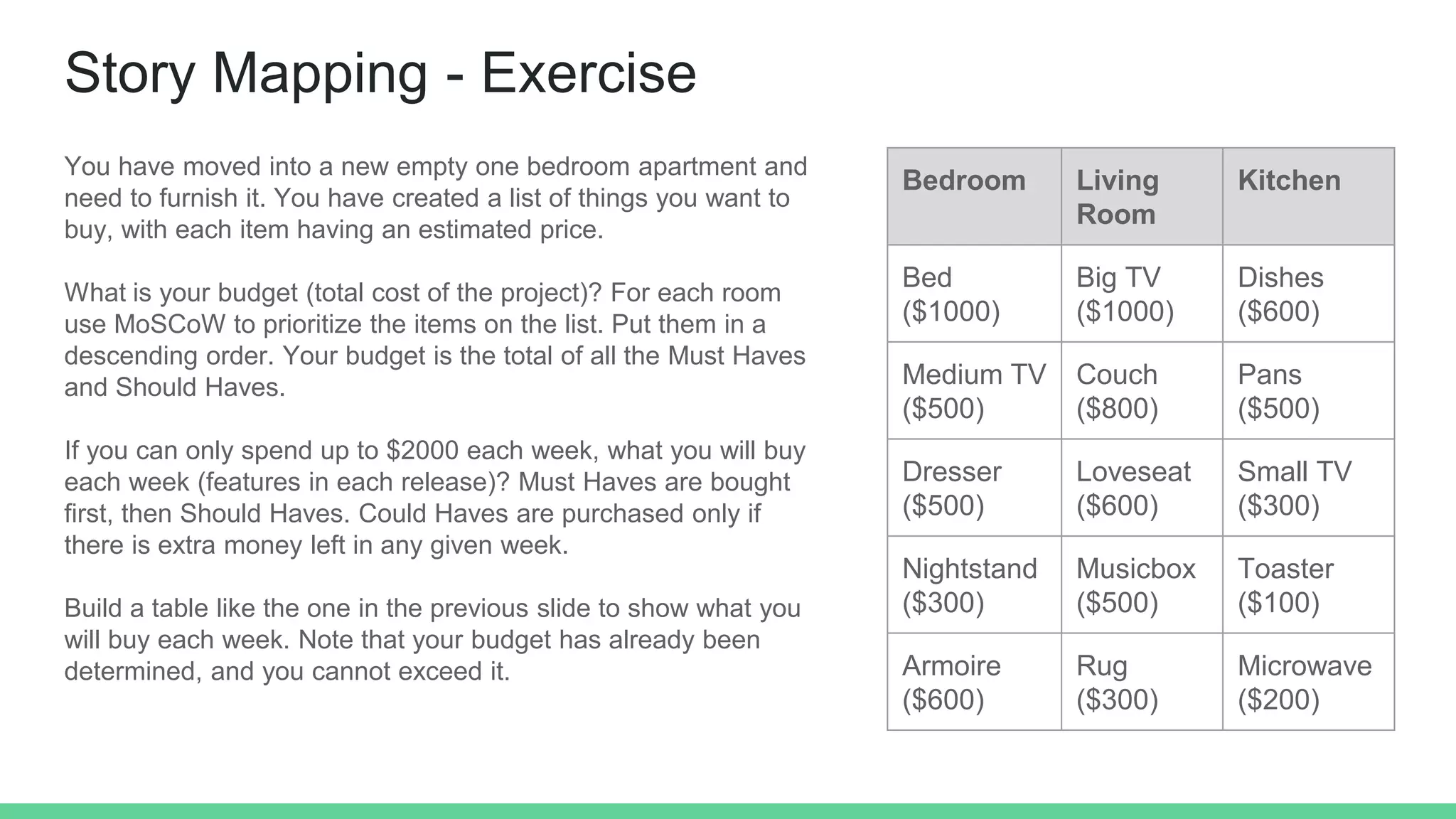
You have moved into a new empty one bedroom apartment and
need to furnish it. You have created a list of things you want to
buy, with each item having an estimated price.
What is your budget (total cost of the project)? For each room
use MoSCoW to prioritize the items on the list. Put them in a
descending order. Your budget is the total of all the Must Haves
and Should Haves.
If you can only spend up to $2000 each week, what you will buy
each week (features in each release)? Must Haves are bought
first, then Should Haves. Could Haves are purchased only if
there is extra money left in any given week.
Build a table like the one in the previous slide to show what you
will buy each week. Note that your budget has already been
determined, and you cannot exceed it.
Bedroom Living
Room
Kitchen
Bed
($1000)
Big TV
($1000)
Dishes
($600)
Medium TV
($500)
Couch
($800)
Pans
($500)
Dresser
($500)
Loveseat
($600)
Small TV
($300)
Nightstand
($300)
Musicbox
($500)
Toaster
($100)
Armoire
($600)
Rug
($300)
Microwave
($200)

Feature Prioritization Strategies

  • 1.
  • 2.
    Categorization of FeaturePrioritization Strategies Feature prioritization strategies can be categorized in two ways: • Priority-based vs. Score-based • Priority-based strategies rank features based on some prioritization methodology, best used when those providing input can or need to agree with each other. Generally leads to discussions about features that help educate the team but requires conflict management. • Score-based strategies rank features based on some scoring methodology, best used when those providing input can’t agree with each other. These strategies avoid the need for conflict management and are best used when those providing input have competing priorities. • Internal Focus vs. External Focus • Internally focussed strategies rank features based on internal metrics and concerns while externally focussed strategies rank features based on customer metrics and concerns. There are dozens of feature prioritization strategies, some very simple, others very complex, some very generic, others very specific. What follows are six that I found most useful for what I have encountered.
  • 3.
    Feature Prioritization Strategies Feature Bucketization VCR MoSCoW Opportunity Scoring StoryMapping Buy a Feature Internal Focus Priority Based Score Based External Focus
  • 4.
    Buy a Feature Ifthere is more than one person deciding the priority of features and they have a hard time agreeing on the order, then Buy a Feature can be used as a way to decide on the priority: • Each feature has a cost associated with it, based on the amount of work required to deliver it (variation: Complexity or some other metric can be used). • Each person gets dollars to spend on his favorite features, equivalent to the total amount of work that has been set aside for this project (variation: Some can get more money if they represent a larger team or have more at stake). • People anonymously buy features at full cost (variation: Buyers can be allowed to negotiate or make deals). • Features are ordered based on how many people have purchased them. • Top purchased feature (or features) is removed from the game and its cost is subtracted from each person’s cash. • The process starts again on the remaining features and with the remaining cash, repeating until we run out of money.
  • 5.
    Buy a Feature- Exercise The pool table balls represent features in the project. The value of each ball to you depends on how much you like the color of the ball. Rank the balls in order of their value to you. The numbers on the balls represent the cost to develop that feature. The project has enough resources to develop features totaling the cost of 20. Each person voting gets $20 monopoly money to buy features. They will vote individually based on what their favorite colors are. Don’t buy a ball because of the number (cost), buy it because of the color (value of feature to you). No deal making allowed in the first round. Deal making allowed in subsequent rounds.
  • 6.
    Opportunity Scoring Features canbe ranked based on the opportunity they provide: • Customers are asked to rate each feature based on how satisfied they are with it and how important it is to them • Each features is placed on the graph based on its average score on Satisfaction and Importance • Features that fall in the Underserved section are prioritized highest • Features that fall in the Overserved section are prioritized lowest
  • 7.
    Opportunity Scoring -Exercise In your last job, rate your satisfaction with the below job features from 1 to 10. Also rate how important each feature is to you, again from 1 to 10. Plot the results on the graph and rank them based on their position on the graph, defining opportunities for a recruiter to find you a new job. Feature Sat. Imp. Salary Stocks Title Boss Relationship Team Dynamic Company Culture Assignments Commute
  • 8.
    VCR Features, resources andtimeline are the three interdependent aspects of a project. One cannot be changed without the others being impacted. VCR composed of Value (of features), Cost (of resources) and Risk (to timeline) uses this interdependency to prioritize features: • For each feature: • Rate its Value as High or Low • Rate its Cost as High or Low • Rate its Risk as High or Low • Use the table to give the feature a priority • For a finer granularity, replace High/Low with a value from 10 to 1 • Use the simple formula P = V - C - R to calculate the priority • Put the features in descending order based on their calculated priorities V C R P H H H 3 H H L 2 H L H 2 H L L 1 L H H 5 L H L 4 L L H 4 L L L 3
  • 9.
    VCR - Example Youare trying to decide which three of the seven natural wonders to visit this summer, spending a month at each. Based on your knowledge of where these wonders are and what it takes to get there, assign High/Low to the cost (travel to location, hotel, guided tour) and risk (dangerous population, unsafe activities, inhospitable climate), involved with each. Use your desire to visit each site as the High/Low value for each wonder. Use the VCR guide in previous slide to determine what priority each wonder will get. Wonder V C R P Victoria Falls in Zimbabwe Paricutin Volcano in Mexico Aurora Borealis in Alaska Mount Everest in Nepal Great Barrier Reef in Australia Harbor of Rio de Janeiro in Brazil Grand Canyon in Arizona
  • 10.
    Feature Bucketization Feature Bucketizationis a strategy to prioritize features based on the purpose they serve: • Buckets are created based on business goals (revenue generated, customer acquisition, etc.), customer desires (better quality, lower cost, etc.) and technical metrics (higher availability, faster page load, etc.), among others. • Features are put in one or more buckets where they contribute to the purpose of the bucket. • Buckets are considered full if the purpose has already been served, the goal has been reached, the customer is happy. • The objective is to give priority to features that belong to buckets that are less full.
  • 11.
    Feature Bucketization -Example Your Weekend is finally free of work, and you have free time to spend. Your options are: • Visit cousins in nearby town (full day) • Get together with some old friends (half day) • Spend time on your #1 hobbie (full day) • Get a full regimen of exercise (half day) • Travel to a place on your list (all weekend) • Spend time on your favorite charity (full day) • Relax around the house and rest (full day) Determine how full each bucket is for you (% of Fullness) and record it in the Fullness column. Based on that decide which of the activities you will do, and recorded it in the Planned column. Note the time commitment required for each activity, and use the full weekend to do as much as possible. Bucket Fullness Planned Family Friends Hobbies Exercise Travel Charity Rest
  • 12.
    MoSCoW The product managercharacterizes each feature as one of the following: • Must Have - A feature that is critical to the product release, is included in the project plan, is resourced and committed to, and the release will be delayed if it is not ready in time. • Should Have - A feature that is important to the product release, is included in the project plan, is resourced and committed to, but the release will NOT be delayed if it is not ready in time. • Could Have - A feature that is nice to have in the product release, is NOT included in the project plan, is NOT resourced and NOT committed to, but if everything else higher priority is done and there is still time, then it can be included in the release. The release will NOT be delayed for this. • Won’t Have - A feature that will NOT be in the product release, even if there are resources and time available to deliver it, either because it causes issues with other features or with product marketing direction, or is simply not worth the effort involved.
  • 13.
    MoSCoW - Exercise Searchingto find a Condo to rent for a two week vacation at Lake Tahoe, your family uses MoSCoW to identify the priority of additional features they are looking for. After they make their selection, you realize you only have a $50/night budget for additional features. What additional features can you get with your budget (must include all Must Haves, as many as Should Haves as possible, and if there is still room in the budget, as many of the Could Haves as possible), or do you have to increase your budget (due to the cost of Must Haves being larger than your budget)? Note that a Condo that has any of the Won’t Haves cannot be considered for rent. Feature MoS CoW Added Cost Pool in the complex $20 Internet connection $10 In downtown $20 Smoking allowed $20 Pets allowed $25 Attached indoor garage $10 Adjacent to bar $10 Central heating $5 Indoor shower $15 In path of potential avalanche $10
  • 14.
    Story Mapping While MoSCoWorders features for a single product release (or a single phase project), Story Mapping orders features for multiple releases of the product (or multiple phase project): • Each feature is broken down to multiple sub-features, and the sub-features are put in order of importance using MoSCoW or some other method • Project is scoped, resourced and committed based on all the Must Have and Should Have sub-features across all features • The most important sub-features are scheduled for the first release, until the release is full • Following releases continue to schedule sub-features until we run out of time for the project or run out of sub-features
  • 15.
    Story Mapping -Exercise You have moved into a new empty one bedroom apartment and need to furnish it. You have created a list of things you want to buy, with each item having an estimated price. What is your budget (total cost of the project)? For each room use MoSCoW to prioritize the items on the list. Put them in a descending order. Your budget is the total of all the Must Haves and Should Haves. If you can only spend up to $2000 each week, what you will buy each week (features in each release)? Must Haves are bought first, then Should Haves. Could Haves are purchased only if there is extra money left in any given week. Build a table like the one in the previous slide to show what you will buy each week. Note that your budget has already been determined, and you cannot exceed it. Bedroom Living Room Kitchen Bed ($1000) Big TV ($1000) Dishes ($600) Medium TV ($500) Couch ($800) Pans ($500) Dresser ($500) Loveseat ($600) Small TV ($300) Nightstand ($300) Musicbox ($500) Toaster ($100) Armoire ($600) Rug ($300) Microwave ($200)