

HashemYaseen, MBBS 2018
 large-for-gestational-age: has mainly been used
for fetuses or newborns with an (estimated) weight
90th percentile or 2 standard deviations from the
mean for the gestational age
Macrosomia: refers to growth beyond a specific
threshold, regardless of gestational age
A grading system has been suggested:
1. grade 1 for infants 4000 to 4499 g
2. grade 2 for 4500 to 4999 g
3. grade 3 for over 5000 g
HashemYaseen, MBBS 2018
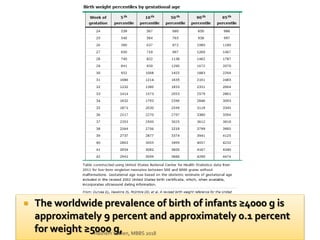
 The worldwide prevalence of birth of infants ≥4000 g is
approximately 9 percent and approximately 0.1 percent
for weight ≥5000 g,HashemYaseen, MBBS 2018
 Maternal:
 Protracted or arrested labor
 Operative vaginal delivery
 Cesarean delivery
 Genital tract lacerations (vaginal, anal sphincter, rectum)
 Postpartum hemorrhage
 Uterine rupture
 Fetal:
 Shoulder dystocia leading to birth trauma (brachial plexus injury, fracture) or asphyxia.
HashemYaseen, MBBS 2018
At birth weights ≥5000 g, the risk of
stillbirth and neonatal mortality
increases. For this reason, the presence
of macrosomia is an important factor to
consider in decision-making during
delivery (eg, whether to use forceps or
vacuum, whether to proceed to cesarean
delivery).
HashemYaseen, MBBS 2018
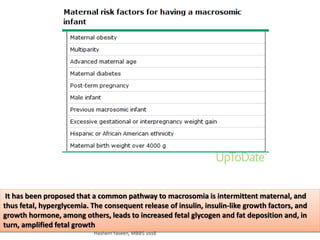
It has been proposed that a common pathway to macrosomia is intermittent maternal, and
thus fetal, hyperglycemia. The consequent release of insulin, insulin-like growth factors, and
growth hormone, among others, leads to increased fetal glycogen and fat deposition and, in
turn, amplified fetal growth
HashemYaseen, MBBS 2018
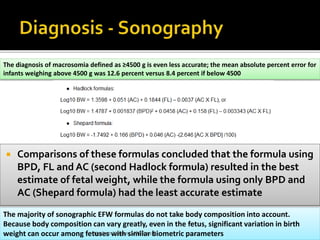
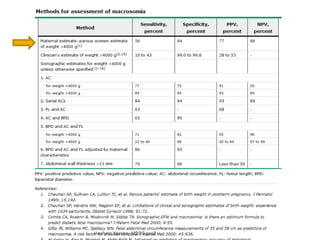
 Comparisons of these formulas concluded that the formula using
BPD, FL and AC (second Hadlock formula) resulted in the best
estimate of fetal weight, while the formula using only BPD and
AC (Shepard formula) had the least accurate estimate
The diagnosis of macrosomia defined as ≥4500 g is even less accurate; the mean absolute percent error for
infants weighing above 4500 g was 12.6 percent versus 8.4 percent if below 4500
The majority of sonographic EFW formulas do not take body composition into account.
Because body composition can vary greatly, even in the fetus, significant variation in birth
weight can occur among fetuses with similar biometric parametersHashemYaseen, MBBS 2018
HashemYaseen, MBBS 2018
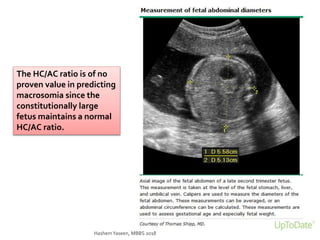
The HC/AC ratio is of no
proven value in predicting
macrosomia since the
constitutionally large
fetus maintains a normal
HC/AC ratio.
HashemYaseen, MBBS 2018
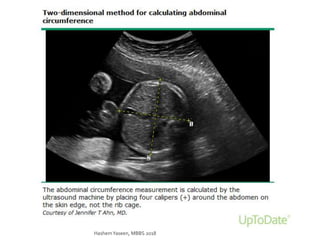
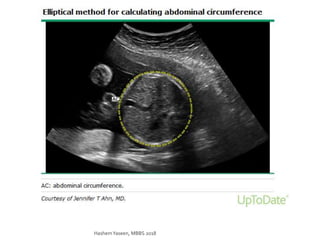
 The AC is the most important parameter for
assessment of risk of macrosomia
 An AC of 35 to 38 cm alone is predictive of
macrosomia
 An AC >90th percentile or two to three
weeks ahead of gestational age may be an
early marker for development of
macrosomia despite normal EFW.
HashemYaseen, MBBS 2018
 Maternal estimation — In several studies, a mother's estimate
of her baby's weight has been reported to be as, or more,
accurate than clinical or sonographic estimates
 Maternal estimation has been used primarily to predict
macrosomia during labor in women without a recent
ultrasound examination.
Physical examination — Fetal weight can be estimated clinically
by simple palpation of the fetus through the maternal abdomen
(eg, Leopold maneuvers) and/or by measurement of fundal height
(the distance between the superior aspect of the symphysis pubis
and the upper border of the uterine fundus).These assessments are
performed with the woman supine and her bladder empty.
HashemYaseen, MBBS 2018
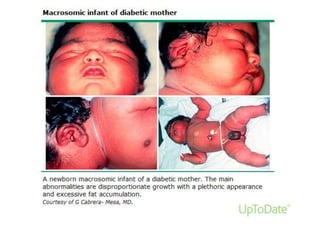
 Macrosomic infants of diabetic mothers have larger shoulders
and greater amounts of body fat, decreased head-to-shoulder
ratio, and increased skin folds in the upper extremities.
 Ultrasound prediction of estimated fetal weight in fetuses of
diabetic mothers tends to overestimate fetal weight since the
formula is very sensitive to measurement of abdominal
circumference (AC), and AC in particular is increased in these
fetuses
HashemYaseen, MBBS 2018
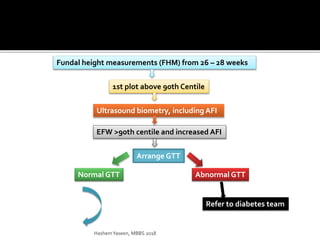
Fundal height measurements (FHM) from 26 – 28 weeks
1st plot above 90th Centile
Arrange GTT
Abnormal GTT
Refer to diabetes team
Ultrasound biometry, including AFI
EFW >90th centile and increased AFI
Normal GTT
HashemYaseen, MBBS 2018
 It is reasonable to offer elective induction of labor to
women:
 Women without diabetes:
4000 and 4500 g -> at 39 weeks of gestation
 Reduced the risk of neonatal fractures (relative risk [RR] 0.20, 95% CI 0.05-0.79)
 Reduced the risk of shoulder dystocia (RR 0.60, 95% CI 0.37-0.98)
HashemYaseen, MBBS 2018
 The American College of Obstetricians and Gynecologists
practice bulletin on operative delivery suggests that
judicious use of forceps or vacuum extraction is not
contraindicated for most fetuses suspected to be
macrosomic, if the maternal pelvis and progress of labor
are adequate
HashemYaseen, MBBS 2018
 It is reasonable to offer prophylactic cesarean delivery to
women:
 Women with diabetes:
to prevent brachial plexus injury when the estimated
fetal weight is greater than 4500 g.
HashemYaseen, MBBS 2018
 Neonatal:
 Hypoglycemia
 Respiratory problems
 Polycythemia
 Minor congenital anomalies
 Increased frequency of admission and prolonged admission
(greater than three days) to a neonatal intensive care unit
 Childhood and beyond:
 Obesity
 Impaired glucose tolerance
 Metabolic syndrome
 Cardiac remodeling (increase in aorta intima-media
thickness and left ventricular mass)
HashemYaseen, MBBS 2018

LGA seminar hashem 2018

  • 2.
  • 3.
  • 4.
  • 5.
  • 6.
  • 7.
  • 8.
  • 9.
     large-for-gestational-age: hasmainly been used for fetuses or newborns with an (estimated) weight 90th percentile or 2 standard deviations from the mean for the gestational age Macrosomia: refers to growth beyond a specific threshold, regardless of gestational age A grading system has been suggested: 1. grade 1 for infants 4000 to 4499 g 2. grade 2 for 4500 to 4999 g 3. grade 3 for over 5000 g HashemYaseen, MBBS 2018
  • 10.
     The worldwideprevalence of birth of infants ≥4000 g is approximately 9 percent and approximately 0.1 percent for weight ≥5000 g,HashemYaseen, MBBS 2018
  • 11.
     Maternal:  Protractedor arrested labor  Operative vaginal delivery  Cesarean delivery  Genital tract lacerations (vaginal, anal sphincter, rectum)  Postpartum hemorrhage  Uterine rupture  Fetal:  Shoulder dystocia leading to birth trauma (brachial plexus injury, fracture) or asphyxia. HashemYaseen, MBBS 2018
  • 12.
    At birth weights≥5000 g, the risk of stillbirth and neonatal mortality increases. For this reason, the presence of macrosomia is an important factor to consider in decision-making during delivery (eg, whether to use forceps or vacuum, whether to proceed to cesarean delivery). HashemYaseen, MBBS 2018
  • 13.
    It has beenproposed that a common pathway to macrosomia is intermittent maternal, and thus fetal, hyperglycemia. The consequent release of insulin, insulin-like growth factors, and growth hormone, among others, leads to increased fetal glycogen and fat deposition and, in turn, amplified fetal growth HashemYaseen, MBBS 2018
  • 14.
  • 15.
     Comparisons ofthese formulas concluded that the formula using BPD, FL and AC (second Hadlock formula) resulted in the best estimate of fetal weight, while the formula using only BPD and AC (Shepard formula) had the least accurate estimate The diagnosis of macrosomia defined as ≥4500 g is even less accurate; the mean absolute percent error for infants weighing above 4500 g was 12.6 percent versus 8.4 percent if below 4500 The majority of sonographic EFW formulas do not take body composition into account. Because body composition can vary greatly, even in the fetus, significant variation in birth weight can occur among fetuses with similar biometric parametersHashemYaseen, MBBS 2018
  • 16.
  • 17.
  • 18.
    The HC/AC ratiois of no proven value in predicting macrosomia since the constitutionally large fetus maintains a normal HC/AC ratio. HashemYaseen, MBBS 2018
  • 19.
     The ACis the most important parameter for assessment of risk of macrosomia  An AC of 35 to 38 cm alone is predictive of macrosomia  An AC >90th percentile or two to three weeks ahead of gestational age may be an early marker for development of macrosomia despite normal EFW. HashemYaseen, MBBS 2018
  • 20.
     Maternal estimation— In several studies, a mother's estimate of her baby's weight has been reported to be as, or more, accurate than clinical or sonographic estimates  Maternal estimation has been used primarily to predict macrosomia during labor in women without a recent ultrasound examination. Physical examination — Fetal weight can be estimated clinically by simple palpation of the fetus through the maternal abdomen (eg, Leopold maneuvers) and/or by measurement of fundal height (the distance between the superior aspect of the symphysis pubis and the upper border of the uterine fundus).These assessments are performed with the woman supine and her bladder empty. HashemYaseen, MBBS 2018
  • 21.
  • 22.
     Macrosomic infantsof diabetic mothers have larger shoulders and greater amounts of body fat, decreased head-to-shoulder ratio, and increased skin folds in the upper extremities.  Ultrasound prediction of estimated fetal weight in fetuses of diabetic mothers tends to overestimate fetal weight since the formula is very sensitive to measurement of abdominal circumference (AC), and AC in particular is increased in these fetuses HashemYaseen, MBBS 2018
  • 23.
    Fundal height measurements(FHM) from 26 – 28 weeks 1st plot above 90th Centile Arrange GTT Abnormal GTT Refer to diabetes team Ultrasound biometry, including AFI EFW >90th centile and increased AFI Normal GTT HashemYaseen, MBBS 2018
  • 24.
     It isreasonable to offer elective induction of labor to women:  Women without diabetes: 4000 and 4500 g -> at 39 weeks of gestation  Reduced the risk of neonatal fractures (relative risk [RR] 0.20, 95% CI 0.05-0.79)  Reduced the risk of shoulder dystocia (RR 0.60, 95% CI 0.37-0.98) HashemYaseen, MBBS 2018
  • 25.
     The AmericanCollege of Obstetricians and Gynecologists practice bulletin on operative delivery suggests that judicious use of forceps or vacuum extraction is not contraindicated for most fetuses suspected to be macrosomic, if the maternal pelvis and progress of labor are adequate HashemYaseen, MBBS 2018
  • 26.
  • 27.
     It isreasonable to offer prophylactic cesarean delivery to women:  Women with diabetes: to prevent brachial plexus injury when the estimated fetal weight is greater than 4500 g. HashemYaseen, MBBS 2018
  • 28.
     Neonatal:  Hypoglycemia Respiratory problems  Polycythemia  Minor congenital anomalies  Increased frequency of admission and prolonged admission (greater than three days) to a neonatal intensive care unit  Childhood and beyond:  Obesity  Impaired glucose tolerance  Metabolic syndrome  Cardiac remodeling (increase in aorta intima-media thickness and left ventricular mass) HashemYaseen, MBBS 2018
  • 30.

Editor's Notes

  • #11 These thresholds are not useful for identifying the preterm macrosomic fetus since they are not based upon population statistics, where normal weight is typically defined as between the 10th and 90th percentile for gestational age (assuming a normal population distribution). Using a statistical approach, any fetus/infant weighing >90th percentile for gestational age is considered large for gestational age
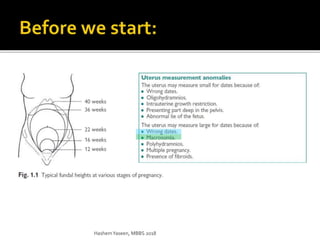
  • #14 Risk factors for macrosomia are listed in the table (table 2) and include constitutional factors (eg, familial trait, male sex, ethnicity), environmental factors (maternal diabetes, gestational weight gain, maternal obesity, post-term gestation, multiparity, large placenta in early pregnancy), or heritable genetic abnormalities [28,29]. The long-term consequences vary depending on the etiology [30].
  • #15 then the possibility of one of the rare syndromes associated with accelerated fetal growth should be considered, particularly in the presence of one or more fetal structural anomalies
  • #23 Women with diabetes — The growth pattern of fetuses of women with diabetes, especially when glycemic control has been poor, is different from that in fetuses of women without diabetes [50,113,114]. Macrosomic infants of diabetic mothers have larger shoulders and greater amounts of body fat, decreased head-to-shoulder ratio, and increased skin folds in the upper extremities [115,116]. Several studies have used this information in an attempt to predict the risk of shoulder dystocia in pregnancies complicated by diabetes, but no method has proven to be reliable [117-121].