Prematurity
and it’s complications
Introduction
⦁ Definition
⦁ Incidence
⦁ Appropriate birth weight at different gestational ages
⦁ Etiology
Definition
⦁ It is defined as live born infant delivered before 37
weeks from the first day of the last menstrual period.
Incidence
⦁ The exact incidence in Pakistan is not known.
⦁ Estimated 11-13%
⦁ It includes both small for gestational age (SGA) and
appropriate for gestational age (AGA)
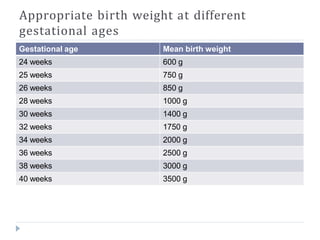
Appropriate birth weight at different
gestational ages
Gestational age Mean birth weight
24 weeks 600 g
25 weeks 750 g
26 weeks 850 g
28 weeks 1000 g
30 weeks 1400 g
32 weeks 1750 g
34 weeks 2000 g
36 weeks 2500 g
38 weeks 3000 g
40 weeks 3500 g
Etiology
⦁ Maternal causes
⦁ Uterine causes
⦁ Fetal causes
⦁ Others
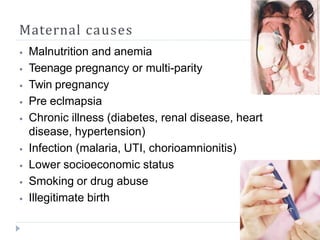
Maternal causes
⦁ Malnutrition and anemia
⦁ Teenage pregnancy or multi-parity
⦁ Twin pregnancy
⦁ Pre eclmapsia
⦁ Chronic illness (diabetes, renal disease, heart
disease, hypertension)
⦁ Infection (malaria, UTI, chorioamnionitis)
⦁ Lower socioeconomic status
⦁ Smoking or drug abuse
⦁ Illegitimate birth
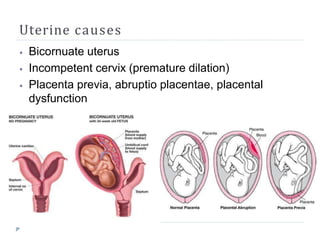
Uterine causes
⦁ Bicornuate uterus
⦁ Incompetent cervix (premature dilation)
⦁ Placenta previa, abruptio placentae, placental
dysfunction
Fetal causes
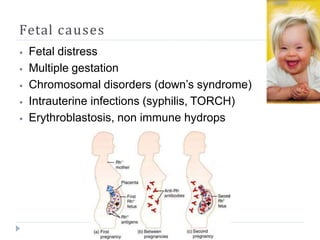
⦁ Fetal distress
⦁ Multiple gestation
⦁ Chromosomal disorders (down’s syndrome)
⦁ Intrauterine infections (syphilis, TORCH)
⦁ Erythroblastosis, non immune hydrops
Others
⦁ Polyhydramnios
⦁ Trauma
⦁ Premature rupture of membranes
⦁ Iatrogenic
Problems/complications of prematurity
⦁ Immediate
⦁ Long term
Immediate (acute) problems
1. Hypothermia
2. Hypoglycemia
3. Hypocalcemia
4. Respiratory difficulties
5. Intra-ventricular hemorrhage (IVH)
6. Liver immaturity
7. Increased susceptibility to infections
8. Necrotizing enterocolitis (NEC)
9. Patent ductus arteriosus
10. Feeding problems
11. Anemia of prematurity
12. Retinopathy of prematurity
13. Metabolic bone diseases of prematurity
Hypothermia
It occurs in preterm babies due to:
⦁ High surface area to body weight ratio
⦁ Little subcutaneous fat
⦁ Muscular inactivity
⦁ Inadequate sweating mechanism
⦁ Decreased brown fat
⦁ Immature heat regulation mechanism
Hypoglycemia
⦁ It is common due to lack f glycogen stores and
immature hepatic and autonomic responses
Hypocalcemia
⦁ Early hypocalcemia occurs due to immaturity of
hormonal control system
Respiratory difficulties
⦁ Hyaline membrane disease due to surfactant
deficiency leading to IRDS
⦁ Apneic spells: the immaturity of respiratory centre
may lead to periodic breathing and frequent apneic
apells
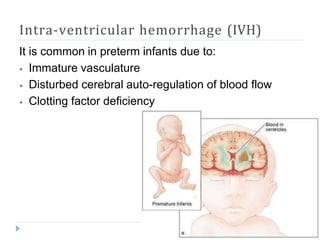
Intra-ventricular hemorrhage (IVH)
It is common in preterm infants due to:
⦁ Immature vasculature
⦁ Disturbed cerebral auto-regulation of blood flow
⦁ Clotting factor deficiency
Liver immaturity
⦁ It results in prolonged physiological jaundice due to
immaturity of liver enzymes and there is increased
risk of kernicterus at relatively lower bilirubin level
Increased susceptibility to infections
⦁ It results from lack of the protective maternal
immunoglobulins (IgG), which are transferred across
the placenta during the last trimester
⦁ In addition to this, delicate surfaces of skin and
mucous membranes also predispose to infections
⦁ Insertion of IV cannula, endotracheal tubes,
nasogastric tubes also increase the risk of infections
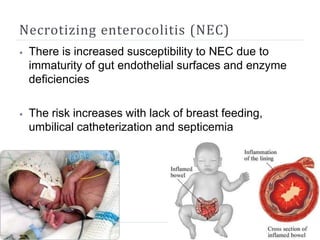
Necrotizing enterocolitis (NEC)
⦁ There is increased susceptibility to NEC due to
immaturity of gut endothelial surfaces and enzyme
deficiencies
⦁ The risk increases with lack of breast feeding,
umbilical catheterization and septicemia
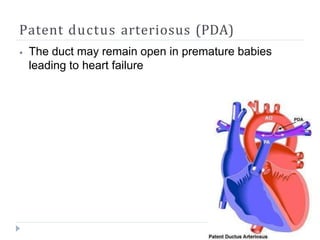
Patent ductus arteriosus (PDA)
⦁ The duct may remain open in premature babies
leading to heart failure
Feeding problems
⦁ These result from uncoordinated sucking and
swallowing and also from gastro-esophageal reflux
leading to frequent aspirations
Anemia of prematurity
⦁ Anemia occurs due to decreased iron stores, vitamin
E deficiency and exaggerated physiological anemia
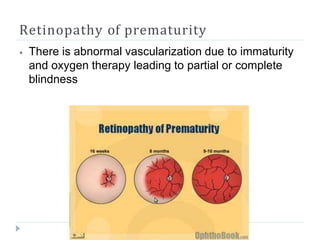
Retinopathy of prematurity
⦁ There is abnormal vascularization due to immaturity
and oxygen therapy leading to partial or complete
blindness
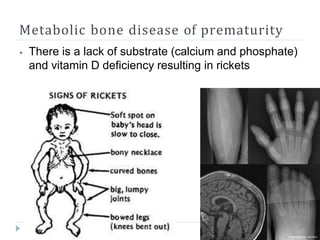
Metabolic bone disease of prematurity
⦁ There is a lack of substrate (calcium and phosphate)
and vitamin D deficiency resulting in rickets
Long term problems
⦁ Chronic lung disease (bronchopulmonary dysplasia)
⦁ Poor growth
⦁ CNS dysfunctions
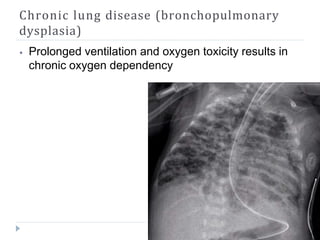
Chronic lung disease (bronchopulmonary
dysplasia)
⦁ Prolonged ventilation and oxygen toxicity results in
chronic oxygen dependency
Poor growth
⦁ Growth is restricted due to feeding problems, vitamin
and iron deficiency
CNS dysfunctions
⦁ Cerebral palsy due to intraventricular hemorrhage
⦁ Post hemorrhagic hydrocephalus
⦁ Learning problems
⦁ Deafness
⦁ Mental subnormality
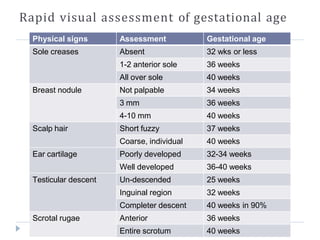
Assessment of gestational age
⦁ Gestational age can be assessed appropriately in
weeks by simple visual assessment of certain
physical signs and more accurately by using Ballard
scoring system
Physical signs Assessment Gestational age
Sole creases Absent 32 wks or less
1-2 anterior sole 36 weeks
All over sole 40 weeks
Breast nodule Not palpable 34 weeks
3 mm 36 weeks
4-10 mm 40 weeks
Scalp hair Short fuzzy 37 weeks
Coarse, individual 40 weeks
Ear cartilage Poorly developed 32-34 weeks
Well developed 36-40 weeks
Testicular descent Un-descended 25 weeks
Inguinal region 32 weeks
Completer descent 40 weeks in 90%
Scrotal rugae Anterior 36 weeks
Entire scrotum 40 weeks
Rapid visual assessment of gestational age
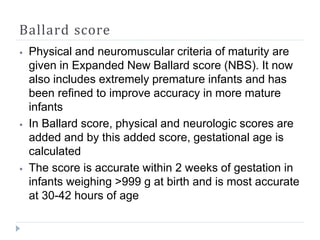
Ballard score
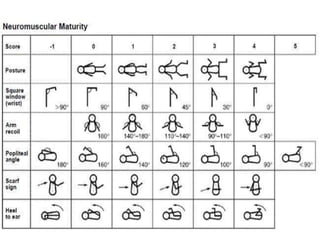
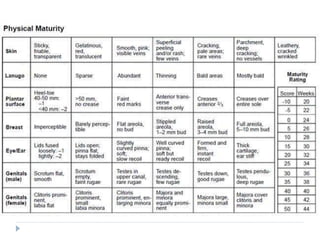
⦁ Physical and neuromuscular criteria of maturity are
given in Expanded New Ballard score (NBS). It now
also includes extremely premature infants and has
been refined to improve accuracy in more mature
infants
⦁ In Ballard score, physical and neurologic scores are
added and by this added score, gestational age is
calculated
⦁ The score is accurate within 2 weeks of gestation in
infants weighing >999 g at birth and is most accurate
at 30-42 hours of age
Management
⦁ The management of preterm baby is based upon the
proper anticipation and prevention of complications
Delivery room care
⦁ Every preterm delivery should be attended by a
pediatrician
⦁ Proper resuscitation at birth, early stabilization of
vital signs, prevention of hypothermia and
hypoglycemia in delivery room is related with good
outcomes with minimal complications
⦁ If baby is of good size and vigorous, then by simply
cleaning airways, wrap the baby properly and shift
to well baby nursery with instructions of early
feeding and monitoring for hypoglycemia and
hypothermia
⦁ If baby weight is very low < 1kg, then electively
incubate the baby and shift to NICU for ventilator
care
⦁ Babies weighing 1-1.5kg should also be shifted to
NICU for observation and management of potential
problems
After birth care
⦁ Maintain thermo-neutral environment
⦁ Maintenance of fluid and electrolyte balance
⦁ Oxygen administration
⦁ Feeding
⦁ Supplementation of iron and vitamins
⦁ Protection from infection
⦁ Early detection and management of complications of
prematurity
⦁ Immaturity of drug metabolism
Maintain thermo-neutral environment
⦁ It is environmental temperature at which heat
production and O2 consumption is minimal yet the
core temperature is maintained within normal range
⦁ Maintain temperature of nursery in range of 25-
30°C
⦁ Place the baby in incubator, keep humidity at 70%
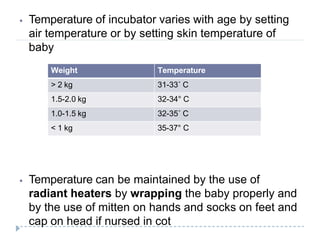
⦁ Temperature of incubator varies with age by setting
air temperature or by setting skin temperature of
baby
⦁ Temperature can be maintained by the use of
radiant heaters by wrapping the baby properly and
by the use of mitten on hands and socks on feet and
cap on head if nursed in cot
Weight Temperature
> 2 kg 31-33˚ C
1.5-2.0 kg 32-34° C
1.0-1.5 kg 32-35˚ C
< 1 kg 35-37° C
Maintenance of fluid and
electrolyte balance
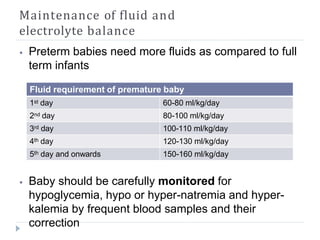
⦁ Preterm babies need more fluids as compared to full
term infants
⦁ Baby should be carefully monitored for
hypoglycemia, hypo or hyper-natremia and hyper-
kalemia by frequent blood samples and their
correction
Fluid requirement of premature baby
1st day 60-80 ml/kg/day
2nd day 80-100 ml/kg/day
3rd day 100-110 ml/kg/day
4th day 120-130 ml/kg/day
5th day and onwards 150-160 ml/kg/day
Oxygen administration
⦁ O2 administration should be carefully monitored in a
very premature infant because concentration of O2
more than 40% increases the risk of lung and visual
toxicity (bronchopulmonary dysplasia and retrolental
fibroplasia)
Feeding
⦁ The method of feeding should be individualized as it
varies with weight and gestational age of infant
⦁ The process of oral feeding in addition to sucking
requires coordination of swallowing, epiglottic
closure of larynx, normal esophageal motility, a
synchronized process which is usually absent prior
to 34 weeks of gestation
⦁ If the infant is more than 35 wk gestation, weighing
> 2kg and there is no contraindication of feeding like
persistent vomiting, RDS, sepsis, seizures etc; he
should be started on oral feeding preferably by
breast milk or infant formula with bottle or cup and
spoon
⦁ If baby cannot suck and general condition is better,
tube feeding is preferred
⦁ If very sick or premature, then total or partial
parenteral nutrition is the choice
Supplementation of iron and vitamins
⦁ Every preterm infant should receive supplement
vitamins in addition to breast milk until full mixed
feeding is established or weight is more than 2250
gm
⦁ All preterm babies should receive vitamin K
prophylaxis 1 mg at birth
⦁ Requirement of vitamin A, D, B6 and C is fulfilled by
simply prescribing 0.6ml Vidaylin drops per oral
⦁ Iron supplementation should be started at the age
of 4-8 weeks at dose of 2mg/kg/day
⦁ Before this age it is not well absorbed and also
increases the risk of gastrointestinal infection and
also predisposes to vitamin E deficient hemolysis
Protection from infection
⦁ Proper antiseptic measures should be taken in
maintenance of nursery, incubator and other
equipment and in addition proper hand washing,
cleansing of preterm baby, proper cord care are very
important
⦁ All procedures in nursery should be done with strict
aseptic measures
Early detection and management of
complications of prematurity
⦁ It can be done by good nursery care, monitoring of
heart rate, respiratory rate, temperature, blood
pressure, activity, daily weight and intake and output
record
⦁ Oxygen saturation monitoring is very important in
care of preterm babies
Immaturity of drug metabolism
⦁ Due to renal and hepatic immaturity and diminished
renal and hepatic clearance of almost all drugs,
intervals between doses should be extended
Prognosis
⦁ It is related to gestation and birth weight
⦁ With new advancement in neonatal intensive care in
developed countries, the survival rate for 24 wk
gestation is 25%. But still there is marked disability in
survivors
⦁ 5-10% of babies with birth weight less than 1500 gm
have major handicap such as cerebral palsy,
developmental delay, blindness or deafness
⦁ Risk increases with decreasing gestational age and
weight
Discharge criteria for preterm
⦁ A premature infant should be taking feed by nipple
(either bottle or breast feed)
⦁ Baby should be gaining weight properly (10-30
g/day)
⦁ Temperature should be stabilized in an open cot
⦁ There should be no recent episode of apnea or
bradycardia
⦁ There should be no parenteral drug administration, it
may be converted to oral dosing
Thank you

Prematurity by jawad

  • 1.
  • 2.
    Introduction ⦁ Definition ⦁ Incidence ⦁Appropriate birth weight at different gestational ages ⦁ Etiology
  • 3.
    Definition ⦁ It isdefined as live born infant delivered before 37 weeks from the first day of the last menstrual period.
  • 4.
    Incidence ⦁ The exactincidence in Pakistan is not known. ⦁ Estimated 11-13% ⦁ It includes both small for gestational age (SGA) and appropriate for gestational age (AGA)
  • 5.
    Appropriate birth weightat different gestational ages Gestational age Mean birth weight 24 weeks 600 g 25 weeks 750 g 26 weeks 850 g 28 weeks 1000 g 30 weeks 1400 g 32 weeks 1750 g 34 weeks 2000 g 36 weeks 2500 g 38 weeks 3000 g 40 weeks 3500 g
  • 6.
    Etiology ⦁ Maternal causes ⦁Uterine causes ⦁ Fetal causes ⦁ Others
  • 7.
    Maternal causes ⦁ Malnutritionand anemia ⦁ Teenage pregnancy or multi-parity ⦁ Twin pregnancy ⦁ Pre eclmapsia ⦁ Chronic illness (diabetes, renal disease, heart disease, hypertension) ⦁ Infection (malaria, UTI, chorioamnionitis) ⦁ Lower socioeconomic status ⦁ Smoking or drug abuse ⦁ Illegitimate birth
  • 8.
    Uterine causes ⦁ Bicornuateuterus ⦁ Incompetent cervix (premature dilation) ⦁ Placenta previa, abruptio placentae, placental dysfunction
  • 9.
    Fetal causes ⦁ Fetaldistress ⦁ Multiple gestation ⦁ Chromosomal disorders (down’s syndrome) ⦁ Intrauterine infections (syphilis, TORCH) ⦁ Erythroblastosis, non immune hydrops
  • 10.
    Others ⦁ Polyhydramnios ⦁ Trauma ⦁Premature rupture of membranes ⦁ Iatrogenic
  • 11.
  • 12.
    Immediate (acute) problems 1.Hypothermia 2. Hypoglycemia 3. Hypocalcemia 4. Respiratory difficulties 5. Intra-ventricular hemorrhage (IVH) 6. Liver immaturity 7. Increased susceptibility to infections 8. Necrotizing enterocolitis (NEC) 9. Patent ductus arteriosus 10. Feeding problems 11. Anemia of prematurity 12. Retinopathy of prematurity 13. Metabolic bone diseases of prematurity
  • 13.
    Hypothermia It occurs inpreterm babies due to: ⦁ High surface area to body weight ratio ⦁ Little subcutaneous fat ⦁ Muscular inactivity ⦁ Inadequate sweating mechanism ⦁ Decreased brown fat ⦁ Immature heat regulation mechanism
  • 14.
    Hypoglycemia ⦁ It iscommon due to lack f glycogen stores and immature hepatic and autonomic responses
  • 15.
    Hypocalcemia ⦁ Early hypocalcemiaoccurs due to immaturity of hormonal control system
  • 16.
    Respiratory difficulties ⦁ Hyalinemembrane disease due to surfactant deficiency leading to IRDS ⦁ Apneic spells: the immaturity of respiratory centre may lead to periodic breathing and frequent apneic apells
  • 17.
    Intra-ventricular hemorrhage (IVH) Itis common in preterm infants due to: ⦁ Immature vasculature ⦁ Disturbed cerebral auto-regulation of blood flow ⦁ Clotting factor deficiency
  • 18.
    Liver immaturity ⦁ Itresults in prolonged physiological jaundice due to immaturity of liver enzymes and there is increased risk of kernicterus at relatively lower bilirubin level
  • 19.
    Increased susceptibility toinfections ⦁ It results from lack of the protective maternal immunoglobulins (IgG), which are transferred across the placenta during the last trimester ⦁ In addition to this, delicate surfaces of skin and mucous membranes also predispose to infections ⦁ Insertion of IV cannula, endotracheal tubes, nasogastric tubes also increase the risk of infections
  • 20.
    Necrotizing enterocolitis (NEC) ⦁There is increased susceptibility to NEC due to immaturity of gut endothelial surfaces and enzyme deficiencies ⦁ The risk increases with lack of breast feeding, umbilical catheterization and septicemia
  • 21.
    Patent ductus arteriosus(PDA) ⦁ The duct may remain open in premature babies leading to heart failure
  • 22.
    Feeding problems ⦁ Theseresult from uncoordinated sucking and swallowing and also from gastro-esophageal reflux leading to frequent aspirations
  • 23.
    Anemia of prematurity ⦁Anemia occurs due to decreased iron stores, vitamin E deficiency and exaggerated physiological anemia
  • 24.
    Retinopathy of prematurity ⦁There is abnormal vascularization due to immaturity and oxygen therapy leading to partial or complete blindness
  • 25.
    Metabolic bone diseaseof prematurity ⦁ There is a lack of substrate (calcium and phosphate) and vitamin D deficiency resulting in rickets
  • 26.
    Long term problems ⦁Chronic lung disease (bronchopulmonary dysplasia) ⦁ Poor growth ⦁ CNS dysfunctions
  • 27.
    Chronic lung disease(bronchopulmonary dysplasia) ⦁ Prolonged ventilation and oxygen toxicity results in chronic oxygen dependency
  • 28.
    Poor growth ⦁ Growthis restricted due to feeding problems, vitamin and iron deficiency
  • 29.
    CNS dysfunctions ⦁ Cerebralpalsy due to intraventricular hemorrhage ⦁ Post hemorrhagic hydrocephalus ⦁ Learning problems ⦁ Deafness ⦁ Mental subnormality
  • 30.
    Assessment of gestationalage ⦁ Gestational age can be assessed appropriately in weeks by simple visual assessment of certain physical signs and more accurately by using Ballard scoring system
  • 31.
    Physical signs AssessmentGestational age Sole creases Absent 32 wks or less 1-2 anterior sole 36 weeks All over sole 40 weeks Breast nodule Not palpable 34 weeks 3 mm 36 weeks 4-10 mm 40 weeks Scalp hair Short fuzzy 37 weeks Coarse, individual 40 weeks Ear cartilage Poorly developed 32-34 weeks Well developed 36-40 weeks Testicular descent Un-descended 25 weeks Inguinal region 32 weeks Completer descent 40 weeks in 90% Scrotal rugae Anterior 36 weeks Entire scrotum 40 weeks Rapid visual assessment of gestational age
  • 32.
    Ballard score ⦁ Physicaland neuromuscular criteria of maturity are given in Expanded New Ballard score (NBS). It now also includes extremely premature infants and has been refined to improve accuracy in more mature infants ⦁ In Ballard score, physical and neurologic scores are added and by this added score, gestational age is calculated ⦁ The score is accurate within 2 weeks of gestation in infants weighing >999 g at birth and is most accurate at 30-42 hours of age
  • 35.
    Management ⦁ The managementof preterm baby is based upon the proper anticipation and prevention of complications
  • 36.
    Delivery room care ⦁Every preterm delivery should be attended by a pediatrician ⦁ Proper resuscitation at birth, early stabilization of vital signs, prevention of hypothermia and hypoglycemia in delivery room is related with good outcomes with minimal complications
  • 37.
    ⦁ If babyis of good size and vigorous, then by simply cleaning airways, wrap the baby properly and shift to well baby nursery with instructions of early feeding and monitoring for hypoglycemia and hypothermia ⦁ If baby weight is very low < 1kg, then electively incubate the baby and shift to NICU for ventilator care ⦁ Babies weighing 1-1.5kg should also be shifted to NICU for observation and management of potential problems
  • 38.
    After birth care ⦁Maintain thermo-neutral environment ⦁ Maintenance of fluid and electrolyte balance ⦁ Oxygen administration ⦁ Feeding ⦁ Supplementation of iron and vitamins ⦁ Protection from infection ⦁ Early detection and management of complications of prematurity ⦁ Immaturity of drug metabolism
  • 39.
    Maintain thermo-neutral environment ⦁It is environmental temperature at which heat production and O2 consumption is minimal yet the core temperature is maintained within normal range ⦁ Maintain temperature of nursery in range of 25- 30°C ⦁ Place the baby in incubator, keep humidity at 70%
  • 40.
    ⦁ Temperature ofincubator varies with age by setting air temperature or by setting skin temperature of baby ⦁ Temperature can be maintained by the use of radiant heaters by wrapping the baby properly and by the use of mitten on hands and socks on feet and cap on head if nursed in cot Weight Temperature > 2 kg 31-33˚ C 1.5-2.0 kg 32-34° C 1.0-1.5 kg 32-35˚ C < 1 kg 35-37° C
  • 41.
    Maintenance of fluidand electrolyte balance ⦁ Preterm babies need more fluids as compared to full term infants ⦁ Baby should be carefully monitored for hypoglycemia, hypo or hyper-natremia and hyper- kalemia by frequent blood samples and their correction Fluid requirement of premature baby 1st day 60-80 ml/kg/day 2nd day 80-100 ml/kg/day 3rd day 100-110 ml/kg/day 4th day 120-130 ml/kg/day 5th day and onwards 150-160 ml/kg/day
  • 42.
    Oxygen administration ⦁ O2administration should be carefully monitored in a very premature infant because concentration of O2 more than 40% increases the risk of lung and visual toxicity (bronchopulmonary dysplasia and retrolental fibroplasia)
  • 43.
    Feeding ⦁ The methodof feeding should be individualized as it varies with weight and gestational age of infant ⦁ The process of oral feeding in addition to sucking requires coordination of swallowing, epiglottic closure of larynx, normal esophageal motility, a synchronized process which is usually absent prior to 34 weeks of gestation
  • 44.
    ⦁ If theinfant is more than 35 wk gestation, weighing > 2kg and there is no contraindication of feeding like persistent vomiting, RDS, sepsis, seizures etc; he should be started on oral feeding preferably by breast milk or infant formula with bottle or cup and spoon ⦁ If baby cannot suck and general condition is better, tube feeding is preferred ⦁ If very sick or premature, then total or partial parenteral nutrition is the choice
  • 45.
    Supplementation of ironand vitamins ⦁ Every preterm infant should receive supplement vitamins in addition to breast milk until full mixed feeding is established or weight is more than 2250 gm ⦁ All preterm babies should receive vitamin K prophylaxis 1 mg at birth ⦁ Requirement of vitamin A, D, B6 and C is fulfilled by simply prescribing 0.6ml Vidaylin drops per oral
  • 46.
    ⦁ Iron supplementationshould be started at the age of 4-8 weeks at dose of 2mg/kg/day ⦁ Before this age it is not well absorbed and also increases the risk of gastrointestinal infection and also predisposes to vitamin E deficient hemolysis
  • 47.
    Protection from infection ⦁Proper antiseptic measures should be taken in maintenance of nursery, incubator and other equipment and in addition proper hand washing, cleansing of preterm baby, proper cord care are very important ⦁ All procedures in nursery should be done with strict aseptic measures
  • 48.
    Early detection andmanagement of complications of prematurity ⦁ It can be done by good nursery care, monitoring of heart rate, respiratory rate, temperature, blood pressure, activity, daily weight and intake and output record ⦁ Oxygen saturation monitoring is very important in care of preterm babies
  • 49.
    Immaturity of drugmetabolism ⦁ Due to renal and hepatic immaturity and diminished renal and hepatic clearance of almost all drugs, intervals between doses should be extended
  • 50.
    Prognosis ⦁ It isrelated to gestation and birth weight ⦁ With new advancement in neonatal intensive care in developed countries, the survival rate for 24 wk gestation is 25%. But still there is marked disability in survivors ⦁ 5-10% of babies with birth weight less than 1500 gm have major handicap such as cerebral palsy, developmental delay, blindness or deafness ⦁ Risk increases with decreasing gestational age and weight
  • 51.
    Discharge criteria forpreterm ⦁ A premature infant should be taking feed by nipple (either bottle or breast feed) ⦁ Baby should be gaining weight properly (10-30 g/day) ⦁ Temperature should be stabilized in an open cot ⦁ There should be no recent episode of apnea or bradycardia ⦁ There should be no parenteral drug administration, it may be converted to oral dosing
  • 52.