Inquiry, Teaching & Technology S. Raj Chaudhury Christopher Newport University Newport News, Virginia, USA [email_address]
Outline Parable – “Fish is Fish” Convergence of idea frameworks Design of Learning Environments Network technologies for assessment Supporting Multiple Representations Knowledge Integration Framework GroupScribbles - an evolution
“ Fish is Fish” by  Leo Lionni A parable for how people learn
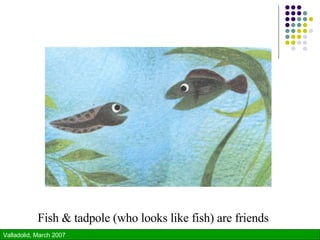
Fish & tadpole (who looks like fish) are friends
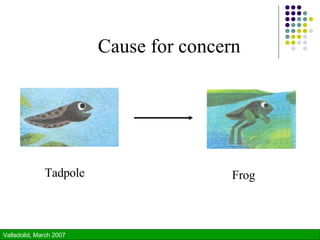
Tadpole Frog Cause for concern
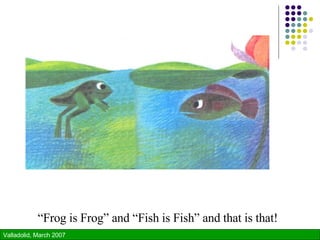
“ Frog is Frog” and “Fish is Fish” and that is that!
the frog leaves the pond  and is gone for a while…
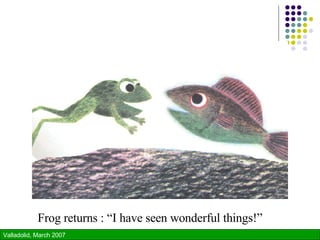
Frog returns : “I have seen wonderful things!”
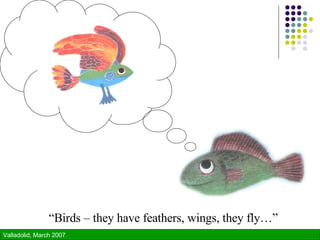
“ Birds – they have feathers, wings, they fly…”
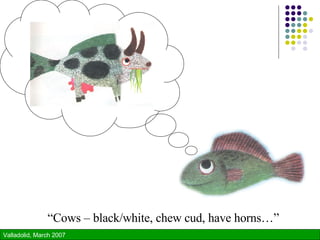
“ Cows – black/white, chew cud, have horns…”
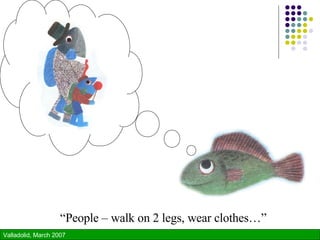
“ People – walk on 2 legs, wear clothes…”
Fish took a test Which of the following best describes a  cow ? A creature that has wings, covered with feathers and can fly A creature that walks upright on 2 feet and wears clothes A creature that has black and white markings, has horns and chews cud
View inside students’ mind Do you know what picture they are building from your teaching? Formative assessment is necessary Innovative ways of representation Technology can help…
Finally… One day, the fish was curious about life on the land He jumped to the shore but then he could not breathe… Luckily, his friend the frog came by and put him back in the water Frog: “What are you doing? You will die on land - fish is fish and you must stay in the water!”
Lesson to be learned Sometimes we want ‘hands-on’/direct experience but it is simply not possible Technology can play a big part in providing an experience where reality can not
Convergence… “ How People Learn”  (Bransford et. al., NRC) Framework : Learner, Knowledge, Assessment & Community centered Principle of  Constructivism Students build their knowledge by  processing the information  they receive –  making connections  between  what they know  and  what they are learning Technology Design of Learning Environment, Assessment…
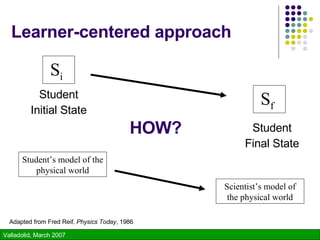
Learner-centered approach S i   S f   Student Initial State Student Final State Student’s model of the physical world Scientist’s model of the physical world HOW? Adapted from Fred Reif,  Physics Today , 1986
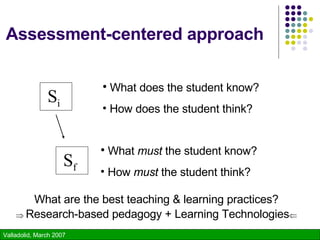
Assessment-centered approach   What are the best teaching & learning practices?    Research-based pedagogy + Learning Technologies  S i   S f   What does the student know? How does the student think? What  must  the student know? How  must  the student think?
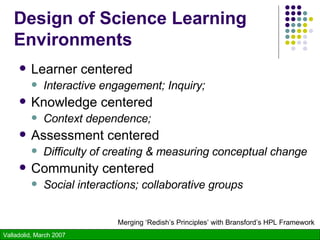
Design of Science Learning  Environments Learner centered Interactive engagement; Inquiry; Knowledge centered Context dependence;   Assessment centered Difficulty of creating & measuring conceptual change Community centered Social interactions; collaborative groups Merging ‘Redish’s Principles’ with Bransford’s HPL Framework
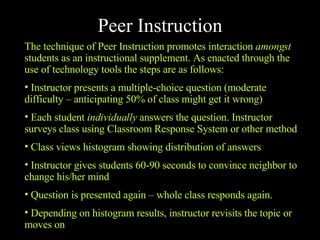
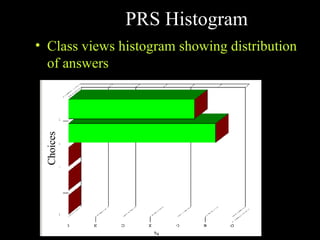
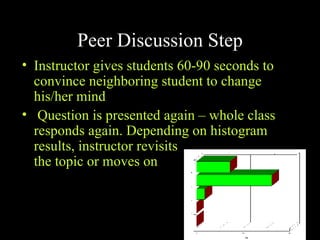
Peer Instruction The technique of Peer Instruction promotes interaction  amongst  students as an instructional supplement. As enacted through the use of technology tools the steps are as follows: Instructor presents a multiple-choice question (moderate difficulty – anticipating 50% of class might get it wrong) Each student  individually  answers the question. Instructor surveys class using Classroom Response System or other method Class views histogram showing distribution of answers Instructor gives students 60-90 seconds to convince neighbor to change his/her mind Question is presented again – whole class responds again. Depending on histogram results, instructor revisits the topic or moves on
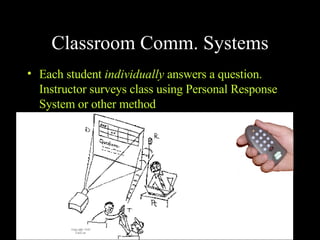
Classroom Comm. Systems Each student  individually  answers a question. Instructor surveys class using Personal Response System or other method Student transmitter IR Receiver + Cables Software
Q1. People think of lots of different ways of losing weight. Which of the following would make you weigh half as much as you do right now? Take away half of the Earth’s atmosphere. Double the distance between the Sun and the Earth. Make the Earth spin half as fast. Take away half of the Earth’s mass. More than one of the above
PRS Histogram Class views histogram showing distribution of answers Choices
Peer Discussion Step Instructor gives students 60-90 seconds to convince neighboring student to change his/her mind Question is presented again – whole class responds again. Depending on histogram  results, instructor revisits  the topic or moves on
Whole class shared display Topology N students : 1 instructor
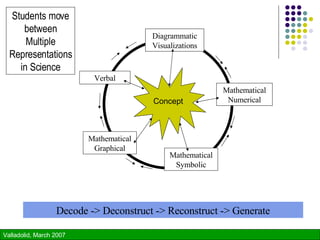
Verbal Diagrammatic Visualizations Mathematical Numerical Mathematical Symbolic Students move between Multiple Representations in Science Decode -> Deconstruct -> Reconstruct -> Generate Concept Mathematical Graphical
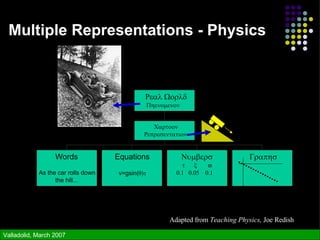
Multiple Representations - Physics Adapted from  Teaching Physics,  Joe Redish
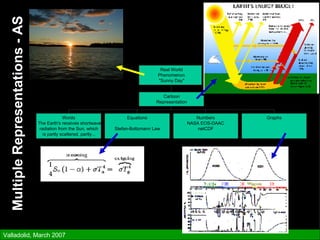
Multiple Representations - AS
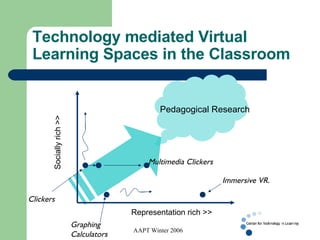
Technology mediated Virtual Learning Spaces in the Classroom Representation rich >> Socially rich >> Clickers Graphing Calculators Multimedia Clickers Pedagogical Research Immersive VR.
So what ELSE does a learning environment look like? GroupScribbles TELS Projects
TELS for Inquiry + Science TELS = Technology Enhanced Learning of Science Research Center ($10,000,000 for 5 years) University of California + Concord Consortium 5 other University Partners + Secondary Schools Science for grades 6-12 Topics in Physics, Chemistry, Biology Uses the Web-based Inquiry in Science Environment (WISE)
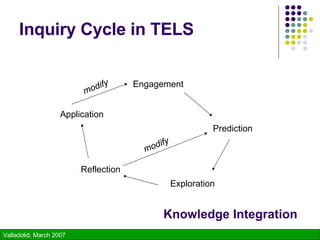
Inquiry Cycle in TELS Engagement Prediction Exploration Reflection modify Application modify Knowledge Integration
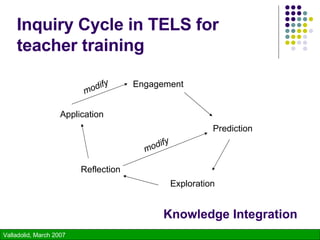
Inquiry Cycle in TELS for teacher training Engagement Prediction Exploration Reflection modify Application modify Knowledge Integration
Thermodynamics “Probing your surroundings” Look briefly at the structure and the use of computational models (simulations)
What if ‘clickers’ are not enough? GroupScribbles Electronic Post-It notes Shareable via Virtual Whiteboard Private/Public areas Exchange of ideas, sorting of ideas Supports Multiple Representations So…what does it look like?

presntacionRaj

  • 1.
    Inquiry, Teaching &Technology S. Raj Chaudhury Christopher Newport University Newport News, Virginia, USA [email_address]
  • 2.
    Outline Parable –“Fish is Fish” Convergence of idea frameworks Design of Learning Environments Network technologies for assessment Supporting Multiple Representations Knowledge Integration Framework GroupScribbles - an evolution
  • 3.
    “ Fish isFish” by Leo Lionni A parable for how people learn
  • 4.
    Fish & tadpole(who looks like fish) are friends
  • 5.
    Tadpole Frog Causefor concern
  • 6.
    “ Frog isFrog” and “Fish is Fish” and that is that!
  • 7.
    the frog leavesthe pond and is gone for a while…
  • 8.
    Frog returns :“I have seen wonderful things!”
  • 9.
    “ Birds –they have feathers, wings, they fly…”
  • 10.
    “ Cows –black/white, chew cud, have horns…”
  • 11.
    “ People –walk on 2 legs, wear clothes…”
  • 12.
    Fish took atest Which of the following best describes a cow ? A creature that has wings, covered with feathers and can fly A creature that walks upright on 2 feet and wears clothes A creature that has black and white markings, has horns and chews cud
  • 13.
    View inside students’mind Do you know what picture they are building from your teaching? Formative assessment is necessary Innovative ways of representation Technology can help…
  • 14.
    Finally… One day,the fish was curious about life on the land He jumped to the shore but then he could not breathe… Luckily, his friend the frog came by and put him back in the water Frog: “What are you doing? You will die on land - fish is fish and you must stay in the water!”
  • 15.
    Lesson to belearned Sometimes we want ‘hands-on’/direct experience but it is simply not possible Technology can play a big part in providing an experience where reality can not
  • 16.
    Convergence… “ HowPeople Learn” (Bransford et. al., NRC) Framework : Learner, Knowledge, Assessment & Community centered Principle of Constructivism Students build their knowledge by processing the information they receive – making connections between what they know and what they are learning Technology Design of Learning Environment, Assessment…
  • 17.
    Learner-centered approach Si S f Student Initial State Student Final State Student’s model of the physical world Scientist’s model of the physical world HOW? Adapted from Fred Reif, Physics Today , 1986
  • 18.
    Assessment-centered approach What are the best teaching & learning practices?  Research-based pedagogy + Learning Technologies  S i S f What does the student know? How does the student think? What must the student know? How must the student think?
  • 19.
    Design of ScienceLearning Environments Learner centered Interactive engagement; Inquiry; Knowledge centered Context dependence; Assessment centered Difficulty of creating & measuring conceptual change Community centered Social interactions; collaborative groups Merging ‘Redish’s Principles’ with Bransford’s HPL Framework
  • 20.
    Peer Instruction Thetechnique of Peer Instruction promotes interaction amongst students as an instructional supplement. As enacted through the use of technology tools the steps are as follows: Instructor presents a multiple-choice question (moderate difficulty – anticipating 50% of class might get it wrong) Each student individually answers the question. Instructor surveys class using Classroom Response System or other method Class views histogram showing distribution of answers Instructor gives students 60-90 seconds to convince neighbor to change his/her mind Question is presented again – whole class responds again. Depending on histogram results, instructor revisits the topic or moves on
  • 21.
    Classroom Comm. SystemsEach student individually answers a question. Instructor surveys class using Personal Response System or other method Student transmitter IR Receiver + Cables Software
  • 22.
    Q1. People thinkof lots of different ways of losing weight. Which of the following would make you weigh half as much as you do right now? Take away half of the Earth’s atmosphere. Double the distance between the Sun and the Earth. Make the Earth spin half as fast. Take away half of the Earth’s mass. More than one of the above
  • 23.
    PRS Histogram Classviews histogram showing distribution of answers Choices
  • 24.
    Peer Discussion StepInstructor gives students 60-90 seconds to convince neighboring student to change his/her mind Question is presented again – whole class responds again. Depending on histogram results, instructor revisits the topic or moves on
  • 25.
    Whole class shareddisplay Topology N students : 1 instructor
  • 26.
    Verbal Diagrammatic VisualizationsMathematical Numerical Mathematical Symbolic Students move between Multiple Representations in Science Decode -> Deconstruct -> Reconstruct -> Generate Concept Mathematical Graphical
  • 27.
    Multiple Representations -Physics Adapted from Teaching Physics, Joe Redish
  • 28.
  • 29.
    Technology mediated VirtualLearning Spaces in the Classroom Representation rich >> Socially rich >> Clickers Graphing Calculators Multimedia Clickers Pedagogical Research Immersive VR.
  • 30.
    So what ELSEdoes a learning environment look like? GroupScribbles TELS Projects
  • 31.
    TELS for Inquiry+ Science TELS = Technology Enhanced Learning of Science Research Center ($10,000,000 for 5 years) University of California + Concord Consortium 5 other University Partners + Secondary Schools Science for grades 6-12 Topics in Physics, Chemistry, Biology Uses the Web-based Inquiry in Science Environment (WISE)
  • 32.
    Inquiry Cycle inTELS Engagement Prediction Exploration Reflection modify Application modify Knowledge Integration
  • 33.
    Inquiry Cycle inTELS for teacher training Engagement Prediction Exploration Reflection modify Application modify Knowledge Integration
  • 34.
    Thermodynamics “Probing yoursurroundings” Look briefly at the structure and the use of computational models (simulations)
  • 35.
    What if ‘clickers’are not enough? GroupScribbles Electronic Post-It notes Shareable via Virtual Whiteboard Private/Public areas Exchange of ideas, sorting of ideas Supports Multiple Representations So…what does it look like?