Theory of
Basic
Structure
JONIKA LAMBA
ROLL NO. 201090880054
Presentation Outline
I. Introduction
II. Evolution of Basic Structure Theory
III.Contents of the basic structure of Constitution
IV. Supreme Court Judgements in Famous Case Laws in Brief
V. Conclusion
Introduction
The constitution of India is considered to be the ‘General Will’ of the people of India. It is a document of immense
importance.
It is not only is the basic law of the land but the living organic by which the other laws are to be created as per the
requirement of the nation.
The life of a nation is dynamic, living, and organic its political, social and economic conditions are always subject
to change.
Therefore, a constitution drafted in one era and in a particular circumstance may be found to be inadequate in
another era in a different context.
It becomes necessary therefore to have machinery or some process by which the constitution may be adopted from
time to time as per the contemporary needs of the nation. Such changes may be brought by different ways
including formal method of amendment contained in Article 368 of the constitution. Article 368 of the constitution
does not prescribe any express limitation upon the parliament’s amending power.
Introduction
The constitution, though expressly confers amending powers on the parliament, but it is the Supreme Court which
is to finally interpret the scope of such power and to spell out the limitations, if any, on such amending power.
This battle between the parliament and judiciary gave birth to one of the important doctrine a limitation on
parliaments amending power which is known as the doctrine of Basic Structure.
This doctrine was evolved in the famous case of Kashvananda Bharti vs. State of Kerala A.I.R 1973 SC popularly
known as the Fundamental Rights case in which the court observed that article 368 of the Indian constitution did
not enable parliament to alter the ‘Basic Structure or Framework’
The basic structure doctrine is a judicial creation whereby certain features of the constitution of India are beyond
the limits of amending powers of parliament of the constitution. From then till very recently, this doctrine
continues to be the limitation upon the parliament’s power to amend the constitution, in spite of the fact that
Article368 is really silent as to the width of amending power.
Basic Structure of Constitution
The Constitution of India is a dynamic document which has been amended as per the needs
and requirements of the society. The doctrine of basic structure is just a judicial innovation
which ensures that the power of amendment is not being misused by Parliament. The
general idea behind this doctrine is that the basic features of the Constitution of India
should not be altered to such an extent that the true identity of the Constitution gets lost in
the process. Certain governing rules are provided in the Indian Constitution, for the
Parliament. And any amendment cannot be made that changes these principles. The
doctrine has evolved over the years through various judgements, overruling, criticism and
many dissenting opinions.
BASIC STRUCTURE DOCTRINE
Amendments with case laws
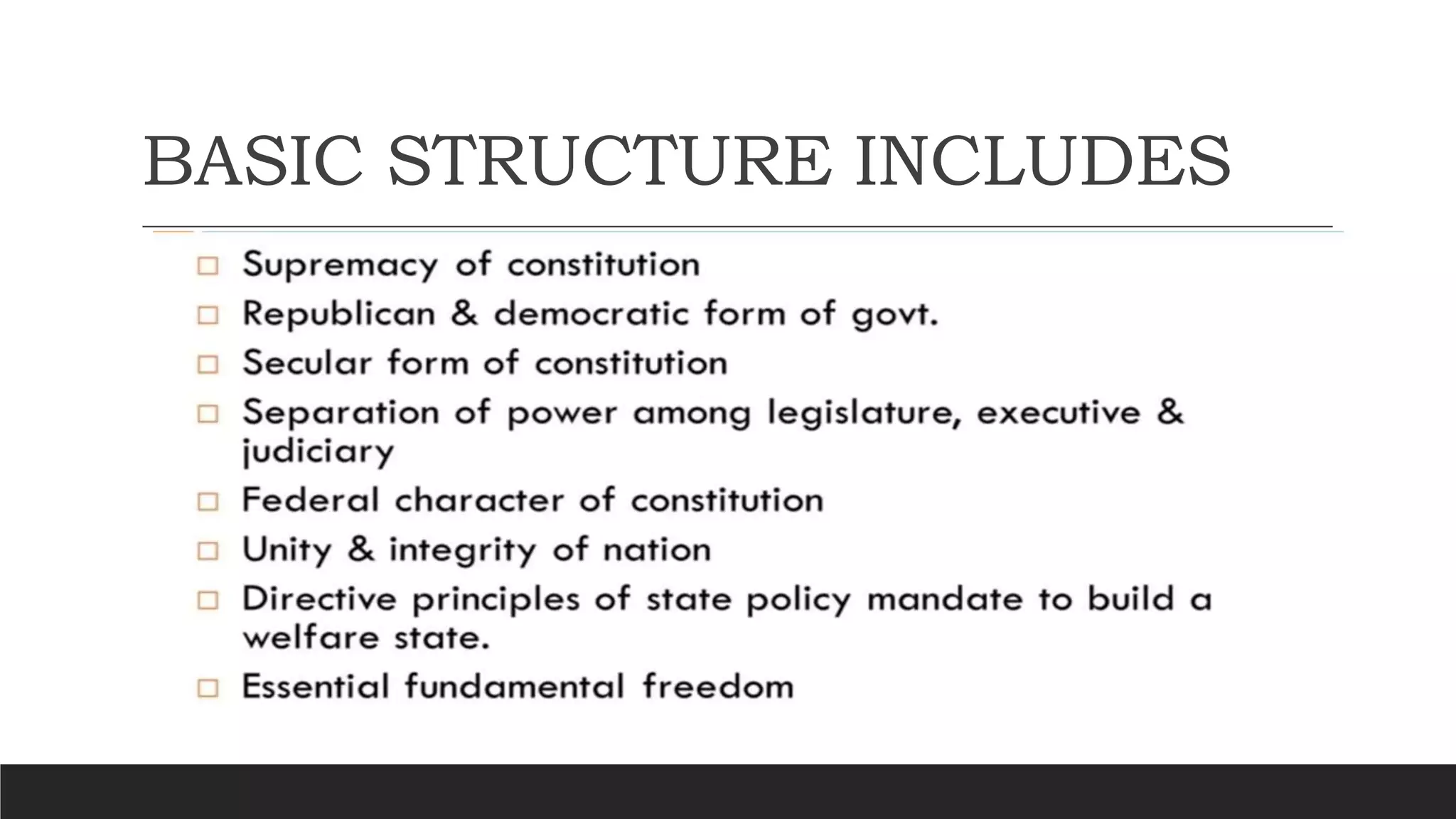
BASIC STRUCTURE INCLUDES
Evolution of Basic Structure
Doctrine
Shankari Prasad Singh Deo v. Union of India (AIR. 1951 SC 458)
In this case, the Supreme Court in its unanimous judgement held that the terms mentioned in the article 368 are
perfectly general and they empower the Parliament to make amendments in the Constitution without any exception.
This also meant that, Article 368 also empowered the Parliament to amend the Fundamental Rights guaranteed under
Part III of the Constitution.
Sajjan Singh v. State of Rajasthan (AIR 845, 1965 SCR (1) 933)
The Constitutional validity of the 17th Constitutional Amendment which had added around 44 statutes to the 9th
Schedule, was challenged in this case. Hence the Supreme Court contended that, Article 368 gives the right to the
Parliament to amend the Constitution and this right can be exercised over all the provisions of the Constitution without
any exceptions. But the two dissenting judges, Justice Hidyatullah and Justice Mudholkar JJ, in this case, raised
questions on the unfettered power being provided to the Parliament to amend the Constitution and curtailing the
fundamental rights of the citizens. They asked whether the fundamental rights of the citizens can be considered as a
plaything of the majority party in Parliament.
Golaknath and Ors. vs State of
Punjab and Anrs. (AIR 1643; 1967
SCR (2) 762)
In these 11 judge-bench decisions, the Hon’ble Supreme Court with a 6:5 majority observed that the fundamental rights lie outside the
purview of the amendment of the Constitution.
Article 368 does not provide the power to the Parliament to amend the Constitution.
It has been clearly mentioned that Article 368 only provides the Procedure of Amendment.
Any amendment against the Fundamental Rights was, therefore, declared void.
The argument that the power to amend the Constitution is a sovereign power and it is above the legislative power.
Hence it lies outside the scope of judicial review and was thus rejected. However, the Court did not declare the 1st, 4th and 17th
amendment as invalid, implying that the Constitution cannot be amended further which would violate fundamental rights. Further the
apex court held that the amending power and the legislative powers of Parliament were quite equal. The majority bench held that the
Parliament cannot modify, restrict or impair the fundamental freedoms. The judges also observed that, if required, the Parliament can
summon a Constituent Assembly to amend the fundamental rights. Thus, according to the apex Court, the core features of the
Constitution require much more than the usual procedures to change them.
Constitution 24th Amendment
After the Golak Nath case the Parliament was devoid of its powers to amend the Constitution freely. Thus, to
re-establish its earlier position, the 24th Constitutional Amendment was brought forth. The Amendment Act
did not only restore its earlier position but extended the powers of Parliament.
New clause (4) was inserted to Article 13 which stated that ‘nothing in this Article shall apply to any
amendment of this Constitution made under Article 368’.
The heading of Article 368 was changed from ‘Procedure for amendment of the Constitution” to ‘Power of
Parliament to amend the Constitution and Procedure’.
An obligation was put on the President to give this assent to all the bills for amending the Constitution by
stating that, ‘it shall be presented to the President for his assent and upon such assent being given to the Bill’
from ‘it shall be presented to the President who shall give his assent to the Bill and thereupon’.
Kesavnanda Bharati Vs the State of
Kerala (Basic structure Doctrine
created)
This historic judgment was delivered by a 13-judge bench, with the majority ratio of 7:6. This case overruled the Golak
Nath case. In this case, it was held that the power to amend the Constitution lies with the Parliament and it extends to
all the Articles but there are restrictions to that. The amendments so done should not destroy certain basic features or
framework of the Constitution. However, the judges did not provide what constitutes the basic structure but they
provided an illustrative list of what may constitute the basic structure.
As per Sikri, C.J., the basic structure constitutes the:
The supremacy of the Constitution
Republican and Democratic forms of Government
Secular and Federal character of the Constitution
Separation of Powers between the legislature, the Executive, and the Judiciary
Kesavnanda Bharati Vs the State
of Kerala
Shelat and Grover, JJ., added:
Building a welfare state provided in the Directive Principles of State Policy
Maintenance of unity and integrity of India
The sovereignty of the country
Hegde and Mukherjee, JJ., further added:
The sovereignty and unity of India
The democratic character of the polity
BASIC STRUCTURE DOCTRINE
STRENGTHENED
Indira Nehru Gandhi V Raj Narain, 1975
Issue: To keep the election matter out of the purview of the
court.
Democracy is one of the basic feature of constitution. It includes
free and fair election.
BASIC STRUCTURE DOCTRINE
CYSTALIZED
Minerva Mills V. Union of India, 1980
Constitution is supreme. Parliamentary power of
amendment is not absolute. Unlimited amending power
of parliament was struck down.
S.R. Bommai vs Union of India, 1994
In this landmark judgement, the Supreme Court tried to cut down the
blatant misuse of Article 356 which provided the imposition of
President’s Rule on states. The basic structure doctrine was applied in this
case and the Supreme Court observed that any policy of a state
government which is directed against an element of the basic structure of
the Constitution can be considered as a valid ground for the exercise of
the central power under Article 356.
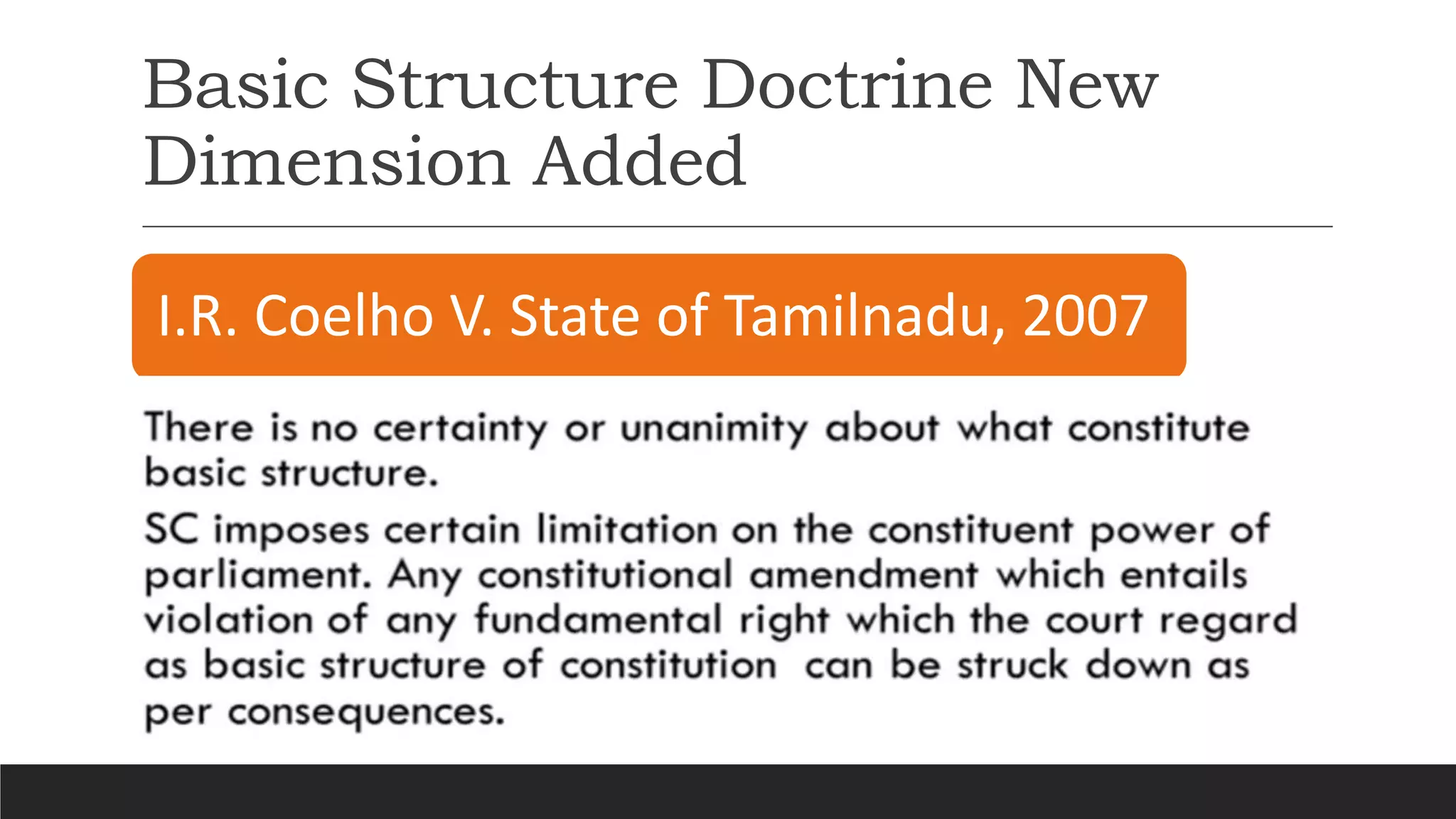
Basic Structure Doctrine New
Dimension Added
I.R. Coelho V. State of Tamilnadu, 2007
Important Supreme Court Decisions (In brief)
Case Decision by the Supreme Court
Shankari Prasad Vs. Union of India, 1951
The Parliament, under Article 368, has power to
amend any part of the constitution
Sajjan Singh Vs. State of Rajasthan, 1965
The Parliament, under Article 368, has power to
amend any part of the constitution
Golak Nath Vs. State of Punjab, 1967
The Parliament is not powered to amend the Part III
(Fundamental Rights) of the constitution
Kesavananda Bharti Vs. State of Kerala,1971
The Parliament can amend any provision, but can't
dilute the basic structure
Indira Gandhi Vs. Raj Narain, 1975
The Supreme Court reaffirmed its concept of basic
structure
Minerva Mills Vs. Union of India, 1980
The concept of basic structure was further developed by adding
'judicial review' and the 'balance between Fundamental Rights and
Directive Principles' to the basic features
Kihoto hollohan Vs. Zachillhu, 1992 'Free and fair elections' was added to the basic features
Indira Sawhney Vs. Union of India,
1992
'Rule of law, was added to the basic features
S.R Bommai vs Union of India, 1994
Federal structure, unity and integrity of India, secularism, socialism,
social justice and judicial review were reiterated as basic features
Important Supreme Court Decisions (In brief)
Conclusion
The basic structure doctrine helps to maintain the fine balance between flexibility and rigidity
present in the amending powers of the Constitution. Some of the core and essential features of
the Constitution which have been upheld in the judgements of the apex court include the
sovereign, democratic and secular character of the polity, the established rule of law, the
independence of the judiciary and the fundamental rights of citizens etc. Between the tussle in
Parliament and the judiciary, one thing that has become certain is that all the laws and
constitutional amendments are now subject to judicial review and any law which transgresses the
basic structure is likely to be struck down by the Supreme Court. The Parliament's power to
amend the Constitution isn’t absolute and therefore the Supreme Court is still considered as the
final interpreter of all constitutional amendments.

Theory of Basic Structure.pptx

  • 1.
  • 2.
    Presentation Outline I. Introduction II.Evolution of Basic Structure Theory III.Contents of the basic structure of Constitution IV. Supreme Court Judgements in Famous Case Laws in Brief V. Conclusion
  • 3.
    Introduction The constitution ofIndia is considered to be the ‘General Will’ of the people of India. It is a document of immense importance. It is not only is the basic law of the land but the living organic by which the other laws are to be created as per the requirement of the nation. The life of a nation is dynamic, living, and organic its political, social and economic conditions are always subject to change. Therefore, a constitution drafted in one era and in a particular circumstance may be found to be inadequate in another era in a different context. It becomes necessary therefore to have machinery or some process by which the constitution may be adopted from time to time as per the contemporary needs of the nation. Such changes may be brought by different ways including formal method of amendment contained in Article 368 of the constitution. Article 368 of the constitution does not prescribe any express limitation upon the parliament’s amending power.
  • 4.
    Introduction The constitution, thoughexpressly confers amending powers on the parliament, but it is the Supreme Court which is to finally interpret the scope of such power and to spell out the limitations, if any, on such amending power. This battle between the parliament and judiciary gave birth to one of the important doctrine a limitation on parliaments amending power which is known as the doctrine of Basic Structure. This doctrine was evolved in the famous case of Kashvananda Bharti vs. State of Kerala A.I.R 1973 SC popularly known as the Fundamental Rights case in which the court observed that article 368 of the Indian constitution did not enable parliament to alter the ‘Basic Structure or Framework’ The basic structure doctrine is a judicial creation whereby certain features of the constitution of India are beyond the limits of amending powers of parliament of the constitution. From then till very recently, this doctrine continues to be the limitation upon the parliament’s power to amend the constitution, in spite of the fact that Article368 is really silent as to the width of amending power.
  • 5.
    Basic Structure ofConstitution The Constitution of India is a dynamic document which has been amended as per the needs and requirements of the society. The doctrine of basic structure is just a judicial innovation which ensures that the power of amendment is not being misused by Parliament. The general idea behind this doctrine is that the basic features of the Constitution of India should not be altered to such an extent that the true identity of the Constitution gets lost in the process. Certain governing rules are provided in the Indian Constitution, for the Parliament. And any amendment cannot be made that changes these principles. The doctrine has evolved over the years through various judgements, overruling, criticism and many dissenting opinions.
  • 6.
  • 7.
  • 8.
  • 9.
    Evolution of BasicStructure Doctrine Shankari Prasad Singh Deo v. Union of India (AIR. 1951 SC 458) In this case, the Supreme Court in its unanimous judgement held that the terms mentioned in the article 368 are perfectly general and they empower the Parliament to make amendments in the Constitution without any exception. This also meant that, Article 368 also empowered the Parliament to amend the Fundamental Rights guaranteed under Part III of the Constitution. Sajjan Singh v. State of Rajasthan (AIR 845, 1965 SCR (1) 933) The Constitutional validity of the 17th Constitutional Amendment which had added around 44 statutes to the 9th Schedule, was challenged in this case. Hence the Supreme Court contended that, Article 368 gives the right to the Parliament to amend the Constitution and this right can be exercised over all the provisions of the Constitution without any exceptions. But the two dissenting judges, Justice Hidyatullah and Justice Mudholkar JJ, in this case, raised questions on the unfettered power being provided to the Parliament to amend the Constitution and curtailing the fundamental rights of the citizens. They asked whether the fundamental rights of the citizens can be considered as a plaything of the majority party in Parliament.
  • 10.
    Golaknath and Ors.vs State of Punjab and Anrs. (AIR 1643; 1967 SCR (2) 762) In these 11 judge-bench decisions, the Hon’ble Supreme Court with a 6:5 majority observed that the fundamental rights lie outside the purview of the amendment of the Constitution. Article 368 does not provide the power to the Parliament to amend the Constitution. It has been clearly mentioned that Article 368 only provides the Procedure of Amendment. Any amendment against the Fundamental Rights was, therefore, declared void. The argument that the power to amend the Constitution is a sovereign power and it is above the legislative power. Hence it lies outside the scope of judicial review and was thus rejected. However, the Court did not declare the 1st, 4th and 17th amendment as invalid, implying that the Constitution cannot be amended further which would violate fundamental rights. Further the apex court held that the amending power and the legislative powers of Parliament were quite equal. The majority bench held that the Parliament cannot modify, restrict or impair the fundamental freedoms. The judges also observed that, if required, the Parliament can summon a Constituent Assembly to amend the fundamental rights. Thus, according to the apex Court, the core features of the Constitution require much more than the usual procedures to change them.
  • 11.
    Constitution 24th Amendment Afterthe Golak Nath case the Parliament was devoid of its powers to amend the Constitution freely. Thus, to re-establish its earlier position, the 24th Constitutional Amendment was brought forth. The Amendment Act did not only restore its earlier position but extended the powers of Parliament. New clause (4) was inserted to Article 13 which stated that ‘nothing in this Article shall apply to any amendment of this Constitution made under Article 368’. The heading of Article 368 was changed from ‘Procedure for amendment of the Constitution” to ‘Power of Parliament to amend the Constitution and Procedure’. An obligation was put on the President to give this assent to all the bills for amending the Constitution by stating that, ‘it shall be presented to the President for his assent and upon such assent being given to the Bill’ from ‘it shall be presented to the President who shall give his assent to the Bill and thereupon’.
  • 12.
    Kesavnanda Bharati Vsthe State of Kerala (Basic structure Doctrine created) This historic judgment was delivered by a 13-judge bench, with the majority ratio of 7:6. This case overruled the Golak Nath case. In this case, it was held that the power to amend the Constitution lies with the Parliament and it extends to all the Articles but there are restrictions to that. The amendments so done should not destroy certain basic features or framework of the Constitution. However, the judges did not provide what constitutes the basic structure but they provided an illustrative list of what may constitute the basic structure. As per Sikri, C.J., the basic structure constitutes the: The supremacy of the Constitution Republican and Democratic forms of Government Secular and Federal character of the Constitution Separation of Powers between the legislature, the Executive, and the Judiciary
  • 13.
    Kesavnanda Bharati Vsthe State of Kerala Shelat and Grover, JJ., added: Building a welfare state provided in the Directive Principles of State Policy Maintenance of unity and integrity of India The sovereignty of the country Hegde and Mukherjee, JJ., further added: The sovereignty and unity of India The democratic character of the polity
  • 14.
    BASIC STRUCTURE DOCTRINE STRENGTHENED IndiraNehru Gandhi V Raj Narain, 1975 Issue: To keep the election matter out of the purview of the court. Democracy is one of the basic feature of constitution. It includes free and fair election.
  • 15.
    BASIC STRUCTURE DOCTRINE CYSTALIZED MinervaMills V. Union of India, 1980 Constitution is supreme. Parliamentary power of amendment is not absolute. Unlimited amending power of parliament was struck down.
  • 16.
    S.R. Bommai vsUnion of India, 1994 In this landmark judgement, the Supreme Court tried to cut down the blatant misuse of Article 356 which provided the imposition of President’s Rule on states. The basic structure doctrine was applied in this case and the Supreme Court observed that any policy of a state government which is directed against an element of the basic structure of the Constitution can be considered as a valid ground for the exercise of the central power under Article 356.
  • 17.
    Basic Structure DoctrineNew Dimension Added I.R. Coelho V. State of Tamilnadu, 2007
  • 18.
    Important Supreme CourtDecisions (In brief) Case Decision by the Supreme Court Shankari Prasad Vs. Union of India, 1951 The Parliament, under Article 368, has power to amend any part of the constitution Sajjan Singh Vs. State of Rajasthan, 1965 The Parliament, under Article 368, has power to amend any part of the constitution Golak Nath Vs. State of Punjab, 1967 The Parliament is not powered to amend the Part III (Fundamental Rights) of the constitution Kesavananda Bharti Vs. State of Kerala,1971 The Parliament can amend any provision, but can't dilute the basic structure Indira Gandhi Vs. Raj Narain, 1975 The Supreme Court reaffirmed its concept of basic structure
  • 19.
    Minerva Mills Vs.Union of India, 1980 The concept of basic structure was further developed by adding 'judicial review' and the 'balance between Fundamental Rights and Directive Principles' to the basic features Kihoto hollohan Vs. Zachillhu, 1992 'Free and fair elections' was added to the basic features Indira Sawhney Vs. Union of India, 1992 'Rule of law, was added to the basic features S.R Bommai vs Union of India, 1994 Federal structure, unity and integrity of India, secularism, socialism, social justice and judicial review were reiterated as basic features Important Supreme Court Decisions (In brief)
  • 20.
    Conclusion The basic structuredoctrine helps to maintain the fine balance between flexibility and rigidity present in the amending powers of the Constitution. Some of the core and essential features of the Constitution which have been upheld in the judgements of the apex court include the sovereign, democratic and secular character of the polity, the established rule of law, the independence of the judiciary and the fundamental rights of citizens etc. Between the tussle in Parliament and the judiciary, one thing that has become certain is that all the laws and constitutional amendments are now subject to judicial review and any law which transgresses the basic structure is likely to be struck down by the Supreme Court. The Parliament's power to amend the Constitution isn’t absolute and therefore the Supreme Court is still considered as the final interpreter of all constitutional amendments.