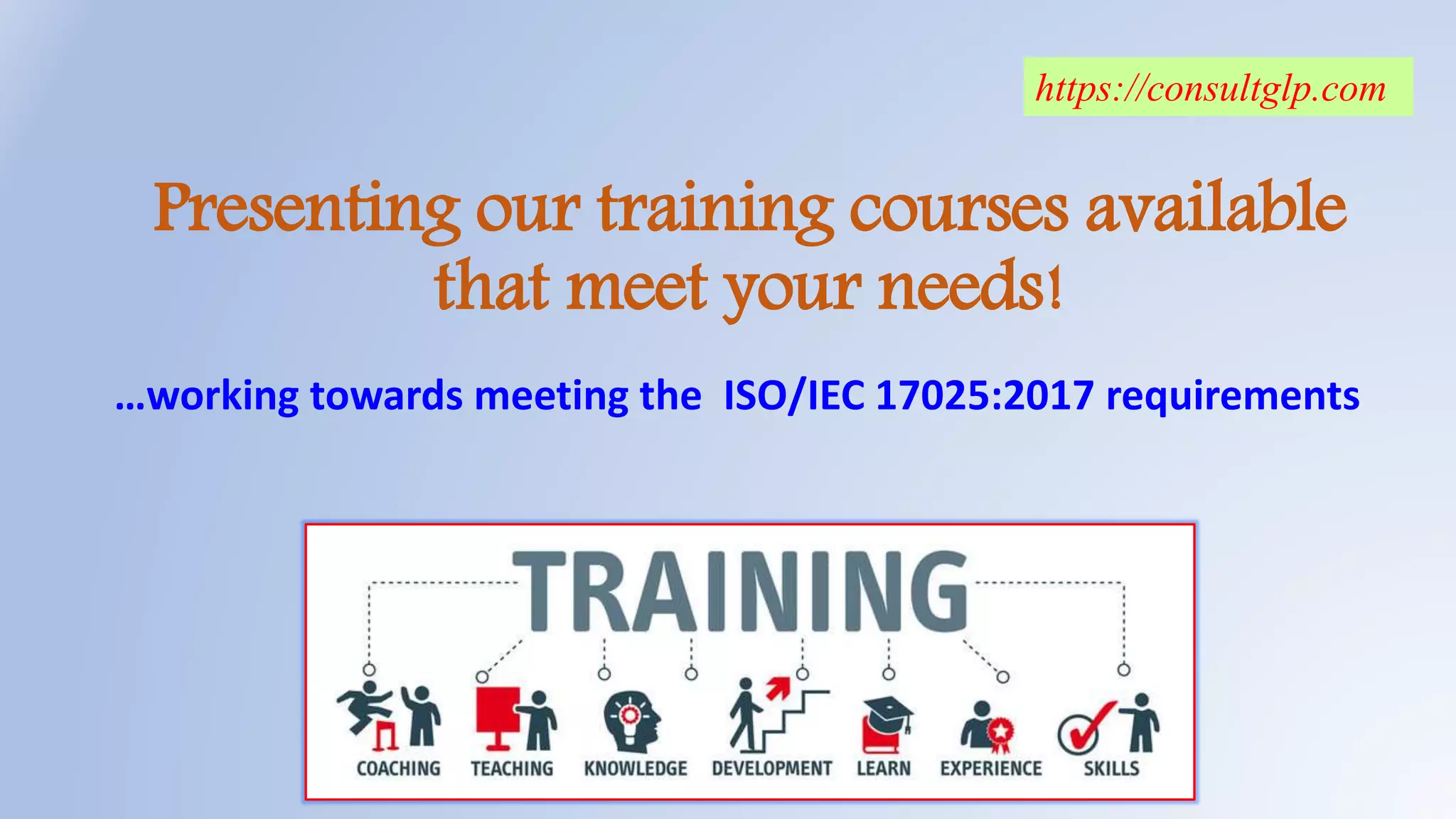
Presenting our training courses available
that meet your needs!
…working towards meeting the ISO/IEC 17025:2017 requirements
https://consultglp.com
Our ultimate aims of training courses
• Upon completing each of our workshops /
courses, the participants will:
• leave the class room with satisfaction
• have gained confidence in grabbing the concepts
of the elements learned
• be able to start applying the practical concepts in
their routine works
Characteristics of our training courses
• Readable training materials which become a good source of
future reference
• Conducting hands-on class exercises after studying worked
examples
• Worked examples of in-house courses can be tailored to the
specific requirements of your organization
• Mastering the applications of statistical methods for test and
calibration laboratories in plain language
• Free sharing of our relevant MS Excel ® worksheet templates
• Free on-line consultation on related issues after training
• More importantly, sharing our 40–year practical experiences
in laboratory quality management ideas
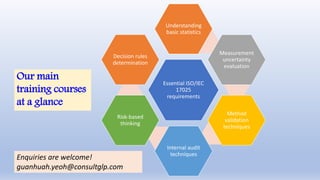
Essential ISO/IEC
17025
requirements
Understanding
basic statistics
Measurement
uncertainty
evaluation
Method
validation
techniques
Internal audit
techniques
Risk-based
thinking
Decision rules
determination
Our main
training courses
at a glance
Enquiries are welcome!
guanhuah.yeoh@consultglp.com
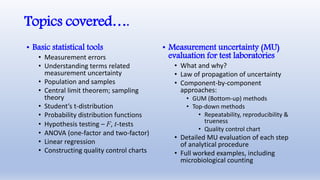
Topics covered….
• Basic statistical tools
• Measurement errors
• Understanding terms related
measurement uncertainty
• Population and samples
• Central limit theorem; sampling
theory
• Student’s t-distribution
• Probability distribution functions
• Hypothesis testing – F, t-tests
• ANOVA (one-factor and two-factor)
• Linear regression
• Constructing quality control charts
• Measurement uncertainty (MU)
evaluation for test laboratories
• What and why?
• Law of propagation of uncertainty
• Component-by-component
approaches:
• GUM (Bottom-up) methods
• Top-down methods
• Repeatability, reproducibility &
trueness
• Quality control chart
• Detailed MU evaluation of each step
of analytical procedure
• Full worked examples, including
microbiological counting
Topics covered….
• Method validation (MV) techniques
• What and why?
• ISO/IEC 17025 requirements
• Validation and verification
• Strategies to conduct a MV study
• Essential elements included:
• Specificity & sensitivity
• Precision, accuracy and trueness
• Range and linearity
• Detection limits (IDL, MDL, LOQ)
• Robustness and ruggedness
• Measurement uncertainty
• Evaluation of data and monitoring
• Internal audit techniques
• Understanding the elements of ISO/IEC
17025:2017 standard
• Importance of internal audits
• Types of internal audits
• Planning of internal audits
• Internal audit approaches – horizontal
and vertical
• Procedures of conducting an internal
audit
• Elements of a laboratory internal audit
using a check list
• Preparation of audit findings and reports
• Common non-conformities found in
laboratory auditing
Topics covered….
• Risk-based thinking and risk
assessment
• Requirements under ISO standard
• What are the risks and
opportunities in an accredited
laboratory
• Risk assessment methods –
qualitative and quantitative
• Risk identification & evaluation
• Risk analysis
• Risk response, control and
monitoring
• Sharing real life worked examples
• Decision risk and rule for conformity
assessment
• Reviewing hypothesis testing
• Type I and Type II errors
• What is conformity testing?
• Relevant clauses of the ISO standard
• Issues on making a statement of
conformity and risk involved
• Basic theory of making a decision rule
• Setting a guard band for decision risk
control
• How to present your decision rules to
your clients
• Worked examples
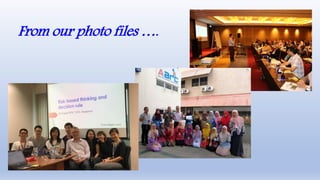
From our photo files ….
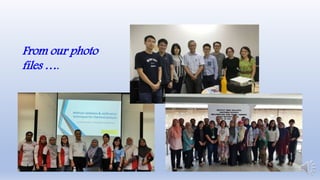
From our photo
files ….
Thank you for viewing!
For enquiries and more information, please write to:
guanhuah.yeoh@consultglp.com
https://consultglp.com

Presenting our training courses

  • 1.
    Presenting our trainingcourses available that meet your needs! …working towards meeting the ISO/IEC 17025:2017 requirements https://consultglp.com
  • 2.
    Our ultimate aimsof training courses • Upon completing each of our workshops / courses, the participants will: • leave the class room with satisfaction • have gained confidence in grabbing the concepts of the elements learned • be able to start applying the practical concepts in their routine works
  • 3.
    Characteristics of ourtraining courses • Readable training materials which become a good source of future reference • Conducting hands-on class exercises after studying worked examples • Worked examples of in-house courses can be tailored to the specific requirements of your organization • Mastering the applications of statistical methods for test and calibration laboratories in plain language • Free sharing of our relevant MS Excel ® worksheet templates • Free on-line consultation on related issues after training • More importantly, sharing our 40–year practical experiences in laboratory quality management ideas
  • 4.
    Essential ISO/IEC 17025 requirements Understanding basic statistics Measurement uncertainty evaluation Method validation techniques Internalaudit techniques Risk-based thinking Decision rules determination Our main training courses at a glance Enquiries are welcome! guanhuah.yeoh@consultglp.com
  • 5.
    Topics covered…. • Basicstatistical tools • Measurement errors • Understanding terms related measurement uncertainty • Population and samples • Central limit theorem; sampling theory • Student’s t-distribution • Probability distribution functions • Hypothesis testing – F, t-tests • ANOVA (one-factor and two-factor) • Linear regression • Constructing quality control charts • Measurement uncertainty (MU) evaluation for test laboratories • What and why? • Law of propagation of uncertainty • Component-by-component approaches: • GUM (Bottom-up) methods • Top-down methods • Repeatability, reproducibility & trueness • Quality control chart • Detailed MU evaluation of each step of analytical procedure • Full worked examples, including microbiological counting
  • 6.
    Topics covered…. • Methodvalidation (MV) techniques • What and why? • ISO/IEC 17025 requirements • Validation and verification • Strategies to conduct a MV study • Essential elements included: • Specificity & sensitivity • Precision, accuracy and trueness • Range and linearity • Detection limits (IDL, MDL, LOQ) • Robustness and ruggedness • Measurement uncertainty • Evaluation of data and monitoring • Internal audit techniques • Understanding the elements of ISO/IEC 17025:2017 standard • Importance of internal audits • Types of internal audits • Planning of internal audits • Internal audit approaches – horizontal and vertical • Procedures of conducting an internal audit • Elements of a laboratory internal audit using a check list • Preparation of audit findings and reports • Common non-conformities found in laboratory auditing
  • 7.
    Topics covered…. • Risk-basedthinking and risk assessment • Requirements under ISO standard • What are the risks and opportunities in an accredited laboratory • Risk assessment methods – qualitative and quantitative • Risk identification & evaluation • Risk analysis • Risk response, control and monitoring • Sharing real life worked examples • Decision risk and rule for conformity assessment • Reviewing hypothesis testing • Type I and Type II errors • What is conformity testing? • Relevant clauses of the ISO standard • Issues on making a statement of conformity and risk involved • Basic theory of making a decision rule • Setting a guard band for decision risk control • How to present your decision rules to your clients • Worked examples
  • 8.
    From our photofiles ….
  • 9.
    From our photofiles ….
  • 10.
  • 11.
    Thank you forviewing! For enquiries and more information, please write to: guanhuah.yeoh@consultglp.com https://consultglp.com