M.P. Birla Institute of Fundamental Research 
Multi-Wavelength Analysis of Active Galactic Nuclei 
Candidate 
Sameer Patel 
December 14, 2014
Introduction 
 Highly energetic manifestations in the nuclei of galaxies, powered 
by accretion onto supermassive massive black holes. 
 Empirical classi
cation schemes have been developed, on the 
basis of the spectra; but recently, various uni
cation schemes 
have been developed (  the same underlying phenomenon). 
 Evolve strongly in time, with the comoving densities of luminous 
ones increasing by  103 from z  0 to z  2. 
 At z  0, at least 30% of all galaxies show some sign of a nuclear 
activity;  1% can be classi
ed as Seyferts, and  106 contain 
luminous quasars. 
 Most (or all) non-dwarf galaxies contain SMBHs, and thus 
probably underwent at least one AGN phase. 
2 of 28 
Multi-Wavelength Analysis of Active Galactic Nuclei
Seyfert Galaxies 
Carl Seyfert, in his
rst observation, had reported a small percentage 
of galaxies had very bright nuclei that were the source of broad 
emission lines produced by atoms in a wide range of ionization 
states. 
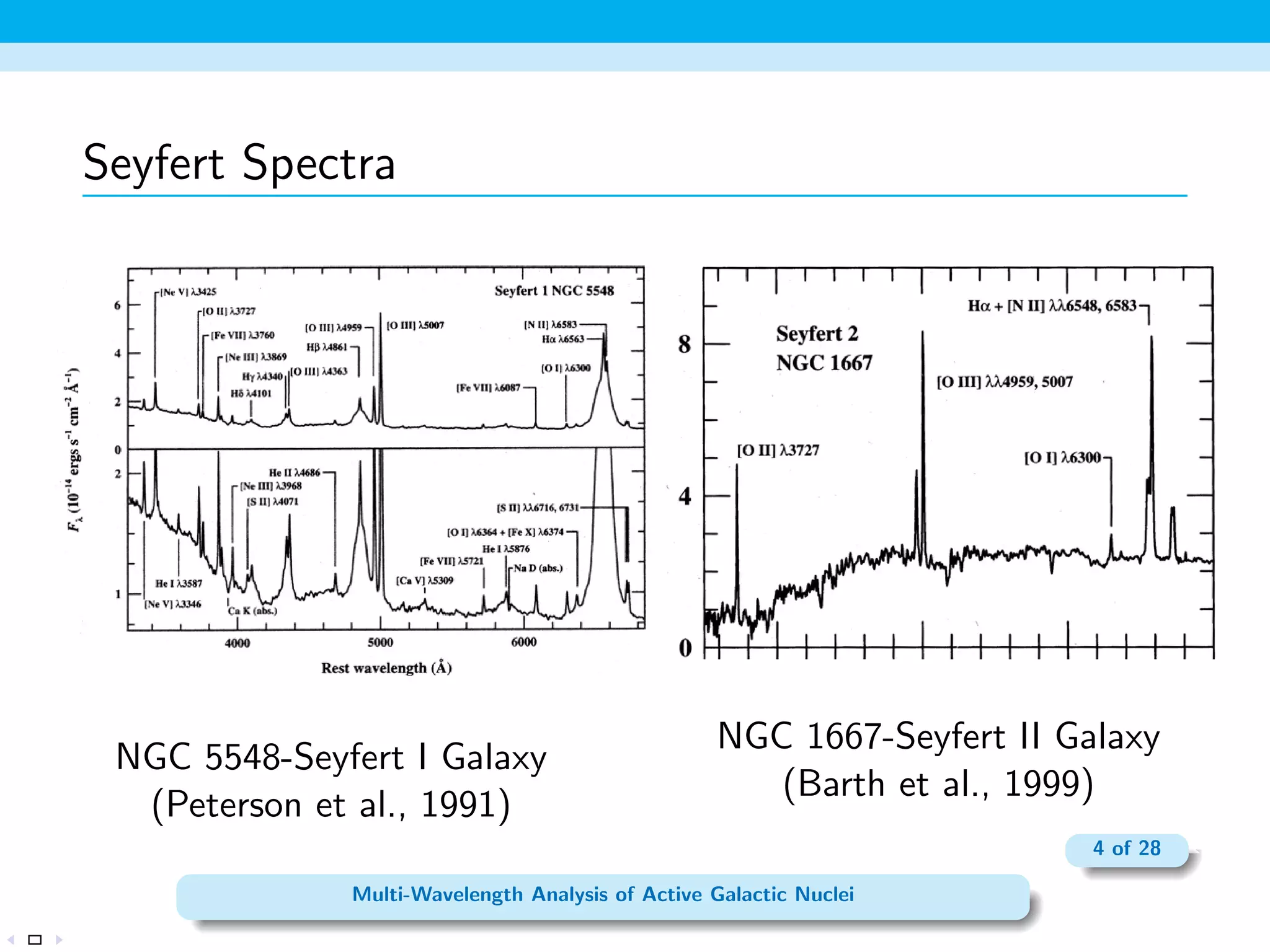
 Seyfert I- Spectra contain very broad emission lines that include 
both allowed lines (H I, He I, He II) and narrower forbidden lines 
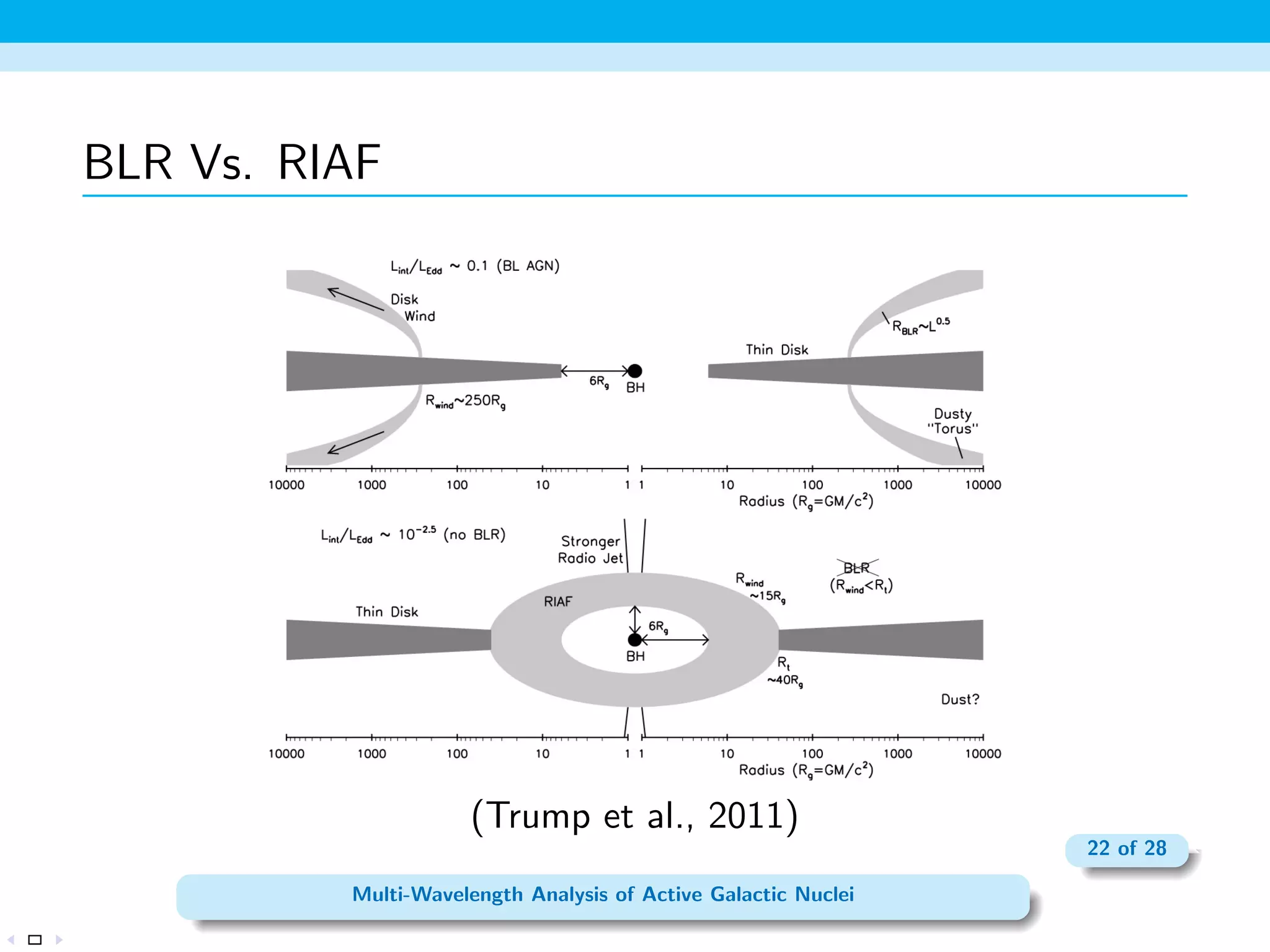
(O [III]); sources with speeds typically between 1000 and 5000 
km s1. 
 Seyfert II- Spectra contain only narrow lines (both permitted and 
forbidden), with characteristic speeds of about 500 km s1. 
3 of 28 
Multi-Wavelength Analysis of Active Galactic Nuclei
Seyfert Spectra 
NGC 5548-Seyfert I Galaxy 
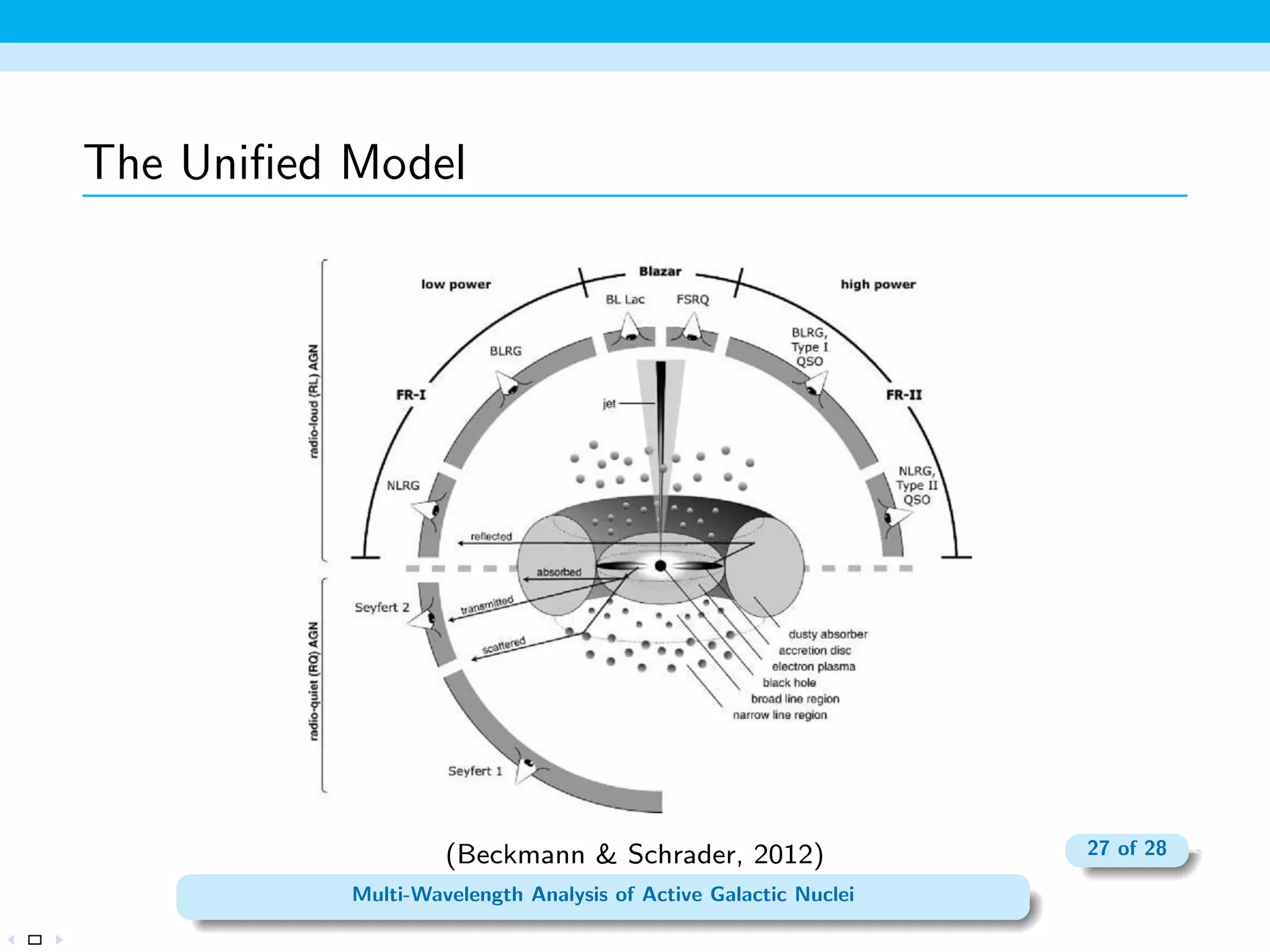
(Peterson et al., 1991) 
NGC 1667-Seyfert II Galaxy 
(Barth et al., 1999) 
4 of 28 
Multi-Wavelength Analysis of Active Galactic Nuclei
Quasars and QSOs 
 Terms often used interchangeably. 
 Scaled up versions of Type I Seyferts. 
 Small fraction (5-10%) are the strong radio sources which 
originally de
ned the quasar class. 
 Nuclear emission normally dominates host galaxy light. The 
nucleus has luminosity MB  21:5 + log h0. 
 Spectra very similar to Seyfert galaxies, except that: 
 Stellar absorption lines are very weak, if detectable at all. 
 Quasars are all `Type I' in Seyfert jargon - i.e can see the broad lines. 
5 of 28 
Multi-Wavelength Analysis of Active Galactic Nuclei
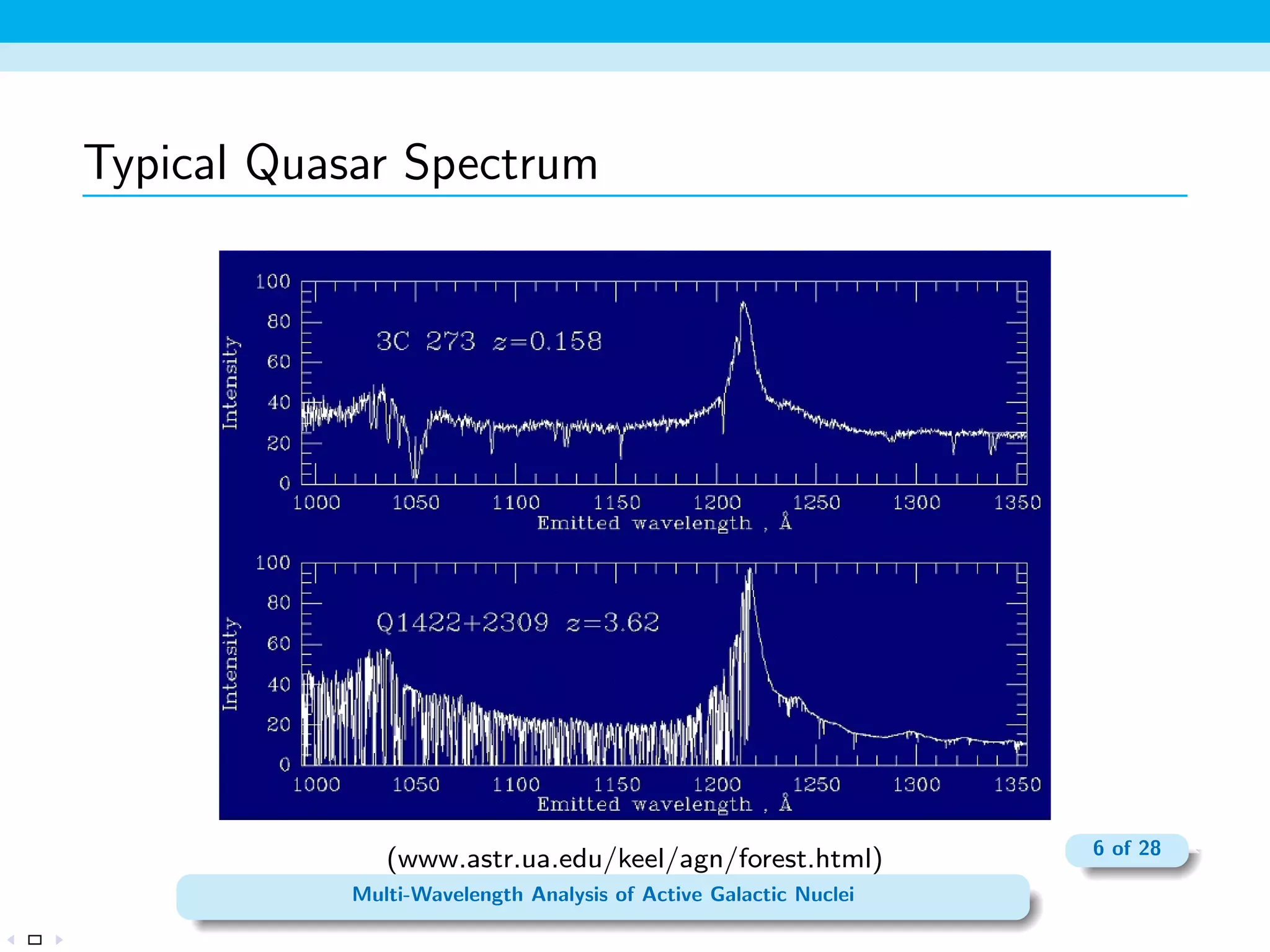
Typical Quasar Spectrum 
(www.astr.ua.edu/keel/agn/forest.html) 6 of 28 
Multi-Wavelength Analysis of Active Galactic Nuclei
Radio Galaxies 
 Strong radio sources typically associated with giant elliptical 
galaxies. Two types of radio galaxies have optical spectra that 
show AGN activity: 
 Broad-line radio galaxies (BLRG) like Type I Seyferts 
 Narrow-line radio galaxies (NLRG) like Type II Seyferts 
 These look like radio loud Seyferts, but they seem to occur in 
ellipticals rather than spirals. . . 
7 of 28 
Multi-Wavelength Analysis of Active Galactic Nuclei
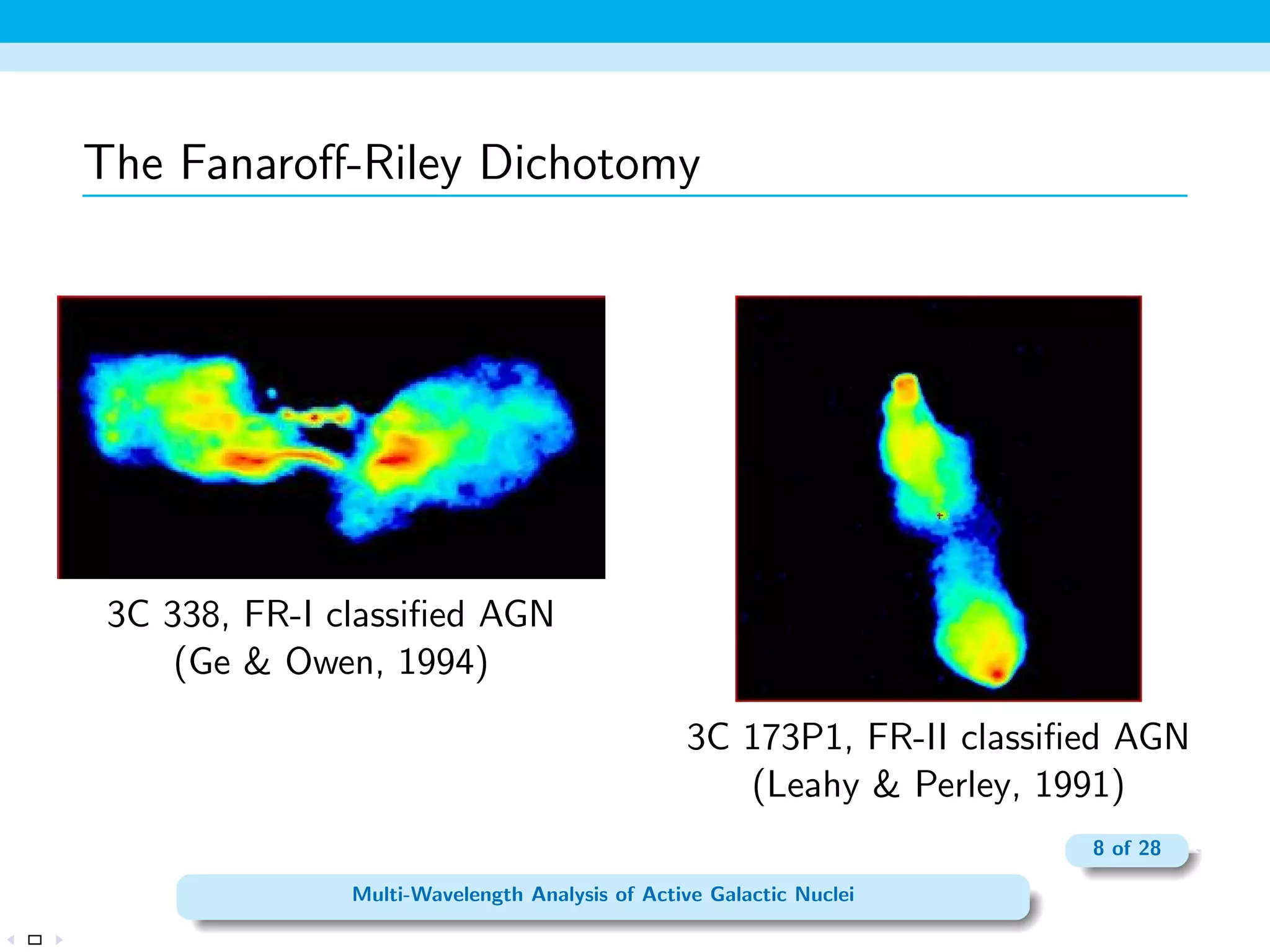
The Fanaro-Riley Dichotomy 
3C 338, FR-I classi
ed AGN 
(Ge  Owen, 1994) 
3C 173P1, FR-II classi
ed AGN 
(Leahy  Perley, 1991) 
8 of 28 
Multi-Wavelength Analysis of Active Galactic Nuclei
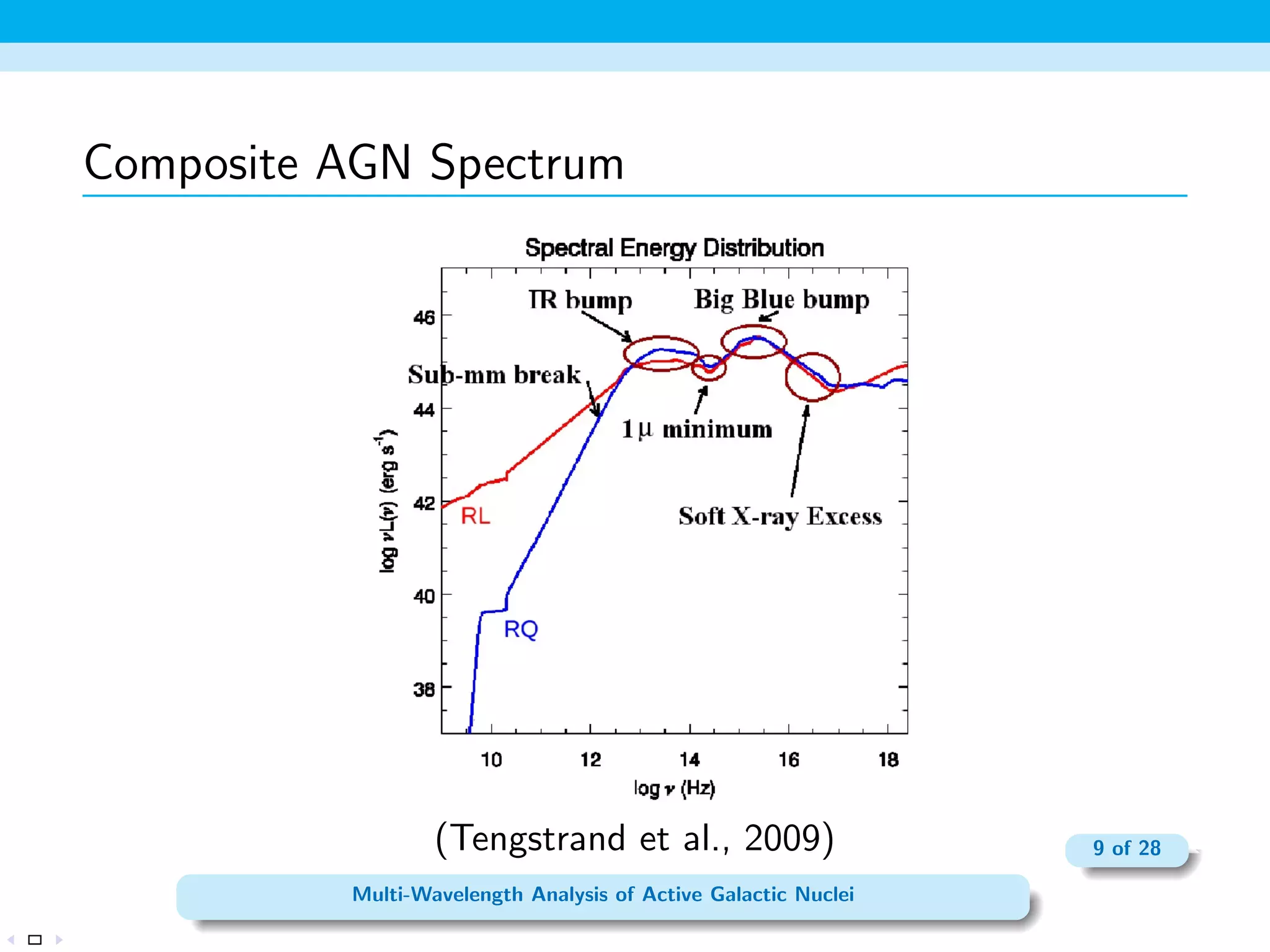
Composite AGN Spectrum 
(Tengstrand et al., 2009) 9 of 28 
Multi-Wavelength Analysis of Active Galactic Nuclei
AGNs in IR/Sub-mm Wavelengths 
 Most of the emission in the NIR and MIR bands due to secondary 
dust emission (emission by cold, warm, or hot dust grains heated 
by the primary AGN radiation source). 
 The temperature of the NIR- and MIR-emitting dust is between 
100 and 2000 K. 
 Broad and narrow emission lines seen in the NIR-FIR part of the 
spectrum of many AGNs. 
 Ability to detect highly obscured (Compton thick) AGNs 
 For Type I Seyferts,  10% of the bolometric luminosity is 
emitted in the IR. 
 IR emission at wavelengths longward of   1 m accounts for 
 50% of the bolometric luminosity of Type II Seyferts. 
10 of 28 
Multi-Wavelength Analysis of Active Galactic Nuclei
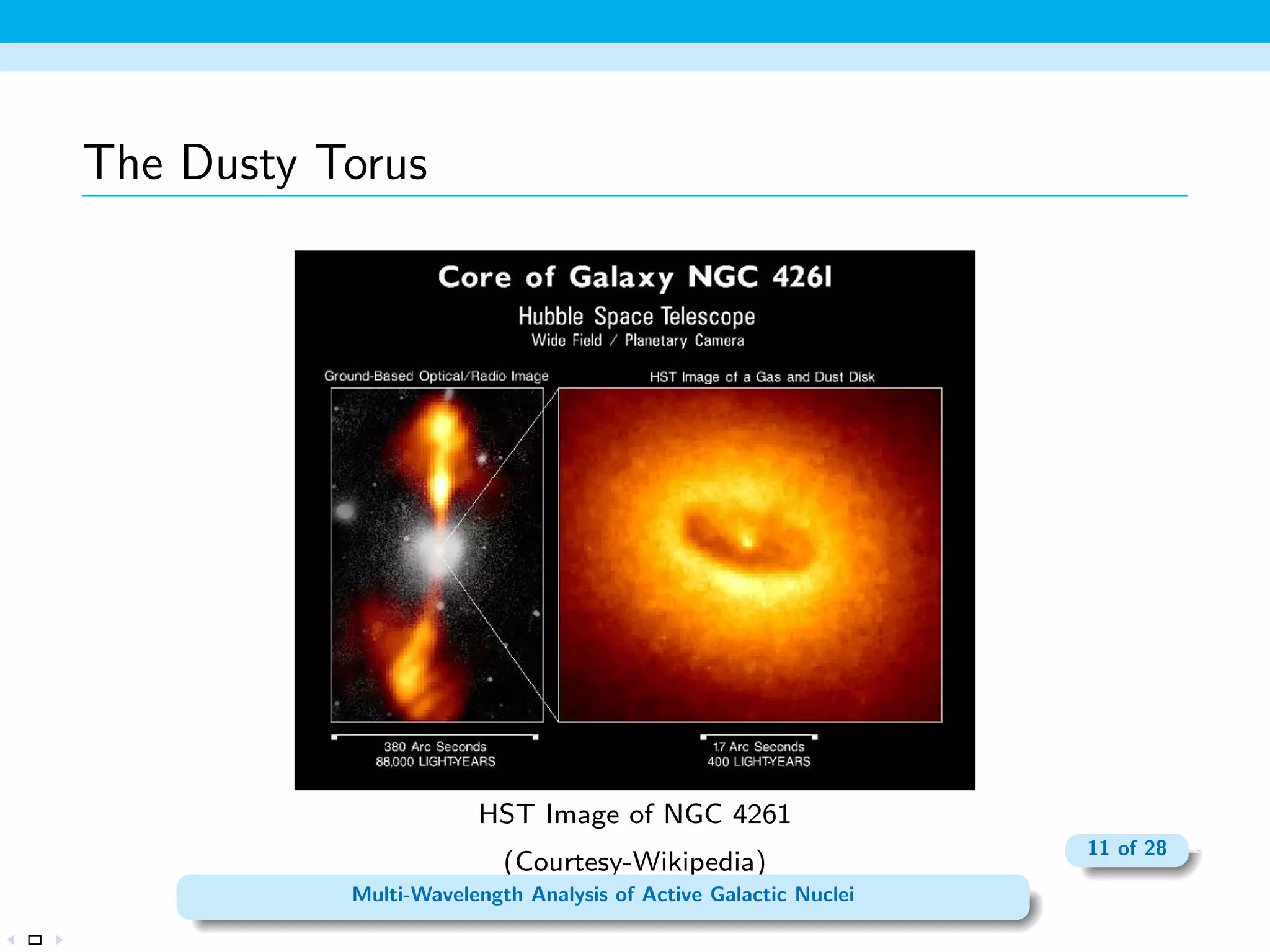
The Dusty Torus 
HST Image of NGC 4261 
(Courtesy-Wikipedia) 11 of 28 
Multi-Wavelength Analysis of Active Galactic Nuclei
The Radio Regime 
 About 10% of all AGNs are core-dominated radio-loud sources. 
 Stars are extremely weak radio sources =) an optical point 
source that is a strong radio source is likely to be a radio-loud 
AGN. 
 Radio lobes and jets often seen in radio-loud AGNs. 
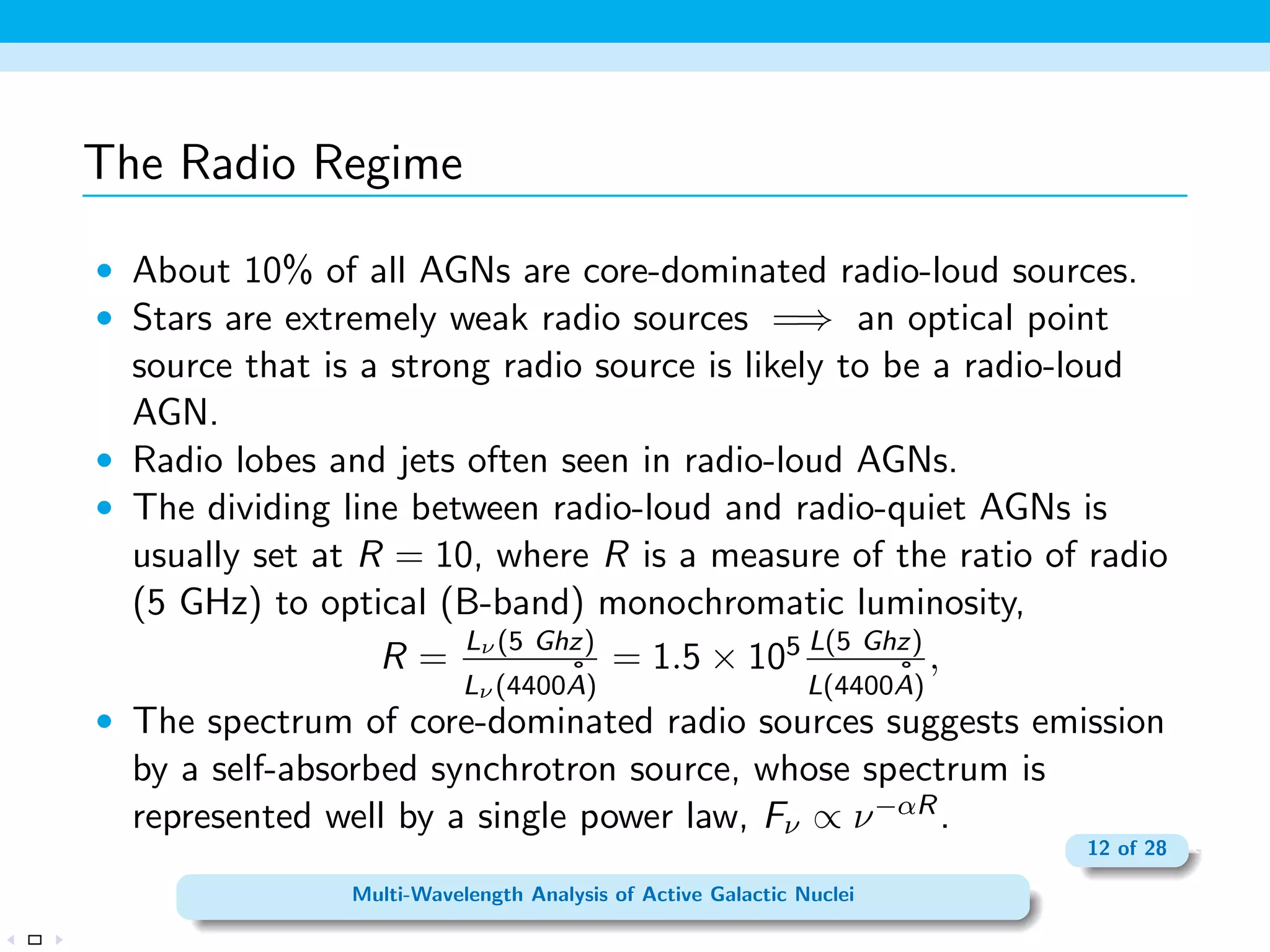
 The dividing line between radio-loud and radio-quiet AGNs is 
usually set at R = 10, where R is a measure of the ratio of radio 
(5 GHz) to optical (B-band) monochromatic luminosity, 
R = L(5 Ghz) 
L(4400A 
) 
= 1:5  105 L(5 Ghz) 
L(4400A 
) 
; 
 The spectrum of core-dominated radio sources suggests emission 
by a self-absorbed synchrotron source, whose spectrum is 
represented well by a single power law, F / R. 
12 of 28 
Multi-Wavelength Analysis of Active Galactic Nuclei
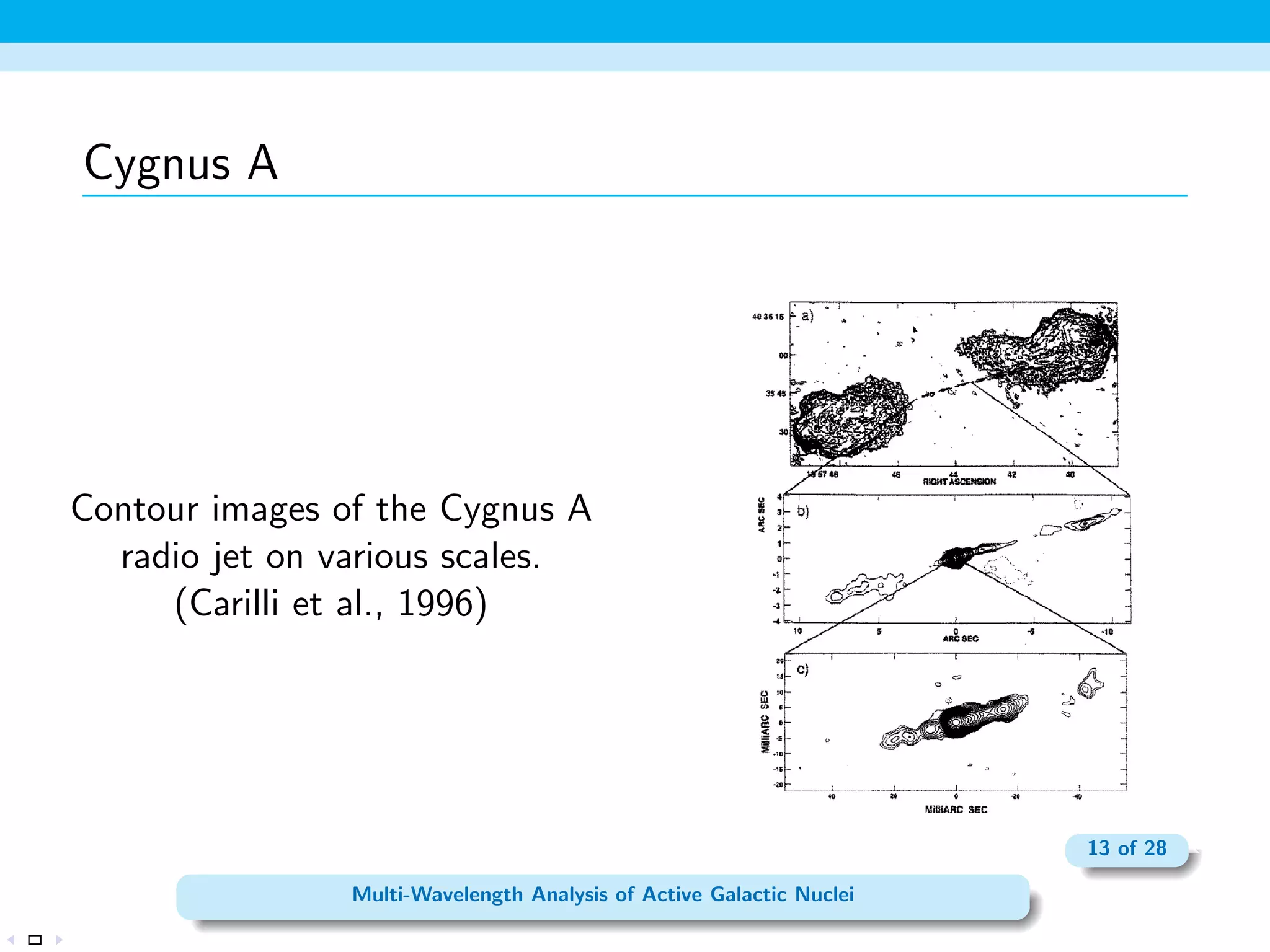
Cygnus A 
Contour images of the Cygnus A 
radio jet on various scales. 
(Carilli et al., 1996) 
13 of 28 
Multi-Wavelength Analysis of Active Galactic Nuclei
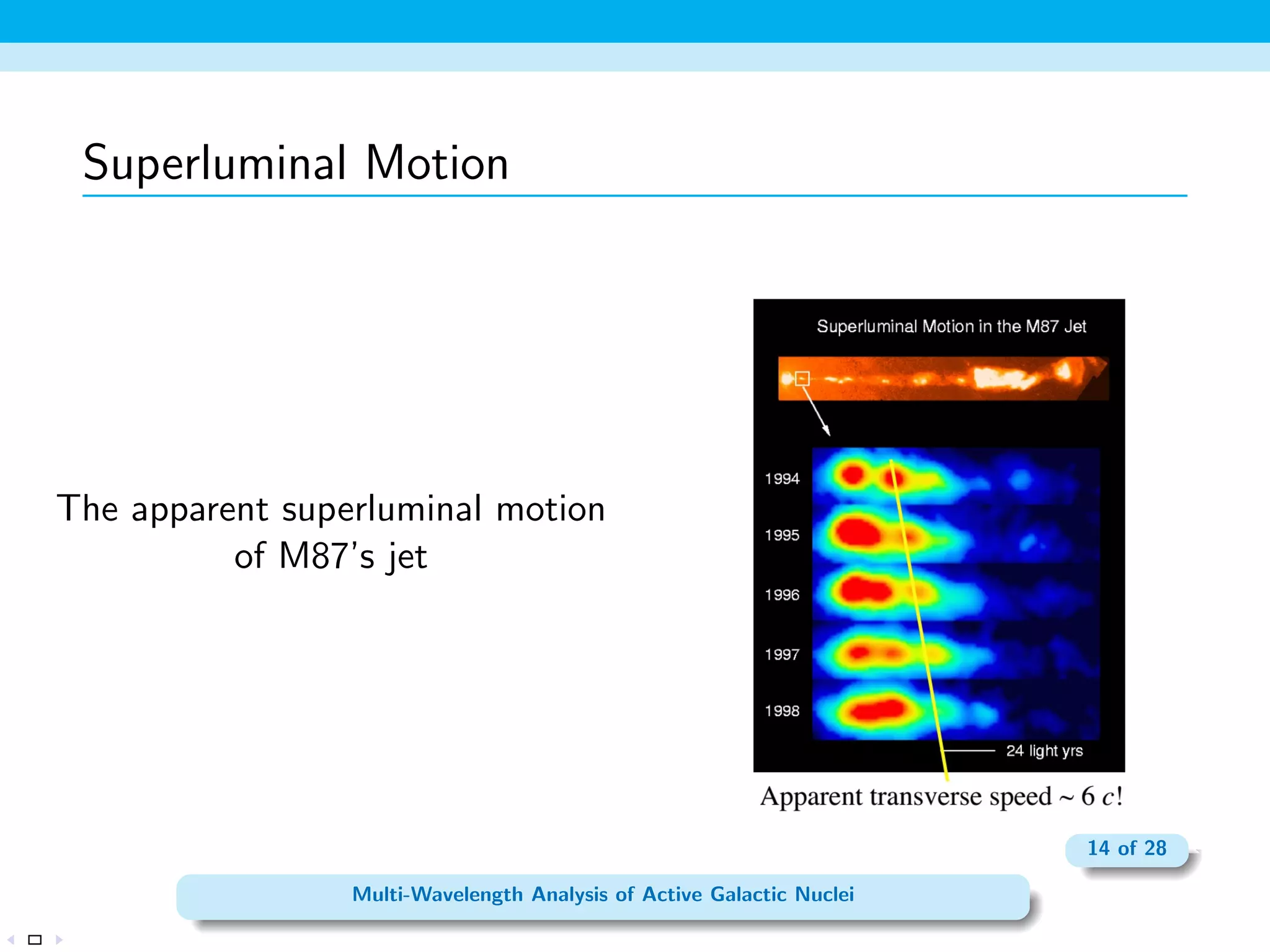
Superluminal Motion 
The apparent superluminal motion 
of M87's jet 
14 of 28 
Multi-Wavelength Analysis of Active Galactic Nuclei
AGNs in Optical-UV Wavelengths 
 Optical images of luminous Type I AGNs show clear signatures of 
point-like central sources with excess emission over the 
surrounding stellar background of their host galaxy. 
 In early observations, the continuum spectral distribution was very 
distinct from an integrated stellar continuum characteristic of 
normal galaxies. 
 Observationally, AGN were comparatively very blue. 
 The blue colors were due to both the fact that the continuum 
emission extended into the UV and beyond and that structure was 
often seen in the blue continua { the so-called big blue bump 
(Richstone  Schmidt, 1980). 
15 of 28 
Multi-Wavelength Analysis of Active Galactic Nuclei
Probing the Central Engine Through X-Rays 
 Provides insight about the inner parts of the accretion disk and 
some information about the parameters of the SMBH like its 
intrinsic angular momentum or spin (Brenneman  Reynolds, 
2009). 
 Basic idea- the asymmetry of a line pro
le produced in the inner 
AGN accretion disk depends in a predictable manner on the black 
hole's spin. 
 Speci
c spectral signatures are attributed to the characteristics of 
the gas in
ow and out
ow near the central most regions in AGN. 
 X-ray observations also provide signatures of reprocessing of 
radiation in material withing approximative distance of hundreds 
of gravitational radii. 
16 of 28 
Multi-Wavelength Analysis of Active Galactic Nuclei
Probing the Central Engine Through X-Rays (Contd.) 
 The resultant emergent spectrum consists of direct radiation from 
the central source plus a scattered or re
ected spectrum that 
includes imprinted photoabsorption, 
uorescent emission and 
Compton scattering from matter within the surrounding accretion 

ow. 
 The reprocessing (vis a vis | re
ection), leads to yet another 
bump in the hard X-ray spectrum (like in the IR). 
 This bump has its maximum around 20-30 keV, where the 
re
ection eciency reaches its maximum. 
 A soft (E . 2 keV) excess over the power law component 
dominant at higher energies has been found in the X-ray spectra 
of many Seyfert galaxies (Saxton et al., 1993) | open issue! 
17 of 28 
Multi-Wavelength Analysis of Active Galactic Nuclei
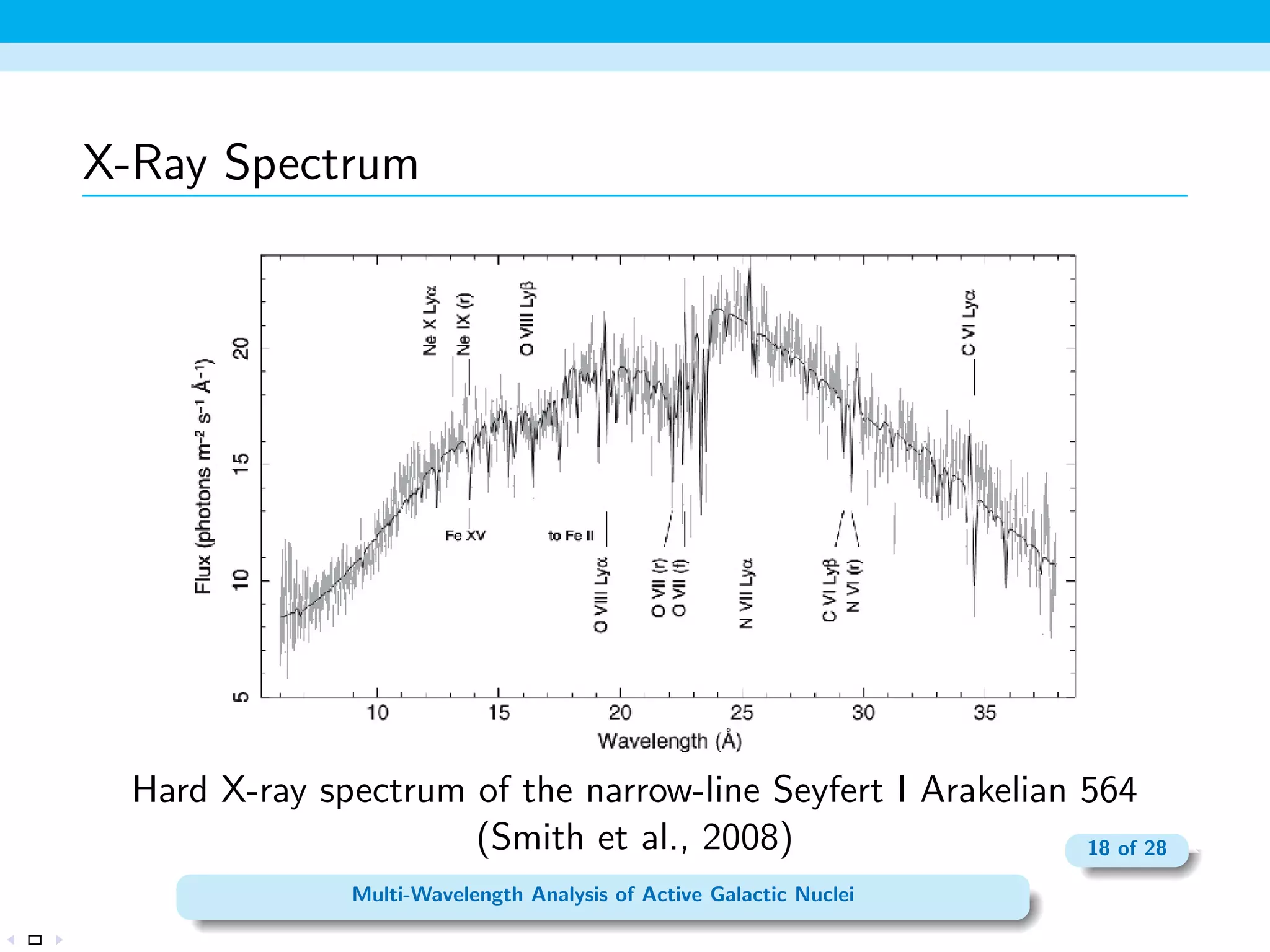
X-Ray Spectrum 
Hard X-ray spectrum of the narrow-line Seyfert I Arakelian 564 
(Smith et al., 2008) 18 of 28 
Multi-Wavelength Analysis of Active Galactic Nuclei
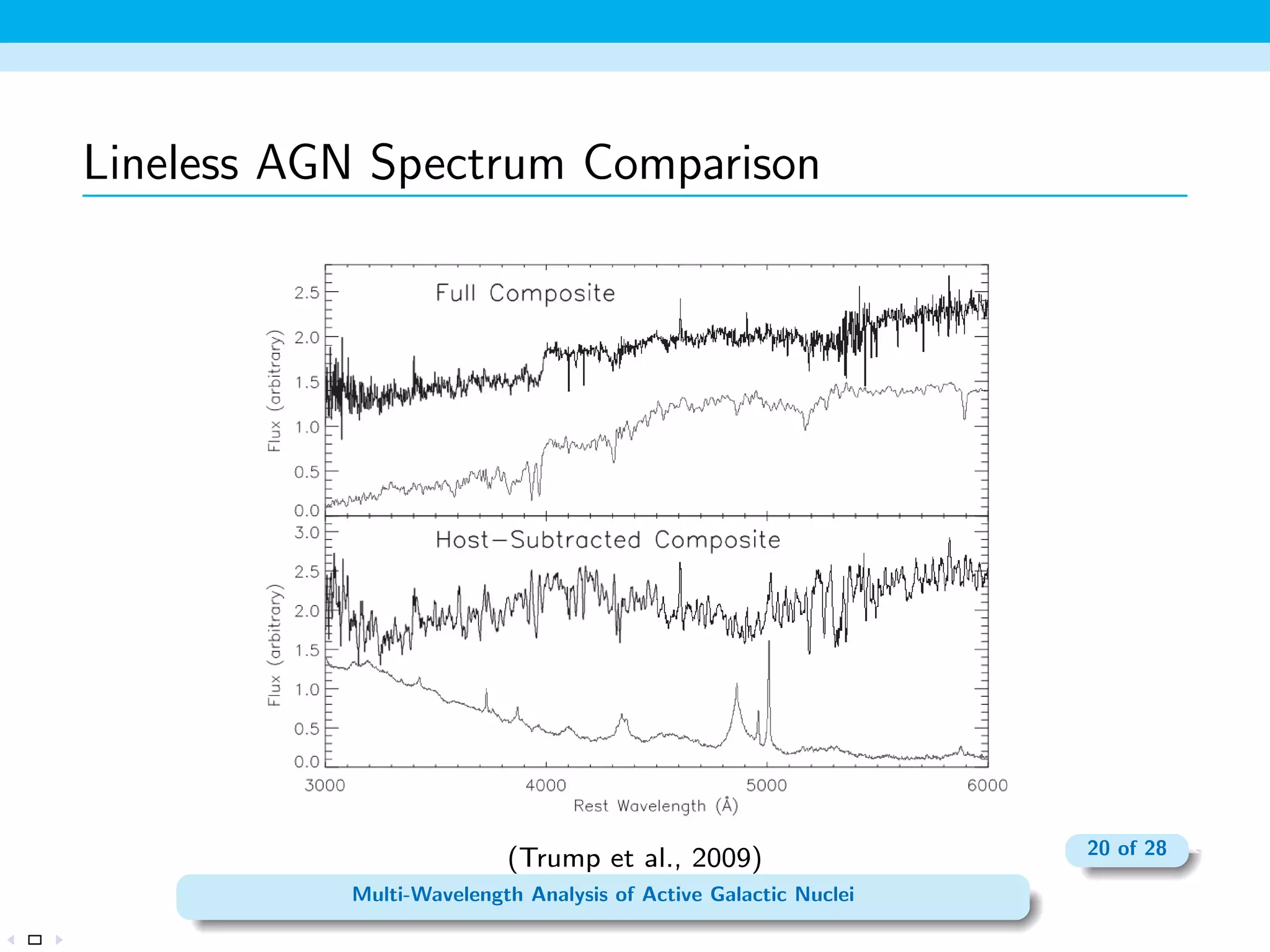
Lineless AGNs 
 Subpopulation of AGNs with extremely weak, sometimes 
completely undetected emission lines. 
 High-redshift sources with extremely weak broad emission lines 
that are 1 or 2 orders of magnitude fainter compared to other 
Type-I sources. 
 Exhibit, usually, a non-stellar continuum with occasional 
ux 
variations. 
 Clear indication for the active BH is an observed point X-ray 
source in many of the sources. 
 Do not show a power law continuum. 
 Are mostly radio quiet. 
 Variability, if any, is of very small amplitude. 
19 of 28 
Multi-Wavelength Analysis of Active Galactic Nuclei

Presentation-Multi-Wavelength Analysis of Active Galactic Nuclei

  • 1.
    M.P. Birla Instituteof Fundamental Research Multi-Wavelength Analysis of Active Galactic Nuclei Candidate Sameer Patel December 14, 2014
  • 2.
    Introduction Highlyenergetic manifestations in the nuclei of galaxies, powered by accretion onto supermassive massive black holes. Empirical classi
  • 3.
    cation schemes havebeen developed, on the basis of the spectra; but recently, various uni
  • 4.
    cation schemes havebeen developed ( the same underlying phenomenon). Evolve strongly in time, with the comoving densities of luminous ones increasing by 103 from z 0 to z 2. At z 0, at least 30% of all galaxies show some sign of a nuclear activity; 1% can be classi
  • 5.
    ed as Seyferts,and 106 contain luminous quasars. Most (or all) non-dwarf galaxies contain SMBHs, and thus probably underwent at least one AGN phase. 2 of 28 Multi-Wavelength Analysis of Active Galactic Nuclei
  • 6.
    Seyfert Galaxies CarlSeyfert, in his
  • 7.
    rst observation, hadreported a small percentage of galaxies had very bright nuclei that were the source of broad emission lines produced by atoms in a wide range of ionization states. Seyfert I- Spectra contain very broad emission lines that include both allowed lines (H I, He I, He II) and narrower forbidden lines (O [III]); sources with speeds typically between 1000 and 5000 km s1. Seyfert II- Spectra contain only narrow lines (both permitted and forbidden), with characteristic speeds of about 500 km s1. 3 of 28 Multi-Wavelength Analysis of Active Galactic Nuclei
  • 8.
    Seyfert Spectra NGC5548-Seyfert I Galaxy (Peterson et al., 1991) NGC 1667-Seyfert II Galaxy (Barth et al., 1999) 4 of 28 Multi-Wavelength Analysis of Active Galactic Nuclei
  • 9.
    Quasars and QSOs Terms often used interchangeably. Scaled up versions of Type I Seyferts. Small fraction (5-10%) are the strong radio sources which originally de
  • 10.
    ned the quasarclass. Nuclear emission normally dominates host galaxy light. The nucleus has luminosity MB 21:5 + log h0. Spectra very similar to Seyfert galaxies, except that: Stellar absorption lines are very weak, if detectable at all. Quasars are all `Type I' in Seyfert jargon - i.e can see the broad lines. 5 of 28 Multi-Wavelength Analysis of Active Galactic Nuclei
  • 11.
    Typical Quasar Spectrum (www.astr.ua.edu/keel/agn/forest.html) 6 of 28 Multi-Wavelength Analysis of Active Galactic Nuclei
  • 12.
    Radio Galaxies Strong radio sources typically associated with giant elliptical galaxies. Two types of radio galaxies have optical spectra that show AGN activity: Broad-line radio galaxies (BLRG) like Type I Seyferts Narrow-line radio galaxies (NLRG) like Type II Seyferts These look like radio loud Seyferts, but they seem to occur in ellipticals rather than spirals. . . 7 of 28 Multi-Wavelength Analysis of Active Galactic Nuclei
  • 13.
    The Fanaro-Riley Dichotomy 3C 338, FR-I classi
  • 14.
    ed AGN (Ge Owen, 1994) 3C 173P1, FR-II classi
  • 15.
    ed AGN (Leahy Perley, 1991) 8 of 28 Multi-Wavelength Analysis of Active Galactic Nuclei
  • 16.
    Composite AGN Spectrum (Tengstrand et al., 2009) 9 of 28 Multi-Wavelength Analysis of Active Galactic Nuclei
  • 17.
    AGNs in IR/Sub-mmWavelengths Most of the emission in the NIR and MIR bands due to secondary dust emission (emission by cold, warm, or hot dust grains heated by the primary AGN radiation source). The temperature of the NIR- and MIR-emitting dust is between 100 and 2000 K. Broad and narrow emission lines seen in the NIR-FIR part of the spectrum of many AGNs. Ability to detect highly obscured (Compton thick) AGNs For Type I Seyferts, 10% of the bolometric luminosity is emitted in the IR. IR emission at wavelengths longward of 1 m accounts for 50% of the bolometric luminosity of Type II Seyferts. 10 of 28 Multi-Wavelength Analysis of Active Galactic Nuclei
  • 18.
    The Dusty Torus HST Image of NGC 4261 (Courtesy-Wikipedia) 11 of 28 Multi-Wavelength Analysis of Active Galactic Nuclei
  • 19.
    The Radio Regime About 10% of all AGNs are core-dominated radio-loud sources. Stars are extremely weak radio sources =) an optical point source that is a strong radio source is likely to be a radio-loud AGN. Radio lobes and jets often seen in radio-loud AGNs. The dividing line between radio-loud and radio-quiet AGNs is usually set at R = 10, where R is a measure of the ratio of radio (5 GHz) to optical (B-band) monochromatic luminosity, R = L(5 Ghz) L(4400A ) = 1:5 105 L(5 Ghz) L(4400A ) ; The spectrum of core-dominated radio sources suggests emission by a self-absorbed synchrotron source, whose spectrum is represented well by a single power law, F / R. 12 of 28 Multi-Wavelength Analysis of Active Galactic Nuclei
  • 20.
    Cygnus A Contourimages of the Cygnus A radio jet on various scales. (Carilli et al., 1996) 13 of 28 Multi-Wavelength Analysis of Active Galactic Nuclei
  • 21.
    Superluminal Motion Theapparent superluminal motion of M87's jet 14 of 28 Multi-Wavelength Analysis of Active Galactic Nuclei
  • 22.
    AGNs in Optical-UVWavelengths Optical images of luminous Type I AGNs show clear signatures of point-like central sources with excess emission over the surrounding stellar background of their host galaxy. In early observations, the continuum spectral distribution was very distinct from an integrated stellar continuum characteristic of normal galaxies. Observationally, AGN were comparatively very blue. The blue colors were due to both the fact that the continuum emission extended into the UV and beyond and that structure was often seen in the blue continua { the so-called big blue bump (Richstone Schmidt, 1980). 15 of 28 Multi-Wavelength Analysis of Active Galactic Nuclei
  • 23.
    Probing the CentralEngine Through X-Rays Provides insight about the inner parts of the accretion disk and some information about the parameters of the SMBH like its intrinsic angular momentum or spin (Brenneman Reynolds, 2009). Basic idea- the asymmetry of a line pro
  • 24.
    le produced inthe inner AGN accretion disk depends in a predictable manner on the black hole's spin. Speci
  • 25.
    c spectral signaturesare attributed to the characteristics of the gas in ow and out ow near the central most regions in AGN. X-ray observations also provide signatures of reprocessing of radiation in material withing approximative distance of hundreds of gravitational radii. 16 of 28 Multi-Wavelength Analysis of Active Galactic Nuclei
  • 26.
    Probing the CentralEngine Through X-Rays (Contd.) The resultant emergent spectrum consists of direct radiation from the central source plus a scattered or re ected spectrum that includes imprinted photoabsorption, uorescent emission and Compton scattering from matter within the surrounding accretion ow. The reprocessing (vis a vis | re ection), leads to yet another bump in the hard X-ray spectrum (like in the IR). This bump has its maximum around 20-30 keV, where the re ection eciency reaches its maximum. A soft (E . 2 keV) excess over the power law component dominant at higher energies has been found in the X-ray spectra of many Seyfert galaxies (Saxton et al., 1993) | open issue! 17 of 28 Multi-Wavelength Analysis of Active Galactic Nuclei
  • 27.
    X-Ray Spectrum HardX-ray spectrum of the narrow-line Seyfert I Arakelian 564 (Smith et al., 2008) 18 of 28 Multi-Wavelength Analysis of Active Galactic Nuclei
  • 28.
    Lineless AGNs Subpopulation of AGNs with extremely weak, sometimes completely undetected emission lines. High-redshift sources with extremely weak broad emission lines that are 1 or 2 orders of magnitude fainter compared to other Type-I sources. Exhibit, usually, a non-stellar continuum with occasional ux variations. Clear indication for the active BH is an observed point X-ray source in many of the sources. Do not show a power law continuum. Are mostly radio quiet. Variability, if any, is of very small amplitude. 19 of 28 Multi-Wavelength Analysis of Active Galactic Nuclei
  • 29.
    Lineless AGN SpectrumComparison (Trump et al., 2009) 20 of 28 Multi-Wavelength Analysis of Active Galactic Nuclei
  • 30.
    Lineless AGNs (Contd.) Extremely large L=LEdd is one possible explanation for the weak broad emission line. For the low-luminosity sources, a very low accretion rate =) RIAF =) systems can lack much or all of the (otherwise strong) UV ionizing radiation. For the high-luminosity sources, the Lyman continuum radiation by the disk depends on the BH mass and accretion rate and can be extremely weak in disks around very massive BHs =) such systems are likely to show very luminous continua but no line emission. 21 of 28 Multi-Wavelength Analysis of Active Galactic Nuclei
  • 31.
    BLR Vs. RIAF (Trump et al., 2011) 22 of 28 Multi-Wavelength Analysis of Active Galactic Nuclei
  • 32.
    AGNs in -Rays Many blazars are also powerful -ray emitters, and some of them show one or more of the following properties:- Intense, highly variable high-energy emission in the -ray part of the spectrum. Intense, highly variable radio emission associated with a at radio spectrum and occasional superluminal motion. Radio, X-ray, and/or -ray jet with clear indications for relativistic motion. A double-peak SED with a lower-frequency peak at radio-to-X-ray energies and a high-frequency peak at X-ray-to- -ray energies. Very weak broad and/or narrow emission lines indicative of photoionization by a non-stellar source of radiation on top of a highly variable continuum. 23 of 28 Multi-Wavelength Analysis of Active Galactic Nuclei
  • 33.
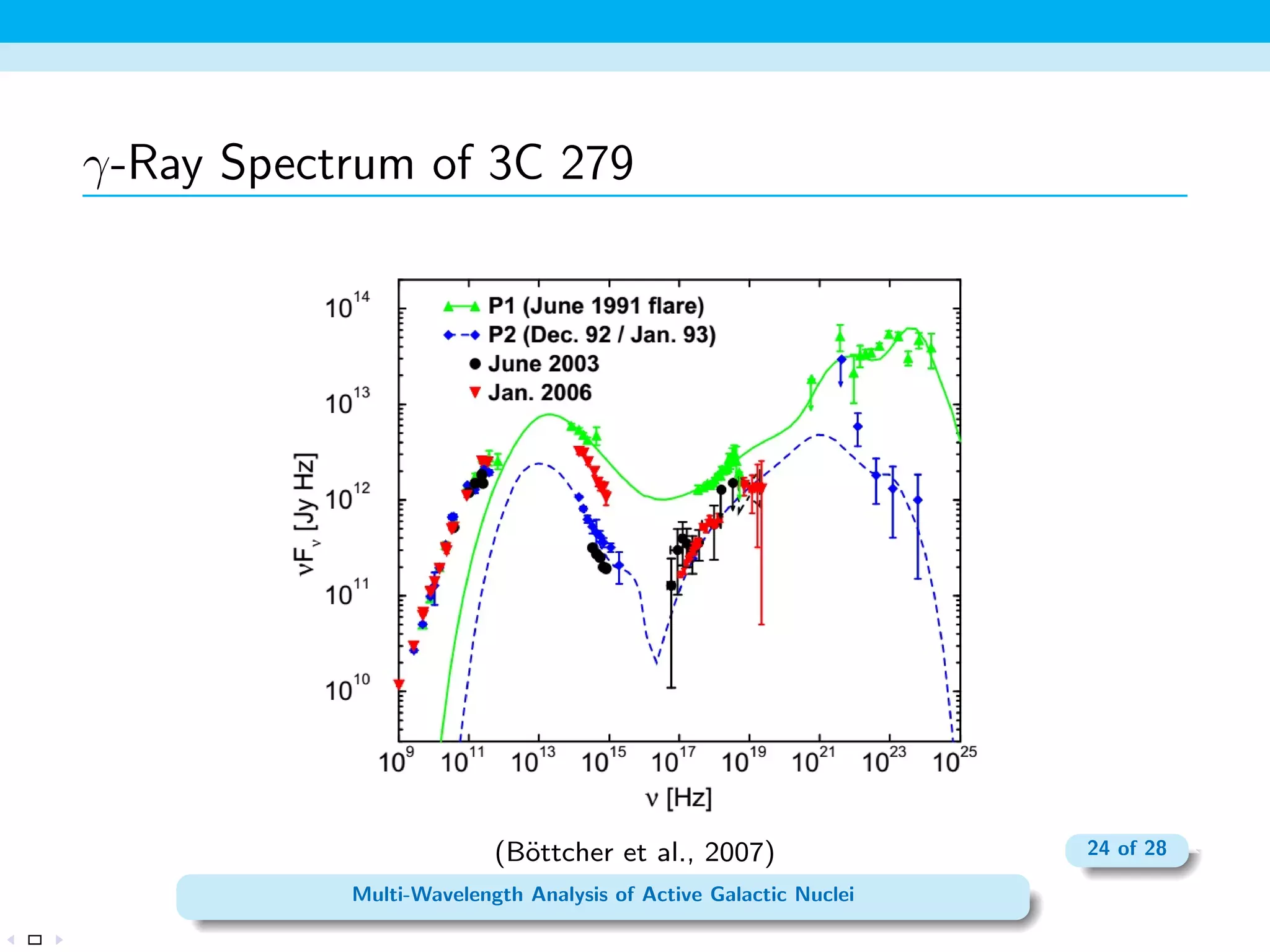
    -Ray Spectrum of3C 279 (Bottcher et al., 2007) 24 of 28 Multi-Wavelength Analysis of Active Galactic Nuclei
  • 34.
  • 35.
    ed AGN Model Fundamental question | can all the distinct appearances of the AGN phenomenon be explained by a common underlying model? Or are the dierent classes are intrinsically distinct? At a 1978 BL Lac conference in Pittsburgh, the foundations for the beaming uni
  • 36.
    cation were outlined(Blandford Rees, 1978), a concept still believed to be true. Scheuer Readhead (1979) | radio-core dominated quasars could be uni
  • 37.
    ed with theradio-quiet quasars by assuming the former ones are beamed towards the observer. Later studies: dierence in orientation, and dierence in obscuration (Barthel, 1989). Most simpli
  • 38.
    ed picture |two types of AGN: radio-quiet and radio-loud. 25 of 28 Multi-Wavelength Analysis of Active Galactic Nuclei
  • 39.
  • 40.
    ed AGN Model(Contd.) For each type, a range of luminosities is observed, leading for example to the Fanaro-Riley classes as well as to the distinction between a Seyfert and a quasar, and all other observed dierences would be explained by orientation eects. Antonucci (1993) | existence of an optically thick torus surrounding the central regions of an AGN on scales of 1-100 pc would lead to the absence of broad emission lines in the case of Seyfert II if they were observed edge-on. 26 of 28 Multi-Wavelength Analysis of Active Galactic Nuclei
  • 41.
  • 42.
    ed Model (Beckmann Schrader, 2012) 27 of 28 Multi-Wavelength Analysis of Active Galactic Nuclei
  • 43.
    References Antonucci, R.1993, ARAA, 31, 473 Barth, A. J., Filippenko, A. V., Moran, E. C. 1999, ApJ, 525, 673 Barthel, P. D. 1989, ApJ, 336, 606 Blandford, R. D., Rees, M. J. 1978, in BL Lac Objects, ed. A. M. Wolfe, 328{341 Bottcher, M., Basu, S., Joshi, M., et al. 2007, ApJ, 670, 968 Brenneman, L. W., Reynolds, C. S. 2009, ApJ, 702, 1367 Carilli, C. L., Perley, R. A., Bartel, N., Sorathia, B. 1996, in Astronomical Society of the Paci
  • 44.
    c Conference Series,Vol. 100, Energy Transport in Radio Galaxies and Quasars, ed. P. E. Hardee, A. H. Bridle, J. A. Zensus, 287 Ge, J., Owen, F. N. 1994, AJ, 108, 1523 Leahy, J. P., Perley, R. A. 1991, AJ, 102, 537 Peterson, B. M., Balonek, T. J., Barker, E. S., et al. 1991, ApJ, 368, 119 Richstone, D. O., Schmidt, M. 1980, ApJ, 235, 361 Saxton, R. D., Turner, M. J. L., Williams, O. R., et al. 1993, MNRAS, 262, 63 Scheuer, P. A. G., Readhead, A. C. S. 1979, Nature, 277, 182 Smith, R. A. N., Page, M. J., Branduardi-Raymont, G. 2008, AA, 490, 103 Tengstrand, O., Guainazzi, M., Siemiginowska, A., et al. 2009, AA, 501, 89 Trump, J. R., Impey, C. D., Taniguchi, Y., et al. 2009, ApJ, 706, 797 Trump, J. R., Impey, C. D., Kelly, B. C., et al. 2011, ApJ, 733, 60 28 of 28 Multi-Wavelength Analysis of Active Galactic Nuclei