High-Excitation and Low-Excitation
Radio Galaxies: an X-ray
comparison
ALMA Mater Studiorum - Università di Bologna
Presentata da: Relatore:
Chiar.mo Prof.
Valentina Scipione Giorgio G. C. Palumbo
Co-relatore:
Dott.ssa Paola Grandi
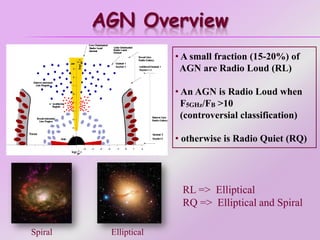
AGN Overview
• A small fraction (15-20%) of
AGN are Radio Loud (RL)
• An AGN is Radio Loud when
F5GHz/FB >10
(controversial classification)
• otherwise is Radio Quiet (RQ)
Spiral Elliptical
RL => Elliptical
RQ => Elliptical and Spiral
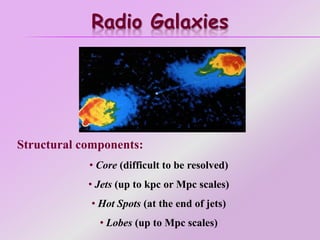
Structural components:
• Core (difficult to be resolved)
• Jets (up to kpc or Mpc scales)
• Hot Spots (at the end of jets)
• Lobes (up to Mpc scales)
Radio Galaxies
FR I & FR II
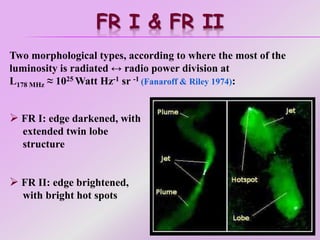
Two morphological types, according to where the most of the
luminosity is radiated ↔ radio power division at
L178 MHz ≈ 1025 Watt Hz-1 sr -1 (Fanaroff & Riley 1974):
 FR I: edge darkened, with
extended twin lobe
structure
 FR II: edge brightened,
with bright hot spots
Optical Classification
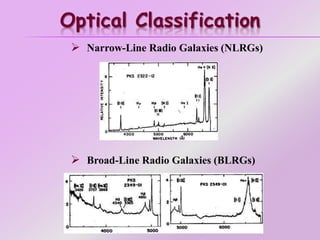
 Narrow-Line Radio Galaxies (NLRGs)
 Broad-Line Radio Galaxies (BLRGs)
NLRGs: Optical Classification
Based on optical oxygen lines ratios (Laing et al. 1994):
Low-Excitation Radio Galaxies
(LEGs):
• [O II]/[O III] > 1
(Jackson & Rawlings 1997)
• both FR I and FR II
morphology
High-Excitation Radio Galaxies
(HEGs):
• exclusively FR II
morphology
NLRGs: Optical Classification
FR II LEGs share the same radio properties of HEGs, host similar
massive black holes, but…
are less bright than HEGs in the [O III] line by a factor of 10!
Strong obscuration or different accretion modes?
Low-Excitation Radio Galaxies
(LEGs):
• [O II]/[O III] > 1
(Jackson & Rawlings 1997)
• both FR I and FR II
morphology
High-Excitation Radio Galaxies
(HEGs):
• exclusively FR II
morphology
Based on optical oxygen lines ratios (Laing et al. 1994):
Outline
• Definition of the sample
• Chandra analysis of the objects in the sample
• Comparison between HEG and LEG on the basis of their X-ray
nuclear properties:
• Measure of the X-ray unabsorbed luminosities in the energy
range 2 – 10 keV
• Measure of the intrinsic neutral hydrogen column densities
• Characterization of the Fe Kα line (~ 6.4 keV)  indicator of
efficient accretion disk
• Comparison between [O III] line luminosities (taken from
Buttiglione et al. 2010) and X-ray luminosities
Our Sample
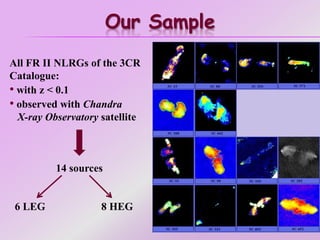
All FR II NLRGs of the 3CR
Catalogue:
• with z < 0.1
• observed with Chandra
X-ray Observatory satellite
14 sources
6 LEG 8 HEG
3CR Catalogue
• Third (revised) Cambridge Catalogue (3CR) of radio sources
(Bennet 1972) using extended emission at 178 MHz
• Survey of all sources North of δ = - 05 degrees with a Fr > 9 Jy:
unbiased and homogeneous
• Largely used catalogue
• Huge set of multiwavelenghts observations (VLA, HST, Spitzer,
Chandra, Fermi…)
• Complete optical spectroscopy (Buttiglione et al. 2010)
• …but systematic X-ray comparison between LEGs and HEGs
still missing
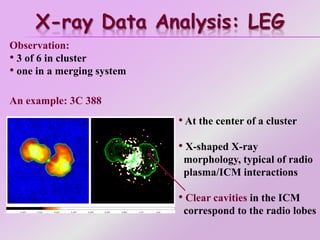
X-ray Data Analysis: LEG
Observation:
• 3 of 6 in cluster
• one in a merging system
An example: 3C 388
• At the center of a cluster
• X-shaped X-ray
morphology, typical of radio
plasma/ICM interactions
• Clear cavities in the ICM
correspond to the radio lobes
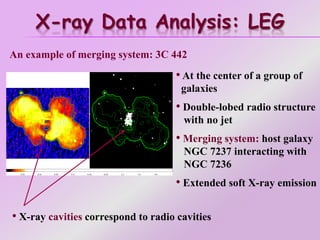
X-ray Data Analysis: LEG
An example of merging system: 3C 442
• At the center of a group of
galaxies
• Double-lobed radio structure
with no jet
• Merging system: host galaxy
NGC 7237 interacting with
NGC 7236
• Extended soft X-ray emission
• X-ray cavities correspond to radio cavities
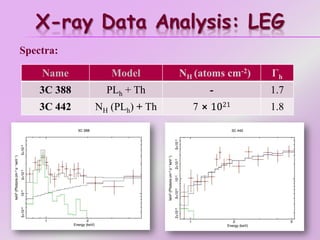
X-ray Data Analysis: LEG
Spectra:
Name Model NH (atoms cm-2) Γh
3C 388 PLh + Th - 1.7
3C 442 NH (PLh) + Th 7 ⨯ 1021 1.8
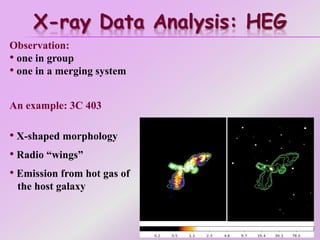
X-ray Data Analysis: HEG
Observation:
• one in group
• one in a merging system
An example: 3C 403
• X-shaped morphology
• Radio “wings”
• Emission from hot gas of
the host galaxy
X-ray Data Analysis: HEG
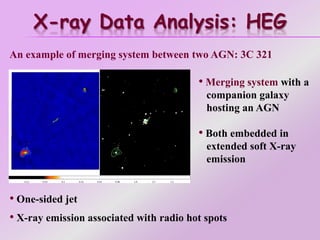
An example of merging system between two AGN: 3C 321
• Merging system with a
companion galaxy
hosting an AGN
• Both embedded in
extended soft X-ray
emission
• One-sided jet
• X-ray emission associated with radio hot spots
X-ray Data Analysis: HEG
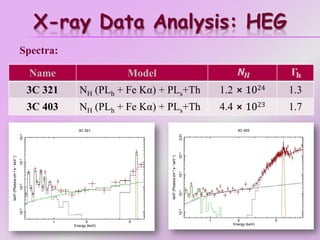
Spectra:
Name Model
3C 321 NH (PLh + Fe Kα) + PLs+Th 1.2 ⨯ 1024 1.3
3C 403 NH (PLh + Fe Kα) + PLs+Th 4.4 ⨯ 1023 1.7
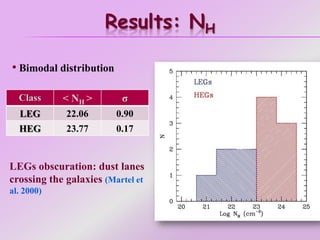
Results: NH
• Bimodal distribution
Class < NH > σ
LEG 22.06 0.90
HEG 23.77 0.17
LEGs obscuration: dust lanes
crossing the galaxies (Martel et
al. 2000)
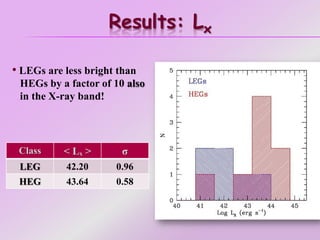
Results: Lx
• LEGs are less bright than
HEGs by a factor of 10 also
in the X-ray band!
Class < Lₓ > σ
LEG 42.20 0.96
HEG 43.64 0.58
X-ray – optical correlation
• LEGs and HEGs occupy
different regions of the
L[O III] – Lₓ plane
• HEGs have higher Lₓ and
L[O III]
• Lₓ and L[O III] correlated
(r ~ 0.6 and Pcorrelation ~ 98%)
• Lₓ and L[O III] good tracers
of accretion rate
[O III] line luminosity vs X-ray luminosity:
A possible interpretation
HEGs
• Higher intrinsic neutral
hydrogen column densities
• High X-ray luminosities
• Fe Kα line in 6 out of 8
• High [O III] line luminosities
LEGs
• Lower intrinsic neutral
hydrogen column densities
• Low X-ray luminosities
• No Fe Kα line
• Low [O III] line luminosities
 Accretion less efficient in LEGs
 LEGs probably only accrete hot gas
 FR II LEGs could be in a quiescent phase
Conclusions
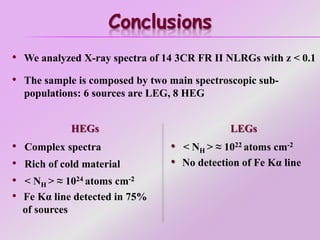
• We analyzed X-ray spectra of 14 3CR FR II NLRGs with z < 0.1
• The sample is composed by two main spectroscopic sub-
populations: 6 sources are LEG, 8 HEG
HEGs
• Complex spectra
• Rich of cold material
• < NH > ≈ 1024 atoms cm-2
• Fe Kα line detected in 75%
of sources
LEGs
• < NH > ≈ 1022 atoms cm-2
• No detection of Fe Kα line
Conclusions
• Intrinsic neutral hydrogen column densities of LEG are lower
than HEG: bimodal distribution
• HEG are 10 times brighter than LEG in X-ray luminosity
• HEG and LEG occupy different regions of the L[O III] – Lₓ plane
• Hypothesis of different accretion regime is preferred: LEG
accretion is less efficient than HEG
• LEG could be in a quiescent phase

X-ray spectroscopy AGN - High-Excitation and Low-Excitation Radio Galaxies: an X-ray comparison

  • 1.
    High-Excitation and Low-Excitation RadioGalaxies: an X-ray comparison ALMA Mater Studiorum - Università di Bologna Presentata da: Relatore: Chiar.mo Prof. Valentina Scipione Giorgio G. C. Palumbo Co-relatore: Dott.ssa Paola Grandi
  • 2.
    AGN Overview • Asmall fraction (15-20%) of AGN are Radio Loud (RL) • An AGN is Radio Loud when F5GHz/FB >10 (controversial classification) • otherwise is Radio Quiet (RQ) Spiral Elliptical RL => Elliptical RQ => Elliptical and Spiral
  • 3.
    Structural components: • Core(difficult to be resolved) • Jets (up to kpc or Mpc scales) • Hot Spots (at the end of jets) • Lobes (up to Mpc scales) Radio Galaxies
  • 4.
    FR I &FR II Two morphological types, according to where the most of the luminosity is radiated ↔ radio power division at L178 MHz ≈ 1025 Watt Hz-1 sr -1 (Fanaroff & Riley 1974):  FR I: edge darkened, with extended twin lobe structure  FR II: edge brightened, with bright hot spots
  • 5.
    Optical Classification  Narrow-LineRadio Galaxies (NLRGs)  Broad-Line Radio Galaxies (BLRGs)
  • 6.
    NLRGs: Optical Classification Basedon optical oxygen lines ratios (Laing et al. 1994): Low-Excitation Radio Galaxies (LEGs): • [O II]/[O III] > 1 (Jackson & Rawlings 1997) • both FR I and FR II morphology High-Excitation Radio Galaxies (HEGs): • exclusively FR II morphology
  • 7.
    NLRGs: Optical Classification FRII LEGs share the same radio properties of HEGs, host similar massive black holes, but… are less bright than HEGs in the [O III] line by a factor of 10! Strong obscuration or different accretion modes? Low-Excitation Radio Galaxies (LEGs): • [O II]/[O III] > 1 (Jackson & Rawlings 1997) • both FR I and FR II morphology High-Excitation Radio Galaxies (HEGs): • exclusively FR II morphology Based on optical oxygen lines ratios (Laing et al. 1994):
  • 8.
    Outline • Definition ofthe sample • Chandra analysis of the objects in the sample • Comparison between HEG and LEG on the basis of their X-ray nuclear properties: • Measure of the X-ray unabsorbed luminosities in the energy range 2 – 10 keV • Measure of the intrinsic neutral hydrogen column densities • Characterization of the Fe Kα line (~ 6.4 keV)  indicator of efficient accretion disk • Comparison between [O III] line luminosities (taken from Buttiglione et al. 2010) and X-ray luminosities
  • 9.
    Our Sample All FRII NLRGs of the 3CR Catalogue: • with z < 0.1 • observed with Chandra X-ray Observatory satellite 14 sources 6 LEG 8 HEG
  • 10.
    3CR Catalogue • Third(revised) Cambridge Catalogue (3CR) of radio sources (Bennet 1972) using extended emission at 178 MHz • Survey of all sources North of δ = - 05 degrees with a Fr > 9 Jy: unbiased and homogeneous • Largely used catalogue • Huge set of multiwavelenghts observations (VLA, HST, Spitzer, Chandra, Fermi…) • Complete optical spectroscopy (Buttiglione et al. 2010) • …but systematic X-ray comparison between LEGs and HEGs still missing
  • 11.
    X-ray Data Analysis:LEG Observation: • 3 of 6 in cluster • one in a merging system An example: 3C 388 • At the center of a cluster • X-shaped X-ray morphology, typical of radio plasma/ICM interactions • Clear cavities in the ICM correspond to the radio lobes
  • 12.
    X-ray Data Analysis:LEG An example of merging system: 3C 442 • At the center of a group of galaxies • Double-lobed radio structure with no jet • Merging system: host galaxy NGC 7237 interacting with NGC 7236 • Extended soft X-ray emission • X-ray cavities correspond to radio cavities
  • 13.
    X-ray Data Analysis:LEG Spectra: Name Model NH (atoms cm-2) Γh 3C 388 PLh + Th - 1.7 3C 442 NH (PLh) + Th 7 ⨯ 1021 1.8
  • 14.
    X-ray Data Analysis:HEG Observation: • one in group • one in a merging system An example: 3C 403 • X-shaped morphology • Radio “wings” • Emission from hot gas of the host galaxy
  • 15.
    X-ray Data Analysis:HEG An example of merging system between two AGN: 3C 321 • Merging system with a companion galaxy hosting an AGN • Both embedded in extended soft X-ray emission • One-sided jet • X-ray emission associated with radio hot spots
  • 16.
    X-ray Data Analysis:HEG Spectra: Name Model 3C 321 NH (PLh + Fe Kα) + PLs+Th 1.2 ⨯ 1024 1.3 3C 403 NH (PLh + Fe Kα) + PLs+Th 4.4 ⨯ 1023 1.7
  • 17.
    Results: NH • Bimodaldistribution Class < NH > σ LEG 22.06 0.90 HEG 23.77 0.17 LEGs obscuration: dust lanes crossing the galaxies (Martel et al. 2000)
  • 18.
    Results: Lx • LEGsare less bright than HEGs by a factor of 10 also in the X-ray band! Class < Lₓ > σ LEG 42.20 0.96 HEG 43.64 0.58
  • 19.
    X-ray – opticalcorrelation • LEGs and HEGs occupy different regions of the L[O III] – Lₓ plane • HEGs have higher Lₓ and L[O III] • Lₓ and L[O III] correlated (r ~ 0.6 and Pcorrelation ~ 98%) • Lₓ and L[O III] good tracers of accretion rate [O III] line luminosity vs X-ray luminosity:
  • 20.
    A possible interpretation HEGs •Higher intrinsic neutral hydrogen column densities • High X-ray luminosities • Fe Kα line in 6 out of 8 • High [O III] line luminosities LEGs • Lower intrinsic neutral hydrogen column densities • Low X-ray luminosities • No Fe Kα line • Low [O III] line luminosities  Accretion less efficient in LEGs  LEGs probably only accrete hot gas  FR II LEGs could be in a quiescent phase
  • 21.
    Conclusions • We analyzedX-ray spectra of 14 3CR FR II NLRGs with z < 0.1 • The sample is composed by two main spectroscopic sub- populations: 6 sources are LEG, 8 HEG HEGs • Complex spectra • Rich of cold material • < NH > ≈ 1024 atoms cm-2 • Fe Kα line detected in 75% of sources LEGs • < NH > ≈ 1022 atoms cm-2 • No detection of Fe Kα line
  • 22.
    Conclusions • Intrinsic neutralhydrogen column densities of LEG are lower than HEG: bimodal distribution • HEG are 10 times brighter than LEG in X-ray luminosity • HEG and LEG occupy different regions of the L[O III] – Lₓ plane • Hypothesis of different accretion regime is preferred: LEG accretion is less efficient than HEG • LEG could be in a quiescent phase