Geologic Processes
on Earth
• Exogenic Processes
• Endogenic Processes
Exogenic Processes
-it is formed or occuring on the surface of Earth
⟶ these processes are carried through by
Geomorphic Agents: gravity, flowing water
(rivers), moving ice (glaciers), waves and tides
(oceans and lakes), wind, plants, organisms,
animals and humans.
Types of Exogenic Processes
a. Weathering
b. Mass Wasting
c. Erosion and Transportation
d. Sedimentation
Weathering
It is the process of disintegration and
decomposition of rocks
There are three types of weathering:
1.Physical or Mechanical Weathering
2.Chemical Weathering
3.Biological Weathering
Physical or Mechanical Weathering
• the breakdown of rocks into pieces
without any change in it’s
composition.
• the size and shape of the rocks may
change and this occur because of
different factors.
Types of Weathering
Factors Affecting Physical
Weathering
PRESSURE
• due to tectonic forces, granite may rise
to form mountain range. After the
granite ascends and cools, the
overlaying rocks and sediments may
erode. At the point when the pressure
diminishes, the rock expands, cools and
became brittle and fractured.
Factors Affecting Physical
Weathering
TEMPERATURE
• rocks expand and are fractured when
expose to high temperature. However, if
the temperature drops to zero degree
celsius (freezing point of water), it also
expands and causes fracture.
Factors Affecting Physical
Weathering
FROST WEDGING
• generally, rocks have fracture in its
surface and when water accumulates in
the crack and at that point freezes, the
ice expands and break the rock apart.
Factors Affecting Physical
Weathering
ABRASION
• the breakdown of rocks is the caused by
impact and friction. This primarily
occurs during collision of rocks, sand,
and silt due to current or waves along a
stream or seashore causing sharp edges
and corners to wear off and became
rounded.
Factors Affecting Physical
Weathering
ORGANIC ACTIVITY
• the roots grow causing penetration into
the crack, expand and in the long run,
break the rock.
Factors Affecting Physical
Weathering
HUMAN ACTIVITY
• the activities such as digging, quarrying,
denuding forests and cultivating land
contribute to physical weathering.
Factors Affecting Physical
Weathering
BURROWING ANIMALS
• animals like rats, rabbits and squirrels
excavate into the ground to create a
space for habitation.
Chemical Weathering
• the changes in the composition of
rocks due to the chemical reactions
below:
a. dissolution
b. hydrolysis
c. oxidation
Types of Weathering
Chemical Reactions Affecting Chemical Weathering
DISSOLUTION
• it occurs in specific minerals which are
dissolved in water.
• the formation of stalactites and
stalagmites in caves are brought about
by this chemical reactions.
HYDROLYSIS
• the rock-forming minerals like
amphibole, pyroxene, and feldspar react
with water and form different kinds of
clay minerals.
Chemical Reactions Affecting Chemical Weathering
OXIDATION
• the response of oxygen with minerals.
• if the iron oxidizes, the mineral in rock
descomposes.
• rusting is an example of this chemical
reaction.
Chemical Reactions Affecting Chemical Weathering
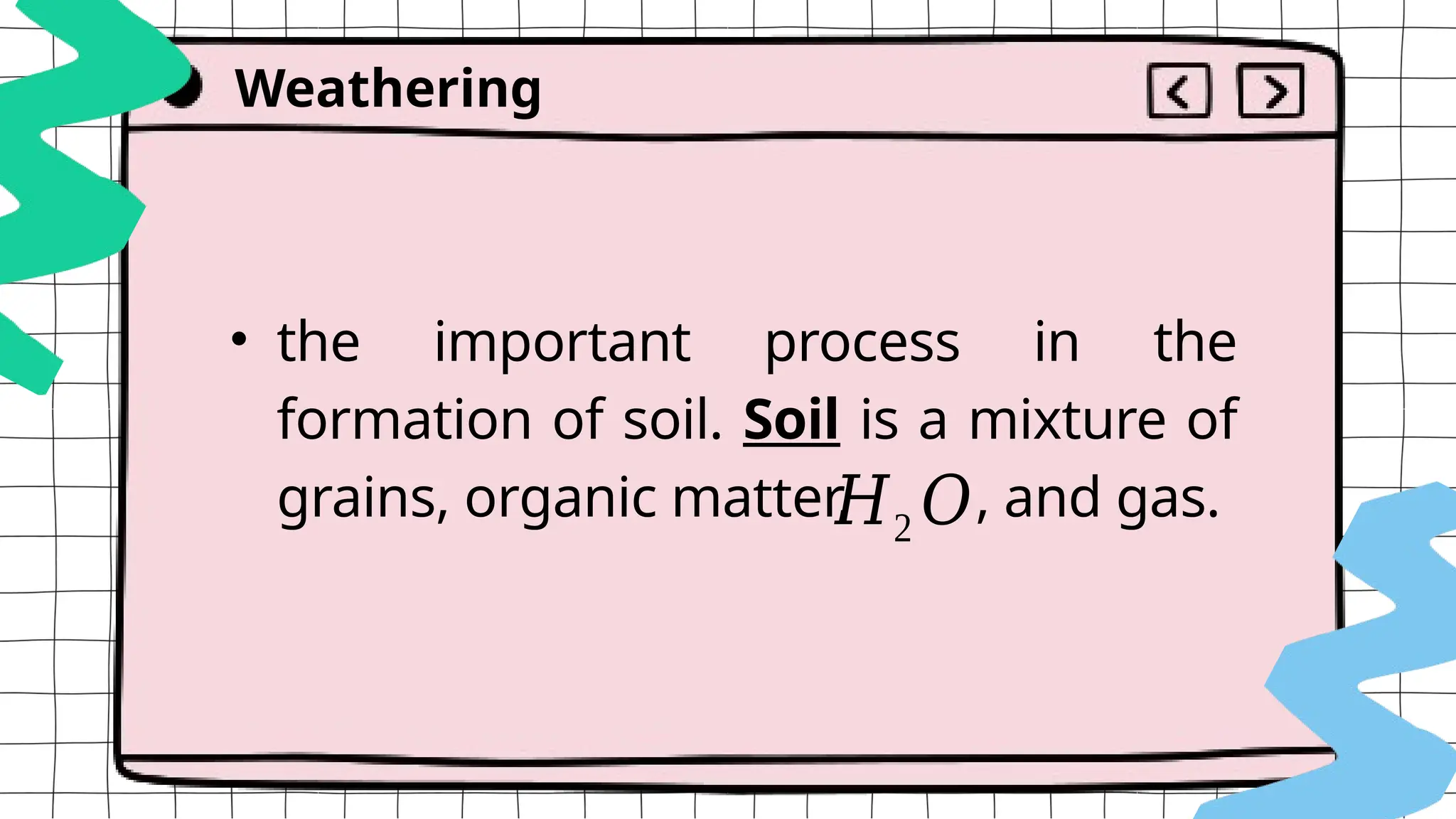
• the important process in the
formation of soil. Soil is a mixture of
grains, organic matter, , and gas.
Weathering
𝐻2 𝑂
Erosion
• the separation and removal of
weathered rocks due to different agents
like water, wind, and glacier that causes
transportation of the material to where
they are deposited.
Plants, animals, and humans play an
important role in the erosional process.
• the movement of sediments
downslope under the influence
of gravity.
• examples are fall, slide,
avalanche, and flow.
Mass Wasting
• the process in which the
weathered materials carried out
by erosion settle down in a
particular location.
Deposition

Geologic Processes on Earth ( Exogenic & Endogenic)

  • 1.
    Geologic Processes on Earth •Exogenic Processes • Endogenic Processes
  • 2.
    Exogenic Processes -it isformed or occuring on the surface of Earth ⟶ these processes are carried through by Geomorphic Agents: gravity, flowing water (rivers), moving ice (glaciers), waves and tides (oceans and lakes), wind, plants, organisms, animals and humans.
  • 3.
    Types of ExogenicProcesses a. Weathering b. Mass Wasting c. Erosion and Transportation d. Sedimentation
  • 4.
    Weathering It is theprocess of disintegration and decomposition of rocks There are three types of weathering: 1.Physical or Mechanical Weathering 2.Chemical Weathering 3.Biological Weathering
  • 5.
    Physical or MechanicalWeathering • the breakdown of rocks into pieces without any change in it’s composition. • the size and shape of the rocks may change and this occur because of different factors. Types of Weathering
  • 6.
    Factors Affecting Physical Weathering PRESSURE •due to tectonic forces, granite may rise to form mountain range. After the granite ascends and cools, the overlaying rocks and sediments may erode. At the point when the pressure diminishes, the rock expands, cools and became brittle and fractured.
  • 7.
    Factors Affecting Physical Weathering TEMPERATURE •rocks expand and are fractured when expose to high temperature. However, if the temperature drops to zero degree celsius (freezing point of water), it also expands and causes fracture.
  • 8.
    Factors Affecting Physical Weathering FROSTWEDGING • generally, rocks have fracture in its surface and when water accumulates in the crack and at that point freezes, the ice expands and break the rock apart.
  • 9.
    Factors Affecting Physical Weathering ABRASION •the breakdown of rocks is the caused by impact and friction. This primarily occurs during collision of rocks, sand, and silt due to current or waves along a stream or seashore causing sharp edges and corners to wear off and became rounded.
  • 10.
    Factors Affecting Physical Weathering ORGANICACTIVITY • the roots grow causing penetration into the crack, expand and in the long run, break the rock.
  • 11.
    Factors Affecting Physical Weathering HUMANACTIVITY • the activities such as digging, quarrying, denuding forests and cultivating land contribute to physical weathering.
  • 12.
    Factors Affecting Physical Weathering BURROWINGANIMALS • animals like rats, rabbits and squirrels excavate into the ground to create a space for habitation.
  • 13.
    Chemical Weathering • thechanges in the composition of rocks due to the chemical reactions below: a. dissolution b. hydrolysis c. oxidation Types of Weathering
  • 14.
    Chemical Reactions AffectingChemical Weathering DISSOLUTION • it occurs in specific minerals which are dissolved in water. • the formation of stalactites and stalagmites in caves are brought about by this chemical reactions.
  • 15.
    HYDROLYSIS • the rock-formingminerals like amphibole, pyroxene, and feldspar react with water and form different kinds of clay minerals. Chemical Reactions Affecting Chemical Weathering
  • 16.
    OXIDATION • the responseof oxygen with minerals. • if the iron oxidizes, the mineral in rock descomposes. • rusting is an example of this chemical reaction. Chemical Reactions Affecting Chemical Weathering
  • 17.
    • the importantprocess in the formation of soil. Soil is a mixture of grains, organic matter, , and gas. Weathering 𝐻2 𝑂
  • 18.
    Erosion • the separationand removal of weathered rocks due to different agents like water, wind, and glacier that causes transportation of the material to where they are deposited. Plants, animals, and humans play an important role in the erosional process.
  • 19.
    • the movementof sediments downslope under the influence of gravity. • examples are fall, slide, avalanche, and flow. Mass Wasting
  • 20.
    • the processin which the weathered materials carried out by erosion settle down in a particular location. Deposition