CURRICULUM SOURCES AND INFLUENCES
• Curriculum Sources
3 Major Sources of Curriculum:
- subject matter
- society
- learners
Society as a Source of Curriculum
• Culture
• Socio-economic
• Political conditions of the people
• Changes – Science and Technology
Learner as Source of Curriculum
• Students come from different contexts:
– Cultures,
– Languages
– Learning styles
– Needs
– Types and levels of motivation
– Socio-economic Status
– Educational backgrounds
Subject Matter as Source of Curriculum
• Different subjects are unique in terms of design and
content
• There are specific skills and content that should be
emphasized in each of the discipline
• There are similarities in skills, concepts, and strands
in different subjects that may be possible points for
integration
• Understanding the Nature of the discipline/subject
matter requires educators to closely analyze the
contents prescribed by DepEd especially the K-12
curriculum.
CURRICULUM INFLUENCES
• There are 3 major factors that influence
curriculum development (Stark and Lattuca,
1997)
• These curriculum influences affect the whole
academic plan that incorporates a total
blueprint for action, including the purposes,
activities, and ways of measuring success.
CURRICULUM INFLUENCES
• 3 Major factors that influence curriculum
development (Stark and Lattuca, 1997)
• External
• Organizational
• internal
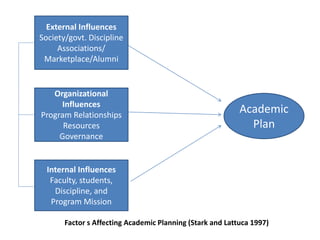
External Influences
Society/govt. Discipline
Associations/
Marketplace/Alumni
Organizational
Influences
Program Relationships
Resources
Governance
Internal Influences
Faculty, students,
Discipline, and
Program Mission
Academic
Plan
Factor s Affecting Academic Planning (Stark and Lattuca 1997)
CURRICULUM INFLUENCES
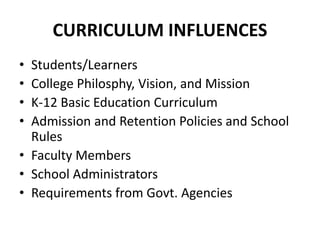
• Students/Learners
• College Philosphy, Vision, and Mission
• K-12 Basic Education Curriculum
• Admission and Retention Policies and School
Rules
• Faculty Members
• School Administrators
• Requirements from Govt. Agencies
CURRICULUM INFLUENCES
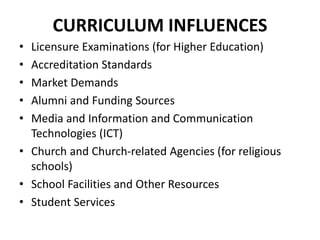
• Licensure Examinations (for Higher Education)
• Accreditation Standards
• Market Demands
• Alumni and Funding Sources
• Media and Information and Communication
Technologies (ICT)
• Church and Church-related Agencies (for religious
schools)
• School Facilities and Other Resources
• Student Services
Lesson Activity
• Brainstorm on the following and Submit Outputs in Groups
 What are the different social issues, needs
and demands to be considered in developing
the curriculum.
 How do these influence the curriculum
a) Aims, goals, and objectives; b) Content,
c) Learning experience; d) Evaluation

CURRICULUM-SOURCES-AND-INFLUENCES.pptx

  • 1.
  • 2.
    CURRICULUM SOURCES ANDINFLUENCES • Curriculum Sources 3 Major Sources of Curriculum: - subject matter - society - learners
  • 3.
    Society as aSource of Curriculum • Culture • Socio-economic • Political conditions of the people • Changes – Science and Technology
  • 4.
    Learner as Sourceof Curriculum • Students come from different contexts: – Cultures, – Languages – Learning styles – Needs – Types and levels of motivation – Socio-economic Status – Educational backgrounds
  • 5.
    Subject Matter asSource of Curriculum • Different subjects are unique in terms of design and content • There are specific skills and content that should be emphasized in each of the discipline • There are similarities in skills, concepts, and strands in different subjects that may be possible points for integration • Understanding the Nature of the discipline/subject matter requires educators to closely analyze the contents prescribed by DepEd especially the K-12 curriculum.
  • 6.
    CURRICULUM INFLUENCES • Thereare 3 major factors that influence curriculum development (Stark and Lattuca, 1997) • These curriculum influences affect the whole academic plan that incorporates a total blueprint for action, including the purposes, activities, and ways of measuring success.
  • 7.
    CURRICULUM INFLUENCES • 3Major factors that influence curriculum development (Stark and Lattuca, 1997) • External • Organizational • internal
  • 8.
    External Influences Society/govt. Discipline Associations/ Marketplace/Alumni Organizational Influences ProgramRelationships Resources Governance Internal Influences Faculty, students, Discipline, and Program Mission Academic Plan Factor s Affecting Academic Planning (Stark and Lattuca 1997)
  • 9.
    CURRICULUM INFLUENCES • Students/Learners •College Philosphy, Vision, and Mission • K-12 Basic Education Curriculum • Admission and Retention Policies and School Rules • Faculty Members • School Administrators • Requirements from Govt. Agencies
  • 10.
    CURRICULUM INFLUENCES • LicensureExaminations (for Higher Education) • Accreditation Standards • Market Demands • Alumni and Funding Sources • Media and Information and Communication Technologies (ICT) • Church and Church-related Agencies (for religious schools) • School Facilities and Other Resources • Student Services
  • 11.
    Lesson Activity • Brainstormon the following and Submit Outputs in Groups  What are the different social issues, needs and demands to be considered in developing the curriculum.  How do these influence the curriculum a) Aims, goals, and objectives; b) Content, c) Learning experience; d) Evaluation