The intended target group is Tata Sky users in SEC 
A & B service class person in the metros in the age 
group of 25 – 45 years. While the intended 
consumer is both male & female. Now a days, both 
are working and not have time to see their favorite 
channels and serials due to meeting and stuck in 
traffic.
People’s schedule are so hectic and are always travelling, 
waiting for a meeting or stuck somewhere, use their 
smartphones to pass the time. First they play games and 
then they go to video streaming portals. But they often 
complain that discovery of their favorite content is not that 
easy on these portals. TATA 
Sky wanted to present a platform where consumers could 
see their favorite TV channel without the hassle of 
searching extensively.
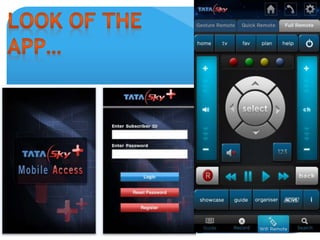
TATA Sky has launched its new mobile app in which it is possible 
to watch live TV channels while on the move. The service entitles 
a subscriber to access 54 channels with a monthly payment of Rs 
60.
Three W's principle-’whichever, whenever, wherever’ 
 The first W stands for 'whichever' and to address that, the DTH 
platform has all major channels available on a la carte basis so 
that consumers can take whichever channels they want. 
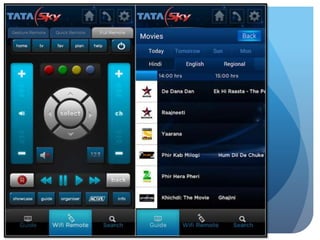
 The second W signifies 'whenever' and to address that Tata Sky 
has a service where people can record their favorite shows 
even through a mobile app and watch it whenever they get time. 
 The final W stands for 'wherever' and the new app addresses 
that. Now everyone can see their favorite show wherever they 
are.
 The service entitles a subscriber to access 54 channels with a 
monthly payment of Rs 60. 
 Besides live channels, the app also allows consumers to watch 
previous five days' episodes of shows. 
 This app could be availed by downloading Tata Sky's mobile 
app from the Apple and Android stores. 
 “Everywhere TV” will be accessible on 3G and broadband 
services.
 In the recent past, DTH operators as well as broadcasters have 
been launching their own mobile app services aiming to reach 
out to an added user base that consumes content on the 
mobile phone. 
 Earlier this month, Zee Group's Dish TV had launched a similar 
service called Dish Online for Android and iOS. Dish Online 
subscribers can enjoy TV in four forms - live TV, movies, TV 
shows and videos. The app is available on two Dish Online 
packs - the Jumbo Pack priced at Rs 129 and the Starter pack 
priced at Rs 49. 
 Besides this, major broadcasters like Sony and STAR India have 
also launched their mobile app services to present their 
content on the mobile platform.
 Recently, MSM's SonyLIV.com had launched a big noise 
multi-media campaign, inspired by the well-established 
truth that modern life is all about the little escapes. 
 Meanwhile, STAR Player from Star India offers content from 
all shows on the STAR Network channels including Star Plus 
and Life OK. Also, STAR India's key channel sites like 
Starplus.in, ChannelV.in and LifeOK.com redirect users to 
STAR Player to consume content. 
 There are other online players too, like Zee Group's Ditto 
TV, Times Internet's Box TV and Digivive's NexGTV which 
offer TV content on mobile phones and every player in the 
market is pushing hard to get a share of the mobile 
consumer pie.
 The primary challenge that a product is the popularity of the 
concept. The focus is on making the consumer realize that the 
mobile phone is a more powerful device than the TV. This 
device gives the consumers one more chance to stay closer to 
the TV content. The challenge currently is to get this message 
across among the consumers. 
 Besides, even if people like to watch TV when 'on the move', in 
the present scenario, it won't be affordable given the current 
3G tariff, and people opting to use it on their home Wi-Fi 
networks doesn't really serve the purpose of mobility. 
 However, since India comprises mainly of single-TV households, 
people might use the app as an extended TV in the home Wi-Fi 
networks to watch their favorite programs. ‘Everywhere TV’ 
allows users to connect two mobile devises with one DTH 
connection.
 Besides, public Wi-Fi zones like major airports, railway 
stations, coffee outlets and luxury hotels might also become 
major spots where mobile TV services can be accessed in 
India. 
 For India's mobile TV market, however, cost of services 
remains the biggest challenge. Nearly 96 per cent of the 
country's mobile sector comprises prepaid subscribers who are 
primarily low-average revenue users and mobile TV services 
are likely to be adopted by high-end post-paid consumers. 
 However, such services give consumers more power so they 
decide the type of content they want to watch and how they 
want to watch it. This, coupled with the fact that users do not 
need to subscribe to a separate service, represents an 
attractive proposition. Such services have proven popular in 
Japan where mobile TV is free-to-air, and in South Korea 
where operators offer a mix of pay and free-to-air TV 
services.
Tag Line
Presentation2
Presentation2

Presentation2

  • 4.
    The intended targetgroup is Tata Sky users in SEC A & B service class person in the metros in the age group of 25 – 45 years. While the intended consumer is both male & female. Now a days, both are working and not have time to see their favorite channels and serials due to meeting and stuck in traffic.
  • 5.
    People’s schedule areso hectic and are always travelling, waiting for a meeting or stuck somewhere, use their smartphones to pass the time. First they play games and then they go to video streaming portals. But they often complain that discovery of their favorite content is not that easy on these portals. TATA Sky wanted to present a platform where consumers could see their favorite TV channel without the hassle of searching extensively.
  • 6.
    TATA Sky haslaunched its new mobile app in which it is possible to watch live TV channels while on the move. The service entitles a subscriber to access 54 channels with a monthly payment of Rs 60.
  • 7.
    Three W's principle-’whichever,whenever, wherever’  The first W stands for 'whichever' and to address that, the DTH platform has all major channels available on a la carte basis so that consumers can take whichever channels they want.  The second W signifies 'whenever' and to address that Tata Sky has a service where people can record their favorite shows even through a mobile app and watch it whenever they get time.  The final W stands for 'wherever' and the new app addresses that. Now everyone can see their favorite show wherever they are.
  • 8.
     The serviceentitles a subscriber to access 54 channels with a monthly payment of Rs 60.  Besides live channels, the app also allows consumers to watch previous five days' episodes of shows.  This app could be availed by downloading Tata Sky's mobile app from the Apple and Android stores.  “Everywhere TV” will be accessible on 3G and broadband services.
  • 9.
     In therecent past, DTH operators as well as broadcasters have been launching their own mobile app services aiming to reach out to an added user base that consumes content on the mobile phone.  Earlier this month, Zee Group's Dish TV had launched a similar service called Dish Online for Android and iOS. Dish Online subscribers can enjoy TV in four forms - live TV, movies, TV shows and videos. The app is available on two Dish Online packs - the Jumbo Pack priced at Rs 129 and the Starter pack priced at Rs 49.  Besides this, major broadcasters like Sony and STAR India have also launched their mobile app services to present their content on the mobile platform.
  • 10.
     Recently, MSM'sSonyLIV.com had launched a big noise multi-media campaign, inspired by the well-established truth that modern life is all about the little escapes.  Meanwhile, STAR Player from Star India offers content from all shows on the STAR Network channels including Star Plus and Life OK. Also, STAR India's key channel sites like Starplus.in, ChannelV.in and LifeOK.com redirect users to STAR Player to consume content.  There are other online players too, like Zee Group's Ditto TV, Times Internet's Box TV and Digivive's NexGTV which offer TV content on mobile phones and every player in the market is pushing hard to get a share of the mobile consumer pie.
  • 11.
     The primarychallenge that a product is the popularity of the concept. The focus is on making the consumer realize that the mobile phone is a more powerful device than the TV. This device gives the consumers one more chance to stay closer to the TV content. The challenge currently is to get this message across among the consumers.  Besides, even if people like to watch TV when 'on the move', in the present scenario, it won't be affordable given the current 3G tariff, and people opting to use it on their home Wi-Fi networks doesn't really serve the purpose of mobility.  However, since India comprises mainly of single-TV households, people might use the app as an extended TV in the home Wi-Fi networks to watch their favorite programs. ‘Everywhere TV’ allows users to connect two mobile devises with one DTH connection.
  • 12.
     Besides, publicWi-Fi zones like major airports, railway stations, coffee outlets and luxury hotels might also become major spots where mobile TV services can be accessed in India.  For India's mobile TV market, however, cost of services remains the biggest challenge. Nearly 96 per cent of the country's mobile sector comprises prepaid subscribers who are primarily low-average revenue users and mobile TV services are likely to be adopted by high-end post-paid consumers.  However, such services give consumers more power so they decide the type of content they want to watch and how they want to watch it. This, coupled with the fact that users do not need to subscribe to a separate service, represents an attractive proposition. Such services have proven popular in Japan where mobile TV is free-to-air, and in South Korea where operators offer a mix of pay and free-to-air TV services.
  • 16.