OTT Market Analysis
EMERGING PATTERNS AND OPPORTUNITIES
ROHAN PANJIAR
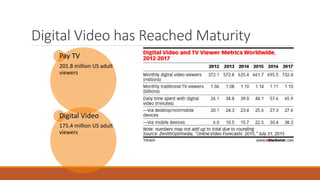
Digital Video has Reached Maturity
Pay TV
201.8 million US adult
viewers
Digital Video
175.4 million US adult
viewers
Broadband-only Homes Growing and
Adopting OTT Services
Growth of broadband only homes
◦ 9% of U.S. population in 2013
◦ 15% of U.S. population in 2017
◦ Approximately 17 million broadband-only homes
63% of U.S. broadband households subscribe to at least one OTT service
31% of U.S. broadband homes have multiple OTT service subscriptions
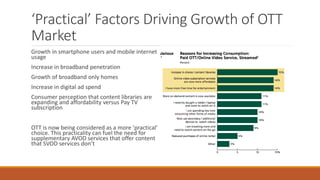
‘Practical’ Factors Driving Growth of OTT
Market
Growth in smartphone users and mobile internet
usage
Increase in broadband penetration
Growth of broadband only homes
Increase in digital ad spend
Consumer perception that content libraries are
expanding and affordability versus Pay TV
subscription
OTT is now being considered as a more ‘practical’
choice. This practicality can fuel the need for
supplementary AVOD services that offer content
that SVOD services don’t
OTT Market Landscape Germinating
Multiple Business Models
OTT market is growing 20% annually
Pay TV revenues only growing 2% annually
AVOD
◦ Free to air, advertiser supported
◦ Premium video content
◦ Digital content created by digital creators
TVOD
◦ Digital rentals and purchases
◦ Apple iTunes’ store
SVOD
◦ Monthly fee for access to content library
◦ Netflix, Amazon Prime Video
DVMPD
◦ Subscription services that replicate traditional
cable bundle in a digital context
◦ Sling TV, Playstation Vue, DirecTV Now
Growth being Captured by AVOD and
SVOD
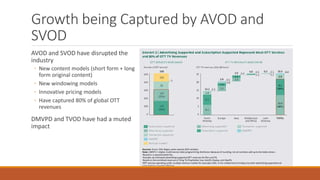
AVOD and SVOD have disrupted the
industry
◦ New content models (short form + long
form original content)
◦ New windowing models
◦ Innovative pricing models
◦ Have captured 80% of global OTT
revenues
DMVPD and TVOD have had a muted
impact
SVOD Services Growth Projection
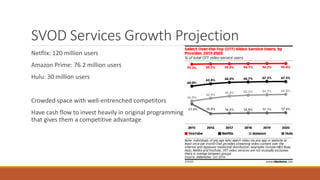
Netflix: 120 million users
Amazon Prime: 76.2 million users
Hulu: 30 million users
Crowded space with well-entrenched competitors
Have cash flow to invest heavily in original programming
that gives them a competitive advantage
Original Content Driving OTT Growth
Primary growth driver for Netflix, Amazon & Hulu
Has allowed HBO and Showtime to also make a mark in the OTT market
Critical to demonstrate value to the consumer to continue paying monthly subscription fee
Netflix subscriber trends (churn and additions) correlate with shows getting phased
out/launched
AVOD Riding on Growth of Online Video
Advertising
Boston Consulting Group projects that global online
advertising expenditures are expected to increase 34.5%
from $15.3 billion in 2015 to $34.5 billion in 2018
Lack of premium video inventory for advertisers
◦ YouTube still dominated by creator content
◦ Hulu has pivoted away from AVOD
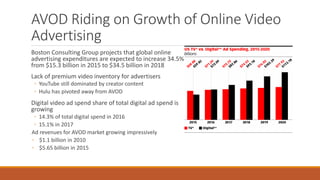
Digital video ad spend share of total digital ad spend is
growing
◦ 14.3% of total digital spend in 2016
◦ 15.1% in 2017
Ad revenues for AVOD market growing impressively
◦ $1.1 billion in 2010
◦ $5.65 billion in 2015
Advertising Buying Trends: Programmatic
Growing but Direct Sales Dominant
Programmatic growing but still a very small share
◦ Automated Transaction Models grew (+64% YOY)
◦ Low percentage of overall premium video ad sales in the U.S. (11.4%)
Factors behind this: -
◦ Strong direct sales across the premium video economy
◦ Restrictions on targeting and tracking in certain environments like OTT
◦ Risk factors related to managing user experience from Automated Transaction Models
Long form content dominant driver of ad views
◦ 41% share of ad views (FreeWheel report Q3 2016)
Advertising Consumer Receptiveness:
Differs from Display Digital Advertising
Online video viewers less receptive than live TV viewers
◦ 19% of online video viewers responded favourably to ads compared to 27% for live TV viewers
◦ Probably biased by the fact that online video was on-demand while TV is more linear, lean-back
More open to interest-based ads as opposed to re-targeting
◦ 41%of people responded favorably to ads tailored to their interests
◦ Only 25% liked ads that tracked their browsing history like a retargeted promo
Stats based on study by Millward Brown
Facebook’s Shift from Live Video to Long-
form Video Content
Change in algorithm to give preference to long-form videos with higher completion rate
Testing mid-roll ads
Testing new video-only tab
Rumored to be in talks with studios and producers about licensing exclusive shows to Facebook
Connected TV apps for Apple TV and Chromecast
Facebook is more interested in the YouTube model of collecting tons of quick video clips than
investing in long-form shows or films like Netflix
Looking to build a wide range of content by paying content creators and sharing revenue
Ultimate aim to attract ‘episodic content’ similar to YouTube where creators regularly post
videos
DirecTV Now more of a DMVPD
To stem subscriber losses for DirecTV pay TV service
Added 200,000 subscribers in first month of operations
Buoyed by introductory price offer of $35 per month
Unlikely to cannibalize growth of SVOD or AVOD services given the differing value propositions
◦ DirecTV Now: cheaper alternative to Pay TV
◦ SVOD: Access to exclusive content for low prices
◦ AVOD: Access to wide content library for no cost, supplementary to SVOD
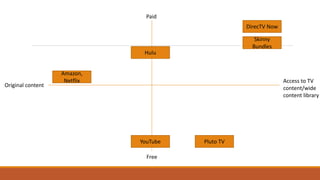
Amazon,
Netflix
Original content
Access to TV
content/wide
content library
Paid
Free
DirecTV Now
Skinny
Bundles
YouTube Pluto TV
Hulu
Connected TV Devices Growth
Projections
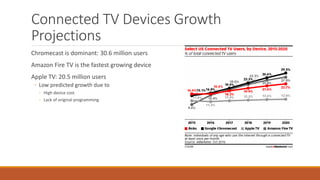
Chromecast is dominant: 30.6 million users
Amazon Fire TV is the fastest growing device
Apple TV: 20.5 million users
◦ Low predicted growth due to
◦ High device cost
◦ Lack of original programming
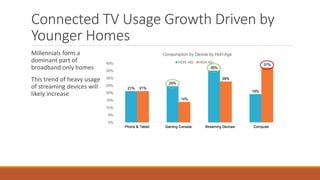
Connected TV Usage Growth Driven by
Younger Homes
Millennials form a
dominant part of
broadband only homes
This trend of heavy usage
of streaming devices will
likely increase
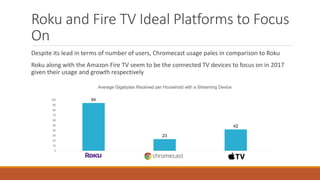
Roku and Fire TV Ideal Platforms to Focus
On
Despite its lead in terms of number of users, Chromecast usage pales in comparison to Roku
Roku along with the Amazon Fire TV seem to be the connected TV devices to focus on in 2017
given their usage and growth respectively
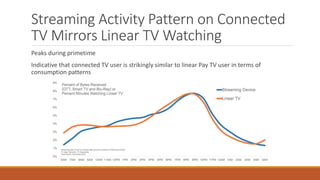
Streaming Activity Pattern on Connected
TV Mirrors Linear TV Watching
Peaks during primetime
Indicative that connected TV user is strikingly similar to linear Pay TV user in terms of
consumption patterns
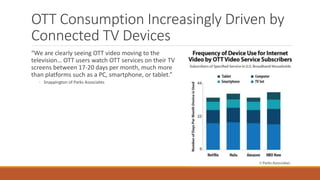
OTT Consumption Increasingly Driven by
Connected TV Devices
“We are clearly seeing OTT video moving to the
television… OTT users watch OTT services on their TV
screens between 17-20 days per month, much more
than platforms such as a PC, smartphone, or tablet.”
◦ Snappington of Parks Associates
Widening Gap in TV Consumption
Amongst Age Groups
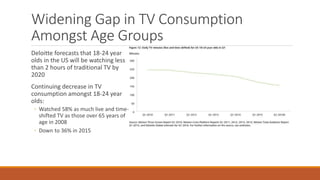
Deloitte forecasts that 18-24 year
olds in the US will be watching less
than 2 hours of traditional TV by
2020
Continuing decrease in TV
consumption amongst 18-24 year
olds:
◦ Watched 58% as much live and time-
shifted TV as those over 65 years of
age in 2008
◦ Down to 36% in 2015
Future Growth in Multiple SVOD
Subscriptions
Digital TV Research has forecasted that the average U.S. SVOD user will pay for 1.33
subscriptions
◦ Implies multiple SVOD subscription
12 % of broadband-only households subscribe to Netflix and Amazon Prime
SVOD Broadband-only Homes Consume
More Devices, Platforms
More affluent customers
◦ Nearly half of homes with SVOD access have a yearly household income of more than $75,000
Heavier users of technology
◦ U.S. households with SVOD subscriptions spend nearly 50 minutes more per day using TV-connected
technology than does the typical U.S. household
◦ Average 10 more minutes daily watching time-shifted TV and double that in terms of time spent using a
multimedia device (such as Apple TV and Roku) than a typical TV home
Clearly they have an appetite to consumer more content, devices and platforms
Key Takeout
Two key growth drivers
◦ Original content
◦ Free access to content library that supplements SVOD services
Connected TV devices growing particularly in millennial homes, mirror behavior of traditional TV
viewer
Relative dearth of premium video inventory for advertisers
YouTube and Facebook video platforms increasingly embracing long-form video content to capture
these ad dollars
◦ Facebook live broadcasts
◦ YouTube skinny bundle
Emerging picture of broadband-only homes depicts multiple subscriptions, devices, platforms
Opportunity for a service that is free and provides access to TV content and a wide content library

OTT Market Analysis

  • 1.
    OTT Market Analysis EMERGINGPATTERNS AND OPPORTUNITIES ROHAN PANJIAR
  • 2.
    Digital Video hasReached Maturity Pay TV 201.8 million US adult viewers Digital Video 175.4 million US adult viewers
  • 3.
    Broadband-only Homes Growingand Adopting OTT Services Growth of broadband only homes ◦ 9% of U.S. population in 2013 ◦ 15% of U.S. population in 2017 ◦ Approximately 17 million broadband-only homes 63% of U.S. broadband households subscribe to at least one OTT service 31% of U.S. broadband homes have multiple OTT service subscriptions
  • 4.
    ‘Practical’ Factors DrivingGrowth of OTT Market Growth in smartphone users and mobile internet usage Increase in broadband penetration Growth of broadband only homes Increase in digital ad spend Consumer perception that content libraries are expanding and affordability versus Pay TV subscription OTT is now being considered as a more ‘practical’ choice. This practicality can fuel the need for supplementary AVOD services that offer content that SVOD services don’t
  • 5.
    OTT Market LandscapeGerminating Multiple Business Models OTT market is growing 20% annually Pay TV revenues only growing 2% annually AVOD ◦ Free to air, advertiser supported ◦ Premium video content ◦ Digital content created by digital creators TVOD ◦ Digital rentals and purchases ◦ Apple iTunes’ store SVOD ◦ Monthly fee for access to content library ◦ Netflix, Amazon Prime Video DVMPD ◦ Subscription services that replicate traditional cable bundle in a digital context ◦ Sling TV, Playstation Vue, DirecTV Now
  • 6.
    Growth being Capturedby AVOD and SVOD AVOD and SVOD have disrupted the industry ◦ New content models (short form + long form original content) ◦ New windowing models ◦ Innovative pricing models ◦ Have captured 80% of global OTT revenues DMVPD and TVOD have had a muted impact
  • 7.
    SVOD Services GrowthProjection Netflix: 120 million users Amazon Prime: 76.2 million users Hulu: 30 million users Crowded space with well-entrenched competitors Have cash flow to invest heavily in original programming that gives them a competitive advantage
  • 8.
    Original Content DrivingOTT Growth Primary growth driver for Netflix, Amazon & Hulu Has allowed HBO and Showtime to also make a mark in the OTT market Critical to demonstrate value to the consumer to continue paying monthly subscription fee Netflix subscriber trends (churn and additions) correlate with shows getting phased out/launched
  • 9.
    AVOD Riding onGrowth of Online Video Advertising Boston Consulting Group projects that global online advertising expenditures are expected to increase 34.5% from $15.3 billion in 2015 to $34.5 billion in 2018 Lack of premium video inventory for advertisers ◦ YouTube still dominated by creator content ◦ Hulu has pivoted away from AVOD Digital video ad spend share of total digital ad spend is growing ◦ 14.3% of total digital spend in 2016 ◦ 15.1% in 2017 Ad revenues for AVOD market growing impressively ◦ $1.1 billion in 2010 ◦ $5.65 billion in 2015
  • 10.
    Advertising Buying Trends:Programmatic Growing but Direct Sales Dominant Programmatic growing but still a very small share ◦ Automated Transaction Models grew (+64% YOY) ◦ Low percentage of overall premium video ad sales in the U.S. (11.4%) Factors behind this: - ◦ Strong direct sales across the premium video economy ◦ Restrictions on targeting and tracking in certain environments like OTT ◦ Risk factors related to managing user experience from Automated Transaction Models Long form content dominant driver of ad views ◦ 41% share of ad views (FreeWheel report Q3 2016)
  • 11.
    Advertising Consumer Receptiveness: Differsfrom Display Digital Advertising Online video viewers less receptive than live TV viewers ◦ 19% of online video viewers responded favourably to ads compared to 27% for live TV viewers ◦ Probably biased by the fact that online video was on-demand while TV is more linear, lean-back More open to interest-based ads as opposed to re-targeting ◦ 41%of people responded favorably to ads tailored to their interests ◦ Only 25% liked ads that tracked their browsing history like a retargeted promo Stats based on study by Millward Brown
  • 12.
    Facebook’s Shift fromLive Video to Long- form Video Content Change in algorithm to give preference to long-form videos with higher completion rate Testing mid-roll ads Testing new video-only tab Rumored to be in talks with studios and producers about licensing exclusive shows to Facebook Connected TV apps for Apple TV and Chromecast Facebook is more interested in the YouTube model of collecting tons of quick video clips than investing in long-form shows or films like Netflix Looking to build a wide range of content by paying content creators and sharing revenue Ultimate aim to attract ‘episodic content’ similar to YouTube where creators regularly post videos
  • 13.
    DirecTV Now moreof a DMVPD To stem subscriber losses for DirecTV pay TV service Added 200,000 subscribers in first month of operations Buoyed by introductory price offer of $35 per month Unlikely to cannibalize growth of SVOD or AVOD services given the differing value propositions ◦ DirecTV Now: cheaper alternative to Pay TV ◦ SVOD: Access to exclusive content for low prices ◦ AVOD: Access to wide content library for no cost, supplementary to SVOD
  • 14.
    Amazon, Netflix Original content Access toTV content/wide content library Paid Free DirecTV Now Skinny Bundles YouTube Pluto TV Hulu
  • 15.
    Connected TV DevicesGrowth Projections Chromecast is dominant: 30.6 million users Amazon Fire TV is the fastest growing device Apple TV: 20.5 million users ◦ Low predicted growth due to ◦ High device cost ◦ Lack of original programming
  • 16.
    Connected TV UsageGrowth Driven by Younger Homes Millennials form a dominant part of broadband only homes This trend of heavy usage of streaming devices will likely increase
  • 17.
    Roku and FireTV Ideal Platforms to Focus On Despite its lead in terms of number of users, Chromecast usage pales in comparison to Roku Roku along with the Amazon Fire TV seem to be the connected TV devices to focus on in 2017 given their usage and growth respectively
  • 18.
    Streaming Activity Patternon Connected TV Mirrors Linear TV Watching Peaks during primetime Indicative that connected TV user is strikingly similar to linear Pay TV user in terms of consumption patterns
  • 19.
    OTT Consumption IncreasinglyDriven by Connected TV Devices “We are clearly seeing OTT video moving to the television… OTT users watch OTT services on their TV screens between 17-20 days per month, much more than platforms such as a PC, smartphone, or tablet.” ◦ Snappington of Parks Associates
  • 20.
    Widening Gap inTV Consumption Amongst Age Groups Deloitte forecasts that 18-24 year olds in the US will be watching less than 2 hours of traditional TV by 2020 Continuing decrease in TV consumption amongst 18-24 year olds: ◦ Watched 58% as much live and time- shifted TV as those over 65 years of age in 2008 ◦ Down to 36% in 2015
  • 21.
    Future Growth inMultiple SVOD Subscriptions Digital TV Research has forecasted that the average U.S. SVOD user will pay for 1.33 subscriptions ◦ Implies multiple SVOD subscription 12 % of broadband-only households subscribe to Netflix and Amazon Prime
  • 22.
    SVOD Broadband-only HomesConsume More Devices, Platforms More affluent customers ◦ Nearly half of homes with SVOD access have a yearly household income of more than $75,000 Heavier users of technology ◦ U.S. households with SVOD subscriptions spend nearly 50 minutes more per day using TV-connected technology than does the typical U.S. household ◦ Average 10 more minutes daily watching time-shifted TV and double that in terms of time spent using a multimedia device (such as Apple TV and Roku) than a typical TV home Clearly they have an appetite to consumer more content, devices and platforms
  • 23.
    Key Takeout Two keygrowth drivers ◦ Original content ◦ Free access to content library that supplements SVOD services Connected TV devices growing particularly in millennial homes, mirror behavior of traditional TV viewer Relative dearth of premium video inventory for advertisers YouTube and Facebook video platforms increasingly embracing long-form video content to capture these ad dollars ◦ Facebook live broadcasts ◦ YouTube skinny bundle Emerging picture of broadband-only homes depicts multiple subscriptions, devices, platforms Opportunity for a service that is free and provides access to TV content and a wide content library