
PRESENTED BY:-
SOURABH BHATTACHARYA
FINAL YEAR ECE
1.HISTORY
 1 JULY 2005
GOOGLE ACQUIRED Android Inc.
 5 Nov 2007
Open handset alliance format.
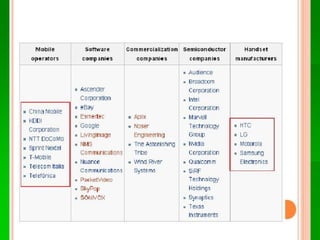
Google, HTC ,INTEL,MOTORLA,T –MOBILE.
Android is the OHA first product
 12 Nov 2007
OHA released a preview of the Android OHA
 Android is a software stack for mobile devices
that includes an operating system middleware and
key applications.
 A complete & modem embedded operating
system.
2.What is Android ?
Why Android was created?
Full Phone Software stack including
applications.
Designed as a platform for software
development.
100% JAVA Phone.
3.ANDROID FEATURE
 SOFTWARE FEATURES
 HARDWARE FEATURES
 SOFTWARE FEATURES
 SQ LITE for structured data storage.
 Media support for common audio, video, and still image
formats (MPEG4, H.264, MP3, AAC, AMR, JPG, and PNG)..
 Optimized Graphics powered by a custom 2D graphics
library; 3D graphics based on the Open GL ES 1.0
specification .
 HARDWARE FEATURE
 GSM Telephony
 Camera, GPS, compass, and accelerometer.
 Bluetooth, EDGE, 3G, and Wi-Fi.
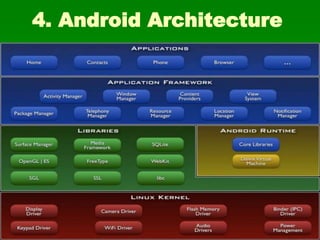
4. Android Architecture
 APPLICATIONS
Android will ship with a set of core
applications including an email client, SMS
program, calendar, maps, browser, contacts,
and others. All applications are written using
the Java programming language.
 FRAMEWORK
 A rich and extensible set of views that can be used to build
an application, including lists, grids, text boxes, buttons, and
even an embeddable web browser.
 Contents provider that enable applications to access data
from other applications (such as Contacts).
 A Resources manager, providing access to non-code
resources such as localized strings, graphics, and layout
files.
 A Notification Manager that enables all applications to
display custom alerts in the status bar.
 An Activity Manager that manages the lifecycle of
 LIBRARIES
Android includes a set of C/C++ libraries used by various
components of the Android system. These capabilities are
exposed to developers through the Android application
framework. Some of the core libraries are listed below:
 System C library - a BSD-derived implementation of the
standard C system library , tuned for embedded Linux-
based devices.
 Media Libraries - based on Packet Video's Open CORE;
the libraries support playback and recording of many
popular audio and video formats, as well as static image
files, including MPEG4, H.264, MP3, AAC, AMR, JPG,
and PNG.
 LINUX KERNEL
 Android relies on Linux version 2.6 for core
system services such as security, memory
management, process management, network stack,
and driver model. The kernel also acts as an
abstraction layer between the hardware and the rest
of the software stack
5. ANDROID RUNTIME
 JAVA Language is used.
 Every Android application runs in its own
process.
 Files in (.dex) format.
6. DEVELOPMENT TOOLS
An Android SDK includes a variety of customer tools
that help you develop mobile applications on the
Android platform. Three of the most significant tools
are:-
 Virtual Mobile device.
 Eclipse IDE.
 DALVIKE.
7.ANDROID SDK
Step to set up the Android SDK.
 Prepare your development computer and ensure it meets the
system requirements.
 Install the SDK starter package from the table above.
 Install the ADT Plug-in for Eclipse.
 Add Android platforms and other packages to your SDK.
 Explore the contents of the Android SDK
8. CONCLUSION
 Android is open to all : industry, developers
and users.
 Participating in may of the successful open
source Projects.
 Google Android is stepping into the next
level of mobile internet.
Presentation2

Presentation2

  • 1.
  • 2.
    1.HISTORY  1 JULY2005 GOOGLE ACQUIRED Android Inc.  5 Nov 2007 Open handset alliance format. Google, HTC ,INTEL,MOTORLA,T –MOBILE. Android is the OHA first product  12 Nov 2007 OHA released a preview of the Android OHA
  • 4.
     Android isa software stack for mobile devices that includes an operating system middleware and key applications.  A complete & modem embedded operating system. 2.What is Android ?
  • 5.
    Why Android wascreated? Full Phone Software stack including applications. Designed as a platform for software development. 100% JAVA Phone.
  • 6.
    3.ANDROID FEATURE  SOFTWAREFEATURES  HARDWARE FEATURES
  • 7.
     SOFTWARE FEATURES SQ LITE for structured data storage.  Media support for common audio, video, and still image formats (MPEG4, H.264, MP3, AAC, AMR, JPG, and PNG)..  Optimized Graphics powered by a custom 2D graphics library; 3D graphics based on the Open GL ES 1.0 specification .
  • 8.
     HARDWARE FEATURE GSM Telephony  Camera, GPS, compass, and accelerometer.  Bluetooth, EDGE, 3G, and Wi-Fi.
  • 10.
  • 11.
     APPLICATIONS Android willship with a set of core applications including an email client, SMS program, calendar, maps, browser, contacts, and others. All applications are written using the Java programming language.
  • 12.
     FRAMEWORK  Arich and extensible set of views that can be used to build an application, including lists, grids, text boxes, buttons, and even an embeddable web browser.  Contents provider that enable applications to access data from other applications (such as Contacts).  A Resources manager, providing access to non-code resources such as localized strings, graphics, and layout files.  A Notification Manager that enables all applications to display custom alerts in the status bar.  An Activity Manager that manages the lifecycle of
  • 13.
     LIBRARIES Android includesa set of C/C++ libraries used by various components of the Android system. These capabilities are exposed to developers through the Android application framework. Some of the core libraries are listed below:  System C library - a BSD-derived implementation of the standard C system library , tuned for embedded Linux- based devices.  Media Libraries - based on Packet Video's Open CORE; the libraries support playback and recording of many popular audio and video formats, as well as static image files, including MPEG4, H.264, MP3, AAC, AMR, JPG, and PNG.
  • 14.
     LINUX KERNEL Android relies on Linux version 2.6 for core system services such as security, memory management, process management, network stack, and driver model. The kernel also acts as an abstraction layer between the hardware and the rest of the software stack
  • 16.
    5. ANDROID RUNTIME JAVA Language is used.  Every Android application runs in its own process.  Files in (.dex) format.
  • 17.
    6. DEVELOPMENT TOOLS AnAndroid SDK includes a variety of customer tools that help you develop mobile applications on the Android platform. Three of the most significant tools are:-  Virtual Mobile device.  Eclipse IDE.  DALVIKE.
  • 18.
    7.ANDROID SDK Step toset up the Android SDK.  Prepare your development computer and ensure it meets the system requirements.  Install the SDK starter package from the table above.  Install the ADT Plug-in for Eclipse.  Add Android platforms and other packages to your SDK.  Explore the contents of the Android SDK
  • 19.
    8. CONCLUSION  Androidis open to all : industry, developers and users.  Participating in may of the successful open source Projects.  Google Android is stepping into the next level of mobile internet.