FLORISTIC STUDY OF BENTHIC ALGAE OF
TELOK GONG, MELAKA
PREPARED BY:
NOR ADIBAH BINTI RAMLI (P80090)
SUPERVISOR:
PROF MADYA DR AHMAD BIN ISMAIL
INTRODUCTION
• As a key space occupiers of rocky shores and interact
with other organism; hence play a key role in overall
coastal biodiversity (Satheesh & Wesley 2012).
• Melaka has few publication and research of benthic
algae
• Telok Gong is chosen because there are no research
conducted in this area.
OBJECTIVES:
1. To determine the diversity and distribution of benthic algae in
Telok Gong, Melaka.
2. To investigate the temporal and spatial distribution pattern of
benthic algae in Telok Gong, Melaka.
3. To identify the benthic algae that dominates in Telok Gong,
Melaka.
4. To generate identification key of benthic algae from genus up to
species level.
LITERATURE REVIEW
DEFINITIONS OF
BENTHIC ALGAE
PRESCOTT (1968) AHMAD (1995) LEE (1980)
• Lower plant
• Non-vascular
• Firstly introduced
by Linnaeus (1754)
• Latin - seaweeds
• Thallophytes
• Chlorophyll ‘a’ as
photosynthetic
pigment
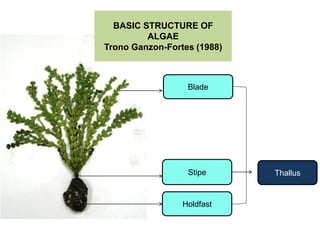
BASIC STRUCTURE OF
ALGAE
Trono Ganzon-Fortes (1988)
Blade
Stipe
Holdfast
Thallus
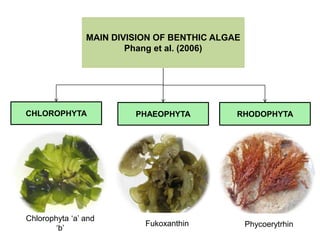
MAIN DIVISION OF BENTHIC ALGAE
Phang et al. (2006)
CHLOROPHYTA RHODOPHYTAPHAEOPHYTA
Chlorophyta ‘a’ and
‘b’
Fukoxanthin Phycoerytrhin
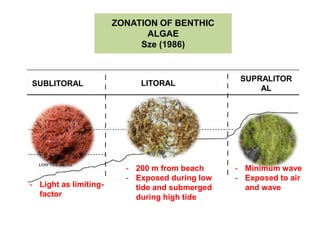
ZONATION OF BENTHIC
ALGAE
Sze (1986)
SUBLITORAL LITORAL
SUPRALITOR
AL
I
I
I
I
I
I
I
I
I
I
I
I
I
I
I
I
I
I
I
I
I
I- 200 m from beach
- Exposed during low
tide and submerged
during high tide
- Minimum wave
- Exposed to air
and wave- Light as limiting-
factor
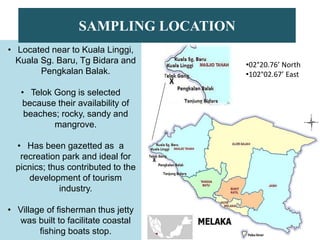
• Located near to Kuala Linggi,
Kuala Sg. Baru, Tg Bidara and
Pengkalan Balak.
• Telok Gong is selected
because their availability of
beaches; rocky, sandy and
mangrove.
• Has been gazetted as a
recreation park and ideal for
picnics; thus contributed to the
development of tourism
industry.
• Village of fisherman thus jetty
was built to facilitate coastal
fishing boats stop.
SAMPLING LOCATION
•02°20.76’ North
•102°02.67’ East
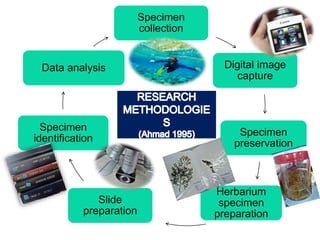
Specimen
collection
Digital image
capture
Specimen
preservation
Herbarium
specimen
preparation
Slide
preparation
Specimen
identification
Data analysis
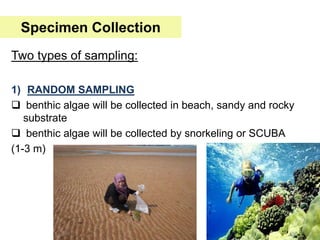
Two types of sampling:
1) RANDOM SAMPLING
 benthic algae will be collected in beach, sandy and rocky
substrate
 benthic algae will be collected by snorkeling or SCUBA
(1-3 m)
Specimen Collection
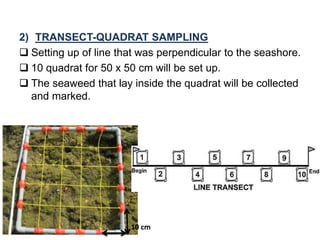
2) TRANSECT-QUADRAT SAMPLING
 Setting up of line that was perpendicular to the seashore.
 10 quadrat for 50 x 50 cm will be set up.
 The seaweed that lay inside the quadrat will be collected
and marked.
10 cm
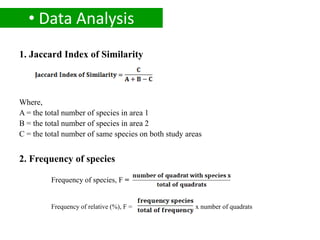
• Data Analysis
1. Jaccard Index of Similarity
Where,
A = the total number of species in area 1
B = the total number of species in area 2
C = the total number of same species on both study areas
2. Frequency of species
Frequency of species, F =
Frequency of relative (%), F = x number of quadrats
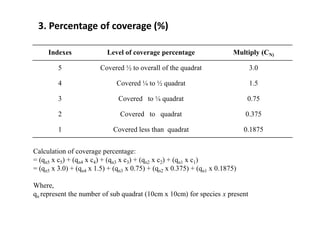
3. Percentage of coverage (%)
Indexes Level of coverage percentage Multiply (CN)
5 Covered ½ to overall of the quadrat 3.0
4 Covered ¼ to ½ quadrat 1.5
3 Covered to ¼ quadrat 0.75
2 Covered to quadrat 0.375
1 Covered less than quadrat 0.1875
Calculation of coverage percentage:
= (qn5 x c5) + (qn4 x c4) + (qn3 x c3) + (qn2 x c2) + (qn1 x c1)
= (qn5 x 3.0) + (qn4 x 1.5) + (qn3 x 0.75) + (qn2 x 0.375) + (qn1 x 0.1875)
Where,
qn represent the number of sub quadrat (10cm x 10cm) for species x present
RESULT AND DISCUSSIONS
a) FLORISTIC STUDY
b) TEMPORAL & SPATIAL
c) RELATIVE FREQUENCY & COVERAGE
d) SIMILARITY OF SPECIES
e) IDENTIFICATION OF SPECIES
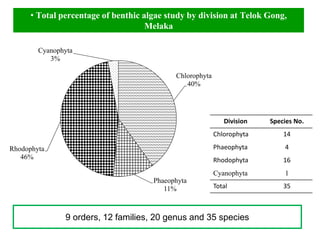
Chlorophyta
40%
Phaeophyta
11%
Rhodophyta
46%
Cyanophyta
3%
Division Species No.
Chlorophyta 14
Phaeophyta 4
Rhodophyta 16
Cyanophyta 1
Total 35
• Total percentage of benthic algae study by division at Telok Gong,
Melaka
9 orders, 12 families, 20 genus and 35 species
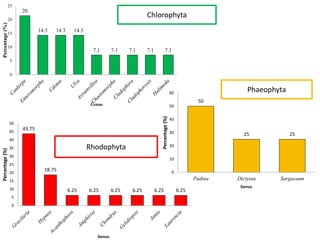
20
14.3 14.3 14.3
7.1 7.1 7.1 7.1 7.1
0
5
10
15
20
25Percentage(%)
Genus
50
25 25
0
10
20
30
40
50
60
Padina Dictyota Sargassum
Percentage(%)
Genus
43.75
18.75
6.25 6.25 6.25 6.25 6.25 6.25
0
5
10
15
20
25
30
35
40
45
50
Percentage(%)
Genus
Chlorophyta
Phaeophyta
Rhodophyta
43.5
13.6
39.1
4.3
31.8
0
63.6
4.5
35.7
7.1
50
7.1
0
10
20
30
40
50
60
70
Chlorophyta Phaeophyta Rhodophyta Cyanophyta
Percentage(%)
Division
May Aug Oct
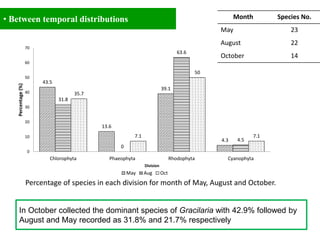
• Between temporal distributions
Percentage of species in each division for month of May, August and October.
Month Species No.
May 23
August 22
October 14
In October collected the dominant species of Gracilaria with 42.9% followed by
August and May recorded as 31.8% and 21.7% respectively
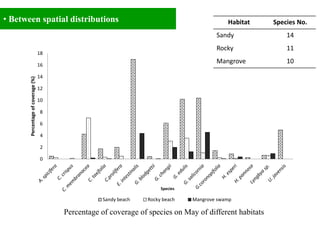
• Between spatial distributions
0
2
4
6
8
10
12
14
16
18
Percentageofcoverage(%)
Species
Sandy beach Rocky beach Mangrove swamp
Percentage of coverage of species on May of different habitats
Habitat Species No.
Sandy 14
Rocky 11
Mangrove 10
0
10
20
30
40
50
60
Percentageofcoverage(%)
Species
Sandy beach Rocky beach Mangrove swamp
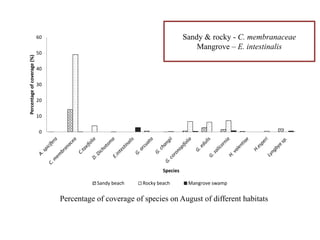
Percentage of coverage of species on August of different habitats
Sandy & rocky - C. membranaceae
Mangrove – E. intestinalis
0
2
4
6
8
10
12
14Percentageofcoverage(%)
Species
Sandy beach Rocky beach Mangrove swamp
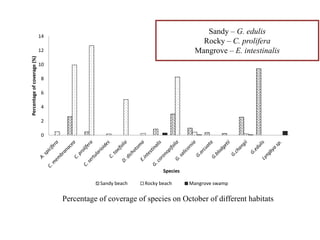
Percentage of coverage of species on October of different habitats
Sandy – G. edulis
Rocky – C. prolifera
Mangrove – E. intestinalis
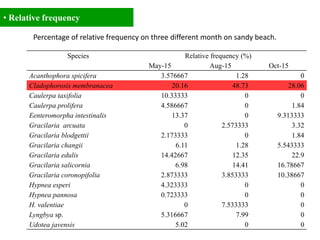
• Relative frequency
Species Relative frequency (%)
May-15 Aug-15 Oct-15
Acanthophora spicifera 3.576667 1.28 0
Cladophorosis membranacea 20.16 48.73 28.06
Caulerpa taxifolia 10.33333 0 0
Caulerpa prolifera 4.586667 0 1.84
Eenteromorpha intestinalis 13.37 0 9.313333
Gracilaria arcuata 0 2.573333 3.32
Gracilaria blodgettii 2.173333 0 1.84
Gracilaria changii 6.11 1.28 5.543333
Gracilaria edulis 14.42667 12.35 22.9
Gracilaria salicornia 6.98 14.41 16.78667
Gracilaria coronopifolia 2.873333 3.853333 10.38667
Hypnea esperi 4.323333 0 0
Hypnea pannosa 0.723333 0 0
H. valentiae 0 7.533333 0
Lyngbya sp. 5.316667 7.99 0
Udotea javensis 5.02 0 0
Percentage of relative frequency on three different month on sandy beach.
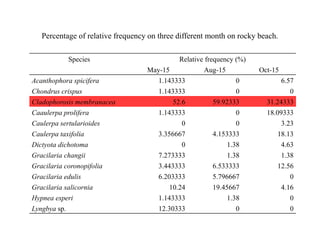
Species Relative frequency (%)
May-15 Aug-15 Oct-15
Acanthophora spicifera 1.143333 0 6.57
Chondrus crispus 1.143333 0 0
Cladophorosis membranacea 52.6 59.92333 31.24333
Caaulerpa prolifera 1.143333 0 18.09333
Caulerpa sertularioides 0 0 3.23
Caulerpa taxifolia 3.356667 4.153333 18.13
Dictyota dichotoma 0 1.38 4.63
Gracilaria changii 7.273333 1.38 1.38
Gracilaria coronopifolia 3.443333 6.533333 12.56
Gracilaria edulis 6.203333 5.796667 0
Gracilaria salicornia 10.24 19.45667 4.16
Hypnea esperi 1.143333 1.38 0
Lyngbya sp. 12.30333 0 0
Percentage of relative frequency on three different month on rocky beach.
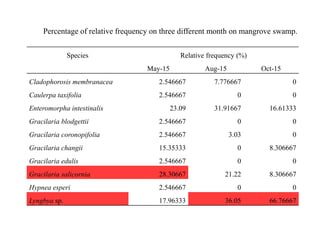
Species Relative frequency (%)
May-15 Aug-15 Oct-15
Cladophorosis membranacea 2.546667 7.776667 0
Caulerpa taxifolia 2.546667 0 0
Enteromorpha intestinalis 23.09 31.91667 16.61333
Gracilaria blodgettii 2.546667 0 0
Gracilaria coronopifolia 2.546667 3.03 0
Gracilaria changii 15.35333 0 8.306667
Gracilaria edulis 2.546667 0 0
Gracilaria salicornia 28.30667 21.22 8.306667
Hypnea esperi 2.546667 0 0
Lyngbya sp. 17.96333 36.05 66.76667
Percentage of relative frequency on three different month on mangrove swamp.
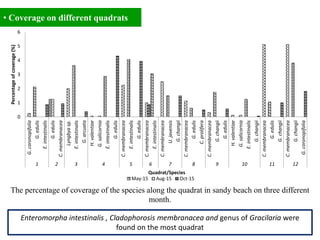
• Coverage on different quadrats
0
1
2
3
4
5
6
G.coronopifolia
G.edulis
E.intestinalis
G.edulis
C.membranacea
Lyngbyasp.
E.intestinalis
G.arcuata
H.valentiae
G.salicornia
E.intestinalis
G.edulis
C.membranacea
E.intestinalis
G.edulis
C.membranacea
E.intestinalis
C.membranacea
U.javensis
G.changii
C.membranacea
G.edulis
C.prolifera
C.membranacea
G.changii
G.edulis
H.valentiae
G.salicornia
E.intestinalis
G.changii
C.membranacea
G.edulis
G.changii
C.membranacea
G.changii
G.coronopifolia
1 2 3 4 5 6 7 8 9 10 11 12
Percentageofcoverage(%)
Quadrat/Species
May-15 Aug-15 Oct-15
Enteromorpha intestinalis , Cladophorosis membranacea and genus of Gracilaria were
found on the most quadrat
The percentage of coverage of the species along the quadrat in sandy beach on three different
month.
0
2
4
6
8
10
12
14
C.membranacea
G.coronopifolia
C.membranacea
G.coronopifolia
C.membranacea
C.membranacea
G.salicornia
C.membranacea
Lyngbyasp.
C.taxifolia
G.salicornia
C.membranacea
C.prolifera
G.edulis
C.membranacea
C.taxifolia
G.coronopifolia
C.membranacea
G.coronopifolia
C.taxifolia
G.edulis
C.prolifera
C.membranacea
G.changii
C.prolifera
C.membranacea
G.edulis
G.coronopifolia
C.membranacea
1 2 3 4 5 6 7 8 9 10 11 12
Percentageofcoverage(%)
Quadrat/Species
May-15 Aug-15 Oct-15
The percentage of coverage of the species along the quadrat in rocky beach on three different
month.
Cladophorosis membranacea was found on the most quadrat
0
0.2
0.4
0.6
0.8
1
1.2
1.4
1.6
1.8
2
E.intestinalis
Lyngbyasp.
E.intestinalis
G.changii
G.coronopifolia
G.salicornia
Lyngbyasp.
G.salicornia
E.intestinalis
H.esperi
E.intestinalis
Lyngbyasp.
Lyngbyasp.
G.changii
Lyngbyasp.
G.salicornia
G.edulis
G.salicornia
G.salicornia
E.intestinalis
C.membranaceae
E.intestinalis
1 2 3 4 5 6 7 8 9 10 11 12
Percentageofcoverage(%)
Quadrat/Species
May-15 Aug-15 Oct-15
The percentage of coverage of the species along the quadrat in mangrove swamp on three
different month
Enteromorpha intestinalis, Lyngbya sp. and genus of Gracilaria was found on the most
quadrat
• Similarity of species
Location Telok Gong
(2015)
Pulau Besar
(2004)
Pulau
Merambong
(2013)
Pulau
Langkawi
(2014)
Pulau Tioman
(2012)
Telok Gong -
Pulau Besar 24.07 -
Pulau Merambong 26.79 11.86 -
Pulau Langkawi 23.40 10.42 23.91 -
Pulau Tioman 20.31 10.77 16.92 21.15 -
The percentage value of Jaccard Index of Similarity for present and previous studies
15 same species
CONCLUSION
• Total: 9 orders, 12 families, 20 genus and 35 species
: Chlorophyta (14 sp.), Pheophyta (4 sp.), Rhodophyta (16 sp.)
and Cyanophyta (1 sp.)
• Temporal: May (23 sp.), August (22 sp.) and October (14 sp.).
: Gracilaria was dominant species in all three month
• Spatial: Sandy (14 sp.), Rocky (11 sp.) and Mangrove (10 sp.).
• Percentage coverage and relative frequency: Cladophorosis
membranaceae was the abundant and dominant species.
• Jaccard’s Index Similarity: The highest value is 26.79% between Telok
Gong (2016) and Pulau Merambong (2013).
THANK YOU

Presentation1

  • 1.
    FLORISTIC STUDY OFBENTHIC ALGAE OF TELOK GONG, MELAKA PREPARED BY: NOR ADIBAH BINTI RAMLI (P80090) SUPERVISOR: PROF MADYA DR AHMAD BIN ISMAIL
  • 2.
    INTRODUCTION • As akey space occupiers of rocky shores and interact with other organism; hence play a key role in overall coastal biodiversity (Satheesh & Wesley 2012). • Melaka has few publication and research of benthic algae • Telok Gong is chosen because there are no research conducted in this area.
  • 3.
    OBJECTIVES: 1. To determinethe diversity and distribution of benthic algae in Telok Gong, Melaka. 2. To investigate the temporal and spatial distribution pattern of benthic algae in Telok Gong, Melaka. 3. To identify the benthic algae that dominates in Telok Gong, Melaka. 4. To generate identification key of benthic algae from genus up to species level.
  • 4.
    LITERATURE REVIEW DEFINITIONS OF BENTHICALGAE PRESCOTT (1968) AHMAD (1995) LEE (1980) • Lower plant • Non-vascular • Firstly introduced by Linnaeus (1754) • Latin - seaweeds • Thallophytes • Chlorophyll ‘a’ as photosynthetic pigment
  • 5.
    BASIC STRUCTURE OF ALGAE TronoGanzon-Fortes (1988) Blade Stipe Holdfast Thallus
  • 6.
    MAIN DIVISION OFBENTHIC ALGAE Phang et al. (2006) CHLOROPHYTA RHODOPHYTAPHAEOPHYTA Chlorophyta ‘a’ and ‘b’ Fukoxanthin Phycoerytrhin
  • 7.
    ZONATION OF BENTHIC ALGAE Sze(1986) SUBLITORAL LITORAL SUPRALITOR AL I I I I I I I I I I I I I I I I I I I I I I- 200 m from beach - Exposed during low tide and submerged during high tide - Minimum wave - Exposed to air and wave- Light as limiting- factor
  • 8.
    • Located nearto Kuala Linggi, Kuala Sg. Baru, Tg Bidara and Pengkalan Balak. • Telok Gong is selected because their availability of beaches; rocky, sandy and mangrove. • Has been gazetted as a recreation park and ideal for picnics; thus contributed to the development of tourism industry. • Village of fisherman thus jetty was built to facilitate coastal fishing boats stop. SAMPLING LOCATION •02°20.76’ North •102°02.67’ East
  • 9.
  • 10.
    Two types ofsampling: 1) RANDOM SAMPLING  benthic algae will be collected in beach, sandy and rocky substrate  benthic algae will be collected by snorkeling or SCUBA (1-3 m) Specimen Collection
  • 11.
    2) TRANSECT-QUADRAT SAMPLING Setting up of line that was perpendicular to the seashore.  10 quadrat for 50 x 50 cm will be set up.  The seaweed that lay inside the quadrat will be collected and marked. 10 cm
  • 12.
    • Data Analysis 1.Jaccard Index of Similarity Where, A = the total number of species in area 1 B = the total number of species in area 2 C = the total number of same species on both study areas 2. Frequency of species Frequency of species, F = Frequency of relative (%), F = x number of quadrats
  • 13.
    3. Percentage ofcoverage (%) Indexes Level of coverage percentage Multiply (CN) 5 Covered ½ to overall of the quadrat 3.0 4 Covered ¼ to ½ quadrat 1.5 3 Covered to ¼ quadrat 0.75 2 Covered to quadrat 0.375 1 Covered less than quadrat 0.1875 Calculation of coverage percentage: = (qn5 x c5) + (qn4 x c4) + (qn3 x c3) + (qn2 x c2) + (qn1 x c1) = (qn5 x 3.0) + (qn4 x 1.5) + (qn3 x 0.75) + (qn2 x 0.375) + (qn1 x 0.1875) Where, qn represent the number of sub quadrat (10cm x 10cm) for species x present
  • 14.
    RESULT AND DISCUSSIONS a)FLORISTIC STUDY b) TEMPORAL & SPATIAL c) RELATIVE FREQUENCY & COVERAGE d) SIMILARITY OF SPECIES e) IDENTIFICATION OF SPECIES
  • 15.
    Chlorophyta 40% Phaeophyta 11% Rhodophyta 46% Cyanophyta 3% Division Species No. Chlorophyta14 Phaeophyta 4 Rhodophyta 16 Cyanophyta 1 Total 35 • Total percentage of benthic algae study by division at Telok Gong, Melaka 9 orders, 12 families, 20 genus and 35 species
  • 16.
    20 14.3 14.3 14.3 7.17.1 7.1 7.1 7.1 0 5 10 15 20 25Percentage(%) Genus 50 25 25 0 10 20 30 40 50 60 Padina Dictyota Sargassum Percentage(%) Genus 43.75 18.75 6.25 6.25 6.25 6.25 6.25 6.25 0 5 10 15 20 25 30 35 40 45 50 Percentage(%) Genus Chlorophyta Phaeophyta Rhodophyta
  • 17.
    43.5 13.6 39.1 4.3 31.8 0 63.6 4.5 35.7 7.1 50 7.1 0 10 20 30 40 50 60 70 Chlorophyta Phaeophyta RhodophytaCyanophyta Percentage(%) Division May Aug Oct • Between temporal distributions Percentage of species in each division for month of May, August and October. Month Species No. May 23 August 22 October 14 In October collected the dominant species of Gracilaria with 42.9% followed by August and May recorded as 31.8% and 21.7% respectively
  • 18.
    • Between spatialdistributions 0 2 4 6 8 10 12 14 16 18 Percentageofcoverage(%) Species Sandy beach Rocky beach Mangrove swamp Percentage of coverage of species on May of different habitats Habitat Species No. Sandy 14 Rocky 11 Mangrove 10
  • 19.
    0 10 20 30 40 50 60 Percentageofcoverage(%) Species Sandy beach Rockybeach Mangrove swamp Percentage of coverage of species on August of different habitats Sandy & rocky - C. membranaceae Mangrove – E. intestinalis
  • 20.
    0 2 4 6 8 10 12 14Percentageofcoverage(%) Species Sandy beach Rockybeach Mangrove swamp Percentage of coverage of species on October of different habitats Sandy – G. edulis Rocky – C. prolifera Mangrove – E. intestinalis
  • 21.
    • Relative frequency SpeciesRelative frequency (%) May-15 Aug-15 Oct-15 Acanthophora spicifera 3.576667 1.28 0 Cladophorosis membranacea 20.16 48.73 28.06 Caulerpa taxifolia 10.33333 0 0 Caulerpa prolifera 4.586667 0 1.84 Eenteromorpha intestinalis 13.37 0 9.313333 Gracilaria arcuata 0 2.573333 3.32 Gracilaria blodgettii 2.173333 0 1.84 Gracilaria changii 6.11 1.28 5.543333 Gracilaria edulis 14.42667 12.35 22.9 Gracilaria salicornia 6.98 14.41 16.78667 Gracilaria coronopifolia 2.873333 3.853333 10.38667 Hypnea esperi 4.323333 0 0 Hypnea pannosa 0.723333 0 0 H. valentiae 0 7.533333 0 Lyngbya sp. 5.316667 7.99 0 Udotea javensis 5.02 0 0 Percentage of relative frequency on three different month on sandy beach.
  • 22.
    Species Relative frequency(%) May-15 Aug-15 Oct-15 Acanthophora spicifera 1.143333 0 6.57 Chondrus crispus 1.143333 0 0 Cladophorosis membranacea 52.6 59.92333 31.24333 Caaulerpa prolifera 1.143333 0 18.09333 Caulerpa sertularioides 0 0 3.23 Caulerpa taxifolia 3.356667 4.153333 18.13 Dictyota dichotoma 0 1.38 4.63 Gracilaria changii 7.273333 1.38 1.38 Gracilaria coronopifolia 3.443333 6.533333 12.56 Gracilaria edulis 6.203333 5.796667 0 Gracilaria salicornia 10.24 19.45667 4.16 Hypnea esperi 1.143333 1.38 0 Lyngbya sp. 12.30333 0 0 Percentage of relative frequency on three different month on rocky beach.
  • 23.
    Species Relative frequency(%) May-15 Aug-15 Oct-15 Cladophorosis membranacea 2.546667 7.776667 0 Caulerpa taxifolia 2.546667 0 0 Enteromorpha intestinalis 23.09 31.91667 16.61333 Gracilaria blodgettii 2.546667 0 0 Gracilaria coronopifolia 2.546667 3.03 0 Gracilaria changii 15.35333 0 8.306667 Gracilaria edulis 2.546667 0 0 Gracilaria salicornia 28.30667 21.22 8.306667 Hypnea esperi 2.546667 0 0 Lyngbya sp. 17.96333 36.05 66.76667 Percentage of relative frequency on three different month on mangrove swamp.
  • 24.
    • Coverage ondifferent quadrats 0 1 2 3 4 5 6 G.coronopifolia G.edulis E.intestinalis G.edulis C.membranacea Lyngbyasp. E.intestinalis G.arcuata H.valentiae G.salicornia E.intestinalis G.edulis C.membranacea E.intestinalis G.edulis C.membranacea E.intestinalis C.membranacea U.javensis G.changii C.membranacea G.edulis C.prolifera C.membranacea G.changii G.edulis H.valentiae G.salicornia E.intestinalis G.changii C.membranacea G.edulis G.changii C.membranacea G.changii G.coronopifolia 1 2 3 4 5 6 7 8 9 10 11 12 Percentageofcoverage(%) Quadrat/Species May-15 Aug-15 Oct-15 Enteromorpha intestinalis , Cladophorosis membranacea and genus of Gracilaria were found on the most quadrat The percentage of coverage of the species along the quadrat in sandy beach on three different month.
  • 25.
  • 26.
    0 0.2 0.4 0.6 0.8 1 1.2 1.4 1.6 1.8 2 E.intestinalis Lyngbyasp. E.intestinalis G.changii G.coronopifolia G.salicornia Lyngbyasp. G.salicornia E.intestinalis H.esperi E.intestinalis Lyngbyasp. Lyngbyasp. G.changii Lyngbyasp. G.salicornia G.edulis G.salicornia G.salicornia E.intestinalis C.membranaceae E.intestinalis 1 2 34 5 6 7 8 9 10 11 12 Percentageofcoverage(%) Quadrat/Species May-15 Aug-15 Oct-15 The percentage of coverage of the species along the quadrat in mangrove swamp on three different month Enteromorpha intestinalis, Lyngbya sp. and genus of Gracilaria was found on the most quadrat
  • 27.
    • Similarity ofspecies Location Telok Gong (2015) Pulau Besar (2004) Pulau Merambong (2013) Pulau Langkawi (2014) Pulau Tioman (2012) Telok Gong - Pulau Besar 24.07 - Pulau Merambong 26.79 11.86 - Pulau Langkawi 23.40 10.42 23.91 - Pulau Tioman 20.31 10.77 16.92 21.15 - The percentage value of Jaccard Index of Similarity for present and previous studies 15 same species
  • 28.
    CONCLUSION • Total: 9orders, 12 families, 20 genus and 35 species : Chlorophyta (14 sp.), Pheophyta (4 sp.), Rhodophyta (16 sp.) and Cyanophyta (1 sp.) • Temporal: May (23 sp.), August (22 sp.) and October (14 sp.). : Gracilaria was dominant species in all three month • Spatial: Sandy (14 sp.), Rocky (11 sp.) and Mangrove (10 sp.). • Percentage coverage and relative frequency: Cladophorosis membranaceae was the abundant and dominant species. • Jaccard’s Index Similarity: The highest value is 26.79% between Telok Gong (2016) and Pulau Merambong (2013).
  • 29.