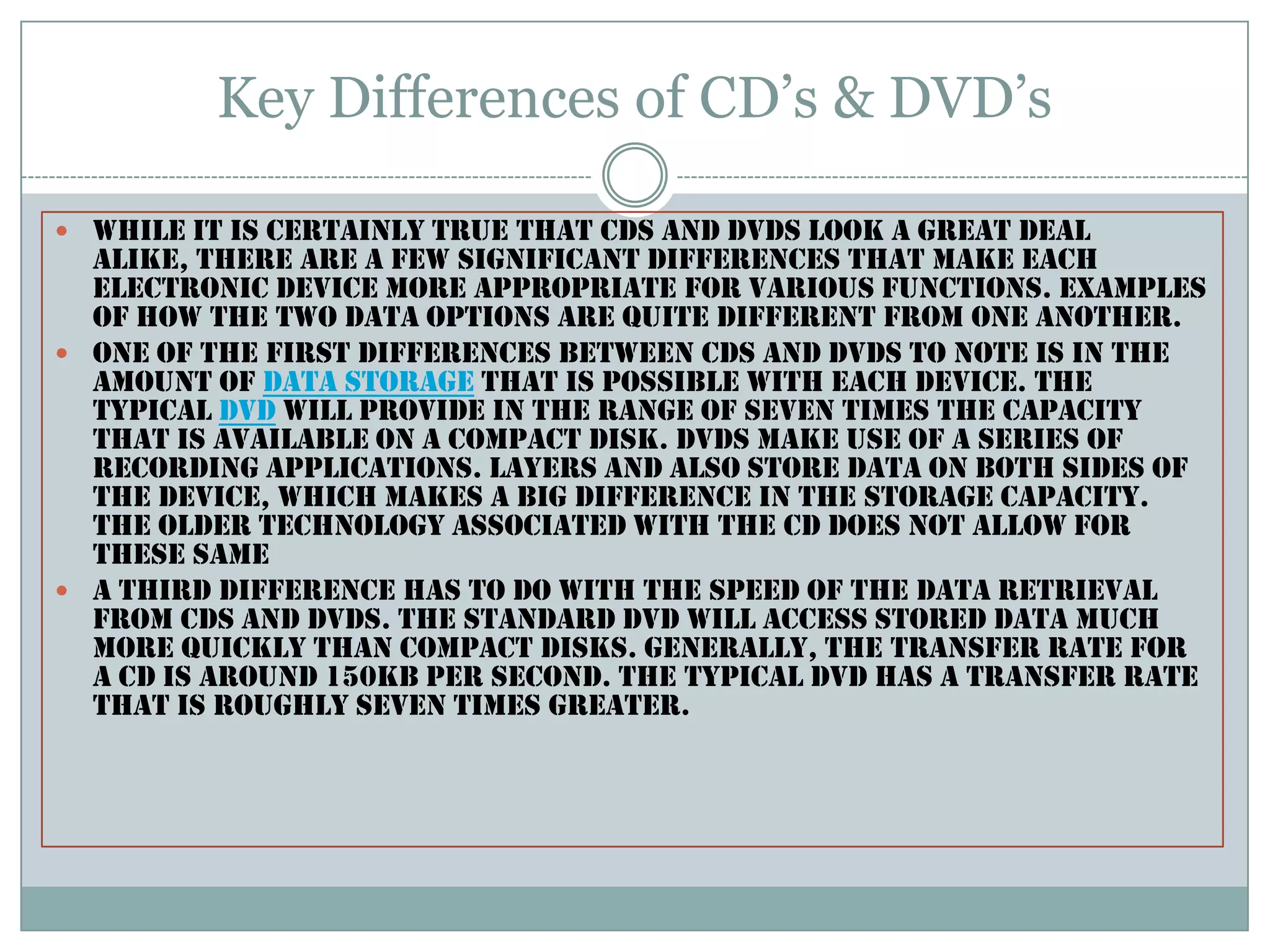
A presentation brought To you by: SpishakProduced by: Maxwell Cohen Inc. the Difference s  of  Cd’sto Dvd’s
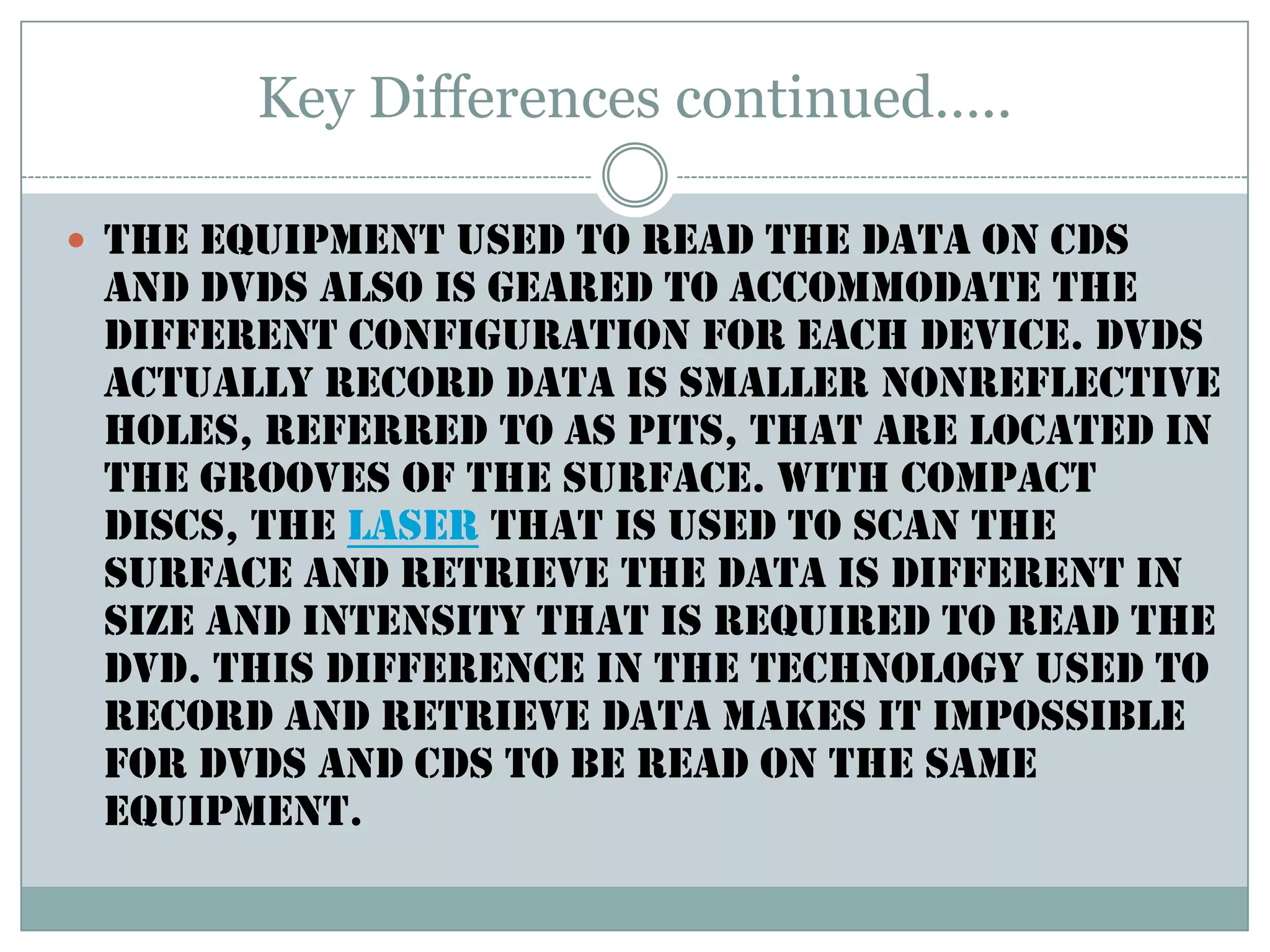
Key Differences of CD’s & DVD’sWhile it is certainly true that CDs and DVDs look a great deal alike, there are a few significant differences that make each electronic device more appropriate for various functions. examples of how the two data options are quite different from one another.One of the first differences between CDs and DVDs to note is in the amount of data storage that is possible with each device. The typical DVD will provide in the range of seven times the capacity that is available on a compact disk. DVDs make use of a series of recording applications. layers and also store data on both sides of the device, which makes a big difference in the storage capacity. The older technology associated with the CD does not allow for these same A third difference has to do with the speed of the data retrieval from CDs and DVDs. The standard DVD will access stored data much more quickly than compact disks. Generally, the transfer rate for a CD is around 150KB per second. The typical DVD has a transfer rate that is roughly seven times greater.
Key Differences continued…..The equipment used to read the data on CDs and DVDs also is geared to accommodate the different configuration for each device. DVDs actually record data is smaller nonreflective holes, referred to as pits, that are located in the grooves of the surface. With compact discs, the laser that is used to scan the surface and retrieve the data is different in size and intensity that is required to read the DVD. This difference in the technology used to record and retrieve data makes it impossible for DVDs and CDs to be read on the same equipment.
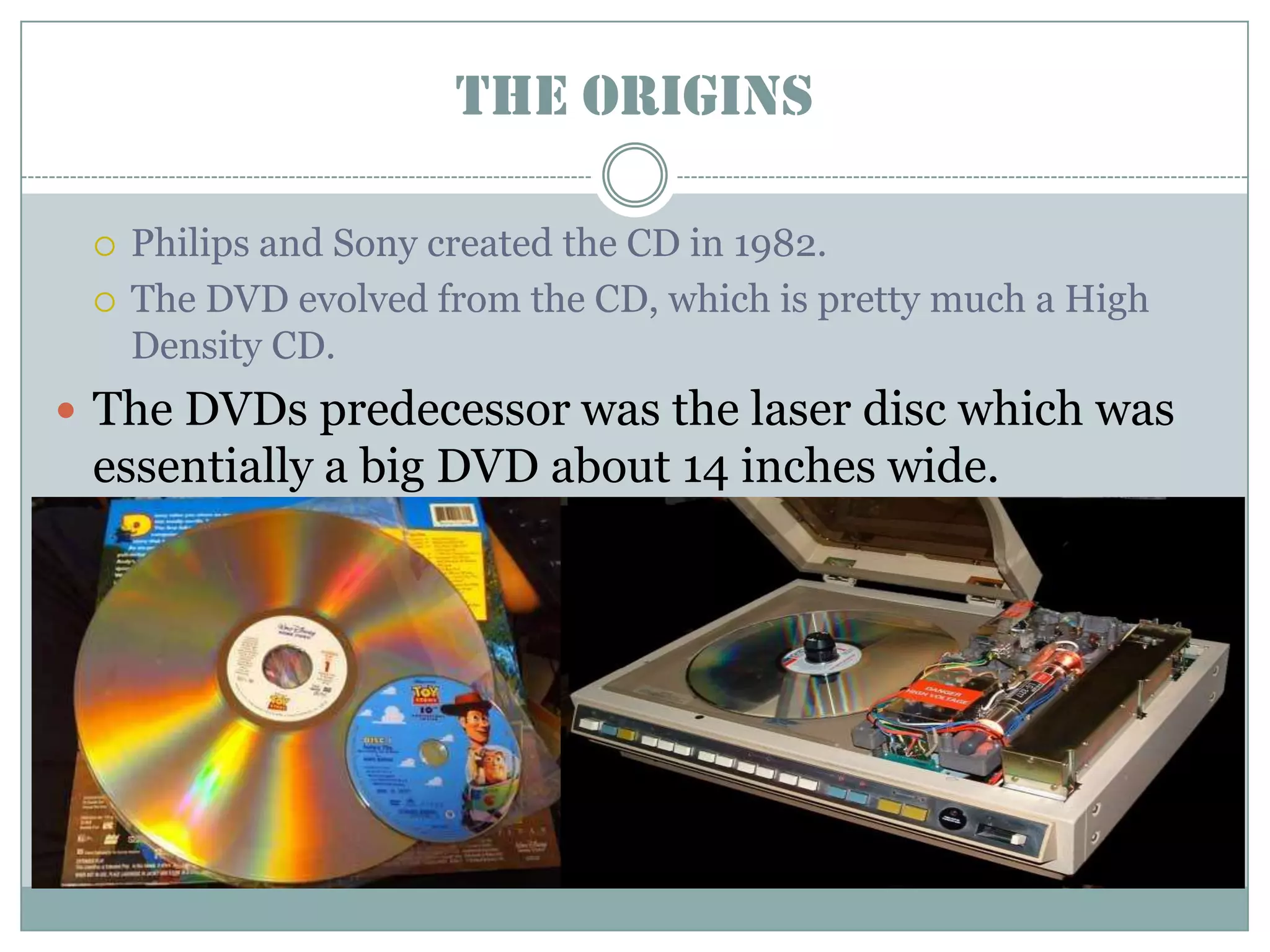
The OriginsPhilips and Sony created the CD in 1982.The DVD evolved from the CD, which is pretty much a High Density CD. The DVDs predecessor was the laser disc which was essentially a big DVD about 14 inches wide.
CDs Composition http://www.metacafe.com/watch/1553480/how_cds_are_made/A base layer made of a polycarbonate plastic. A thin layer of aluminum coating over the polycarbonate plastic. A clear protective acrylic coating over the aluminum layer. Some manufacturers use a silver or even gold layer instead of the aluminum layer in the manufacture of their compact discs.
QuestionWhere on the Compact Disc ( CD) is data stored?a series of tiny indentations known as "pits", encoded in a spiral track moulded into the top of the polycarbonate layer
          Fin

Presentation1

  • 1.
    A presentation broughtTo you by: SpishakProduced by: Maxwell Cohen Inc. the Difference s of Cd’sto Dvd’s
  • 2.
    Key Differences ofCD’s & DVD’sWhile it is certainly true that CDs and DVDs look a great deal alike, there are a few significant differences that make each electronic device more appropriate for various functions. examples of how the two data options are quite different from one another.One of the first differences between CDs and DVDs to note is in the amount of data storage that is possible with each device. The typical DVD will provide in the range of seven times the capacity that is available on a compact disk. DVDs make use of a series of recording applications. layers and also store data on both sides of the device, which makes a big difference in the storage capacity. The older technology associated with the CD does not allow for these same A third difference has to do with the speed of the data retrieval from CDs and DVDs. The standard DVD will access stored data much more quickly than compact disks. Generally, the transfer rate for a CD is around 150KB per second. The typical DVD has a transfer rate that is roughly seven times greater.
  • 3.
    Key Differences continued…..Theequipment used to read the data on CDs and DVDs also is geared to accommodate the different configuration for each device. DVDs actually record data is smaller nonreflective holes, referred to as pits, that are located in the grooves of the surface. With compact discs, the laser that is used to scan the surface and retrieve the data is different in size and intensity that is required to read the DVD. This difference in the technology used to record and retrieve data makes it impossible for DVDs and CDs to be read on the same equipment.
  • 4.
    The OriginsPhilips andSony created the CD in 1982.The DVD evolved from the CD, which is pretty much a High Density CD. The DVDs predecessor was the laser disc which was essentially a big DVD about 14 inches wide.
  • 5.
    CDs Composition http://www.metacafe.com/watch/1553480/how_cds_are_made/Abase layer made of a polycarbonate plastic. A thin layer of aluminum coating over the polycarbonate plastic. A clear protective acrylic coating over the aluminum layer. Some manufacturers use a silver or even gold layer instead of the aluminum layer in the manufacture of their compact discs.
  • 6.
    QuestionWhere on theCompact Disc ( CD) is data stored?a series of tiny indentations known as "pits", encoded in a spiral track moulded into the top of the polycarbonate layer
  • 7.
    Fin