Lauren Hurley
HOW TO ANALYSE A TV DRAMA
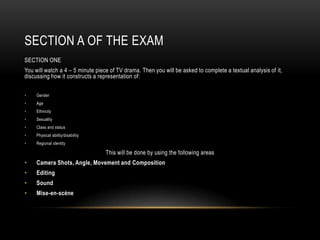
SECTION A OF THE EXAM
SECTION ONE
You will watch a 4 – 5 minute piece of TV drama. Then you will be asked to complete a textual analysis of it,
discussing how it constructs a representation of:
• Gender
• Age
• Ethnicity
• Sexuality
• Class and status
• Physical ability/disability
• Regional identity
This will be done by using the following areas
• Camera Shots, Angle, Movement and Composition
• Editing
• Sound
• Mise-en-scène
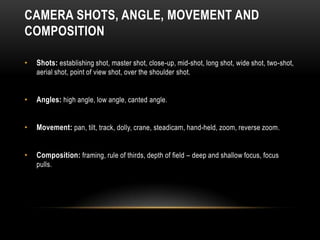
CAMERA SHOTS, ANGLE, MOVEMENT AND
COMPOSITION
• Shots: establishing shot, master shot, close-up, mid-shot, long shot, wide shot, two-shot,
aerial shot, point of view shot, over the shoulder shot.
• Angles: high angle, low angle, canted angle.
• Movement: pan, tilt, track, dolly, crane, steadicam, hand-held, zoom, reverse zoom.
• Composition: framing, rule of thirds, depth of field – deep and shallow focus, focus
pulls.
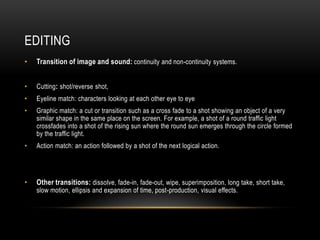
EDITING
• Transition of image and sound: continuity and non-continuity systems.
• Cutting: shot/reverse shot,
• Eyeline match: characters looking at each other eye to eye
• Graphic match: a cut or transition such as a cross fade to a shot showing an object of a very
similar shape in the same place on the screen. For example, a shot of a round traffic light
crossfades into a shot of the rising sun where the round sun emerges through the circle formed
by the traffic light.
• Action match: an action followed by a shot of the next logical action.
• Other transitions: dissolve, fade-in, fade-out, wipe, superimposition, long take, short take,
slow motion, ellipsis and expansion of time, post-production, visual effects.
SOUND
• This includes the use of:
diegetic and non-diegetic sound, synchronous/asynchronous sound, sound effects, sound motif,
sound bridge, dialogue, voiceover, mode of address/direct address, sound mixing, sound
perspective, soundtracks, score, incidental music, themes and stings, ambient sound.
MISE-EN-SCÈNE
Including:
• Production design: location, studio, set design, costume and make-up, properties.
• Lighting; colour design.

How to analyse a tv drama

  • 1.
    Lauren Hurley HOW TOANALYSE A TV DRAMA
  • 2.
    SECTION A OFTHE EXAM SECTION ONE You will watch a 4 – 5 minute piece of TV drama. Then you will be asked to complete a textual analysis of it, discussing how it constructs a representation of: • Gender • Age • Ethnicity • Sexuality • Class and status • Physical ability/disability • Regional identity This will be done by using the following areas • Camera Shots, Angle, Movement and Composition • Editing • Sound • Mise-en-scène
  • 3.
    CAMERA SHOTS, ANGLE,MOVEMENT AND COMPOSITION • Shots: establishing shot, master shot, close-up, mid-shot, long shot, wide shot, two-shot, aerial shot, point of view shot, over the shoulder shot. • Angles: high angle, low angle, canted angle. • Movement: pan, tilt, track, dolly, crane, steadicam, hand-held, zoom, reverse zoom. • Composition: framing, rule of thirds, depth of field – deep and shallow focus, focus pulls.
  • 4.
    EDITING • Transition ofimage and sound: continuity and non-continuity systems. • Cutting: shot/reverse shot, • Eyeline match: characters looking at each other eye to eye • Graphic match: a cut or transition such as a cross fade to a shot showing an object of a very similar shape in the same place on the screen. For example, a shot of a round traffic light crossfades into a shot of the rising sun where the round sun emerges through the circle formed by the traffic light. • Action match: an action followed by a shot of the next logical action. • Other transitions: dissolve, fade-in, fade-out, wipe, superimposition, long take, short take, slow motion, ellipsis and expansion of time, post-production, visual effects.
  • 5.
    SOUND • This includesthe use of: diegetic and non-diegetic sound, synchronous/asynchronous sound, sound effects, sound motif, sound bridge, dialogue, voiceover, mode of address/direct address, sound mixing, sound perspective, soundtracks, score, incidental music, themes and stings, ambient sound.
  • 6.
    MISE-EN-SCÈNE Including: • Production design:location, studio, set design, costume and make-up, properties. • Lighting; colour design.