Founders
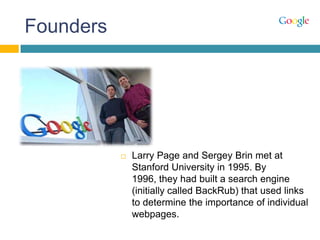
 Larry Page and Sergey Brin met at
Stanford University in 1995. By
1996, they had built a search engine
(initially called BackRub) that used links
to determine the importance of individual
webpages.
About Google
 Google is an American multinational corporation specializing
in Internet-related services and products. These
include search, cloud computing, software, and online
advertising technologies.
 The name „Google‟ was an accident. A spelling mistake made
by the original founders who thought they were going for
„Googol‟.
 96 percent of Google‟s total revenue comes from advertising.
 Google estimates that the "I'm feeling lucky!" button has
cost approximately $100 million dollars in lost ad revenue, but
Google still keeps the button because the users like it.
 620,000,000 daily visitors to Google.
Mission statement
 The Company‟s mission to “organize the
worlds information and make it
universially accessible and
useful.”
Google Locations
 The headquarter in Mountain
View, California, the Googleplex
 70 offices in more than 40 countries
around the globe.
Cloud computing
 Google also pursuing a cloud computing systems to
change market productivity via such applications,
 Word processing,
 Spreedsheets,
 Presentation software
 As technological analysits claims that these
applications improve the cloud computing experience
and thus, it cumulatively expected to grow to $95
billion by 2014.
Rivals
 Including this month announced deal to buy Nest Labs
Inc. for $3.2 billion in cash, Google has spent more than
$17 billion in the past two years to purchase hardware,
software and advertising-technology companies,
according to data compiled by Bloomberg.
 Crunching the numbers, Bloomberg found Apple,
Microsoft, Facebook, Amazon and Yahoo spent a
combined $13 billion acquiring companies during the
same period.
Location
 Google acquired digital mapping company Keyhole in
2004, and launched Google Maps and Google Earth in
2005.
 Today Maps also features live traffic, transit directions
and street-level imagery, and Earth lets you explore the
ocean and the moon.
Maps
 They believe that, the development of new internet applications offering
advertising opportunities.
 Google Maps allowed Internet users to search and view satellite
images of any location in the world. Then, they added,
 Real estate listings and short personal messages could also be
linked to Google Maps locations.
 Location based promotional businesses have great opportunity
(expected to reach over 60 billion in 2016), thus this makes
streetfight within the strongest rivals Apple & Google.
Google Search Engine
 They expanded their search logic and
improved search experience with adding
specific searchs;
 Book Search,
 Music Search,
 Video Search,
 Google News to include archived news articles
dating to 1900.
Adsense
 The AdSense program served content-relevant Google
text ads to pages on Google Network websites.
 60 percent of advertising dollars generated from tha ads.
 Google‟s AdSense program also allowed mobile phone
operators to share in Google revenues if text and image
ads were displayed on mobile handsets.
AdWords
 In 2000, Google introduced AdWords, a self-
service program for creating online ad
campaigns. Today our advertising
solutions, which include
 display,
 mobile and
 video ads as well as
 the simple text ads
Gmail
 In 2004, Google launched Gmail. The approach to email
included features
 Speedy search
 Huge amounts of storage
 Threaded messages (SMS etc.)
 Integrated services for free… (actually, as they said:
“there‟s no free lunch.”)
Broadcast yourself: Youtube
 In 2006, Google acquired online video sharing
site YouTube in 1.65 Billions. Today 60 hours
of video are uploaded to the site every
minute.
 Cat videos,
 Citizen journaism,
 Political candidacy,
 Double rainbows have never been the same.
The little green robot arrives:
Android
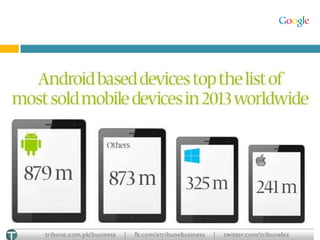
 In 2008, Google had launched Android.
 Android was not a phone but an operating system that Google
made available free to any phone manufacturer wishing to
market mobile devices with internet capability.
 Android core applications included Wi-Fi capability, e-mail, a web
based calender, google earth maps, a browser, and GPS.
 Android is a mobile operating system which allowed wireless
phones manufactures such as LG, HTC, Nokia, Samsung to
produce smartphone businesses. (as Apple‟s rival iphone –iOs-)
Android
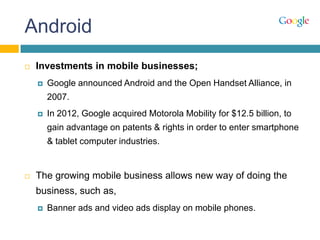
 Investments in mobile businesses;
 Google announced Android and the Open Handset Alliance, in
2007.
 In 2012, Google acquired Motorola Mobility for $12.5 billion, to
gain advantage on patents & rights in order to enter smartphone
& tablet computer industries.
 The growing mobile business allows new way of doing the
business, such as,
 Banner ads and video ads display on mobile phones.
Google Chrome business
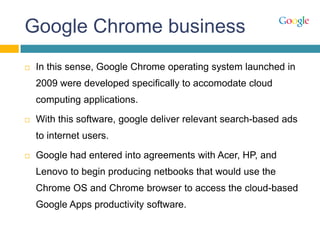
 In this sense, Google Chrome operating system launched in
2009 were developed specifically to accomodate cloud
computing applications.
 With this software, google deliver relevant search-based ads
to internet users.
 Google had entered into agreements with Acer, HP, and
Lenovo to begin producing netbooks that would use the
Chrome OS and Chrome browser to access the cloud-based
Google Apps productivity software.
Google +
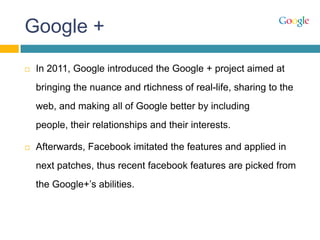
 In 2011, Google introduced the Google + project aimed at
bringing the nuance and rtichness of real-life, sharing to the
web, and making all of Google better by including
people, their relationships and their interests.
 Afterwards, Facebook imitated the features and applied in
next patches, thus recent facebook features are picked from
the Google+‟s abilities.
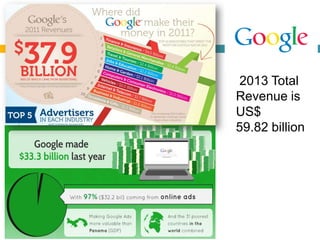
2013 Total
Revenue is
US$
59.82 billion
THANK YOU

Google Inc.

  • 3.
    Founders  Larry Pageand Sergey Brin met at Stanford University in 1995. By 1996, they had built a search engine (initially called BackRub) that used links to determine the importance of individual webpages.
  • 4.
    About Google  Googleis an American multinational corporation specializing in Internet-related services and products. These include search, cloud computing, software, and online advertising technologies.  The name „Google‟ was an accident. A spelling mistake made by the original founders who thought they were going for „Googol‟.  96 percent of Google‟s total revenue comes from advertising.  Google estimates that the "I'm feeling lucky!" button has cost approximately $100 million dollars in lost ad revenue, but Google still keeps the button because the users like it.  620,000,000 daily visitors to Google.
  • 5.
    Mission statement  TheCompany‟s mission to “organize the worlds information and make it universially accessible and useful.”
  • 6.
    Google Locations  Theheadquarter in Mountain View, California, the Googleplex  70 offices in more than 40 countries around the globe.
  • 7.
    Cloud computing  Googlealso pursuing a cloud computing systems to change market productivity via such applications,  Word processing,  Spreedsheets,  Presentation software  As technological analysits claims that these applications improve the cloud computing experience and thus, it cumulatively expected to grow to $95 billion by 2014.
  • 8.
    Rivals  Including thismonth announced deal to buy Nest Labs Inc. for $3.2 billion in cash, Google has spent more than $17 billion in the past two years to purchase hardware, software and advertising-technology companies, according to data compiled by Bloomberg.  Crunching the numbers, Bloomberg found Apple, Microsoft, Facebook, Amazon and Yahoo spent a combined $13 billion acquiring companies during the same period.
  • 9.
    Location  Google acquireddigital mapping company Keyhole in 2004, and launched Google Maps and Google Earth in 2005.  Today Maps also features live traffic, transit directions and street-level imagery, and Earth lets you explore the ocean and the moon.
  • 10.
    Maps  They believethat, the development of new internet applications offering advertising opportunities.  Google Maps allowed Internet users to search and view satellite images of any location in the world. Then, they added,  Real estate listings and short personal messages could also be linked to Google Maps locations.  Location based promotional businesses have great opportunity (expected to reach over 60 billion in 2016), thus this makes streetfight within the strongest rivals Apple & Google.
  • 11.
    Google Search Engine They expanded their search logic and improved search experience with adding specific searchs;  Book Search,  Music Search,  Video Search,  Google News to include archived news articles dating to 1900.
  • 12.
    Adsense  The AdSenseprogram served content-relevant Google text ads to pages on Google Network websites.  60 percent of advertising dollars generated from tha ads.  Google‟s AdSense program also allowed mobile phone operators to share in Google revenues if text and image ads were displayed on mobile handsets.
  • 13.
    AdWords  In 2000,Google introduced AdWords, a self- service program for creating online ad campaigns. Today our advertising solutions, which include  display,  mobile and  video ads as well as  the simple text ads
  • 14.
    Gmail  In 2004,Google launched Gmail. The approach to email included features  Speedy search  Huge amounts of storage  Threaded messages (SMS etc.)  Integrated services for free… (actually, as they said: “there‟s no free lunch.”)
  • 15.
    Broadcast yourself: Youtube In 2006, Google acquired online video sharing site YouTube in 1.65 Billions. Today 60 hours of video are uploaded to the site every minute.  Cat videos,  Citizen journaism,  Political candidacy,  Double rainbows have never been the same.
  • 16.
    The little greenrobot arrives: Android  In 2008, Google had launched Android.  Android was not a phone but an operating system that Google made available free to any phone manufacturer wishing to market mobile devices with internet capability.  Android core applications included Wi-Fi capability, e-mail, a web based calender, google earth maps, a browser, and GPS.  Android is a mobile operating system which allowed wireless phones manufactures such as LG, HTC, Nokia, Samsung to produce smartphone businesses. (as Apple‟s rival iphone –iOs-)
  • 17.
    Android  Investments inmobile businesses;  Google announced Android and the Open Handset Alliance, in 2007.  In 2012, Google acquired Motorola Mobility for $12.5 billion, to gain advantage on patents & rights in order to enter smartphone & tablet computer industries.  The growing mobile business allows new way of doing the business, such as,  Banner ads and video ads display on mobile phones.
  • 19.
    Google Chrome business In this sense, Google Chrome operating system launched in 2009 were developed specifically to accomodate cloud computing applications.  With this software, google deliver relevant search-based ads to internet users.  Google had entered into agreements with Acer, HP, and Lenovo to begin producing netbooks that would use the Chrome OS and Chrome browser to access the cloud-based Google Apps productivity software.
  • 20.
    Google +  In2011, Google introduced the Google + project aimed at bringing the nuance and rtichness of real-life, sharing to the web, and making all of Google better by including people, their relationships and their interests.  Afterwards, Facebook imitated the features and applied in next patches, thus recent facebook features are picked from the Google+‟s abilities.
  • 22.
  • 23.