
The Collection Framework
Collections Framework


 A collection is a group of objects.
 The Collection Framework Standardizes the way in
 which group of objects are handled by your program.

What c++ calls a Container,Java calls a Collection
The Collection interfaces


 Collection- enable you to work with groups of
 objects.

 List- extends collection to handle sequences.


 Set- extends collection to handle sets, which must
 contain unique elements.
The Collection Classes


 ArrayList – implements a dynamic array.
 LinkedList – implements a linked list.
 HashSet – uses hash table.
 linkedHashSet – allow insertion-order iterations.
 TreeSet – implements a set stored in a tree.
ArrayList class


 ArrayList class implements the List interface.
 ArrayList supports dynamic arrays that can grow as needed.
 It is a Variable length array of object references.


 ArrayLists are created with an initial size. When this size is
  enlarged, the collection is automatically enlarged. And when the
  objects are removed, the array may be shrunk.
Using constructor


 ArrayList()
 ArrayList(Collection c)
 ArrayList(int capacity)
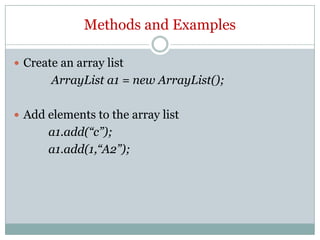
Methods and Examples

 Create an array list
       ArrayList a1 = new ArrayList();

 Add elements to the array list
      a1.add(“c”);
      a1.add(1,“A2”);
 Display the array list
    System.out.println(a1);

 Remove elements from the array list
    a1.remove(“F”);
    a1.remove(2);

 For finding the size of arrayList
      a1.size();
Obtaining an Array from an ArrayList


 Add elements to the array list
   a1.add(new Integer(1));

 Get array
    object ia[ ] = a1.toArray();
LinkedList Class


 LinkedList class extends AbstractSequentialList and
 implements the List interface.

 It provides a linked list data structure.
Constructor


 LinkedList()


 LinkedList(collection c)
Methods

 To add elements at the first /last position.
        addFirst();
        addLast();

 To retrieve the elements at first /last position.
        getFirst();
        getLast();

 To remove the elements at first /last position.
        removeFirst();
        removeLast();
TreeSet class


 TreeSet provides an implementations of the Set
 interface that uses a tree for storage.

 Objects are stored in sorted order i.e ascending
 order.

 Access and retrieval times are quite fast.
Constructors

 TreeSet()
 TreeSet(collection c)
 TreeSet(comparator comp)
 TreeSet(SortedSet ss)
Example

Import java.util.*;
Class TreeSetDemo
{
Public static void main(String args[])
{
TreeSet ts=new TreeSet();
ts.add(“C”);
ts.add(“A”);
ts.add(“B”);
System.out.println(ts);
}
}

Output-    [A,B,C]
HashSet class

 HashSet extends AbstractSet and implements the Set
  interface.
 It creates a collection that uses a hash table for storage.
 Basic operations:
                        add()
                        contains()
                        remove()
                        size()
Using constructor

 HashSet()
 HashSet(collection c)
 HashSet(int capacity)
 HashSet(int capacity, float fillRatio)
Methods

 boolean add(Object o)
 void clear()
 Object clone()
 boolean contains(Object o)
 boolean isEmpty()
 Iterator iterator()
 boolean remove(Object o)
 int size()
Example

import java.util.*;
class hashset
{
public static void main(String args[])
{
HashSet hs = new HashSet();
hs.add("B");
hs.add("A");
hs.add("D");
hs.add("E");
hs.add("C");
hs.add("F");
System.out.println(hs);
hs.remove("C");
System.out.println("elements after removing C"+hs);
 }
 }
LinkedHashSet class


 LinkedHashSet extends HashSet, but adds no
  members of its own.
 LinkedHashSet maintains a linked list of the entries
  in the set.
Using constructor


 LinkedHashSet( )
 LinkedHashSet(Collection c)
 LinkedHashSet(int capacity)
 LinkedHashSet(int capacity, float fillRatio)
Remove all elements from LinkedHashSet

import java.util.LinkedHashSet;
 public class linkedhashset
 {
   public static void main(String[] args)
     {
      LinkedHashSet lhashSet = new LinkedHashSet();
         lhashSet.add(new Integer("1"));
         lhashSet.add(new Integer("2"));
         lhashSet.add(new Integer("3"));
     System.out.println("LinkedHashSet before removal : " + lhashSet);
         lhashSet.clear();
     System.out.println("LinkedHashSet after removal : " + lhashSet);
     System.out.println("Is LinkedHashSet empty ? " + lhashSet.isEmpty());
   }
}
House Is Open For Queries

Presentation1

  • 1.
  • 2.
    Collections Framework  Acollection is a group of objects.  The Collection Framework Standardizes the way in which group of objects are handled by your program. What c++ calls a Container,Java calls a Collection
  • 3.
    The Collection interfaces Collection- enable you to work with groups of objects.  List- extends collection to handle sequences.  Set- extends collection to handle sets, which must contain unique elements.
  • 4.
    The Collection Classes ArrayList – implements a dynamic array.  LinkedList – implements a linked list.  HashSet – uses hash table.  linkedHashSet – allow insertion-order iterations.  TreeSet – implements a set stored in a tree.
  • 5.
    ArrayList class  ArrayListclass implements the List interface.  ArrayList supports dynamic arrays that can grow as needed.  It is a Variable length array of object references.  ArrayLists are created with an initial size. When this size is enlarged, the collection is automatically enlarged. And when the objects are removed, the array may be shrunk.
  • 6.
    Using constructor  ArrayList() ArrayList(Collection c)  ArrayList(int capacity)
  • 7.
    Methods and Examples Create an array list ArrayList a1 = new ArrayList();  Add elements to the array list a1.add(“c”); a1.add(1,“A2”);
  • 8.
     Display thearray list System.out.println(a1);  Remove elements from the array list a1.remove(“F”); a1.remove(2);  For finding the size of arrayList a1.size();
  • 9.
    Obtaining an Arrayfrom an ArrayList  Add elements to the array list a1.add(new Integer(1));  Get array object ia[ ] = a1.toArray();
  • 10.
    LinkedList Class  LinkedListclass extends AbstractSequentialList and implements the List interface.  It provides a linked list data structure.
  • 11.
  • 12.
    Methods  To addelements at the first /last position. addFirst(); addLast();  To retrieve the elements at first /last position. getFirst(); getLast();  To remove the elements at first /last position. removeFirst(); removeLast();
  • 13.
    TreeSet class  TreeSetprovides an implementations of the Set interface that uses a tree for storage.  Objects are stored in sorted order i.e ascending order.  Access and retrieval times are quite fast.
  • 14.
    Constructors  TreeSet()  TreeSet(collectionc)  TreeSet(comparator comp)  TreeSet(SortedSet ss)
  • 15.
    Example Import java.util.*; Class TreeSetDemo { Publicstatic void main(String args[]) { TreeSet ts=new TreeSet(); ts.add(“C”); ts.add(“A”); ts.add(“B”); System.out.println(ts); } } Output- [A,B,C]
  • 16.
    HashSet class  HashSetextends AbstractSet and implements the Set interface.  It creates a collection that uses a hash table for storage.  Basic operations: add() contains() remove() size()
  • 17.
    Using constructor  HashSet() HashSet(collection c)  HashSet(int capacity)  HashSet(int capacity, float fillRatio)
  • 18.
    Methods  boolean add(Objecto)  void clear()  Object clone()  boolean contains(Object o)  boolean isEmpty()  Iterator iterator()  boolean remove(Object o)  int size()
  • 19.
    Example import java.util.*; class hashset { publicstatic void main(String args[]) { HashSet hs = new HashSet(); hs.add("B"); hs.add("A"); hs.add("D"); hs.add("E"); hs.add("C"); hs.add("F"); System.out.println(hs); hs.remove("C"); System.out.println("elements after removing C"+hs); } }
  • 20.
    LinkedHashSet class  LinkedHashSetextends HashSet, but adds no members of its own.  LinkedHashSet maintains a linked list of the entries in the set.
  • 21.
    Using constructor  LinkedHashSet()  LinkedHashSet(Collection c)  LinkedHashSet(int capacity)  LinkedHashSet(int capacity, float fillRatio)
  • 22.
    Remove all elementsfrom LinkedHashSet import java.util.LinkedHashSet; public class linkedhashset { public static void main(String[] args) { LinkedHashSet lhashSet = new LinkedHashSet(); lhashSet.add(new Integer("1")); lhashSet.add(new Integer("2")); lhashSet.add(new Integer("3")); System.out.println("LinkedHashSet before removal : " + lhashSet); lhashSet.clear(); System.out.println("LinkedHashSet after removal : " + lhashSet); System.out.println("Is LinkedHashSet empty ? " + lhashSet.isEmpty()); } }
  • 23.
    House Is OpenFor Queries