MD Anderson Cancer CenterDivision of Information ServicesStrategic Plan for 2007…… and beyondRegina JacksonMay 15,2011EDLD 5362Lamar University1
IntroductionThis Division of Information Services Strategic Plan (for Fiscal Year 2007 … and Beyond) outlines key strategies related to information technology application systems, databases, hardware, and infrastructure at The University of Texas M. D. Anderson Cancer Center (MDACC). 2
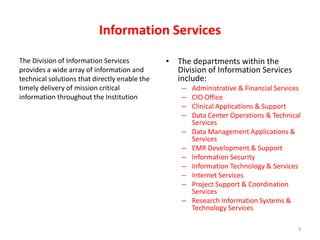
Information Services The Division of Information Servicesprovides a wide array of information andtechnical solutions that directly enable thetimely delivery of mission criticalinformation throughout the InstitutionThe departments within the Division of Information Services include:Administrative & Financial Services CIO Office Clinical Applications & Support Data Center Operations & Technical Services Data Management Applications & Services EMR Development & Support Information Security Information Technology & Services Internet Services Project Support & Coordination Services Research Information Systems & Technology Services3
VisionIT&S will inspire education, research and clinical services by providing expertise, value and excitement for MD Anderson information technology initiatives via secure and reliable data, voice, and personal computing technologies and systems.  With the flood of new technologies that could be utilized by the institution, we are developing a methodology to evaluate and prioritize these to propose IT projects for their implementation.4
IT Operating Budget FISCAL YEAR 2011The IS Division annual operating budget for Fiscal Year 2011 is $81 million. The largest percentage of this budget is staff salaries. The operating budget also accounts for training, travel, minor equipment, purchase services, and some maintenance contracts5
Technology Infrastructure & IS Standards TeamThe Technology Infrastructure and IS Standards Steering Team serves as the central point of focus for organizational governance concerning infrastructure and IS standards development and deployment. Operating in a highly collaborative manner across all mission areas, the team maintains focus on the efficiency, integrity and integration of the organization's IT architectures. The steering team considers economies of scale, redundancy, technology and health care industry trends, availability of resources and other pertinent factors to improve access to local and global data resources through optimal utilization of information resources.6
Strategic Vision This plan identifies a set of seven high-level Guiding Principles that shape how Information Services’ people, processes and technology support MDACC’s Mission and Vision in a manner that provides optimal benefit to the Institution. 7
National Educational Technology PlanLearning: Engage and Empower Assessment: Measure What Matters Teaching: Prepare and Connect Infrastructure: Access and Enable Productivity: Redesign and Transform 8
Information Services Guiding PrinciplesSolutions – Deliver innovative solutions that provide optimal benefit to the Institution 	Workforce– Invest in management and staff to increase the competency, performance, accountability, and customer focus of our workforce 	Communication – Practice the highest level of communication and collaboration 	Service– Continually improve the delivery of customer centric services 	Facilitation – Deploy simple and flexible processes throughout service delivery functions 	Availability – Ensure that information is captured and delivered in a manner that supports institutional goals 	Protection– Continually strengthen our ability to protect the information assets of the Institution.9
Information Technology Initiatives Successfully meet the ongoing need for reliable secure, appropriate and economically effective campus-wide user communication with complimentary information technology and related communication tools 	10
Technology Critical IssuesFoster consistent industry standard software and application development practices that optimize information technology solutions supporting clinical operations, basic science, clinical and translational research and administration Deploy and maintain a best practices based computing, voice and data communications infrastructure that is responsive to current business requirements, while laying the groundwork  for meeting future needsf11
Technology Critical IssuesEffectively manage and reduce risks associated with our information systems, repositories and infrastructure Expand deployment of wireless communications within the Institution Continually assess the needs for and deliver mission critical telecommunications services Telephones, voice mail, paging, mobile computing devicesswitch replacement, voice mail upgrade, Blackberry Provide a knowledgeable IT help desk on a 24 hour, 7 day basis12
Principles of IT Management Principle #1 	Before IT is applied, the basic procedure, process, and data must be thoroughly reviewed for streamlining and then common elements standardized as much as possible across the institution, applying best practices in order to maximize IT yield. Principle #2 	Technology should be chosen that will satisfy needs for at least five years and utilize off-the-shelf versions as much as possible to minimize application time and costs. Software/hardware selections should be from technologies sufficiently mature to ensure ongoing reliability and vendor support. Principle #3 	Manage IT through one centralized organization with expertise for application throughout the Institution. IT professionals can be embedded throughout the organization for best user service, but they report to IT management. Principle #4 	Users must define their needs but within criteria established by the Institution’s management and IT management. Users are responsible for delivering the economic and process improvement benefits used to justify the project expenditures. A client (user) management sponsor should be established for each project to ensure timely benefit capture and appropriate user acceptance/training. 13
Principles of IT Management Principle #5 	Institution management must determine how much IT costs (capital and expense) can be afforded annually and over a five- year period for planning purposes and then set the economic criteria including hurdle rate of return for project justification. Principle #6 	IT management in conjunction with users determines project priorities over the plan period in accordance with the economic criteria and budget. A senior IT management committee of user organizations, chaired by the Chief Information Officer, is an effective way to manage the  processPrinciple #7 	Project re-appraisals one to two years after completion for lessons learned and assurance of objectives accomplished is an essential part of the overall IT management process. Principle #8 	A best practices survey of IT management and application practices by similar institutions as well as high technology businesses is always useful. Principle #9 	Principles for IT management practices should be developed and implemented by management of the institution rather than by an outside firm for best acceptance by the organization 14
RecommendationsChallenging, validating, and updating the existing Core Vendor IT strategies for EHR (electronic healthcare records). Developing the necessary tactical, funding , ROI, staffing and execution plans, and details to support the strategy;Involving key stakeholders across the organization throughout the planning process to ensure that the plan was understood and ultimately owned by UCH leadership; Wireless network upgrade15
Strategy 7.1 - We will continuously improve our administrative infrastructure to support the efforts of our people in achieving our mission through health information technology and quality improvement education and research. Strategy 7.2 - We will employ metrics and rigorous internal and external review to prioritize proposed and existing programs, in order to grow in strategic areas and consolidate in others. Strategy 7.3 - We will maintain an operating margin, cash reserves and the appropriate financial metrics required to sustain our mission. Strategy 7.4 - We will provide transparent and complete financial and operational information, and hold leaders and managers accountable for their performance. Strategy 7.5 - We will be good stewards of the resources entrusted to us by patients, donors, sponsors, partners and governmental entities. Strategy 7.6 - We will develop action plans and performance measures that reflect our brand and advance the goals of this Strategic Vision.16
ReferencesBazzoli, F., (2005).  The New Source for  Healthcare Information Technology.  Healthcare IT News August 2005.  Retrieved from the World Wide Web on May 9, 2011 at  www.dlctechnology.com/images/DLC-HDM-Article.pdfMD Anderson Cancer Center Division of Information Services Strategic Plan for 2007…… and beyond, (2007). MD Anderson Cancer Center Intranet, February 2007.  Retrieved May 9, 2011 from http://inside.mdanderson.org/departments/information-services/resources.htmlNational Educational Technology Plan: (2010).  Retrieved from the World Wide Web on  May 9, 2011 at http://www.ed.gov/technology/netp-2010 See, J., (1992).  Developing Effective Technology Plans. The Computing Teacher, Vol. 19, Number 8, May 1992Retrieved from the World Wide Web on May 11,2011 at http://www.nctp.com/html/john_see.cfmSpeed Matters Blog Team; Blog, (2011) More Doctors and Hospitals Planning to Adopt Electronic Health Records.  Retrieved from the World Wide Web on May 10, 2011 at http://www.speedmatters.org/blog/archive/more-doctors-and-hospitals-planning-to-adopt-electronic-health-records/17

Presentation week 5

  • 1.
    MD Anderson CancerCenterDivision of Information ServicesStrategic Plan for 2007…… and beyondRegina JacksonMay 15,2011EDLD 5362Lamar University1
  • 2.
    IntroductionThis Division ofInformation Services Strategic Plan (for Fiscal Year 2007 … and Beyond) outlines key strategies related to information technology application systems, databases, hardware, and infrastructure at The University of Texas M. D. Anderson Cancer Center (MDACC). 2
  • 3.
    Information Services TheDivision of Information Servicesprovides a wide array of information andtechnical solutions that directly enable thetimely delivery of mission criticalinformation throughout the InstitutionThe departments within the Division of Information Services include:Administrative & Financial Services CIO Office Clinical Applications & Support Data Center Operations & Technical Services Data Management Applications & Services EMR Development & Support Information Security Information Technology & Services Internet Services Project Support & Coordination Services Research Information Systems & Technology Services3
  • 4.
    VisionIT&S will inspireeducation, research and clinical services by providing expertise, value and excitement for MD Anderson information technology initiatives via secure and reliable data, voice, and personal computing technologies and systems.  With the flood of new technologies that could be utilized by the institution, we are developing a methodology to evaluate and prioritize these to propose IT projects for their implementation.4
  • 5.
    IT Operating BudgetFISCAL YEAR 2011The IS Division annual operating budget for Fiscal Year 2011 is $81 million. The largest percentage of this budget is staff salaries. The operating budget also accounts for training, travel, minor equipment, purchase services, and some maintenance contracts5
  • 6.
    Technology Infrastructure &IS Standards TeamThe Technology Infrastructure and IS Standards Steering Team serves as the central point of focus for organizational governance concerning infrastructure and IS standards development and deployment. Operating in a highly collaborative manner across all mission areas, the team maintains focus on the efficiency, integrity and integration of the organization's IT architectures. The steering team considers economies of scale, redundancy, technology and health care industry trends, availability of resources and other pertinent factors to improve access to local and global data resources through optimal utilization of information resources.6
  • 7.
    Strategic Vision Thisplan identifies a set of seven high-level Guiding Principles that shape how Information Services’ people, processes and technology support MDACC’s Mission and Vision in a manner that provides optimal benefit to the Institution. 7
  • 8.
    National Educational TechnologyPlanLearning: Engage and Empower Assessment: Measure What Matters Teaching: Prepare and Connect Infrastructure: Access and Enable Productivity: Redesign and Transform 8
  • 9.
    Information Services GuidingPrinciplesSolutions – Deliver innovative solutions that provide optimal benefit to the Institution Workforce– Invest in management and staff to increase the competency, performance, accountability, and customer focus of our workforce Communication – Practice the highest level of communication and collaboration Service– Continually improve the delivery of customer centric services Facilitation – Deploy simple and flexible processes throughout service delivery functions Availability – Ensure that information is captured and delivered in a manner that supports institutional goals Protection– Continually strengthen our ability to protect the information assets of the Institution.9
  • 10.
    Information Technology InitiativesSuccessfully meet the ongoing need for reliable secure, appropriate and economically effective campus-wide user communication with complimentary information technology and related communication tools 10
  • 11.
    Technology Critical IssuesFosterconsistent industry standard software and application development practices that optimize information technology solutions supporting clinical operations, basic science, clinical and translational research and administration Deploy and maintain a best practices based computing, voice and data communications infrastructure that is responsive to current business requirements, while laying the groundwork for meeting future needsf11
  • 12.
    Technology Critical IssuesEffectivelymanage and reduce risks associated with our information systems, repositories and infrastructure Expand deployment of wireless communications within the Institution Continually assess the needs for and deliver mission critical telecommunications services Telephones, voice mail, paging, mobile computing devicesswitch replacement, voice mail upgrade, Blackberry Provide a knowledgeable IT help desk on a 24 hour, 7 day basis12
  • 13.
    Principles of ITManagement Principle #1 Before IT is applied, the basic procedure, process, and data must be thoroughly reviewed for streamlining and then common elements standardized as much as possible across the institution, applying best practices in order to maximize IT yield. Principle #2 Technology should be chosen that will satisfy needs for at least five years and utilize off-the-shelf versions as much as possible to minimize application time and costs. Software/hardware selections should be from technologies sufficiently mature to ensure ongoing reliability and vendor support. Principle #3 Manage IT through one centralized organization with expertise for application throughout the Institution. IT professionals can be embedded throughout the organization for best user service, but they report to IT management. Principle #4 Users must define their needs but within criteria established by the Institution’s management and IT management. Users are responsible for delivering the economic and process improvement benefits used to justify the project expenditures. A client (user) management sponsor should be established for each project to ensure timely benefit capture and appropriate user acceptance/training. 13
  • 14.
    Principles of ITManagement Principle #5 Institution management must determine how much IT costs (capital and expense) can be afforded annually and over a five- year period for planning purposes and then set the economic criteria including hurdle rate of return for project justification. Principle #6 IT management in conjunction with users determines project priorities over the plan period in accordance with the economic criteria and budget. A senior IT management committee of user organizations, chaired by the Chief Information Officer, is an effective way to manage the processPrinciple #7 Project re-appraisals one to two years after completion for lessons learned and assurance of objectives accomplished is an essential part of the overall IT management process. Principle #8 A best practices survey of IT management and application practices by similar institutions as well as high technology businesses is always useful. Principle #9 Principles for IT management practices should be developed and implemented by management of the institution rather than by an outside firm for best acceptance by the organization 14
  • 15.
    RecommendationsChallenging, validating, andupdating the existing Core Vendor IT strategies for EHR (electronic healthcare records). Developing the necessary tactical, funding , ROI, staffing and execution plans, and details to support the strategy;Involving key stakeholders across the organization throughout the planning process to ensure that the plan was understood and ultimately owned by UCH leadership; Wireless network upgrade15
  • 16.
    Strategy 7.1 -We will continuously improve our administrative infrastructure to support the efforts of our people in achieving our mission through health information technology and quality improvement education and research. Strategy 7.2 - We will employ metrics and rigorous internal and external review to prioritize proposed and existing programs, in order to grow in strategic areas and consolidate in others. Strategy 7.3 - We will maintain an operating margin, cash reserves and the appropriate financial metrics required to sustain our mission. Strategy 7.4 - We will provide transparent and complete financial and operational information, and hold leaders and managers accountable for their performance. Strategy 7.5 - We will be good stewards of the resources entrusted to us by patients, donors, sponsors, partners and governmental entities. Strategy 7.6 - We will develop action plans and performance measures that reflect our brand and advance the goals of this Strategic Vision.16
  • 17.
    ReferencesBazzoli, F., (2005). The New Source for Healthcare Information Technology. Healthcare IT News August 2005. Retrieved from the World Wide Web on May 9, 2011 at www.dlctechnology.com/images/DLC-HDM-Article.pdfMD Anderson Cancer Center Division of Information Services Strategic Plan for 2007…… and beyond, (2007). MD Anderson Cancer Center Intranet, February 2007. Retrieved May 9, 2011 from http://inside.mdanderson.org/departments/information-services/resources.htmlNational Educational Technology Plan: (2010). Retrieved from the World Wide Web on May 9, 2011 at http://www.ed.gov/technology/netp-2010 See, J., (1992). Developing Effective Technology Plans. The Computing Teacher, Vol. 19, Number 8, May 1992Retrieved from the World Wide Web on May 11,2011 at http://www.nctp.com/html/john_see.cfmSpeed Matters Blog Team; Blog, (2011) More Doctors and Hospitals Planning to Adopt Electronic Health Records. Retrieved from the World Wide Web on May 10, 2011 at http://www.speedmatters.org/blog/archive/more-doctors-and-hospitals-planning-to-adopt-electronic-health-records/17

Editor's Notes

  • #16 Since the existing network was installed more than eight years ago, patient care has seen an increase in products that rely on wireless configuration. These tools, such as Vocera badges and Alaris infusion pumps, all compete for space on the existing network with laptops and smartphones.