IBM Global Technology Services                                                IBM Global Data Center Study   i

Research Report


Data center operational efficiency
best practices
Enabling increased new project spending by improving data center efficiency


Findings from the IBM Global Data Center Study
ii   Data center operational efficiency best practices


                       Data center operational efficiency best practices: Enabling increased new project spending
                       by improving data center efficiency is an IBM study that developed a data center operational
                       efficiency model for assessing the capability levels of today’s data center and describes the ways
                       IT organizations can progress along the path of data center transformation. The report was
                       written by IDC, which also executed the survey and interviews on behalf of IBM.

                       The authors would like to give special thanks to the following individuals for their assistance and
                       support in developing this report:

                       â—Ź   	 Dr. Ian Stewart, Director of Advanced Computing, University of Bristol
                       â—Ź   	 Antonio Buratti, CIO, ABI (Associazione Bancaria Italiana)
                       â—Ź   	 Pierre Debagnard, General Manager of Albiant-IT, BPCE Group
                       â—Ź   	 Xiao Xiao Bin, IT Manager, INESA Information Solution Group Co. Ltd
                       â—Ź   	 Martin Constant, Corporate Director of Information Technology, NORAMPAC
IBM Global Data Center Study    iii


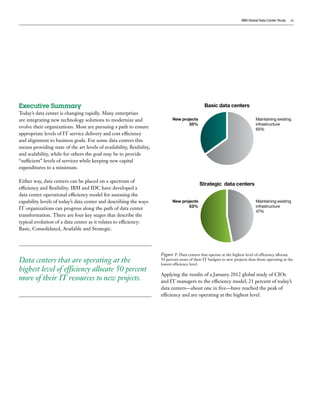
Executive Summary                                                                                  Basic data centers
Today’s data center is changing rapidly. Many enterprises
are integrating new technology solutions to modernize and                      New projects                                       Maintaining existing
                                                                                      35%                                         infrastructure
evolve their organizations. Most are pursuing a path to ensure                                                                    65%
appropriate levels of IT service delivery and cost efficiency
and alignment to business goals. For some data centers this
means providing state of the art levels of availability, flexibility,
and scalability, while for others the goal may be to provide
“sufficient” levels of services while keeping new capital
expenditures to a minimum.

Either way, data centers can be placed on a spectrum of
                                                                                                Strategic data centers
efficiency and flexibility. IBM and IDC have developed a
data center operational efficiency model for assessing the
capability levels of today’s data center and describing the ways               New projects                                       Maintaining existing
                                                                                      53%                                         infrastructure
IT organizations can progress along the path of data center
                                                                                                                                  47%
transformation. There are four key stages that describe the
typical evolution of a data center as it relates to efficiency:
Basic, Consolidated, Available and Strategic.


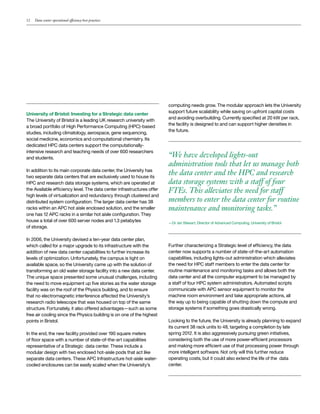
                                                                        Figure 1: Data centers that operate at the highest level of efficiency allocate
Data centers that are operating at the                                  50 percent more of their IT budgets to new projects than those operating at the
                                                                        lowest efficiency level.
highest level of efficiency allocate 50 percent
                                                                        Applying the results of a January 2012 global study of CIOs
more of their IT resources to new projects.                             and IT managers to the efficiency model, 21 percent of today’s
                                                                        data centers—about one in five—have reached the peak of
                                                                        efficiency and are operating at the highest level.
iv   Data center operational efficiency best practices


Improving data center efficiency can yield tangible benefits to       While the “right” solution cannot be dictated by a single,
the organization. This study found that Strategic data centers        standardized blueprint, and reaching the Strategic efficiency
were able to deliver:                                                 level may not align with the goals of all organizations, many
                                                                      IT professionals are looking for something analogous to
â—Ź	 Greater investment on strategic initiatives. Staff spend more      a playbook that provides context for designing an
   than half of their time on new projects versus maintaining         appropriate strategy.
   the infrastructure, compared to only 35 percent for Basic
   data centers (Figure 1). Further, 39 percent are planning
   transformational projects to reengineer their IT service           About this study
   delivery as compared to 23 percent.                                The information for this paper came from a global survey of 308
â—Ź	 Greater efficiency. They enjoy more than 2.5 times the
                                                                      IT executives in seven countries to understand the current state
   staffing efficiency, averaging 27 servers per administrator        of their data center operational efficiency—processes, tools,
   compared to 10 for Basic data centers.                             and technologies—across eight separate areas: data center
â—Ź	 Greater flexibility. More than half of the companies support       operations, facilities management, servers, storage, network,
   a high rate of organizational change compared to just 6            applications and tools, governance and staffing. The survey
   percent for Basic data centers.                                    was supplemented by in-depth interviews with IT managers and
                                                                      CIOs from North America, Europe and Asia. For additional study
                                                                      details, see Study Methodology.
There were four distinguishing characteristics of companies
that have moved toward a more strategic approach:

â—Ź	 Optimize the server, storage, network and facilities assets to 	
   maximize capacity and availability
â—Ź	 Design for flexibility to support changing business needs

â—Ź	 Use automation tools to improve service levels and 		

   availability
â—Ź	 Have a plan that aligns with the business goals and keep

   it current.
IBM Global Data Center Study   1


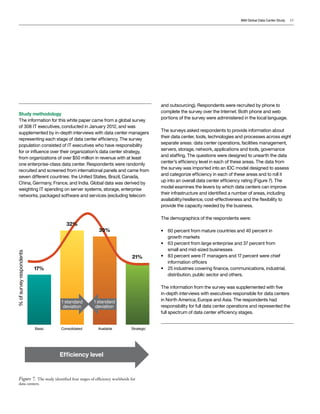
Contents                                                            Emerging from the survey responses were four distinctive
                                                                    stages that differentiate data centers from one another as
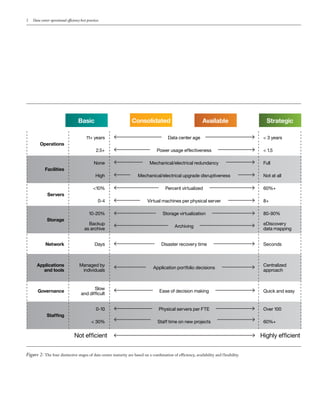
	1	 Defining the state of the data center                           IT organizations move toward business alignment (Figure
                                                                    2). Each stage characterizes the data center based on a
	3	 Distinguishing characteristics of a Strategic
                                                                    combination of efficiency, availability and flexibility.
		 data center

	8	 Recommended investments to improve your data 		                 â—Ź	 Basic: The environment is relatively stable and is 			
		 center operational efficiency                                       maintained based on short-term objectives, with standalone 	
                                                                       infrastructure as the norm. Companies gain the advantages 		
	11	 Moving up the efficiency ladder: Case studies
                                                                       of server consolidation but have not implemented tools
	14	 Moving toward a Strategic data center                             to improve availability levels, which vary widely from 		
                                                                       application to application and site to site.
	14	 How IBM can help                                               â—Ź	 Consolidated: Server virtualization and site consolidation 	

                                                                       are used to take out sizeable numbers of systems and
	15	 Study methodology                                                 facilities and thereby lower capital costs. Server and storage
                                                                       technologies are well utilized and the possibilities for
                                                                       improving availability through virtual machine (VM) 		
Defining the state of the data center                                  mobility are beginning to be realized.
There are two critical concepts to keep in mind when                â—Ź	 Available: IT infrastructure is treated as a general 	 esource 	
                                                                                                                             r
evaluating the state of data center efficiency and alignment           “pool” that can be allocated and scaled freely to meet the
with the needs of the business. First, there is no single “magic       changing demands of workloads and to ensure uptime and 	
bullet” indicator of movement from one efficiency stage to the         performance while providing high rates of utilization. The
next. The data center environment is a compilation of servers,         focus is on measuring and improving service levels while
storage, network systems, mechanical/electrical systems,               building out governance procedures that capture 			
applications and tools, governance procedures and staff. The           business requirements.
only effective means to measure the efficiency of data center       â—Ź	 Strategic: Widespread adoption of policy-based 			

operations is to take a holistic approach that considers multiple      automation tools lowers the manual complexity of the data 	
measures across all elements. Second, the evolution of the data        center and ensures availability requirements and dynamic
center is a journey, one in which the destination may change as        movement of applications and data. Instrumentation and 		
the business needs change. This framework should therefore             metrics are consistently used to validate compliance with 		
not be considered a recipe that should be followed blindly, but        governance polices.
rather a playbook that should be flexibly applied based on the
individual needs of the organization.
0/44/100/00/44/100/0

                                                                                                                          0/9/80/0 0/9/80/0

2   Data center operational efficiency best practices
                                                                                                                          0/44/100/00/44/100/0
                                                                                                                                                            0/9/80/0
                                                                                                                          0/9/80/0 0/9/80/0
                                                                                                                          0/44/100/00/44/100/0              0/44/100/0
                                                                                                                          0/9/80/0 0/9/80/0
                                                                                                                          0/44/100/00/44/100/0

                                                                                                                          0/9/80/0 0/9/80/0
                                                                                                                          0/44/100/00/44/100/0
                                                                                                                                                     0/9/80/0
                                                                                                                                                  0/9/80/0 0/9/80/0
                                                                                                                                                        0/9/80/0
                                                                                                                          0/9/80/0 0/9/80/0
                                                                                                                          0/44/100/00/44/100/0
                                                                                                                                                         0/9/80/0
                                                                                                                                                     0/44/100/0
                                                                                                                                                        0/44/100/0
                                                                                                                                                           0/44/100/0
                                                                                                                                                  0/44/100/0

                                                                                                                                                            0/44/100/0
                                                                                                                          0/9/80/0 0/9/80/0
                                                                                                                          0/44/100/00/44/100/0

                                                                                                                          0/9/80/0 0/9/80/0
                                                                                                                          0/44/100/00/44/100/0


                                                                                                                          0/9/80/0 0/9/80/0
                                                                                                                          0/44/100/00/44/100/0
                                                                                                                                                            0/9/80/0
                                     Basic                        Consolidated                                Available                              Strategic
                                                                                                                          0/9/80/0 0/9/80/0                 0/44/100/0
                                                                                                                          0/44/100/00/44/100/0
                                           11+ years                                     Data center age                                            < 3 years
         Operations
                                                   2.5+                           Power usage effectiveness               0/9/80/0 0/9/80/0         < 1.5
                                                                                                                          0/44/100/0 0/44/100/0

                                                 None                        Mechanical/electrical redundancy                                       Full  0/9/80/0
            Facilities
                                                                                                                                                    Not at0/44/100/0
                                                                                                                          0/9/80/0 0/9/80/0
                                                                                                                          0/44/100/00/44/100/0
                                                  High                Mechanical/electrical upgrade disruptiveness                                        all
                                                                                                                          0/9/80/0 0/9/80/0
                                                                                                                          0/44/100/0 0/44/100/0
                                                 <10%                                  Percent virtualized                                          60%+
              Servers
                                                    0-4                     Virtual machines per physical server                                    8+

                                             10-20%                                  Storage virtualization                                         80-90%
              Storage
                                            Backup                                                                                                  eDiscovery
                                                                                             Archiving
                                          as archive                                                                                                data mapping


             Network                              Days                               Disaster recovery time                                         Seconds


      Applications                    Managed by                                                                                                    Centralized
                                                                               Application portfolio decisions
        and tools                      individuals                                                                                                  approach


                                              Slow
       Governance                                                                  Ease of decision making                                          Quick and easy
                                       and difficult


                                                   0-10                            Physical servers per FTE                                         Over 100
              Staffing
                                               < 30%                              Staff time on new projects                                        60%+


                                  Not efficient	                                                                                                   Highly efficient

Figure 2: The four distinctive stages of data center maturity are based on a combination of efficiency, availability and f lexibility.
IBM Global Data Center Study   3


When taking a more strategic approach to data center              Distinguishing characteristics of a
operations, IT organizations put the needs of the end user        Strategic data center
at the center of their strategy. As data centers move up the      With almost 60 percent of the respondents indicating plans
efficiency scale, many have already taken out a significant       to upgrade their data centers in the next two years and 68
portion of hard cost via consolidation and virtualization, and    percent indicating rapid technology adoption, it is useful to
the real focus is on providing business benefits.                 understand the key differences that characterize Strategic
                                                                  data centers. Not all organizations have environments that
These include not only application availability and               require data centers built to support high rates of change,
performance but, even more important, the ability to respond      and some may never require the near-real time flexibility
rapidly to business changes. This focus on business outcomes      and “always on” availability typified by the Strategic level.
can result in huge payoff for organizations where revenue         However, for those that do require these capabilities, this
generation, innovation or competitive advantage is the goal;      framework provides a roadmap for thinking about the future
in comparison, efficiency and cost containment are typically      data center and underscores how companies can build an
foundational elements.                                            infrastructure that prioritizes availability and flexibility as
                                                                  well as cost containment.
Globally, the distribution of data centers follows a bell curve
with 21 percent, or about 1 in 5 data centers, operating at       Companies that operate a Strategic data center consistently:
the highest Strategic level of optimization, with more than
half moving into differing stages of Consolidated and             â—Ź	 Optimize the server, storage, network and facilities assets
Available environments.                                              to maximize capacity and availability
                                                                  â—Ź	 Design for flexibility to support changing business needs

                                                                  â—Ź	 Use automation tools to improve service levels

                                                                     and availability
                                                                  â—Ź	 Have a plan that aligns with the business goals and keep

                                                                     it current.
4   Data center operational efficiency best practices


Moving beyond consolidation to high levels                                                                 93%                       92%
of optimization
Consolidation through virtualization is a necessary first
step in the path to achieving data center efficiency. Most IT
organizations initially introduce consolidation into the data
center at the server level to cut costs by reducing redundancy
in physical servers. This is often followed by virtualization
in storage and networking environments, usually driven                    48%
by a similar goal of consolidation to streamline and reduce
expenditures on physical infrastructure.
                                                                                     27%
Virtualization is table stakes for data center capability, and in                                                    21%
fact by the time data centers reach the Strategic phase they
                                                                                                                                             14%
have high levels of virtualization across their servers, storage,
and network environments and are advanced in the use of
software and automation tools. Leaders achieve significantly
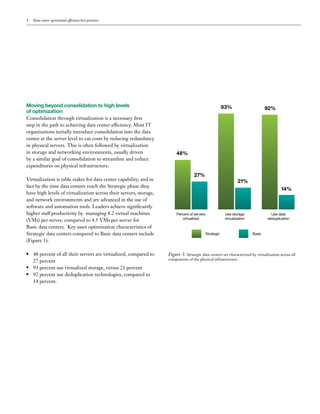
higher staff productivity by managing 8.2 virtual machines                Percent of servers                Use storage                Use data
                                                                              virtualized                   virtualization           deduplication
(VMs) per server, compared to 4.5 VMs per server for
Basic data centers. Key asset optimization characteristics of
Strategic data centers compared to Basic data centers include                                  Strategic                     Basic
(Figure 3):

â—Ź	 48 percent of all their servers are virtualized, compared to 		   Figure 3: Strategic data centers are characterized by virtualization across all
   27 percent                                                        components of the physical infrastructure.
â—Ź	 93 percent use virtualized storage, versus 21 percent

â—Ź	 92 percent use deduplication technologies, compared to 		

   14 percent.
IBM Global Data Center Study    5


Designing for flexibility to meet changing
business needs                                                                             90%
Change is accelerating, putting pressure on infrastructures to
keep pace. Almost 90 percent of executives operating Strategic
data centers indicate they are the first to adopt or among the
first to adopt new technology. Having a plan that is designed
to be flexible to respond to the ever changing needs of the
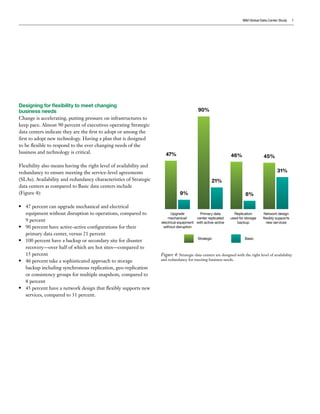
business and technology is critical.                                   47%                                     46%                  45%
Flexibility also means having the right level of availability and
redundancy to ensure meeting the service-level agreements                                                                                   31%
(SLAs). Availability and redundancy characteristics of Strategic                                   21%
data centers as compared to Basic data centers include
(Figure 4):                                                                    9%                                       8%

â—Ź	 47 percent can upgrade mechanical and electrical
   equipment without disruption to operations, compared to                Upgrade          Primary data          Replication        Network design
                                                                        mechanical/      center replicated     used for storage    flexibly supports
   9 percent                                                        electrical equipment with active-active        backup            new services
â—Ź	 90 percent have active-active configurations for their 		         without disruption
   primary data center, versus 21 percent
â—Ź	 100 percent have a backup or secondary site for disaster 		                             Strategic                    Basic

   recovery—over half of which are hot sites—compared to 		
   15 percent                                                       Figure 4: Strategic data centers are designed with the right level of availability
â—Ź	 46 percent take a sophisticated approach to storage 	            and redundancy for meeting business needs.

   backup including synchronous replication, geo-replication 	
   or consistency groups for multiple snapshots, compared to 		
   8 percent
â—Ź	 45 percent have a network design that flexibly supports new 	

   services, compared to 31 percent.
6   Data center operational efficiency best practices


Employing automation tools to improve service levels
and availability                                                                              87%
Automation is typically the next step in the data center journey.
Introducing higher levels of automation enables greater levels
of flexibility and helps support even higher levels of availability.
Greater reliance on automation tools and technologies offloads           58%
manually intensive tasks for system administrators, reduces
error rates and ensures the performance of applications against
their SLAs. Management characteristics of Strategic data
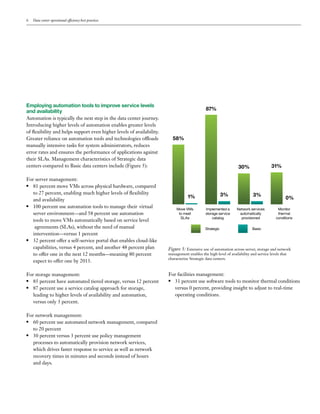
centers compared to Basic data centers include (Figure 5):                                                        30%                 31%

For server management:
â—Ź	 81 percent move VMs across physical hardware, compared 		

   to 27 percent, enabling much higher levels of flexibility                                             3%                3%
                                                                                   1%                                                          0%
   and availability
â—Ź	 100 percent use automation tools to manage their 	virtual
                                                                            Move VMs          Implemented a      Network services         Monitor
   server environment—and 58 percent use automation                          to meet          storage service     automatically           thermal
                                                                              SLAs                catalog          provisioned           conditions
   tools to move VMs automatically based on service level 	
    agreements (SLAs), without the need of manual                                            Strategic                    Basic
   intervention—versus 1 percent
â—Ź	 32 percent offer a self-service portal that enables cloud-like

   capabilities, versus 4 percent, and another 48 percent plan 	       Figure 5: Extensive use of automation across server, storage and network
   to offer one in the next 12 months—meaning 80 percent 		            management enables the high level of availability and service levels that
                                                                       characterize Strategic data centers.
   expect to offer one by 2013.

For storage management:                                                For facilities management:
â—Ź	 85 percent have automated tiered storage, versus 12 percent         â—Ź	 31 percent use software tools to monitor thermal conditions 	

â—Ź	 87 percent use a service catalog approach for storage, 	            	 versus 0 percent, providing insight to adjust to real-time 		
   leading to higher levels of availability and automation,            	 operating conditions.
   versus only 3 percent.

For network management:
â—Ź	 60 percent use automated network management, compared 	
   to 20 percent
â—Ź	 30 percent versus 3 percent use policy management

   processes to automatically provision network services, 		
   which drives faster response to service as well as network 		
   recovery times in minutes and seconds instead of hours
   and days.
IBM Global Data Center Study   7


Having a plan that aligns with business goals and
keeping it current
Organizations with Strategic data centers are far better                                                    77%
prepared to take advantage of market opportunities as the
                                                                     68%
economy rebounds. They have heavily utilized consolidation
projects to optimize the number of data center sites they
maintain. Moreover, we find they are significantly more likely               53%
to continually evaluate the target number of data centers they
should have in a continual focus on strategy and execution.
                                                                                                                                33%
For example, IT organizations with Strategic data centers                                25%
were much more likely to have expanded and modernized
their capabilities during the recent economic downturn. Over                                                        14%
60 percent of Basic data center operations made no strategic
                                                                                                    0%                                     2%
changes or investments over the past two years, and more than
70 percent don’t expect to do so over the next two. In contrast,
                                                                      Build capacity    Forecast space      Forecast power    Implement high- and
nearly all Strategic data centers experienced some form of               in smaller     (10 to 20 years)       demand          low-density zones
                                                                       increments
expansion or growth over the past two years, and more than 80
percent of them expect to do so over the next two.                                      Strategic                   Basic


Additionally, IT organizations operating Strategic data centers
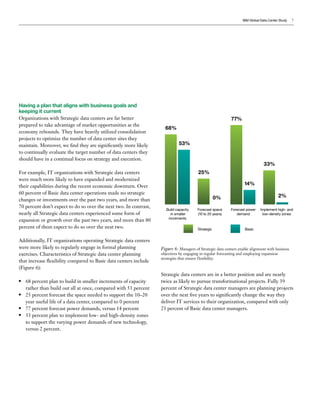
were more likely to regularly engage in formal planning            Figure 6: Managers of Strategic data centers enable alignment with business
exercises. Characteristics of Strategic data center planning       objectives by engaging in regular forecasting and employing expansion
                                                                   strategies that ensure f lexibility.
that increase flexibility compared to Basic data centers include
(Figure 6):
                                                                   Strategic data centers are in a better position and are nearly
â—Ź	 68 percent plan to build in smaller increments of capacity 		   twice as likely to pursue transformational projects. Fully 39
   rather than build out all at once, compared with 53 percent     percent of Strategic data center managers are planning projects
●	 25 percent forecast the space needed to support the 10–20 		    over the next five years to significantly change the way they
   year useful life of a data center, compared to 0 percent        deliver IT services to their organization, compared with only
â—Ź	 77 percent forecast power demands, versus 14 percent            23 percent of Basic data center managers.
â—Ź	 33 percent plan to implement low- and high-density zones 		

   to support the varying power demands of new technology, 		
   versus 2 percent.
8   Data center operational efficiency best practices


                                                                    from one stage to the next, getting to the Strategic level
                                                                    requires a succession of steps. Leveraging the distinguishing
85 percent of Strategic data center managers                        characteristics of leaders applied to each discipline area can
planning major projects, and 77 percent of                          help determine how to get started, including:

those planning projects overall, say they will                      â—Ź	 Data center operations and facilities management
turn to outside help.                                               â—Ź	Servers
                                                                    â—Ź	Storage

                                                                    â—Ź	Network

                                                                    â—Ź	 Business resilience

                                                                    â—Ź	 Governance, including applications, tools and staffing.
Data center managers across the board understand that this
will require investment in outside tools, technologies and
                                                                    Data center operations and facilities management
assistance. Of those planning a major project, over three in
                                                                    Strategic data centers pay careful attention to their facility
four said they will turn to outside help, with an even greater
                                                                    design and understand the need for a holistic view that treats
percentage (85 percent) among Strategic data centers. What’s
                                                                    the data center as a single system. They plan to meet the
more, Strategic data centers are significantly more likely to
                                                                    business needs over the useful life of a facility by forecasting
leverage more off-premises capabilities—including hosting,
                                                                    power, space, capacity and availability—which leads to better
collocation and alternative sites for disaster recovery—while
                                                                    predictability and lower disruption during changes and build-
still having 64 percent of their capacity on-premises.
                                                                    outs. Insights from leaders include:

Recommended investments to improve                                  â—Ź	 Right size capacity and availability. Forecast capacity 	
your data center operational efficiency                                and availability to meet the business needs of primary and 	
While cost containment is certainly a critical benefit of data         backup centers. Then continue to manage for efficiency 	
center efficiency, probably the most important benefit comes           using real-time monitoring and management software.
in the ability to better serve the needs of the core business and   â—Ź	 Design for flexibility. Ensure that investments provide the

respond to shifts in market demand. Evidence shows that the            scalability required to support rapid changes in demand 	
journey toward greater levels of data center efficiency requires       and technology by, for example, building new capacity in
significant changes to the organization’s tools, technologies          smaller increments over time and designing mechanical/	
and processes.                                                         electrical systems so that equipment changes can be made 		
                                                                       without disrupting operations.
Once companies understand what stage they are at and                â—Ź	 Optimize total costs over the long term. Ensure trade-

where they want to go on the efficiency spectrum, they                 offs between capital and operating costs are included in
will need to consider appropriate investments in time and              facilities design, and measure energy efficiency and power
resources. Because there are dependencies required to move             consumption on a real-time basis.
IBM Global Data Center Study   9


                                                                           Storage
                                                                           Strategic data centers are dealing with all aspects of storage
“Building a new data center has provided                                   optimization and management. They realize the need to
us with more space, more efficient and green                               get ahead of the explosion in storage by using software and
                                                                           policy-based management systems to reduce the hands-on
cooling and power, and more robust service                                 labor required to provision and manage storage. Insights from
delivery. Incorporating greater levels of                                  leaders include:
redundancy was a key component of that.”
                                                                           â—Ź	 Increase storage optimization. Leaders implement
—Martin Constant, Corporate Director of Information Technology, NORAMPAC      four to six times more storage optimization techniques,
Paper and Packaging industry, Canada                                          including virtualization, deduplication, thin provisioning
                                                                              and others.
                                                                           â—Ź	 Reduce the time spent by storage architects. Implement

                                                                              storage management technologies, especially storage
Servers                                                                       service catalog, to drive self-service and policy-based
Strategic data center operators have consolidated their server                management.
infrastructure to achieve the fundamental efficiencies from                ●	 Don’t overlook storage backup and archive. With all the


server management. They understand the need to tackle the                     focus on the volume of storage, leaders realize they need
“harder” projects to leverage automation and software tools                   to manage the full lifecycle of data. Consider using more
to drive higher levels of availability and improved quality of                sophisticated approaches to storage backup—including
service. Specific insights to leverage include:                               geo-replication or consistency groups for multiple
                                                                              snapshots. For archiving, consider using eDiscovery data
â—Ź	 Move beyond consolidation to virtualization. Improve                       mapping or defined processes for audits.
   SLA performance by using software tools and automation
   to move virtual images between physical servers and data
   centers based on policies.
â—Ź	 Prepare for cloud computing. Plan to use a self-service

   portal that allows VMs to be automatically ordered online,              “We are already using automated
   with a choice of size, operating system and service level.              hierarchical storage, storage virtualization
â—Ź	 Take advantage of the latest technology. Knowing how
                                                                           and deduplication as well as dynamic
   to optimize systems and move workloads will allow you
   to take advantage of converged infrastructures (server,                 resource allocation (on demand).”
   storage and networking systems that are sold together with
                                                                           —Pierre Debagnard, General Manager of Albiant-IT, BPCE Group, France
   management software in a pre-integrated package).
10   Data center operational efficiency best practices


Network                                                            â—Ź	 Review your business continuity plan. Avoid reliance
There are many external pressures on the network today, such          on tape alone for data backup and recovery, whether at
as the explosion of smartphones and how they have greatly             the data center or a remote location. Combine onsite and
accelerated the demand for access to applications and data;           remote disk storage for backup.
the growing use of video; and the adoption of cloud                â—Ź	 Understand the impact of systems not being available

computing. Leaders realize the need to have a data center             to specific business processes or applications. Leaders
networking strategy in place. They are also moving beyond             provide the optimal level of availability to meet business
traditional network optimization techniques to approaches             needs by using an active-active configuration, which allows
that include network management and automation in order               for rapid failover of systems in the event of failure.
to improve overall IT efficiency and flexibility. Insights from    â—Ź	 Examine business and regulatory compliance

leaders include:                                                      requirements. Gain an understanding of your potential
                                                                      long-term data archiving needs, including how search
â—Ź	 Develop and execute a network strategy. Take a holistic,           capabilities affect your ability to meet compliance
   long-term view that considers the network, servers, storage        requirements. Have a defined process for audits and have
   and applications and end-to-end manageability balanced             archive eDiscovery capabilities.
   against business and financial goals.
â—Ź	 Implement network management and automation.                    Governance, applications, tools and staffing
   Use tools and processes that enable continuous network          Strategic data center executives establish an environment that
   adjustments to meet policy-based application requirements,      is supportive of using a number of management best practices,
   and use predictive tools to avoid unscheduled outages.          including:
â—Ź	 Design for flexibility. Incorporate into the architecture

   the ability to automatically provision network services based   â—Ź	 Use a centralized portfolio approach to application 	
   on policies, with minimal human intervention.                      management. Leaders will also apply different service and
                                                                      support levels to individual applications if the application
Business resilience                                                   owner is prepared to pay.
The ability to manage IT risk is essential for enabling growth,    â—Ź	 Focus on both hard, upfront capital costs and ongoing

dealing with changing business conditions and addressing              operational costs when deciding on data center
new regulations, security threats and service outages. Leaders        investments. Leaders use monitoring and management
distinguish themselves in their approaches and their ability          software to ensure a total-cost focus in ongoing operations
to mitigate negative risks while enhancing their ability to           as well as when making point-in-time investment decisions.
optimize potential opportunities. Insights from the strategies     â—Ź	 Implement decision-making procedures and policies.

of leaders include:                                                   Leaders employ documented procedures and policies
                                                                      to ease decision making regarding ongoing data center
                                                                      operations.
IBM Global Data Center Study   11


                                                                             modifications. Nevertheless, ABI identified a suitable space, an
                                                                             860 square foot high-ceilinged hall located within the palace, and
“We currently manage applications via                                        began renovating the site.

individual tools, but we are planning to                                     After determining it could not completely retrofit the site (for
implement a single management platform in                                    example, it couldn’t introduce raised-floor cooling), ABI opted
the future.”                                                                 to equip the hall with an innovative cooling system based on
                                                                             APC in-rack water cooling blocks connected to chillers above
                                                                             the rack cabinets. By transforming its data center this way, ABI
—Xiao Xiao Bin , IT Manager, INESA Information IT Services industry, China
                                                                             believes it has reduced the average power consumption of the IT
                                                                             infrastructure by about 35 percent, or 25 kW.


Moving up the efficiency ladder:                                             “Our system provides cooling directly to
Case studies                                                                 the IT equipment, alleviating the need
                                                                             to provide room-wide air conditioning.
Associazione Bancaria Italiana (ABI): Moving from Basic
                                                                             By transforming our data center we have
to Consolidated                                                              reduced the average power consumption of
ABI, the Italian Bank Association, is a nonprofit organization that
represents the interests of Italian financial institutions both at
                                                                             the IT infrastructure by about 35 percent or
home and abroad. Headquartered in Rome, the association’s                    25 kW.”
offices are located within the Palazzo Altieri, a national historical
monument filled with significant works of art.                               — Antonio Buratti, CIO, ABI


In 2010, ABI’s IT infrastructure consisted of 110 servers and
50 switches and routers hosted in 6 separate server rooms
dispersed throughout the building and managed by a staff of                  Now that ABI has modernized its facilities, with a focus on
6 IT administrators and a total of 19 IT department staff. These             mechanical/electrical and power and cooling, it has opened the
systems supported 600 internal connections and several                       door to completing its transition to a Consolidated data center.
thousand external connections through a web portal. There was                It is planning to further consolidate servers from rack-mounted
no virtualization, the server rooms were not properly equipped               units to blades, whose higher server densities can now be
or cooled, and the need to maintain each one separately led to               supported by the more efficient cooling system and, in tandem,
staffing inefficiencies. Looking to take its infrastructure to the next      to introduce greater levels of server virtualization. In addition, it
level, ABI decided to push forward with consolidation, beginning             is planning to incorporate advanced management tools that will
with centralizing its data center into a single facility.                    further increase the efficiency of the data center by enabling the
                                                                             operation of the entire facility, from monitoring racks to operating
One of ABI’s unique challenges was the requirement to locate the             facilities security systems all from a single dashboard.
new data center in its existing headquarters—which, as a cultural
heritage, is under significant restrictions that limit structural
12   Data center operational efficiency best practices


                                                                        computing needs grow. The modular approach lets the University
                                                                        support future scalability while saving on upfront capital costs
University of Bristol: Investing for a Strategic data center
                                                                        and avoiding overbuilding. Currently specified at 20 kW per rack,
The University of Bristol is a leading UK research university with
                                                                        the facility is designed to and can support higher densities in
a broad portfolio of High Performance Computing (HPC)-based
                                                                        the future.
studies, including climatology, aerospace, gene sequencing,
social medicine, economics and computational chemistry. Its
dedicated HPC data centers support the computationally-
intensive research and teaching needs of over 600 researchers
and students.                                                           “We have developed lights-out
                                                                        administration tools that let us manage both
In addition to its main corporate data center, the University has
two separate data centers that are exclusively used to house its
                                                                        the data center and the HPC and research
HPC and research data storage systems, which are operated at            data storage systems with a staff of four
the Available efficiency level. The data center infrastructures offer   FTEs. This alleviates the need for staff
high levels of virtualization and redundancy through clustered and
distributed system configuration. The larger data center has 38         members to enter the data center for routine
racks within an APC hot aisle enclosed solution, and the smaller        maintenance and monitoring tasks.”
one has 12 APC racks in a similar hot aisle configuration. They
house a total of over 600 server nodes and 1.3 petabytes                —Dr. Ian Stewart, Director of Advanced Computing, University of Bristol
of storage.

In 2006, the University devised a ten-year data center plan,
which called for a major upgrade to its infrastructure with the         Further characterizing a Strategic level of efficiency, the data
addition of new data center capabilities to further increase its        center now supports a number of state-of-the-art automation
levels of optimization. Unfortunately, the campus is tight on           capabilities, including lights-out administration which alleviates
available space, so the University came up with the solution of         the need for HPC staff members to enter the data center for
transforming an old water storage facility into a new data center.      routine maintenance and monitoring tasks and allows both the
The unique space presented some unusual challenges, including           data center and all the computer equipment to be managed by
the need to move equipment up five stories as the water storage         a staff of four HPC system administrators. Automated scripts
facility was on the roof of the Physics building, and to ensure         communicate with APC sensor equipment to monitor the
that no electromagnetic interference affected the University’s          machine room environment and take appropriate actions, all
research radio telescope that was housed on top of the same             the way up to being capable of shutting down the compute and
structure. Fortunately, it also offered advantages—such as some         storage systems if something goes drastically wrong.
free air cooling since the Physics building is on one of the highest
points in Bristol.                                                      Looking to the future, the University is already planning to expand
                                                                        its current 38 rack units to 48, targeting a completion by late
In the end, the new facility provided over 190 square meters            spring 2012. It is also aggressively pursuing green initiatives,
of floor space with a number of state-of-the-art capabilities           considering both the use of more power-efficient processors
representative of a Strategic data center. These include a              and making more efficient use of that processing power through
modular design with two enclosed hot-aisle pods that act like           more intelligent software. Not only will this further reduce
separate data centers. These APC Infrastructure hot-aisle water-        operating costs, but it could also extend the life of the data
cooled enclosures can be easily scaled when the University’s            center.
IBM Global Data Center Study   13


                                                                          There is widespread deployment of virtualization, with overall
                                                                          server virtualization levels over 60 percent. VM movement is
Albiant-IT, Group BPCE: Operating at the Strategic level
                                                                          supported in an automated capacity (for example, in case of
Albiant-IT is the services provider dedicated to hosting and
                                                                          server failure). Virtualization is also incorporated into the storage
managing the data centers of the banking Group BPCE, a
                                                                          environment, with deduplication and dynamic resource allocation
French company offering a comprehensive range of banking and
                                                                          on demand. Backup is performed onsite via tape and on disks
financial services to a wide range of corporate and consumer
                                                                          with geo-replication. The network is architected to recover
customers. The group has 36 million customers served by 117,000
                                                                          from an outage in real-time. Governance is provided through a
employees and 8,000 branches. To support these operations
                                                                          change committee representing each of the client organizations
Albiant-IT operates a total of four datacenters across two sites,
                                                                          within the bank, and the core decision making criteria are always
one in the Paris metropolitan area and one in the south of France.
                                                                          ensuring the ability to deliver high availability and minimize
The four datacenters combined have a capacity of 80,800 square
                                                                          operating costs.
feet extendable to 97,000 square feet and currently host 18,000
servers. 80 percent of the servers are x86, with the remainder
consisting of Unix servers and seven mainframes.

Albiant-IT has made strategic investments in its datacenter that          “We operate at a 99.999 percent SLA and
enable it to operate optimally. It operates at a five nine availability   have had 100 percent measured availability
SLA (99.999 percent uptime) and in fact has a measured 100
percent uptime since it put its current facilities in place more than
                                                                          since our current facility was deployed two
two years ago. It currently has a ten-year capacity plan in place to      years ago.”
account for its internal IT and hosting services infrastructure.
                                                                          —Pierre Debagnard, General Manager of Albiant-IT, BPCE Group
The datacenters operate in a hot-hot (active-active) mode with
a 2(N+1) architecture. Each datacenter replicates into the other
and workloads can be moved as necessary. Capacity can be
added in a modular fashion, both by increasing energy capacity            Even though the datacenter is operating in most respects at
and by equipping new “rooms” within the existing physical                 the Strategic level, this is not to say there are not future areas
facilities. Energy consumption is measured at the facility level          of further optimization that Albiant-IT is considering. One of the
according to the energy capacity plan in place. A great deal of           areas is the introduction of a converged infrastructure. Albiant-
focus is placed on optimizing power usage effectiveness (PUE);            IT, with its BPCE clients, is considering implementing such an
the facility is currently operating at a PUE ratio of 2, with the goal    infrastructure providing it helps reduce costs and enables a quick
of achieving 1.7 in the very near future. There is an entire system in    return on investment (ROI).
place to optimize energy consumption that relies on a number of
variables, including a room’s population, air flow, hygrometry and
temperature optimization.
14   Data center operational efficiency best practices


Moving toward a Strategic data center                                  How IBM can help
Data centers are under constant pressure to scale and evolve           IBM helps enterprises around the world plan, optimize
to meet the changing needs of the underlying business. To              and automate their data centers in order to support their
adapt to these challenges, each data center takes a slightly           business growth and objectives. IBM has a broad portfolio
different approach.                                                    of data center facilities planning and design, cloud, IT
                                                                       virtualization, network modernization, business resilience
Today, about one in five data centers operate at the Strategic,        and automation services that can help you meet your data
or highest efficiency, level. Companies not yet operating at           center efficiency objectives.
this level can achieve greater efficiency by emulating the
four key behaviors of IT organizations that operate Strategic          You can get started on your data center efficiency journey
data centers:                                                          by taking the Data Center Efficiency Self-Assessment. This
                                                                       no-cost online tool will give you a quick snapshot of your
â—Ź	 Optimize the server, storage, network and facilities assets to      efficiency status across facilities management, servers, storage
   maximize capacity and availability                                  and networks.
â—Ź	 Design for flexibility to support changing business needs

â—Ź	 Use automation tools to improve service levels
                                                                       For more information
   and availability                                                    To learn more about how IBM can help you progress on your
â—Ź	 Have a plan that aligns with the business goals and keep 		
                                                                       journey to greater data center efficiency, you can contact your
   it current.                                                         IBM representative or visit the following websites:

For most companies, getting there will not happen overnight.           ibm.com/data-center/study
It typically takes organizations several years of planning and
strategic investments in each area of the data center to achieve       ibm.com/services/smarterdatacenter
Strategic status. While North American organizations and
companies with more than 500 employees had the highest
proportion of Strategic data centers, this level of efficiency is
achievable for any company. Strategic data centers were found
in all regions of the world and in smaller companies.

Most companies, whatever their size, plan on using outside
help with the projects that advance efficiency, a realization
especially shared by Strategic data centers. To achieve the
highest levels of efficiency, data centers must continually
re-evaluate their performance, reviewing their investments in
tools, technologies and governance, and must have the right
level of skills and assistance. Doing so can yield benefits in
greater staffing efficiencies, greater levels of flexibility and the
ability to spend more time on strategic IT initiative to support
the business.
IBM Global Data Center Study   15


                                                                                    and outsourcing). Respondents were recruited by phone to
                                                                                    complete the survey over the Internet. Both phone and web
     Study methodology
                                                                                    portions of the survey were administered in the local language.
     The information for this white paper came from a global survey
     of 308 IT executives, conducted in January 2012, and was
                                                                                    The surveys asked respondents to provide information about
     supplemented by in-depth interviews with data center managers
                                                                                    their data center, tools, technologies and processes across eight
     representing each stage of data center efficiency. The survey
                                                                                    separate areas: data center operations, facilities management,
     population consisted of IT executives who have responsibility
                                                                                    servers, storage, network, applications and tools, governance
     for or influence over their organization’s data center strategy,
                                                                                    and staffing. The questions were designed to unearth the data
     from organizations of over $50 million in revenue with at least
                                                                                    center’s efficiency level in each of these areas. The data from
     one enterprise-class data center. Respondents were randomly
                                                                                    the survey was imported into an IDC model designed to assess
     recruited and screened from international panels and came from
                                                                                    and categorize efficiency in each of these areas and to roll it
     seven different countries: the United States, Brazil, Canada,
                                                                                    up into an overall data center efficiency rating (Figure 7). The
     China, Germany, France, and India. Global data was derived by
                                                                                    model examines the levers by which data centers can improve
     weighting IT spending on server systems, storage, enterprise
                                                                                    their infrastructure and identified a number of areas, including
     networks, packaged software and services (excluding telecom
                                                                                    availability/resilience, cost-effectiveness and the flexibility to
                                                                                    provide the capacity needed by the business.

                                                                                    The demographics of the respondents were:
                                    32%
                                                     30%                            •	   60 percent from mature countries and 40 percent in 	
                                                                                    	    growth markets
                                                                                    •	   63 percent from large enterprise and 37 percent from 	               	
                                                                                    	    small and mid-sized businesses
% of survey respondents


                                                                         21%        •	   83 percent were IT managers and 17 percent were chief 	              	
                                                                                    	    information officers
                          17%                                                       •	   25 industries covering finance, communications, industrial, 	        	
                                                                                    	    distribution, public sector and others.

                                                                                    The information from the survey was supplemented with five
                                                                                    in-depth interviews with executives responsible for data centers
                                  1 standard      1 standard                        in North America, Europe and Asia. The respondents had
                                   deviation       deviation                        responsibility for full data center operations and represented the
                                                                                    full spectrum of data center efficiency stages.


                          Basic   Consolidated      Available           Strategic


                                  Efficiency level


     Figure 7. The study identified four stages of efficiency worldwide for
     data centers.
16   Data center operational efficiency best practices


                                                         © Copyright IBM Corporation 2012

                                                         IBM Corporation
                                                         IBM Global Technology Services
                                                         Route 100
                                                         Somers, NY 10589

                                                         Produced in the United States of America
                                                         April 2012

                                                         IBM, the IBM logo and ibm.com are trademarks of International
                                                         Business Machines Corp., registered in many jurisdictions worldwide.
                                                         Other product and service names might be trademarks of IBM or other
                                                         companies. A current list of IBM trademarks is available on the Web
                                                         at “Copyright and trademark information” at www.ibm.com/legal/
                                                         copytrade.shtml

                                                         This document is current as of the initial date of publication and may
                                                         be changed by IBM at any time. Not all offerings are available in every
                                                         country in which IBM operates.

                                                         THE INFORMATION IN THIS DOCUMENT IS PROVIDED
                                                         “AS IS” WITHOUT ANY WARRANTY, EXPRESS OR
                                                         IMPLIED, INCLUDING WITHOUT ANY WARRANTIES
                                                         OF MERCHANTABILITY, FITNESS FOR A PARTICULAR
                                                         PURPOSE AND ANY WARRANTY OR CONDITION OF NON-
                                                         INFRINGEMENT. IBM products are warranted according to the terms
                                                         and conditions of the agreements under which they are provided.


                                                                  Please Recycle


                                                                                                         RLW03007-USEN-01

Dc ops

  • 1.
    IBM Global TechnologyServices IBM Global Data Center Study i Research Report Data center operational efficiency best practices Enabling increased new project spending by improving data center efficiency Findings from the IBM Global Data Center Study
  • 2.
    ii Data center operational efficiency best practices Data center operational efficiency best practices: Enabling increased new project spending by improving data center efficiency is an IBM study that developed a data center operational efficiency model for assessing the capability levels of today’s data center and describes the ways IT organizations can progress along the path of data center transformation. The report was written by IDC, which also executed the survey and interviews on behalf of IBM. The authors would like to give special thanks to the following individuals for their assistance and support in developing this report: ● Dr. Ian Stewart, Director of Advanced Computing, University of Bristol ● Antonio Buratti, CIO, ABI (Associazione Bancaria Italiana) ● Pierre Debagnard, General Manager of Albiant-IT, BPCE Group ● Xiao Xiao Bin, IT Manager, INESA Information Solution Group Co. Ltd ● Martin Constant, Corporate Director of Information Technology, NORAMPAC
  • 3.
    IBM Global DataCenter Study iii Executive Summary Basic data centers Today’s data center is changing rapidly. Many enterprises are integrating new technology solutions to modernize and New projects Maintaining existing 35% infrastructure evolve their organizations. Most are pursuing a path to ensure 65% appropriate levels of IT service delivery and cost efficiency and alignment to business goals. For some data centers this means providing state of the art levels of availability, flexibility, and scalability, while for others the goal may be to provide “sufficient” levels of services while keeping new capital expenditures to a minimum. Either way, data centers can be placed on a spectrum of Strategic data centers efficiency and flexibility. IBM and IDC have developed a data center operational efficiency model for assessing the capability levels of today’s data center and describing the ways New projects Maintaining existing 53% infrastructure IT organizations can progress along the path of data center 47% transformation. There are four key stages that describe the typical evolution of a data center as it relates to efficiency: Basic, Consolidated, Available and Strategic. Figure 1: Data centers that operate at the highest level of efficiency allocate Data centers that are operating at the 50 percent more of their IT budgets to new projects than those operating at the lowest efficiency level. highest level of efficiency allocate 50 percent Applying the results of a January 2012 global study of CIOs more of their IT resources to new projects. and IT managers to the efficiency model, 21 percent of today’s data centers—about one in five—have reached the peak of efficiency and are operating at the highest level.
  • 4.
    iv Data center operational efficiency best practices Improving data center efficiency can yield tangible benefits to While the “right” solution cannot be dictated by a single, the organization. This study found that Strategic data centers standardized blueprint, and reaching the Strategic efficiency were able to deliver: level may not align with the goals of all organizations, many IT professionals are looking for something analogous to ● Greater investment on strategic initiatives. Staff spend more a playbook that provides context for designing an than half of their time on new projects versus maintaining appropriate strategy. the infrastructure, compared to only 35 percent for Basic data centers (Figure 1). Further, 39 percent are planning transformational projects to reengineer their IT service About this study delivery as compared to 23 percent. The information for this paper came from a global survey of 308 ● Greater efficiency. They enjoy more than 2.5 times the IT executives in seven countries to understand the current state staffing efficiency, averaging 27 servers per administrator of their data center operational efficiency—processes, tools, compared to 10 for Basic data centers. and technologies—across eight separate areas: data center ● Greater flexibility. More than half of the companies support operations, facilities management, servers, storage, network, a high rate of organizational change compared to just 6 applications and tools, governance and staffing. The survey percent for Basic data centers. was supplemented by in-depth interviews with IT managers and CIOs from North America, Europe and Asia. For additional study details, see Study Methodology. There were four distinguishing characteristics of companies that have moved toward a more strategic approach: ● Optimize the server, storage, network and facilities assets to maximize capacity and availability ● Design for flexibility to support changing business needs ● Use automation tools to improve service levels and availability ● Have a plan that aligns with the business goals and keep it current.
  • 5.
    IBM Global DataCenter Study 1 Contents Emerging from the survey responses were four distinctive stages that differentiate data centers from one another as 1 Defining the state of the data center IT organizations move toward business alignment (Figure 2). Each stage characterizes the data center based on a 3 Distinguishing characteristics of a Strategic combination of efficiency, availability and flexibility. data center 8 Recommended investments to improve your data ● Basic: The environment is relatively stable and is center operational efficiency maintained based on short-term objectives, with standalone infrastructure as the norm. Companies gain the advantages 11 Moving up the efficiency ladder: Case studies of server consolidation but have not implemented tools 14 Moving toward a Strategic data center to improve availability levels, which vary widely from application to application and site to site. 14 How IBM can help ● Consolidated: Server virtualization and site consolidation are used to take out sizeable numbers of systems and 15 Study methodology facilities and thereby lower capital costs. Server and storage technologies are well utilized and the possibilities for improving availability through virtual machine (VM) Defining the state of the data center mobility are beginning to be realized. There are two critical concepts to keep in mind when ● Available: IT infrastructure is treated as a general esource r evaluating the state of data center efficiency and alignment “pool” that can be allocated and scaled freely to meet the with the needs of the business. First, there is no single “magic changing demands of workloads and to ensure uptime and bullet” indicator of movement from one efficiency stage to the performance while providing high rates of utilization. The next. The data center environment is a compilation of servers, focus is on measuring and improving service levels while storage, network systems, mechanical/electrical systems, building out governance procedures that capture applications and tools, governance procedures and staff. The business requirements. only effective means to measure the efficiency of data center ● Strategic: Widespread adoption of policy-based operations is to take a holistic approach that considers multiple automation tools lowers the manual complexity of the data measures across all elements. Second, the evolution of the data center and ensures availability requirements and dynamic center is a journey, one in which the destination may change as movement of applications and data. Instrumentation and the business needs change. This framework should therefore metrics are consistently used to validate compliance with not be considered a recipe that should be followed blindly, but governance polices. rather a playbook that should be flexibly applied based on the individual needs of the organization.
  • 6.
    0/44/100/00/44/100/0 0/9/80/0 0/9/80/0 2 Data center operational efficiency best practices 0/44/100/00/44/100/0 0/9/80/0 0/9/80/0 0/9/80/0 0/44/100/00/44/100/0 0/44/100/0 0/9/80/0 0/9/80/0 0/44/100/00/44/100/0 0/9/80/0 0/9/80/0 0/44/100/00/44/100/0 0/9/80/0 0/9/80/0 0/9/80/0 0/9/80/0 0/9/80/0 0/9/80/0 0/44/100/00/44/100/0 0/9/80/0 0/44/100/0 0/44/100/0 0/44/100/0 0/44/100/0 0/44/100/0 0/9/80/0 0/9/80/0 0/44/100/00/44/100/0 0/9/80/0 0/9/80/0 0/44/100/00/44/100/0 0/9/80/0 0/9/80/0 0/44/100/00/44/100/0 0/9/80/0 Basic Consolidated Available Strategic 0/9/80/0 0/9/80/0 0/44/100/0 0/44/100/00/44/100/0 11+ years Data center age < 3 years Operations 2.5+ Power usage effectiveness 0/9/80/0 0/9/80/0 < 1.5 0/44/100/0 0/44/100/0 None Mechanical/electrical redundancy Full 0/9/80/0 Facilities Not at0/44/100/0 0/9/80/0 0/9/80/0 0/44/100/00/44/100/0 High Mechanical/electrical upgrade disruptiveness all 0/9/80/0 0/9/80/0 0/44/100/0 0/44/100/0 <10% Percent virtualized 60%+ Servers 0-4 Virtual machines per physical server 8+ 10-20% Storage virtualization 80-90% Storage Backup eDiscovery Archiving as archive data mapping Network Days Disaster recovery time Seconds Applications Managed by Centralized Application portfolio decisions and tools individuals approach Slow Governance Ease of decision making Quick and easy and difficult 0-10 Physical servers per FTE Over 100 Staffing < 30% Staff time on new projects 60%+ Not efficient Highly efficient Figure 2: The four distinctive stages of data center maturity are based on a combination of efficiency, availability and f lexibility.
  • 7.
    IBM Global DataCenter Study 3 When taking a more strategic approach to data center Distinguishing characteristics of a operations, IT organizations put the needs of the end user Strategic data center at the center of their strategy. As data centers move up the With almost 60 percent of the respondents indicating plans efficiency scale, many have already taken out a significant to upgrade their data centers in the next two years and 68 portion of hard cost via consolidation and virtualization, and percent indicating rapid technology adoption, it is useful to the real focus is on providing business benefits. understand the key differences that characterize Strategic data centers. Not all organizations have environments that These include not only application availability and require data centers built to support high rates of change, performance but, even more important, the ability to respond and some may never require the near-real time flexibility rapidly to business changes. This focus on business outcomes and “always on” availability typified by the Strategic level. can result in huge payoff for organizations where revenue However, for those that do require these capabilities, this generation, innovation or competitive advantage is the goal; framework provides a roadmap for thinking about the future in comparison, efficiency and cost containment are typically data center and underscores how companies can build an foundational elements. infrastructure that prioritizes availability and flexibility as well as cost containment. Globally, the distribution of data centers follows a bell curve with 21 percent, or about 1 in 5 data centers, operating at Companies that operate a Strategic data center consistently: the highest Strategic level of optimization, with more than half moving into differing stages of Consolidated and ● Optimize the server, storage, network and facilities assets Available environments. to maximize capacity and availability ● Design for flexibility to support changing business needs ● Use automation tools to improve service levels and availability ● Have a plan that aligns with the business goals and keep it current.
  • 8.
    4 Data center operational efficiency best practices Moving beyond consolidation to high levels 93% 92% of optimization Consolidation through virtualization is a necessary first step in the path to achieving data center efficiency. Most IT organizations initially introduce consolidation into the data center at the server level to cut costs by reducing redundancy in physical servers. This is often followed by virtualization in storage and networking environments, usually driven 48% by a similar goal of consolidation to streamline and reduce expenditures on physical infrastructure. 27% Virtualization is table stakes for data center capability, and in 21% fact by the time data centers reach the Strategic phase they 14% have high levels of virtualization across their servers, storage, and network environments and are advanced in the use of software and automation tools. Leaders achieve significantly higher staff productivity by managing 8.2 virtual machines Percent of servers Use storage Use data virtualized virtualization deduplication (VMs) per server, compared to 4.5 VMs per server for Basic data centers. Key asset optimization characteristics of Strategic data centers compared to Basic data centers include Strategic Basic (Figure 3): â—Ź 48 percent of all their servers are virtualized, compared to Figure 3: Strategic data centers are characterized by virtualization across all 27 percent components of the physical infrastructure. â—Ź 93 percent use virtualized storage, versus 21 percent â—Ź 92 percent use deduplication technologies, compared to 14 percent.
  • 9.
    IBM Global DataCenter Study 5 Designing for flexibility to meet changing business needs 90% Change is accelerating, putting pressure on infrastructures to keep pace. Almost 90 percent of executives operating Strategic data centers indicate they are the first to adopt or among the first to adopt new technology. Having a plan that is designed to be flexible to respond to the ever changing needs of the business and technology is critical. 47% 46% 45% Flexibility also means having the right level of availability and redundancy to ensure meeting the service-level agreements 31% (SLAs). Availability and redundancy characteristics of Strategic 21% data centers as compared to Basic data centers include (Figure 4): 9% 8% ● 47 percent can upgrade mechanical and electrical equipment without disruption to operations, compared to Upgrade Primary data Replication Network design mechanical/ center replicated used for storage flexibly supports 9 percent electrical equipment with active-active backup new services ● 90 percent have active-active configurations for their without disruption primary data center, versus 21 percent ● 100 percent have a backup or secondary site for disaster Strategic Basic recovery—over half of which are hot sites—compared to 15 percent Figure 4: Strategic data centers are designed with the right level of availability ● 46 percent take a sophisticated approach to storage and redundancy for meeting business needs. backup including synchronous replication, geo-replication or consistency groups for multiple snapshots, compared to 8 percent ● 45 percent have a network design that flexibly supports new services, compared to 31 percent.
  • 10.
    6 Data center operational efficiency best practices Employing automation tools to improve service levels and availability 87% Automation is typically the next step in the data center journey. Introducing higher levels of automation enables greater levels of flexibility and helps support even higher levels of availability. Greater reliance on automation tools and technologies offloads 58% manually intensive tasks for system administrators, reduces error rates and ensures the performance of applications against their SLAs. Management characteristics of Strategic data centers compared to Basic data centers include (Figure 5): 30% 31% For server management: ● 81 percent move VMs across physical hardware, compared to 27 percent, enabling much higher levels of flexibility 3% 3% 1% 0% and availability ● 100 percent use automation tools to manage their virtual Move VMs Implemented a Network services Monitor server environment—and 58 percent use automation to meet storage service automatically thermal SLAs catalog provisioned conditions tools to move VMs automatically based on service level agreements (SLAs), without the need of manual Strategic Basic intervention—versus 1 percent ● 32 percent offer a self-service portal that enables cloud-like capabilities, versus 4 percent, and another 48 percent plan Figure 5: Extensive use of automation across server, storage and network to offer one in the next 12 months—meaning 80 percent management enables the high level of availability and service levels that characterize Strategic data centers. expect to offer one by 2013. For storage management: For facilities management: ● 85 percent have automated tiered storage, versus 12 percent ● 31 percent use software tools to monitor thermal conditions ● 87 percent use a service catalog approach for storage, versus 0 percent, providing insight to adjust to real-time leading to higher levels of availability and automation, operating conditions. versus only 3 percent. For network management: ● 60 percent use automated network management, compared to 20 percent ● 30 percent versus 3 percent use policy management processes to automatically provision network services, which drives faster response to service as well as network recovery times in minutes and seconds instead of hours and days.
  • 11.
    IBM Global DataCenter Study 7 Having a plan that aligns with business goals and keeping it current Organizations with Strategic data centers are far better 77% prepared to take advantage of market opportunities as the 68% economy rebounds. They have heavily utilized consolidation projects to optimize the number of data center sites they maintain. Moreover, we find they are significantly more likely 53% to continually evaluate the target number of data centers they should have in a continual focus on strategy and execution. 33% For example, IT organizations with Strategic data centers 25% were much more likely to have expanded and modernized their capabilities during the recent economic downturn. Over 14% 60 percent of Basic data center operations made no strategic 0% 2% changes or investments over the past two years, and more than 70 percent don’t expect to do so over the next two. In contrast, Build capacity Forecast space Forecast power Implement high- and nearly all Strategic data centers experienced some form of in smaller (10 to 20 years) demand low-density zones increments expansion or growth over the past two years, and more than 80 percent of them expect to do so over the next two. Strategic Basic Additionally, IT organizations operating Strategic data centers were more likely to regularly engage in formal planning Figure 6: Managers of Strategic data centers enable alignment with business exercises. Characteristics of Strategic data center planning objectives by engaging in regular forecasting and employing expansion strategies that ensure f lexibility. that increase flexibility compared to Basic data centers include (Figure 6): Strategic data centers are in a better position and are nearly ● 68 percent plan to build in smaller increments of capacity twice as likely to pursue transformational projects. Fully 39 rather than build out all at once, compared with 53 percent percent of Strategic data center managers are planning projects ● 25 percent forecast the space needed to support the 10–20 over the next five years to significantly change the way they year useful life of a data center, compared to 0 percent deliver IT services to their organization, compared with only ● 77 percent forecast power demands, versus 14 percent 23 percent of Basic data center managers. ● 33 percent plan to implement low- and high-density zones to support the varying power demands of new technology, versus 2 percent.
  • 12.
    8 Data center operational efficiency best practices from one stage to the next, getting to the Strategic level requires a succession of steps. Leveraging the distinguishing 85 percent of Strategic data center managers characteristics of leaders applied to each discipline area can planning major projects, and 77 percent of help determine how to get started, including: those planning projects overall, say they will ● Data center operations and facilities management turn to outside help. ● Servers ● Storage ● Network ● Business resilience ● Governance, including applications, tools and staffing. Data center managers across the board understand that this will require investment in outside tools, technologies and Data center operations and facilities management assistance. Of those planning a major project, over three in Strategic data centers pay careful attention to their facility four said they will turn to outside help, with an even greater design and understand the need for a holistic view that treats percentage (85 percent) among Strategic data centers. What’s the data center as a single system. They plan to meet the more, Strategic data centers are significantly more likely to business needs over the useful life of a facility by forecasting leverage more off-premises capabilities—including hosting, power, space, capacity and availability—which leads to better collocation and alternative sites for disaster recovery—while predictability and lower disruption during changes and build- still having 64 percent of their capacity on-premises. outs. Insights from leaders include: Recommended investments to improve ● Right size capacity and availability. Forecast capacity your data center operational efficiency and availability to meet the business needs of primary and While cost containment is certainly a critical benefit of data backup centers. Then continue to manage for efficiency center efficiency, probably the most important benefit comes using real-time monitoring and management software. in the ability to better serve the needs of the core business and ● Design for flexibility. Ensure that investments provide the respond to shifts in market demand. Evidence shows that the scalability required to support rapid changes in demand journey toward greater levels of data center efficiency requires and technology by, for example, building new capacity in significant changes to the organization’s tools, technologies smaller increments over time and designing mechanical/ and processes. electrical systems so that equipment changes can be made without disrupting operations. Once companies understand what stage they are at and ● Optimize total costs over the long term. Ensure trade- where they want to go on the efficiency spectrum, they offs between capital and operating costs are included in will need to consider appropriate investments in time and facilities design, and measure energy efficiency and power resources. Because there are dependencies required to move consumption on a real-time basis.
  • 13.
    IBM Global DataCenter Study 9 Storage Strategic data centers are dealing with all aspects of storage “Building a new data center has provided optimization and management. They realize the need to us with more space, more efficient and green get ahead of the explosion in storage by using software and policy-based management systems to reduce the hands-on cooling and power, and more robust service labor required to provision and manage storage. Insights from delivery. Incorporating greater levels of leaders include: redundancy was a key component of that.” ● Increase storage optimization. Leaders implement —Martin Constant, Corporate Director of Information Technology, NORAMPAC four to six times more storage optimization techniques, Paper and Packaging industry, Canada including virtualization, deduplication, thin provisioning and others. ● Reduce the time spent by storage architects. Implement storage management technologies, especially storage Servers service catalog, to drive self-service and policy-based Strategic data center operators have consolidated their server management. infrastructure to achieve the fundamental efficiencies from ● Don’t overlook storage backup and archive. With all the server management. They understand the need to tackle the focus on the volume of storage, leaders realize they need “harder” projects to leverage automation and software tools to manage the full lifecycle of data. Consider using more to drive higher levels of availability and improved quality of sophisticated approaches to storage backup—including service. Specific insights to leverage include: geo-replication or consistency groups for multiple snapshots. For archiving, consider using eDiscovery data ● Move beyond consolidation to virtualization. Improve mapping or defined processes for audits. SLA performance by using software tools and automation to move virtual images between physical servers and data centers based on policies. ● Prepare for cloud computing. Plan to use a self-service portal that allows VMs to be automatically ordered online, “We are already using automated with a choice of size, operating system and service level. hierarchical storage, storage virtualization ● Take advantage of the latest technology. Knowing how and deduplication as well as dynamic to optimize systems and move workloads will allow you to take advantage of converged infrastructures (server, resource allocation (on demand).” storage and networking systems that are sold together with —Pierre Debagnard, General Manager of Albiant-IT, BPCE Group, France management software in a pre-integrated package).
  • 14.
    10 Data center operational efficiency best practices Network â—Ź Review your business continuity plan. Avoid reliance There are many external pressures on the network today, such on tape alone for data backup and recovery, whether at as the explosion of smartphones and how they have greatly the data center or a remote location. Combine onsite and accelerated the demand for access to applications and data; remote disk storage for backup. the growing use of video; and the adoption of cloud â—Ź Understand the impact of systems not being available computing. Leaders realize the need to have a data center to specific business processes or applications. Leaders networking strategy in place. They are also moving beyond provide the optimal level of availability to meet business traditional network optimization techniques to approaches needs by using an active-active configuration, which allows that include network management and automation in order for rapid failover of systems in the event of failure. to improve overall IT efficiency and flexibility. Insights from â—Ź Examine business and regulatory compliance leaders include: requirements. Gain an understanding of your potential long-term data archiving needs, including how search â—Ź Develop and execute a network strategy. Take a holistic, capabilities affect your ability to meet compliance long-term view that considers the network, servers, storage requirements. Have a defined process for audits and have and applications and end-to-end manageability balanced archive eDiscovery capabilities. against business and financial goals. â—Ź Implement network management and automation. Governance, applications, tools and staffing Use tools and processes that enable continuous network Strategic data center executives establish an environment that adjustments to meet policy-based application requirements, is supportive of using a number of management best practices, and use predictive tools to avoid unscheduled outages. including: â—Ź Design for flexibility. Incorporate into the architecture the ability to automatically provision network services based â—Ź Use a centralized portfolio approach to application on policies, with minimal human intervention. management. Leaders will also apply different service and support levels to individual applications if the application Business resilience owner is prepared to pay. The ability to manage IT risk is essential for enabling growth, â—Ź Focus on both hard, upfront capital costs and ongoing dealing with changing business conditions and addressing operational costs when deciding on data center new regulations, security threats and service outages. Leaders investments. Leaders use monitoring and management distinguish themselves in their approaches and their ability software to ensure a total-cost focus in ongoing operations to mitigate negative risks while enhancing their ability to as well as when making point-in-time investment decisions. optimize potential opportunities. Insights from the strategies â—Ź Implement decision-making procedures and policies. of leaders include: Leaders employ documented procedures and policies to ease decision making regarding ongoing data center operations.
  • 15.
    IBM Global DataCenter Study 11 modifications. Nevertheless, ABI identified a suitable space, an 860 square foot high-ceilinged hall located within the palace, and “We currently manage applications via began renovating the site. individual tools, but we are planning to After determining it could not completely retrofit the site (for implement a single management platform in example, it couldn’t introduce raised-floor cooling), ABI opted the future.” to equip the hall with an innovative cooling system based on APC in-rack water cooling blocks connected to chillers above the rack cabinets. By transforming its data center this way, ABI —Xiao Xiao Bin , IT Manager, INESA Information IT Services industry, China believes it has reduced the average power consumption of the IT infrastructure by about 35 percent, or 25 kW. Moving up the efficiency ladder: “Our system provides cooling directly to Case studies the IT equipment, alleviating the need to provide room-wide air conditioning. Associazione Bancaria Italiana (ABI): Moving from Basic By transforming our data center we have to Consolidated reduced the average power consumption of ABI, the Italian Bank Association, is a nonprofit organization that represents the interests of Italian financial institutions both at the IT infrastructure by about 35 percent or home and abroad. Headquartered in Rome, the association’s 25 kW.” offices are located within the Palazzo Altieri, a national historical monument filled with significant works of art. — Antonio Buratti, CIO, ABI In 2010, ABI’s IT infrastructure consisted of 110 servers and 50 switches and routers hosted in 6 separate server rooms dispersed throughout the building and managed by a staff of Now that ABI has modernized its facilities, with a focus on 6 IT administrators and a total of 19 IT department staff. These mechanical/electrical and power and cooling, it has opened the systems supported 600 internal connections and several door to completing its transition to a Consolidated data center. thousand external connections through a web portal. There was It is planning to further consolidate servers from rack-mounted no virtualization, the server rooms were not properly equipped units to blades, whose higher server densities can now be or cooled, and the need to maintain each one separately led to supported by the more efficient cooling system and, in tandem, staffing inefficiencies. Looking to take its infrastructure to the next to introduce greater levels of server virtualization. In addition, it level, ABI decided to push forward with consolidation, beginning is planning to incorporate advanced management tools that will with centralizing its data center into a single facility. further increase the efficiency of the data center by enabling the operation of the entire facility, from monitoring racks to operating One of ABI’s unique challenges was the requirement to locate the facilities security systems all from a single dashboard. new data center in its existing headquarters—which, as a cultural heritage, is under significant restrictions that limit structural
  • 16.
    12 Data center operational efficiency best practices computing needs grow. The modular approach lets the University support future scalability while saving on upfront capital costs University of Bristol: Investing for a Strategic data center and avoiding overbuilding. Currently specified at 20 kW per rack, The University of Bristol is a leading UK research university with the facility is designed to and can support higher densities in a broad portfolio of High Performance Computing (HPC)-based the future. studies, including climatology, aerospace, gene sequencing, social medicine, economics and computational chemistry. Its dedicated HPC data centers support the computationally- intensive research and teaching needs of over 600 researchers and students. “We have developed lights-out administration tools that let us manage both In addition to its main corporate data center, the University has two separate data centers that are exclusively used to house its the data center and the HPC and research HPC and research data storage systems, which are operated at data storage systems with a staff of four the Available efficiency level. The data center infrastructures offer FTEs. This alleviates the need for staff high levels of virtualization and redundancy through clustered and distributed system configuration. The larger data center has 38 members to enter the data center for routine racks within an APC hot aisle enclosed solution, and the smaller maintenance and monitoring tasks.” one has 12 APC racks in a similar hot aisle configuration. They house a total of over 600 server nodes and 1.3 petabytes —Dr. Ian Stewart, Director of Advanced Computing, University of Bristol of storage. In 2006, the University devised a ten-year data center plan, which called for a major upgrade to its infrastructure with the Further characterizing a Strategic level of efficiency, the data addition of new data center capabilities to further increase its center now supports a number of state-of-the-art automation levels of optimization. Unfortunately, the campus is tight on capabilities, including lights-out administration which alleviates available space, so the University came up with the solution of the need for HPC staff members to enter the data center for transforming an old water storage facility into a new data center. routine maintenance and monitoring tasks and allows both the The unique space presented some unusual challenges, including data center and all the computer equipment to be managed by the need to move equipment up five stories as the water storage a staff of four HPC system administrators. Automated scripts facility was on the roof of the Physics building, and to ensure communicate with APC sensor equipment to monitor the that no electromagnetic interference affected the University’s machine room environment and take appropriate actions, all research radio telescope that was housed on top of the same the way up to being capable of shutting down the compute and structure. Fortunately, it also offered advantages—such as some storage systems if something goes drastically wrong. free air cooling since the Physics building is on one of the highest points in Bristol. Looking to the future, the University is already planning to expand its current 38 rack units to 48, targeting a completion by late In the end, the new facility provided over 190 square meters spring 2012. It is also aggressively pursuing green initiatives, of floor space with a number of state-of-the-art capabilities considering both the use of more power-efficient processors representative of a Strategic data center. These include a and making more efficient use of that processing power through modular design with two enclosed hot-aisle pods that act like more intelligent software. Not only will this further reduce separate data centers. These APC Infrastructure hot-aisle water- operating costs, but it could also extend the life of the data cooled enclosures can be easily scaled when the University’s center.
  • 17.
    IBM Global DataCenter Study 13 There is widespread deployment of virtualization, with overall server virtualization levels over 60 percent. VM movement is Albiant-IT, Group BPCE: Operating at the Strategic level supported in an automated capacity (for example, in case of Albiant-IT is the services provider dedicated to hosting and server failure). Virtualization is also incorporated into the storage managing the data centers of the banking Group BPCE, a environment, with deduplication and dynamic resource allocation French company offering a comprehensive range of banking and on demand. Backup is performed onsite via tape and on disks financial services to a wide range of corporate and consumer with geo-replication. The network is architected to recover customers. The group has 36 million customers served by 117,000 from an outage in real-time. Governance is provided through a employees and 8,000 branches. To support these operations change committee representing each of the client organizations Albiant-IT operates a total of four datacenters across two sites, within the bank, and the core decision making criteria are always one in the Paris metropolitan area and one in the south of France. ensuring the ability to deliver high availability and minimize The four datacenters combined have a capacity of 80,800 square operating costs. feet extendable to 97,000 square feet and currently host 18,000 servers. 80 percent of the servers are x86, with the remainder consisting of Unix servers and seven mainframes. Albiant-IT has made strategic investments in its datacenter that “We operate at a 99.999 percent SLA and enable it to operate optimally. It operates at a five nine availability have had 100 percent measured availability SLA (99.999 percent uptime) and in fact has a measured 100 percent uptime since it put its current facilities in place more than since our current facility was deployed two two years ago. It currently has a ten-year capacity plan in place to years ago.” account for its internal IT and hosting services infrastructure. —Pierre Debagnard, General Manager of Albiant-IT, BPCE Group The datacenters operate in a hot-hot (active-active) mode with a 2(N+1) architecture. Each datacenter replicates into the other and workloads can be moved as necessary. Capacity can be added in a modular fashion, both by increasing energy capacity Even though the datacenter is operating in most respects at and by equipping new “rooms” within the existing physical the Strategic level, this is not to say there are not future areas facilities. Energy consumption is measured at the facility level of further optimization that Albiant-IT is considering. One of the according to the energy capacity plan in place. A great deal of areas is the introduction of a converged infrastructure. Albiant- focus is placed on optimizing power usage effectiveness (PUE); IT, with its BPCE clients, is considering implementing such an the facility is currently operating at a PUE ratio of 2, with the goal infrastructure providing it helps reduce costs and enables a quick of achieving 1.7 in the very near future. There is an entire system in return on investment (ROI). place to optimize energy consumption that relies on a number of variables, including a room’s population, air flow, hygrometry and temperature optimization.
  • 18.
    14 Data center operational efficiency best practices Moving toward a Strategic data center How IBM can help Data centers are under constant pressure to scale and evolve IBM helps enterprises around the world plan, optimize to meet the changing needs of the underlying business. To and automate their data centers in order to support their adapt to these challenges, each data center takes a slightly business growth and objectives. IBM has a broad portfolio different approach. of data center facilities planning and design, cloud, IT virtualization, network modernization, business resilience Today, about one in five data centers operate at the Strategic, and automation services that can help you meet your data or highest efficiency, level. Companies not yet operating at center efficiency objectives. this level can achieve greater efficiency by emulating the four key behaviors of IT organizations that operate Strategic You can get started on your data center efficiency journey data centers: by taking the Data Center Efficiency Self-Assessment. This no-cost online tool will give you a quick snapshot of your â—Ź Optimize the server, storage, network and facilities assets to efficiency status across facilities management, servers, storage maximize capacity and availability and networks. â—Ź Design for flexibility to support changing business needs â—Ź Use automation tools to improve service levels For more information and availability To learn more about how IBM can help you progress on your â—Ź Have a plan that aligns with the business goals and keep journey to greater data center efficiency, you can contact your it current. IBM representative or visit the following websites: For most companies, getting there will not happen overnight. ibm.com/data-center/study It typically takes organizations several years of planning and strategic investments in each area of the data center to achieve ibm.com/services/smarterdatacenter Strategic status. While North American organizations and companies with more than 500 employees had the highest proportion of Strategic data centers, this level of efficiency is achievable for any company. Strategic data centers were found in all regions of the world and in smaller companies. Most companies, whatever their size, plan on using outside help with the projects that advance efficiency, a realization especially shared by Strategic data centers. To achieve the highest levels of efficiency, data centers must continually re-evaluate their performance, reviewing their investments in tools, technologies and governance, and must have the right level of skills and assistance. Doing so can yield benefits in greater staffing efficiencies, greater levels of flexibility and the ability to spend more time on strategic IT initiative to support the business.
  • 19.
    IBM Global DataCenter Study 15 and outsourcing). Respondents were recruited by phone to complete the survey over the Internet. Both phone and web Study methodology portions of the survey were administered in the local language. The information for this white paper came from a global survey of 308 IT executives, conducted in January 2012, and was The surveys asked respondents to provide information about supplemented by in-depth interviews with data center managers their data center, tools, technologies and processes across eight representing each stage of data center efficiency. The survey separate areas: data center operations, facilities management, population consisted of IT executives who have responsibility servers, storage, network, applications and tools, governance for or influence over their organization’s data center strategy, and staffing. The questions were designed to unearth the data from organizations of over $50 million in revenue with at least center’s efficiency level in each of these areas. The data from one enterprise-class data center. Respondents were randomly the survey was imported into an IDC model designed to assess recruited and screened from international panels and came from and categorize efficiency in each of these areas and to roll it seven different countries: the United States, Brazil, Canada, up into an overall data center efficiency rating (Figure 7). The China, Germany, France, and India. Global data was derived by model examines the levers by which data centers can improve weighting IT spending on server systems, storage, enterprise their infrastructure and identified a number of areas, including networks, packaged software and services (excluding telecom availability/resilience, cost-effectiveness and the flexibility to provide the capacity needed by the business. The demographics of the respondents were: 32% 30% • 60 percent from mature countries and 40 percent in growth markets • 63 percent from large enterprise and 37 percent from small and mid-sized businesses % of survey respondents 21% • 83 percent were IT managers and 17 percent were chief information officers 17% • 25 industries covering finance, communications, industrial, distribution, public sector and others. The information from the survey was supplemented with five in-depth interviews with executives responsible for data centers 1 standard 1 standard in North America, Europe and Asia. The respondents had deviation deviation responsibility for full data center operations and represented the full spectrum of data center efficiency stages. Basic Consolidated Available Strategic Efficiency level Figure 7. The study identified four stages of efficiency worldwide for data centers.
  • 20.
    16 Data center operational efficiency best practices © Copyright IBM Corporation 2012 IBM Corporation IBM Global Technology Services Route 100 Somers, NY 10589 Produced in the United States of America April 2012 IBM, the IBM logo and ibm.com are trademarks of International Business Machines Corp., registered in many jurisdictions worldwide. Other product and service names might be trademarks of IBM or other companies. A current list of IBM trademarks is available on the Web at “Copyright and trademark information” at www.ibm.com/legal/ copytrade.shtml This document is current as of the initial date of publication and may be changed by IBM at any time. Not all offerings are available in every country in which IBM operates. THE INFORMATION IN THIS DOCUMENT IS PROVIDED “AS IS” WITHOUT ANY WARRANTY, EXPRESS OR IMPLIED, INCLUDING WITHOUT ANY WARRANTIES OF MERCHANTABILITY, FITNESS FOR A PARTICULAR PURPOSE AND ANY WARRANTY OR CONDITION OF NON- INFRINGEMENT. IBM products are warranted according to the terms and conditions of the agreements under which they are provided. Please Recycle RLW03007-USEN-01