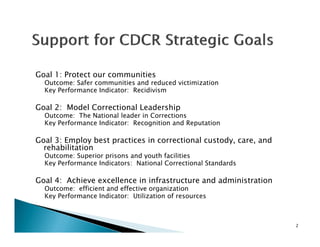
Goal 1: Protect our communities
  Outcome: Safer communities and reduced victimization
  Key Performance Indicator: Recidivism

Goal 2: Model Correctional Leadership
  Outcome: The National leader in Corrections
  Key Performance Indicator: Recognition and Reputation

Goal 3: Employ best practices in correctional custody care and
                                              custody, care,
  rehabilitation
  Outcome: Superior prisons and youth facilities
  Key Performance Indicators: National Correctional Standards

Goal 4: Achieve excellence in infrastructure and administration
  Outcome: efficient and effective organization
  Key Performance Indicator: Utilization of resources


                                                                  2
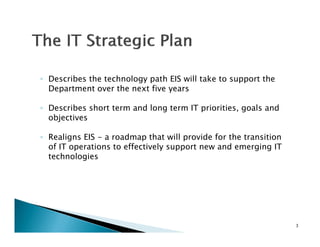
◦ Describes the technology path EIS will take to support the
  D    ib th t h l            th      ill t k t        t th
  Department over the next five years

◦ Describes short term and long term IT priorities goals and
                                        priorities,
  objectives

◦ Realigns EIS - a roadmap that will provide for the transition
  of IT operations to effectively support new and emerging IT
  technologies


                                                                  3
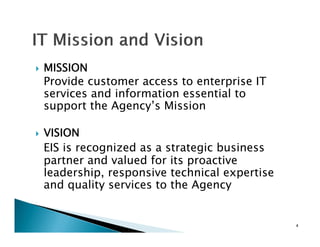
MISSION
Provide customer access to enterprise IT
     d
services and information essential to
support the Agency’s Mission
            Agency s

VISION
EIS is recognized as a strategic business
partner and valued for its proactive
leadership responsi e technical e pertise
leadership, responsive            expertise
and quality services to the Agency


                                              4
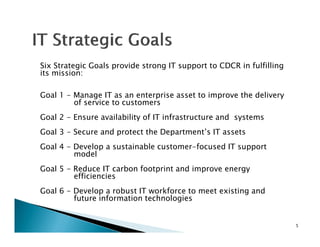
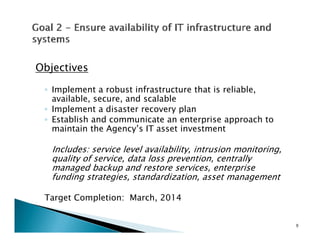
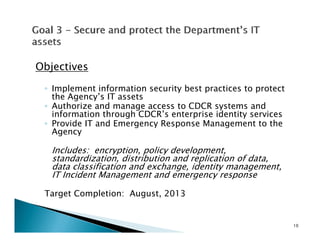
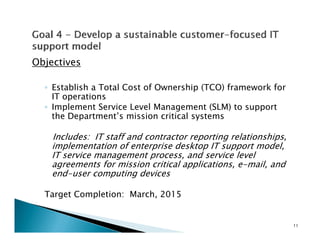
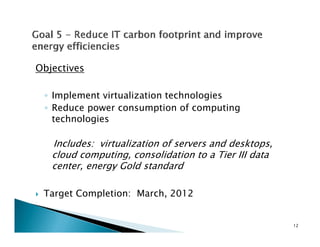
Six Strategic Goals provide strong IT support to CDCR in fulfilling
its mission:

Goal 1 - Manage IT as an enterprise asset to improve the delivery
         of service to customers
Goal 2 - Ensure availability of IT infrastructure and systems
Goal 3 - Secure and protect the Department’s IT assets
Goal 4 - Develop a sustainable customer-focused IT support
         model
Goal 5 - Reduce IT carbon footprint and improve energy
         efficiencies
Goal 6 - Develop a robust IT workforce to meet existing and
                                    g
         future information technologies


                                                                      5
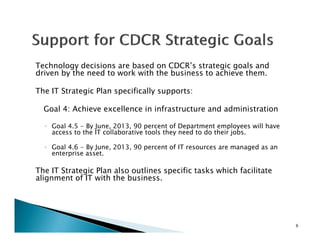
Technology decisions are based on CDCR’s strategic goals and
        y
driven by the need to work with the business to achieve them.

The IT Strategic Plan specifically supports:

  Goal 4: Achieve excellence in infrastructure and administration

  ◦ Goal 4.5 - By June, 2013, 90 percent of Department employees will have
    access to the IT collaborative tools they need to do their jobs.

  ◦ Goal 4.6 - By June, 2013, 90 percent of IT resources are managed as an
    enterprise asset.

The IT Strategic Plan also outlines specific tasks which facilitate
alignment of IT with the business.


                                                                             6
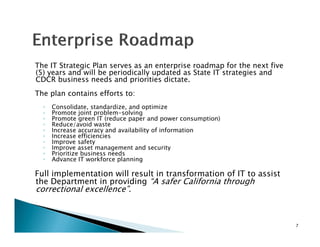
The IT Strategic Plan serves as an enterprise roadmap for the next five
(5) years and will be periodically updated as State IT strategies and
CDCR business needs and priorities dictate.
       b i          d     d i i i di
The plan contains efforts to:
  ◦   Consolidate, standardize,
      Consolidate standardize and optimize
  ◦   Promote joint problem-solving
  ◦   Promote green IT (reduce paper and power consumption)
  ◦   Reduce/avoid waste
  ◦   Increase accuracy and availability of information
  ◦   Increase efficiencies
  ◦   Improve safety
  ◦   Improve asset management and security
  ◦   Prioritize business needs
  ◦   Advance IT workforce planning

  ll    l             ll     l          f          f
Full implementation will result in transformation of IT to assist
the Department in providing “A safer California through
correctional excellence”.


                                                                          7
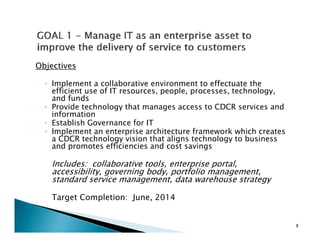
Objectives

  ◦ Implement a collaborative environment to effectuate the
    efficient use of IT resources, people, processes, technology,
    and funds
  ◦ Provide technology that manages access to CDCR services and
    information
  ◦ Establish Governance for IT
  ◦ Implement an enterprise architecture framework which creates
    a CDCR technology vision that aligns technology to business
    and promotes efficiencies and cost savings

    Includes: collaborative tools, enterprise portal,
    accessibility governing body portfolio management
    accessibility,          body,            management,
    standard service management, data warehouse strategy

    Target Completion: June, 2014
       g      p


                                                                    8
Objectives

 ◦ Implement a robust infrastructure that is reliable,
   available, secure, and scalable
 ◦ Implement a disaster recovery plan
 ◦ Establish and communicate an enterprise approach to
   maintain the Agency’s IT asset investment

   Includes: service level availability, intrusion monitoring,
   quality of service, data loss prevention, centrally
   managed backup and restore services, enterprise
   funding strategies, standardization, asset management

 Target Completion: March, 2014
    g      p             ,


                                                                 9
Objectives

 ◦ Implement information security best practices to protect
   the Agency’s IT assets
 ◦ Authorize and manage access to CDCR systems and
   information through CDCR’s enterprise identity services
 ◦ Provide IT and Emergency Response Management to the
   Agency

   Includes: encryption, policy development,
   standardization, distribution and replication of data,
   data classification and exchange, identity management,
                                  g ,       y       g     ,
   IT Incident Management and emergency response

 Target Completion: August, 2013


                                                              10
Objectives

  ◦ Establish a Total Cost of Ownership (TCO) framework for
    IT operations
  ◦ Implement Service Level Management (SLM) to support
    the Department’s mission critical systems

    Includes: IT staff and contractor reporting relationships,
    implementation of enterprise desktop IT support model,
    IT service management process, and service level
    agreements for mission critical applications, e-mail, and
    end-user computing d
       d                  devices

  Target Completion: March, 2015


                                                                 11
Objectives

 ◦ Implement virtualization technologies
 ◦ Reduce power consumption of computing
   technologies

   Includes: virtualization of servers and desktops,
   cloud computing, consolidation to a Tier III data
   center, energy Gold standard
         ,     gy

 Target Completion: March, 2012


                                                       12
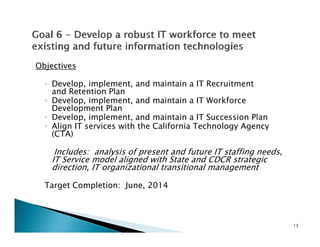
Objectives

  ◦ Develop, implement, and      maintain a IT Recruitment
    and Retention Plan
  ◦ Develop, implement, and      maintain a IT Workforce
    Development Plan
  ◦ Develop, implement, and      maintain a IT Succession Plan
  ◦ Align IT services with the   California Technology Agency
    (CTA)

    Includes: analysis of present and future IT staffing needs,
   IT Service model aligned with State and CDCR strategic
   direction, IT organizational t a s t o a management
   d ect o , o ga at o a transitional a age e t

  Target Completion: June, 2014


                                                                  13

Gtc West 2011 It Strategic Plan Presentation

  • 2.
    Goal 1: Protectour communities Outcome: Safer communities and reduced victimization Key Performance Indicator: Recidivism Goal 2: Model Correctional Leadership Outcome: The National leader in Corrections Key Performance Indicator: Recognition and Reputation Goal 3: Employ best practices in correctional custody care and custody, care, rehabilitation Outcome: Superior prisons and youth facilities Key Performance Indicators: National Correctional Standards Goal 4: Achieve excellence in infrastructure and administration Outcome: efficient and effective organization Key Performance Indicator: Utilization of resources 2
  • 3.
    ◦ Describes thetechnology path EIS will take to support the D ib th t h l th ill t k t t th Department over the next five years ◦ Describes short term and long term IT priorities goals and priorities, objectives ◦ Realigns EIS - a roadmap that will provide for the transition of IT operations to effectively support new and emerging IT technologies 3
  • 4.
    MISSION Provide customer accessto enterprise IT d services and information essential to support the Agency’s Mission Agency s VISION EIS is recognized as a strategic business partner and valued for its proactive leadership responsi e technical e pertise leadership, responsive expertise and quality services to the Agency 4
  • 5.
    Six Strategic Goalsprovide strong IT support to CDCR in fulfilling its mission: Goal 1 - Manage IT as an enterprise asset to improve the delivery of service to customers Goal 2 - Ensure availability of IT infrastructure and systems Goal 3 - Secure and protect the Department’s IT assets Goal 4 - Develop a sustainable customer-focused IT support model Goal 5 - Reduce IT carbon footprint and improve energy efficiencies Goal 6 - Develop a robust IT workforce to meet existing and g future information technologies 5
  • 6.
    Technology decisions arebased on CDCR’s strategic goals and y driven by the need to work with the business to achieve them. The IT Strategic Plan specifically supports: Goal 4: Achieve excellence in infrastructure and administration ◦ Goal 4.5 - By June, 2013, 90 percent of Department employees will have access to the IT collaborative tools they need to do their jobs. ◦ Goal 4.6 - By June, 2013, 90 percent of IT resources are managed as an enterprise asset. The IT Strategic Plan also outlines specific tasks which facilitate alignment of IT with the business. 6
  • 7.
    The IT StrategicPlan serves as an enterprise roadmap for the next five (5) years and will be periodically updated as State IT strategies and CDCR business needs and priorities dictate. b i d d i i i di The plan contains efforts to: ◦ Consolidate, standardize, Consolidate standardize and optimize ◦ Promote joint problem-solving ◦ Promote green IT (reduce paper and power consumption) ◦ Reduce/avoid waste ◦ Increase accuracy and availability of information ◦ Increase efficiencies ◦ Improve safety ◦ Improve asset management and security ◦ Prioritize business needs ◦ Advance IT workforce planning ll l ll l f f Full implementation will result in transformation of IT to assist the Department in providing “A safer California through correctional excellence”. 7
  • 8.
    Objectives ◦Implement a collaborative environment to effectuate the efficient use of IT resources, people, processes, technology, and funds ◦ Provide technology that manages access to CDCR services and information ◦ Establish Governance for IT ◦ Implement an enterprise architecture framework which creates a CDCR technology vision that aligns technology to business and promotes efficiencies and cost savings Includes: collaborative tools, enterprise portal, accessibility governing body portfolio management accessibility, body, management, standard service management, data warehouse strategy Target Completion: June, 2014 g p 8
  • 9.
    Objectives ◦ Implementa robust infrastructure that is reliable, available, secure, and scalable ◦ Implement a disaster recovery plan ◦ Establish and communicate an enterprise approach to maintain the Agency’s IT asset investment Includes: service level availability, intrusion monitoring, quality of service, data loss prevention, centrally managed backup and restore services, enterprise funding strategies, standardization, asset management Target Completion: March, 2014 g p , 9
  • 10.
    Objectives ◦ Implementinformation security best practices to protect the Agency’s IT assets ◦ Authorize and manage access to CDCR systems and information through CDCR’s enterprise identity services ◦ Provide IT and Emergency Response Management to the Agency Includes: encryption, policy development, standardization, distribution and replication of data, data classification and exchange, identity management, g , y g , IT Incident Management and emergency response Target Completion: August, 2013 10
  • 11.
    Objectives ◦Establish a Total Cost of Ownership (TCO) framework for IT operations ◦ Implement Service Level Management (SLM) to support the Department’s mission critical systems Includes: IT staff and contractor reporting relationships, implementation of enterprise desktop IT support model, IT service management process, and service level agreements for mission critical applications, e-mail, and end-user computing d d devices Target Completion: March, 2015 11
  • 12.
    Objectives ◦ Implementvirtualization technologies ◦ Reduce power consumption of computing technologies Includes: virtualization of servers and desktops, cloud computing, consolidation to a Tier III data center, energy Gold standard , gy Target Completion: March, 2012 12
  • 13.
    Objectives ◦Develop, implement, and maintain a IT Recruitment and Retention Plan ◦ Develop, implement, and maintain a IT Workforce Development Plan ◦ Develop, implement, and maintain a IT Succession Plan ◦ Align IT services with the California Technology Agency (CTA) Includes: analysis of present and future IT staffing needs, IT Service model aligned with State and CDCR strategic direction, IT organizational t a s t o a management d ect o , o ga at o a transitional a age e t Target Completion: June, 2014 13