GREATER NOIDA INSTITUTE OF TECHNOLOGY
SEMINAR ON UNDERWATER DRY WELDING
Presented To. Presented By.
Mr. ANUJ DIXIT MAHTAB ALAM
ROLL NO.1413240092
INTRODUCTION:-
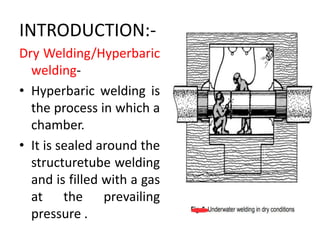
Dry Welding/Hyperbaric
welding-
• Hyperbaric welding is
the process in which a
chamber.
• It is sealed around the
structuretube welding
and is filled with a gas
at the prevailing
pressure .
HISTORY:-
• First underwater welding introduced by British
Admiralty-Dockyard.
• In 1946,special waterproof electrodes were
developed in Holland by ‘Vander Willingen’
• In 1970s:First standard welding performed
Chicago bridge and welding procedure to
American Welding Society (AWS) standards.
Types of Dry Welding:-
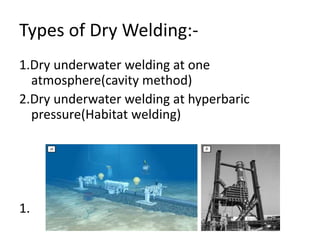
1.Dry underwater welding at one
atmosphere(cavity method)
2.Dry underwater welding at hyperbaric
pressure(Habitat welding)
1.
Working
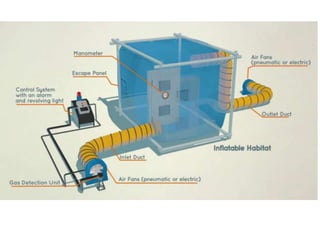
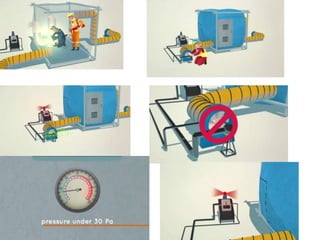
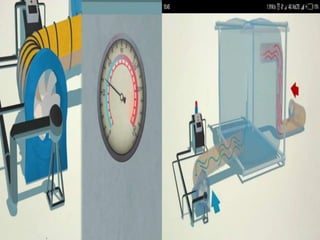
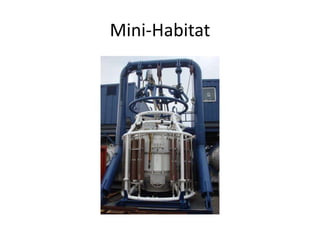
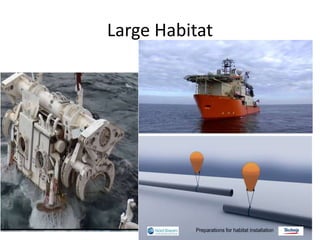
Type of habitat :-
• Mini-Habitat
• Large Habitat
Mini-Habitat
Large Habitat
New technology in hyperbaric welding
• The automation of the welding process
underwater has give a boost to the industry.
• “THOR(TIG hyperbaric orbital robot)”have
changed the way underwater welders do
things.
• Once they have reached the weld site, the
welders-divers must simply install the track
,orbital head and pipefit .afterward THOR take
over the rest of the weld.
Advantages of dry welding:-
• Welder/driver safety
• Good weld quality
• Surface Monitoring
• Non-Destructive Testing(NDT)
Disadvantages:-
• It requires large quantities of complex
equipment and much support equipment on
the surface.
• Cost of habitat welding is extremely high and
increases with depth.
APPLICATIONS:-
• Temporary repair work caused by ships collisions
or unexpected accidents.
• Offshore construction for tapping sea resources.
• Salvaging vessels sunk in the sea.
• Repair and maintenance of ship.
• Construction of large ships beyond the capacity
of existing docks.
• Repairs and maintenance of underwater
pipelines.
THANK YOU

Presentation on underwater dry welding

  • 1.
    GREATER NOIDA INSTITUTEOF TECHNOLOGY SEMINAR ON UNDERWATER DRY WELDING Presented To. Presented By. Mr. ANUJ DIXIT MAHTAB ALAM ROLL NO.1413240092
  • 2.
    INTRODUCTION:- Dry Welding/Hyperbaric welding- • Hyperbaricwelding is the process in which a chamber. • It is sealed around the structuretube welding and is filled with a gas at the prevailing pressure .
  • 3.
    HISTORY:- • First underwaterwelding introduced by British Admiralty-Dockyard. • In 1946,special waterproof electrodes were developed in Holland by ‘Vander Willingen’ • In 1970s:First standard welding performed Chicago bridge and welding procedure to American Welding Society (AWS) standards.
  • 4.
    Types of DryWelding:- 1.Dry underwater welding at one atmosphere(cavity method) 2.Dry underwater welding at hyperbaric pressure(Habitat welding) 1.
  • 5.
  • 8.
    Type of habitat:- • Mini-Habitat • Large Habitat
  • 9.
  • 10.
  • 11.
    New technology inhyperbaric welding • The automation of the welding process underwater has give a boost to the industry. • “THOR(TIG hyperbaric orbital robot)”have changed the way underwater welders do things. • Once they have reached the weld site, the welders-divers must simply install the track ,orbital head and pipefit .afterward THOR take over the rest of the weld.
  • 12.
    Advantages of drywelding:- • Welder/driver safety • Good weld quality • Surface Monitoring • Non-Destructive Testing(NDT)
  • 13.
    Disadvantages:- • It requireslarge quantities of complex equipment and much support equipment on the surface. • Cost of habitat welding is extremely high and increases with depth.
  • 14.
    APPLICATIONS:- • Temporary repairwork caused by ships collisions or unexpected accidents. • Offshore construction for tapping sea resources. • Salvaging vessels sunk in the sea. • Repair and maintenance of ship. • Construction of large ships beyond the capacity of existing docks. • Repairs and maintenance of underwater pipelines.
  • 15.