A Model for Organizational Development:
Organization development is a continuing process of long-term organizational improvement
consisting of a series of stages; the emphasis is placed on a combination of individual, team, and
organizational relationships.
The primary difference between OD and other behavioral science techniques is the emphasis upon
viewing the organization as a total system of interacting and interrelated elements. Organization
development is the application of an organization-wide approach to the functional,
structural, technical, and personal relationships in organizations. OD programs are based upon a
systematic analysis of problems and a top management actively committed to the change effort.
The purpose of such a program is to increase organizational effectiveness by the application of
OD values and techniques. Many organization development programs use the action research
model.
Action research involves collecting information about the organization, feeding this information
back to the client system, and developing and implementing action programs to improve system
performance. The manager also needs to be aware of the processes that should be considered
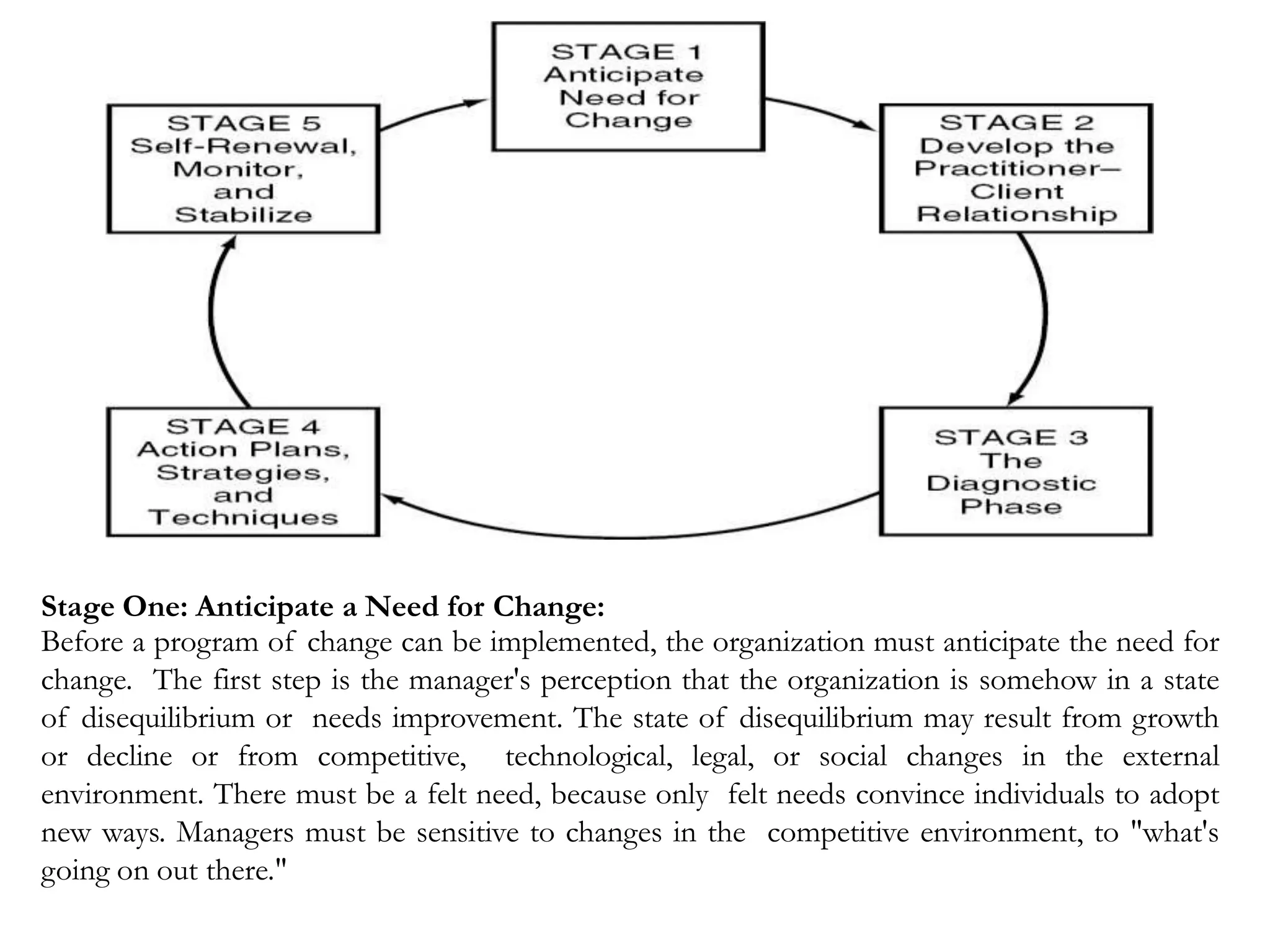
when one is attempting to create change. This section presents a five- stage model of the total
organization development process. Each stage is dependent on the preceding one, and successful
change is more probable when each of these stages is considered in a logical sequence.
Stage One: Anticipate a Need for Change:
Before a program of change can be implemented, the organization must anticipate the need for
change. The first step is the manager's perception that the organization is somehow in a state
of disequilibrium or needs improvement. The state of disequilibrium may result from growth
or decline or from competitive, technological, legal, or social changes in the external
environment. There must be a felt need, because only felt needs convince individuals to adopt
new ways. Managers must be sensitive to changes in the competitive environment, to "what's
going on out there."
Stage Two: Develop the Practitioner-Client Relationship:
After an organization recognizes a need for change and an OD practitioner enters the system, a
relationship begins to develop between the practitioner and the client system. The client is the
person or organization that is being assisted. The development of this relationship is an important
determinant of the probable success or failure of an OD program. As with many interpersonal
relationships, the exchange of expectations and obligations (the formation of a psychological
contract) depends to a great degree upon a good first impression or match between the
practitioner and the client system. The practitioner attempts to establish a pattern of open
communication, a relationship of trust and an atmosphere of shared responsibility. Issues dealing
with responsibility, rewards, and objectives must be clarified, defined, or worked through at this
point.
The practitioner must decide when to enter the system and what his or her role should be. For
instance, the practitioner may intervene with the sanction and approval of top management and
either with or without the sanction and support of members in the lower levels of the
organization. At one company, OD started at the vice-presidential level, and by using internal OD
practitioners the OD program was gradually expanded to include line managers and workers. At
another company, an external practitioner from a university was invited in by the organization's
industrial relations group to initiate the OD program.
Stage Three: The Diagnostic Phase:
After the OD practitioner has intervened and developed a working relationship with the client,
the practitioner and the client begin to gather data about the system. The collection of data is
an important activity providing the organization and the practitioner with a better
understanding of client system problems: the diagnosis.
One rule of operation for the OD practitioner is to question the client's diagnosis of the
problem, because the client's perspective may be biased. After acquiring information relevant to
the situation perceived to be the problem, the OD practitioner and client together analyze the
data to identify problem areas and causal relationships. A weak, inaccurate, or faulty diagnosis
can lead to a costly and ineffective change program. The diagnostic phase, then, is used to
determine the exact problem that needs solution, to identify the forces causing the situation,
and to provide a basis for selecting effective change strategies and techniques. Although
organizations usually generate a large amount of "hard" or operational data, the data may
present an incomplete picture of organizational performance. The practitioner and client may
agree to increase the range or depth of the available data by interview or questionnaire as a
basis for further action programs.
One organization, for instance, was having a problem with high employee turnover. The
practitioner investigated the high turnover rate by means of a questionnaire to determine why
the problem existed, and from these data designed an OD program to correct the problems.
The firm's employees felt it had become a bureaucratic organization clogged with red tape,
causing high turnover. OD programs have since reduced employee turnover to 19 percent,
compared with 34 percent for the industry.
At a major food company, a new executive vice president needed to move quickly to improve the
division's performance. With the help of an external practitioner, data were gathered by
conducting intensive interviews with top management, as well as with outsiders, to determine key
problem areas. Then, without identifying the source of comments, the management team worked
on the information in a 10-hour session until solutions to the major problems was hammered out
and action plans developed.
Stage Four: Action Plans, Strategies, and Techniques:
The diagnostic phase leads to a series of interventions, activities, or programs aimed at resolving
problems and increasing organization effectiveness. These programs apply such OD techniques as
total quality management (TQM), job design, role analysis, goal setting, team building, and inter-
group development to the causes specified in the diagnostic phase (all of these techniques are
discussed in detail in subsequent chapters). In all likelihood, more time will be spent on this fourth
stage than on any of the other stages of an OD program.
Stage Five: Self-Renewal, Monitor, and Stabilize:
Once an action program is implemented, the final step is to monitor the results and stabilize the
desired changes. This stage assesses the effectiveness of change strategies in attaining stated
objectives. Each stage of an OD program needs to be monitored to gain feedback on member
reaction to the change efforts. The system members need to know the results of change efforts in
order to determine whether they ought to modify, continue, or discontinue the activities. Once a
problem has been corrected and a change program is implemented and monitored, means must be
devised to make sure that the new behavior is stabilized and internalized. If this is not done, the
system will regress to previous ineffective modes or states. The client system needs to develop the
capability to maintain innovation without outside support.

)rganization Devolpment and Change Managment

  • 1.
    A Model forOrganizational Development: Organization development is a continuing process of long-term organizational improvement consisting of a series of stages; the emphasis is placed on a combination of individual, team, and organizational relationships. The primary difference between OD and other behavioral science techniques is the emphasis upon viewing the organization as a total system of interacting and interrelated elements. Organization development is the application of an organization-wide approach to the functional, structural, technical, and personal relationships in organizations. OD programs are based upon a systematic analysis of problems and a top management actively committed to the change effort. The purpose of such a program is to increase organizational effectiveness by the application of OD values and techniques. Many organization development programs use the action research model. Action research involves collecting information about the organization, feeding this information back to the client system, and developing and implementing action programs to improve system performance. The manager also needs to be aware of the processes that should be considered when one is attempting to create change. This section presents a five- stage model of the total organization development process. Each stage is dependent on the preceding one, and successful change is more probable when each of these stages is considered in a logical sequence.
  • 2.
    Stage One: Anticipatea Need for Change: Before a program of change can be implemented, the organization must anticipate the need for change. The first step is the manager's perception that the organization is somehow in a state of disequilibrium or needs improvement. The state of disequilibrium may result from growth or decline or from competitive, technological, legal, or social changes in the external environment. There must be a felt need, because only felt needs convince individuals to adopt new ways. Managers must be sensitive to changes in the competitive environment, to "what's going on out there."
  • 3.
    Stage Two: Developthe Practitioner-Client Relationship: After an organization recognizes a need for change and an OD practitioner enters the system, a relationship begins to develop between the practitioner and the client system. The client is the person or organization that is being assisted. The development of this relationship is an important determinant of the probable success or failure of an OD program. As with many interpersonal relationships, the exchange of expectations and obligations (the formation of a psychological contract) depends to a great degree upon a good first impression or match between the practitioner and the client system. The practitioner attempts to establish a pattern of open communication, a relationship of trust and an atmosphere of shared responsibility. Issues dealing with responsibility, rewards, and objectives must be clarified, defined, or worked through at this point. The practitioner must decide when to enter the system and what his or her role should be. For instance, the practitioner may intervene with the sanction and approval of top management and either with or without the sanction and support of members in the lower levels of the organization. At one company, OD started at the vice-presidential level, and by using internal OD practitioners the OD program was gradually expanded to include line managers and workers. At another company, an external practitioner from a university was invited in by the organization's industrial relations group to initiate the OD program.
  • 4.
    Stage Three: TheDiagnostic Phase: After the OD practitioner has intervened and developed a working relationship with the client, the practitioner and the client begin to gather data about the system. The collection of data is an important activity providing the organization and the practitioner with a better understanding of client system problems: the diagnosis. One rule of operation for the OD practitioner is to question the client's diagnosis of the problem, because the client's perspective may be biased. After acquiring information relevant to the situation perceived to be the problem, the OD practitioner and client together analyze the data to identify problem areas and causal relationships. A weak, inaccurate, or faulty diagnosis can lead to a costly and ineffective change program. The diagnostic phase, then, is used to determine the exact problem that needs solution, to identify the forces causing the situation, and to provide a basis for selecting effective change strategies and techniques. Although organizations usually generate a large amount of "hard" or operational data, the data may present an incomplete picture of organizational performance. The practitioner and client may agree to increase the range or depth of the available data by interview or questionnaire as a basis for further action programs. One organization, for instance, was having a problem with high employee turnover. The practitioner investigated the high turnover rate by means of a questionnaire to determine why the problem existed, and from these data designed an OD program to correct the problems. The firm's employees felt it had become a bureaucratic organization clogged with red tape, causing high turnover. OD programs have since reduced employee turnover to 19 percent, compared with 34 percent for the industry.
  • 5.
    At a majorfood company, a new executive vice president needed to move quickly to improve the division's performance. With the help of an external practitioner, data were gathered by conducting intensive interviews with top management, as well as with outsiders, to determine key problem areas. Then, without identifying the source of comments, the management team worked on the information in a 10-hour session until solutions to the major problems was hammered out and action plans developed. Stage Four: Action Plans, Strategies, and Techniques: The diagnostic phase leads to a series of interventions, activities, or programs aimed at resolving problems and increasing organization effectiveness. These programs apply such OD techniques as total quality management (TQM), job design, role analysis, goal setting, team building, and inter- group development to the causes specified in the diagnostic phase (all of these techniques are discussed in detail in subsequent chapters). In all likelihood, more time will be spent on this fourth stage than on any of the other stages of an OD program. Stage Five: Self-Renewal, Monitor, and Stabilize: Once an action program is implemented, the final step is to monitor the results and stabilize the desired changes. This stage assesses the effectiveness of change strategies in attaining stated objectives. Each stage of an OD program needs to be monitored to gain feedback on member reaction to the change efforts. The system members need to know the results of change efforts in order to determine whether they ought to modify, continue, or discontinue the activities. Once a problem has been corrected and a change program is implemented and monitored, means must be devised to make sure that the new behavior is stabilized and internalized. If this is not done, the system will regress to previous ineffective modes or states. The client system needs to develop the capability to maintain innovation without outside support.