PRESENTED BY:-
PRANAB BHAKTA
Aei/15/me/036
SUBMITED TO:-
MECHANICAL DEPT.
LUBRICATION
CONTENTS
1. INTRODUCTION
2. DIFFERENT TYPES OF LUBRICATION SYSTEM
3. FUNCTION OF LUBRICATION
4. TYPES OF LUBRICANT
5. PROPERTIES OF LUBRICATION
6. ADDITIVES
7. MODES OF LUBRICATION
8. CONCLUSION
LUBRICATION :
Lubrication is a procedure to separate
the surfaces with a film of lubricant to
minimise friction and to restrict wear and
tear as well. The substances used for this
purpose are called “lubricants”.
Different types of Lubrication System
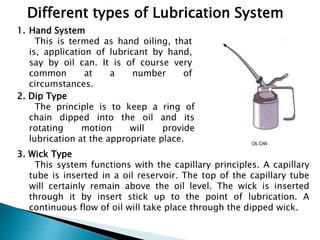
1. Hand System
This is termed as hand oiling, that
is, application of lubricant by hand,
say by oil can. It is of course very
common at a number of
circumstances.
2. Dip Type
The principle is to keep a ring of
chain dipped into the oil and its
rotating motion will provide
lubrication at the appropriate place.
3. Wick Type
This system functions with the capillary principles. A capillary
tube is inserted in a oil reservoir. The top of the capillary tube
will certainly remain above the oil level. The wick is inserted
through it by insert stick up to the point of lubrication. A
continuous flow of oil will take place through the dipped wick.
4. Splash Type
Such a system operates when a running component itself is
dipped into a oil sump and it splashes oil round the parts requiring
it. Splash lubrication is very much common in small power vertical
and horizontal high-speed engines with a closed crank case.
5. Circulating Type
Such a system term provides means to supply a lubricant to
different points from the tank or sump by a pressure pump. It may
consist of a suction filter, pump, lubricating points and a return-
line filter.
FUNCTIONS OF LUBRICATION
The major function of Lubrications are:-
a) To minimise friction in the mating surfaces.
b) To minimise wear and tear of the surfaces.
c) To carry out the heat generated due to friction, leaving the
assembly cool as far as practicable.
d) To lengthen the service-life of the components by
performing the above functions.
It may be noted that the lubrication can procedure the desired
result, depending on the
a) Physical, Chemical and Mechanical properties of the
selected lubricants, and
b) The lubricating methods
TYPES OF LUBRICANT
The lubricants may be either solid or liquid or semi-liquid.
The solid lubricants are used when oils or greases are
unsuitable or not permissible, such as at very low or high
temperatures. The solid lubricants may be used in pure or
combination or suspended form.
The common solid lubricants are soap, mica,
molybdenum-disulphite etc.
The very popular semi-liquid lubricant is grease. It
has got a number of grades and depending on the types of
lubrication required, the grade is judiciously selected.
Different types of Lubrication System
The major important properties of lubricants are stated below:
1. Viscosity
It is the indication of the degree of fluidity of lubricating oil. It
only focuses how the liquid/lubricating oil will flow under the
temperature at which it is to function.
2. Flash point and fire point
Flash point is the temperature at which the lubricants produce
sufficient vapour at the application of a flame and the fire point
is to some extent, higher temperature at which the generated
vapour will ignite and the oil will burn steadily.
3. Pour point
This is the property to know the behaviour of lubricants at low
temperatures. The pour point can be specified by the
temperature at which the lubricant ceases to flow.
4. Oiliness
It is the degree of ability to form an oily surface on the mental. It
is a combined measure of surface-tension and wettability to
form a film of lubrication.
ADDITIVES
To use very common lubricants, different additives are
sometimes added with them to use the lubricant purposefully to
establish an optimum operating condition.
Different types of additives are :
Additives may be of Three major types.
• Primarily, it may be ‘Antifriction Additives’ which are
generally fatty acids and natural or synthetic fats.
• Secondly, it may be ‘Antiwear Additives’. They are
generally derivatives of Phosphorous and Phosphoric acids.
• Finally, it may be ‘Extreme Pressure Additives’. They can
withstand high contact temperature and loads. They are
generally organic derivatives of sulphur and chlorine.
Modes of Lubrication
The modes of lubrications are usually characterised by
friction and wear behaviour of surface layers. It is generally of
three types.
a) Boundary lubrication
b) Fluid film lubrication
c) Mixed lubrication
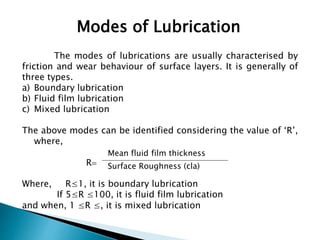
The above modes can be identified considering the value of ‘R’,
where,
R
Where, R≤1, it is boundary lubrication
If 5≤R ≤100, it is fluid film lubrication
and when, 1 ≤R ≤, it is mixed lubrication
Mean fluid film thickness
Surface Roughness (cla)
CONCLUSION
Thus, The lubrication system is
designed to deliver clean oil at the
correct temperature and pressure
to every part of the engine
THANK YOU

Presentation on Lubrication

  • 2.
  • 3.
  • 4.
    CONTENTS 1. INTRODUCTION 2. DIFFERENTTYPES OF LUBRICATION SYSTEM 3. FUNCTION OF LUBRICATION 4. TYPES OF LUBRICANT 5. PROPERTIES OF LUBRICATION 6. ADDITIVES 7. MODES OF LUBRICATION 8. CONCLUSION
  • 5.
    LUBRICATION : Lubrication isa procedure to separate the surfaces with a film of lubricant to minimise friction and to restrict wear and tear as well. The substances used for this purpose are called “lubricants”.
  • 6.
    Different types ofLubrication System 1. Hand System This is termed as hand oiling, that is, application of lubricant by hand, say by oil can. It is of course very common at a number of circumstances. 2. Dip Type The principle is to keep a ring of chain dipped into the oil and its rotating motion will provide lubrication at the appropriate place. 3. Wick Type This system functions with the capillary principles. A capillary tube is inserted in a oil reservoir. The top of the capillary tube will certainly remain above the oil level. The wick is inserted through it by insert stick up to the point of lubrication. A continuous flow of oil will take place through the dipped wick.
  • 7.
    4. Splash Type Sucha system operates when a running component itself is dipped into a oil sump and it splashes oil round the parts requiring it. Splash lubrication is very much common in small power vertical and horizontal high-speed engines with a closed crank case. 5. Circulating Type Such a system term provides means to supply a lubricant to different points from the tank or sump by a pressure pump. It may consist of a suction filter, pump, lubricating points and a return- line filter.
  • 8.
    FUNCTIONS OF LUBRICATION Themajor function of Lubrications are:- a) To minimise friction in the mating surfaces. b) To minimise wear and tear of the surfaces. c) To carry out the heat generated due to friction, leaving the assembly cool as far as practicable. d) To lengthen the service-life of the components by performing the above functions. It may be noted that the lubrication can procedure the desired result, depending on the a) Physical, Chemical and Mechanical properties of the selected lubricants, and b) The lubricating methods
  • 9.
    TYPES OF LUBRICANT Thelubricants may be either solid or liquid or semi-liquid. The solid lubricants are used when oils or greases are unsuitable or not permissible, such as at very low or high temperatures. The solid lubricants may be used in pure or combination or suspended form. The common solid lubricants are soap, mica, molybdenum-disulphite etc. The very popular semi-liquid lubricant is grease. It has got a number of grades and depending on the types of lubrication required, the grade is judiciously selected.
  • 10.
    Different types ofLubrication System The major important properties of lubricants are stated below: 1. Viscosity It is the indication of the degree of fluidity of lubricating oil. It only focuses how the liquid/lubricating oil will flow under the temperature at which it is to function. 2. Flash point and fire point Flash point is the temperature at which the lubricants produce sufficient vapour at the application of a flame and the fire point is to some extent, higher temperature at which the generated vapour will ignite and the oil will burn steadily. 3. Pour point This is the property to know the behaviour of lubricants at low temperatures. The pour point can be specified by the temperature at which the lubricant ceases to flow. 4. Oiliness It is the degree of ability to form an oily surface on the mental. It is a combined measure of surface-tension and wettability to form a film of lubrication.
  • 11.
    ADDITIVES To use verycommon lubricants, different additives are sometimes added with them to use the lubricant purposefully to establish an optimum operating condition. Different types of additives are : Additives may be of Three major types. • Primarily, it may be ‘Antifriction Additives’ which are generally fatty acids and natural or synthetic fats. • Secondly, it may be ‘Antiwear Additives’. They are generally derivatives of Phosphorous and Phosphoric acids. • Finally, it may be ‘Extreme Pressure Additives’. They can withstand high contact temperature and loads. They are generally organic derivatives of sulphur and chlorine.
  • 12.
    Modes of Lubrication Themodes of lubrications are usually characterised by friction and wear behaviour of surface layers. It is generally of three types. a) Boundary lubrication b) Fluid film lubrication c) Mixed lubrication The above modes can be identified considering the value of ‘R’, where, R Where, R≤1, it is boundary lubrication If 5≤R ≤100, it is fluid film lubrication and when, 1 ≤R ≤, it is mixed lubrication Mean fluid film thickness Surface Roughness (cla)
  • 13.
    CONCLUSION Thus, The lubricationsystem is designed to deliver clean oil at the correct temperature and pressure to every part of the engine
  • 14.