Case study on the business models aspects of luxury
management with respect to brand Chloe
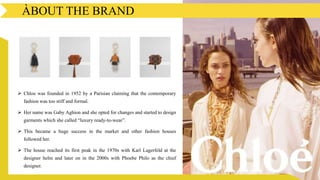
 Chloe was founded in 1952 by a Parisian claiming that the contemporary
fashion was too stiff and formal.
 Her name was Gaby Aghion and she opted for changes and started to design
garments which she called “luxury ready-to-wear”.
 This became a huge success in the market and other fashion houses
followed her.
 The house reached its first peak in the 1970s with Karl Lagerfeld at the
designer helm and later on in the 2000s with Phoebe Philo as the chief
designer.
ÀBOUT THE BRAND
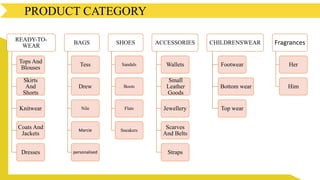
PRODUCT CATEGORY
READY-TO-
WEAR
Tops And
Blouses
Skirts
And
Shorts
Knitwear
Coats And
Jackets
Dresses
BAGS
Tess
Drew
Nile
Marcie
personalised
SHOES
Sandals
Boots
Flats
Sneakers
ACCESSORIES
Wallets
Small
Leather
Goods
Jewellery
Scarves
And Belts
Straps
CHILDRENSWEAR
Footwear
Bottom wear
Top wear
Fragrances
Her
Him
Segment: Women & children
Target: Chloe is aimed at females
customers.
Positioning: Young, Modern & Fresh.
PRODUCT CATEGORIES:
Ready to wear
Bags
Shoes
Accessories
Children-wear
PRODUCTS OFFERED BY CHLOE
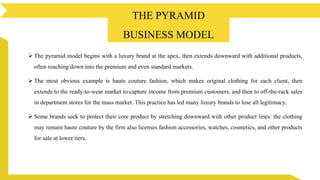
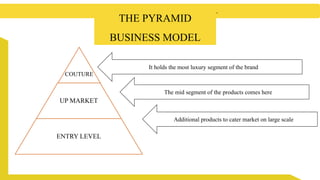
 The pyramid model begins with a luxury brand at the apex, then extends downward with additional products,
often reaching down into the premium and even standard markets.
 The most obvious example is haute couture fashion, which makes original clothing for each client, then
extends to the ready-to-wear market to capture income from premium customers, and then to off-the-rack sales
in department stores for the mass market. This practice has led many luxury brands to lose all legitimacy.
 Some brands seek to protect their core product by stretching downward with other product lines: the clothing
may remain haute couture by the firm also licenses fashion accessories, watches, cosmetics, and other products
for sale at lower tiers.
About The Pyramid Business Model
THE PYRAMID
BUSINESS MODEL
COUTURE
UP MARKET
ENTRY LEVEL
It holds the most luxury segment of the brand
The mid segment of the products comes here
Additional products to cater market on large scale
THE PYRAMID LUXURY BUSINESS MODEL
THE PYRAMID
BUSINESS MODEL
COUTURE
UP MARKET
ENTRY LEVEL
THE PYRAMID LUXURY BUSINESS MODEL
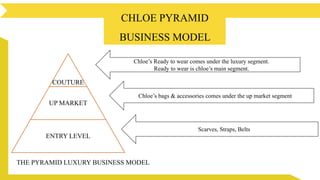
Chloe’s Ready to wear comes under the luxury segment.
Ready to wear is chloe’s main segment.
Scarves, Straps, Belts
Chloe’s bags & accessories comes under the up market segment
Chloe Pyramid Business Model
CHLOE PYRAMID
BUSINESS MODEL
ABSTRACT:
1. Luxury fashion companies are today part of a dynamic and fast growing industry.
2. Chloé is a French luxury fashion company belonging to Richemont, since being acquired by the group in
1985.
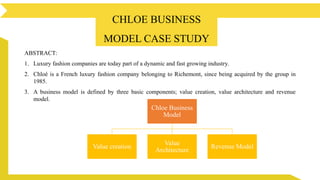
3. A business model is defined by three basic components; value creation, value architecture and revenue
model.
THE PYRAMID LUXURY BUSINESS MODEL
CHLOE BUSINESS
MODEL CASE STUDY
Chloe Business
Model
Value creation
Value
Architecture
Revenue Model
1. The value creation deals with the value proposition as well as the customer segments of the company.
2. The value architecture explains customer relationships, distribution channels, key activities, key resources and
key partners.
3. The revenue model is based on the cost structure and the revenue streams of the company.
4. For a company, it is highly important to detect its own business model in order to know where improvements are
needed to improve growth and profitability.
• The value proposition Chloé offers its clients over and above the actual products of ready-to-wear, bags,
shoes and accessories, is a lifestyle recognized by elegance, comfort and luxury in a clean and simple
manner.
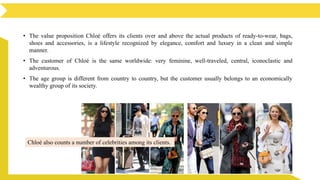
• The customer of Chloé is the same worldwide: very feminine, well-traveled, central, iconoclastic and
adventurous.
• The age group is different from country to country, but the customer usually belongs to an economically
wealthy group of its society.
Chloé also counts a number of celebrities among its clients.
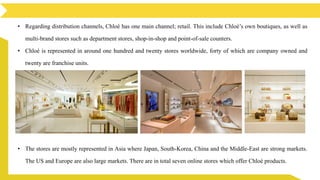
• Regarding distribution channels, Chloé has one main channel; retail. This include Chloé’s own boutiques, as well as
multi-brand stores such as department stores, shop-in-shop and point-of-sale counters.
• Chloé is represented in around one hundred and twenty stores worldwide, forty of which are company owned and
twenty are franchise units.
• The stores are mostly represented in Asia where Japan, South-Korea, China and the Middle-East are strong markets.
The US and Europe are also large markets. There are in total seven online stores which offer Chloé products.
• Regarding the revenue model, Chloé has two main streams of income; retail and wholesale.
• The retail is divided into direct retail, in other words online sales, which count for 40% of the retail, and the
normal retail in stores which counts for sixty percent of the retail.
• It is uncertain how much revenue the wholesale counts for percent wise compared to retail, but it is estimated
to be a figure around three hundred million dollars. Main cost sources are manufacture, branding and retail.
Captures from website
• As a genre of POV (point of view) marketing – a camera and script style that immerses the viewer into a digital
pseudo-relationship – has been taking off.
• Ads shot in POV style are not only letting viewers feel closer to their idols, but they also make these brands’ message
more pleasant and digestible to consumers.
• Chloé’s collaboration with actor Jing Boran offers a subtler path towards creating virtual intimacy between idol and
fan.
• Instead of explicitly flirting with the viewer, Chloé’s perfume ad implies old-fashioned romance through handwritten
letters and calligraphy.
CHLOE VIRTUAL EXPERIENCE FOR WOMEN
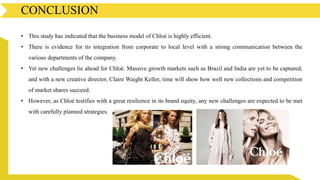
• This study has indicated that the business model of Chloé is highly efficient.
• There is evidence for its integration from corporate to local level with a strong communication between the
various departments of the company.
• Yet new challenges lie ahead for Chloé. Massive growth markets such as Brazil and India are yet to be captured,
and with a new creative director, Claire Waight Keller, time will show how well new collections and competition
of market shares succeed.
• However, as Chloé testifies with a great resilience in its brand equity, any new challenges are expected to be met
with carefully planned strategies.
CONCLUSION
THANK YOU!

PRESENTATION ON THE BRAND CHLOE

  • 1.
    Case study onthe business models aspects of luxury management with respect to brand Chloe
  • 2.
     Chloe wasfounded in 1952 by a Parisian claiming that the contemporary fashion was too stiff and formal.  Her name was Gaby Aghion and she opted for changes and started to design garments which she called “luxury ready-to-wear”.  This became a huge success in the market and other fashion houses followed her.  The house reached its first peak in the 1970s with Karl Lagerfeld at the designer helm and later on in the 2000s with Phoebe Philo as the chief designer. ÀBOUT THE BRAND
  • 3.
    PRODUCT CATEGORY READY-TO- WEAR Tops And Blouses Skirts And Shorts Knitwear CoatsAnd Jackets Dresses BAGS Tess Drew Nile Marcie personalised SHOES Sandals Boots Flats Sneakers ACCESSORIES Wallets Small Leather Goods Jewellery Scarves And Belts Straps CHILDRENSWEAR Footwear Bottom wear Top wear Fragrances Her Him
  • 4.
    Segment: Women &children Target: Chloe is aimed at females customers. Positioning: Young, Modern & Fresh. PRODUCT CATEGORIES: Ready to wear Bags Shoes Accessories Children-wear
  • 5.
  • 6.
     The pyramidmodel begins with a luxury brand at the apex, then extends downward with additional products, often reaching down into the premium and even standard markets.  The most obvious example is haute couture fashion, which makes original clothing for each client, then extends to the ready-to-wear market to capture income from premium customers, and then to off-the-rack sales in department stores for the mass market. This practice has led many luxury brands to lose all legitimacy.  Some brands seek to protect their core product by stretching downward with other product lines: the clothing may remain haute couture by the firm also licenses fashion accessories, watches, cosmetics, and other products for sale at lower tiers. About The Pyramid Business Model THE PYRAMID BUSINESS MODEL
  • 7.
    COUTURE UP MARKET ENTRY LEVEL Itholds the most luxury segment of the brand The mid segment of the products comes here Additional products to cater market on large scale THE PYRAMID LUXURY BUSINESS MODEL THE PYRAMID BUSINESS MODEL
  • 8.
    COUTURE UP MARKET ENTRY LEVEL THEPYRAMID LUXURY BUSINESS MODEL Chloe’s Ready to wear comes under the luxury segment. Ready to wear is chloe’s main segment. Scarves, Straps, Belts Chloe’s bags & accessories comes under the up market segment Chloe Pyramid Business Model CHLOE PYRAMID BUSINESS MODEL
  • 9.
    ABSTRACT: 1. Luxury fashioncompanies are today part of a dynamic and fast growing industry. 2. Chloé is a French luxury fashion company belonging to Richemont, since being acquired by the group in 1985. 3. A business model is defined by three basic components; value creation, value architecture and revenue model. THE PYRAMID LUXURY BUSINESS MODEL CHLOE BUSINESS MODEL CASE STUDY Chloe Business Model Value creation Value Architecture Revenue Model
  • 10.
    1. The valuecreation deals with the value proposition as well as the customer segments of the company. 2. The value architecture explains customer relationships, distribution channels, key activities, key resources and key partners. 3. The revenue model is based on the cost structure and the revenue streams of the company. 4. For a company, it is highly important to detect its own business model in order to know where improvements are needed to improve growth and profitability.
  • 11.
    • The valueproposition Chloé offers its clients over and above the actual products of ready-to-wear, bags, shoes and accessories, is a lifestyle recognized by elegance, comfort and luxury in a clean and simple manner. • The customer of Chloé is the same worldwide: very feminine, well-traveled, central, iconoclastic and adventurous. • The age group is different from country to country, but the customer usually belongs to an economically wealthy group of its society. Chloé also counts a number of celebrities among its clients.
  • 12.
    • Regarding distributionchannels, Chloé has one main channel; retail. This include Chloé’s own boutiques, as well as multi-brand stores such as department stores, shop-in-shop and point-of-sale counters. • Chloé is represented in around one hundred and twenty stores worldwide, forty of which are company owned and twenty are franchise units. • The stores are mostly represented in Asia where Japan, South-Korea, China and the Middle-East are strong markets. The US and Europe are also large markets. There are in total seven online stores which offer Chloé products.
  • 13.
    • Regarding therevenue model, Chloé has two main streams of income; retail and wholesale. • The retail is divided into direct retail, in other words online sales, which count for 40% of the retail, and the normal retail in stores which counts for sixty percent of the retail. • It is uncertain how much revenue the wholesale counts for percent wise compared to retail, but it is estimated to be a figure around three hundred million dollars. Main cost sources are manufacture, branding and retail. Captures from website
  • 14.
    • As agenre of POV (point of view) marketing – a camera and script style that immerses the viewer into a digital pseudo-relationship – has been taking off. • Ads shot in POV style are not only letting viewers feel closer to their idols, but they also make these brands’ message more pleasant and digestible to consumers. • Chloé’s collaboration with actor Jing Boran offers a subtler path towards creating virtual intimacy between idol and fan. • Instead of explicitly flirting with the viewer, Chloé’s perfume ad implies old-fashioned romance through handwritten letters and calligraphy. CHLOE VIRTUAL EXPERIENCE FOR WOMEN
  • 15.
    • This studyhas indicated that the business model of Chloé is highly efficient. • There is evidence for its integration from corporate to local level with a strong communication between the various departments of the company. • Yet new challenges lie ahead for Chloé. Massive growth markets such as Brazil and India are yet to be captured, and with a new creative director, Claire Waight Keller, time will show how well new collections and competition of market shares succeed. • However, as Chloé testifies with a great resilience in its brand equity, any new challenges are expected to be met with carefully planned strategies. CONCLUSION
  • 16.