By Amandeep Singh
PRESENTATION ON
How Google Works
 Crawling
 Indexing
 Displaying
What are Google Algorithms
 Google Algorithms are complex system to retrieve data
from the search index and instantly deliver the best
possible results for a query.
Why Google update its Algorithms
 In order to fight low quality sites from appearing on the
Search Engine Result Page.
 To ensure that its users are getting the most relevant
results.
 To provide the best & relevant content so that people don’t
go anywhere else.
Some terms used in the
presentation
 Link spam:
 Posting of out-of-context links on websites, discussion forums, blog
comments, or any other online venue that displays user comments.
 Purpose is to increase the number of external links made to a site
the spammer wishes to promote.
 Webspam: Intentional attempts to manipulate search engine rankings for
specific keywords or keyword phrase queries.
How is the quality of a
website determined?
Page content and page title do not match the
search request
Visitor retention time(time on page & time on site).
Percentage of duplicate content.
High repetition of the same word on a page..... & a
lot more
Some Algorithms discussed in
the next slides:
Panda
Penguin
Hummingbird
Pigeon
Pagerank
Panda Algorithm
 'Search filter' introduced in February 2011.
 Purpose is:
1. To increase the rank of high-quality websites in
Google's SERP's.
2. To lower the visibility of low-quality websites in
Google's SERPs.
 Goal is to increase the quality of the search results.
What to do if you are
affected?
 Work on getting an overview of the situation:
Is the entire website affected, or just parts of it?
 Analyse the website:
are there pages with positive signals
 Improve the website:
Create content in compliance with the Google Quality Guidelines
Keyword
stuffing
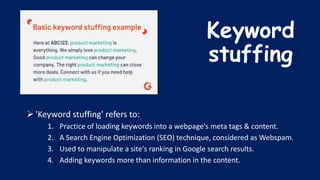
 'Keyword stuffing' refers to:
1. Practice of loading keywords into a webpage's meta tags & content.
2. A Search Engine Optimization (SEO) technique, considered as Webspam.
3. Used to manipulate a site's ranking in Google search results.
4. Adding keywords more than information in the content.
Penguin Algorithm
 Launched in April 2012.
 Aims at decreasing 'search engine rankings' of websites that
violate Google's Webmaster Guidelines.
 Disavow(ban) spammy links
 Diminish the presence of websites that engaged in
manipulative link schemes and keyword stuffing In the Google
SERPs.
How to recover if affected by
Penguin Algorithm
 Remove unnatural links over which you have control.
 By ensuring that the topic and the keywords match.
 By removing the repeatedly used keywords.
 By removing 'Spammy links'.
Hummingbird Algorithm
 Google announced Hummingbird on September 2013.
 Focuses on sending the lead users directly to the most appropriate
page rather than just a website's homepage.
 Designed to improve the search results relevancy & quality.
 Provides the best answers to the searcher with the fewest possible
clicks.
Pigeon Algorithm
Released on July 2014.
Aim is to provide more useful, relevant and
accurate local search results.
Designed to improve ranking parameters based on
distance and location.
Connects web search and map search in a more
cohesive(linked) way.
Effects of Pigeon
Algorithm
The local search results provided by Google may
become even more relevant and neat on both
desktop and mobile devices.
Help Local businesses by recommending them in the
Google SERPs.
Pagerank Algorithm
PageRank assigns a 'rank' or 'score' to every search
result.
The higher the page's score, the further up the search
results list it will appear.
Scores are partially determined by the number of
other Web pages that link to the target page.
Each link is counted as a vote for the target.
Thankyou

Presentation on Google algorithms

  • 1.
  • 2.
    How Google Works Crawling  Indexing  Displaying
  • 3.
    What are GoogleAlgorithms  Google Algorithms are complex system to retrieve data from the search index and instantly deliver the best possible results for a query.
  • 4.
    Why Google updateits Algorithms  In order to fight low quality sites from appearing on the Search Engine Result Page.  To ensure that its users are getting the most relevant results.  To provide the best & relevant content so that people don’t go anywhere else.
  • 5.
    Some terms usedin the presentation  Link spam:  Posting of out-of-context links on websites, discussion forums, blog comments, or any other online venue that displays user comments.  Purpose is to increase the number of external links made to a site the spammer wishes to promote.  Webspam: Intentional attempts to manipulate search engine rankings for specific keywords or keyword phrase queries.
  • 6.
    How is thequality of a website determined? Page content and page title do not match the search request Visitor retention time(time on page & time on site). Percentage of duplicate content. High repetition of the same word on a page..... & a lot more
  • 7.
    Some Algorithms discussedin the next slides: Panda Penguin Hummingbird Pigeon Pagerank
  • 8.
    Panda Algorithm  'Searchfilter' introduced in February 2011.  Purpose is: 1. To increase the rank of high-quality websites in Google's SERP's. 2. To lower the visibility of low-quality websites in Google's SERPs.  Goal is to increase the quality of the search results.
  • 9.
    What to doif you are affected?  Work on getting an overview of the situation: Is the entire website affected, or just parts of it?  Analyse the website: are there pages with positive signals  Improve the website: Create content in compliance with the Google Quality Guidelines
  • 10.
    Keyword stuffing  'Keyword stuffing'refers to: 1. Practice of loading keywords into a webpage's meta tags & content. 2. A Search Engine Optimization (SEO) technique, considered as Webspam. 3. Used to manipulate a site's ranking in Google search results. 4. Adding keywords more than information in the content.
  • 11.
    Penguin Algorithm  Launchedin April 2012.  Aims at decreasing 'search engine rankings' of websites that violate Google's Webmaster Guidelines.  Disavow(ban) spammy links  Diminish the presence of websites that engaged in manipulative link schemes and keyword stuffing In the Google SERPs.
  • 12.
    How to recoverif affected by Penguin Algorithm  Remove unnatural links over which you have control.  By ensuring that the topic and the keywords match.  By removing the repeatedly used keywords.  By removing 'Spammy links'.
  • 13.
    Hummingbird Algorithm  Googleannounced Hummingbird on September 2013.  Focuses on sending the lead users directly to the most appropriate page rather than just a website's homepage.  Designed to improve the search results relevancy & quality.  Provides the best answers to the searcher with the fewest possible clicks.
  • 14.
    Pigeon Algorithm Released onJuly 2014. Aim is to provide more useful, relevant and accurate local search results. Designed to improve ranking parameters based on distance and location. Connects web search and map search in a more cohesive(linked) way.
  • 15.
    Effects of Pigeon Algorithm Thelocal search results provided by Google may become even more relevant and neat on both desktop and mobile devices. Help Local businesses by recommending them in the Google SERPs.
  • 16.
    Pagerank Algorithm PageRank assignsa 'rank' or 'score' to every search result. The higher the page's score, the further up the search results list it will appear. Scores are partially determined by the number of other Web pages that link to the target page. Each link is counted as a vote for the target.
  • 17.