
Presented By- nazmussakib reza
Department of EEE
ID:1711EEE00136
2
TABLE OF CONTENT
Computer Networks
Types of Network
Local Area Network(LAN)
Metropolitan Area Network(MAN)
Wide Area Network(WAN)
Comparison of LAN,MAN,WAN
Network Topology
Bus Topology
Ring Topology
Star Topology
Differences
3
Computer network
A computer network is a system of interconnected computers and peripheral
devices.
For example, it may connect computers, printers , scanners and cameras.
Computer network communication
We transmit information or data by using two types of signals, namely
analog and digital.
Computers communicate with digital signals.
Types of Networks
4
LOCALAREA NETWORK (LAN):
Smallest network evaluated to the added two networks.
The simplest type of LAN is to join two computers
collectively.
LAN is maneuvered within a partial physical area, for instance at
home, a single building, school, or several buildings.
Computer Networks are differentiated between three
types of Computer Networks such as LAN, MAN, WAN.
METROPOLITAN AREA NETWORK (MAN):
5
‘Metropolitan' - Describes important cities such as Kuala Lumpur,
Manila, Singapore, Tokyo, London and New York. located at different
sites within a large physical area, such as a city.
Companies that have several branches within the Kuala Lumpur city
such as banks, use a MAN.
MAN can be defined as a group of computers and network devices
connected together within a large physical area.
The largest network of all network types.
Internet is the largest WAN in the world.
WAN generally covers large distances such as states, countries or
continents.
WAN is a group of MANs or LANs or the mixture of both networks.
WIDE AREA NETWORK (WAN):
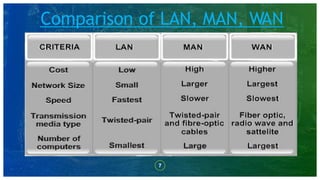
Comparison of LAN, MAN, WAN
7
8
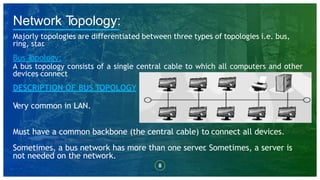
Majorly topologies are differentiated between three types of topologies i.e. bus,
ring, star.
Bus Topology:
A bus topology consists of a single central cable to which all computers and other
devices connect
DESCRIPTION OF BUS TOPOLOGY
Very common in LAN.
Must have a common backbone (the central cable) to connect all devices.
Sometimes, a bus network has more than one server. Sometimes, a server is
not needed on the network.
Network Topology:
Ring Topology:
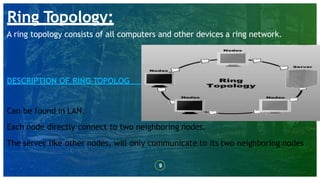
A ring topology consists of all computers and other devices a ring network.
DESCRIPTION OF RING TOPOLOG
Can be found in LAN.
Each node directly connect to two neighboring nodes.
The server, like other nodes, will only communicate to its two neighboring nodes
9
10
Star Topology:
DESCRIPTION OF STAR TOPOLOGY
A star network is found in a Local
Area Network setting.
A star network must have a host which
acts as the centre.
The host can be a server, hub or router.
Every node must connect to the host in order to communicate.
The host will control the flow of communication in the
A star topology consists of a central host which acts as the Centre, and all nodes connect to the host. A star
topology is also known as star network.
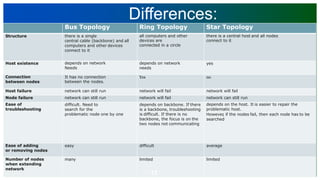
Bus Topology Ring Topology Star Topology
Structure there is a single
central cable (backbone) and all
computers and other devices
connect to it
all computers and other
devices are
connected in a circle
there is a central host and all nodes
connect to it
Host existence depends on network
Needs
depends on network
needs
yes
Connection
between nodes
It has no connection
between the nodes.
Yes no
Host failure network can still run network will fail network will fail
Node failure network can still run network will fail network can still run
Ease of
troubleshooting
difficult. Need to
search for the
problematic node one by one
depends on backbone. If there
is a backbone, troubleshooting
is difficult. If there is no
backbone, the focus is on the
two nodes not communicating
depends on the host. It is easier to repair the
problematic host.
However, if the nodes fail, then each node has to be
searched
Ease of adding
or removing nodes
easy difficult average
Number of nodes
when extending
network
many limited limited
Differences:
12
THANK YOU!
Nazmussakib Reza
ID:
1711EEE00136
Email
justnazmussakib@gmail.co
m

Presentation on computer networking and topology

  • 1.
    Presented By- nazmussakibreza Department of EEE ID:1711EEE00136
  • 2.
    2 TABLE OF CONTENT ComputerNetworks Types of Network Local Area Network(LAN) Metropolitan Area Network(MAN) Wide Area Network(WAN) Comparison of LAN,MAN,WAN Network Topology Bus Topology Ring Topology Star Topology Differences
  • 3.
    3 Computer network A computernetwork is a system of interconnected computers and peripheral devices. For example, it may connect computers, printers , scanners and cameras. Computer network communication We transmit information or data by using two types of signals, namely analog and digital. Computers communicate with digital signals.
  • 4.
    Types of Networks 4 LOCALAREANETWORK (LAN): Smallest network evaluated to the added two networks. The simplest type of LAN is to join two computers collectively. LAN is maneuvered within a partial physical area, for instance at home, a single building, school, or several buildings. Computer Networks are differentiated between three types of Computer Networks such as LAN, MAN, WAN.
  • 5.
    METROPOLITAN AREA NETWORK(MAN): 5 ‘Metropolitan' - Describes important cities such as Kuala Lumpur, Manila, Singapore, Tokyo, London and New York. located at different sites within a large physical area, such as a city. Companies that have several branches within the Kuala Lumpur city such as banks, use a MAN. MAN can be defined as a group of computers and network devices connected together within a large physical area.
  • 6.
    The largest networkof all network types. Internet is the largest WAN in the world. WAN generally covers large distances such as states, countries or continents. WAN is a group of MANs or LANs or the mixture of both networks. WIDE AREA NETWORK (WAN):
  • 7.
  • 8.
    8 Majorly topologies aredifferentiated between three types of topologies i.e. bus, ring, star. Bus Topology: A bus topology consists of a single central cable to which all computers and other devices connect DESCRIPTION OF BUS TOPOLOGY Very common in LAN. Must have a common backbone (the central cable) to connect all devices. Sometimes, a bus network has more than one server. Sometimes, a server is not needed on the network. Network Topology:
  • 9.
    Ring Topology: A ringtopology consists of all computers and other devices a ring network. DESCRIPTION OF RING TOPOLOG Can be found in LAN. Each node directly connect to two neighboring nodes. The server, like other nodes, will only communicate to its two neighboring nodes 9
  • 10.
    10 Star Topology: DESCRIPTION OFSTAR TOPOLOGY A star network is found in a Local Area Network setting. A star network must have a host which acts as the centre. The host can be a server, hub or router. Every node must connect to the host in order to communicate. The host will control the flow of communication in the A star topology consists of a central host which acts as the Centre, and all nodes connect to the host. A star topology is also known as star network.
  • 11.
    Bus Topology RingTopology Star Topology Structure there is a single central cable (backbone) and all computers and other devices connect to it all computers and other devices are connected in a circle there is a central host and all nodes connect to it Host existence depends on network Needs depends on network needs yes Connection between nodes It has no connection between the nodes. Yes no Host failure network can still run network will fail network will fail Node failure network can still run network will fail network can still run Ease of troubleshooting difficult. Need to search for the problematic node one by one depends on backbone. If there is a backbone, troubleshooting is difficult. If there is no backbone, the focus is on the two nodes not communicating depends on the host. It is easier to repair the problematic host. However, if the nodes fail, then each node has to be searched Ease of adding or removing nodes easy difficult average Number of nodes when extending network many limited limited Differences: 12
  • 12.