Presentation of bio-chemistry Topic   β -OXIDATION OF FATTY ACIDS  Submitted to:-  Submitted by:- Dr.Zia Ur Rehman  Simranjeet kaur  B-Pharmacy(5th sem)
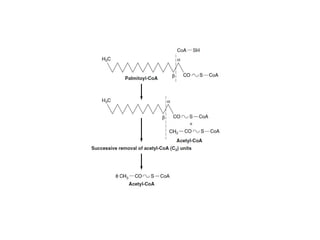
β -OXIDATION OF FATTY ACIDS INVOLVES SUCCESSIVE CLEAVAGE WITH RELEASE OF ACETYL-CoA In β-oxidation, two carbons at a time are cleaved from acyl-CoA molecules, starting at the carboxyl end.  The chain is broken between the α(2)- and β(3)-carbon atoms—hence the name β-oxidation.  The two-carbon units formed are acetyl-CoA; thus, palmitoyl- CoA forms eight acetyl-CoA molecules.
 
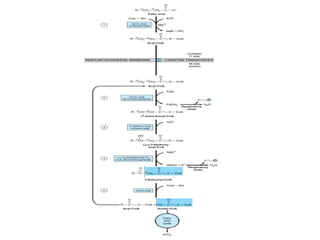
The Cyclic Reaction Sequence Generates FADH2 & NADH Several enzymes, known collectively as “fatty acid oxidase,” are found in the mitochondrial matrix or inner membrane adjacent to the respiratory chain. These catalyze the oxidation of acyl-CoA to acetyl-CoA, the system being coupled with the phosphorylation of ADP to ATP.
 
Oxidation of a Fatty Acid With an Odd Number of Carbon Atoms Yields Acetyl CoA Plus a Molecule of Propionyl-CoA Fatty acids with an odd number of carbon atoms are oxidized by the pathway of β-oxidation, producing acetyl-CoA, until a three-carbon (propionyl-CoA) residue remains.  This compound is converted to succinyl-CoA, a constituent of the citric acid cycle.  Hence,  the propionyl residue from an odd-chain fatty acid is the only part of a fatty acid that is glucogenic
Peroxisomes Oxidize Very Long Chain Fatty Acids A modified form of β-oxidation is found in peroxisomes and leads to the formation of acetyl-CoA and H 2 O 2  (from the flavoprotein-linked dehydrogenase step), which is broken down by catalase.  
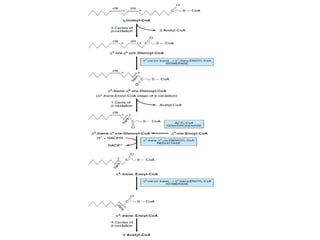
OXIDATION OF UNSATURATED FATTY ACIDS OCCURS BY A MODIFIED β-OXIDATION PATHWAY
 
Thanks …………………………..

Presentation of bio chemistry

  • 1.
    Presentation of bio-chemistryTopic β -OXIDATION OF FATTY ACIDS Submitted to:- Submitted by:- Dr.Zia Ur Rehman Simranjeet kaur B-Pharmacy(5th sem)
  • 2.
    β -OXIDATION OFFATTY ACIDS INVOLVES SUCCESSIVE CLEAVAGE WITH RELEASE OF ACETYL-CoA In β-oxidation, two carbons at a time are cleaved from acyl-CoA molecules, starting at the carboxyl end. The chain is broken between the α(2)- and β(3)-carbon atoms—hence the name β-oxidation. The two-carbon units formed are acetyl-CoA; thus, palmitoyl- CoA forms eight acetyl-CoA molecules.
  • 3.
  • 4.
    The Cyclic ReactionSequence Generates FADH2 & NADH Several enzymes, known collectively as “fatty acid oxidase,” are found in the mitochondrial matrix or inner membrane adjacent to the respiratory chain. These catalyze the oxidation of acyl-CoA to acetyl-CoA, the system being coupled with the phosphorylation of ADP to ATP.
  • 5.
  • 6.
    Oxidation of aFatty Acid With an Odd Number of Carbon Atoms Yields Acetyl CoA Plus a Molecule of Propionyl-CoA Fatty acids with an odd number of carbon atoms are oxidized by the pathway of β-oxidation, producing acetyl-CoA, until a three-carbon (propionyl-CoA) residue remains. This compound is converted to succinyl-CoA, a constituent of the citric acid cycle. Hence, the propionyl residue from an odd-chain fatty acid is the only part of a fatty acid that is glucogenic
  • 7.
    Peroxisomes Oxidize VeryLong Chain Fatty Acids A modified form of β-oxidation is found in peroxisomes and leads to the formation of acetyl-CoA and H 2 O 2 (from the flavoprotein-linked dehydrogenase step), which is broken down by catalase.  
  • 8.
    OXIDATION OF UNSATURATEDFATTY ACIDS OCCURS BY A MODIFIED β-OXIDATION PATHWAY
  • 9.
  • 10.