
Medical Devices: how to stay included
Post-market reviews
Amanda Craig
Technical Officer
Device Vigilance and Monitoring Section
Medical Devices Branch
Therapeutic Goods Administration
Learning outcomes
It is envisaged at the end of this session you will you be able to:
• understand the post-market review process of medical devices.
• appreciate the importance of strong working relationship between the manufacturer and
sponsor.
• recognise appropriate and acceptable documentation that provides evidence of compliance
with the Essential Principles.
• understand the continuum of a QMS, with the evidence informing the CER, which informs
the risk assessment, which in turn informs the risk mitigation strategies, for the life of the
device.
• implement processes to ensure appropriate responses to post-market vigilance and post-
market reviews.
Medical Devices: how to stay included 1
Overview
• The TGA’s role in post-market monitoring
• Post-market monitoring
 the why, who, when, and what
• Quality Management System
 Clinical evaluation report
 Literature search
 Risk management documentation
 Instructions for Use
 Technical documentation
Medical Devices: how to stay included 2
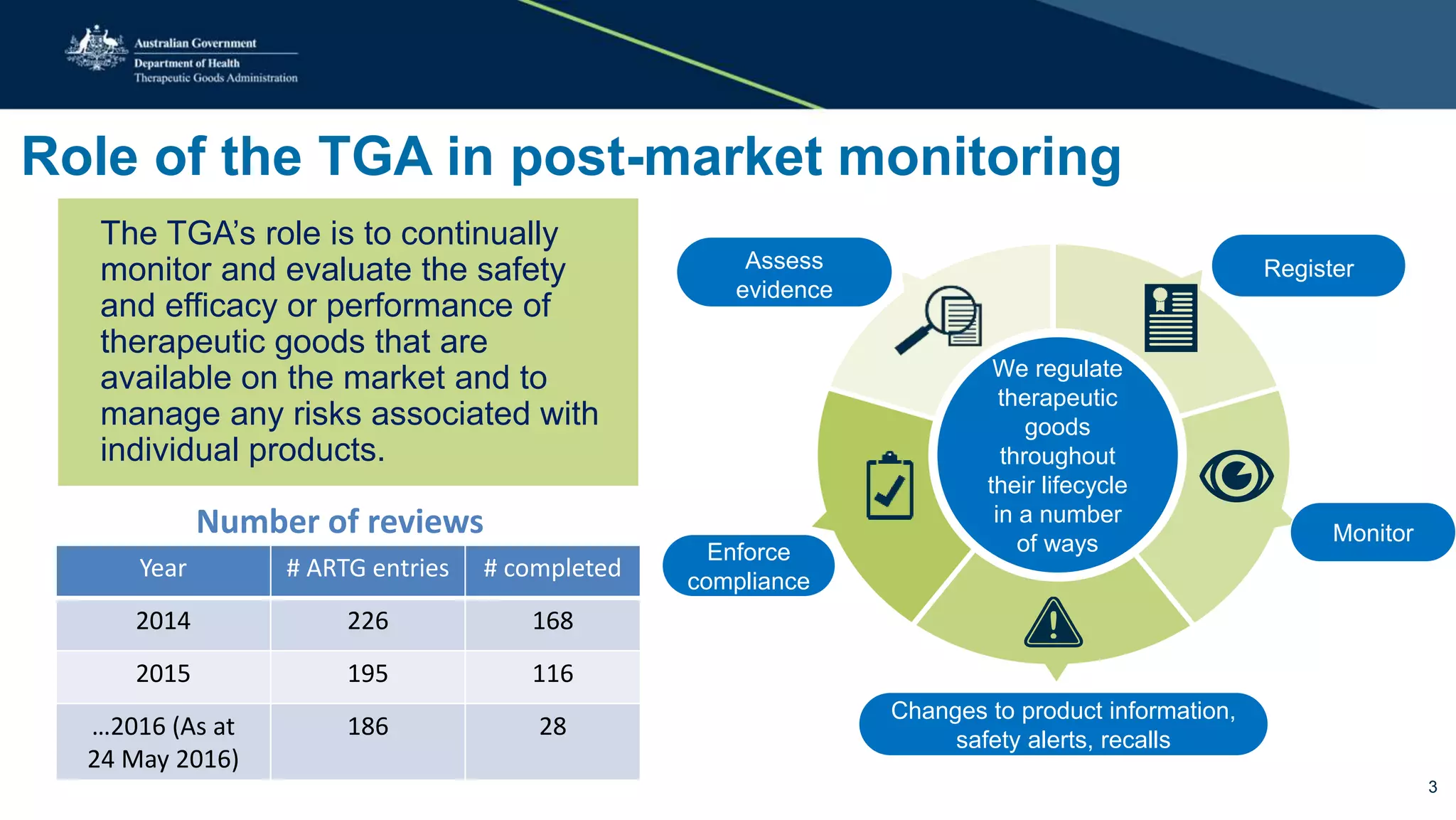
Role of the TGA in post-market monitoring
The TGA’s role is to continually
monitor and evaluate the safety
and efficacy or performance of
therapeutic goods that are
available on the market and to
manage any risks associated with
individual products.
Number of reviews
Year # ARTG entries # completed
2014 226 168
2015 195 116
…2016 (As at
24 May 2016)
186 28
We regulate
therapeutic
goods
throughout
their lifecycle
in a number
of ways
Assess
evidence
Register
Enforce
compliance
Monitor
Changes to product information,
safety alerts, recalls
3
Post-market monitoring
• Why are post-market reviews conducted
(not an exhaustive list):
− Trends from IRIS
− Recurrent advertising breaches
− Unresolved/repeated recalls
− Information from other regulatory
agencies
− ARTG anomalies
• Who or what is reviewed:
− Sponsor
− Manufacturer
− Ingredient
− Product
− Kind of device
• When:
− Any point in the product’s life-cycle.
Medical Devices: how to stay included 4
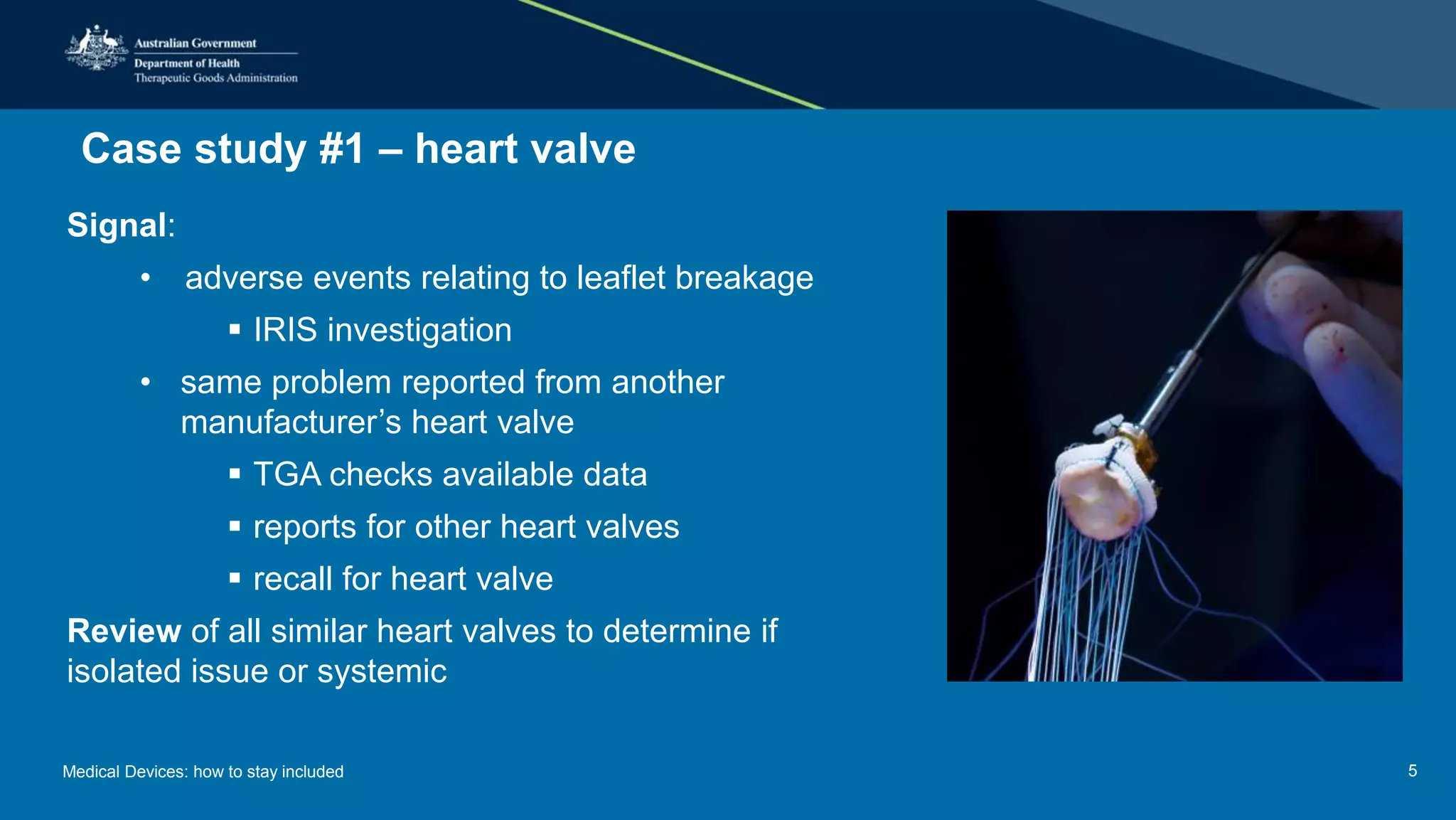
Case study #1 – heart valve
Signal:
• adverse events relating to leaflet breakage
 IRIS investigation
• same problem reported from another
manufacturer’s heart valve
 TGA checks available data
 reports for other heart valves
 recall for heart valve
Review of all similar heart valves to determine if
isolated issue or systemic
Medical Devices: how to stay included 5
Post-market review process
Calling in and reviewing:
- Essential Principles checklist
- Post-market data incl. supply, adverse
events and complaints
- Labels
- IFU
- Current clinical evidence report
- Risk management documentation
- Declaration of conformity & manufacturer’s
certification
- Technical documentation
- Ingredients and formulations of
medicated/formulated devices
- Advertising material
- CAPAs
- Samples
Dependent on the issue under review
Medical Devices: how to stay included 6
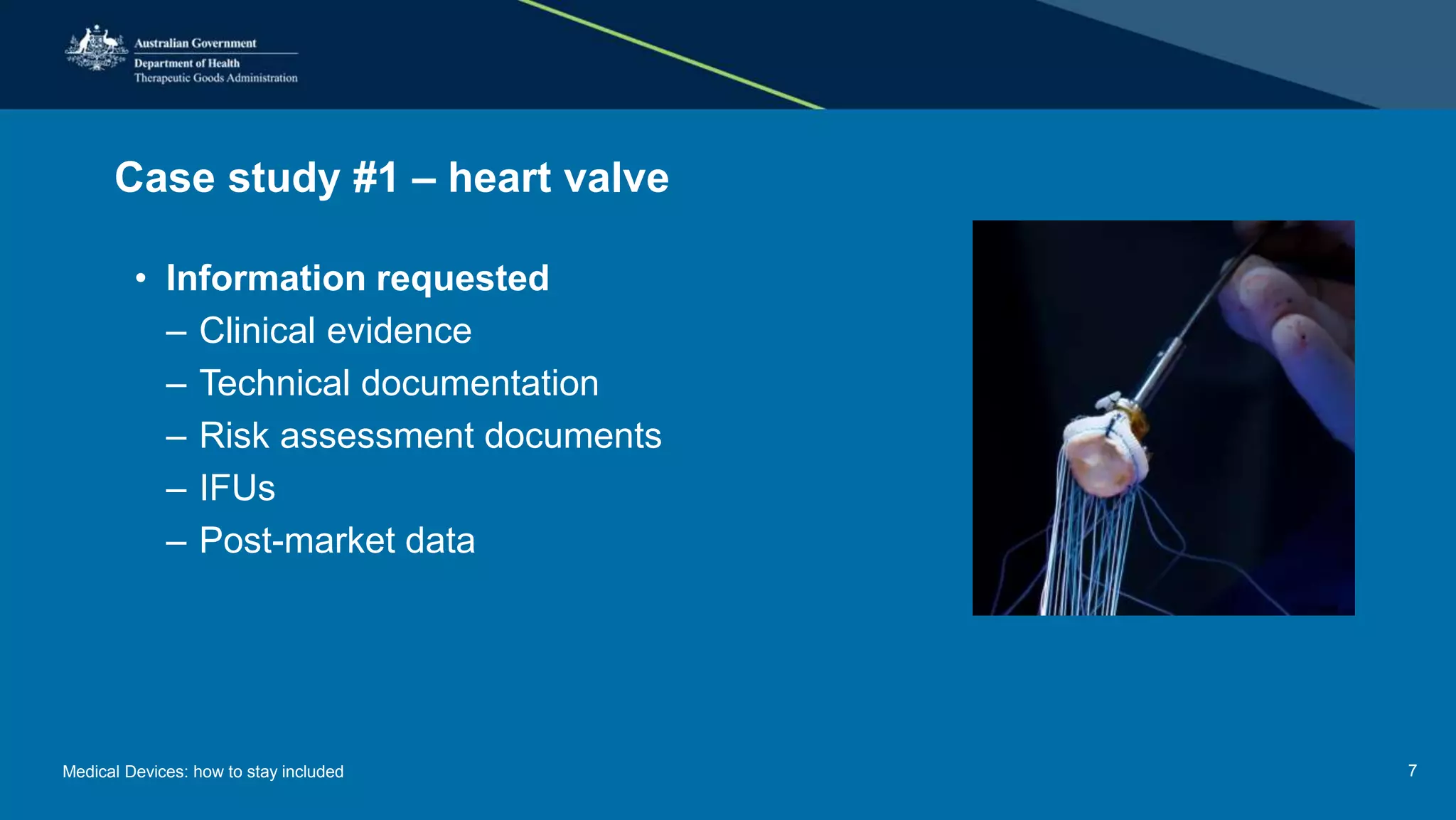
Case study #1 – heart valve
• Information requested
– Clinical evidence
– Technical documentation
– Risk assessment documents
– IFUs
– Post-market data
Medical Devices: how to stay included 7
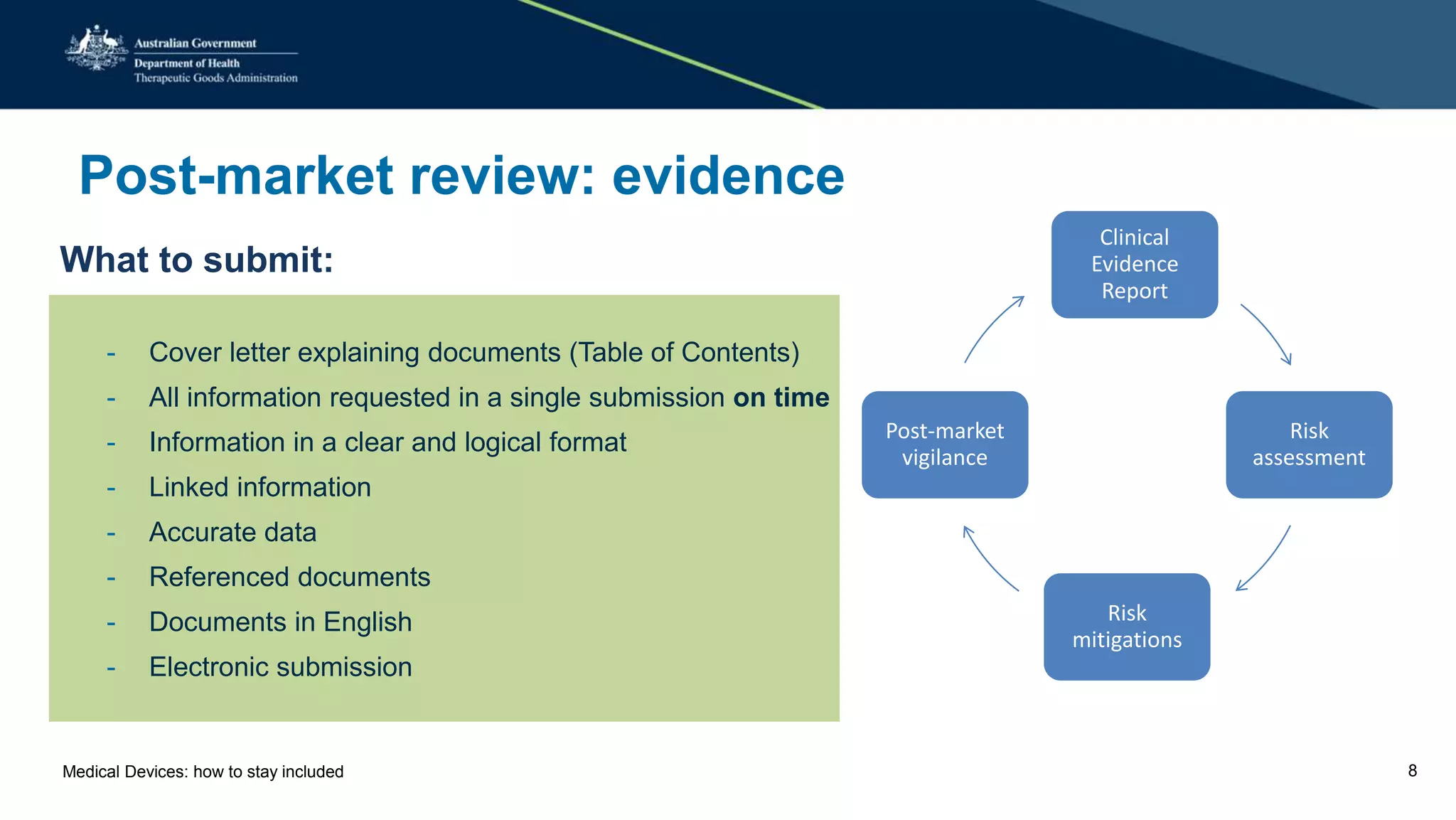
Post-market review: evidence
What to submit:
- Cover letter explaining documents (Table of Contents)
- All information requested in a single submission on time
- Information in a clear and logical format
- Linked information
- Accurate data
- Referenced documents
- Documents in English
- Electronic submission
Clinical
Evidence
Report
Risk
assessment
Risk
mitigations
Post-market
vigilance
Medical Devices: how to stay included 8
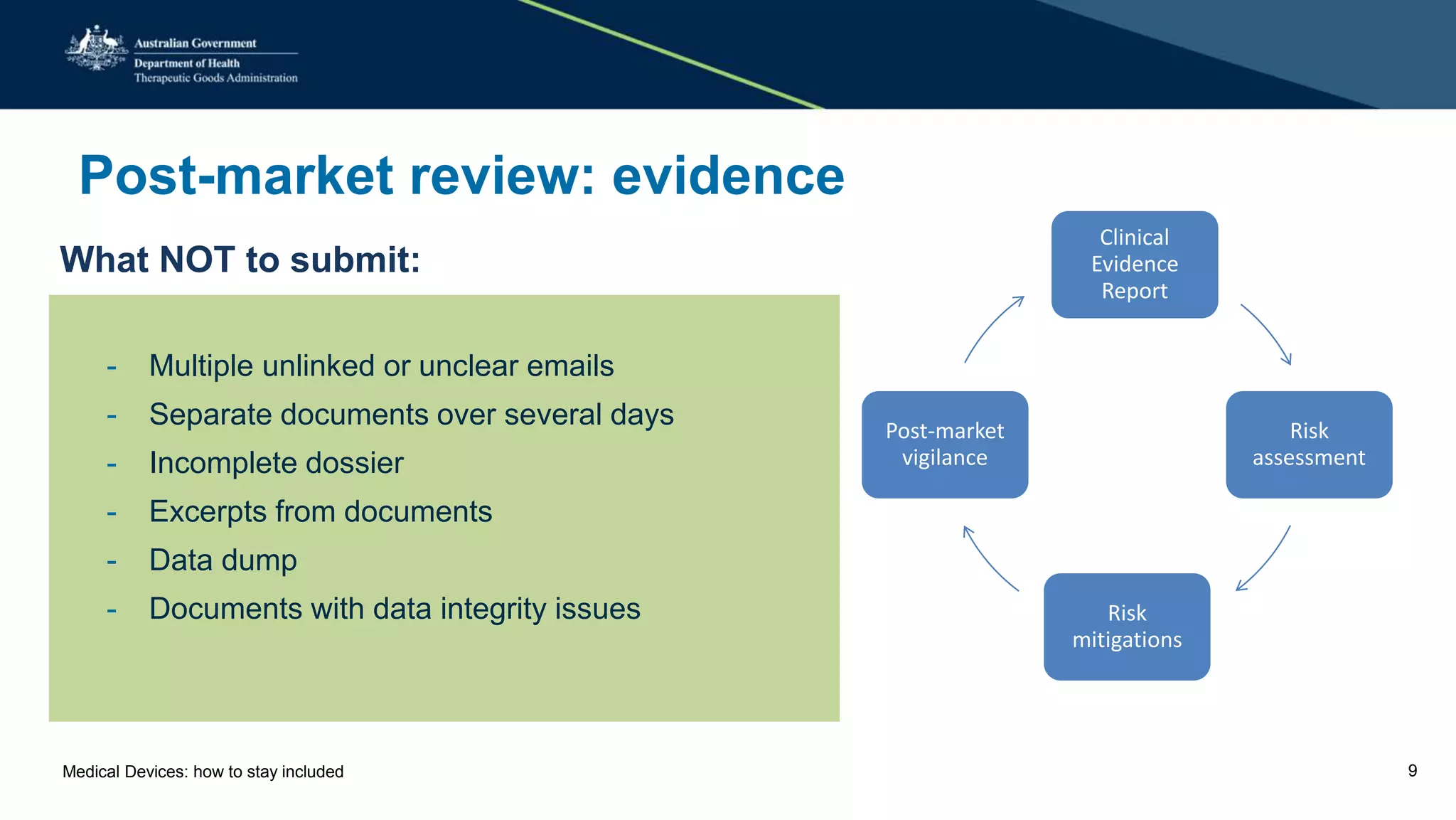
Post-market review: evidence
What NOT to submit:
- Multiple unlinked or unclear emails
- Separate documents over several days
- Incomplete dossier
- Excerpts from documents
- Data dump
- Documents with data integrity issues
Clinical
Evidence
Report
Risk
assessment
Risk
mitigations
Post-market
vigilance
Medical Devices: how to stay included 9
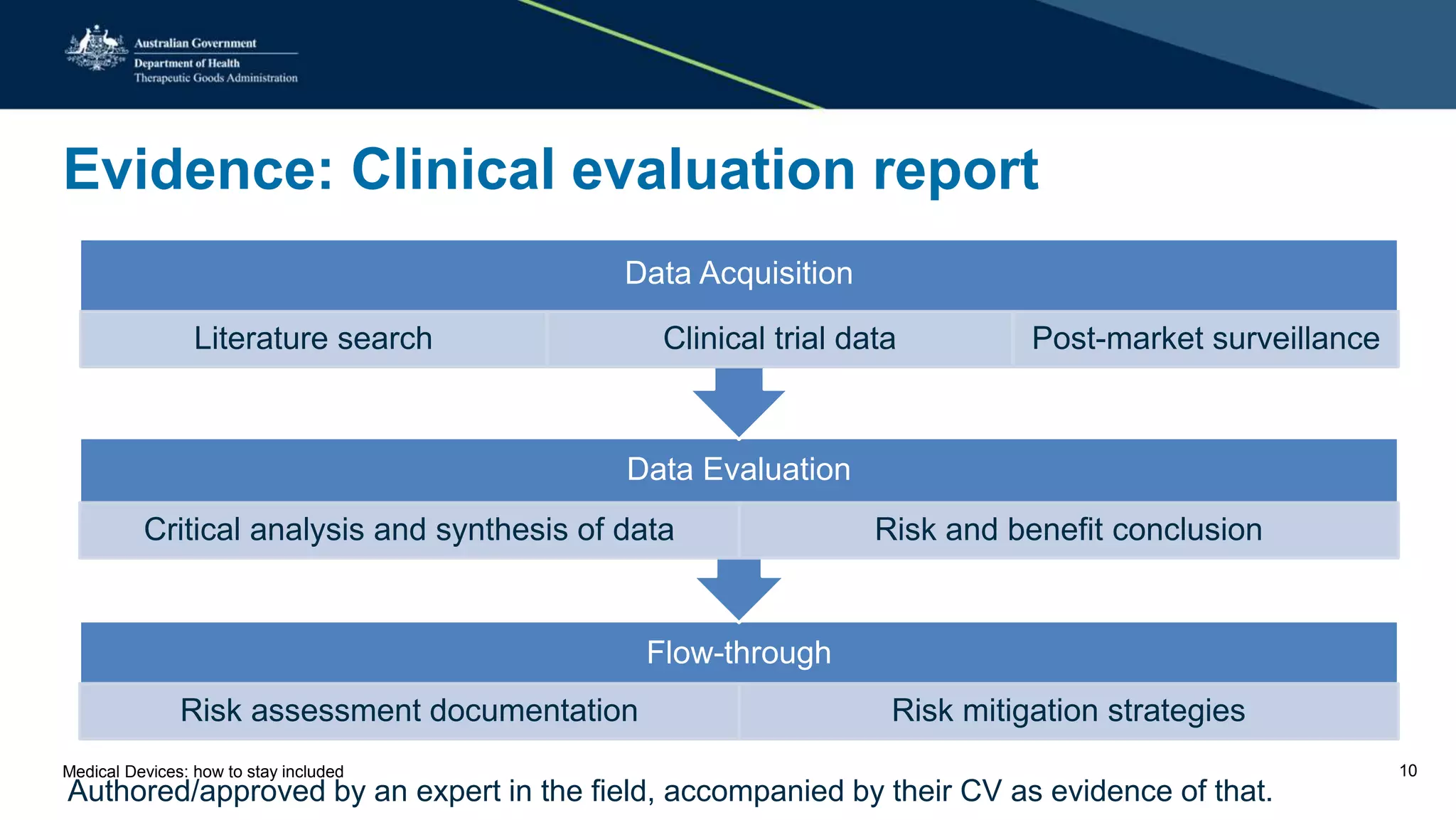
Evidence: Clinical evaluation report
Flow-through
Risk assessment documentation Risk mitigation strategies
Data Evaluation
Critical analysis and synthesis of data Risk and benefit conclusion
Data Acquisition
Literature search Clinical trial data Post-market surveillance
Authored/approved by an expert in the field, accompanied by their CV as evidence of that.
Medical Devices: how to stay included 10
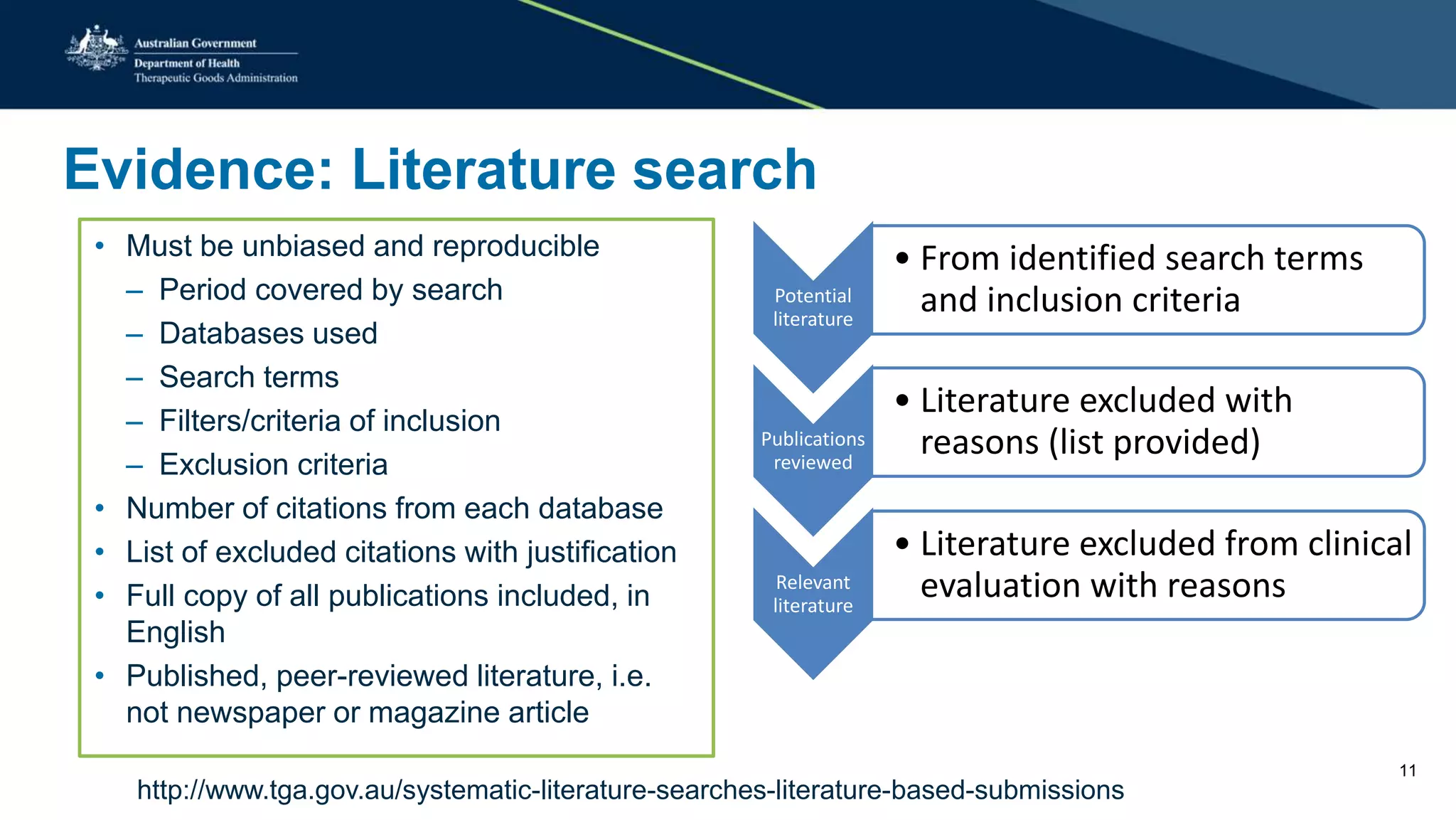
Evidence: Literature search
• Must be unbiased and reproducible
– Period covered by search
– Databases used
– Search terms
– Filters/criteria of inclusion
– Exclusion criteria
• Number of citations from each database
• List of excluded citations with justification
• Full copy of all publications included, in
English
• Published, peer-reviewed literature, i.e.
not newspaper or magazine article
Potential
literature
• From identified search terms
and inclusion criteria
Publications
reviewed
• Literature excluded with
reasons (list provided)
Relevant
literature
• Literature excluded from clinical
evaluation with reasons
http://www.tga.gov.au/systematic-literature-searches-literature-based-submissions
11
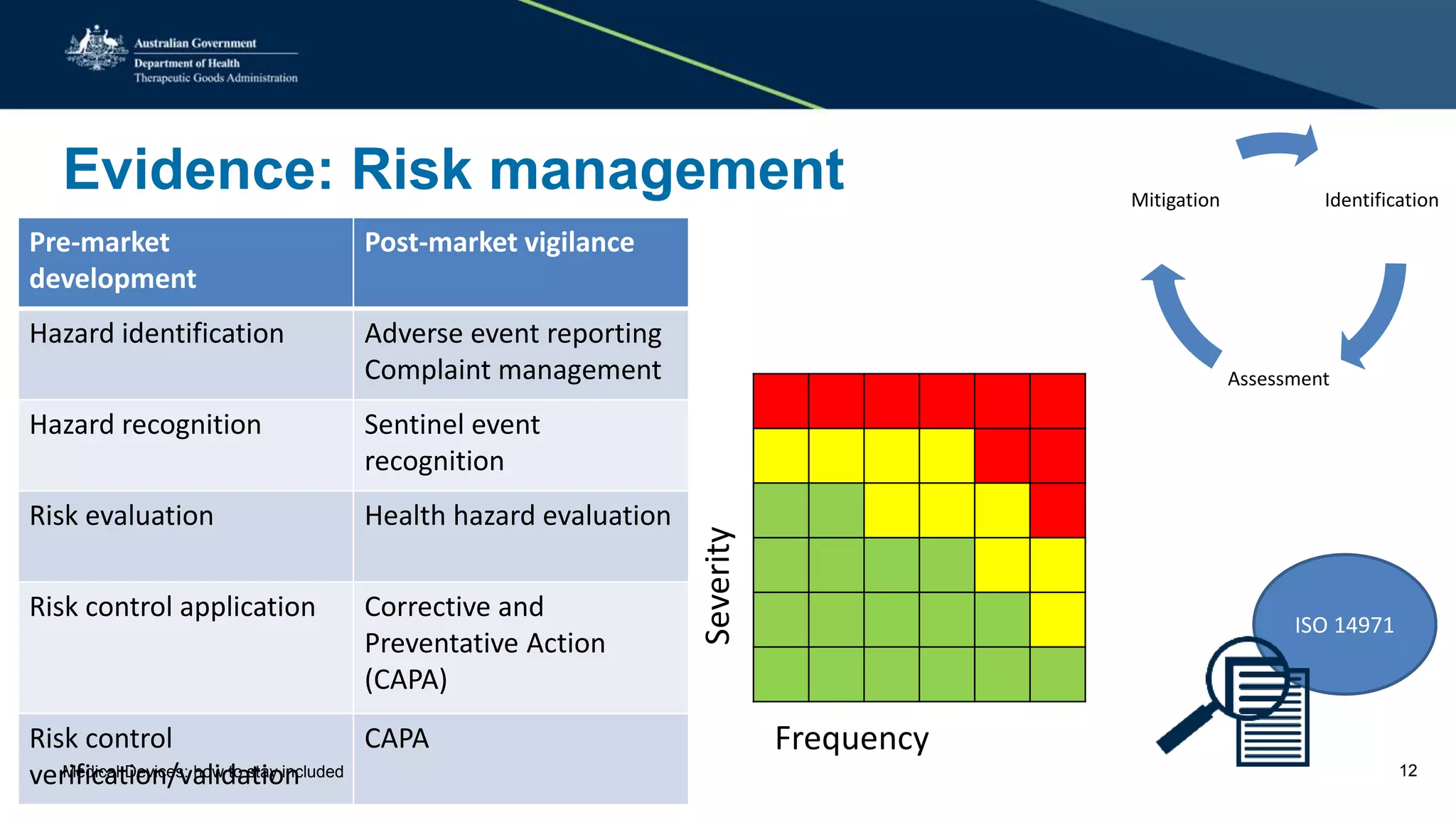
Evidence: Risk management
Pre-market
development
Post-market vigilance
Hazard identification Adverse event reporting
Complaint management
Hazard recognition Sentinel event
recognition
Risk evaluation Health hazard evaluation
Risk control application Corrective and
Preventative Action
(CAPA)
Risk control
verification/validation
CAPA
Identification
Assessment
Mitigation
Frequency
Severity
ISO 14971
Medical Devices: how to stay included 12
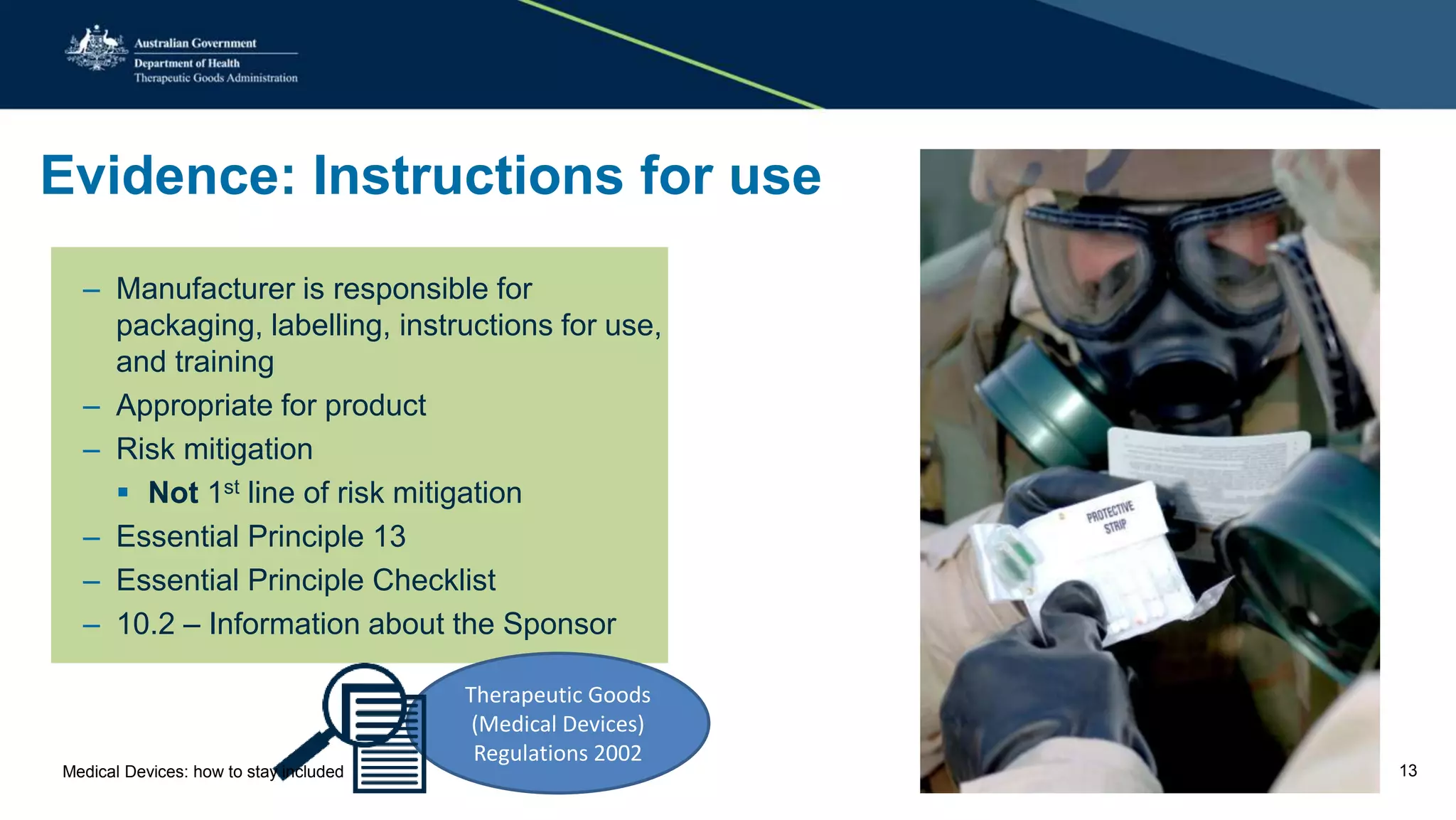
Evidence: Instructions for use
– Manufacturer is responsible for
packaging, labelling, instructions for use,
and training
– Appropriate for product
– Risk mitigation
 Not 1st line of risk mitigation
– Essential Principle 13
– Essential Principle Checklist
– 10.2 – Information about the Sponsor
Therapeutic Goods
(Medical Devices)
Regulations 2002
Medical Devices: how to stay included 13
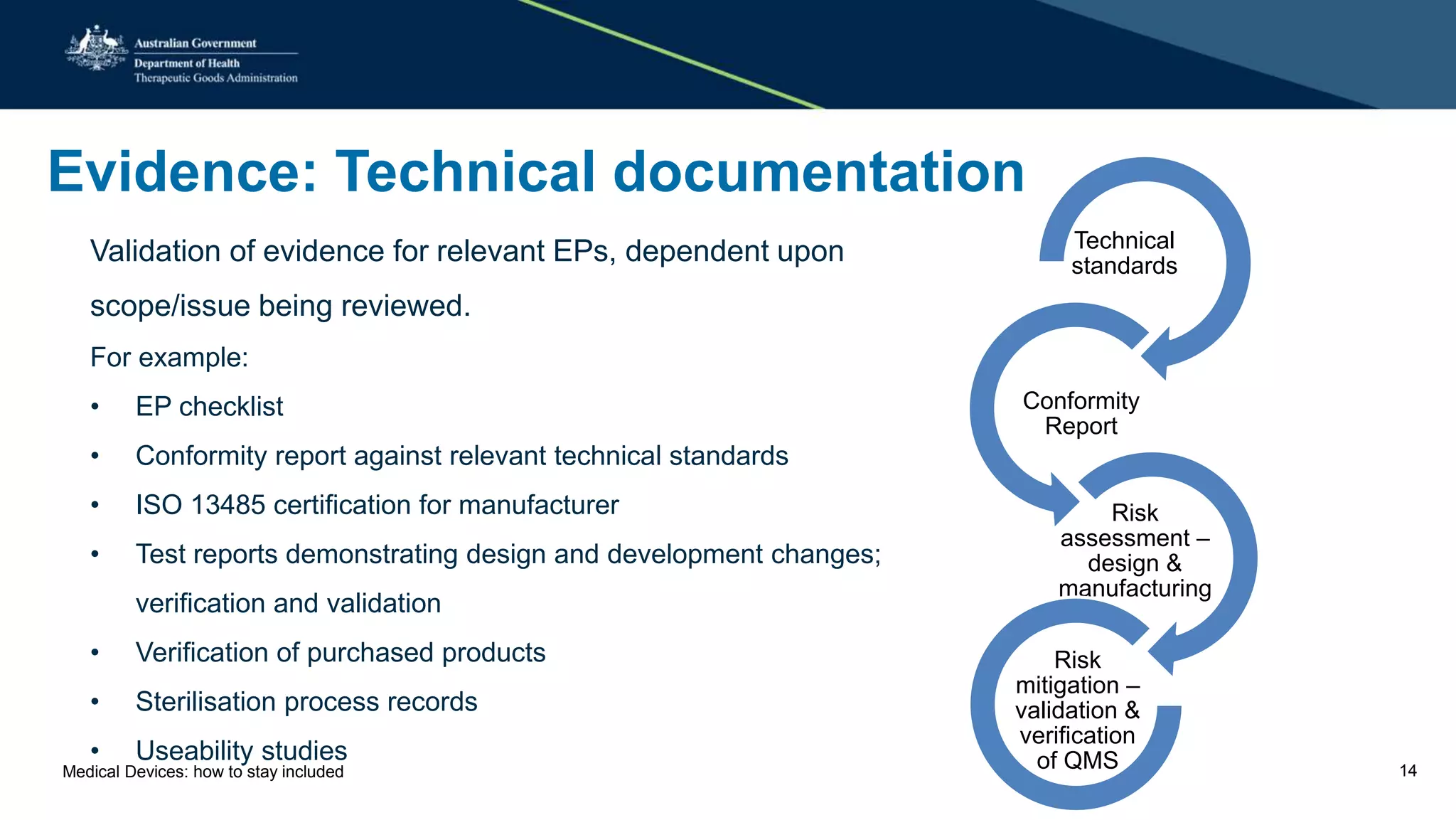
Evidence: Technical documentation
Validation of evidence for relevant EPs, dependent upon
scope/issue being reviewed.
For example:
• EP checklist
• Conformity report against relevant technical standards
• ISO 13485 certification for manufacturer
• Test reports demonstrating design and development changes;
verification and validation
• Verification of purchased products
• Sterilisation process records
• Useability studies
Technical
standards
Conformity
Report
Risk
assessment –
design &
manufacturing
Risk
mitigation –
validation &
verification
of QMSMedical Devices: how to stay included 14
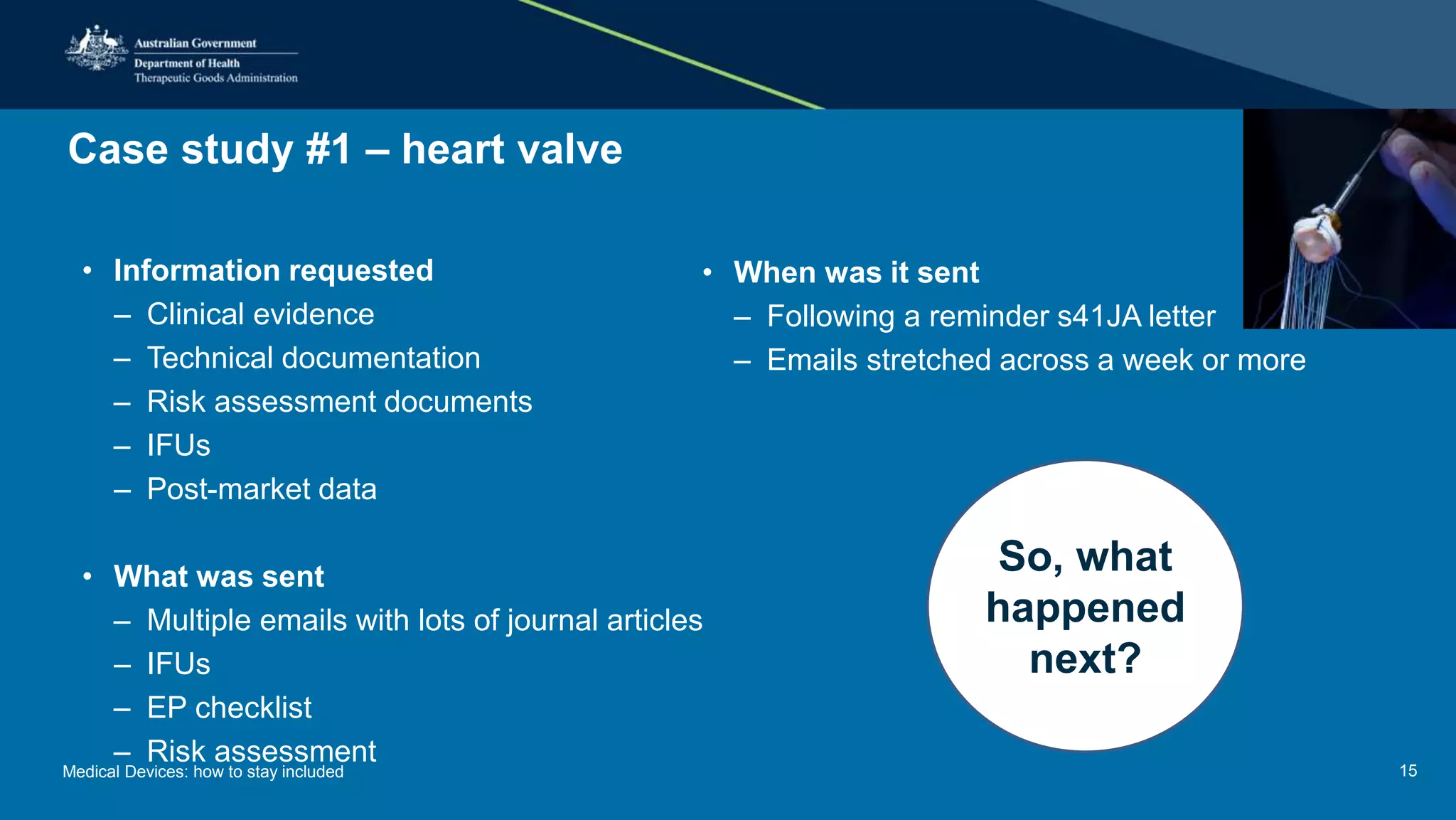
Case study #1 – heart valve
• Information requested
– Clinical evidence
– Technical documentation
– Risk assessment documents
– IFUs
– Post-market data
• What was sent
– Multiple emails with lots of journal articles
– IFUs
– EP checklist
– Risk assessment
• When was it sent
– Following a reminder s41JA letter
– Emails stretched across a week or more
So, what
happened
next?
Medical Devices: how to stay included 15
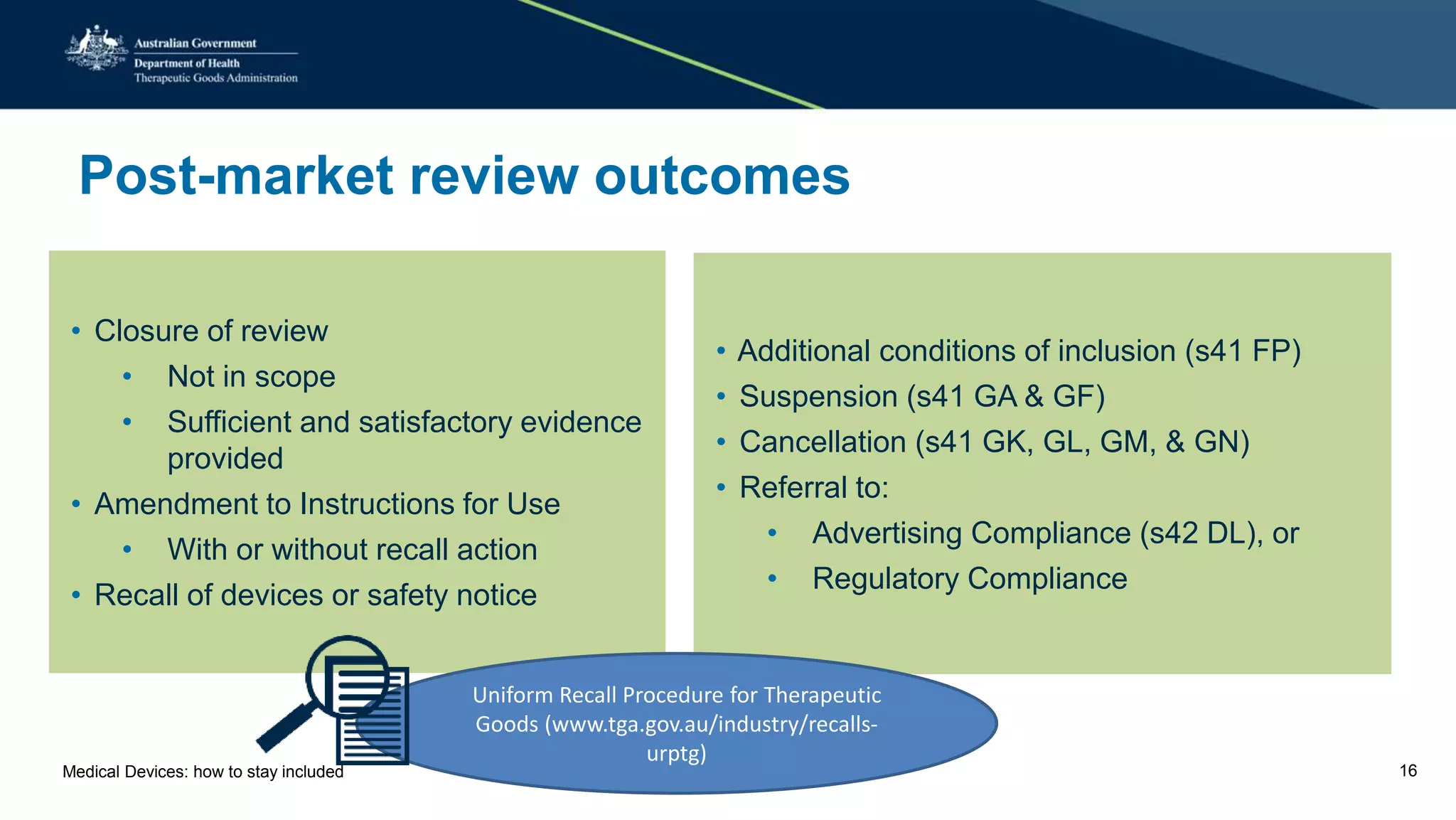
Post-market review outcomes
• Closure of review
• Not in scope
• Sufficient and satisfactory evidence
provided
• Amendment to Instructions for Use
• With or without recall action
• Recall of devices or safety notice
• Additional conditions of inclusion (s41 FP)
• Suspension (s41 GA & GF)
• Cancellation (s41 GK, GL, GM, & GN)
• Referral to:
• Advertising Compliance (s42 DL), or
• Regulatory Compliance
Uniform Recall Procedure for Therapeutic
Goods (www.tga.gov.au/industry/recalls-
urptg)
Medical Devices: how to stay included 16
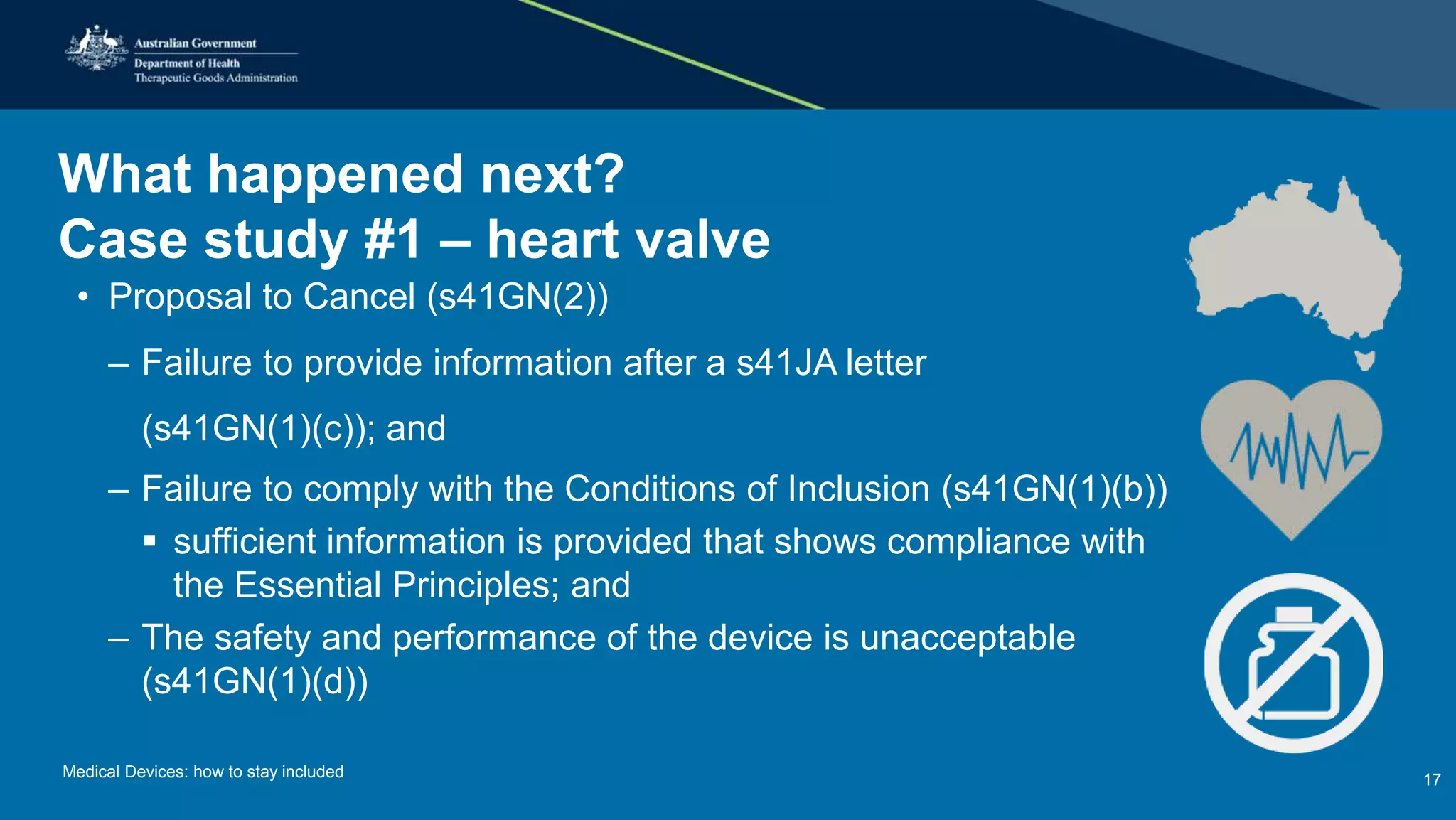
What happened next?
Case study #1 – heart valve
• Proposal to Cancel (s41GN(2))
– Failure to provide information after a s41JA letter
(s41GN(1)(c)); and
– Failure to comply with the Conditions of Inclusion (s41GN(1)(b))
 sufficient information is provided that shows compliance with
the Essential Principles; and
– The safety and performance of the device is unacceptable
(s41GN(1)(d))
Medical Devices: how to stay included 17
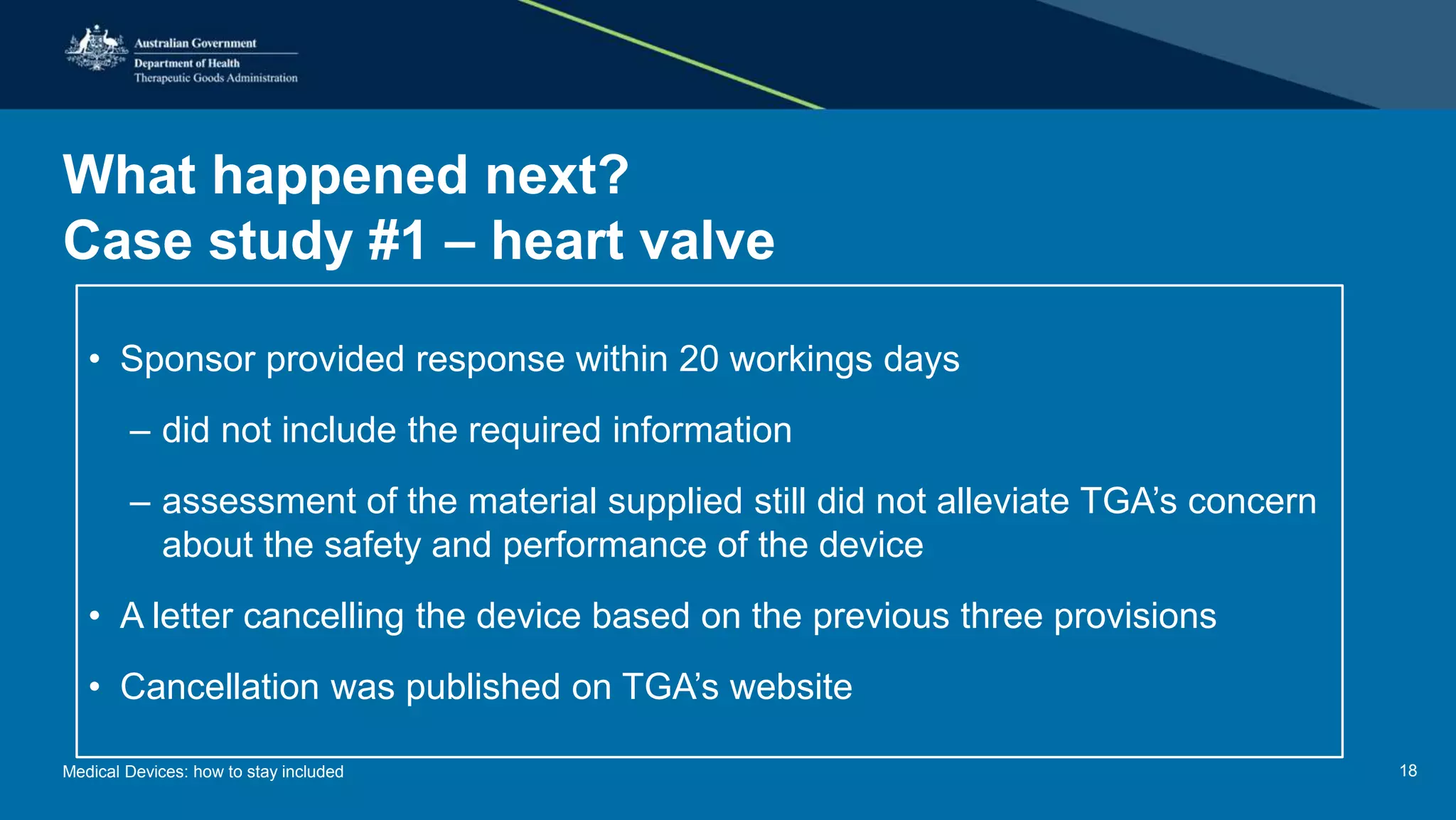
What happened next?
Case study #1 – heart valve
• Sponsor provided response within 20 workings days
– did not include the required information
– assessment of the material supplied still did not alleviate TGA’s concern
about the safety and performance of the device
• A letter cancelling the device based on the previous three provisions
• Cancellation was published on TGA’s website
Medical Devices: how to stay included 18
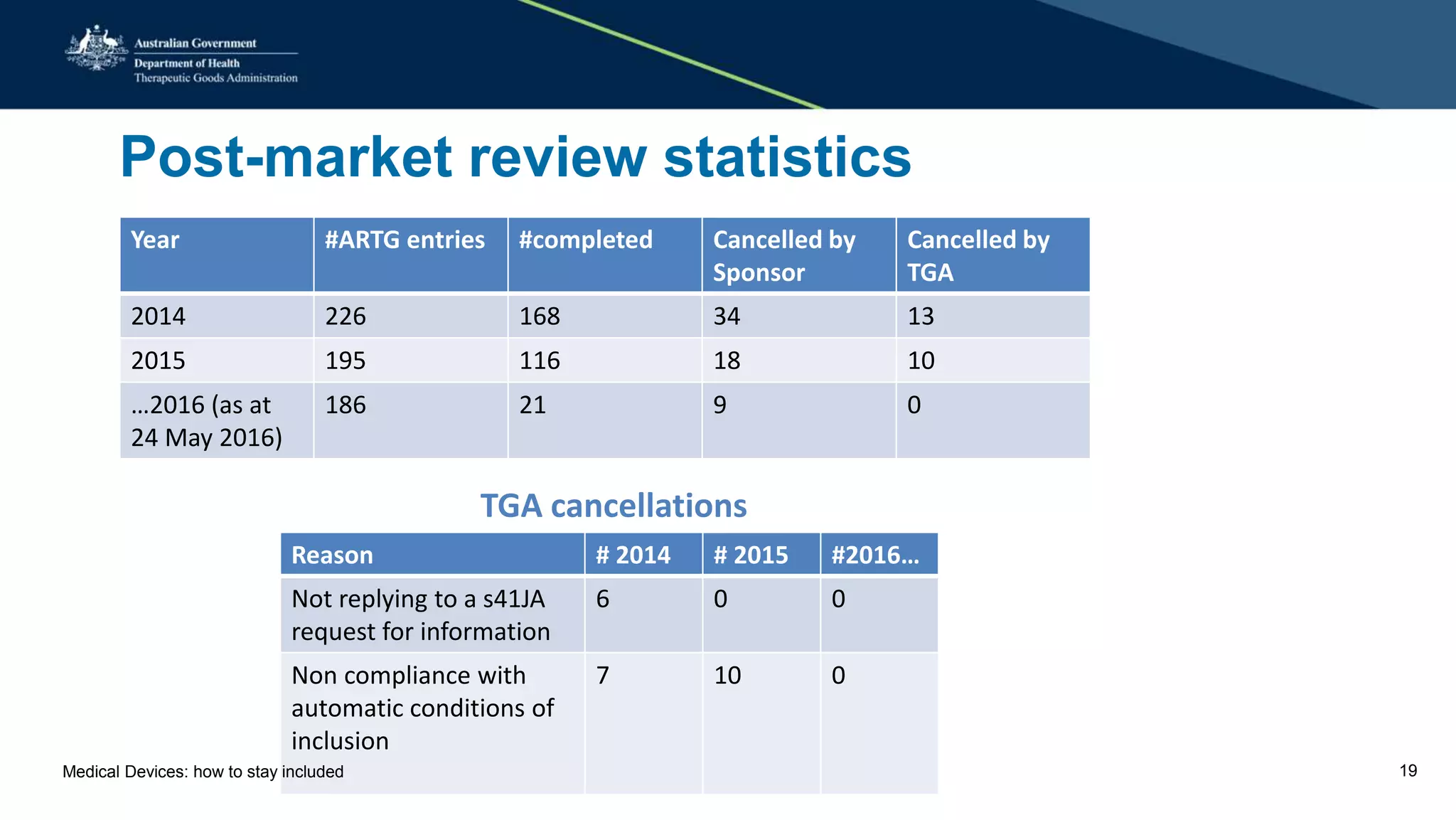
Post-market review statistics
Year #ARTG entries #completed Cancelled by
Sponsor
Cancelled by
TGA
2014 226 168 34 13
2015 195 116 18 10
…2016 (as at
24 May 2016)
186 21 9 0
TGA cancellations
Reason # 2014 # 2015 #2016…
Not replying to a s41JA
request for information
6 0 0
Non compliance with
automatic conditions of
inclusion
7 10 0
Medical Devices: how to stay included 19
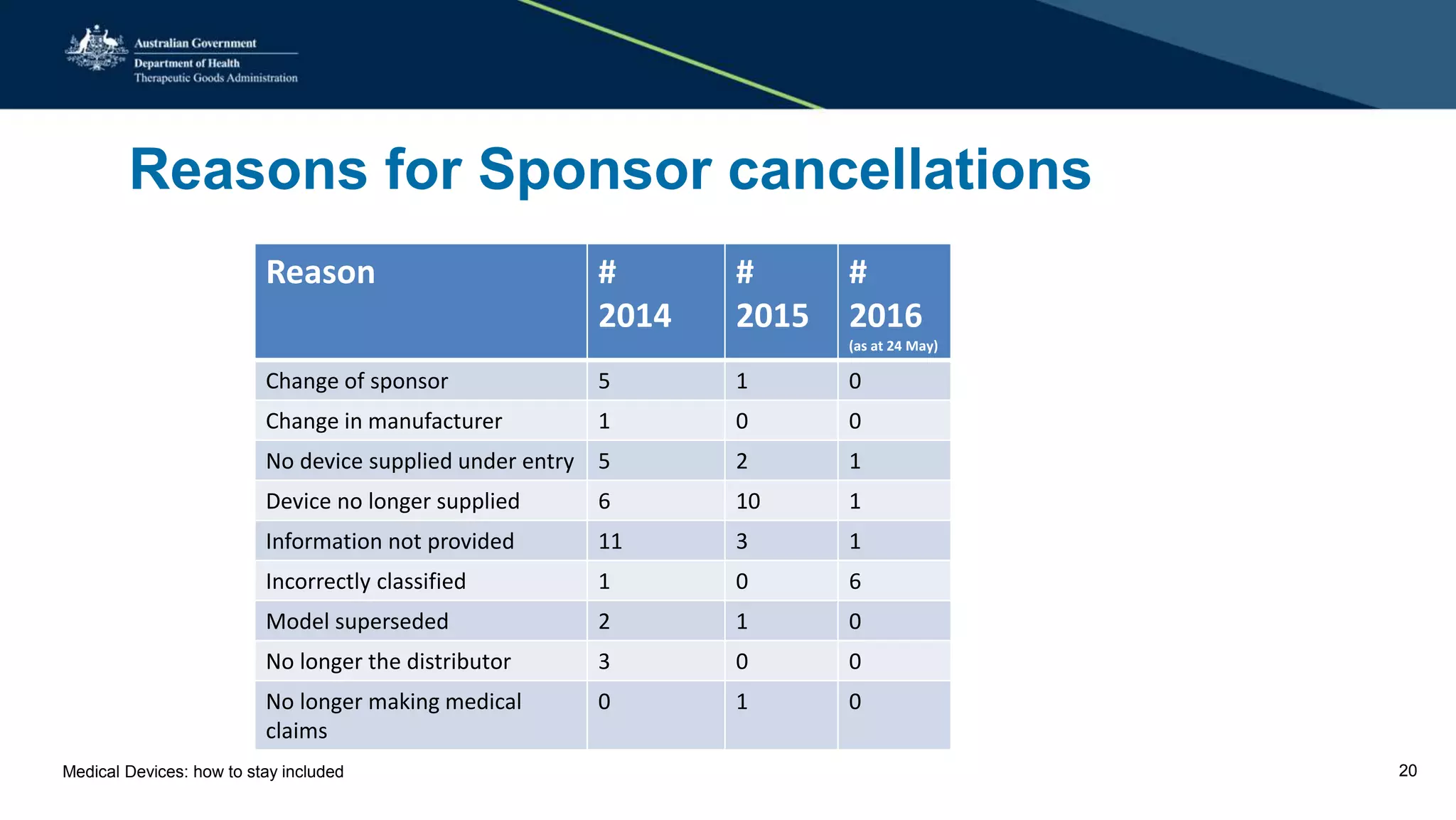
Reasons for Sponsor cancellations
Reason #
2014
#
2015
#
2016
(as at 24 May)
Change of sponsor 5 1 0
Change in manufacturer 1 0 0
No device supplied under entry 5 2 1
Device no longer supplied 6 10 1
Information not provided 11 3 1
Incorrectly classified 1 0 6
Model superseded 2 1 0
No longer the distributor 3 0 0
No longer making medical
claims
0 1 0
Medical Devices: how to stay included 20
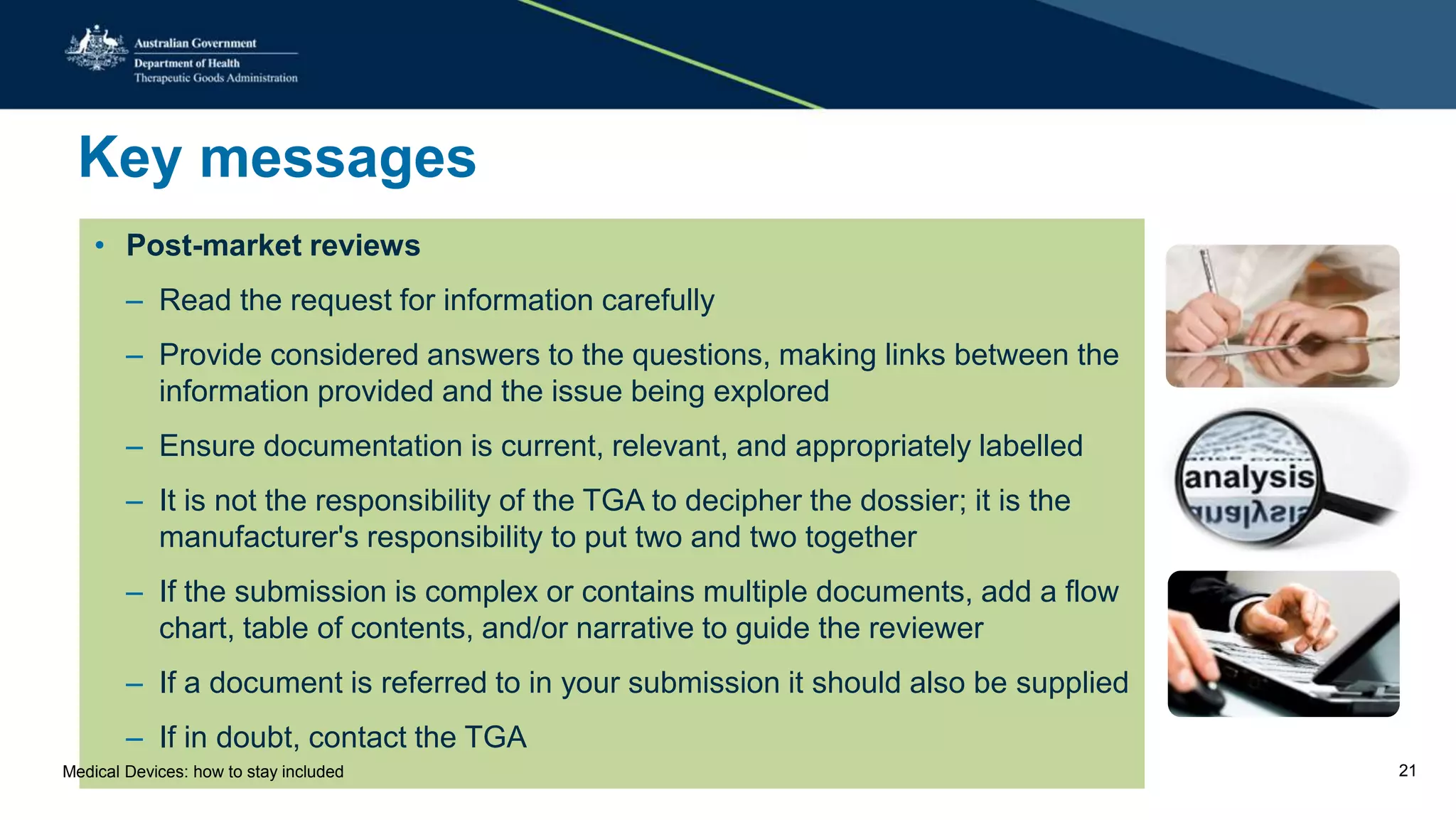
Key messages
• Post-market reviews
– Read the request for information carefully
– Provide considered answers to the questions, making links between the
information provided and the issue being explored
– Ensure documentation is current, relevant, and appropriately labelled
– It is not the responsibility of the TGA to decipher the dossier; it is the
manufacturer's responsibility to put two and two together
– If the submission is complex or contains multiple documents, add a flow
chart, table of contents, and/or narrative to guide the reviewer
– If a document is referred to in your submission it should also be supplied
– If in doubt, contact the TGA
Medical Devices: how to stay included 21
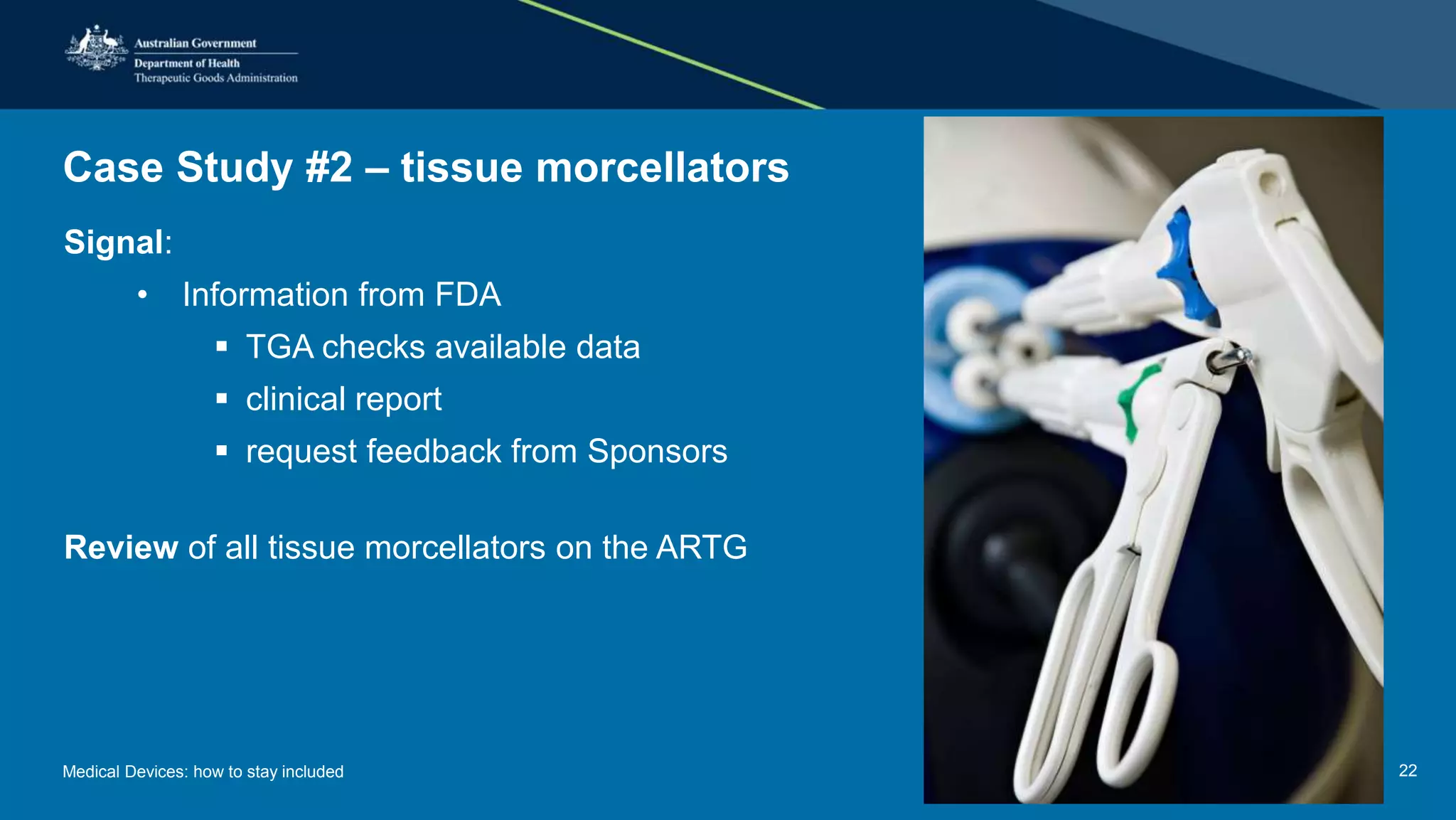
Case Study #2 – tissue morcellators
Signal:
• Information from FDA
 TGA checks available data
 clinical report
 request feedback from Sponsors
Review of all tissue morcellators on the ARTG
Medical Devices: how to stay included 22
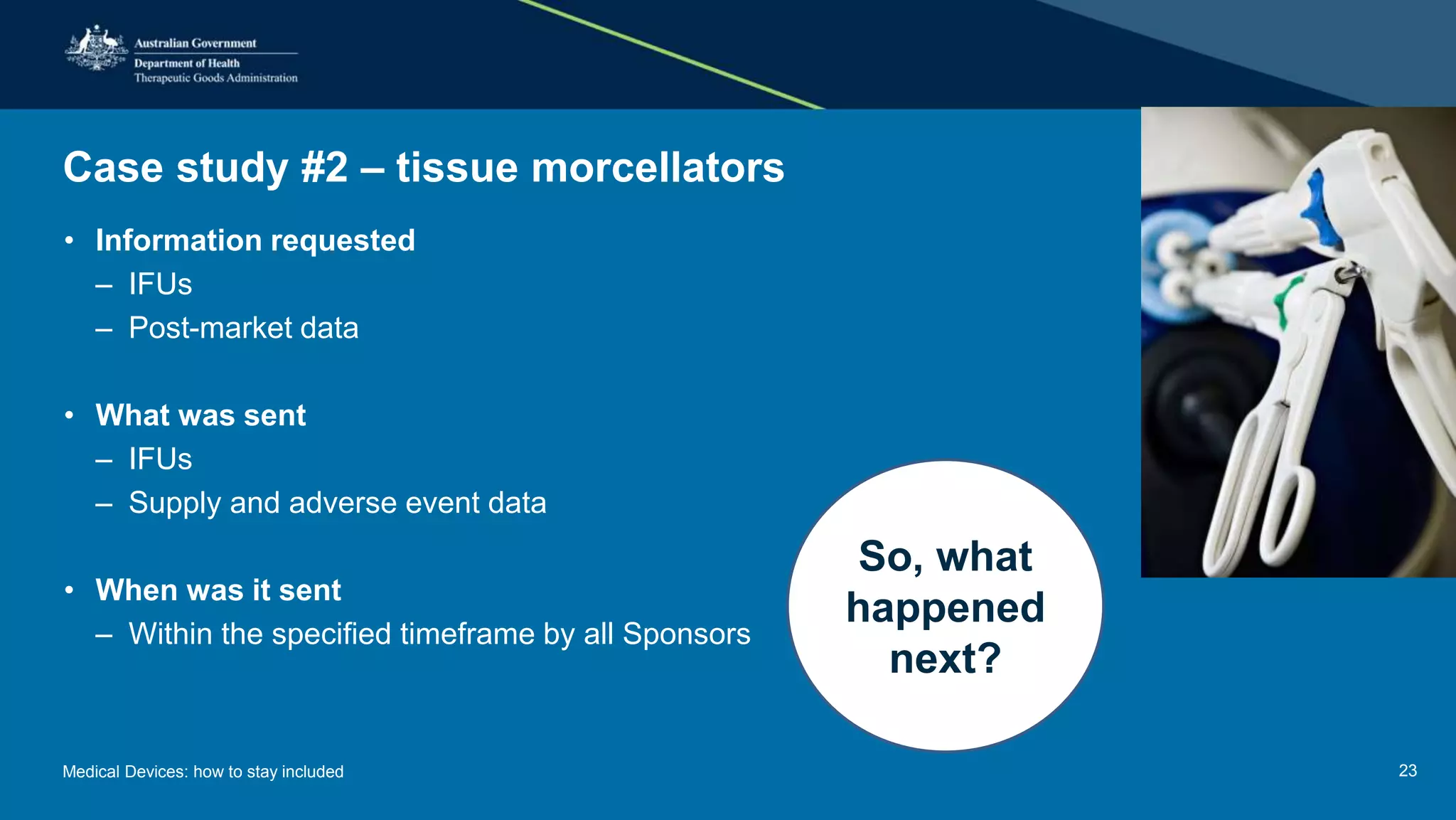
Case study #2 – tissue morcellators
• Information requested
– IFUs
– Post-market data
• What was sent
– IFUs
– Supply and adverse event data
• When was it sent
– Within the specified timeframe by all Sponsors
So, what
happened
next?
Medical Devices: how to stay included 23
What happened next?
Case study #2 – tissue morcellators
• Amended IFUs distributed through recall
sections with new black box warning
Medical Devices: how to stay included 24
Learning outcomes
At the end of this session it is envisaged that you will:
• Have an understanding of the post-market review process of medical devices.
• Appreciate the importance of strong working relationship between the manufacturer and
sponsor.
• Recognise appropriate and acceptable documentation that provides evidence of
compliance with the Essential Principles.
• Understand the continuum of a QMS, with the evidence informing the CER, which informs
the risk assessment, which in turn informs the risk mitigation strategies, for the life of the
device.
• Implement processes to ensure appropriate responses to post-market vigilance and post-
market reviews.
Medical Devices: how to stay included 25
Further information
• Therapeutic Goods Act 1989
• Therapeutic Goods (Medical Devices) Regulations 2002
– http://www.tga.gov.au/legislation-legislative-instruments
• Australian regulatory guidelines for medical devices
– http://www.tga.gov.au/publication/australian-regulatory-guidelines-medical-devices-argmd
• Essential Principles checklist
– http://www.tga.gov.au/form/essential-principles-checklist-medical-devices
• Systematic literature searches for literature based submissions
– http://www.tga.gov.au/systematic-literature-searches-literature-based-submissions
• Draft clinical evidence guidelines – Medical devices
– https://www.tga.gov.au/consultation/consultation-draft-clinical-evidence-guidelines-medical-devices
• International Medical Device Regulators Forum
– www.imdrf.org
Medical Devices: how to stay included 26
Presentation: Medical Devices: how to stay included workshop - Post-market reviews

Presentation: Medical Devices: how to stay included workshop - Post-market reviews

  • 1.
    Medical Devices: howto stay included Post-market reviews Amanda Craig Technical Officer Device Vigilance and Monitoring Section Medical Devices Branch Therapeutic Goods Administration
  • 2.
    Learning outcomes It isenvisaged at the end of this session you will you be able to: • understand the post-market review process of medical devices. • appreciate the importance of strong working relationship between the manufacturer and sponsor. • recognise appropriate and acceptable documentation that provides evidence of compliance with the Essential Principles. • understand the continuum of a QMS, with the evidence informing the CER, which informs the risk assessment, which in turn informs the risk mitigation strategies, for the life of the device. • implement processes to ensure appropriate responses to post-market vigilance and post- market reviews. Medical Devices: how to stay included 1
  • 3.
    Overview • The TGA’srole in post-market monitoring • Post-market monitoring  the why, who, when, and what • Quality Management System  Clinical evaluation report  Literature search  Risk management documentation  Instructions for Use  Technical documentation Medical Devices: how to stay included 2
  • 4.
    Role of theTGA in post-market monitoring The TGA’s role is to continually monitor and evaluate the safety and efficacy or performance of therapeutic goods that are available on the market and to manage any risks associated with individual products. Number of reviews Year # ARTG entries # completed 2014 226 168 2015 195 116 …2016 (As at 24 May 2016) 186 28 We regulate therapeutic goods throughout their lifecycle in a number of ways Assess evidence Register Enforce compliance Monitor Changes to product information, safety alerts, recalls 3
  • 5.
    Post-market monitoring • Whyare post-market reviews conducted (not an exhaustive list): − Trends from IRIS − Recurrent advertising breaches − Unresolved/repeated recalls − Information from other regulatory agencies − ARTG anomalies • Who or what is reviewed: − Sponsor − Manufacturer − Ingredient − Product − Kind of device • When: − Any point in the product’s life-cycle. Medical Devices: how to stay included 4
  • 6.
    Case study #1– heart valve Signal: • adverse events relating to leaflet breakage  IRIS investigation • same problem reported from another manufacturer’s heart valve  TGA checks available data  reports for other heart valves  recall for heart valve Review of all similar heart valves to determine if isolated issue or systemic Medical Devices: how to stay included 5
  • 7.
    Post-market review process Callingin and reviewing: - Essential Principles checklist - Post-market data incl. supply, adverse events and complaints - Labels - IFU - Current clinical evidence report - Risk management documentation - Declaration of conformity & manufacturer’s certification - Technical documentation - Ingredients and formulations of medicated/formulated devices - Advertising material - CAPAs - Samples Dependent on the issue under review Medical Devices: how to stay included 6
  • 8.
    Case study #1– heart valve • Information requested – Clinical evidence – Technical documentation – Risk assessment documents – IFUs – Post-market data Medical Devices: how to stay included 7
  • 9.
    Post-market review: evidence Whatto submit: - Cover letter explaining documents (Table of Contents) - All information requested in a single submission on time - Information in a clear and logical format - Linked information - Accurate data - Referenced documents - Documents in English - Electronic submission Clinical Evidence Report Risk assessment Risk mitigations Post-market vigilance Medical Devices: how to stay included 8
  • 10.
    Post-market review: evidence WhatNOT to submit: - Multiple unlinked or unclear emails - Separate documents over several days - Incomplete dossier - Excerpts from documents - Data dump - Documents with data integrity issues Clinical Evidence Report Risk assessment Risk mitigations Post-market vigilance Medical Devices: how to stay included 9
  • 11.
    Evidence: Clinical evaluationreport Flow-through Risk assessment documentation Risk mitigation strategies Data Evaluation Critical analysis and synthesis of data Risk and benefit conclusion Data Acquisition Literature search Clinical trial data Post-market surveillance Authored/approved by an expert in the field, accompanied by their CV as evidence of that. Medical Devices: how to stay included 10
  • 12.
    Evidence: Literature search •Must be unbiased and reproducible – Period covered by search – Databases used – Search terms – Filters/criteria of inclusion – Exclusion criteria • Number of citations from each database • List of excluded citations with justification • Full copy of all publications included, in English • Published, peer-reviewed literature, i.e. not newspaper or magazine article Potential literature • From identified search terms and inclusion criteria Publications reviewed • Literature excluded with reasons (list provided) Relevant literature • Literature excluded from clinical evaluation with reasons http://www.tga.gov.au/systematic-literature-searches-literature-based-submissions 11
  • 13.
    Evidence: Risk management Pre-market development Post-marketvigilance Hazard identification Adverse event reporting Complaint management Hazard recognition Sentinel event recognition Risk evaluation Health hazard evaluation Risk control application Corrective and Preventative Action (CAPA) Risk control verification/validation CAPA Identification Assessment Mitigation Frequency Severity ISO 14971 Medical Devices: how to stay included 12
  • 14.
    Evidence: Instructions foruse – Manufacturer is responsible for packaging, labelling, instructions for use, and training – Appropriate for product – Risk mitigation  Not 1st line of risk mitigation – Essential Principle 13 – Essential Principle Checklist – 10.2 – Information about the Sponsor Therapeutic Goods (Medical Devices) Regulations 2002 Medical Devices: how to stay included 13
  • 15.
    Evidence: Technical documentation Validationof evidence for relevant EPs, dependent upon scope/issue being reviewed. For example: • EP checklist • Conformity report against relevant technical standards • ISO 13485 certification for manufacturer • Test reports demonstrating design and development changes; verification and validation • Verification of purchased products • Sterilisation process records • Useability studies Technical standards Conformity Report Risk assessment – design & manufacturing Risk mitigation – validation & verification of QMSMedical Devices: how to stay included 14
  • 16.
    Case study #1– heart valve • Information requested – Clinical evidence – Technical documentation – Risk assessment documents – IFUs – Post-market data • What was sent – Multiple emails with lots of journal articles – IFUs – EP checklist – Risk assessment • When was it sent – Following a reminder s41JA letter – Emails stretched across a week or more So, what happened next? Medical Devices: how to stay included 15
  • 17.
    Post-market review outcomes •Closure of review • Not in scope • Sufficient and satisfactory evidence provided • Amendment to Instructions for Use • With or without recall action • Recall of devices or safety notice • Additional conditions of inclusion (s41 FP) • Suspension (s41 GA & GF) • Cancellation (s41 GK, GL, GM, & GN) • Referral to: • Advertising Compliance (s42 DL), or • Regulatory Compliance Uniform Recall Procedure for Therapeutic Goods (www.tga.gov.au/industry/recalls- urptg) Medical Devices: how to stay included 16
  • 18.
    What happened next? Casestudy #1 – heart valve • Proposal to Cancel (s41GN(2)) – Failure to provide information after a s41JA letter (s41GN(1)(c)); and – Failure to comply with the Conditions of Inclusion (s41GN(1)(b))  sufficient information is provided that shows compliance with the Essential Principles; and – The safety and performance of the device is unacceptable (s41GN(1)(d)) Medical Devices: how to stay included 17
  • 19.
    What happened next? Casestudy #1 – heart valve • Sponsor provided response within 20 workings days – did not include the required information – assessment of the material supplied still did not alleviate TGA’s concern about the safety and performance of the device • A letter cancelling the device based on the previous three provisions • Cancellation was published on TGA’s website Medical Devices: how to stay included 18
  • 20.
    Post-market review statistics Year#ARTG entries #completed Cancelled by Sponsor Cancelled by TGA 2014 226 168 34 13 2015 195 116 18 10 …2016 (as at 24 May 2016) 186 21 9 0 TGA cancellations Reason # 2014 # 2015 #2016… Not replying to a s41JA request for information 6 0 0 Non compliance with automatic conditions of inclusion 7 10 0 Medical Devices: how to stay included 19
  • 21.
    Reasons for Sponsorcancellations Reason # 2014 # 2015 # 2016 (as at 24 May) Change of sponsor 5 1 0 Change in manufacturer 1 0 0 No device supplied under entry 5 2 1 Device no longer supplied 6 10 1 Information not provided 11 3 1 Incorrectly classified 1 0 6 Model superseded 2 1 0 No longer the distributor 3 0 0 No longer making medical claims 0 1 0 Medical Devices: how to stay included 20
  • 22.
    Key messages • Post-marketreviews – Read the request for information carefully – Provide considered answers to the questions, making links between the information provided and the issue being explored – Ensure documentation is current, relevant, and appropriately labelled – It is not the responsibility of the TGA to decipher the dossier; it is the manufacturer's responsibility to put two and two together – If the submission is complex or contains multiple documents, add a flow chart, table of contents, and/or narrative to guide the reviewer – If a document is referred to in your submission it should also be supplied – If in doubt, contact the TGA Medical Devices: how to stay included 21
  • 23.
    Case Study #2– tissue morcellators Signal: • Information from FDA  TGA checks available data  clinical report  request feedback from Sponsors Review of all tissue morcellators on the ARTG Medical Devices: how to stay included 22
  • 24.
    Case study #2– tissue morcellators • Information requested – IFUs – Post-market data • What was sent – IFUs – Supply and adverse event data • When was it sent – Within the specified timeframe by all Sponsors So, what happened next? Medical Devices: how to stay included 23
  • 25.
    What happened next? Casestudy #2 – tissue morcellators • Amended IFUs distributed through recall sections with new black box warning Medical Devices: how to stay included 24
  • 26.
    Learning outcomes At theend of this session it is envisaged that you will: • Have an understanding of the post-market review process of medical devices. • Appreciate the importance of strong working relationship between the manufacturer and sponsor. • Recognise appropriate and acceptable documentation that provides evidence of compliance with the Essential Principles. • Understand the continuum of a QMS, with the evidence informing the CER, which informs the risk assessment, which in turn informs the risk mitigation strategies, for the life of the device. • Implement processes to ensure appropriate responses to post-market vigilance and post- market reviews. Medical Devices: how to stay included 25
  • 27.
    Further information • TherapeuticGoods Act 1989 • Therapeutic Goods (Medical Devices) Regulations 2002 – http://www.tga.gov.au/legislation-legislative-instruments • Australian regulatory guidelines for medical devices – http://www.tga.gov.au/publication/australian-regulatory-guidelines-medical-devices-argmd • Essential Principles checklist – http://www.tga.gov.au/form/essential-principles-checklist-medical-devices • Systematic literature searches for literature based submissions – http://www.tga.gov.au/systematic-literature-searches-literature-based-submissions • Draft clinical evidence guidelines – Medical devices – https://www.tga.gov.au/consultation/consultation-draft-clinical-evidence-guidelines-medical-devices • International Medical Device Regulators Forum – www.imdrf.org Medical Devices: how to stay included 26