Navigating regulation
Which devices does the TGA regulate and how do they do it?
Dr Lee Walsh CPEng NER
Senior Engineer, Biomaterials and Engineering Section
Laboratories Branch
Therapeutic Goods Administration
Innovate Health
26 Jun 2018
Overview of the TGA
• Part of the Australian Government Department of
Health
• Administers the Therapeutic Goods Act 1989
• Main offices in Canberra – satellite offices in Sydney,
Melbourne, Adelaide and Brisbane
• Operations cost recovered from industry
• Mission: To safeguard and enhance the health of the
Australian community through the effective and timely
regulation of therapeutic goods
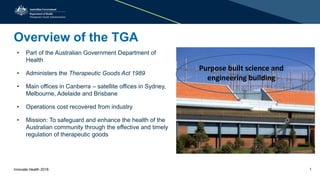
Purpose built science and
engineering building
Innovate Health 2018 1
Overview of the TGA – What we do
• Evaluate therapeutic goods before they are supplied
• Focus on safety, quality and performance
• Monitor products once they are on the market
• Allow for access to unapproved goods in certain
circumstances
• Provide input to therapeutic goods standards
• We do not make decisions based on value for
money or make decisions about which products
receive Government subsidy
Innovate Health 2018 2
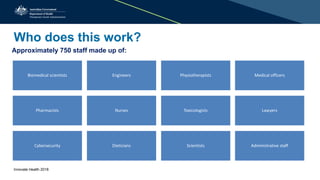
Who does this work?
Approximately 750 staff made up of:
Biomedical scientists Engineers Physiotherapists Medical officers
Pharmacists Nurses Toxicologists Lawyers
Cybersecurity Dieticians Scientists Administrative staff
Innovate Health 2018
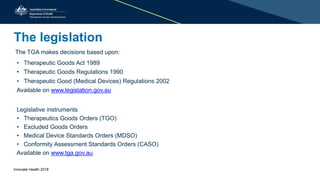
The legislation
The TGA makes decisions based upon:
• Therapeutic Goods Act 1989
• Therapeutic Goods Regulations 1990
• Therapeutic Good (Medical Devices) Regulations 2002
Available on www.legislation.gov.au
Legislative instruments
• Therapeutics Goods Orders (TGO)
• Excluded Goods Orders
• Medical Device Standards Orders (MDSO)
• Conformity Assessment Standards Orders (CASO)
Available on www.tga.gov.au
Innovate Health 2018
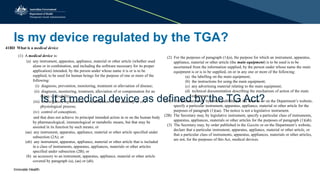
Is my device regulated by the TGA?
Is it a medical device as defined by the TG Act?
41BD What is a medical device
(1) A medical device is:
(a) any instrument, apparatus, appliance, material or other article (whether used
alone or in combination, and including the software necessary for its proper
application) intended, by the person under whose name it is or is to be
supplied, to be used for human beings for the purpose of one or more of the
following:
(i) diagnosis, prevention, monitoring, treatment or alleviation of disease;
(ii) diagnosis, monitoring, treatment, alleviation of or compensation for an
injury or disability;
(iii) investigation, replacement or modification of the anatomy or of a
physiological process;
(iv) control of conception;
and that does not achieve its principal intended action in or on the human body
by pharmacological, immunological or metabolic means, but that may be
assisted in its function by such means; or
(aa) any instrument, apparatus, appliance, material or other article specified under
subsection (2A); or
(ab) any instrument, apparatus, appliance, material or other article that is included
in a class of instruments, apparatus, appliances, materials or other articles
specified under subsection (2B); or
(b) an accessory to an instrument, apparatus, appliance, material or other article
covered by paragraph (a), (aa) or (ab).
(2) For the purposes of paragraph (1)(a), the purpose for which an instrument, apparatus,
appliance, material or other article (the main equipment) is to be used is to be
ascertained from the information supplied, by the person under whose name the main
equipment is or is to be supplied, on or in any one or more of the following:
(a) the labelling on the main equipment;
(b) the instructions for using the main equipment;
(c) any advertising material relating to the main equipment;
(d) technical documentation describing the mechanism of action of the main
equipment.
(2A) The Secretary may, by notice published in the Gazette or on the Department’s website,
specify a particular instrument, apparatus, appliance, material or other article for the
purposes of paragraph (1)(aa). The notice is not a legislative instrument.
(2B) The Secretary may, by legislative instrument, specify a particular class of instruments,
apparatus, appliances, materials or other articles for the purposes of paragraph (1)(ab).
(3) The Secretary may, by order published in the Gazette or on the Department’s website,
declare that a particular instrument, apparatus, appliance, material or other article, or
that a particular class of instruments, apparatus, appliances, materials or other articles,
are not, for the purposes of this Act, medical devices.
Innovate Health
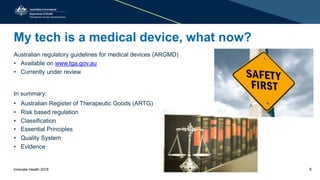
My tech is a medical device, what now?
Australian regulatory guidelines for medical devices (ARGMD)
• Available on www.tga.gov.au
• Currently under review
In summary:
• Australian Register of Therapeutic Goods (ARTG)
• Risk based regulation
• Classification
• Essential Principles
• Quality System
• Evidence
Innovate Health 2018 6
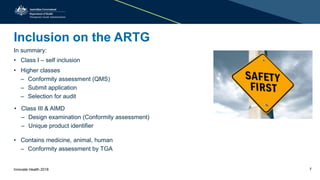
Inclusion on the ARTG
In summary:
• Class I – self inclusion
• Higher classes
– Conformity assessment (QMS)
– Submit application
– Selection for audit
• Class III & AIMD
– Design examination (Conformity assessment)
– Unique product identifier
• Contains medicine, animal, human
– Conformity assessment by TGA
Innovate Health 2018 7
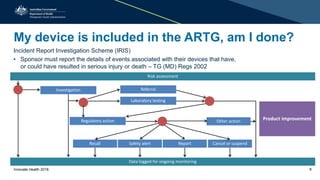
My device is included in the ARTG, am I done?
Incident Report Investigation Scheme (IRIS)
• Sponsor must report the details of events associated with their devices that have,
or could have resulted in serious injury or death – TG (MD) Regs 2002
Risk assessment
Product improvement
Data logged for ongoing monitoring
Investigation
Regulatory action
Laboratory testing
Referral
Recall Safety alert Report Cancel or suspend
Other action
Innovate Health 2018 8
How does TGA assess your evidence
• Expert review
Innovate Health 2018 9
Who does this work?
Approximately 750 staff made up of:
Biomedical scientists Engineers Physiotherapists Medical officers
Pharmacists Nurses Toxicologists Lawyers
Cybersecurity Dieticians Scientists Administrative staff
Innovate Health 2018
How does TGA assess your evidence
• Expert review
• Against recognised standards and state-of-the-art
• Subject matter expertise
• Best practice (e.g. clinical, software, security)
• But most importantly…
11Innovate Health 2018
The Essential Principles
Therapeutic Goods (Medical Devices) Regulations 2002, Schedule 1
• A legislated requirement for medical devices (TG Act 1989, Section 41CA)
• Used in pre-market evaluations
• Used in post market monitoring
• Standards may or may not be sufficient to demonstrate compliance
TGA assessors will assess your device against the Essential Principles
You should assess your device against the Essential Principles
You should consider the Essential Principles at every stage of you medical device’s life
Innovate Health 2018 12
The Essential Principles
Therapeutic Goods (Medical Devices) Regulations 2002, Schedule 1
General principles
1. Use of medical devices not to compromise health
and safety
2. Design and construction of medical devices to
conform to safety principles
3. Medical devices to be suitable for intended
purpose
4. Long-term safety
5. Medical devices not to be adversely affected by
transport or storage
6. Benefits of medical devices to outweigh any side
effects
Principles about design and construction
7. Chemical, physical and biological properties
8. Infection and microbial contamination
9. Construction and environmental properties
10. Medical devices with a measuring function
11. Protection against radiation
12. Medical devices connected to or equipped with an energy
source
13. Information to be provided with medical devices
14. Clinical evidence
15. Principles applying to IVD medical devices only
www.legislation.gov.au
Innovate Health 2018 13
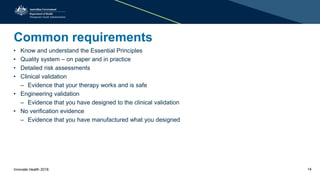
Common requirements
• Know and understand the Essential Principles
• Quality system – on paper and in practice
• Detailed risk assessments
• Clinical validation
– Evidence that your therapy works and is safe
• Engineering validation
– Evidence that you have designed to the clinical validation
• No verification evidence
– Evidence that you have manufactured what you designed
Innovate Health 2018 14
Common mistakes
• Not realising you are regulated
• Lack of familiarity with the Essential Principles
• Ineffective quality system
• Missing evidence (e.g. V&V, clinical, risk)
• Lack of engagement with TGA
Innovate Health 2018 15
Remember
• Guidance (http://www.tga.gov.au/)
– ARGMD
– Clinical evidence guidelines
– Conformity assessment guidelines
– Software and ‘apps’
– Standards orders
• You can talk to us
– Premarket – 1800 141 144 or devices@tga.gov.au
– Postmarket – 1800 809 361 or iris@tga.gov.au
– Conferences
– Your investigators and assessors
• TGA administers the legislation
• and…
Innovate Health 2018 16
Remember
Essential Principles
General principles
1. Use of medical devices not to compromise health
and safety
2. Design and construction of medical devices to
conform to safety principles
3. Medical devices to be suitable for intended
purpose
4. Long-term safety
5. Medical devices not to be adversely affected by
transport or storage
6. Benefits of medical devices to outweigh any side
effects
Principles about design and construction
7. Chemical, physical and biological properties
8. Infection and microbial contamination
9. Construction and environmental properties
10. Medical devices with a measuring function
11. Protection against radiation
12. Medical devices connected to or equipped with an energy
source
13. Information to be provided with medical devices
14. Clinical evidence
15. Principles applying to IVD medical devices only
Innovate Health 2018 17
Presentation: Navigating regulation

Presentation: Navigating regulation

  • 1.
    Navigating regulation Which devicesdoes the TGA regulate and how do they do it? Dr Lee Walsh CPEng NER Senior Engineer, Biomaterials and Engineering Section Laboratories Branch Therapeutic Goods Administration Innovate Health 26 Jun 2018
  • 2.
    Overview of theTGA • Part of the Australian Government Department of Health • Administers the Therapeutic Goods Act 1989 • Main offices in Canberra – satellite offices in Sydney, Melbourne, Adelaide and Brisbane • Operations cost recovered from industry • Mission: To safeguard and enhance the health of the Australian community through the effective and timely regulation of therapeutic goods Purpose built science and engineering building Innovate Health 2018 1
  • 3.
    Overview of theTGA – What we do • Evaluate therapeutic goods before they are supplied • Focus on safety, quality and performance • Monitor products once they are on the market • Allow for access to unapproved goods in certain circumstances • Provide input to therapeutic goods standards • We do not make decisions based on value for money or make decisions about which products receive Government subsidy Innovate Health 2018 2
  • 4.
    Who does thiswork? Approximately 750 staff made up of: Biomedical scientists Engineers Physiotherapists Medical officers Pharmacists Nurses Toxicologists Lawyers Cybersecurity Dieticians Scientists Administrative staff Innovate Health 2018
  • 5.
    The legislation The TGAmakes decisions based upon: • Therapeutic Goods Act 1989 • Therapeutic Goods Regulations 1990 • Therapeutic Good (Medical Devices) Regulations 2002 Available on www.legislation.gov.au Legislative instruments • Therapeutics Goods Orders (TGO) • Excluded Goods Orders • Medical Device Standards Orders (MDSO) • Conformity Assessment Standards Orders (CASO) Available on www.tga.gov.au Innovate Health 2018
  • 6.
    Is my deviceregulated by the TGA? Is it a medical device as defined by the TG Act? 41BD What is a medical device (1) A medical device is: (a) any instrument, apparatus, appliance, material or other article (whether used alone or in combination, and including the software necessary for its proper application) intended, by the person under whose name it is or is to be supplied, to be used for human beings for the purpose of one or more of the following: (i) diagnosis, prevention, monitoring, treatment or alleviation of disease; (ii) diagnosis, monitoring, treatment, alleviation of or compensation for an injury or disability; (iii) investigation, replacement or modification of the anatomy or of a physiological process; (iv) control of conception; and that does not achieve its principal intended action in or on the human body by pharmacological, immunological or metabolic means, but that may be assisted in its function by such means; or (aa) any instrument, apparatus, appliance, material or other article specified under subsection (2A); or (ab) any instrument, apparatus, appliance, material or other article that is included in a class of instruments, apparatus, appliances, materials or other articles specified under subsection (2B); or (b) an accessory to an instrument, apparatus, appliance, material or other article covered by paragraph (a), (aa) or (ab). (2) For the purposes of paragraph (1)(a), the purpose for which an instrument, apparatus, appliance, material or other article (the main equipment) is to be used is to be ascertained from the information supplied, by the person under whose name the main equipment is or is to be supplied, on or in any one or more of the following: (a) the labelling on the main equipment; (b) the instructions for using the main equipment; (c) any advertising material relating to the main equipment; (d) technical documentation describing the mechanism of action of the main equipment. (2A) The Secretary may, by notice published in the Gazette or on the Department’s website, specify a particular instrument, apparatus, appliance, material or other article for the purposes of paragraph (1)(aa). The notice is not a legislative instrument. (2B) The Secretary may, by legislative instrument, specify a particular class of instruments, apparatus, appliances, materials or other articles for the purposes of paragraph (1)(ab). (3) The Secretary may, by order published in the Gazette or on the Department’s website, declare that a particular instrument, apparatus, appliance, material or other article, or that a particular class of instruments, apparatus, appliances, materials or other articles, are not, for the purposes of this Act, medical devices. Innovate Health
  • 7.
    My tech isa medical device, what now? Australian regulatory guidelines for medical devices (ARGMD) • Available on www.tga.gov.au • Currently under review In summary: • Australian Register of Therapeutic Goods (ARTG) • Risk based regulation • Classification • Essential Principles • Quality System • Evidence Innovate Health 2018 6
  • 8.
    Inclusion on theARTG In summary: • Class I – self inclusion • Higher classes – Conformity assessment (QMS) – Submit application – Selection for audit • Class III & AIMD – Design examination (Conformity assessment) – Unique product identifier • Contains medicine, animal, human – Conformity assessment by TGA Innovate Health 2018 7
  • 9.
    My device isincluded in the ARTG, am I done? Incident Report Investigation Scheme (IRIS) • Sponsor must report the details of events associated with their devices that have, or could have resulted in serious injury or death – TG (MD) Regs 2002 Risk assessment Product improvement Data logged for ongoing monitoring Investigation Regulatory action Laboratory testing Referral Recall Safety alert Report Cancel or suspend Other action Innovate Health 2018 8
  • 10.
    How does TGAassess your evidence • Expert review Innovate Health 2018 9
  • 11.
    Who does thiswork? Approximately 750 staff made up of: Biomedical scientists Engineers Physiotherapists Medical officers Pharmacists Nurses Toxicologists Lawyers Cybersecurity Dieticians Scientists Administrative staff Innovate Health 2018
  • 12.
    How does TGAassess your evidence • Expert review • Against recognised standards and state-of-the-art • Subject matter expertise • Best practice (e.g. clinical, software, security) • But most importantly… 11Innovate Health 2018
  • 13.
    The Essential Principles TherapeuticGoods (Medical Devices) Regulations 2002, Schedule 1 • A legislated requirement for medical devices (TG Act 1989, Section 41CA) • Used in pre-market evaluations • Used in post market monitoring • Standards may or may not be sufficient to demonstrate compliance TGA assessors will assess your device against the Essential Principles You should assess your device against the Essential Principles You should consider the Essential Principles at every stage of you medical device’s life Innovate Health 2018 12
  • 14.
    The Essential Principles TherapeuticGoods (Medical Devices) Regulations 2002, Schedule 1 General principles 1. Use of medical devices not to compromise health and safety 2. Design and construction of medical devices to conform to safety principles 3. Medical devices to be suitable for intended purpose 4. Long-term safety 5. Medical devices not to be adversely affected by transport or storage 6. Benefits of medical devices to outweigh any side effects Principles about design and construction 7. Chemical, physical and biological properties 8. Infection and microbial contamination 9. Construction and environmental properties 10. Medical devices with a measuring function 11. Protection against radiation 12. Medical devices connected to or equipped with an energy source 13. Information to be provided with medical devices 14. Clinical evidence 15. Principles applying to IVD medical devices only www.legislation.gov.au Innovate Health 2018 13
  • 15.
    Common requirements • Knowand understand the Essential Principles • Quality system – on paper and in practice • Detailed risk assessments • Clinical validation – Evidence that your therapy works and is safe • Engineering validation – Evidence that you have designed to the clinical validation • No verification evidence – Evidence that you have manufactured what you designed Innovate Health 2018 14
  • 16.
    Common mistakes • Notrealising you are regulated • Lack of familiarity with the Essential Principles • Ineffective quality system • Missing evidence (e.g. V&V, clinical, risk) • Lack of engagement with TGA Innovate Health 2018 15
  • 17.
    Remember • Guidance (http://www.tga.gov.au/) –ARGMD – Clinical evidence guidelines – Conformity assessment guidelines – Software and ‘apps’ – Standards orders • You can talk to us – Premarket – 1800 141 144 or devices@tga.gov.au – Postmarket – 1800 809 361 or iris@tga.gov.au – Conferences – Your investigators and assessors • TGA administers the legislation • and… Innovate Health 2018 16
  • 18.
    Remember Essential Principles General principles 1.Use of medical devices not to compromise health and safety 2. Design and construction of medical devices to conform to safety principles 3. Medical devices to be suitable for intended purpose 4. Long-term safety 5. Medical devices not to be adversely affected by transport or storage 6. Benefits of medical devices to outweigh any side effects Principles about design and construction 7. Chemical, physical and biological properties 8. Infection and microbial contamination 9. Construction and environmental properties 10. Medical devices with a measuring function 11. Protection against radiation 12. Medical devices connected to or equipped with an energy source 13. Information to be provided with medical devices 14. Clinical evidence 15. Principles applying to IVD medical devices only Innovate Health 2018 17