Spotlight on Medical Device MMDR Reforms
Dr Cheryl McRae
Assistant Secretary
Medical Devices Branch, TGA
2017 ARCS Annual Conference
August, 2017
Expert Panel Review (MMDR)
• Two reports released during 2015
– Medicines and Devices
– Complementary medicines and Advertising
• Review included discussion papers, submissions and interviews,
followed by stakeholder workshops and other meetings
• Department considered feedback and advised Minister, who took
preferred position to Cabinet
• Government intent released in May 2016 budget - full response
released on 15 September 2016
– Government accepted 56 of the 58 Recommendations
Spotlight on Medical Device MMDR Reforms
1
Overarching principles for regulation
As endorsed by Government
• The Australian Government retains responsibility for approving
the inclusion of therapeutic goods in the ARTG
– Rather than automatically accepting international approvals
– However need to make much greater use of overseas evaluations
• Need to introduce greater flexibility in approval pathways
• TGA could more appropriately align level of regulation with the
actual risk posed by the products in certain areas
Spotlight on Medical Device MMDR Reforms
2
MMDR medical device projects
• Key projects
• Designation of conformity assessment bodies in Australia
• Expedited review process for certain ‘novel’ devices
• Use of approvals from comparable overseas regulators
• Harmonisation with the European Union
• Strengthening of post market monitoring
Spotlight on Medical Device MMDR Reforms 3
MMDR medical device projects
Other relevant projects
• Further reviews - including review of the range of low-risk devices included in the ARTG
• TGA advisory committees – includes new Advisory Committee on Medical Devices
Related projects
• Simplified and more effective regulation of advertising
• Streamlined regulation of Patient-Specific Access
• SME regulatory assistance
Spotlight on Medical Device MMDR Reforms 4
Designation of conformity assessment bodies
Implementation scheduled for January 2018
• Legislative change in progress:
– Therapeutic Goods Amendment (2016 Measures No 1) Act 2017) – Royal Assent 19 June 2017
– Further legislative change in a further Bill for passage in the Spring 2017 sittings
– Regulations also required
• Key processes being designed:
– TGA as designating authority - Roles and responsibilities, composition, structure, cost recovery and
competitive neutrality
– Conformity assessment bodies - Roles and responsibilities, requirements and market potential
– Designation process - Framework and criteria
Spotlight on Medical Device MMDR Reforms
5
Designation of conformity assessment bodies
Implementation will be complex
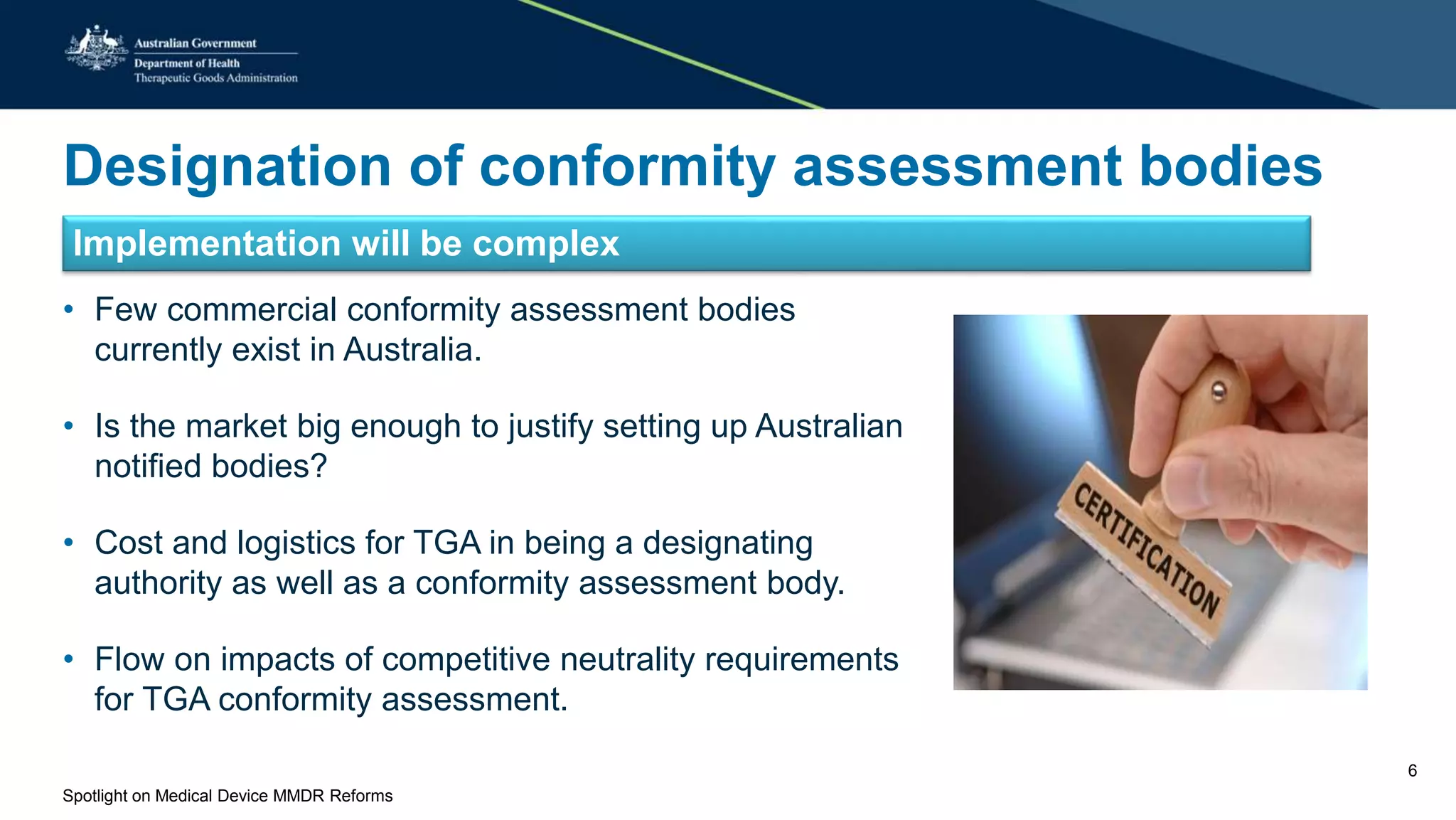
• Few commercial conformity assessment bodies
currently exist in Australia.
• Is the market big enough to justify setting up Australian
notified bodies?
• Cost and logistics for TGA in being a designating
authority as well as a conformity assessment body.
• Flow on impacts of competitive neutrality requirements
for TGA conformity assessment.
Spotlight on Medical Device MMDR Reforms
6
Expedited review process - certain ‘novel’ devices
Implementation scheduled for January 2018
• Legislation in place (regulations also required)
• ‘Front of queue’ approach with normal assessment requirements
– Must still comply with EPs, conformity assessment procedures, etc.
– Compliance with Clinical Evidence Guidelines critical for fast assessment
• Reason for accelerated assessment would be based on health outcomes:
– prevents, diagnoses or treats a life threatening or seriously debilitating disease or condition
– addresses an unmet clinical need
– breakthrough technology
Spotlight on Medical Device MMDR Reforms
7
Expedited review process - certain ‘novel’ devices
Implementation will be complex
• Need to define strict criteria to warrant expedited evaluation
– Will be similar, but not identical, to US FDA criteria
 include devices that can ‘prevent diseases and conditions’
 include ‘seriously debilitating’ rather than ‘irreversibly debilitating’ conditions
• Designation process will be under 6 weeks
– eligible sponsor must submit application within 3 months
• Impacts on other assessments need to be managed
• Rejection by a foreign regulator and failure to continue meeting
eligibility criteria can result in loss of status
Spotlight on Medical Device MMDR Reforms
8
Comparable overseas regulators
Implementation scheduled for January 2018
• Legislation and regulations required
– Legislative change in MMDR Bill for passage in the Spring 2017 sittings
• Consultation closed 30 June 2017
– Submissions being considered (17 received)
• Proposed criteria:
– Scope
– Operational alignment
– IMDRF member
– Life cycle approach
– Communication and cooperation
– Expertise
Spotlight on Medical Device MMDR Reforms
9
Comparable overseas regulators
Implementation will be complex
• International device regulations different to Australia
• Comparable overseas regulators will need to be identified
• Regulations undergoing significant change in Europe
• Sponsors need to provide submissions and evaluation
reports to TGA
Spotlight on Medical Device MMDR Reforms
10
Harmonisation with Europe
New European regulations came into effect from 25 May 2017
• MMDR Recommendation 20 accepted by Government:
“The regulation of medical devices by the Australian NRA is, wherever possible, aligned with the European
Union framework…Should the Australian NRA seek to apply specific requirements, there must be a clear
rationale to do so.”
• Consultation has recently commenced on two specific aspects (closes 25 August 2017):
– Up-classification of surgical mesh from Class IIb to Class III
– Requirement for patient medical device ID cards (patient implant cards)
 Aim to be in place by end of 2017 (with transition aligned with Europe)
• Further consultations on harmonisation with Europe will be released in 2018
Spotlight on Medical Device MMDR Reforms
11
Post market monitoring recommendations
• Better integration and timely analysis of available datasets
• Electronic reporting of adverse events
• Enhanced information-sharing with overseas regulators
• Implementation of registries for all high risk implantable devices
Accepted by Government
Deferred
Spotlight on Medical Device MMDR Reforms
12
Post market monitoring
Enhanced Post Market Monitoring and Analytics (EPMMA)
• TGA has embarked on a project aimed at establishing
enhanced post market monitoring and analytics
– has already delivered enhanced analytics for medical devices
• The next stages in the project will deliver:
– electronic data interchange (EDI) for reporting of medical device incident
reports
– improved TGA adverse event report management systems (AEMS).
Spotlight on Medical Device MMDR Reforms
13
Post market monitoring
Electronic Data Interchange (EDI)
• Currently, details of adverse events and incidents are
manually entered in an online TGA form (via the TGA’s
Business Services portal).
• EDI will enable sponsors (and other users) to submit the
required information directly from their own information
management / investigation systems.
• Expected to be launched early 2018.
Spotlight on Medical Device MMDR Reforms
14
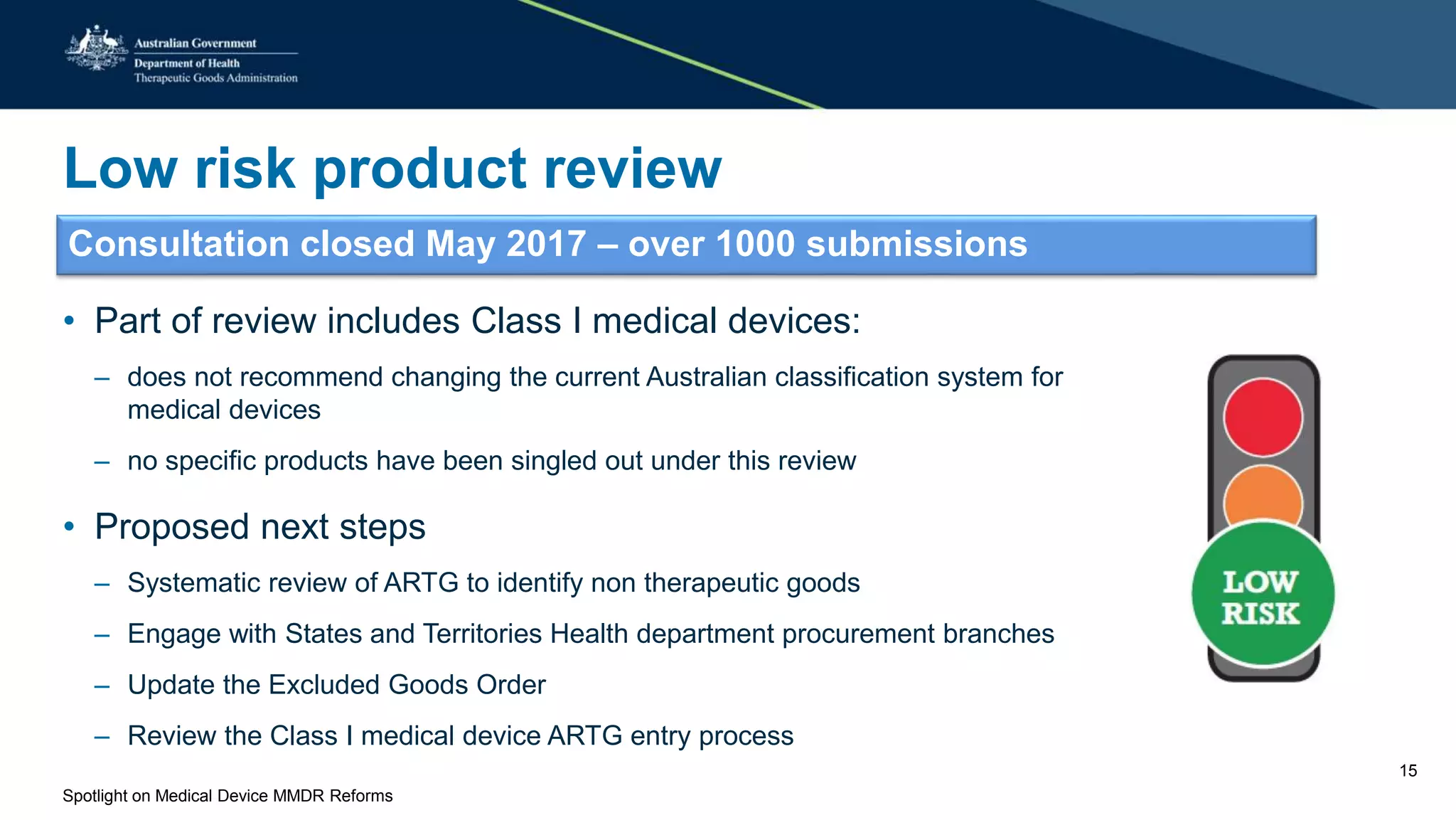
Low risk product review
Consultation closed May 2017 – over 1000 submissions
• Part of review includes Class I medical devices:
– does not recommend changing the current Australian classification system for
medical devices
– no specific products have been singled out under this review
• Proposed next steps
– Systematic review of ARTG to identify non therapeutic goods
– Engage with States and Territories Health department procurement branches
– Update the Excluded Goods Order
– Review the Class I medical device ARTG entry process
Spotlight on Medical Device MMDR Reforms
15
Questions?
16
Presentation: Spotlight on medical device MMDR reforms

Presentation: Spotlight on medical device MMDR reforms

  • 1.
    Spotlight on MedicalDevice MMDR Reforms Dr Cheryl McRae Assistant Secretary Medical Devices Branch, TGA 2017 ARCS Annual Conference August, 2017
  • 2.
    Expert Panel Review(MMDR) • Two reports released during 2015 – Medicines and Devices – Complementary medicines and Advertising • Review included discussion papers, submissions and interviews, followed by stakeholder workshops and other meetings • Department considered feedback and advised Minister, who took preferred position to Cabinet • Government intent released in May 2016 budget - full response released on 15 September 2016 – Government accepted 56 of the 58 Recommendations Spotlight on Medical Device MMDR Reforms 1
  • 3.
    Overarching principles forregulation As endorsed by Government • The Australian Government retains responsibility for approving the inclusion of therapeutic goods in the ARTG – Rather than automatically accepting international approvals – However need to make much greater use of overseas evaluations • Need to introduce greater flexibility in approval pathways • TGA could more appropriately align level of regulation with the actual risk posed by the products in certain areas Spotlight on Medical Device MMDR Reforms 2
  • 4.
    MMDR medical deviceprojects • Key projects • Designation of conformity assessment bodies in Australia • Expedited review process for certain ‘novel’ devices • Use of approvals from comparable overseas regulators • Harmonisation with the European Union • Strengthening of post market monitoring Spotlight on Medical Device MMDR Reforms 3
  • 5.
    MMDR medical deviceprojects Other relevant projects • Further reviews - including review of the range of low-risk devices included in the ARTG • TGA advisory committees – includes new Advisory Committee on Medical Devices Related projects • Simplified and more effective regulation of advertising • Streamlined regulation of Patient-Specific Access • SME regulatory assistance Spotlight on Medical Device MMDR Reforms 4
  • 6.
    Designation of conformityassessment bodies Implementation scheduled for January 2018 • Legislative change in progress: – Therapeutic Goods Amendment (2016 Measures No 1) Act 2017) – Royal Assent 19 June 2017 – Further legislative change in a further Bill for passage in the Spring 2017 sittings – Regulations also required • Key processes being designed: – TGA as designating authority - Roles and responsibilities, composition, structure, cost recovery and competitive neutrality – Conformity assessment bodies - Roles and responsibilities, requirements and market potential – Designation process - Framework and criteria Spotlight on Medical Device MMDR Reforms 5
  • 7.
    Designation of conformityassessment bodies Implementation will be complex • Few commercial conformity assessment bodies currently exist in Australia. • Is the market big enough to justify setting up Australian notified bodies? • Cost and logistics for TGA in being a designating authority as well as a conformity assessment body. • Flow on impacts of competitive neutrality requirements for TGA conformity assessment. Spotlight on Medical Device MMDR Reforms 6
  • 8.
    Expedited review process- certain ‘novel’ devices Implementation scheduled for January 2018 • Legislation in place (regulations also required) • ‘Front of queue’ approach with normal assessment requirements – Must still comply with EPs, conformity assessment procedures, etc. – Compliance with Clinical Evidence Guidelines critical for fast assessment • Reason for accelerated assessment would be based on health outcomes: – prevents, diagnoses or treats a life threatening or seriously debilitating disease or condition – addresses an unmet clinical need – breakthrough technology Spotlight on Medical Device MMDR Reforms 7
  • 9.
    Expedited review process- certain ‘novel’ devices Implementation will be complex • Need to define strict criteria to warrant expedited evaluation – Will be similar, but not identical, to US FDA criteria  include devices that can ‘prevent diseases and conditions’  include ‘seriously debilitating’ rather than ‘irreversibly debilitating’ conditions • Designation process will be under 6 weeks – eligible sponsor must submit application within 3 months • Impacts on other assessments need to be managed • Rejection by a foreign regulator and failure to continue meeting eligibility criteria can result in loss of status Spotlight on Medical Device MMDR Reforms 8
  • 10.
    Comparable overseas regulators Implementationscheduled for January 2018 • Legislation and regulations required – Legislative change in MMDR Bill for passage in the Spring 2017 sittings • Consultation closed 30 June 2017 – Submissions being considered (17 received) • Proposed criteria: – Scope – Operational alignment – IMDRF member – Life cycle approach – Communication and cooperation – Expertise Spotlight on Medical Device MMDR Reforms 9
  • 11.
    Comparable overseas regulators Implementationwill be complex • International device regulations different to Australia • Comparable overseas regulators will need to be identified • Regulations undergoing significant change in Europe • Sponsors need to provide submissions and evaluation reports to TGA Spotlight on Medical Device MMDR Reforms 10
  • 12.
    Harmonisation with Europe NewEuropean regulations came into effect from 25 May 2017 • MMDR Recommendation 20 accepted by Government: “The regulation of medical devices by the Australian NRA is, wherever possible, aligned with the European Union framework…Should the Australian NRA seek to apply specific requirements, there must be a clear rationale to do so.” • Consultation has recently commenced on two specific aspects (closes 25 August 2017): – Up-classification of surgical mesh from Class IIb to Class III – Requirement for patient medical device ID cards (patient implant cards)  Aim to be in place by end of 2017 (with transition aligned with Europe) • Further consultations on harmonisation with Europe will be released in 2018 Spotlight on Medical Device MMDR Reforms 11
  • 13.
    Post market monitoringrecommendations • Better integration and timely analysis of available datasets • Electronic reporting of adverse events • Enhanced information-sharing with overseas regulators • Implementation of registries for all high risk implantable devices Accepted by Government Deferred Spotlight on Medical Device MMDR Reforms 12
  • 14.
    Post market monitoring EnhancedPost Market Monitoring and Analytics (EPMMA) • TGA has embarked on a project aimed at establishing enhanced post market monitoring and analytics – has already delivered enhanced analytics for medical devices • The next stages in the project will deliver: – electronic data interchange (EDI) for reporting of medical device incident reports – improved TGA adverse event report management systems (AEMS). Spotlight on Medical Device MMDR Reforms 13
  • 15.
    Post market monitoring ElectronicData Interchange (EDI) • Currently, details of adverse events and incidents are manually entered in an online TGA form (via the TGA’s Business Services portal). • EDI will enable sponsors (and other users) to submit the required information directly from their own information management / investigation systems. • Expected to be launched early 2018. Spotlight on Medical Device MMDR Reforms 14
  • 16.
    Low risk productreview Consultation closed May 2017 – over 1000 submissions • Part of review includes Class I medical devices: – does not recommend changing the current Australian classification system for medical devices – no specific products have been singled out under this review • Proposed next steps – Systematic review of ARTG to identify non therapeutic goods – Engage with States and Territories Health department procurement branches – Update the Excluded Goods Order – Review the Class I medical device ARTG entry process Spotlight on Medical Device MMDR Reforms 15
  • 17.