


Post-market Vigilance
Activities
Why Post-market?
Arthur Brandwood
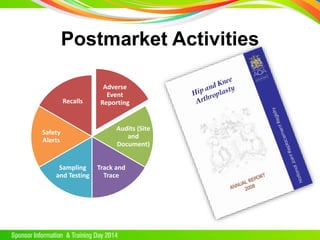
Postmarket Activities
Adverse
Event
Reporting
Audits (Site
and
Document)
Track and
Trace
Sampling
and Testing
Safety
Alerts
Recalls
Post-Market Vigilance Activities
Session A3: Medical Devices
Sharon Bennett
IRIS Coordinator
Office of Product Review
Sponsor Information & Training Day – 9 September 2014
Overview
• The TGA’s Role
• Regulation of medical devices and the TGA’s Regulatory Authority
• The Reporting and Investigation of Medical Device Adverse Events
- What is an adverse event?
- When to report an adverse event
- How to report
• Sponsor Obligations
• IRIS: Incident Report Investigation Scheme
- Role, functions and responsibilities
- What happens to an incident report?
- Some statistics
• Post Market Monitoring/Review
• Vigilance Exchange
Session A3 - Post-Market Vigilance Activities
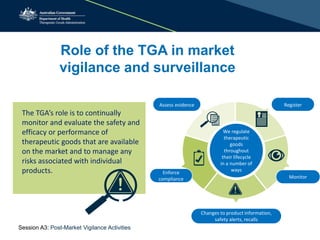
Role of the TGA in market
vigilance and surveillance
The TGA’s role is to continually
monitor and evaluate the safety and
efficacy or performance of
therapeutic goods that are available
on the market and to manage any
risks associated with individual
products.
We regulate
therapeutic
goods
throughout
their lifecycle
in a number of
ways
Assess evidence
Enforce
compliance
Register
Monitor
Changes to product information,
safety alerts, recalls
Session A3: Post-Market Vigilance Activities
Regulation of Medical Devices
• Post market regulation of devices is monitoring to ensure
the device continues to be “free from unacceptable risk”
• At all times the supplier and manufacturer must
demonstrate continued compliance with “essential
principles” that describe the safety and performance of a
medical device
• Proof of compliance is demonstrated through a conformity
assessment procedure
Session A3: Post-Market Vigilance Activities
Device Safety Monitoring
Three major components of device safety monitoring:
• Ensuring that the manufacturer complies with the
TGA’s required post-market surveillance system
• Post-market monitoring of compliance by the TGA
• Vigilance programs, such as incident reporting
The TGA monitors and regulates devices throughout their
life cycle
Session A3: Post-Market Vigilance Activities
The TGA has authority to…
• Ask questions of sponsors and manufacturers. There are
penalties for providing false and misleading information
• Seize products and inspect premises
• Cancel/suspend products from supply
• Mandate a recall of a therapeutic product.
• Manufacturer/Sponsor is obliged to gather and report
certain information
Session A3: Post-Market Vigilance Activities
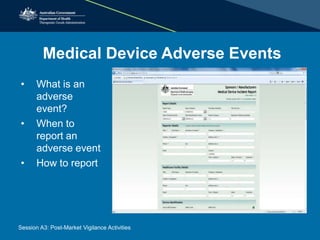
Medical Device Adverse Events
• What is an
adverse
event?
• When to
report an
adverse event
• How to report
Session A3: Post-Market Vigilance Activities
Medical Device Adverse Events
• An event that resulted in, or could have resulted in
(had effective intervention not taken place) serious
injury, illness or death to patient, healthcare worker or
other person.
• A medical device adverse event is an event associated
(caused or partially attributable) with the use (or misuse)
of a medical device
What is an adverse event/incident?
Session A3: Post-Market Vigilance Activities
Serious injury (also known as serious deterioration in state of health) is:
• a life threatening illness or injury;
• a permanent impairment of a body function (The term “permanent”
means irreversible impairment or damage to a body structure or
function. The term excludes minor impairment or damage);
• permanent damage to a body structure; or
• a condition necessitating medical or surgical intervention to prevent
permanent impairment of a body function or permanent damage to a
body structure. (In this context, medical intervention is not in itself a
serious injury. It is the reason that motivated the medical intervention
that should be used to assess whether an event should be reported)
Serious Injury
Session A3: Post-Market Vigilance Activities
Medical Device Adverse Events
Difficulties and Malfunctions
• Problems with getting device to operate
• Repeated repairs
• Difficulty of use
• Difficulty of cleaning after use
• Many different faults that may affect the quality, timeliness and
cost-effectiveness of health care. Events or other information in
relation to the quality, performance and safety of medical
devices (e.g. device design).
• The TGA encourages users to report issues of concern with the
devices that they use. The TGA understands that under reporting
both to the TGA and /or suppliers is an issue.
Session A3: Post-Market Vigilance Activities
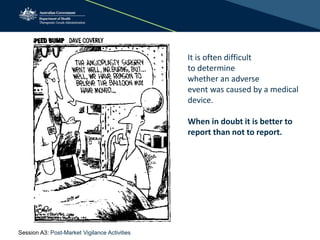
It is often difficult
to determine
whether an adverse
event was caused by a medical
device.
When in doubt it is better to
report than not to report.
Session A3: Post-Market Vigilance Activities
Sponsor – mandatory obligations
• Sponsors must report the details of events associated with their device(s) that
have resulted, or could have resulted, in serious injury or death.
– Guidance allows certain exemptions from reporting. Further information can be found
in the guidance document Australian Regulatory Guidelines for Medical Devices
(ARGMD).
– Guidance stipulates the amount of information that constitutes a complete report.
– These are conditions of inclusion set out in the Therapeutic Goods (Medical Devices)
Regulations (2002).
• Within two days of becoming aware of an issue of serious public health threat
or concern that will require prompt action to reduce the hazard
• Within ten days of becoming aware of a death or serious injury
• Within thirty days of becoming aware of an event that might have led to
serious injury or death.
When to reportn to report
Session A3: Post-Market Vigilance Activities
Medical Device Adverse Events
How to report
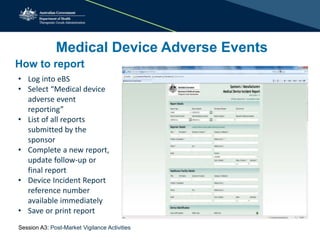
• Log into eBS
• Select “Medical device
adverse event
reporting”
• List of all reports
submitted by the
sponsor
• Complete a new report,
update follow-up or
final report
• Device Incident Report
reference number
available immediately
• Save or print report
Session A3: Post-Market Vigilance Activities
Common Issues noted with reports submitted
• Proof Reading – check accuracy, be careful of cut and paste
• Lack of Information or Relevancy – ensure all the information is made available,
accurate and relevant to the event as it makes assessment easier and reduces the need
of further information being requested
• Duplicates – Ensure all parties in your company are aware of what has already been
sent to the TGA.
- The TGA makes every effort to match any user report it receives to a corresponding
sponsor’s report.
- If you have been sent a questionnaire for a user report and you have not reported it to
the TGA - there is no need to do so separately.
• Similar event rates
- Similar events are based on the clinical event description and not the cause of an
event
- The rate should preferably be provided in the form of an incidence rate or percentage.
Further information on how to fill in the report can be found in the FAQs on the TGA
website
Session A3: Post-Market Vigilance Activities
IRIS - (Medical Device) Incident
Report Investigation Scheme
“A scheme intended to help maintain the
standard of devices used in health care through
the voluntary cooperation between users
government and industry through the
investigation of adverse events and incidents”
Session A3: Post-Market Vigilance Activities
Safety monitoring process
• Every adverse incident report entered into the database is
reviewed by professional and medical staff
• Data is analysed to identify safety signals that may indicate a
problem
• A signal is a preliminary indication of a safety issue and by itself
does not indicate a causal association with the product
• When a signal is identified, a detailed evaluation is undertaken to
establish if the product contributed to the root cause of the
incidents reported
Session A3: Post-Market Vigilance Activities
What happens to reports?
Initial risk assessment...
• All reports are entered into the Scheme’s database so that
they may be easily referenced in the future.
• Urgent reports are addressed immediately by the Scheme
coordinator.
• Focus is on unusual problems, potentially serious problems,
or problems that have high levels of incidence.
• Isolated incidents or problems that are not likely to lead to
injuries or have a detrimental effect on effectiveness are
recorded but not necessarily further investigated.
Session A3: Post-Market Vigilance Activities
What happens to reports? (cont.)
• Scientific, engineering and clinical experts assess the reports.
They then determine what level of investigation will take
place.
• The TGA investigator contacts the sponsor (company) and
works with them to resolve any issues.
• Reports are treated as confidential and the reporter and
sponsor are informed of the outcome of the investigation.
• Most reports are placed onto the Database of Adverse Event
Notifications (DAEN). This is done after a final report is
received & every three months.
Session A3: Post-Market Vigilance Activities
If action is necessary it may involve any of the following;
• Recall - removal of goods from sale or use, or for
correction.
• Safety Alert - urgent information to inform those using
the device, or affected by the problem.
• Report in the TGA News, TGA website or other
appropriate journal/s.
• Product improvement.
• Referral to other TGA sections for regulatory action.
Outcomes of investigations
Session A3: Post-Market Vigilance Activities
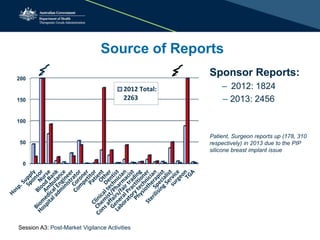
Source of Reports
0
50
100
150
200
2012 Total:
2263
Sponsor Reports:
– 2012: 1824
– 2013: 2456
Patient, Surgeon reports up (178, 310
respectively) in 2013 due to the PIP
silicone breast implant issue
Session A3: Post-Market Vigilance Activities
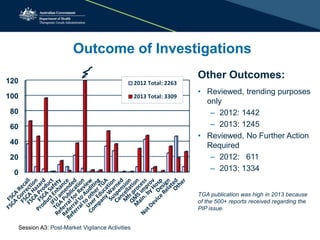
Outcome of Investigations
Other Outcomes:
• Reviewed, trending purposes
only
– 2012: 1442
– 2013: 1245
• Reviewed, No Further Action
Required
– 2012: 611
– 2013: 1334
TGA publication was high in 2013 because
of the 500+ reports received regarding the
PIP issue.
0
20
40
60
80
100
120 2012 Total:
2263
2013 Total:
3309
0
20
40
60
80
100
120 2012 Total: 2263
2013 Total: 3309
Session A3: Post-Market Vigilance Activities
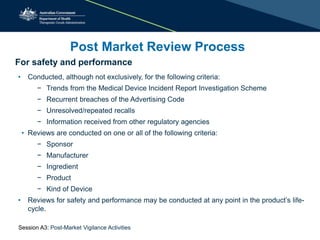
For safety and performance
• Conducted, although not exclusively, for the following criteria:
− Trends from the Medical Device Incident Report Investigation Scheme
− Recurrent breaches of the Advertising Code
− Unresolved/repeated recalls
− Information received from other regulatory agencies
• Reviews are conducted on one or all of the following criteria:
− Sponsor
− Manufacturer
− Ingredient
− Product
− Kind of Device
• Reviews for safety and performance may be conducted at any point in the product’s life-
cycle.
Post Market Review Process
Session A3: Post-Market Vigilance Activities
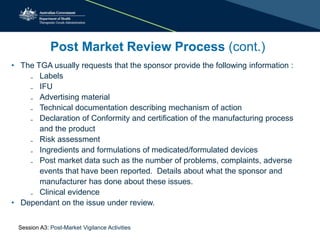
Post Market Review Process (cont.)
• The TGA usually requests that the sponsor provide the following information :
₋ Labels
₋ IFU
₋ Advertising material
₋ Technical documentation describing mechanism of action
₋ Declaration of Conformity and certification of the manufacturing process
and the product
₋ Risk assessment
₋ Ingredients and formulations of medicated/formulated devices
₋ Post market data such as the number of problems, complaints, adverse
events that have been reported. Details about what the sponsor and
manufacturer has done about these issues.
₋ Clinical evidence
• Dependant on the issue under review.
Session A3: Post-Market Vigilance Activities
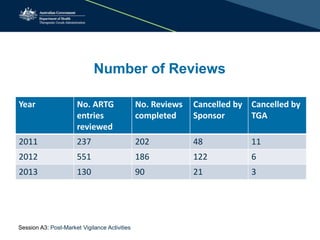
Number of Reviews
Year No. ARTG
entries
reviewed
No. Reviews
completed
Cancelled by
Sponsor
Cancelled by
TGA
2011 237 202 48 11
2012 551 186 122 6
2013 130 90 21 3
Session A3: Post-Market Vigilance Activities
31
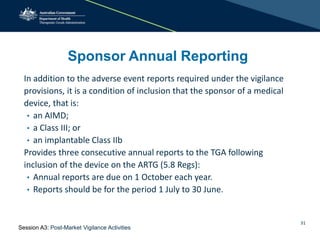
Sponsor Annual Reporting
In addition to the adverse event reports required under the vigilance
provisions, it is a condition of inclusion that the sponsor of a medical
device, that is:
• an AIMD;
• a Class III; or
• an implantable Class IIb
Provides three consecutive annual reports to the TGA following
inclusion of the device on the ARTG (5.8 Regs):
• Annual reports are due on 1 October each year.
• Reports should be for the period 1 July to 30 June.
Session A3: Post-Market Vigilance Activities
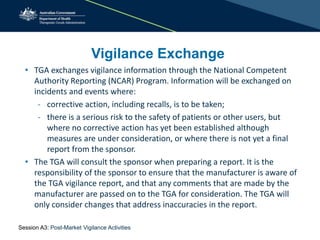
Vigilance Exchange
• TGA exchanges vigilance information through the National Competent
Authority Reporting (NCAR) Program. Information will be exchanged on
incidents and events where:
- corrective action, including recalls, is to be taken;
- there is a serious risk to the safety of patients or other users, but
where no corrective action has yet been established although
measures are under consideration, or where there is not yet a final
report from the sponsor.
• The TGA will consult the sponsor when preparing a report. It is the
responsibility of the sponsor to ensure that the manufacturer is aware of
the TGA vigilance report, and that any comments that are made by the
manufacturer are passed on to the TGA for consideration. The TGA will
only consider changes that address inaccuracies in the report.
Session A3: Post-Market Vigilance Activities
Brought to you by:
Practical Industry
Compliance
By Minta Chen
Principle RAQA Associate
Bard Australia
Overview
• How can sponsors find out about adverse
event?
• How to determine if an event is a TGA
reportable adverse event?
• What happens after an event is captured?
• Annual reports of problems
• Examples of Adverse Events
How can sponsors find out about
adverse event?
How can sponsors find out about
adverse event?
• Post-Market Feedback Mechanism
• Capture post market data/feedback
through product complaints, incidents,
evaluation
• Sales, customer service, distributors to
report events within 2 days of becoming
aware
How to determine if the event is
an adverse event?
How can sponsors determine if
the event is an adverse event?
• Develop a Decision Tree and document decision
– Serious threat to public health 48 hours
– Death or serious injury 10 days
– Might have led to death or serious injury 30 days
– 8 Exemption Rules
• If in doubt as to whether an event is a TGA
reportable adverse event, always report
– Not reporting an adverse event has serious
consequences for the company and you
– It is always better to over report than under report
What happens after an event is
captured?
What happens after an event is
captured?
• Report the event to the manufacturer and event is investigated by
the manufacturer
• Device History Records review - manufacturing records are
reviewed
• Sample evaluation - if the device is returned, it undergoes product
analysis to try to determine the root cause of the issue
• Trending - event is trended by product family
• Risk assessment - Occurrence rate is compared against accepted
risk profile
– Is the rate acceptable when weighed against the benefit of using the
device?
– If not: redesign of the device, change labeling, instructions for use, field
action
• Root cause summary, Remedial Action / Corrective Action /
Preventative Action
Annual reports of problems
• Class III, Class AIMD and implantable
Class IIb medical devices
• Summary of all complaints received by the
manufacturer over the year
• All adverse events reported to TGA
including DIR number, incident rate
In Summary
• You need a complaint/incident handling procedure
• You need to define the processes for receiving
complaints, reviewing complaints, evaluating
complaints, reporting adverse events to TGA
• You need to document complaints, adverse events
reports, investigations and outcomes, remedial
and corrective actions
• Ensure regulatory obligations are well defined and
documented with the manufacturer, through
agreements, contracts etc
Examples of Adverse Events
• During set up of an infusion pump, the slide clamp punctured a hole
in tubing creating a chemotherapy spill. No patient or staff was
injured.
• Patient underwent emergency revision surgery of a hip joint implant
due to elevated metal ion levels.
• Manufacturer provides insufficient details on cleaning methods for
reusable surgical instruments used in brain surgery, despite obvious
risk of transmission of CJD.
• When an attempt was being made to advance a guide wire, it was
noted that the coating proximal end of the guide wire was stripped
and peeling.
• Surgeon did not follow manufacturer’s instructions and over-inflated
the balloon. Balloon burst inside patient intraoperatively leaving
large plastic piece in the patient. This was then retrieved and
removed by the surgeon.
Q&A Time
Thank You!
Brought to you by:

Sponsor Information and Training day Session A3 - Medical Devices: Post-market Vigilance Activities

  • 2.
  • 3.
  • 6.
    Postmarket Activities Adverse Event Reporting Audits (Site and Document) Trackand Trace Sampling and Testing Safety Alerts Recalls
  • 7.
    Post-Market Vigilance Activities SessionA3: Medical Devices Sharon Bennett IRIS Coordinator Office of Product Review Sponsor Information & Training Day – 9 September 2014
  • 8.
    Overview • The TGA’sRole • Regulation of medical devices and the TGA’s Regulatory Authority • The Reporting and Investigation of Medical Device Adverse Events - What is an adverse event? - When to report an adverse event - How to report • Sponsor Obligations • IRIS: Incident Report Investigation Scheme - Role, functions and responsibilities - What happens to an incident report? - Some statistics • Post Market Monitoring/Review • Vigilance Exchange Session A3 - Post-Market Vigilance Activities
  • 9.
    Role of theTGA in market vigilance and surveillance The TGA’s role is to continually monitor and evaluate the safety and efficacy or performance of therapeutic goods that are available on the market and to manage any risks associated with individual products. We regulate therapeutic goods throughout their lifecycle in a number of ways Assess evidence Enforce compliance Register Monitor Changes to product information, safety alerts, recalls Session A3: Post-Market Vigilance Activities
  • 10.
    Regulation of MedicalDevices • Post market regulation of devices is monitoring to ensure the device continues to be “free from unacceptable risk” • At all times the supplier and manufacturer must demonstrate continued compliance with “essential principles” that describe the safety and performance of a medical device • Proof of compliance is demonstrated through a conformity assessment procedure Session A3: Post-Market Vigilance Activities
  • 11.
    Device Safety Monitoring Threemajor components of device safety monitoring: • Ensuring that the manufacturer complies with the TGA’s required post-market surveillance system • Post-market monitoring of compliance by the TGA • Vigilance programs, such as incident reporting The TGA monitors and regulates devices throughout their life cycle Session A3: Post-Market Vigilance Activities
  • 12.
    The TGA hasauthority to… • Ask questions of sponsors and manufacturers. There are penalties for providing false and misleading information • Seize products and inspect premises • Cancel/suspend products from supply • Mandate a recall of a therapeutic product. • Manufacturer/Sponsor is obliged to gather and report certain information Session A3: Post-Market Vigilance Activities
  • 13.
    Medical Device AdverseEvents • What is an adverse event? • When to report an adverse event • How to report Session A3: Post-Market Vigilance Activities
  • 14.
    Medical Device AdverseEvents • An event that resulted in, or could have resulted in (had effective intervention not taken place) serious injury, illness or death to patient, healthcare worker or other person. • A medical device adverse event is an event associated (caused or partially attributable) with the use (or misuse) of a medical device What is an adverse event/incident? Session A3: Post-Market Vigilance Activities
  • 15.
    Serious injury (alsoknown as serious deterioration in state of health) is: • a life threatening illness or injury; • a permanent impairment of a body function (The term “permanent” means irreversible impairment or damage to a body structure or function. The term excludes minor impairment or damage); • permanent damage to a body structure; or • a condition necessitating medical or surgical intervention to prevent permanent impairment of a body function or permanent damage to a body structure. (In this context, medical intervention is not in itself a serious injury. It is the reason that motivated the medical intervention that should be used to assess whether an event should be reported) Serious Injury Session A3: Post-Market Vigilance Activities
  • 16.
    Medical Device AdverseEvents Difficulties and Malfunctions • Problems with getting device to operate • Repeated repairs • Difficulty of use • Difficulty of cleaning after use • Many different faults that may affect the quality, timeliness and cost-effectiveness of health care. Events or other information in relation to the quality, performance and safety of medical devices (e.g. device design). • The TGA encourages users to report issues of concern with the devices that they use. The TGA understands that under reporting both to the TGA and /or suppliers is an issue. Session A3: Post-Market Vigilance Activities
  • 17.
    It is oftendifficult to determine whether an adverse event was caused by a medical device. When in doubt it is better to report than not to report. Session A3: Post-Market Vigilance Activities
  • 18.
    Sponsor – mandatoryobligations • Sponsors must report the details of events associated with their device(s) that have resulted, or could have resulted, in serious injury or death. – Guidance allows certain exemptions from reporting. Further information can be found in the guidance document Australian Regulatory Guidelines for Medical Devices (ARGMD). – Guidance stipulates the amount of information that constitutes a complete report. – These are conditions of inclusion set out in the Therapeutic Goods (Medical Devices) Regulations (2002). • Within two days of becoming aware of an issue of serious public health threat or concern that will require prompt action to reduce the hazard • Within ten days of becoming aware of a death or serious injury • Within thirty days of becoming aware of an event that might have led to serious injury or death. When to reportn to report Session A3: Post-Market Vigilance Activities
  • 19.
    Medical Device AdverseEvents How to report • Log into eBS • Select “Medical device adverse event reporting” • List of all reports submitted by the sponsor • Complete a new report, update follow-up or final report • Device Incident Report reference number available immediately • Save or print report Session A3: Post-Market Vigilance Activities
  • 20.
    Common Issues notedwith reports submitted • Proof Reading – check accuracy, be careful of cut and paste • Lack of Information or Relevancy – ensure all the information is made available, accurate and relevant to the event as it makes assessment easier and reduces the need of further information being requested • Duplicates – Ensure all parties in your company are aware of what has already been sent to the TGA. - The TGA makes every effort to match any user report it receives to a corresponding sponsor’s report. - If you have been sent a questionnaire for a user report and you have not reported it to the TGA - there is no need to do so separately. • Similar event rates - Similar events are based on the clinical event description and not the cause of an event - The rate should preferably be provided in the form of an incidence rate or percentage. Further information on how to fill in the report can be found in the FAQs on the TGA website Session A3: Post-Market Vigilance Activities
  • 21.
    IRIS - (MedicalDevice) Incident Report Investigation Scheme “A scheme intended to help maintain the standard of devices used in health care through the voluntary cooperation between users government and industry through the investigation of adverse events and incidents” Session A3: Post-Market Vigilance Activities
  • 22.
    Safety monitoring process •Every adverse incident report entered into the database is reviewed by professional and medical staff • Data is analysed to identify safety signals that may indicate a problem • A signal is a preliminary indication of a safety issue and by itself does not indicate a causal association with the product • When a signal is identified, a detailed evaluation is undertaken to establish if the product contributed to the root cause of the incidents reported Session A3: Post-Market Vigilance Activities
  • 23.
    What happens toreports? Initial risk assessment... • All reports are entered into the Scheme’s database so that they may be easily referenced in the future. • Urgent reports are addressed immediately by the Scheme coordinator. • Focus is on unusual problems, potentially serious problems, or problems that have high levels of incidence. • Isolated incidents or problems that are not likely to lead to injuries or have a detrimental effect on effectiveness are recorded but not necessarily further investigated. Session A3: Post-Market Vigilance Activities
  • 24.
    What happens toreports? (cont.) • Scientific, engineering and clinical experts assess the reports. They then determine what level of investigation will take place. • The TGA investigator contacts the sponsor (company) and works with them to resolve any issues. • Reports are treated as confidential and the reporter and sponsor are informed of the outcome of the investigation. • Most reports are placed onto the Database of Adverse Event Notifications (DAEN). This is done after a final report is received & every three months. Session A3: Post-Market Vigilance Activities
  • 25.
    If action isnecessary it may involve any of the following; • Recall - removal of goods from sale or use, or for correction. • Safety Alert - urgent information to inform those using the device, or affected by the problem. • Report in the TGA News, TGA website or other appropriate journal/s. • Product improvement. • Referral to other TGA sections for regulatory action. Outcomes of investigations Session A3: Post-Market Vigilance Activities
  • 26.
    Source of Reports 0 50 100 150 200 2012Total: 2263 Sponsor Reports: – 2012: 1824 – 2013: 2456 Patient, Surgeon reports up (178, 310 respectively) in 2013 due to the PIP silicone breast implant issue Session A3: Post-Market Vigilance Activities
  • 27.
    Outcome of Investigations OtherOutcomes: • Reviewed, trending purposes only – 2012: 1442 – 2013: 1245 • Reviewed, No Further Action Required – 2012: 611 – 2013: 1334 TGA publication was high in 2013 because of the 500+ reports received regarding the PIP issue. 0 20 40 60 80 100 120 2012 Total: 2263 2013 Total: 3309 0 20 40 60 80 100 120 2012 Total: 2263 2013 Total: 3309 Session A3: Post-Market Vigilance Activities
  • 28.
    For safety andperformance • Conducted, although not exclusively, for the following criteria: − Trends from the Medical Device Incident Report Investigation Scheme − Recurrent breaches of the Advertising Code − Unresolved/repeated recalls − Information received from other regulatory agencies • Reviews are conducted on one or all of the following criteria: − Sponsor − Manufacturer − Ingredient − Product − Kind of Device • Reviews for safety and performance may be conducted at any point in the product’s life- cycle. Post Market Review Process Session A3: Post-Market Vigilance Activities
  • 29.
    Post Market ReviewProcess (cont.) • The TGA usually requests that the sponsor provide the following information : ₋ Labels ₋ IFU ₋ Advertising material ₋ Technical documentation describing mechanism of action ₋ Declaration of Conformity and certification of the manufacturing process and the product ₋ Risk assessment ₋ Ingredients and formulations of medicated/formulated devices ₋ Post market data such as the number of problems, complaints, adverse events that have been reported. Details about what the sponsor and manufacturer has done about these issues. ₋ Clinical evidence • Dependant on the issue under review. Session A3: Post-Market Vigilance Activities
  • 30.
    Number of Reviews YearNo. ARTG entries reviewed No. Reviews completed Cancelled by Sponsor Cancelled by TGA 2011 237 202 48 11 2012 551 186 122 6 2013 130 90 21 3 Session A3: Post-Market Vigilance Activities
  • 31.
    31 Sponsor Annual Reporting Inaddition to the adverse event reports required under the vigilance provisions, it is a condition of inclusion that the sponsor of a medical device, that is: • an AIMD; • a Class III; or • an implantable Class IIb Provides three consecutive annual reports to the TGA following inclusion of the device on the ARTG (5.8 Regs): • Annual reports are due on 1 October each year. • Reports should be for the period 1 July to 30 June. Session A3: Post-Market Vigilance Activities
  • 32.
    Vigilance Exchange • TGAexchanges vigilance information through the National Competent Authority Reporting (NCAR) Program. Information will be exchanged on incidents and events where: - corrective action, including recalls, is to be taken; - there is a serious risk to the safety of patients or other users, but where no corrective action has yet been established although measures are under consideration, or where there is not yet a final report from the sponsor. • The TGA will consult the sponsor when preparing a report. It is the responsibility of the sponsor to ensure that the manufacturer is aware of the TGA vigilance report, and that any comments that are made by the manufacturer are passed on to the TGA for consideration. The TGA will only consider changes that address inaccuracies in the report. Session A3: Post-Market Vigilance Activities
  • 34.
  • 36.
    Practical Industry Compliance By MintaChen Principle RAQA Associate Bard Australia
  • 37.
    Overview • How cansponsors find out about adverse event? • How to determine if an event is a TGA reportable adverse event? • What happens after an event is captured? • Annual reports of problems • Examples of Adverse Events
  • 38.
    How can sponsorsfind out about adverse event?
  • 39.
    How can sponsorsfind out about adverse event? • Post-Market Feedback Mechanism • Capture post market data/feedback through product complaints, incidents, evaluation • Sales, customer service, distributors to report events within 2 days of becoming aware
  • 40.
    How to determineif the event is an adverse event?
  • 41.
    How can sponsorsdetermine if the event is an adverse event? • Develop a Decision Tree and document decision – Serious threat to public health 48 hours – Death or serious injury 10 days – Might have led to death or serious injury 30 days – 8 Exemption Rules • If in doubt as to whether an event is a TGA reportable adverse event, always report – Not reporting an adverse event has serious consequences for the company and you – It is always better to over report than under report
  • 42.
    What happens afteran event is captured?
  • 43.
    What happens afteran event is captured? • Report the event to the manufacturer and event is investigated by the manufacturer • Device History Records review - manufacturing records are reviewed • Sample evaluation - if the device is returned, it undergoes product analysis to try to determine the root cause of the issue • Trending - event is trended by product family • Risk assessment - Occurrence rate is compared against accepted risk profile – Is the rate acceptable when weighed against the benefit of using the device? – If not: redesign of the device, change labeling, instructions for use, field action • Root cause summary, Remedial Action / Corrective Action / Preventative Action
  • 44.
    Annual reports ofproblems • Class III, Class AIMD and implantable Class IIb medical devices • Summary of all complaints received by the manufacturer over the year • All adverse events reported to TGA including DIR number, incident rate
  • 45.
    In Summary • Youneed a complaint/incident handling procedure • You need to define the processes for receiving complaints, reviewing complaints, evaluating complaints, reporting adverse events to TGA • You need to document complaints, adverse events reports, investigations and outcomes, remedial and corrective actions • Ensure regulatory obligations are well defined and documented with the manufacturer, through agreements, contracts etc
  • 46.
    Examples of AdverseEvents • During set up of an infusion pump, the slide clamp punctured a hole in tubing creating a chemotherapy spill. No patient or staff was injured. • Patient underwent emergency revision surgery of a hip joint implant due to elevated metal ion levels. • Manufacturer provides insufficient details on cleaning methods for reusable surgical instruments used in brain surgery, despite obvious risk of transmission of CJD. • When an attempt was being made to advance a guide wire, it was noted that the coating proximal end of the guide wire was stripped and peeling. • Surgeon did not follow manufacturer’s instructions and over-inflated the balloon. Balloon burst inside patient intraoperatively leaving large plastic piece in the patient. This was then retrieved and removed by the surgeon.
  • 47.
  • 48.