PROPOSED GUIDELINES TO ESTABLISH WORLD HALAL STANDARDS I .  Background The word "Halal" means lawful or permissible and Haram means prohibited or un fit for Muslim consumption in the Arabic language and according to the Islamic Sharia (Law). Foods are classified as Halal for Muslim consumption if they do not contain pork or pork ingredients or alcohol, and the meats are labeled Halal if the animals were slaughtered in accordance with Islamic guidelines. As awareness amongst Muslim consumers around the World increases, demand grows for authentic Halal foods. Besides meat, several other issues concerning food have come to the surface. Food ingredients like flavours, oils, enzymes in cheese, and a variety of other ingredients have further complicated the picture. Alcohol and pork derivatives could be embedded in all kind of products that need to be identified and avoided. This document is an attempt to standardize the Halal procedures by members of the World Halal Council for the purpose of adopting and promoting these Halal Standards among Muslims around  the World.
II.  Halal Supervision. The Halal supervising-certifying organization must have officers who have had education and experience in slaughtering animals/birds and have knowledge in food science and technology in supervising food processing. These officers would be able to effectively monitor and communicate with the industry on matters that are considered sensitive. The organization must be looked upon as a business partner because they would be able to advise and assist industry in production, quality control, product flow systems, sanitizing, packaging and labeling. It is essential for the certifying organization to have religious advisors or consultants to advice in matters related to proper slaughtering procedures and ingredient approval from religious points of view. These religious advisors, should also be aided by scientific knowledge to give sound opinions and specify guidelines. The certifying organization needs to keep a detailed account and data on production procedures including receiving, processing, packaging and labeling. Records need to be maintained on the inspector’s visits and findings during such visits. The inspectors and supervisors should have control over the use of the organization's names and Halal symbols. If the certifying organization ceases to certify a plant or a product the organization should cancel the authorization of the plant's right to use the organization’s name and /or symbol on those products. Consumers also need to be informed of this change in supervision and certification.
Meat & Poultry III. Requirements for Halal Meat and Poultry  A. Species 1. Land Animals/Birds  Species among land animals including cattle, lambs, goats, buffalo, deer, camels, rabbits, and giraffes are acceptable animals for Muslim consumption. Chicken, turkeys, pigeons, ostriches, geese, swans, ducks and alike are acceptable birds. The acceptable animals and birds must also be alive and healthy at the time of slaughter. Un acceptable species including swine from which all pork and pork products are  produced are considered Haram, and they are unfit for Muslim consumption. Also un acceptable are all animals which are considered beasts or birds of prey having talons, fangs or tusks such as lions, wolves, dogs, cats, tigers, hyenas, foxes, jackals, elephants and alike. Birds that prey on other animals and birds or eat the flesh of dead animals are also Haram, such as: falcons, eagles, vultures, crows, owls, etc. In addition animals which are considered filthy or dangerous are also Haram such as domesticated donkeys, mice, rats, poisonous snakes, scorpions, spiders, lice, etc. The milk and eggs of prohibited species are similarly prohibited for consumption.
2.  Aquatic Animals  All fish and seafood including shellfish, crustaceans, shrimps, crabs, lobsters are considered Halal without having to be slaughtered. Excluded are species which are poisonous, intoxicating or hazardous to human health.
3.  Plants and other Species All plants and other species such as mushrooms, algae, bacteria, etc. are considered Halal except those which are poisonous, intoxicating or hazardous to human health.
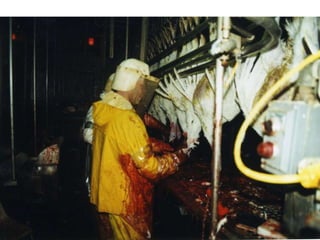
B.  Slaughter Men The Slaughtermen should be sane Muslims who understand the rules and conditions of slaughtering in Islam. They should be educated and have experience in Halal slaughtering practices and be certified by the certifying organization. The certifying organization must ensure that only trained slaughtermen, supervisors and inspectors be permitted to perform the functions of slaughtering, supervision and inspection. The person must be strong enough to assume the responsibilities associated with the task of slaughter.
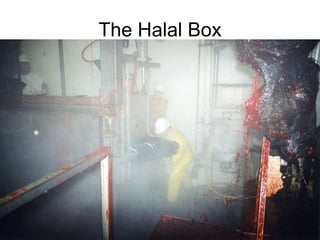
The Halal Box
C.  Slaughtering Tools The slaughtering instrument should be sharp, one edge instrument that cuts by its edge not be its weight, such as knives, swords, etc. The instrument cannot be a claw, tooth or nail or un-sharpened object.
D.  Methods of Slaughter Hand Slaughter:  In this method, the animal or bird is slaughtered by an instrument held directly by the slaughterman’s hand. The slaughterman must be well trained so as not to cause pain or suffering to the animal.  This difficult task requires swiftness and strength.
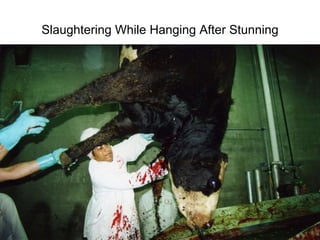
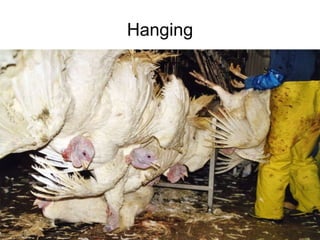
Slaughtering While Hanging After Stunning
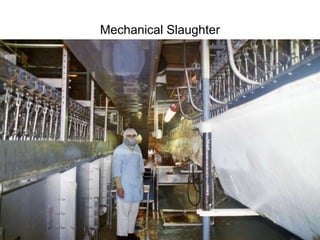
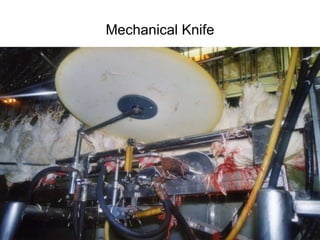
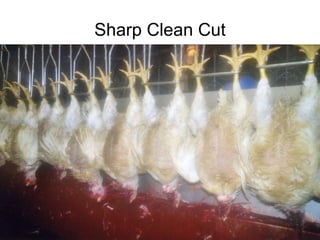
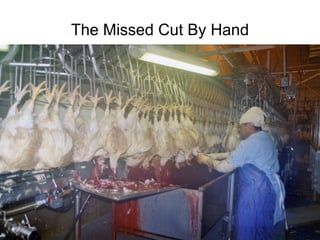
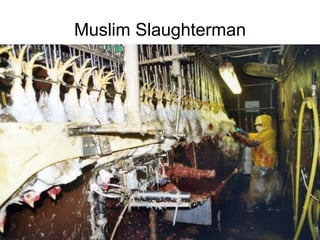
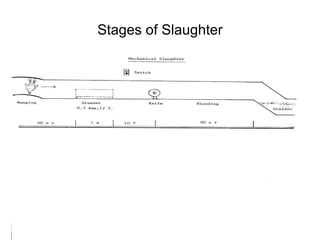
Mechanical Slaughter:  Many Muslim countries now accept mechanically slaughtered birds. The machine is considered as a tool and is in the control of the slaughterman. The mechanical slaughtering machine and the process of slaughtering should be monitored by a Muslim. The mechanical knife must be a single sharp blade that produces a sharp cut on the front side of the bird’s neck. Any bird that misses the mechanical knife has to be slaughtered by hand.
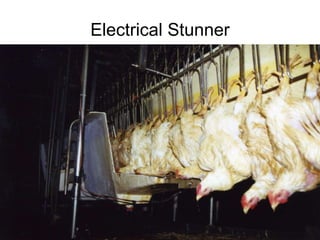
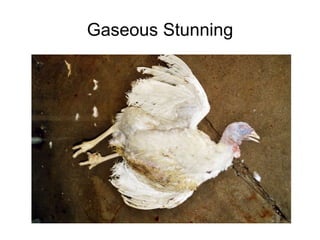
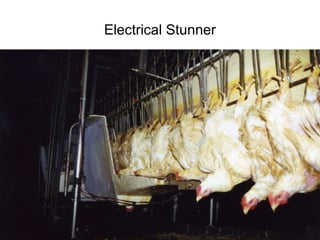
Stunning:  Stunning of animals/birds before slaughtering is intended to render the animals /birds less sensitive to pain, increase safety and efficiency at the plant and maximize bleed out of carcasses.  Stunning is permissible as long as the animal/ bird does not die during the process of stunning. Stunning of animals and birds if necessary should be performed using a stunning method at a certain strength and duration approved by the health and Islamic authorities. Gaseous stunning, however, which results in the death of birds before slaughtering is not acceptable.
Electrical Stunner
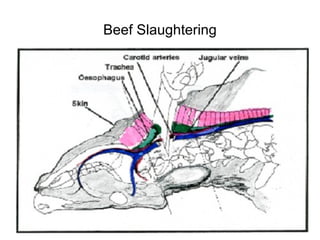
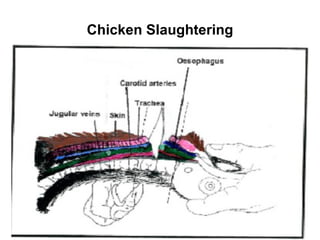
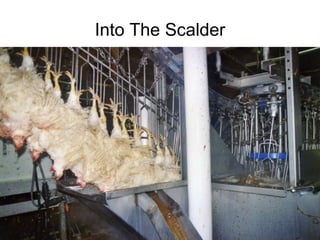
E.  The Slaughtering Process At the time of slaughter, the  tasmiya  and  takbir: Bismillah Alllahu Akbar (by the name of Go,  the greatest)  must be pronounced over animals and bird by a trained, religiously-observant Muslim slaughter man.  It is very important to treat animals humanely and reduce pain and suffering to the animal during slaughtering. The knife should cut the skin, trachea, esophagus and two major blood vessels to ensure thorough and quick bleeding of the animal.  The spine of animal/bird should not be severed at the time of slaughter. There should be enough time for bleeding of animal/bird until the animal/bird dies completely before scolding and evisceration.
Beef Slaughtering
Chicken Slaughtering
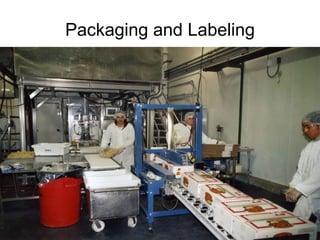
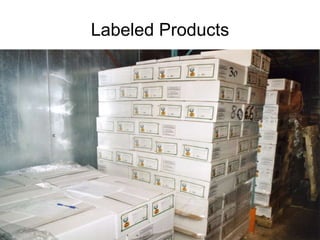
Packaging and Labeling Unless the whole day kill is produced as Halal, carcasses and wogs must be properly marked and traced throughout evisceration, processing and packaging so as not to mix the Halal slaughtered meat with non Halal. All packages and containers must be labeled with the proper information and with the Halal label/logo of the certifying organization. Shipments of Halal meat should be accompanied with a Halal certificate issued by the certifying organization.
Packaging and Labeling
Labeled Products
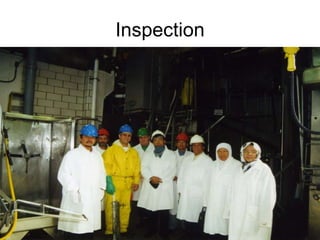
Inspection
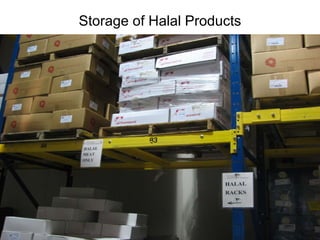
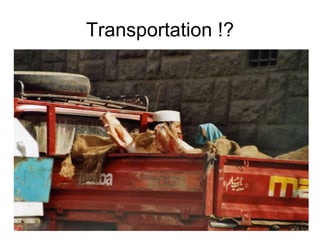
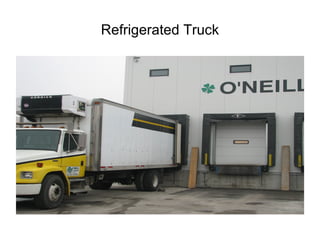
Storage and Shipping The storage place-cooler or freezer should be inspected by the Muslim inspector and approved for storage of Halal meats, in addition to the inspection by the health authorities. Containers of meat should always be placed on clean racks or shelves. The temperature in the cooler/freezer should be checked during inspection. It is preferred to store the Halal meats in separate, designated and labeled areas in the cooler or freezer. Stacking of Halal meat with non Halal meat especially in cases of fresh products should not be allowed to avoid contamination. Shipping of Halal products should be in clean vehicles, preferably refrigerated. Separation of Halal products from non Halal products during shipping is not necessary especially if the containers are well sealed.
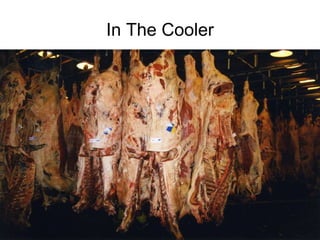
In The Cooler
In The Freezer
Storage of Halal Products
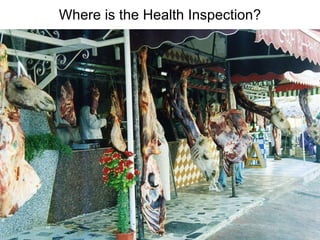
Where is the Health Inspection?
Refrigerated Truck
 
Transportation !?
Main Requirements for Halal Slaughter Of the Right Animal: 1.Tsmiah by a Muslim  –  well trained, sane Muslim saying the prayer of  Bismillah Allahu Akbar 2. Using a Sharp Instrument  –  such as a single edged and sharp knife 3.Thorough Bleed Out  –  which results in maximum draining of blood out of the carcass
  Other Preferred Conditions for Slaughter: 1.   Animals/birds well rested   2. Offering them water before slaughtering   3. They should not see blood or others    being killed   4. Facing the Qiblah   5. Killed without stunning   6. Cut with one stroke   7. Cutting all of the blood vessels-two    carotids arteries and two jugular veins
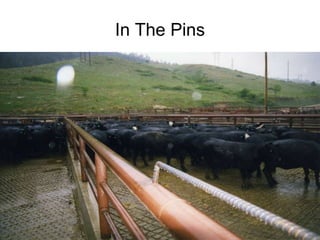
In The Pins
CLASSES OF HALAL SLAUGHTER: . Udhia  – Sacrifice of animals during the Hajj /    Eid-Ul-Adha Qurbani  – Sacrifice of animals to fulfill Nathr    (Nazr) Aqiqah  – Slaughtering of animals to celebrate birth of a  child, i.e. two lambs for a baby boy and one lamb  for a baby girl Zabiha  – Slaughtered with a sharp Knife, by hand    or mechanical Regular Halal   – Slaughtered for personal or      commercial uses
Mechanical Slaughter
THE EFFECT OF ELECTRICAL STUNNING ON  HALAL SLAUGHTERED CHICKENS Ahmad Al-Absy, Ph.D. Halal Transactions P. O. Box 4546,  Omaha, NE  68104  USA
Stages of Slaughter
Hanging
Electrical Stunner
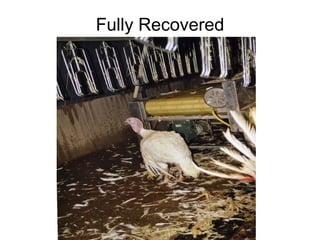
Fully Recovered
Gaseous Stunning
Mechanical Knife
Sharp Clean Cut
The Missed Cut By Hand
Muslim Slaughterman
 
Into The Scalder
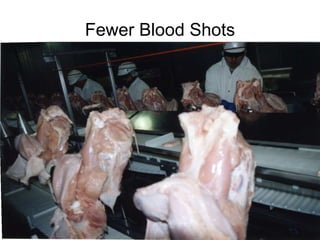
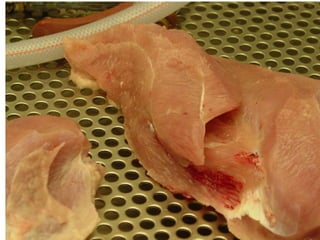
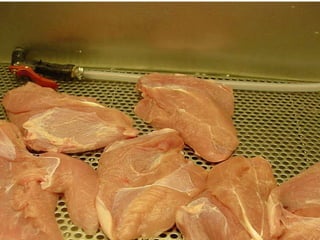
Fewer Blood Shots
breast meat1_1.JPG
 
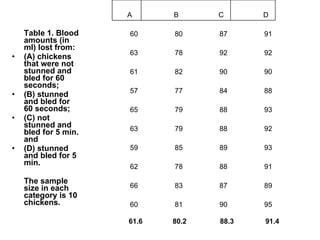
Table 1. Blood amounts (in ml) lost from:  (A) chickens that were not stunned and bled for 60 seconds;  (B) stunned and bled for 60 seconds;  (C) not stunned and bled for 5 min. and  (D) stunned and bled for 5 min.  The sample size in each category is 10 chickens.   61.6   80.2  88.3  91.4 95 90 81 60 89 87 83 66 91 88 78 62 93 89 85 59 92 88 79 63 93 88 79 65 88 84 77 57 90 90 82 61 92 92 78 63 91 87 80 60 D C B A
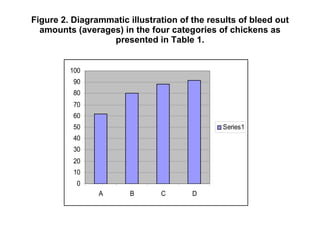
Figure 2. Diagrammatic illustration of the results of bleed out amounts (averages) in the four categories of chickens as presented in Table 1.
LITERATURE CITED Abram, J. and T. L. Goodwin. 1977. Factors affecting chicken bleed-out. A review. World’s Poultry Science Journal 33: 69- 76. Davis, L. L. and M. E. Cole. 1954. Bleeding of chickens during killing operations. Poultry Science. 33:616-619. Harris, I.S. and T. Carter. 1977. Broiler blood loss with manual and mechanical killers. Poultry Science 56:1827-1831. Heath, G.B.S. 1984. The slaughter of broiler chickens. World Poultry Science. J. 40:151-159. Kang, I. S. and A. R. Sams. 1999. Bleed out efficiency, carcass damage and rigor mortis development following electrical stunning or carbon dioxide stunning on shackle line. Poultry Science 78: 139-143. Kotula, A. W. and N. V. Helbacka. 1966a. Blood volume of live chickens and the influence of slaughter technique on blood loss. Poultry Science. 45:684-688. Kotula, A. W. and N. V.  Helbacka. 1966b. Blood retained by chicken carcasses and cut up parts as influenced by slaughter method. Poultry Science. 45:404-410. Kuenzel, W. J. and J. H. Walther. 1978. Heart beat, blood pressure, respiration and brain waves of broilers as affected by electrical stunning and bleed out. Poultry Science 57:655-659. Kuenzel, W. J., A. L. Ingling, M. D. Denbow, J. H. Walther and M. M. Schaeffer. 1978. Variable frequency stunning and the comparison of two bleed out time intervals for maximizing blood release in processed poultry. Poultry Science 57:449-454.  Nowell, G. W. and C. S. Shaffner. 1950. Blood loss by chickens during killing. Poultry Science 29:271-275. Raj, M. 2004. Welfare, economic and practical implications of gas stunning prior to poultry slaughter Seminar, United Poultry Concerns, Machipongo, VA, USA. Raj, M. 2006. Welfare, economics and practical implications of stunning and slaughter of poultry. Seminar on line: www.csrees.usda.gov/nea/animals/pdfs/mohan_pres.pdf - Raj, M., L. J. Wilkins, R. I. Richardson, P. Johnson, and S. B. Wotton. 1997. Carcass and meat quality in broilers either killed with a gas mixture or stunned with an electric current under commercial processing conditions. British Poultry Science 38:169-174.  Skewes, P. and G. Birrenkott. 1993. Turkey stunning: limit amperage to minimize cardiac fibrillation. Turkey World April-May: 24-26.
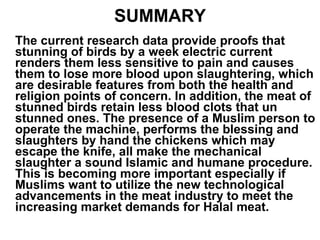
SUMMARY The current research data provide proofs that stunning of birds by a week electric current renders them less sensitive to pain and causes them to lose more blood upon slaughtering, which are desirable features from both the health and religion points of concern. In addition, the meat of stunned birds retain less blood clots that un stunned ones. The presence of a Muslim person to operate the machine, performs the blessing and slaughters by hand the chickens which may escape the knife, all make the mechanical slaughter a sound Islamic and humane procedure. This is becoming more important especially if Muslims want to utilize the new technological advancements in the meat industry to meet the increasing market demands for Halal meat.

Presentation malaysia

  • 1.
  • 2.
    PROPOSED GUIDELINES TOESTABLISH WORLD HALAL STANDARDS I . Background The word "Halal" means lawful or permissible and Haram means prohibited or un fit for Muslim consumption in the Arabic language and according to the Islamic Sharia (Law). Foods are classified as Halal for Muslim consumption if they do not contain pork or pork ingredients or alcohol, and the meats are labeled Halal if the animals were slaughtered in accordance with Islamic guidelines. As awareness amongst Muslim consumers around the World increases, demand grows for authentic Halal foods. Besides meat, several other issues concerning food have come to the surface. Food ingredients like flavours, oils, enzymes in cheese, and a variety of other ingredients have further complicated the picture. Alcohol and pork derivatives could be embedded in all kind of products that need to be identified and avoided. This document is an attempt to standardize the Halal procedures by members of the World Halal Council for the purpose of adopting and promoting these Halal Standards among Muslims around the World.
  • 3.
    II. HalalSupervision. The Halal supervising-certifying organization must have officers who have had education and experience in slaughtering animals/birds and have knowledge in food science and technology in supervising food processing. These officers would be able to effectively monitor and communicate with the industry on matters that are considered sensitive. The organization must be looked upon as a business partner because they would be able to advise and assist industry in production, quality control, product flow systems, sanitizing, packaging and labeling. It is essential for the certifying organization to have religious advisors or consultants to advice in matters related to proper slaughtering procedures and ingredient approval from religious points of view. These religious advisors, should also be aided by scientific knowledge to give sound opinions and specify guidelines. The certifying organization needs to keep a detailed account and data on production procedures including receiving, processing, packaging and labeling. Records need to be maintained on the inspector’s visits and findings during such visits. The inspectors and supervisors should have control over the use of the organization's names and Halal symbols. If the certifying organization ceases to certify a plant or a product the organization should cancel the authorization of the plant's right to use the organization’s name and /or symbol on those products. Consumers also need to be informed of this change in supervision and certification.

  • 4.
    Meat & PoultryIII. Requirements for Halal Meat and Poultry A. Species 1. Land Animals/Birds Species among land animals including cattle, lambs, goats, buffalo, deer, camels, rabbits, and giraffes are acceptable animals for Muslim consumption. Chicken, turkeys, pigeons, ostriches, geese, swans, ducks and alike are acceptable birds. The acceptable animals and birds must also be alive and healthy at the time of slaughter. Un acceptable species including swine from which all pork and pork products are produced are considered Haram, and they are unfit for Muslim consumption. Also un acceptable are all animals which are considered beasts or birds of prey having talons, fangs or tusks such as lions, wolves, dogs, cats, tigers, hyenas, foxes, jackals, elephants and alike. Birds that prey on other animals and birds or eat the flesh of dead animals are also Haram, such as: falcons, eagles, vultures, crows, owls, etc. In addition animals which are considered filthy or dangerous are also Haram such as domesticated donkeys, mice, rats, poisonous snakes, scorpions, spiders, lice, etc. The milk and eggs of prohibited species are similarly prohibited for consumption.
  • 5.
    2. AquaticAnimals All fish and seafood including shellfish, crustaceans, shrimps, crabs, lobsters are considered Halal without having to be slaughtered. Excluded are species which are poisonous, intoxicating or hazardous to human health.
  • 6.
    3. Plantsand other Species All plants and other species such as mushrooms, algae, bacteria, etc. are considered Halal except those which are poisonous, intoxicating or hazardous to human health.
  • 7.
    B. SlaughterMen The Slaughtermen should be sane Muslims who understand the rules and conditions of slaughtering in Islam. They should be educated and have experience in Halal slaughtering practices and be certified by the certifying organization. The certifying organization must ensure that only trained slaughtermen, supervisors and inspectors be permitted to perform the functions of slaughtering, supervision and inspection. The person must be strong enough to assume the responsibilities associated with the task of slaughter.
  • 8.
  • 9.
    C. SlaughteringTools The slaughtering instrument should be sharp, one edge instrument that cuts by its edge not be its weight, such as knives, swords, etc. The instrument cannot be a claw, tooth or nail or un-sharpened object.
  • 10.
    D. Methodsof Slaughter Hand Slaughter: In this method, the animal or bird is slaughtered by an instrument held directly by the slaughterman’s hand. The slaughterman must be well trained so as not to cause pain or suffering to the animal. This difficult task requires swiftness and strength.
  • 11.
  • 12.
    Mechanical Slaughter: Many Muslim countries now accept mechanically slaughtered birds. The machine is considered as a tool and is in the control of the slaughterman. The mechanical slaughtering machine and the process of slaughtering should be monitored by a Muslim. The mechanical knife must be a single sharp blade that produces a sharp cut on the front side of the bird’s neck. Any bird that misses the mechanical knife has to be slaughtered by hand.
  • 13.
    Stunning: Stunningof animals/birds before slaughtering is intended to render the animals /birds less sensitive to pain, increase safety and efficiency at the plant and maximize bleed out of carcasses. Stunning is permissible as long as the animal/ bird does not die during the process of stunning. Stunning of animals and birds if necessary should be performed using a stunning method at a certain strength and duration approved by the health and Islamic authorities. Gaseous stunning, however, which results in the death of birds before slaughtering is not acceptable.
  • 14.
  • 15.
    E. TheSlaughtering Process At the time of slaughter, the tasmiya and takbir: Bismillah Alllahu Akbar (by the name of Go, the greatest) must be pronounced over animals and bird by a trained, religiously-observant Muslim slaughter man. It is very important to treat animals humanely and reduce pain and suffering to the animal during slaughtering. The knife should cut the skin, trachea, esophagus and two major blood vessels to ensure thorough and quick bleeding of the animal. The spine of animal/bird should not be severed at the time of slaughter. There should be enough time for bleeding of animal/bird until the animal/bird dies completely before scolding and evisceration.
  • 16.
  • 17.
  • 18.
    Packaging and LabelingUnless the whole day kill is produced as Halal, carcasses and wogs must be properly marked and traced throughout evisceration, processing and packaging so as not to mix the Halal slaughtered meat with non Halal. All packages and containers must be labeled with the proper information and with the Halal label/logo of the certifying organization. Shipments of Halal meat should be accompanied with a Halal certificate issued by the certifying organization.
  • 19.
  • 20.
  • 21.
  • 22.
    Storage and ShippingThe storage place-cooler or freezer should be inspected by the Muslim inspector and approved for storage of Halal meats, in addition to the inspection by the health authorities. Containers of meat should always be placed on clean racks or shelves. The temperature in the cooler/freezer should be checked during inspection. It is preferred to store the Halal meats in separate, designated and labeled areas in the cooler or freezer. Stacking of Halal meat with non Halal meat especially in cases of fresh products should not be allowed to avoid contamination. Shipping of Halal products should be in clean vehicles, preferably refrigerated. Separation of Halal products from non Halal products during shipping is not necessary especially if the containers are well sealed.
  • 23.
  • 24.
  • 25.
  • 26.
    Where is theHealth Inspection?
  • 27.
  • 28.
  • 29.
  • 30.
    Main Requirements forHalal Slaughter Of the Right Animal: 1.Tsmiah by a Muslim – well trained, sane Muslim saying the prayer of Bismillah Allahu Akbar 2. Using a Sharp Instrument – such as a single edged and sharp knife 3.Thorough Bleed Out – which results in maximum draining of blood out of the carcass
  • 31.
    OtherPreferred Conditions for Slaughter: 1. Animals/birds well rested 2. Offering them water before slaughtering 3. They should not see blood or others being killed 4. Facing the Qiblah 5. Killed without stunning 6. Cut with one stroke 7. Cutting all of the blood vessels-two carotids arteries and two jugular veins
  • 32.
  • 33.
    CLASSES OF HALALSLAUGHTER: . Udhia – Sacrifice of animals during the Hajj / Eid-Ul-Adha Qurbani – Sacrifice of animals to fulfill Nathr (Nazr) Aqiqah – Slaughtering of animals to celebrate birth of a child, i.e. two lambs for a baby boy and one lamb for a baby girl Zabiha – Slaughtered with a sharp Knife, by hand or mechanical Regular Halal – Slaughtered for personal or commercial uses
  • 34.
  • 35.
    THE EFFECT OFELECTRICAL STUNNING ON HALAL SLAUGHTERED CHICKENS Ahmad Al-Absy, Ph.D. Halal Transactions P. O. Box 4546, Omaha, NE 68104 USA
  • 36.
  • 37.
  • 38.
  • 39.
  • 40.
  • 41.
  • 42.
  • 43.
  • 44.
  • 45.
  • 46.
  • 47.
  • 48.
  • 49.
  • 50.
    Table 1. Bloodamounts (in ml) lost from: (A) chickens that were not stunned and bled for 60 seconds; (B) stunned and bled for 60 seconds; (C) not stunned and bled for 5 min. and (D) stunned and bled for 5 min. The sample size in each category is 10 chickens. 61.6 80.2 88.3 91.4 95 90 81 60 89 87 83 66 91 88 78 62 93 89 85 59 92 88 79 63 93 88 79 65 88 84 77 57 90 90 82 61 92 92 78 63 91 87 80 60 D C B A
  • 51.
    Figure 2. Diagrammaticillustration of the results of bleed out amounts (averages) in the four categories of chickens as presented in Table 1.
  • 52.
    LITERATURE CITED Abram,J. and T. L. Goodwin. 1977. Factors affecting chicken bleed-out. A review. World’s Poultry Science Journal 33: 69- 76. Davis, L. L. and M. E. Cole. 1954. Bleeding of chickens during killing operations. Poultry Science. 33:616-619. Harris, I.S. and T. Carter. 1977. Broiler blood loss with manual and mechanical killers. Poultry Science 56:1827-1831. Heath, G.B.S. 1984. The slaughter of broiler chickens. World Poultry Science. J. 40:151-159. Kang, I. S. and A. R. Sams. 1999. Bleed out efficiency, carcass damage and rigor mortis development following electrical stunning or carbon dioxide stunning on shackle line. Poultry Science 78: 139-143. Kotula, A. W. and N. V. Helbacka. 1966a. Blood volume of live chickens and the influence of slaughter technique on blood loss. Poultry Science. 45:684-688. Kotula, A. W. and N. V. Helbacka. 1966b. Blood retained by chicken carcasses and cut up parts as influenced by slaughter method. Poultry Science. 45:404-410. Kuenzel, W. J. and J. H. Walther. 1978. Heart beat, blood pressure, respiration and brain waves of broilers as affected by electrical stunning and bleed out. Poultry Science 57:655-659. Kuenzel, W. J., A. L. Ingling, M. D. Denbow, J. H. Walther and M. M. Schaeffer. 1978. Variable frequency stunning and the comparison of two bleed out time intervals for maximizing blood release in processed poultry. Poultry Science 57:449-454. Nowell, G. W. and C. S. Shaffner. 1950. Blood loss by chickens during killing. Poultry Science 29:271-275. Raj, M. 2004. Welfare, economic and practical implications of gas stunning prior to poultry slaughter Seminar, United Poultry Concerns, Machipongo, VA, USA. Raj, M. 2006. Welfare, economics and practical implications of stunning and slaughter of poultry. Seminar on line: www.csrees.usda.gov/nea/animals/pdfs/mohan_pres.pdf - Raj, M., L. J. Wilkins, R. I. Richardson, P. Johnson, and S. B. Wotton. 1997. Carcass and meat quality in broilers either killed with a gas mixture or stunned with an electric current under commercial processing conditions. British Poultry Science 38:169-174. Skewes, P. and G. Birrenkott. 1993. Turkey stunning: limit amperage to minimize cardiac fibrillation. Turkey World April-May: 24-26.
  • 53.
    SUMMARY The currentresearch data provide proofs that stunning of birds by a week electric current renders them less sensitive to pain and causes them to lose more blood upon slaughtering, which are desirable features from both the health and religion points of concern. In addition, the meat of stunned birds retain less blood clots that un stunned ones. The presence of a Muslim person to operate the machine, performs the blessing and slaughters by hand the chickens which may escape the knife, all make the mechanical slaughter a sound Islamic and humane procedure. This is becoming more important especially if Muslims want to utilize the new technological advancements in the meat industry to meet the increasing market demands for Halal meat.