CBPR Approach to Develop and
Implement Air Quality Mitigation


           MOLLY KRANS
       LOMA LINDA UNIVERSITY
      SCHOOL OF PUBLIC HEALTH
Introduction

 Loma Linda University
   MPH Students


 ENRRICH
   Environmental Railyard Research Impacting Community
    Health
   Environmental Justice issues


 Ramona Alessandro Elementary
   Improve local air quality for students
Background

       Ramona Alessandro Elementary
    •    Less than 490 yards away from the San Bernardino Railyard
         (SBR)
    •     Continuous exposure to harmful air pollutants.


 SBR poses the greatest health risk when compared
    to any other California Railyard
Motivating Concerns

•   Short and long term exposure to air pollution has
    been seen to cause detrimental health effects.
•   According to a study done by Cakmak et. al. (2011),
    “increased traffic density within a two hundred
    meter radius of the neighborhood was associated
    with an increase in respiratory symptoms and
    a significant reduction in forced vital
    capacity in children.”
Motivating Concerns

•       Those living nearby traffic dense areas develop
        respiratory deficiencies.
    •    Children whose lungs are still developing


•       The communities at a higher risk of exposure to
        harmful air pollutants tend to be marginalized,
        minority populations.
Methods

•   Windshield Survey- Photovoice
•   Key Informant Interviews
•   Secondary Literature Review
•   Focus Groups
•   Establish and Maintain Community Relationships
    through regular meetings
Data Analysis

•       Windshield Surveys
•       Secondary literature
•       Analysis of field notes
•       Key informant interviews
    •    Transcription
•       Focus groups
    •    Transcriptions


 Analyzed data to pull emerging themes
Intervention

•       Tree barrier would mitigate the detrimental health
        effects of air pollution at Ramona Alessandro
        Elementary
    •    Decreasing harmful particulate matter
Tree Barrier

 Trees in New York City
   1,821 metric tons of air pollution removed

   Estimated value to society of 9.5 million dollars


 Ways trees are planted


 Species Used
Goals

 Establish partnerships for a future tree barrier
   Cal Poly Pomona

   University of California Riverside

   Pope Landscaping

   Local businesses for funding partnerships


 Create a handbook for next year’s Loma Linda
 student team to implement intervention
Our Product

 Handbook

    Case study of our project
        Field briefs, key informant interviews, focus groups, contact
         information, meeting minutes, funding information,
         demographics and the needs and assets assessment


    “Steps to Building Partnerships and Identifying Resources in a
     Community ”
Lessons Learned

 “Commitment of Understanding” with community
  group

 Time Constraint


 Flexible
   Focus on the experience and not the grade
Acknowledgements

• Loma Linda University School of Public Health
• Environmental Railyard Research Impacting
    Community Health (ENRRICH)
•   Ramona Alessandro Elementary School
•   Center for Community Action and Environmental
    Justice (CCAEJ)
•   Community Action Team (CAT)
•   Mayor's Office of San Bernardino
•   Richard Pope & Associates Landscape Architecture
•   Cal Poly Pomona College of Environmental Design
Thank you
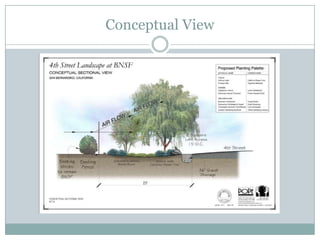
Conceptual View
Trees and Shrubs
Groundcover Palette

CCIH 2012 Conference, Breakout 4, Molly Krans, Student Project Session, CBPR Approach to Development and Implement Air Quality Mitigation

  • 1.
    CBPR Approach toDevelop and Implement Air Quality Mitigation MOLLY KRANS LOMA LINDA UNIVERSITY SCHOOL OF PUBLIC HEALTH
  • 2.
    Introduction  Loma LindaUniversity  MPH Students  ENRRICH  Environmental Railyard Research Impacting Community Health  Environmental Justice issues  Ramona Alessandro Elementary  Improve local air quality for students
  • 3.
    Background  Ramona Alessandro Elementary • Less than 490 yards away from the San Bernardino Railyard (SBR) • Continuous exposure to harmful air pollutants.  SBR poses the greatest health risk when compared to any other California Railyard
  • 5.
    Motivating Concerns • Short and long term exposure to air pollution has been seen to cause detrimental health effects. • According to a study done by Cakmak et. al. (2011), “increased traffic density within a two hundred meter radius of the neighborhood was associated with an increase in respiratory symptoms and a significant reduction in forced vital capacity in children.”
  • 6.
    Motivating Concerns • Those living nearby traffic dense areas develop respiratory deficiencies. • Children whose lungs are still developing • The communities at a higher risk of exposure to harmful air pollutants tend to be marginalized, minority populations.
  • 7.
    Methods • Windshield Survey- Photovoice • Key Informant Interviews • Secondary Literature Review • Focus Groups • Establish and Maintain Community Relationships through regular meetings
  • 8.
    Data Analysis • Windshield Surveys • Secondary literature • Analysis of field notes • Key informant interviews • Transcription • Focus groups • Transcriptions  Analyzed data to pull emerging themes
  • 9.
    Intervention • Tree barrier would mitigate the detrimental health effects of air pollution at Ramona Alessandro Elementary • Decreasing harmful particulate matter
  • 10.
    Tree Barrier  Treesin New York City  1,821 metric tons of air pollution removed  Estimated value to society of 9.5 million dollars  Ways trees are planted  Species Used
  • 11.
    Goals  Establish partnershipsfor a future tree barrier  Cal Poly Pomona  University of California Riverside  Pope Landscaping  Local businesses for funding partnerships  Create a handbook for next year’s Loma Linda student team to implement intervention
  • 12.
    Our Product  Handbook  Case study of our project  Field briefs, key informant interviews, focus groups, contact information, meeting minutes, funding information, demographics and the needs and assets assessment  “Steps to Building Partnerships and Identifying Resources in a Community ”
  • 13.
    Lessons Learned  “Commitmentof Understanding” with community group  Time Constraint  Flexible  Focus on the experience and not the grade
  • 14.
    Acknowledgements • Loma LindaUniversity School of Public Health • Environmental Railyard Research Impacting Community Health (ENRRICH) • Ramona Alessandro Elementary School • Center for Community Action and Environmental Justice (CCAEJ) • Community Action Team (CAT) • Mayor's Office of San Bernardino • Richard Pope & Associates Landscape Architecture • Cal Poly Pomona College of Environmental Design
  • 15.
  • 16.
  • 17.
  • 18.

Editor's Notes

  • #2 Community-based participatory research (CBPR) is research that is conducted as an equal partnership between traditionally trained "experts" and members of a community. In CBPR projects, the community participates fully in all aspects of the research process.[1] CBPR projects start with the community. Community is often self-defined, but general categories of community include geographic community, community of individuals with a common problem or issue, or a community of individuals with a common interest or goal. CBPR encourages collaboration of “formally trained research” partners from any area of expertise, provided that the researcher provide expertise that is seen as useful to the investigation by the community, and be fully committed to a partnership of equals and producing outcomes usable to the community. Equitable partnerships require sharing power, resources, credit, results, and knowledge, as well as a reciprocal appreciation of each partner's knowledge and skills at each stage of the project, including problem definition/issue selection, research design, conducting research, interpreting the results, and determining how the results should be used for action. CBPR differs from traditional research in many ways. One of the principal ways in which it is different is that instead of creating knowledge for the advancement of a field or for knowledge's sake, CBPR is an iterative process, incorporating research, reflection, and action in a cyclical process.
  • #6 Vital capacity is the maximum amount of air a person can expel from the lungs after a maximum inhalation. It is equal to the inspiratory reserve volume plus the tidal volume plus the expiratory reserve volume.A person's vital capacity can be measured by a spirometer which can be a wet or regular spirometer. In combination with other physiological measurements, the vital capacity can help make a diagnosis of underlying lung disease.
  • #10 According to Nowak (2000) “Trees in New York City removed an estimated 1,821 metric tons of air pollution at an estimated value to society of 9.5 million dollars” (pg.23). This research shows that the planting of trees will remove harmful air pollutants and will benefit the community as a whole. In fact, it has been shown that the way trees are planted and which species are used also affect the amount of air pollutants that may be removed by trees. According to research done by Lancaster University, mature, mixed woodlands capture airborne particles at three times the rate of grasslands (Stewart et al., 2004)
  • #11 According to Nowak (2000) “Trees in New York City removed an estimated 1,821 metric tons of air pollution at an estimated value to society of 9.5 million dollars” (pg.23). This research shows that the planting of trees will remove harmful air pollutants and will benefit the community as a whole. In fact, it has been shown that the way trees are planted and which species are used also affect the amount of air pollutants that may be removed by trees. According to research done by Lancaster University, mature, mixed woodlands capture airborne particles at three times the rate of grasslands (Stewart et al., 2004)