Intrapartum fetal
monitoring
The purpose of intrapartum surveillance, in general, is a timely
detection of babies who may be hypoxic, so that additional
assessments of fetal wellbeing may be used or the baby be
delivered by caesarean or instrumental vaginal birth, to prevent
perinatal/neonatal morbidity or mortality. NICE 2014, FIGO
2015
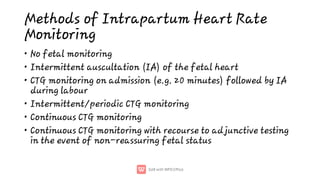
Methods of Intrapartum Heart Rate
Monitoring
•
•
•
•
•
•
No fetal monitoring
Intermittent auscultation (IA) of the fetal heart
CTG monitoring on admission (e.g. 20 minutes) followed by IA
during labour
Intermittent/periodic CTG monitoring
Continuous CTG monitoring
Continuous CTG monitoring with recourse to adjunctive testing
in the event of non-reassuring fetal status
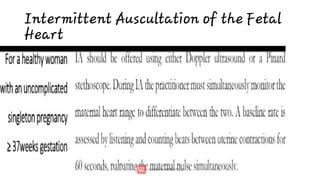
Intermittent Auscultation of the Fetal
Heart
Intermittent Auscultation of the Fetal
Heart
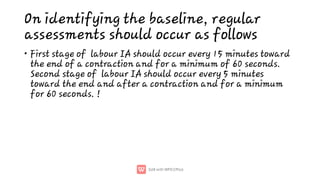
On identifying the baseline, regular
assessments should occur as follows
• First stage of labour IA should occur every 15 minutes toward
the end of a contraction and for a minimum of 60 seconds.
Second stage of labour IA should occur every 5 minutes
toward the end and after a contraction and for a minimum
for 60 seconds. !
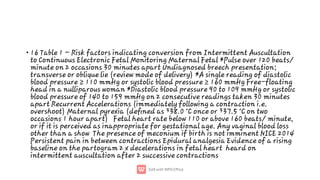
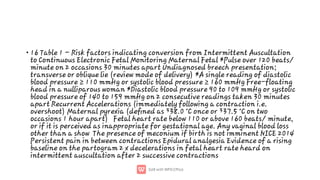
• 16 Table 1 – Risk factors indicating conversion from Intermittent Auscultation
to Continuous Electronic Fetal Monitoring Maternal Fetal *Pulse over 120 beats/
minute on 2 occasions 30 minutes apart Undiagnosed breech presentation;
transverse or oblique lie (review mode of delivery) *A single reading of diastolic
blood pressure ≥ 110 mmHg or systolic blood pressure ≥ 160 mmHg Free-floating
head in a nulliparous woman *Diastolic blood pressure 90 to 109 mmHg or systolic
blood pressure of 140 to 159 mmHg on 2 consecutive readings taken 30 minutes
apart Recurrent Accelerations (immediately following a contraction i.e.
overshoot) Maternal pyrexia (defined as ³38.0 °C once or ³37.5 °C on two
occasions 1 hour apart) Fetal heart rate below 110 or above 160 beats/ minute,
or if it is perceived as inappropriate for gestational age. Any vaginal blood loss
other than a show The presence of meconium if birth is not imminent NICE 2014
Persistent pain in between contractions Epidural analgesia Evidence of a rising
baseline on the partogram 2 x decelerations in fetal heart heard on
intermittent auscultation after 2 successive contractions
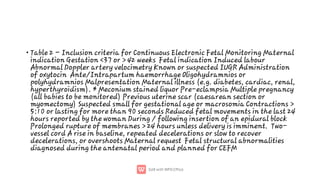
• Table 2 – Inclusion criteria for Continuous Electronic Fetal Monitoring Maternal
indication Gestation <37 or > 42 weeks Fetal indication Induced labour
Abnormal Doppler artery velocimetry Known or suspected IUGR Administration
of oxytocin Ante/Intrapartum haemorrhage Oligohydramnios or
polyhydramnios Malpresentation Maternal illness (e.g. diabetes, cardiac, renal,
hyperthyroidism). * Meconium stained liquor Pre-eclampsia Multiple pregnancy
(all babies to be monitored) Previous uterine scar (caesarean section or
myomectomy) Suspected small for gestational age or macrosomia Contractions >
5:10 or lasting for more than 90 seconds Reduced fetal movements in the last 24
hours reported by the woman During / following insertion of an epidural block
Prolonged rupture of membranes > 24 hours unless delivery is imminent. Two-
vessel cord A rise in baseline, repeated decelerations or slow to recover
decelerations, or overshoots Maternal request Fetal structural abnormalities
diagnosed during the antenatal period and planned for CEFM
• 16 Table 1 – Risk factors indicating conversion from Intermittent Auscultation
to Continuous Electronic Fetal Monitoring Maternal Fetal *Pulse over 120 beats/
minute on 2 occasions 30 minutes apart Undiagnosed breech presentation;
transverse or oblique lie (review mode of delivery) *A single reading of diastolic
blood pressure ≥ 110 mmHg or systolic blood pressure ≥ 160 mmHg Free-floating
head in a nulliparous woman *Diastolic blood pressure 90 to 109 mmHg or systolic
blood pressure of 140 to 159 mmHg on 2 consecutive readings taken 30 minutes
apart Recurrent Accelerations (immediately following a contraction i.e.
overshoot) Maternal pyrexia (defined as ³38.0 °C once or ³37.5 °C on two
occasions 1 hour apart) Fetal heart rate below 110 or above 160 beats/ minute,
or if it is perceived as inappropriate for gestational age. Any vaginal blood loss
other than a show The presence of meconium if birth is not imminent NICE 2014
Persistent pain in between contractions Epidural analgesia Evidence of a rising
baseline on the partogram 2 x decelerations in fetal heart rate heard on
intermittent auscultation after 2 successive contractions
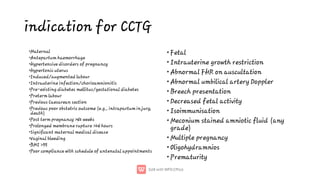
indication for CCTG
•
•
•
•
•
•
•
•
•
•
•
•
•
•
•
•
Maternal
Antepartum haemorrhage
Hypertensive disorders of pregnancy
Hypertonic uterus
Induced/augmented labour
Intrauterine infection/chorioamnionitis
Pre-existing diabetes mellitus/gestational diabetes
Preterm labour
Previous Caesarean section
Previous poor obstetric outcome (e.g., intrapartum injury,
death)
Post term pregnancy >42 weeks
Prolonged membrane rupture >24 hours
Significant maternal medical disease
Vaginal bleeding
BMI >35
Poor compliance with schedule of antenatal appointments
•
•
•
•
•
•
•
•
•
•
•
Fetal
Intrauterine growth restriction
Abnormal FHR on auscultation
Abnormal umbilical artery Doppler
Breech presentation
Decreased fetal activity
Isoimmunisation
Meconium stained amniotic fluid (any
grade)
Multiple pregnancy
Oligohydramnios
Prematurity
•
•
•
•
•
•
•
•
•
•
•
•
•
•
•
•
•
Abnormal antenatal CTG
Abnormal Doppler umbilical artery velocimetry
Abnormalities of maternal serum screening associated with an increased risk of
poor perinatal outcomes e.g. low PAPP-A <0.4MoM.
Antepartum haemorrhage
Breech presentation
Decreased fetal movements
Diabetes where medication is indicated or poorly controlled, or with fetal
macrosomia
Essential hypertension or pre-eclampsia
Known fetal abnormality which requires monitoring
Maternal age greater than or equal to 42
Multiple pregnancy
Oligohydramnios or polyhydramnios
Other current or previous obstetric or medical conditions which constitute a
significant risk of fetal compromise e.g. cholestasis, isoimmunisation, substance
abuse
Prior uterine scar / caesarean section
Prolonged pregnancy >42 weeks gestation
Prolonged rupture of membranes (>24 hours)
Suspected or confirmed intrauterine growth restriction
•
•
•
•
•
•
•
•
•
•
•
•
•
•
•
. Intrapartum risk factors1
Induction of labour with prostaglandin / oxytocin
Abnormal auscultation or CTG
Oxytocin augmentation
Regional analgesia e.g. epidural or spinal, paracervical block*
Abnormal vaginal bleeding in labour
Maternal pyrexia greater than or equal to 38°C
Meconium or blood stained liquor
Absent liquor following amniotomy
Active first stage of labour >12 hours (i.e. after diagnosis of labour)
Active second stage (i.e. pushing) >1 hour where birth is not imminent
Preterm labour less than 37 completed weeks1
Tachysystole (more than 5 active labour contractions in 10 minutes, without
fetal heart rate changes)
Uterine hypertonus (contractions lasting more than 2 minutes or occurring
within 60s of each other, without fetal heart rate changes
Uterine hyperstimulation (tachysystole/hypertonus with fetal heart rate
changes
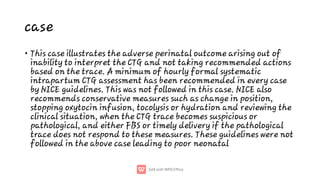
case
• This case illustrates the adverse perinatal outcome arising out of
inability to interpret the CTG and not taking recommended actions
based on the trace. A minimum of hourly formal systematic
intrapartum CTG assessment has been recommended in every case
by NICE guidelines. This was not followed in this case. NICE also
recommends conservative measures such as change in position,
stopping oxytocin infusion, tocolysis or hydration and reviewing the
clinical situation, when the CTG trace becomes suspicious or
pathological, and either FBS or timely delivery if the pathological
trace does not respond to these measures. These guidelines were not
followed in the above case leading to poor neonatal

Presentation IP CTG.pdf

  • 1.
    Intrapartum fetal monitoring The purposeof intrapartum surveillance, in general, is a timely detection of babies who may be hypoxic, so that additional assessments of fetal wellbeing may be used or the baby be delivered by caesarean or instrumental vaginal birth, to prevent perinatal/neonatal morbidity or mortality. NICE 2014, FIGO 2015
  • 2.
    Methods of IntrapartumHeart Rate Monitoring • • • • • • No fetal monitoring Intermittent auscultation (IA) of the fetal heart CTG monitoring on admission (e.g. 20 minutes) followed by IA during labour Intermittent/periodic CTG monitoring Continuous CTG monitoring Continuous CTG monitoring with recourse to adjunctive testing in the event of non-reassuring fetal status
  • 3.
  • 5.
  • 6.
    On identifying thebaseline, regular assessments should occur as follows • First stage of labour IA should occur every 15 minutes toward the end of a contraction and for a minimum of 60 seconds. Second stage of labour IA should occur every 5 minutes toward the end and after a contraction and for a minimum for 60 seconds. !
  • 7.
    • 16 Table1 – Risk factors indicating conversion from Intermittent Auscultation to Continuous Electronic Fetal Monitoring Maternal Fetal *Pulse over 120 beats/ minute on 2 occasions 30 minutes apart Undiagnosed breech presentation; transverse or oblique lie (review mode of delivery) *A single reading of diastolic blood pressure ≥ 110 mmHg or systolic blood pressure ≥ 160 mmHg Free-floating head in a nulliparous woman *Diastolic blood pressure 90 to 109 mmHg or systolic blood pressure of 140 to 159 mmHg on 2 consecutive readings taken 30 minutes apart Recurrent Accelerations (immediately following a contraction i.e. overshoot) Maternal pyrexia (defined as ³38.0 °C once or ³37.5 °C on two occasions 1 hour apart) Fetal heart rate below 110 or above 160 beats/ minute, or if it is perceived as inappropriate for gestational age. Any vaginal blood loss other than a show The presence of meconium if birth is not imminent NICE 2014 Persistent pain in between contractions Epidural analgesia Evidence of a rising baseline on the partogram 2 x decelerations in fetal heart heard on intermittent auscultation after 2 successive contractions
  • 8.
    • Table 2– Inclusion criteria for Continuous Electronic Fetal Monitoring Maternal indication Gestation <37 or > 42 weeks Fetal indication Induced labour Abnormal Doppler artery velocimetry Known or suspected IUGR Administration of oxytocin Ante/Intrapartum haemorrhage Oligohydramnios or polyhydramnios Malpresentation Maternal illness (e.g. diabetes, cardiac, renal, hyperthyroidism). * Meconium stained liquor Pre-eclampsia Multiple pregnancy (all babies to be monitored) Previous uterine scar (caesarean section or myomectomy) Suspected small for gestational age or macrosomia Contractions > 5:10 or lasting for more than 90 seconds Reduced fetal movements in the last 24 hours reported by the woman During / following insertion of an epidural block Prolonged rupture of membranes > 24 hours unless delivery is imminent. Two- vessel cord A rise in baseline, repeated decelerations or slow to recover decelerations, or overshoots Maternal request Fetal structural abnormalities diagnosed during the antenatal period and planned for CEFM
  • 9.
    • 16 Table1 – Risk factors indicating conversion from Intermittent Auscultation to Continuous Electronic Fetal Monitoring Maternal Fetal *Pulse over 120 beats/ minute on 2 occasions 30 minutes apart Undiagnosed breech presentation; transverse or oblique lie (review mode of delivery) *A single reading of diastolic blood pressure ≥ 110 mmHg or systolic blood pressure ≥ 160 mmHg Free-floating head in a nulliparous woman *Diastolic blood pressure 90 to 109 mmHg or systolic blood pressure of 140 to 159 mmHg on 2 consecutive readings taken 30 minutes apart Recurrent Accelerations (immediately following a contraction i.e. overshoot) Maternal pyrexia (defined as ³38.0 °C once or ³37.5 °C on two occasions 1 hour apart) Fetal heart rate below 110 or above 160 beats/ minute, or if it is perceived as inappropriate for gestational age. Any vaginal blood loss other than a show The presence of meconium if birth is not imminent NICE 2014 Persistent pain in between contractions Epidural analgesia Evidence of a rising baseline on the partogram 2 x decelerations in fetal heart rate heard on intermittent auscultation after 2 successive contractions
  • 10.
    indication for CCTG • • • • • • • • • • • • • • • • Maternal Antepartumhaemorrhage Hypertensive disorders of pregnancy Hypertonic uterus Induced/augmented labour Intrauterine infection/chorioamnionitis Pre-existing diabetes mellitus/gestational diabetes Preterm labour Previous Caesarean section Previous poor obstetric outcome (e.g., intrapartum injury, death) Post term pregnancy >42 weeks Prolonged membrane rupture >24 hours Significant maternal medical disease Vaginal bleeding BMI >35 Poor compliance with schedule of antenatal appointments • • • • • • • • • • • Fetal Intrauterine growth restriction Abnormal FHR on auscultation Abnormal umbilical artery Doppler Breech presentation Decreased fetal activity Isoimmunisation Meconium stained amniotic fluid (any grade) Multiple pregnancy Oligohydramnios Prematurity
  • 12.
    • • • • • • • • • • • • • • • • • Abnormal antenatal CTG AbnormalDoppler umbilical artery velocimetry Abnormalities of maternal serum screening associated with an increased risk of poor perinatal outcomes e.g. low PAPP-A <0.4MoM. Antepartum haemorrhage Breech presentation Decreased fetal movements Diabetes where medication is indicated or poorly controlled, or with fetal macrosomia Essential hypertension or pre-eclampsia Known fetal abnormality which requires monitoring Maternal age greater than or equal to 42 Multiple pregnancy Oligohydramnios or polyhydramnios Other current or previous obstetric or medical conditions which constitute a significant risk of fetal compromise e.g. cholestasis, isoimmunisation, substance abuse Prior uterine scar / caesarean section Prolonged pregnancy >42 weeks gestation Prolonged rupture of membranes (>24 hours) Suspected or confirmed intrauterine growth restriction • • • • • • • • • • • • • • • . Intrapartum risk factors1 Induction of labour with prostaglandin / oxytocin Abnormal auscultation or CTG Oxytocin augmentation Regional analgesia e.g. epidural or spinal, paracervical block* Abnormal vaginal bleeding in labour Maternal pyrexia greater than or equal to 38°C Meconium or blood stained liquor Absent liquor following amniotomy Active first stage of labour >12 hours (i.e. after diagnosis of labour) Active second stage (i.e. pushing) >1 hour where birth is not imminent Preterm labour less than 37 completed weeks1 Tachysystole (more than 5 active labour contractions in 10 minutes, without fetal heart rate changes) Uterine hypertonus (contractions lasting more than 2 minutes or occurring within 60s of each other, without fetal heart rate changes Uterine hyperstimulation (tachysystole/hypertonus with fetal heart rate changes
  • 13.
    case • This caseillustrates the adverse perinatal outcome arising out of inability to interpret the CTG and not taking recommended actions based on the trace. A minimum of hourly formal systematic intrapartum CTG assessment has been recommended in every case by NICE guidelines. This was not followed in this case. NICE also recommends conservative measures such as change in position, stopping oxytocin infusion, tocolysis or hydration and reviewing the clinical situation, when the CTG trace becomes suspicious or pathological, and either FBS or timely delivery if the pathological trace does not respond to these measures. These guidelines were not followed in the above case leading to poor neonatal