PHYSICAL THERAPISTS:
Who We Are in 45 Minutes or
Less
Laura M. Romeo, SPT
May 20, 2015
TODAY’S TOPICS
Physical therapist education and how it
has evolved;
Licensing and continuing education;
Guide to PT Practice and Colorado Practice
Act;
Brief Overview of PT Documentation
WHO ARE PHYSICAL THERAPISTS?
American Physical Therapy
Association:
 “Physical therapists are highly-
educated, licensed health care
professionals who can help
patients reduce pain and improve
or restore mobility.”
Movement experts with
musculoskeletal knowledge
second only to orthopedists
(Childs, et al, 2005)
SCOPE OF PRACTICE
Examination
Evaluation
Diagnosis
Prognosis
Intervention
Outcome assessment
I have no idea what’s happening in this picture 
EVOLUTION OF PT EDUCATION
Certificate Programs (1900 – 1930)
 Response to poliomyelitis epidemics, those
wounded in World War I
 “Reconstruction aide”
Baccalaureate Programs (1930-1950)
 Educational standard from 1950-1980
EVOLUTION OF PT EDUCATION
Post-Baccalaureate Requirement (1980 – now)
 Master’s Degree required as of 1999
Current: Clinical Doctorate
 Transitional DPT (tDPT)
EDUCATION AND WHERE WE ARE
NOW
Doctorate of Physical Therapy
 Baccalaureate degree required in any major; required basic science and math pre-
requisites
 Typically 3-year full-time programs, didactic and clinical education
FOR YOUR REFERENCE…
A few specialties and their abbreviations:
 CSCS: Certified Sports and Conditioning Specialist
 OCS: Orthopedic Certified Specialist
 CCS: Certified Clinical Specialist
 PCS: Pediatric Certified Specialist
 CHT: Certified Hand Therapist
 FAAOMPT: Fellow of the American Academy of Orthopedic Manual Physical
Therapists
 ATC: Athletic trainer (NOT the same as personal trainer, and may or may
not be a PT)
 More information through the American Board of Physical Therapy
Specialties
 http://www.abpts.org/home.aspx
LICENSING REQUIREMENTS
Physical therapists are licensed by states and
District of Columbia
CAPTE and then NPTE
Signature designation – “PT” or “PT, DPT”
Continuing education requirements in Colorado
DIRECT ACCESS
Referrals vs. no referrals
No medical diagnoses, but well-equipped
to identify when a patient’s signs and
symptoms fall outside scope of practice
Colorado is a direct-access state
COLORADO PRACTICE ACT
Colorado Revised Statutes
 Title 12 – Professions and Occupations
 Article 41 – Physical Therapists
Pertinent points:
 State physical therapy board is the agency that regulates PTs;
 PTs need to complete a physical therapy program and be licensed in
order to practice;
 Lists “special practice authorities and requirements,” including
supervision, medication administration, wound debridement, even
physical therapy of animals;
 Requires PTs in Colorado to maintain continuing professional
competency;
 Grounds for disciplinary action and all the cool ways PTs can get in
trouble
AMERICAN PHYSICAL THERAPY
ASSOCIATION
Vision Statement:
 Transforming society by optimizing movement to improve the human experience.
 Yeah…
Some history and function
 Early on, had a role in how to further the “status of physical therapy within the medical
establishment”
 Plays a role in regulatory and legislative arenas. Effective or not? Lots of debate
 Keeps members up to date on research
GUIDE TO PHYSICAL THERAPIST
PRACTICE
Developed as a resource for physical therapist
and physical therapist assistants
 “Description of practice”
Preferred Physical Therapist Practice Patterns
AND NOW, WHAT YOU’VE ALL BEEN
WAITING FOR…
THE SOAP NOTE
S - SUBJECTIVE
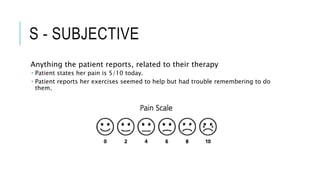
Anything the patient reports, related to their therapy
 Patient states her pain is 5/10 today.
 Patient reports her exercises seemed to help but had trouble remembering to do
them.
O - OBJECTIVE
What the therapist actually did in the session
Sometimes (often) it’s really vague…
 Manual therapy x15 m followed by therex x15 min. E-stim
and heat pack x10 min. Educated patient on HEP.
And sometimes it’s really specific.
 Coordination activities including bear crawls, crab walks,
and jumping jacks to warm-up x5 min. Therapeutic
exercise to include single-leg balancing with ball toss x5
min, obstacle course while walking in tall kneeling x10 min,
education on safety and body awareness.
Which would you prefer?
A - ASSESSMENT
How the therapist evaluates the patient’s
performance/progress during the session
 Is the treatment doing what it should? Is the
condition/injury behaving as expected?
 How did the patient perform the exercises you
gave them? Did they do them correctly or did
they cheat?
 How did your manual therapy elicit change?
This section requires the most thinking.
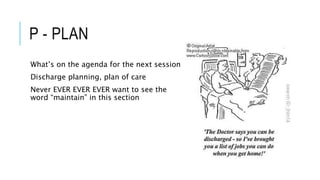
P - PLAN
What’s on the agenda for the next session
Discharge planning, plan of care
Never EVER EVER EVER want to see the
word “maintain” in this section
SOAP – SOUNDS CLEAN, RIGHT?
Copy and paste lingo that makes me crazy
(but that you will see often):
 “Patient will benefit from continued physical therapy
services, including but not limited to modalities, e-
stim, therapeutic exercise, manual therapy, and
neuromuscular re-education.”
 “Patient tolerated treatment well” or “Patient did
well with all activities” or “Continue with plan”
 Notes like these, in my humble student opinion, are
lazy.
QUESTIONS?
Was this helpful for you?
What else do you want to know?
My contact info and life story:
 Laura.m.romeo@gmail.com
 Laura.romeo@ucdenver.edu
 www.lauraromeo.com

Physical Therapists: Who We Are in 45 Minutes or Less

  • 1.
    PHYSICAL THERAPISTS: Who WeAre in 45 Minutes or Less Laura M. Romeo, SPT May 20, 2015
  • 2.
    TODAY’S TOPICS Physical therapisteducation and how it has evolved; Licensing and continuing education; Guide to PT Practice and Colorado Practice Act; Brief Overview of PT Documentation
  • 3.
    WHO ARE PHYSICALTHERAPISTS? American Physical Therapy Association:  “Physical therapists are highly- educated, licensed health care professionals who can help patients reduce pain and improve or restore mobility.” Movement experts with musculoskeletal knowledge second only to orthopedists (Childs, et al, 2005)
  • 4.
    SCOPE OF PRACTICE Examination Evaluation Diagnosis Prognosis Intervention Outcomeassessment I have no idea what’s happening in this picture 
  • 5.
    EVOLUTION OF PTEDUCATION Certificate Programs (1900 – 1930)  Response to poliomyelitis epidemics, those wounded in World War I  “Reconstruction aide” Baccalaureate Programs (1930-1950)  Educational standard from 1950-1980
  • 6.
    EVOLUTION OF PTEDUCATION Post-Baccalaureate Requirement (1980 – now)  Master’s Degree required as of 1999 Current: Clinical Doctorate  Transitional DPT (tDPT)
  • 7.
    EDUCATION AND WHEREWE ARE NOW Doctorate of Physical Therapy  Baccalaureate degree required in any major; required basic science and math pre- requisites  Typically 3-year full-time programs, didactic and clinical education
  • 8.
    FOR YOUR REFERENCE… Afew specialties and their abbreviations:  CSCS: Certified Sports and Conditioning Specialist  OCS: Orthopedic Certified Specialist  CCS: Certified Clinical Specialist  PCS: Pediatric Certified Specialist  CHT: Certified Hand Therapist  FAAOMPT: Fellow of the American Academy of Orthopedic Manual Physical Therapists  ATC: Athletic trainer (NOT the same as personal trainer, and may or may not be a PT)  More information through the American Board of Physical Therapy Specialties  http://www.abpts.org/home.aspx
  • 9.
    LICENSING REQUIREMENTS Physical therapistsare licensed by states and District of Columbia CAPTE and then NPTE Signature designation – “PT” or “PT, DPT” Continuing education requirements in Colorado
  • 10.
    DIRECT ACCESS Referrals vs.no referrals No medical diagnoses, but well-equipped to identify when a patient’s signs and symptoms fall outside scope of practice Colorado is a direct-access state
  • 11.
    COLORADO PRACTICE ACT ColoradoRevised Statutes  Title 12 – Professions and Occupations  Article 41 – Physical Therapists Pertinent points:  State physical therapy board is the agency that regulates PTs;  PTs need to complete a physical therapy program and be licensed in order to practice;  Lists “special practice authorities and requirements,” including supervision, medication administration, wound debridement, even physical therapy of animals;  Requires PTs in Colorado to maintain continuing professional competency;  Grounds for disciplinary action and all the cool ways PTs can get in trouble
  • 12.
    AMERICAN PHYSICAL THERAPY ASSOCIATION VisionStatement:  Transforming society by optimizing movement to improve the human experience.  Yeah… Some history and function  Early on, had a role in how to further the “status of physical therapy within the medical establishment”  Plays a role in regulatory and legislative arenas. Effective or not? Lots of debate  Keeps members up to date on research
  • 13.
    GUIDE TO PHYSICALTHERAPIST PRACTICE Developed as a resource for physical therapist and physical therapist assistants  “Description of practice” Preferred Physical Therapist Practice Patterns
  • 14.
    AND NOW, WHATYOU’VE ALL BEEN WAITING FOR…
  • 15.
  • 16.
    S - SUBJECTIVE Anythingthe patient reports, related to their therapy  Patient states her pain is 5/10 today.  Patient reports her exercises seemed to help but had trouble remembering to do them.
  • 17.
    O - OBJECTIVE Whatthe therapist actually did in the session Sometimes (often) it’s really vague…  Manual therapy x15 m followed by therex x15 min. E-stim and heat pack x10 min. Educated patient on HEP. And sometimes it’s really specific.  Coordination activities including bear crawls, crab walks, and jumping jacks to warm-up x5 min. Therapeutic exercise to include single-leg balancing with ball toss x5 min, obstacle course while walking in tall kneeling x10 min, education on safety and body awareness. Which would you prefer?
  • 18.
    A - ASSESSMENT Howthe therapist evaluates the patient’s performance/progress during the session  Is the treatment doing what it should? Is the condition/injury behaving as expected?  How did the patient perform the exercises you gave them? Did they do them correctly or did they cheat?  How did your manual therapy elicit change? This section requires the most thinking.
  • 19.
    P - PLAN What’son the agenda for the next session Discharge planning, plan of care Never EVER EVER EVER want to see the word “maintain” in this section
  • 20.
    SOAP – SOUNDSCLEAN, RIGHT? Copy and paste lingo that makes me crazy (but that you will see often):  “Patient will benefit from continued physical therapy services, including but not limited to modalities, e- stim, therapeutic exercise, manual therapy, and neuromuscular re-education.”  “Patient tolerated treatment well” or “Patient did well with all activities” or “Continue with plan”  Notes like these, in my humble student opinion, are lazy.
  • 21.
    QUESTIONS? Was this helpfulfor you? What else do you want to know? My contact info and life story:  Laura.m.romeo@gmail.com  Laura.romeo@ucdenver.edu  www.lauraromeo.com

Editor's Notes

  • #3 Has anyone in this room had any experience with PT? Post-surgery or post-injury? How about a chiropractor? Someone give me a “definition” of what a physical therapist does – be honest! Cynicism welcome.
  • #4 “Experienced physical therapists had higher levels of knowledge in managing musculoskeletal conditions than medical students, physician interns and residents, and all physician specialists except for orthopaedists. Physical therapist students enrolled in doctoral degree educational programs achieved significantly higher scores than their peers enrolled in master's degree programs. Furthermore, experienced physical therapists who were board-certified in orthopaedic or sports physical therapy achieved significantly higher scores and passing rates than their non board-certified colleagues.” – Childs, et al study
  • #10 New therapists: National Physical Therapy Exam (NPTE) of the Federation of the State Boards of Physical Therapy In order to sit for the exam, required graduation from an accredited program through Commission on Accreditation of Physical Therapy Education (CAPTE). Recognized through the Department of Education. PT – Physical therapy’s EXCLUSVE licensure designation. New debate in APTA House of Delegates is whether or not everyone should sign “PT, DPT” in clinical notes, regardless of the level of education. Please note that anyone other than a physical therapist who says they provide “physical therapy services,” they are violating licensure law by misrepresenting themselves. AHEM, chiropractor ads that promote “physical therapy.” Don’t get me started. Continuing education:
  • #11 Referral often only says “evaluate and treat” or has a catch-all diagnosis like “sciatica” or “low back pain”
  • #13 Initially focused on establishing educational and research standards, promoting the science of PT, and working under the medical profession, determining merits of licensure