If you are an educator or business trainer, you 
have probably heard all the talk about...... 
21st Century Schools 
Social Software and e-Learning
When the buzz dies down and it's time to do 
something for your organization, what do you 
want from an online learning system? 
Easy creation of courses from existing resources? 
Course content which can be re-used with different learners, 
including content from other vendors (Blackboard, WebCT etc.)? 
Learner involvement? 
Enrollment and learner authentication which is simple yet secure? 
Intuitive online learner and teacher management features? 
An active support community to help solve problems and 
generate new ideas? 
Affordability?
Introducing...... Moodle! 
Moodle is an alternative to proprietary commercial online learning solutions, 
and is distributed free under open source licensing. An organization has 
complete access to the source code and can make changes if needed. 
Moodle’s modular design makes it easy to create new courses, adding 
content that will engage learners. 
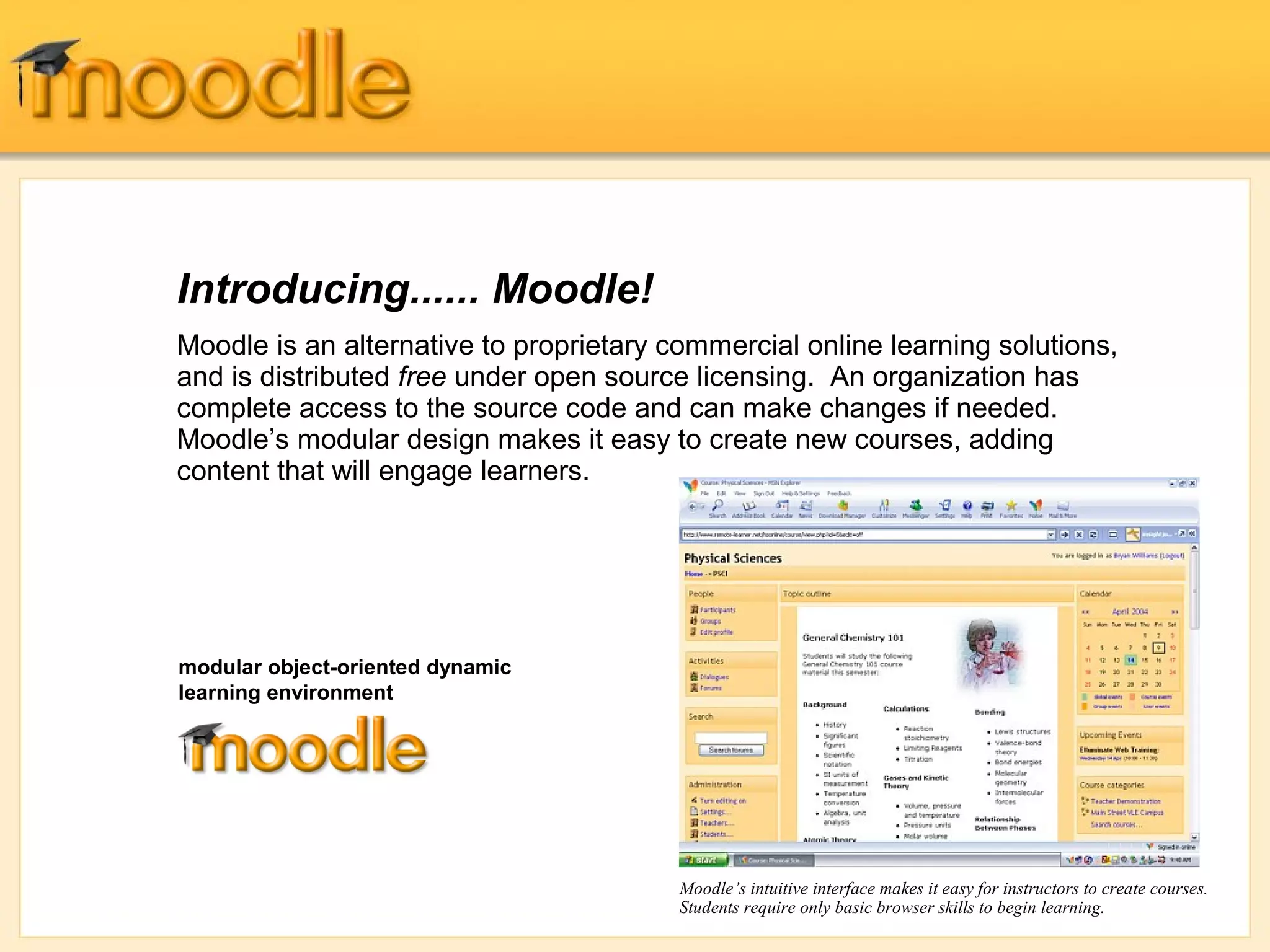
Moodle’s intuitive interface makes it easy for instructors to create courses. 
Students require only basic browser skills to begin learning. 
modular object-oriented dynamic 
learning environment
Moodle Architecture 
Activities are at the heart of a course management 
system. Moodle was designed by an educator and 
computer scientist, with “social constructionist” principles 
in mind. “Constructionism asserts that learning is 
particularly effective when constructing something for 
others to experience. This can be anything from a 
spoken sentence or an internet posting, to more complex 
artifacts like a painting, a house or a software package. 
The concept of social constructivism extends the above 
ideas into a social group constructing things for one 
another, collaboratively creating a small culture of 
shared artifacts with shared meanings. When one is 
immersed within a culture like this, one is learning all the 
time about how to be a part of that culture, on many 
levels.” 
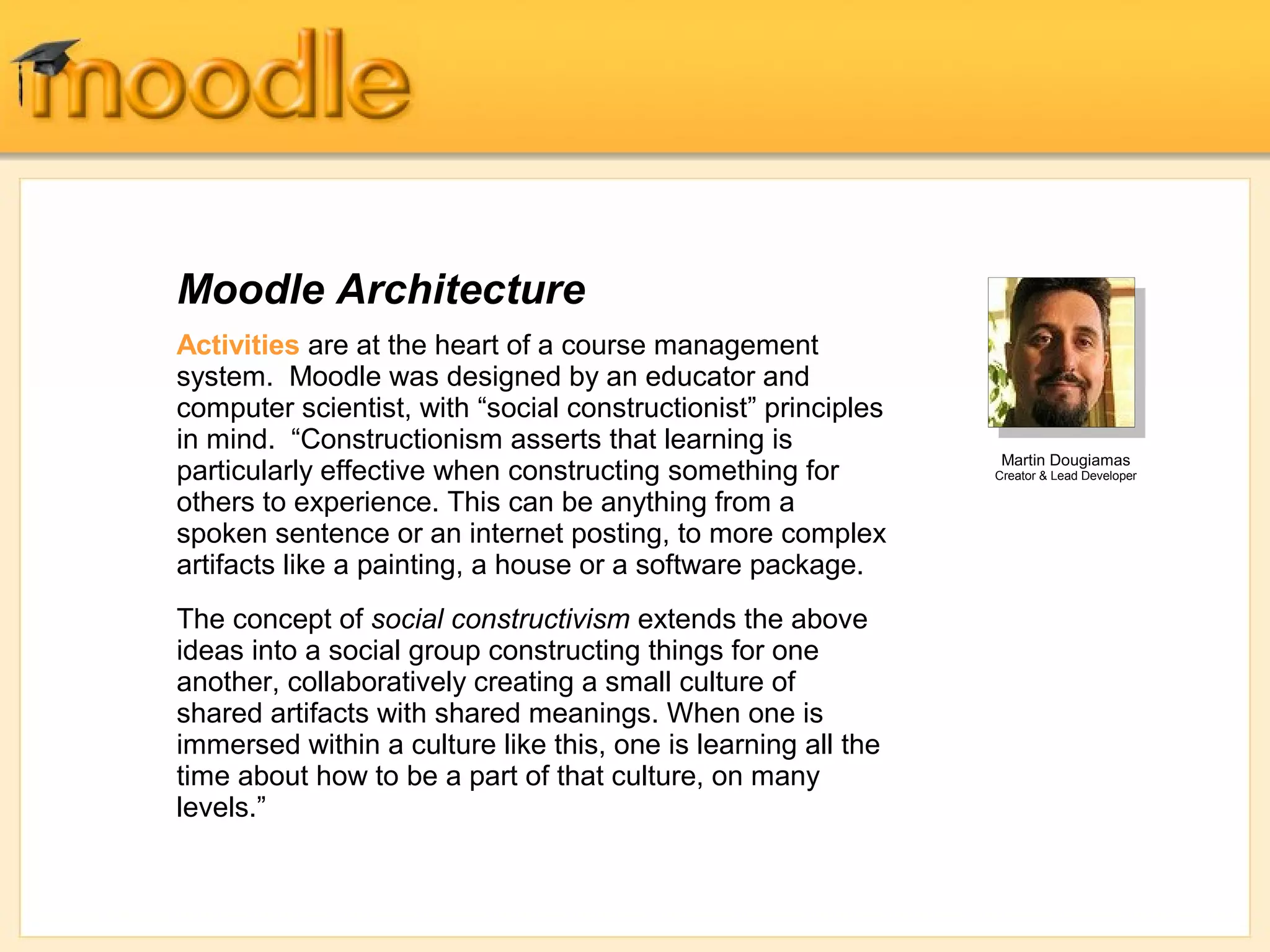
Martin Dougiamas 
Creator & Lead Developer
Promoting Learner Involvement 
“A constructivist perspective views learners as actively 
engaged in making meaning, and teaching with that 
approach looks for what students can analyze, investigate, 
collaborate, share, build and generate based on what they 
already know, rather than what facts, skills, and processes 
they can parrot. Some of the tenets of constructivism in 
pedagogical terms include:” 
Students come to class with an established world-view, formed by 
years of prior experience and learning. 
Even as it evolves, a student’s world-view filters all experiences and 
affects their interpretations of observations. 
For students to change their world-view requires work. 
Students learn from each other as well as the teacher. 
Students learn better by doing. 
Allowing and creating opportunities for all to have a voice promotes 
the construction of new ideas.
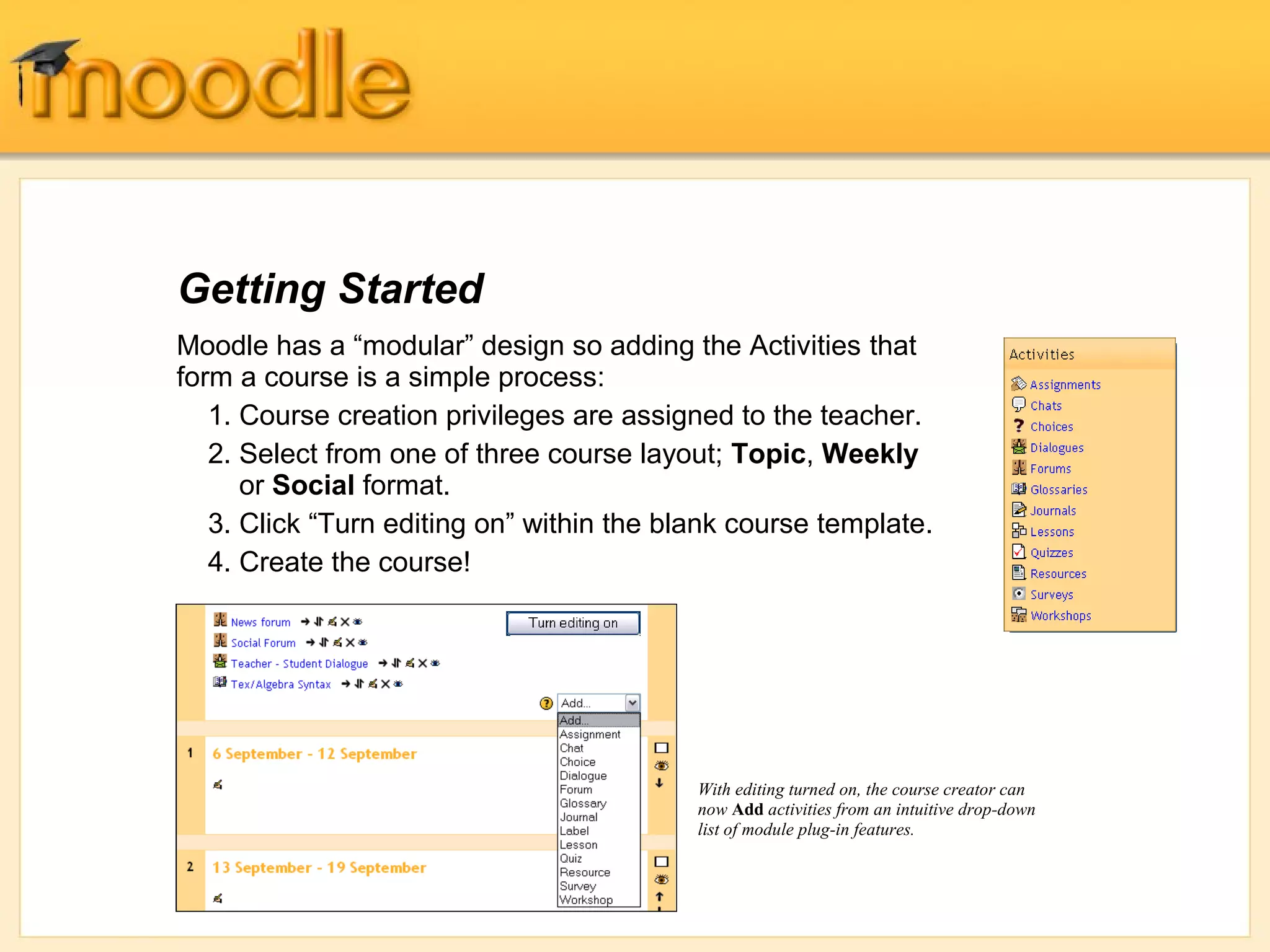
Getting Started 
Moodle has a “modular” design so adding the Activities that 
form a course is a simple process: 
1. Course creation privileges are assigned to the teacher. 
2. Select from one of three course layout; Topic, Weekly 
or Social format. 
3. Click “Turn editing on” within the blank course template. 
4. Create the course! 
With editing turned on, the course creator can 
now Add activities from an intuitive drop-down 
list of module plug-in features.
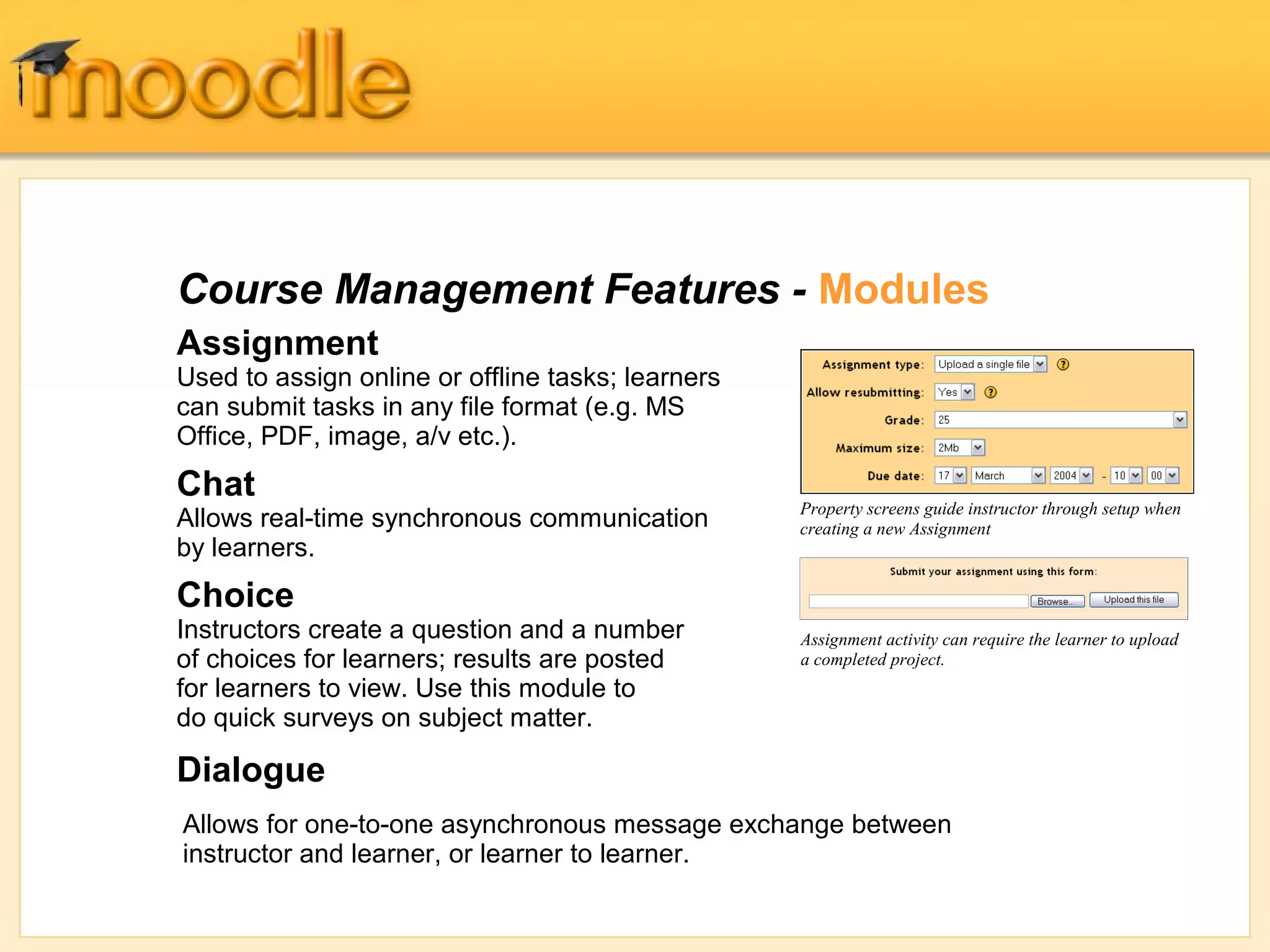
Course Management Features - Modules 
Assignment 
Used to assign online or offline tasks; learners 
can submit tasks in any file format (e.g. MS 
Office, PDF, image, a/v etc.). 
Chat 
Allows real-time synchronous communication 
by learners. 
Choice 
Instructors create a question and a number 
of choices for learners; results are posted 
for learners to view. Use this module to 
do quick surveys on subject matter. 
Dialogue 
Property screens guide instructor through setup when 
creating a new Assignment 
Assignment activity can require the learner to upload 
a completed project. 
Allows for one-to-one asynchronous message exchange between 
instructor and learner, or learner to learner.
Course Management Features - Modules 
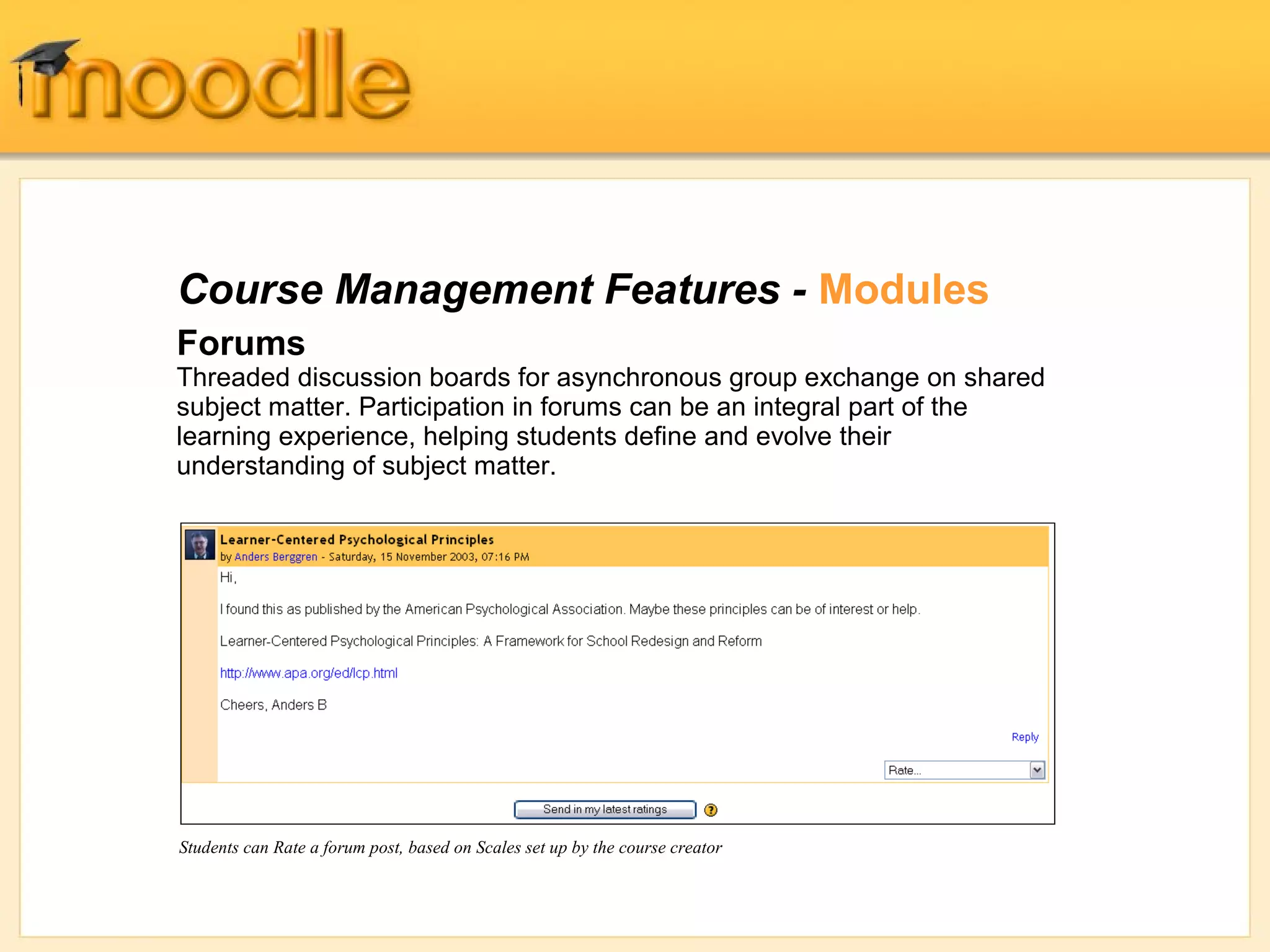
Forums 
Threaded discussion boards for asynchronous group exchange on shared 
subject matter. Participation in forums can be an integral part of the 
learning experience, helping students define and evolve their 
understanding of subject matter. 
Students can Rate a forum post, based on Scales set up by the course creator
Course Management Features - Modules 
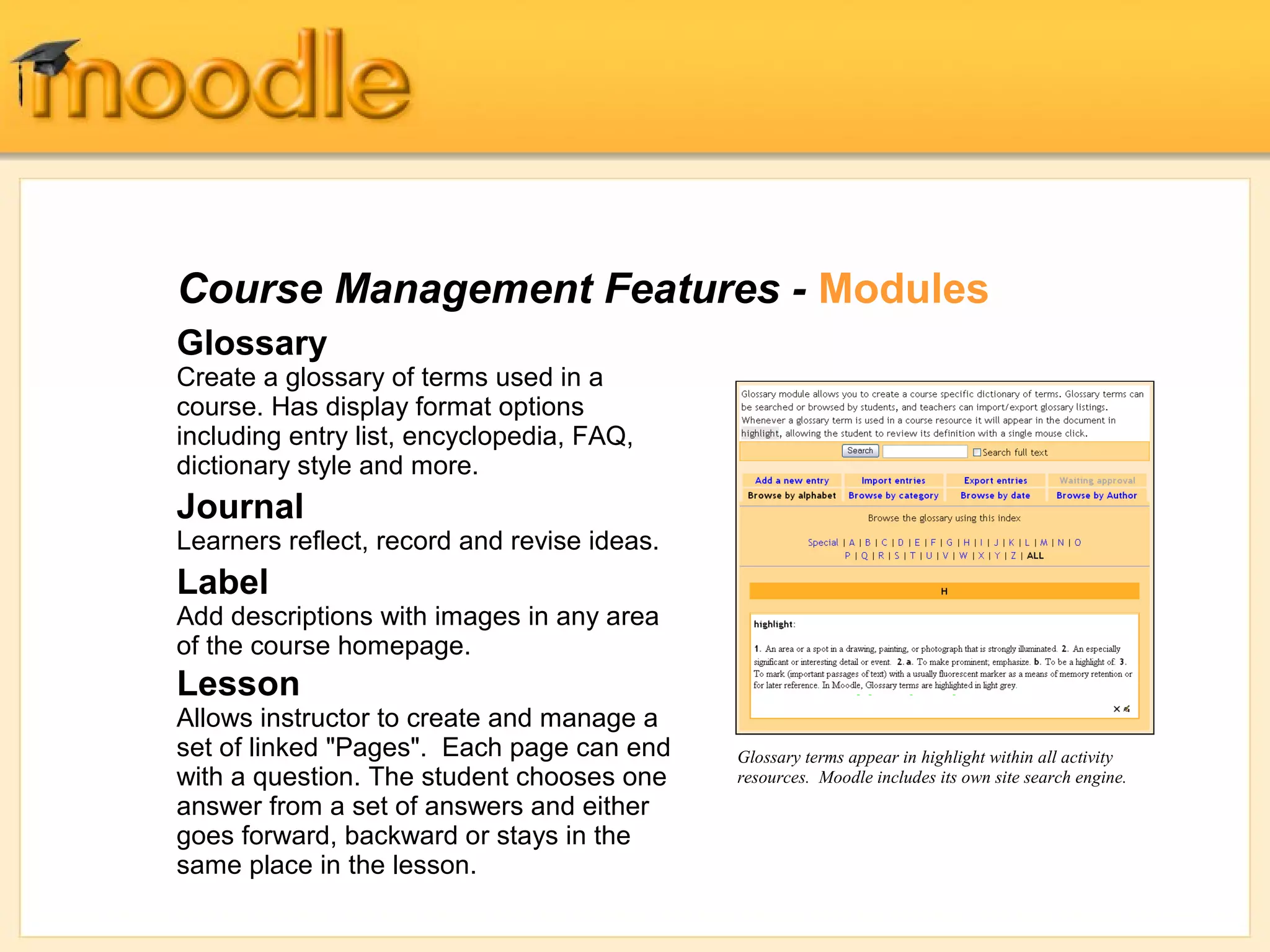
Glossary 
Create a glossary of terms used in a 
course. Has display format options 
including entry list, encyclopedia, FAQ, 
dictionary style and more. 
Journal 
Learners reflect, record and revise ideas. 
Label 
Add descriptions with images in any area 
of the course homepage. 
Lesson 
Allows instructor to create and manage a 
set of linked "Pages". Each page can end 
with a question. The student chooses one 
answer from a set of answers and either 
goes forward, backward or stays in the 
same place in the lesson. 
Glossary terms appear in highlight within all activity 
resources. Moodle includes its own site search engine.
Course Management Features - Modules 
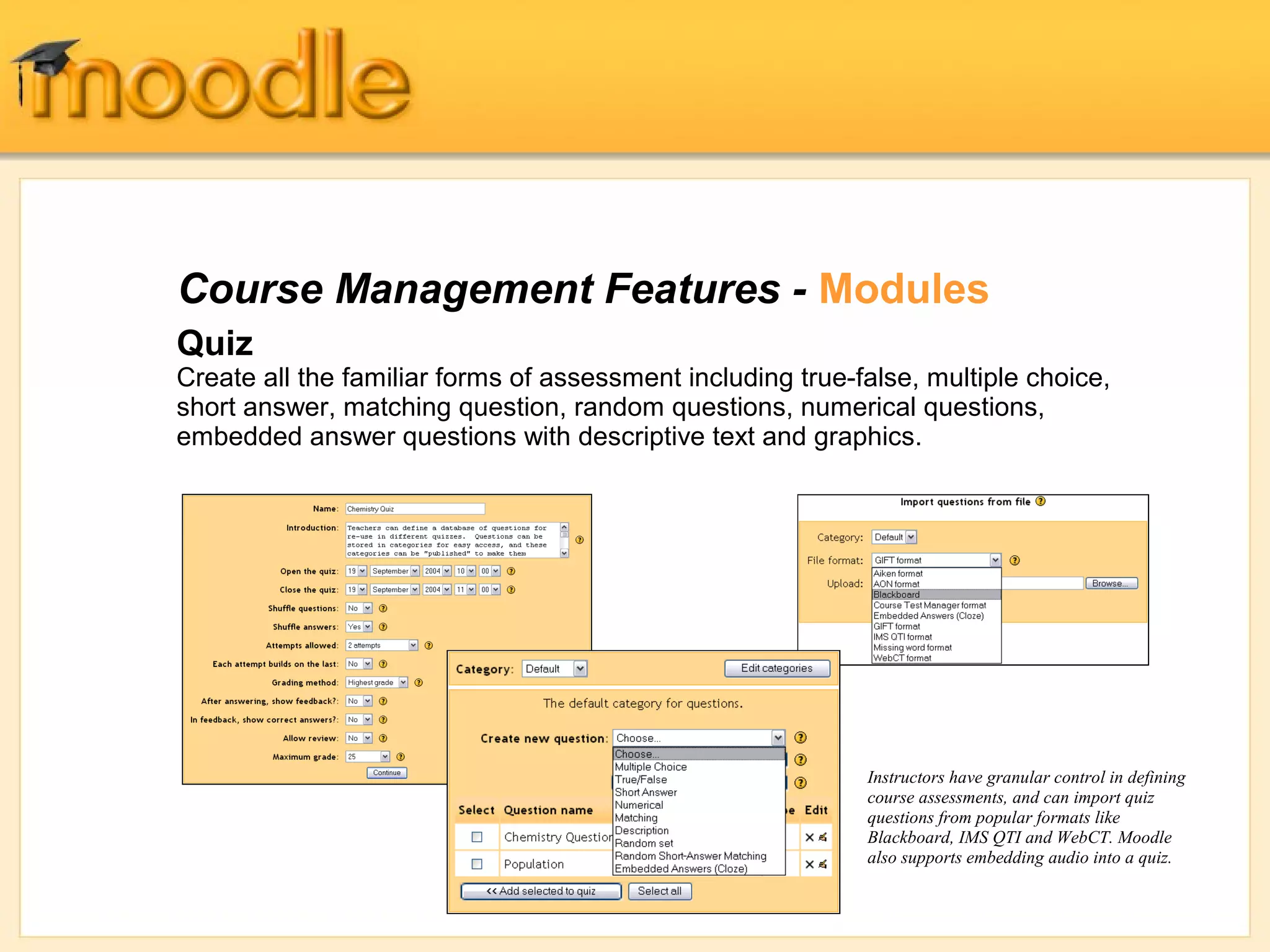
Quiz 
Create all the familiar forms of assessment including true-false, multiple choice, 
short answer, matching question, random questions, numerical questions, 
embedded answer questions with descriptive text and graphics. 
Instructors have granular control in defining 
course assessments, and can import quiz 
questions from popular formats like 
Blackboard, IMS QTI and WebCT. Moodle 
also supports embedding audio into a quiz.
Course Management Features - Modules 
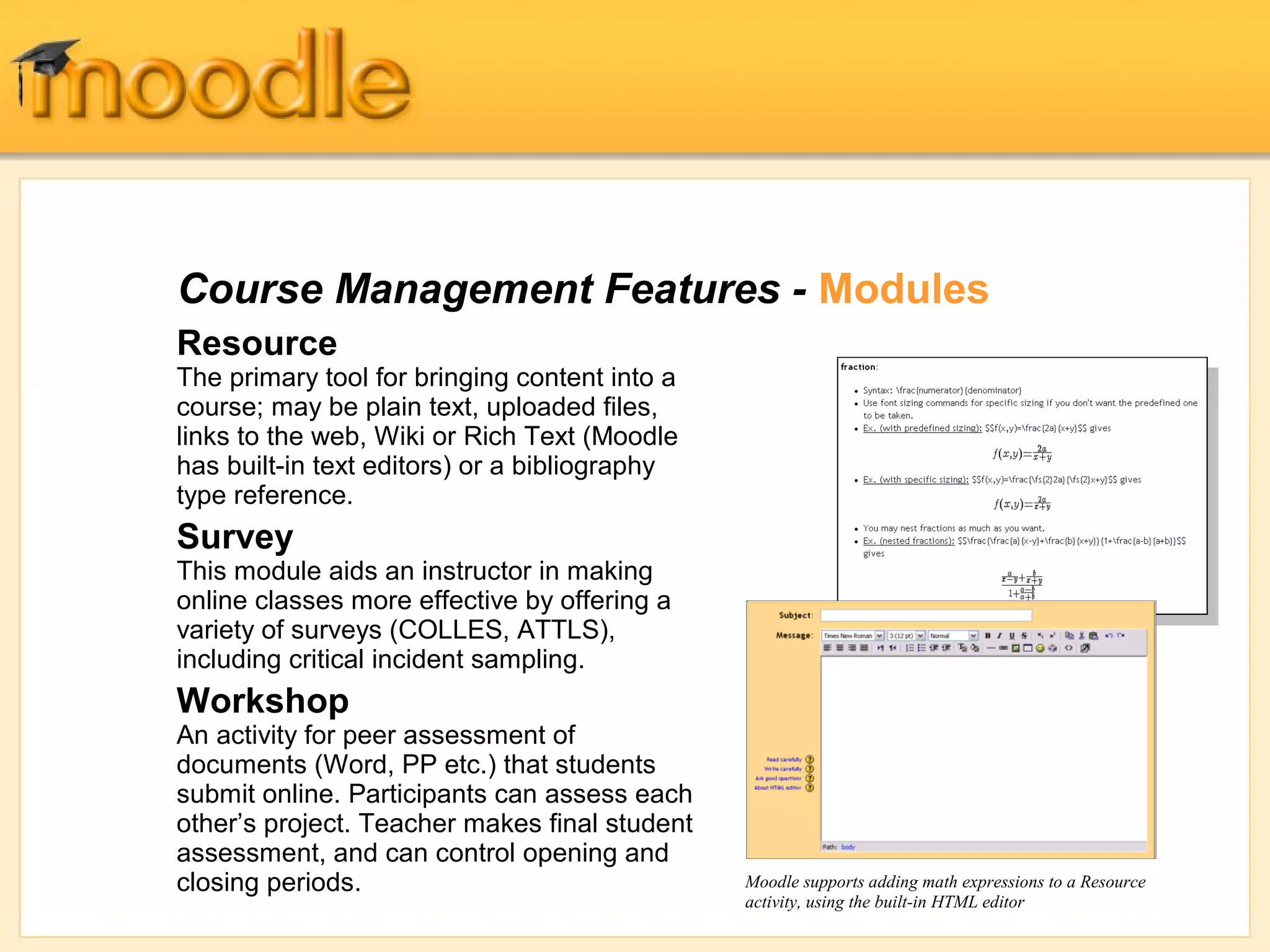
Resource 
The primary tool for bringing content into a 
course; may be plain text, uploaded files, 
links to the web, Wiki or Rich Text (Moodle 
has built-in text editors) or a bibliography 
type reference. 
Survey 
This module aids an instructor in making 
online classes more effective by offering a 
variety of surveys (COLLES, ATTLS), 
including critical incident sampling. 
Workshop 
An activity for peer assessment of 
documents (Word, PP etc.) that students 
submit online. Participants can assess each 
other’s project. Teacher makes final student 
assessment, and can control opening and 
closing periods. Moodle supports adding math expressions to a Resource 
activity, using the built-in HTML editor
Learner Management Features 
Creating learning content is only part of what a good 
course management system (CMS) must do. The 
CMS must manage learners in a variety of ways. 
Learner management includes: 
Access to information about learners in a course. 
Ability to segment participants into groups. 
Site, course and user calendar event scheduling. 
And so much more…e.g. applying scales to 
different learner activities, managing grades, 
tracking user access logs and uploading external 
files for use within the course etc.
Learner Management Features – Participants 
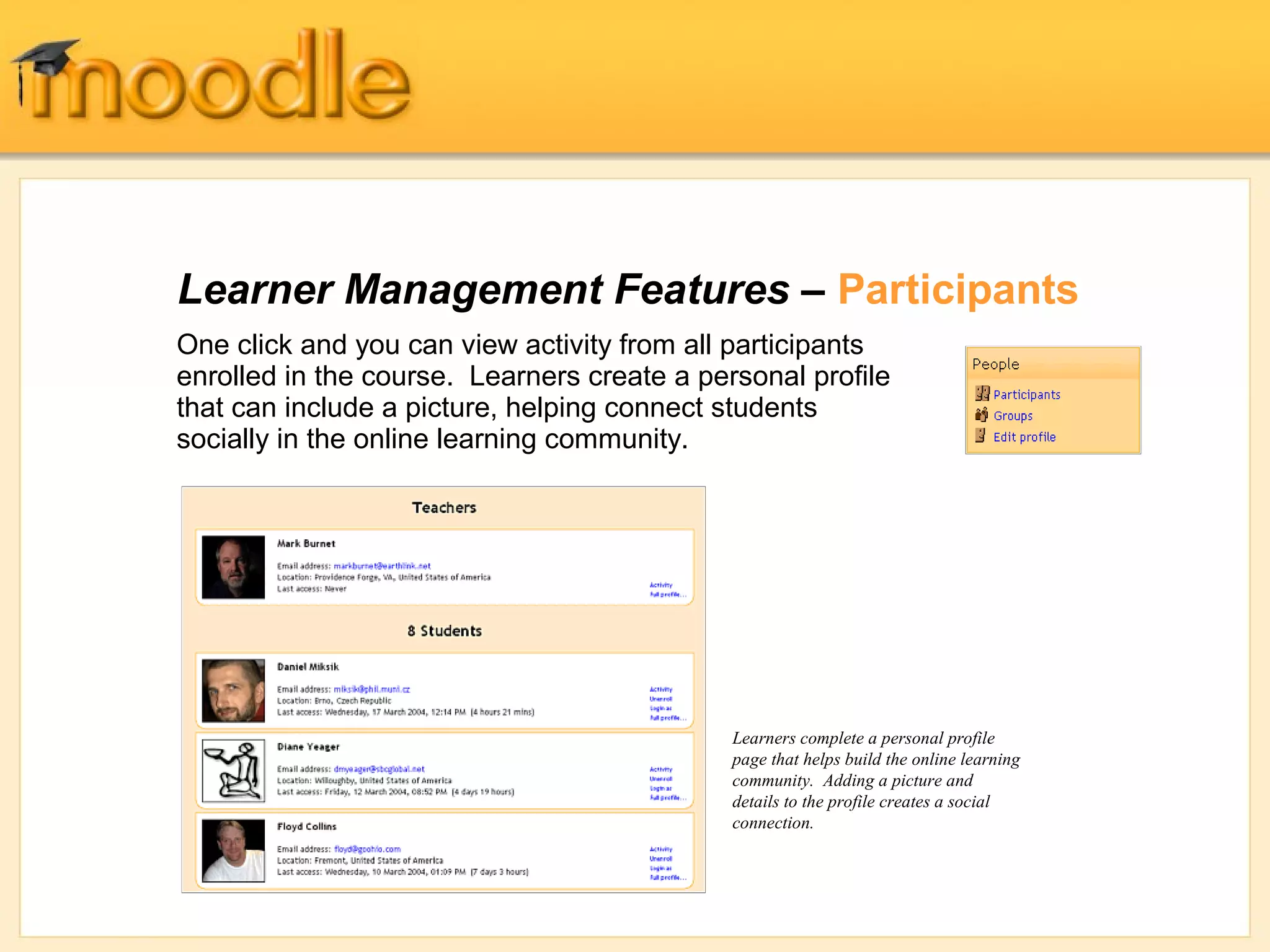
One click and you can view activity from all participants 
enrolled in the course. Learners create a personal profile 
that can include a picture, helping connect students 
socially in the online learning community. 
Learners complete a personal profile 
page that helps build the online learning 
community. Adding a picture and 
details to the profile creates a social 
connection.
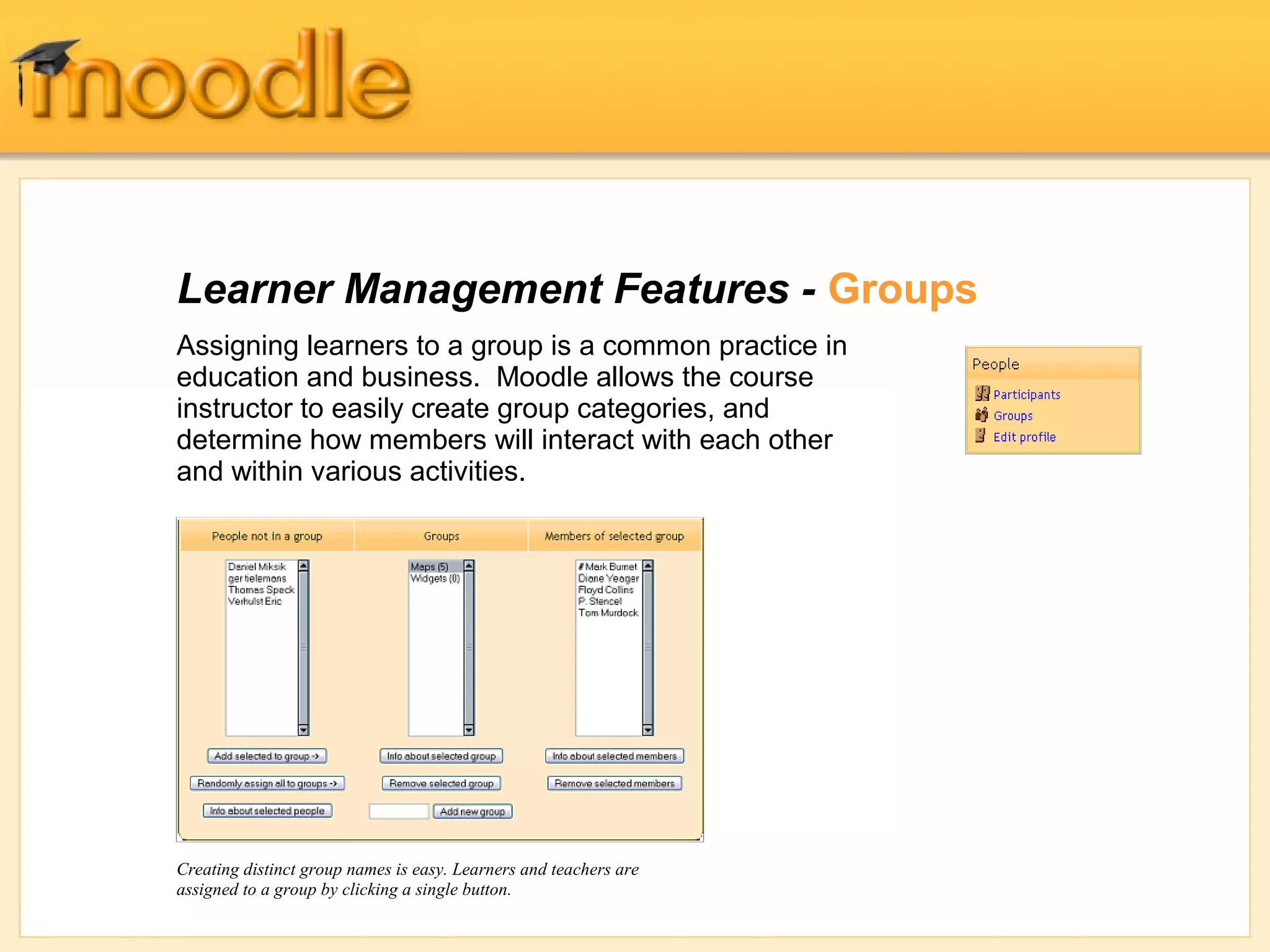
Learner Management Features - Groups 
Assigning learners to a group is a common practice in 
education and business. Moodle allows the course 
instructor to easily create group categories, and 
determine how members will interact with each other 
and within various activities. 
Creating distinct group names is easy. Learners and teachers are 
assigned to a group by clicking a single button.
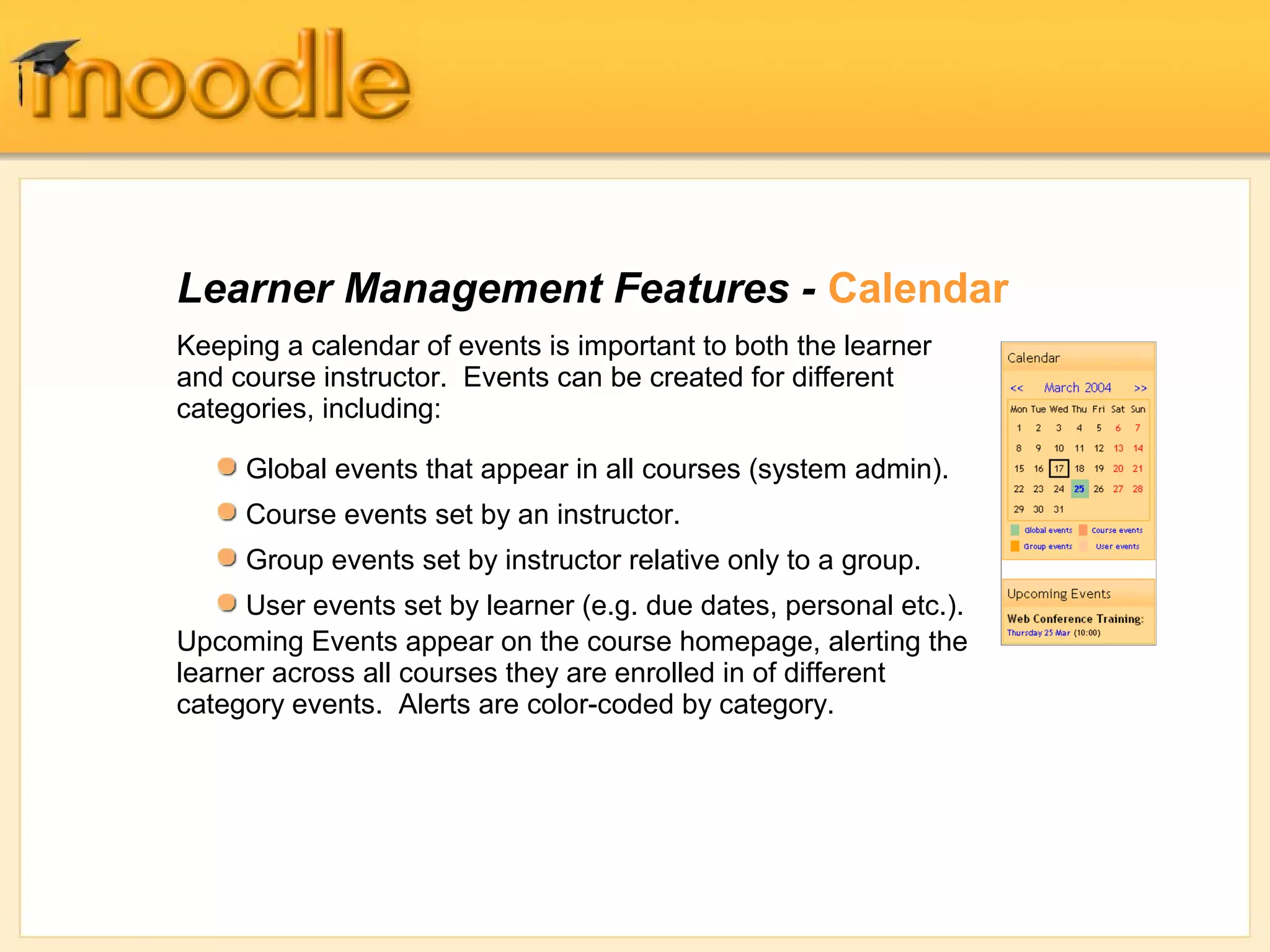
Learner Management Features - Calendar 
Keeping a calendar of events is important to both the learner 
and course instructor. Events can be created for different 
categories, including: 
Global events that appear in all courses (system admin). 
Course events set by an instructor. 
Group events set by instructor relative only to a group. 
User events set by learner (e.g. due dates, personal etc.). 
Upcoming Events appear on the course homepage, alerting the 
learner across all courses they are enrolled in of different 
category events. Alerts are color-coded by category.
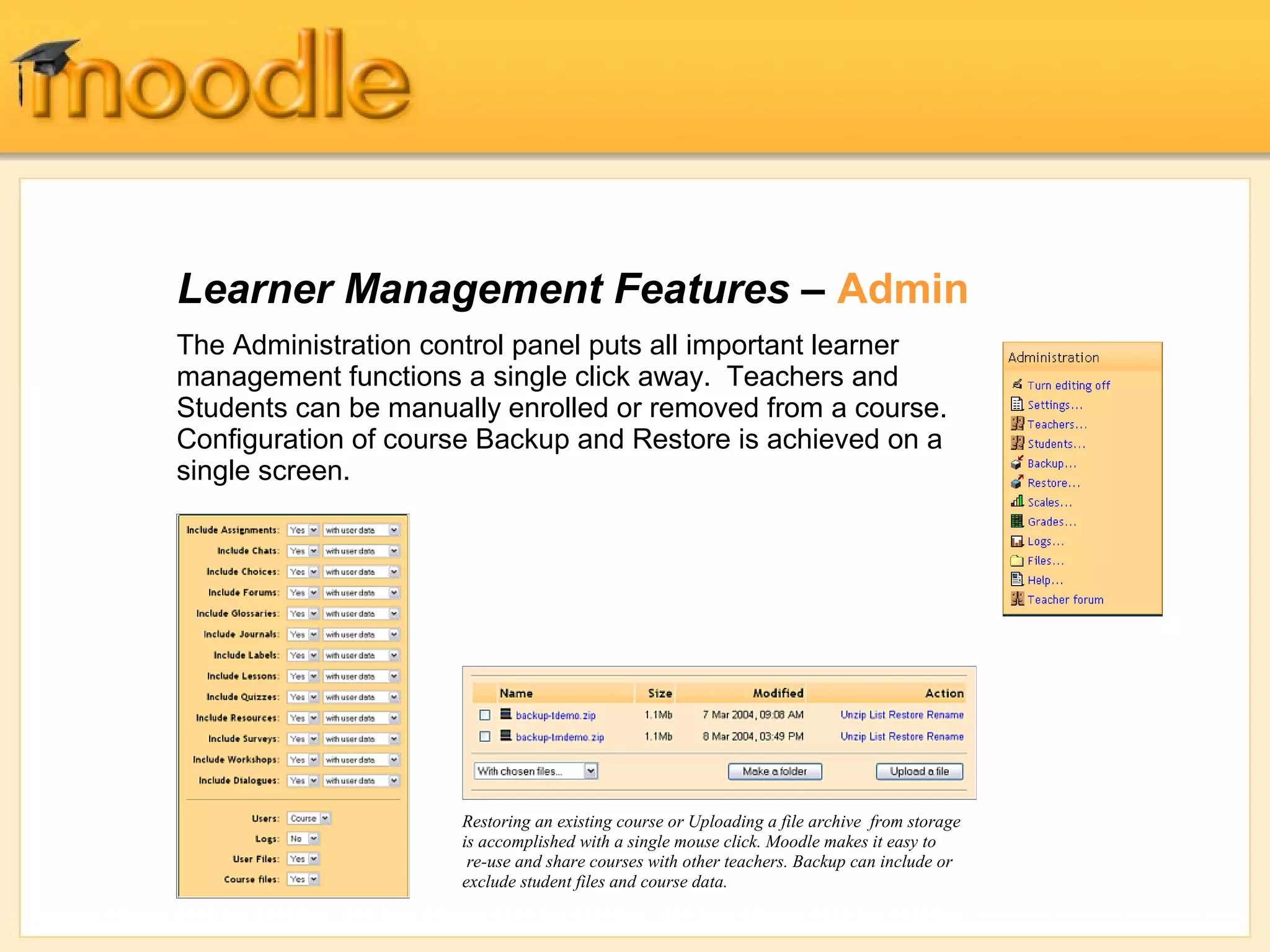
Learner Management Features – Admin 
The Administration control panel puts all important learner 
management functions a single click away. Teachers and 
Students can be manually enrolled or removed from a course. 
Configuration of course Backup and Restore is achieved on a 
single screen. 
Restoring an existing course or Uploading a file archive from storage 
is accomplished with a single mouse click. Moodle makes it easy to 
re-use and share courses with other teachers. Backup can include or 
exclude student files and course data.
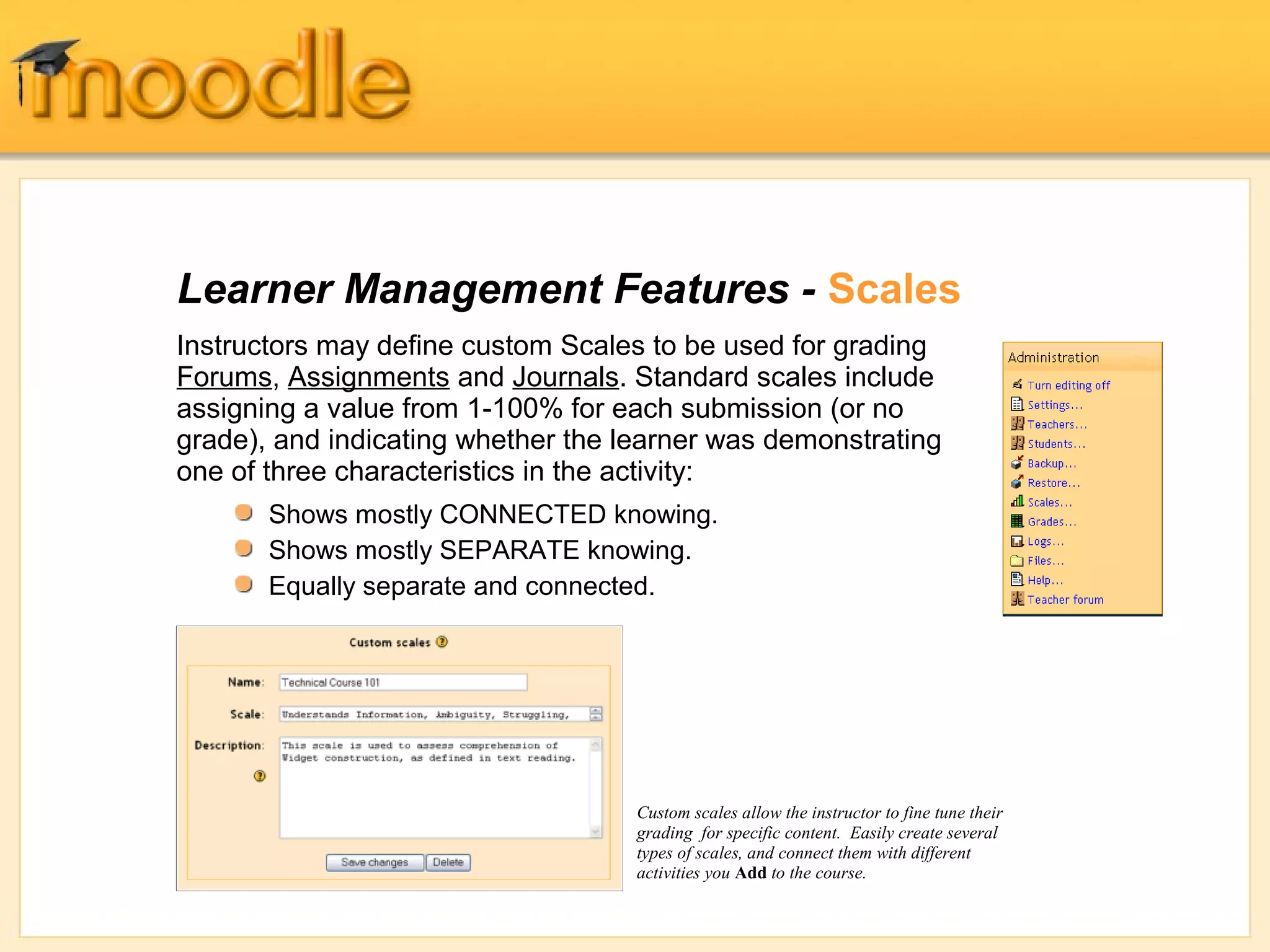
Learner Management Features - Scales 
Instructors may define custom Scales to be used for grading 
Forums, Assignments and Journals. Standard scales include 
assigning a value from 1-100% for each submission (or no 
grade), and indicating whether the learner was demonstrating 
one of three characteristics in the activity: 
Shows mostly CONNECTED knowing. 
Shows mostly SEPARATE knowing. 
Equally separate and connected. 
Custom scales allow the instructor to fine tune their 
grading for specific content. Easily create several 
types of scales, and connect them with different 
activities you Add to the course.
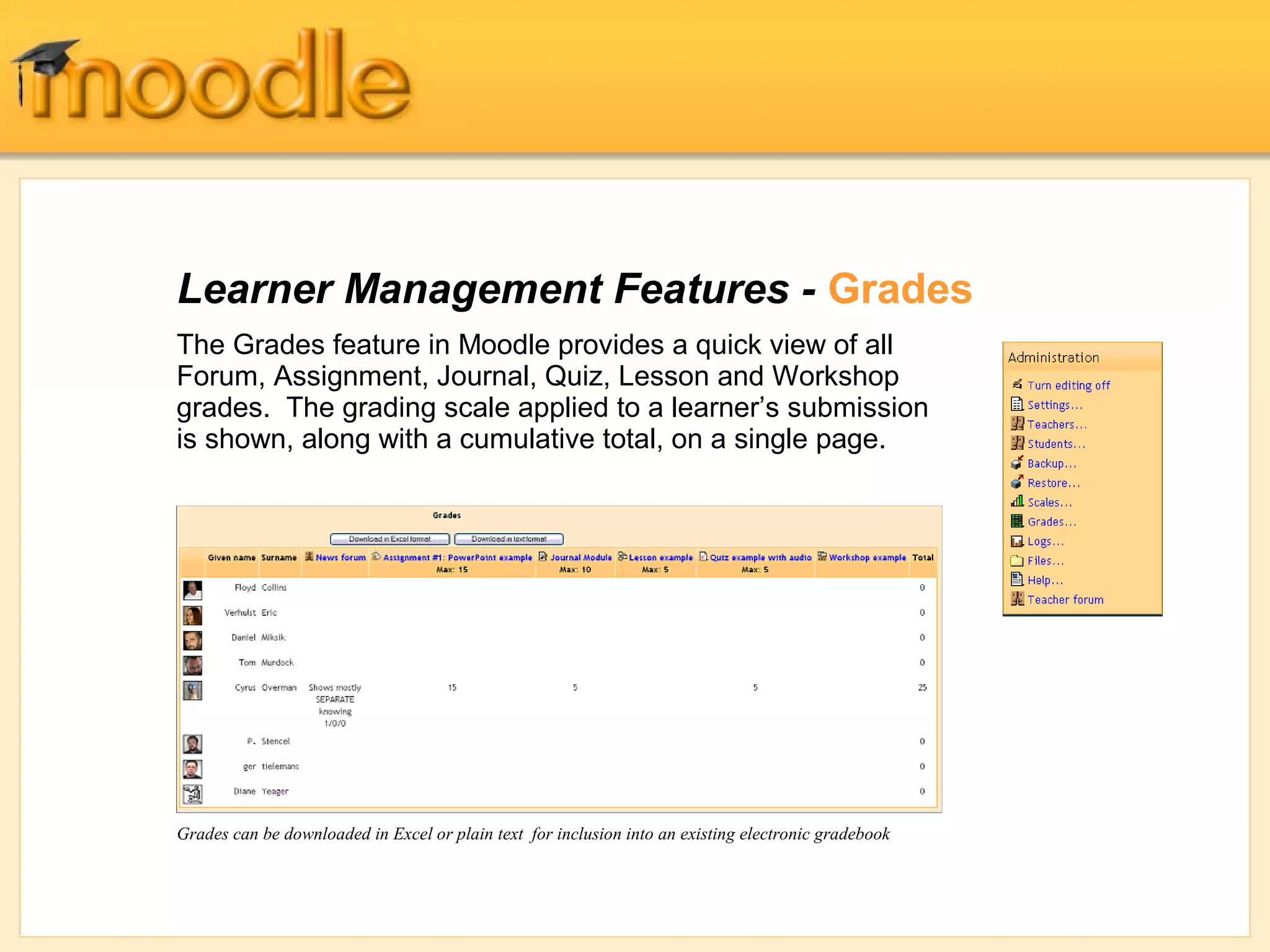
Learner Management Features - Grades 
The Grades feature in Moodle provides a quick view of all 
Forum, Assignment, Journal, Quiz, Lesson and Workshop 
grades. The grading scale applied to a learner’s submission 
is shown, along with a cumulative total, on a single page. 
Grades can be downloaded in Excel or plain text for inclusion into an existing electronic gradebook
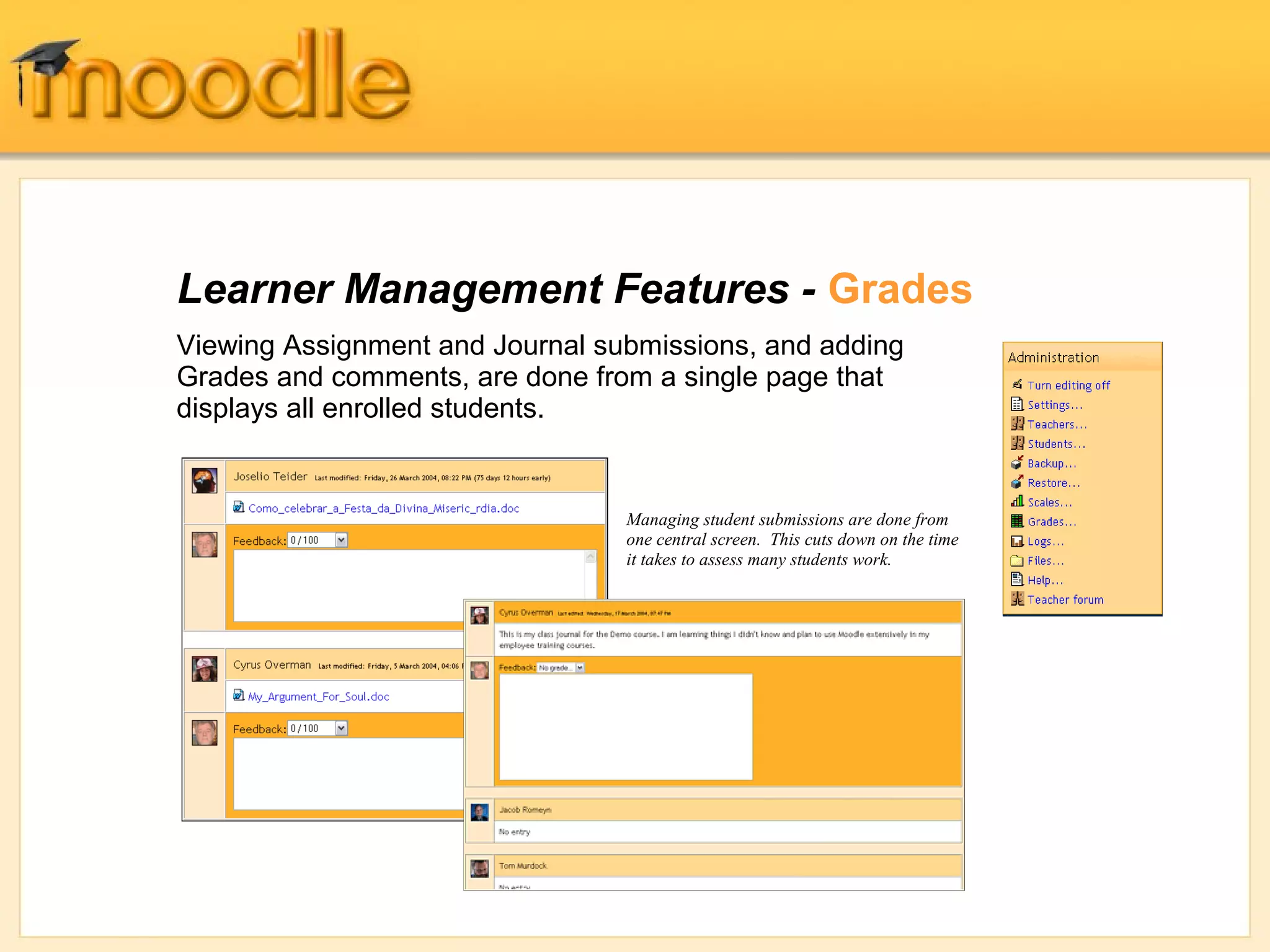
Learner Management Features - Grades 
Viewing Assignment and Journal submissions, and adding 
Grades and comments, are done from a single page that 
displays all enrolled students. 
Managing student submissions are done from 
one central screen. This cuts down on the time 
it takes to assess many students work.
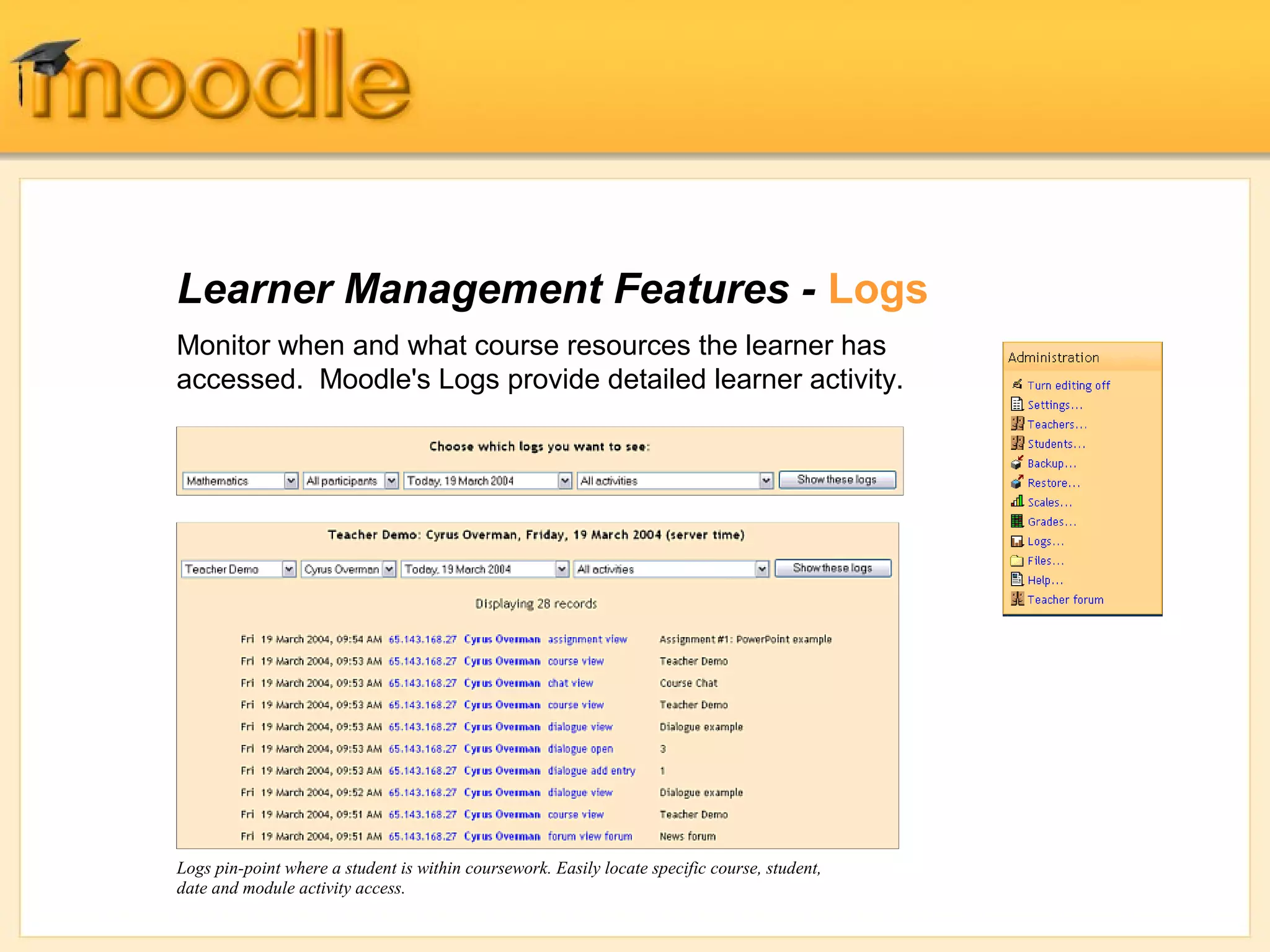
Learner Management Features - Logs 
Monitor when and what course resources the learner has 
accessed. Moodle's Logs provide detailed learner activity. 
Logs pin-point where a student is within coursework. Easily locate specific course, student, 
date and module activity access.
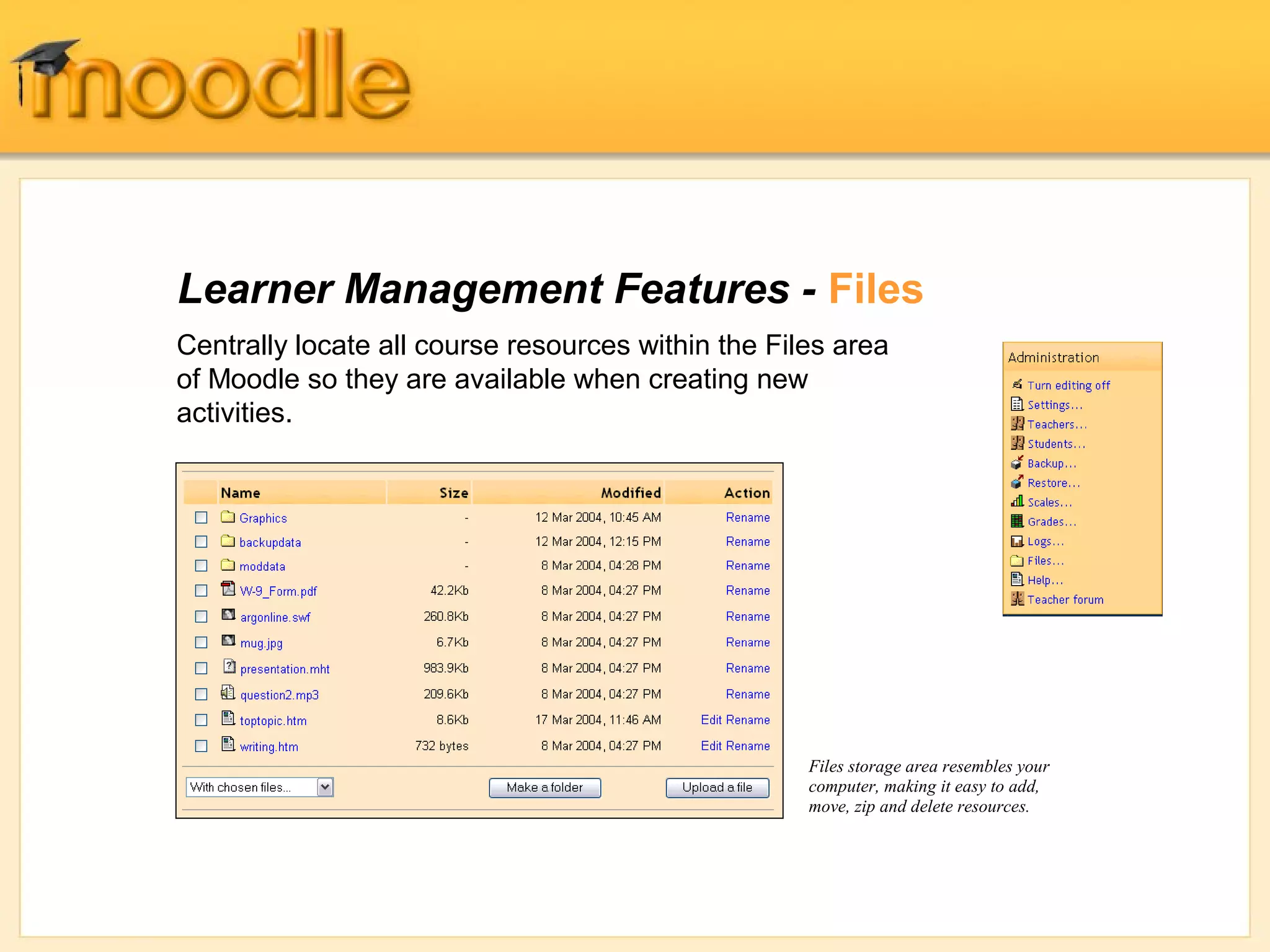
Learner Management Features - Files 
Centrally locate all course resources within the Files area 
of Moodle so they are available when creating new 
activities. 
Files storage area resembles your 
computer, making it easy to add, 
move, zip and delete resources.
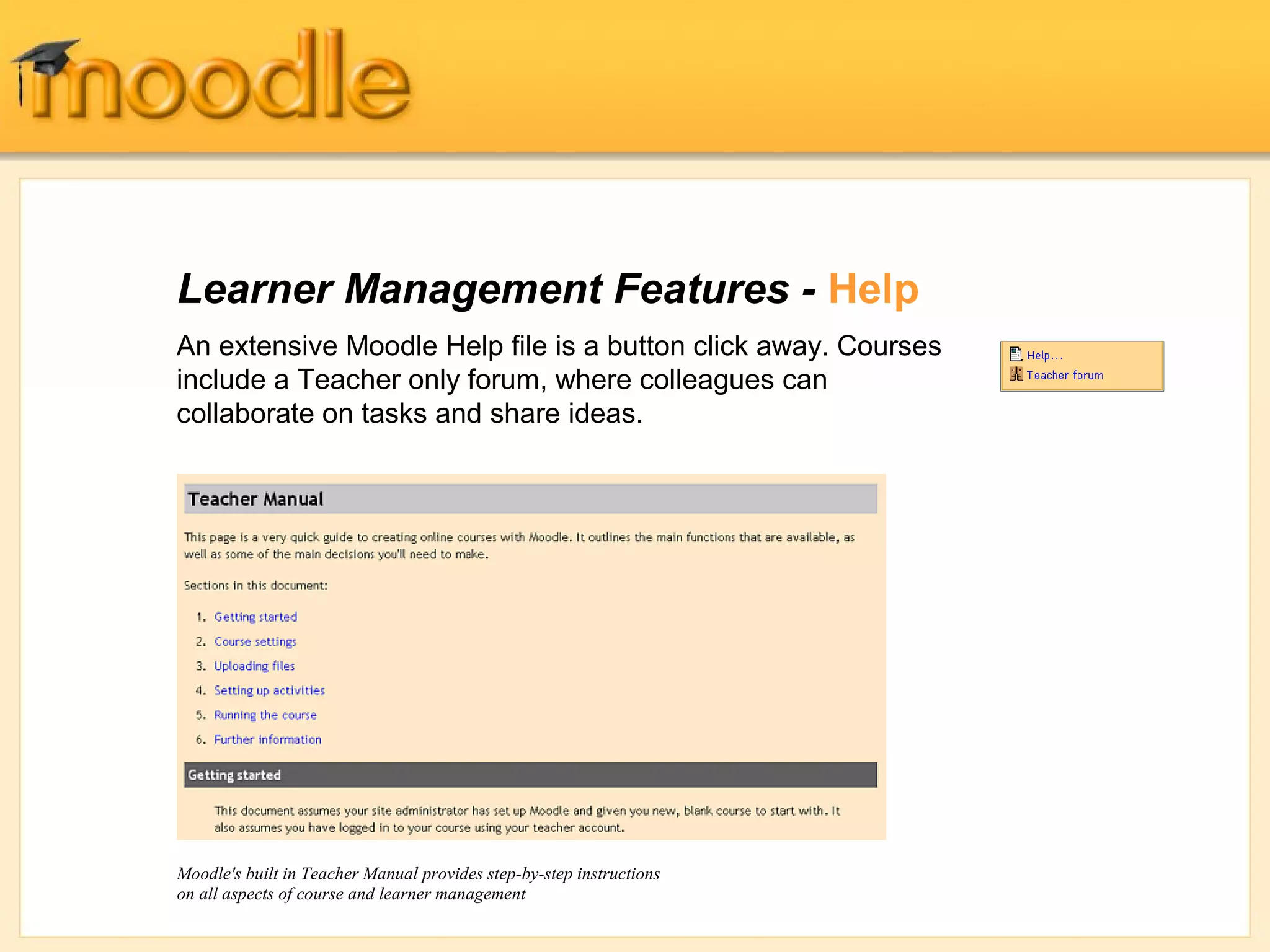
Learner Management Features - Help 
An extensive Moodle Help file is a button click away. Courses 
include a Teacher only forum, where colleagues can 
collaborate on tasks and share ideas. 
Moodle's built in Teacher Manual provides step-by-step instructions 
on all aspects of course and learner management
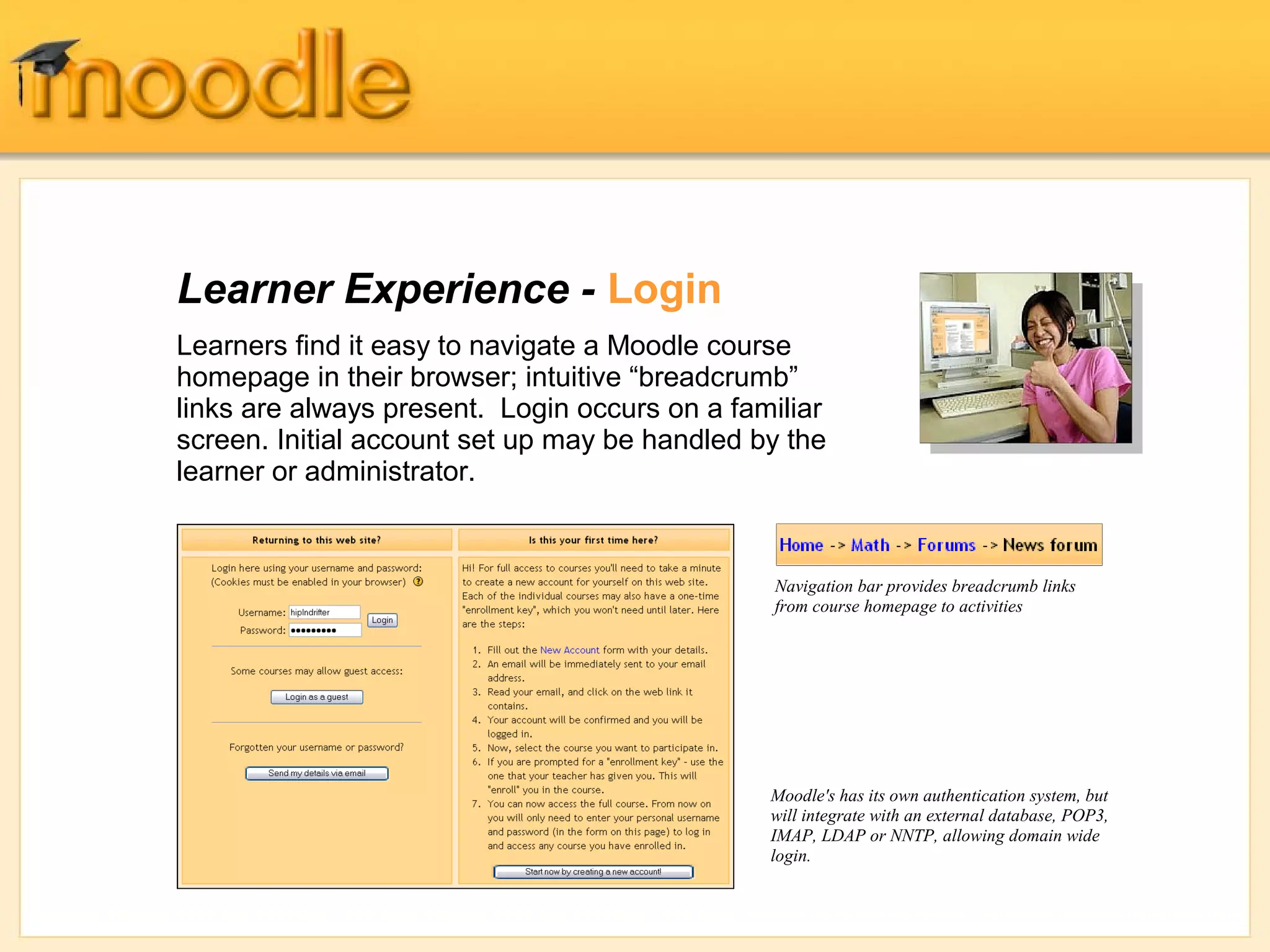
Learner Experience - Login 
Learners find it easy to navigate a Moodle course 
homepage in their browser; intuitive “breadcrumb” 
links are always present. Login occurs on a familiar 
screen. Initial account set up may be handled by the 
learner or administrator. 
Navigation bar provides breadcrumb links 
from course homepage to activities 
Moodle's has its own authentication system, but 
will integrate with an external database, POP3, 
IMAP, LDAP or NNTP, allowing domain wide 
login.
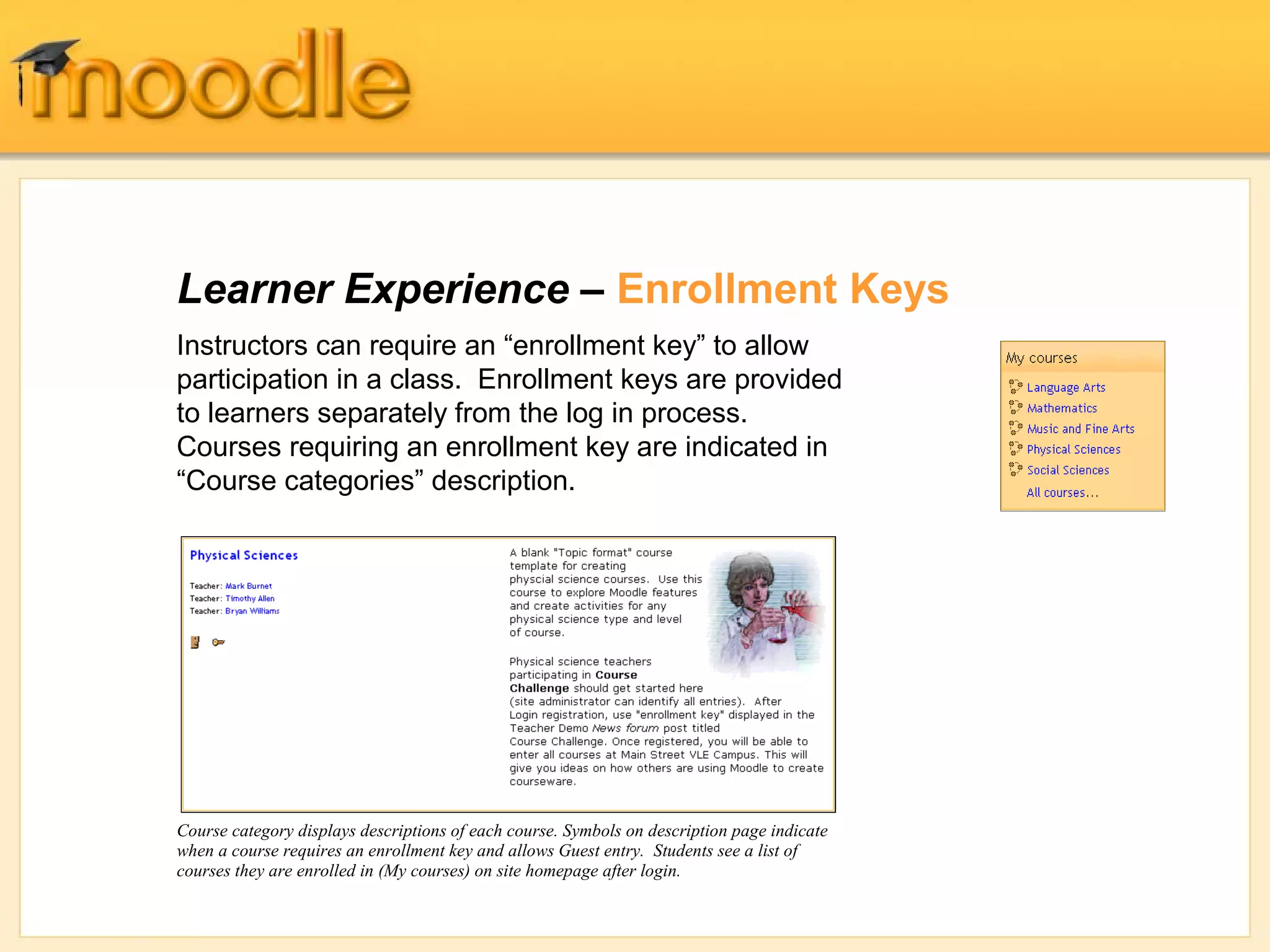
Learner Experience – Enrollment Keys 
Instructors can require an “enrollment key” to allow 
participation in a class. Enrollment keys are provided 
to learners separately from the log in process. 
Courses requiring an enrollment key are indicated in 
“Course categories” description. 
Course category displays descriptions of each course. Symbols on description page indicate 
when a course requires an enrollment key and allows Guest entry. Students see a list of 
courses they are enrolled in (My courses) on site homepage after login.
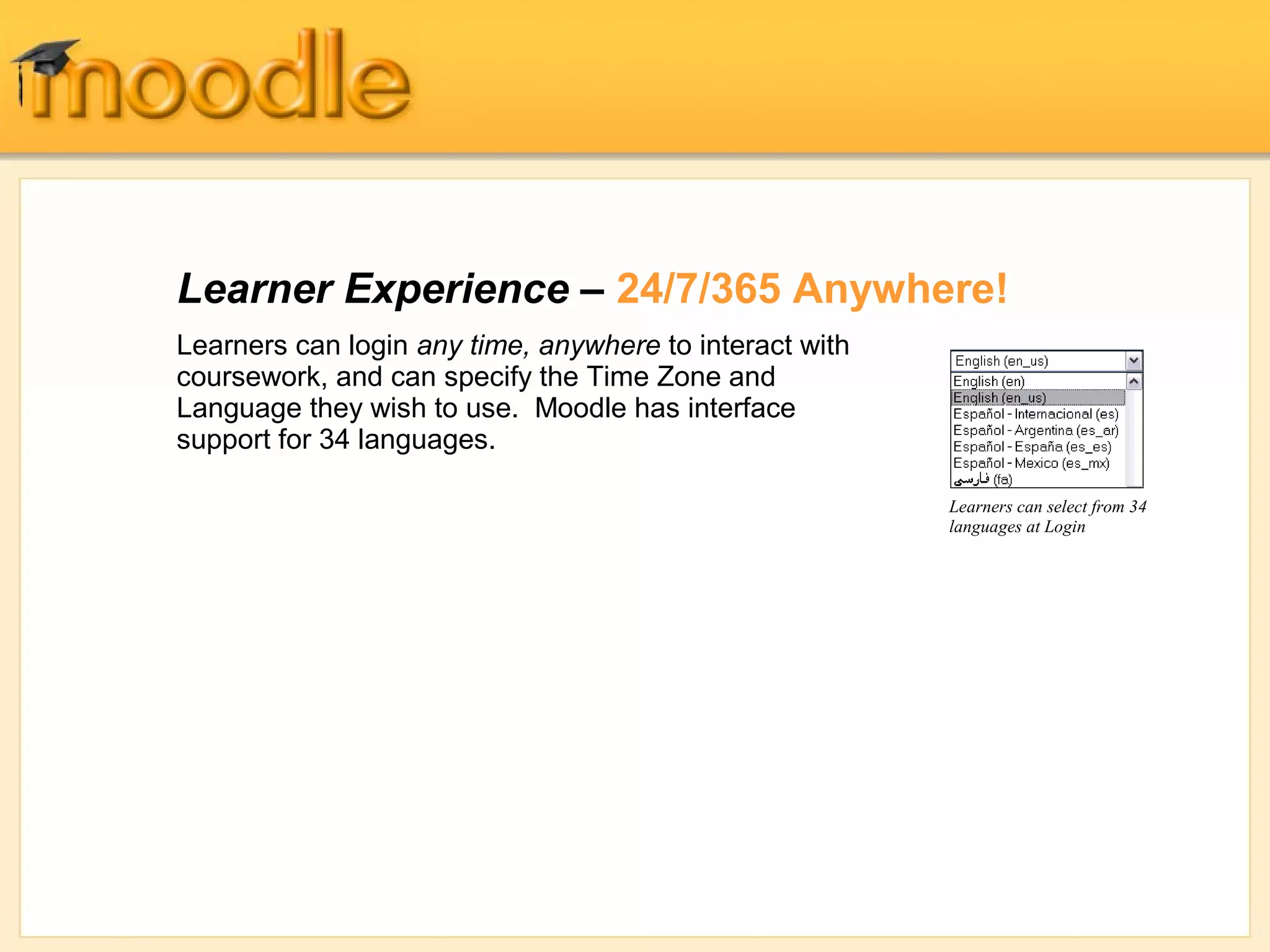
Learner Experience – 24/7/365 Anywhere! 
Learners can select from 34 
languages at Login 
Learners can login any time, anywhere to interact with 
coursework, and can specify the Time Zone and 
Language they wish to use. Moodle has interface 
support for 34 languages.
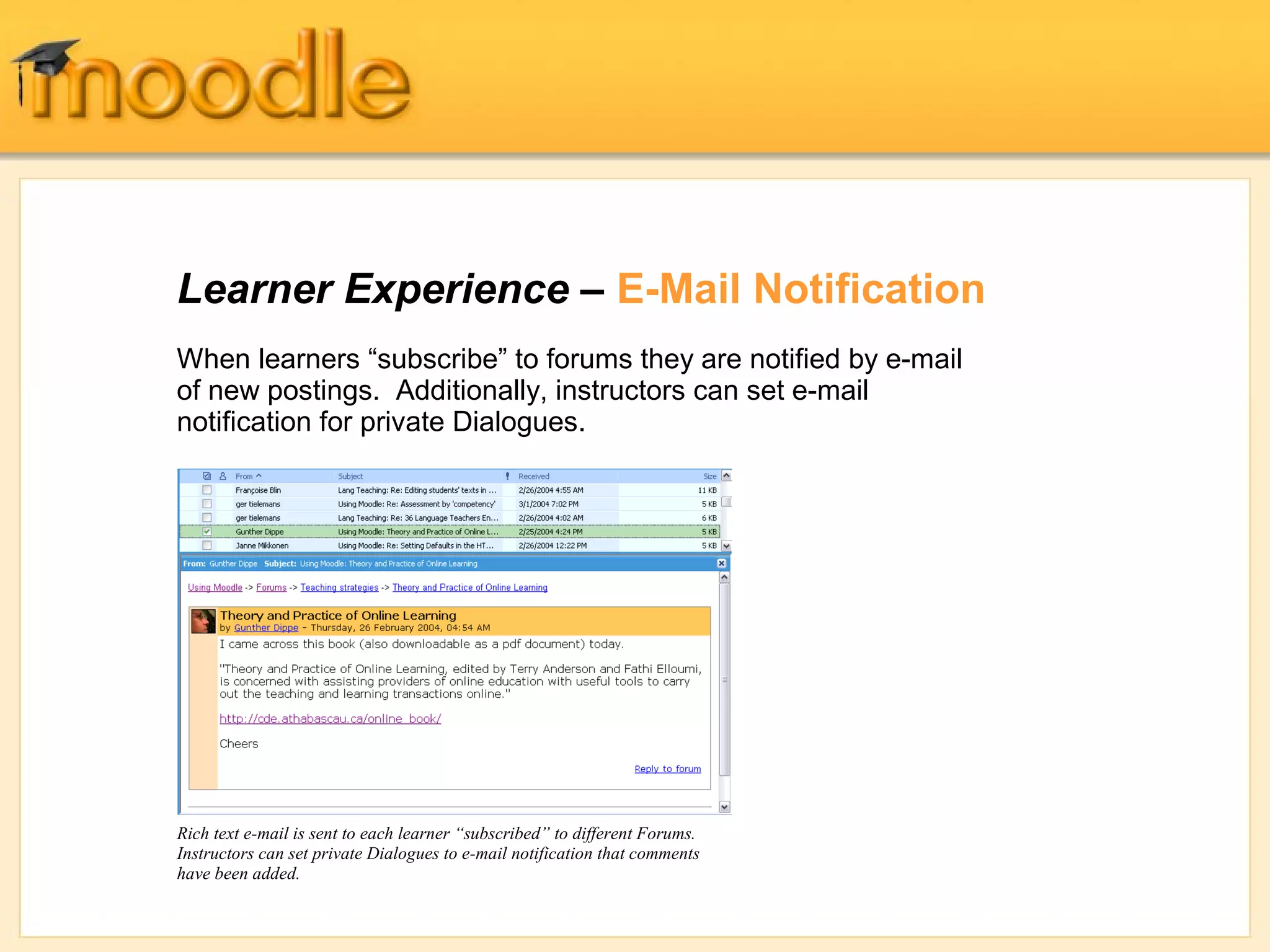
Learner Experience – E-Mail Notification 
When learners “subscribe” to forums they are notified by e-mail 
of new postings. Additionally, instructors can set e-mail 
notification for private Dialogues. 
Rich text e-mail is sent to each learner “subscribed” to different Forums. 
Instructors can set private Dialogues to e-mail notification that comments 
have been added.
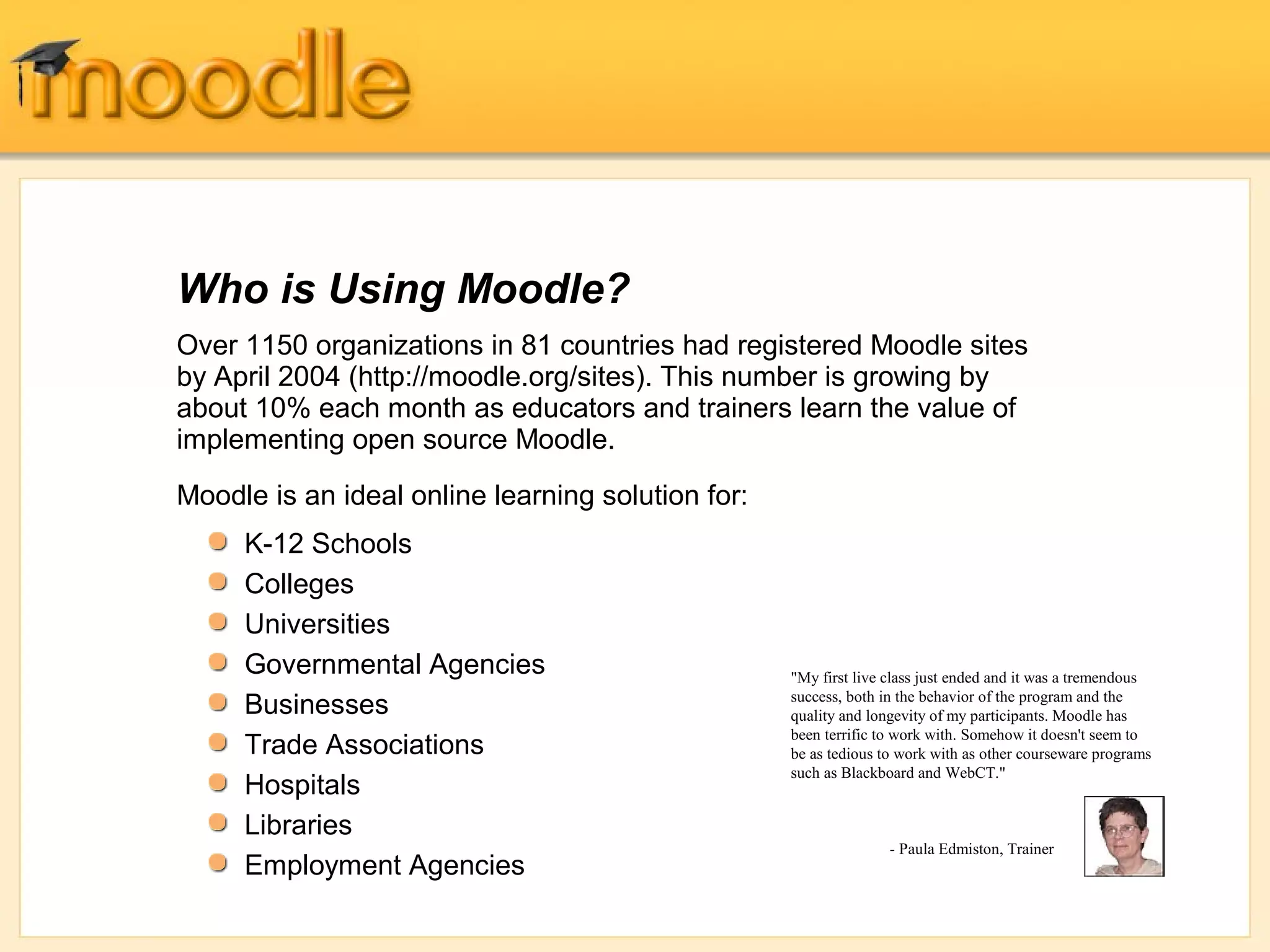
Who is Using Moodle? 
Over 1150 organizations in 81 countries had registered Moodle sites 
by April 2004 (http://moodle.org/sites). This number is growing by 
about 10% each month as educators and trainers learn the value of 
implementing open source Moodle. 
Moodle is an ideal online learning solution for: 
"My first live class just ended and it was a tremendous 
success, both in the behavior of the program and the 
quality and longevity of my participants. Moodle has 
been terrific to work with. Somehow it doesn't seem to 
be as tedious to work with as other courseware programs 
such as Blackboard and WebCT." 
- Paula Edmiston, Trainer 
K-12 Schools 
Colleges 
Universities 
Governmental Agencies 
Businesses 
Trade Associations 
Hospitals 
Libraries 
Employment Agencies
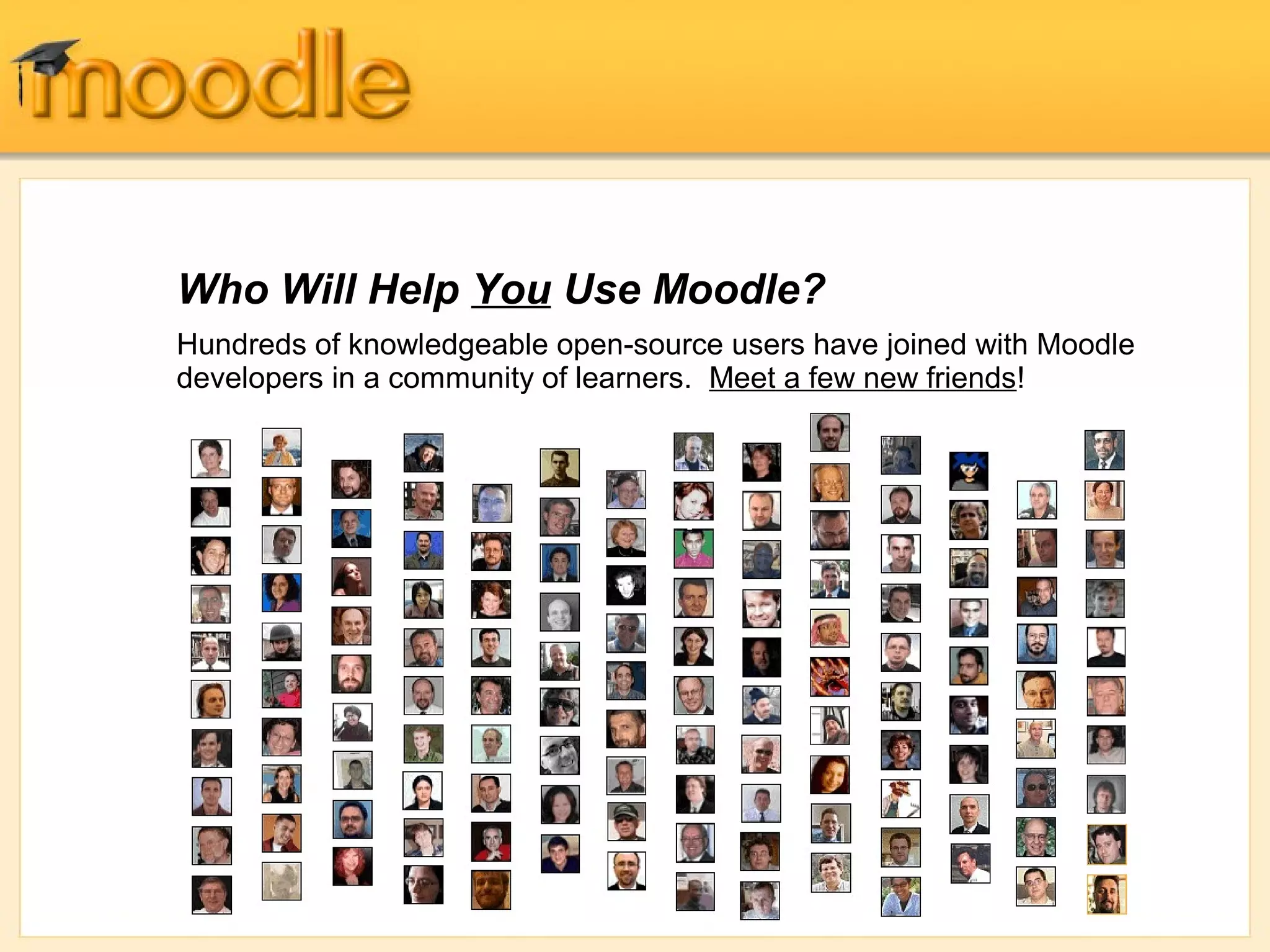
Who Will Help You Use Moodle? 
Hundreds of knowledgeable open-source users have joined with Moodle 
developers in a community of learners. Meet a few new friends!
Why Not Try Moodle Right Now? 
If your organization is ready or needs to support an 
online learning population, here is an opportunity to 
take your research to the next level. These Moodle 
sites are open for you to explore either as a learner, 
or teacher with course creator privileges. 
Using Moodle: http://moodle.org/course/category.php?id=1 
Moodle For Language Teaching: http://moodle.org/course/category.php?id=1 
What is Open Source Software: http://moodle.org/course/category.php?id=2 
Teachers Playground Demo: http://moodle.org/course/category.php?id=2 
Developer Team Support: http://moodle.com

Presentation en

  • 1.
    If you arean educator or business trainer, you have probably heard all the talk about...... 21st Century Schools Social Software and e-Learning
  • 2.
    When the buzzdies down and it's time to do something for your organization, what do you want from an online learning system? Easy creation of courses from existing resources? Course content which can be re-used with different learners, including content from other vendors (Blackboard, WebCT etc.)? Learner involvement? Enrollment and learner authentication which is simple yet secure? Intuitive online learner and teacher management features? An active support community to help solve problems and generate new ideas? Affordability?
  • 3.
    Introducing...... Moodle! Moodleis an alternative to proprietary commercial online learning solutions, and is distributed free under open source licensing. An organization has complete access to the source code and can make changes if needed. Moodle’s modular design makes it easy to create new courses, adding content that will engage learners. Moodle’s intuitive interface makes it easy for instructors to create courses. Students require only basic browser skills to begin learning. modular object-oriented dynamic learning environment
  • 4.
    Moodle Architecture Activitiesare at the heart of a course management system. Moodle was designed by an educator and computer scientist, with “social constructionist” principles in mind. “Constructionism asserts that learning is particularly effective when constructing something for others to experience. This can be anything from a spoken sentence or an internet posting, to more complex artifacts like a painting, a house or a software package. The concept of social constructivism extends the above ideas into a social group constructing things for one another, collaboratively creating a small culture of shared artifacts with shared meanings. When one is immersed within a culture like this, one is learning all the time about how to be a part of that culture, on many levels.” Martin Dougiamas Creator & Lead Developer
  • 5.
    Promoting Learner Involvement “A constructivist perspective views learners as actively engaged in making meaning, and teaching with that approach looks for what students can analyze, investigate, collaborate, share, build and generate based on what they already know, rather than what facts, skills, and processes they can parrot. Some of the tenets of constructivism in pedagogical terms include:” Students come to class with an established world-view, formed by years of prior experience and learning. Even as it evolves, a student’s world-view filters all experiences and affects their interpretations of observations. For students to change their world-view requires work. Students learn from each other as well as the teacher. Students learn better by doing. Allowing and creating opportunities for all to have a voice promotes the construction of new ideas.
  • 6.
    Getting Started Moodlehas a “modular” design so adding the Activities that form a course is a simple process: 1. Course creation privileges are assigned to the teacher. 2. Select from one of three course layout; Topic, Weekly or Social format. 3. Click “Turn editing on” within the blank course template. 4. Create the course! With editing turned on, the course creator can now Add activities from an intuitive drop-down list of module plug-in features.
  • 7.
    Course Management Features- Modules Assignment Used to assign online or offline tasks; learners can submit tasks in any file format (e.g. MS Office, PDF, image, a/v etc.). Chat Allows real-time synchronous communication by learners. Choice Instructors create a question and a number of choices for learners; results are posted for learners to view. Use this module to do quick surveys on subject matter. Dialogue Property screens guide instructor through setup when creating a new Assignment Assignment activity can require the learner to upload a completed project. Allows for one-to-one asynchronous message exchange between instructor and learner, or learner to learner.
  • 8.
    Course Management Features- Modules Forums Threaded discussion boards for asynchronous group exchange on shared subject matter. Participation in forums can be an integral part of the learning experience, helping students define and evolve their understanding of subject matter. Students can Rate a forum post, based on Scales set up by the course creator
  • 9.
    Course Management Features- Modules Glossary Create a glossary of terms used in a course. Has display format options including entry list, encyclopedia, FAQ, dictionary style and more. Journal Learners reflect, record and revise ideas. Label Add descriptions with images in any area of the course homepage. Lesson Allows instructor to create and manage a set of linked "Pages". Each page can end with a question. The student chooses one answer from a set of answers and either goes forward, backward or stays in the same place in the lesson. Glossary terms appear in highlight within all activity resources. Moodle includes its own site search engine.
  • 10.
    Course Management Features- Modules Quiz Create all the familiar forms of assessment including true-false, multiple choice, short answer, matching question, random questions, numerical questions, embedded answer questions with descriptive text and graphics. Instructors have granular control in defining course assessments, and can import quiz questions from popular formats like Blackboard, IMS QTI and WebCT. Moodle also supports embedding audio into a quiz.
  • 11.
    Course Management Features- Modules Resource The primary tool for bringing content into a course; may be plain text, uploaded files, links to the web, Wiki or Rich Text (Moodle has built-in text editors) or a bibliography type reference. Survey This module aids an instructor in making online classes more effective by offering a variety of surveys (COLLES, ATTLS), including critical incident sampling. Workshop An activity for peer assessment of documents (Word, PP etc.) that students submit online. Participants can assess each other’s project. Teacher makes final student assessment, and can control opening and closing periods. Moodle supports adding math expressions to a Resource activity, using the built-in HTML editor
  • 12.
    Learner Management Features Creating learning content is only part of what a good course management system (CMS) must do. The CMS must manage learners in a variety of ways. Learner management includes: Access to information about learners in a course. Ability to segment participants into groups. Site, course and user calendar event scheduling. And so much more…e.g. applying scales to different learner activities, managing grades, tracking user access logs and uploading external files for use within the course etc.
  • 13.
    Learner Management Features– Participants One click and you can view activity from all participants enrolled in the course. Learners create a personal profile that can include a picture, helping connect students socially in the online learning community. Learners complete a personal profile page that helps build the online learning community. Adding a picture and details to the profile creates a social connection.
  • 14.
    Learner Management Features- Groups Assigning learners to a group is a common practice in education and business. Moodle allows the course instructor to easily create group categories, and determine how members will interact with each other and within various activities. Creating distinct group names is easy. Learners and teachers are assigned to a group by clicking a single button.
  • 15.
    Learner Management Features- Calendar Keeping a calendar of events is important to both the learner and course instructor. Events can be created for different categories, including: Global events that appear in all courses (system admin). Course events set by an instructor. Group events set by instructor relative only to a group. User events set by learner (e.g. due dates, personal etc.). Upcoming Events appear on the course homepage, alerting the learner across all courses they are enrolled in of different category events. Alerts are color-coded by category.
  • 16.
    Learner Management Features– Admin The Administration control panel puts all important learner management functions a single click away. Teachers and Students can be manually enrolled or removed from a course. Configuration of course Backup and Restore is achieved on a single screen. Restoring an existing course or Uploading a file archive from storage is accomplished with a single mouse click. Moodle makes it easy to re-use and share courses with other teachers. Backup can include or exclude student files and course data.
  • 17.
    Learner Management Features- Scales Instructors may define custom Scales to be used for grading Forums, Assignments and Journals. Standard scales include assigning a value from 1-100% for each submission (or no grade), and indicating whether the learner was demonstrating one of three characteristics in the activity: Shows mostly CONNECTED knowing. Shows mostly SEPARATE knowing. Equally separate and connected. Custom scales allow the instructor to fine tune their grading for specific content. Easily create several types of scales, and connect them with different activities you Add to the course.
  • 18.
    Learner Management Features- Grades The Grades feature in Moodle provides a quick view of all Forum, Assignment, Journal, Quiz, Lesson and Workshop grades. The grading scale applied to a learner’s submission is shown, along with a cumulative total, on a single page. Grades can be downloaded in Excel or plain text for inclusion into an existing electronic gradebook
  • 19.
    Learner Management Features- Grades Viewing Assignment and Journal submissions, and adding Grades and comments, are done from a single page that displays all enrolled students. Managing student submissions are done from one central screen. This cuts down on the time it takes to assess many students work.
  • 20.
    Learner Management Features- Logs Monitor when and what course resources the learner has accessed. Moodle's Logs provide detailed learner activity. Logs pin-point where a student is within coursework. Easily locate specific course, student, date and module activity access.
  • 21.
    Learner Management Features- Files Centrally locate all course resources within the Files area of Moodle so they are available when creating new activities. Files storage area resembles your computer, making it easy to add, move, zip and delete resources.
  • 22.
    Learner Management Features- Help An extensive Moodle Help file is a button click away. Courses include a Teacher only forum, where colleagues can collaborate on tasks and share ideas. Moodle's built in Teacher Manual provides step-by-step instructions on all aspects of course and learner management
  • 23.
    Learner Experience -Login Learners find it easy to navigate a Moodle course homepage in their browser; intuitive “breadcrumb” links are always present. Login occurs on a familiar screen. Initial account set up may be handled by the learner or administrator. Navigation bar provides breadcrumb links from course homepage to activities Moodle's has its own authentication system, but will integrate with an external database, POP3, IMAP, LDAP or NNTP, allowing domain wide login.
  • 24.
    Learner Experience –Enrollment Keys Instructors can require an “enrollment key” to allow participation in a class. Enrollment keys are provided to learners separately from the log in process. Courses requiring an enrollment key are indicated in “Course categories” description. Course category displays descriptions of each course. Symbols on description page indicate when a course requires an enrollment key and allows Guest entry. Students see a list of courses they are enrolled in (My courses) on site homepage after login.
  • 25.
    Learner Experience –24/7/365 Anywhere! Learners can select from 34 languages at Login Learners can login any time, anywhere to interact with coursework, and can specify the Time Zone and Language they wish to use. Moodle has interface support for 34 languages.
  • 26.
    Learner Experience –E-Mail Notification When learners “subscribe” to forums they are notified by e-mail of new postings. Additionally, instructors can set e-mail notification for private Dialogues. Rich text e-mail is sent to each learner “subscribed” to different Forums. Instructors can set private Dialogues to e-mail notification that comments have been added.
  • 27.
    Who is UsingMoodle? Over 1150 organizations in 81 countries had registered Moodle sites by April 2004 (http://moodle.org/sites). This number is growing by about 10% each month as educators and trainers learn the value of implementing open source Moodle. Moodle is an ideal online learning solution for: "My first live class just ended and it was a tremendous success, both in the behavior of the program and the quality and longevity of my participants. Moodle has been terrific to work with. Somehow it doesn't seem to be as tedious to work with as other courseware programs such as Blackboard and WebCT." - Paula Edmiston, Trainer K-12 Schools Colleges Universities Governmental Agencies Businesses Trade Associations Hospitals Libraries Employment Agencies
  • 28.
    Who Will HelpYou Use Moodle? Hundreds of knowledgeable open-source users have joined with Moodle developers in a community of learners. Meet a few new friends!
  • 29.
    Why Not TryMoodle Right Now? If your organization is ready or needs to support an online learning population, here is an opportunity to take your research to the next level. These Moodle sites are open for you to explore either as a learner, or teacher with course creator privileges. Using Moodle: http://moodle.org/course/category.php?id=1 Moodle For Language Teaching: http://moodle.org/course/category.php?id=1 What is Open Source Software: http://moodle.org/course/category.php?id=2 Teachers Playground Demo: http://moodle.org/course/category.php?id=2 Developer Team Support: http://moodle.com