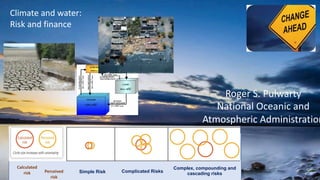
Roger S. Pulwarty
National Oceanic and
Atmospheric Administration
Climate and water:
Risk and finance
Simple Risk Complicated Risks
Complex, compounding and
cascading risks
Calculated
risk Perceived
risk
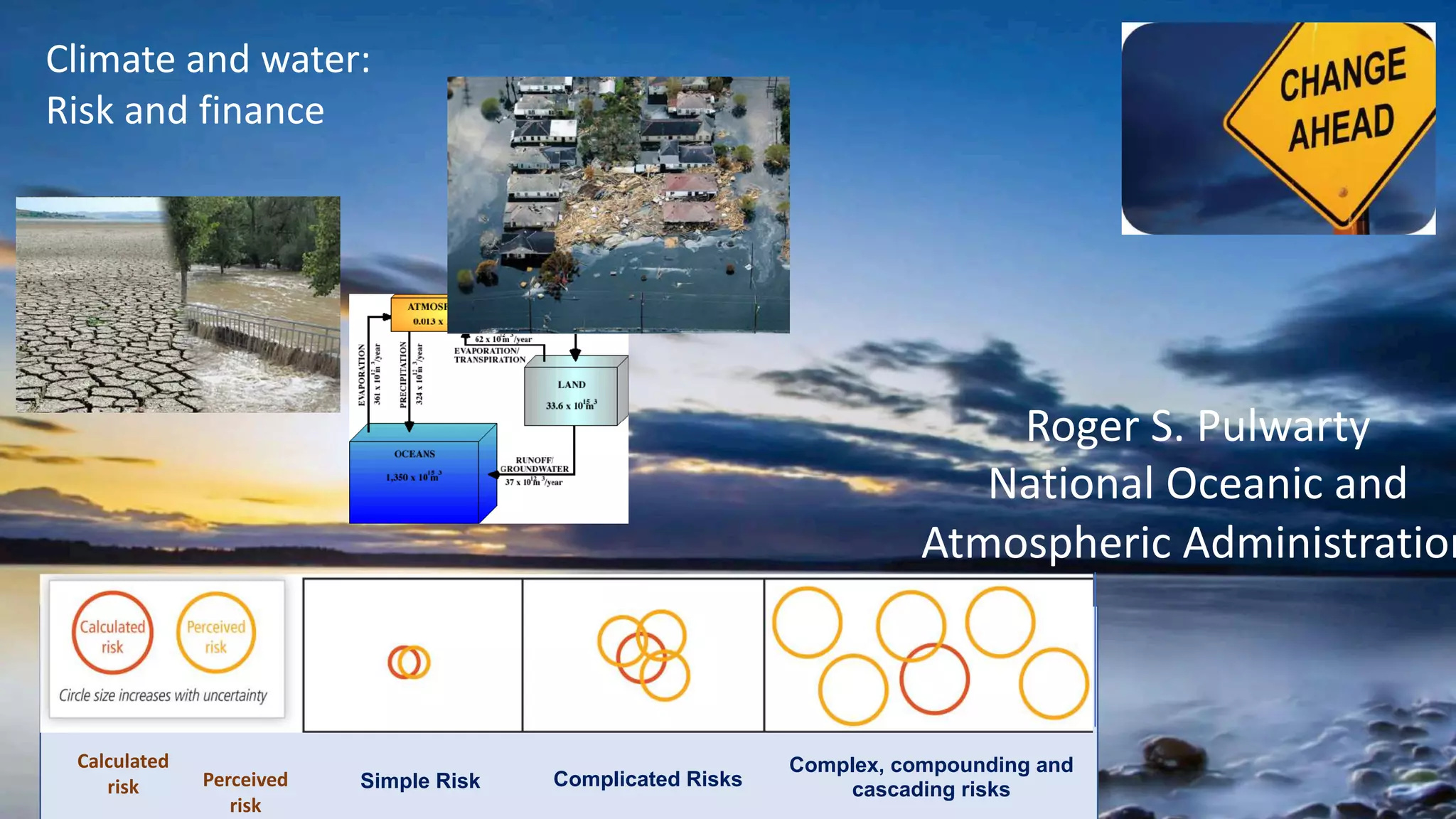
Climate change reinforces existing inequalities and threatens basic
needs, such as food, water, health, shelter, economic security and
collective peace worldwide.
2021
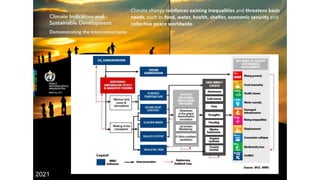
IPCC 2021 Change in drought, heavy precipitation and
soil moisture deficit and confidence in human
contribution (West: increase, medium confidence)
However……………
4
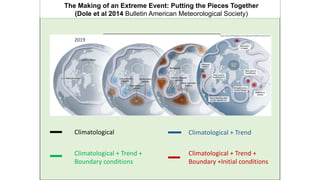
The Making of an Extreme Event: Putting the Pieces Together
(Dole et al 2014 Bulletin American Meteorological Society)
Climatological Climatological + Trend
Climatological + Trend +
Boundary conditions
Climatological + Trend +
Boundary +Initial conditions
2019
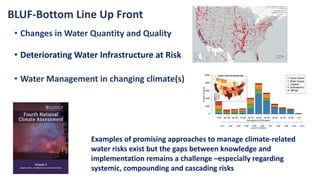
• Changes in Water Quantity and Quality
• Deteriorating Water Infrastructure at Risk
• Water Management in changing climate(s)
Examples of promising approaches to manage climate-related
water risks exist but the gaps between knowledge and
implementation remains a challenge –especially regarding
systemic, compounding and cascading risks
BLUF-Bottom Line Up Front
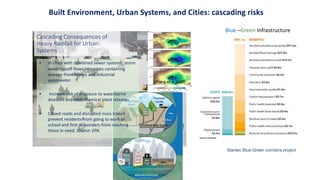
Cascading Consequences of
Heavy Rainfall for Urban
Systems
• In cities with combined sewer systems, storm
water runoff flows into pipes containing
sewage from homes and industrial
wastewater.
• Increase risk of exposure to waterborne
diseases and toxic chemical plant releases
• Closed roads and disrupted mass transit
prevent residents from going to work or
school and first responders from reaching
those in need. Source: EPA.
Built Environment, Urban Systems, and Cities: cascading risks
(Zhang et al 2018)
Stantec Blue Green corridors project
Blue –Green Infrastructure
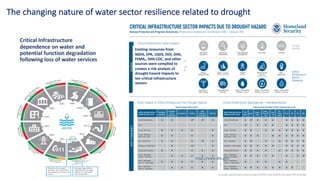
The changing nature of water sector resilience related to drought
Critical Infrastructure
dependence on water and
potential function degradation
following loss of water services
7
CRITICAL INFRASTRUCTURE SECTOR IMPACTS DUE TO DROUGHT HAZARD
National Protection and Programs Directorate Infrastructure Development and Recovery (IDR) | February 2018
Direct Impacts to Critical Infrastructure from Drought Hazards
SERVICE PROVIDER CRITICAL
INFRASTRUCTURE SECTOR
Raw Water
Availability
Raw Water
Quality
Degradation
Dust Storms Flooding
Land
Subsidence
Exacerbation
Wild Fires
Critical Manufacturing ● ● ● ● ●
Dams
Energy - Electricity ● ● ● ● ●
Energy - Petroleum,
Natural Gas + Coal ● ● ● ●
Food + Agriculture ● ● ● ● ●
Healthcare + Public Health ● ● ●
Transportation Systems ● ● ● ● ●
Water + Wastewater
Systems - Raw Water ● ● ● ● ●
Water + Wastewater
Systems - Treated Water ● ● ● ● ● ●
Water + Wastewater
Systems - Wastewater ● ● ● ● ●
DROUGHT HAZARDS, DIRECT IMPACTS
SERVICE PROVIDER CRITICAL
INFRASTRUCTURE SECTOR
Crit.
Manf.
Dams
Energy –
Elect.
Energy -
Petro, NG,
Coal
Food
+ Ag.
HC +
Public
Health
Trans RW TW WW
Critical Manufacturing ● ● ● ● ● ● ● ● ●
Dams ● - ● ● ● ● ● ● ●
Energy - Electricity ● ● - ● ● ● ● ● ● ●
Energy - Petroleum,
Natural Gas + Coal ● ● ● - ● ● ● ● ● ●
Food + Agriculture ● ● ● - ● ● ● ● ●
Healthcare + Public Health ● ● ● ● ● - ● ● ● ●
Transportation Systems ● ● ● ● ● ● ● ● ●
Water + Wastewater
Systems - Raw Water ● ● ● ● ● ● - ● ●
Water + Wastewater
Systems - Treated Water ● ● ● ● ● -
Water + Wastewater
Systems - Wastewater ● ● ● ● ● ● ● ● -
K
E
Y
F
I
N
D
I
N
G
S
*
Dependency
understood
but
not
identified
specifically
by
reference
Critical Infrastructure Dependencies + Interdependences
SERVICE RECEIVER (DEPENDENT) CRITICAL INFRASTRUCTURE SECTOR
This example is generally based on products provided by the Office of Cyber and Infrastructure Analysis, NPPD, list document.
S
C
O
P
E
Critical Infrastructure Sector Impacts
Due to Drought Hazard
Existing resources from NIDIS, EPA, USDA, DOI, DHS, FEMA,
HHS-CDC, and other sources were compiled to create
a risk analysis of drought hazard impacts to critical
infrastructure sectors. The analysis reflects summaries of
identified vulnerabilities of critical infrastructure sectors
to direct exposure of drought hazards, operational impacts
to each sector that contributes to slow down or stoppage
of essential goods and services to meet demand needs,
and indirect/cumulative impacts of dependent sectors
and communities when supply needs cannot be met.
Ten critical infrastructure sectors and subsectors were
investigated in the context of five drought hazards.
Drought
Hazards
RAW WATER
AVAILABILITY
RAW WATER
DEGRADATION
LAND SUBSIDENCE
EXACERBATION
WILD FIRES FLOODING
Critical
Infrastructure
Sectors +
Subsectors
CRITICAL
MANUFACTURING
HEALTHCARE +
PUBLIC HEALTH
DAMS (AS A DEPENDENT
OF WATER + WASTEWATER)
TRANSPORTATION
SYSTEMS
ENERGY
ELECTRICITY
WATER + WASTEWATER
SYSTEMS - RAW WATER
WATER + WASTEWATER
SYSTEMS - TREATED WATER
WATER + WASTEWATER
SYSTEMS - WASTEWATER
ENERGY SECTOR
PETROLEUM,
NATURAL GAS + COAL
FOOD +
AGRICULTURE
https://www.dhs.gov/
Existing resources from
NIDIS, EPA, USDS, DOI, DHS,
FEMA,, HHS-CDC, and other
sources were complied to
creates a risk analysis of
drought hazard impacts to
ten critical infrastructure
sectors
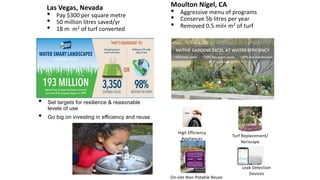
Drought Resiliency Successes
Moulton Nigel, CA
• Aggressive menu of programs
• Conserve 5b litres per year
• Removed 0.5 mil+ m2 of turf
Las Vegas, Nevada
• Pay $300 per square metre
• 50 million litres saved/yr
• 18 m m2 of turf converted
• Set targets for resilience & reasonable
levels of use
• Go big on investing in efficiency and reuse
High Efficiency
Appliances
Turf Replacement/
Xeriscape
Leak Detection
Devices
On-site Non-Potable Reuse
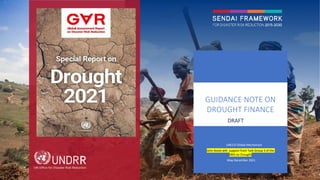
UNCCD Global Mechanism
John Ikeda-wth support from Task Group 3 of the
IWG on Drought
May-December 2021
GUIDANCE NOTE ON
DROUGHT FINANCE
DRAFT
Number of unprecedented
droughts
(UNDRR Special Report on Drought 2021)
rob (robust): a change
significant in sign and in
magnitude, sign (significant):
a change significant in sign, =
or unc (equal or uncertain).
Drought frequency From the unfamiliar to
the unprecedented
© UNDRR – United Nations Office for Disaster Risk Reduction
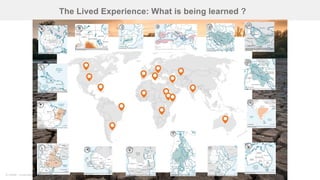
The Lived Experience: What is being learned ?
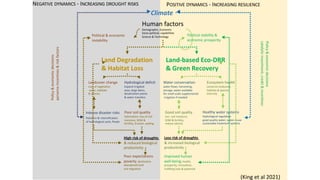
Water conservation
water flows, harvesting,
storage, water available
for small-scale supplemental
irrigation if needed
Ecosystem health
conserve landcover,
habitats & species
diversity
Good soil quality
incr. soil moisture,
SOM & fertility,
reduce salinity
Healthy water systems
Hydrological regulation
good quality water, water reuse
sustainable treatment systems
Landcover change
Loss of vegetation
cover, habitats
& species
Hydrological deficit
Expand irrigated
area, large dams,
desalination plants
& water transfers
Intense disaster risks
Pollution & intensification
of hydrological cycle, floods
Poor soil quality
Salinization, loss of soil
moisture, SOM &
fertility, Erosion, sealing
Less risk of droughts
& increased biological
productivity
Improved human
well-being, health,
prosperity, innovation,
Fulfilling lives & potential
High risk of droughts
& reduced biological
productivity
Poor expectations
poverty, destitution
abandoned land
out-migration
Land Degradation
& Habitat Loss
Land-based Eco-DRR
& Green Recovery
Human factors
Demographic, Economic
Socio-political, capabilities
Science & Technology
Political & economic
instability
Political stability &
economic prosperity
Policy
&
economic
decisions
perverse
incentives
&
risk
factors
Policy
&
economic
decisions
catalytic
investment,
credit
&
incentives
Climate
NEGATIVE DYNAMICS - INCREASING DROUGHT RISKS POSITIVE DYNAMICS - INCREASING RESILIENCE
(King et al 2021)
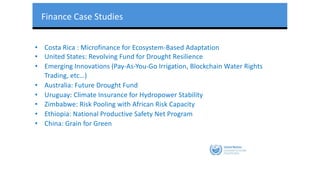
Finance Case Studies
• Costa Rica : Microfinance for Ecosystem-Based Adaptation
• United States: Revolving Fund for Drought Resilience
• Emerging Innovations (Pay-As-You-Go Irrigation, Blockchain Water Rights
Trading, etc…)
• Australia: Future Drought Fund
• Uruguay: Climate Insurance for Hydropower Stability
• Zimbabwe: Risk Pooling with African Risk Capacity
• Ethiopia: National Productive Safety Net Program
• China: Grain for Green
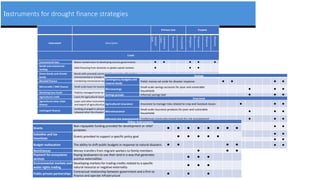
Instruments for drought finance strategies
Primary User Purpose
Instrument Description
National
Govt
Subnationa
l
Govt
Businesses
Households
Mitigation
Preparatio
n
Response
Recovery
Credit
Concessional loan Below-market loans to developing country governments l l l l l
Bonds and commercial
lending
Debt financing from domestic or global capital markets l l l
Green bonds and climate
bonds
Bonds with proceeds earmarked for projects with positive
environmental or climate impact
l l l
Blended finance Combining concessional and commercial finance l l l
Microcredit / SME finance Small-scale loans for businesses and households l l l l
Revolving loan funds Publicly managed funds to support a specific policy goal l l l l l
Agricultural credit Loans for agricultural inputs and equipment l l l l
Agricultural value chain
finance
Loans and other instruments to support the marketing, processing
and export of agricultural products
l l l
Contingent finance
Lending arranged in advance of a natural disaster, with proceeds
released when the disaster occurs
l l l
Savings
Contingency budgets and
reserve funds
Public money set aside for disaster response l l l l
Microsavings
Small-scale savings accounts for poor and vulnerable
households
l l l
Savings groups Informal savings tool l l l
Insurance
Agricultural insurance Insurance to manage risks related to crop and livestock losses l l l
Microinsurance
Small-scale insurance products for poor and vulnerable
households
l l l
Informal risk management Traditional community-based tools for risk management l l l
Business interruption
insurance
Insurance to compensate businesses for lost income if they are
forced to close due to natural disaster
l l l
Sovereign risk insurance Disaster risk insurance for national governments l l l
Risk pools Groups of countries jointly insuring disaster risk l l l
Catastrophe bonds
Insurance-like product to support national governments’
disaster risk management
l l l
Other Instruments
Grants
Non-repayable funding provided for development or relief
purposes
l l l l l l l l
Subsidies and tax
incentives
Grants provided to support a specific policy goal l l l l l
Budget reallocation The ability to shift public budgets in response to natural disasters l l l l
Remittances Money transfers from migrant workers to family members l l l
Payment for ecosystems
services
Paying landowners to use their land in a way that generates
positive externalities
l l l
Environmental markets and
water rights trading
Developing markets for trading credits related to a specific
natural resource or negative externality
l l l
Public-private partnerships
Contractual relationship between government and a firm to
finance and operate infrastructure
l l l
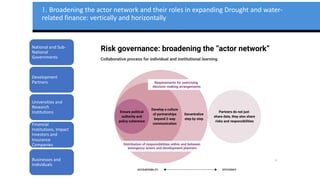
1. Broadening the actor network and their roles in expanding Drought and water-
related finance: vertically and horizontally
National and Sub-
National
Governments
Development
Partners
Universities and
Research
Institutions
Financial
Institutions, Impact
Investors and
Insurance
Companies
Businesses and
Individuals
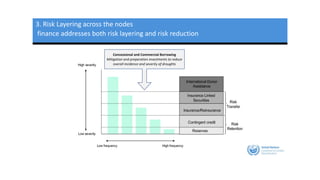
3. Risk Layering across the nodes
finance addresses both risk layering and risk reduction
Concessional and Commercial Borrowing
Mitigation and preparation investments to reduce
overall incidence and severity of droughts
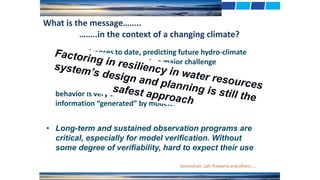
• Long-term and sustained observation programs are
critical, especially for model verification. Without
some degree of verifiability, hard to expect their use
What is the message……..
……..in the context of a changing climate?
Sorooshian, Lall, Pulwarty and others…..
• Despite advances to date, predicting future hydro-climate
variables precisely will remain a major challenge
• Nature is complex and observing and modeling its nonlinear
behavior is very challenging. Esp. reliability of high resolution
information “generated” by models.
tFactoring in resiliency in water resources
system’s design and planning is still the
safest approach
© UNDRR – United Nations Office for Disaster Risk Reduction
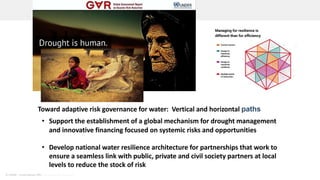
• Support the establishment of a global mechanism for drought management
and innovative financing focused on systemic risks and opportunities
• Develop national water resilience architecture for partnerships that work to
ensure a seamless link with public, private and civil society partners at local
levels to reduce the stock of risk
Toward adaptive risk governance for water: Vertical and horizontal paths
1
9
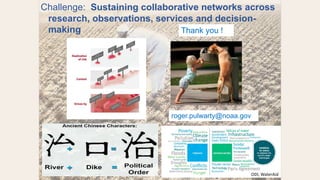
Challenge: Sustaining collaborative networks across
research, observations, services and decision-
making
roger.pulwarty@noaa.gov
Thank you !
ODI, WaterAid

Presentation - Eighth Roundtable on Financing Water - Roger Pulwarty

  • 1.
    Roger S. Pulwarty NationalOceanic and Atmospheric Administration Climate and water: Risk and finance Simple Risk Complicated Risks Complex, compounding and cascading risks Calculated risk Perceived risk
  • 2.
    Climate change reinforcesexisting inequalities and threatens basic needs, such as food, water, health, shelter, economic security and collective peace worldwide. 2021
  • 3.
    IPCC 2021 Changein drought, heavy precipitation and soil moisture deficit and confidence in human contribution (West: increase, medium confidence) However……………
  • 4.
    4 The Making ofan Extreme Event: Putting the Pieces Together (Dole et al 2014 Bulletin American Meteorological Society) Climatological Climatological + Trend Climatological + Trend + Boundary conditions Climatological + Trend + Boundary +Initial conditions 2019
  • 5.
    • Changes inWater Quantity and Quality • Deteriorating Water Infrastructure at Risk • Water Management in changing climate(s) Examples of promising approaches to manage climate-related water risks exist but the gaps between knowledge and implementation remains a challenge –especially regarding systemic, compounding and cascading risks BLUF-Bottom Line Up Front
  • 6.
    Cascading Consequences of HeavyRainfall for Urban Systems • In cities with combined sewer systems, storm water runoff flows into pipes containing sewage from homes and industrial wastewater. • Increase risk of exposure to waterborne diseases and toxic chemical plant releases • Closed roads and disrupted mass transit prevent residents from going to work or school and first responders from reaching those in need. Source: EPA. Built Environment, Urban Systems, and Cities: cascading risks (Zhang et al 2018) Stantec Blue Green corridors project Blue –Green Infrastructure
  • 7.
    The changing natureof water sector resilience related to drought Critical Infrastructure dependence on water and potential function degradation following loss of water services 7 CRITICAL INFRASTRUCTURE SECTOR IMPACTS DUE TO DROUGHT HAZARD National Protection and Programs Directorate Infrastructure Development and Recovery (IDR) | February 2018 Direct Impacts to Critical Infrastructure from Drought Hazards SERVICE PROVIDER CRITICAL INFRASTRUCTURE SECTOR Raw Water Availability Raw Water Quality Degradation Dust Storms Flooding Land Subsidence Exacerbation Wild Fires Critical Manufacturing ● ● ● ● ● Dams Energy - Electricity ● ● ● ● ● Energy - Petroleum, Natural Gas + Coal ● ● ● ● Food + Agriculture ● ● ● ● ● Healthcare + Public Health ● ● ● Transportation Systems ● ● ● ● ● Water + Wastewater Systems - Raw Water ● ● ● ● ● Water + Wastewater Systems - Treated Water ● ● ● ● ● ● Water + Wastewater Systems - Wastewater ● ● ● ● ● DROUGHT HAZARDS, DIRECT IMPACTS SERVICE PROVIDER CRITICAL INFRASTRUCTURE SECTOR Crit. Manf. Dams Energy – Elect. Energy - Petro, NG, Coal Food + Ag. HC + Public Health Trans RW TW WW Critical Manufacturing ● ● ● ● ● ● ● ● ● Dams ● - ● ● ● ● ● ● ● Energy - Electricity ● ● - ● ● ● ● ● ● ● Energy - Petroleum, Natural Gas + Coal ● ● ● - ● ● ● ● ● ● Food + Agriculture ● ● ● - ● ● ● ● ● Healthcare + Public Health ● ● ● ● ● - ● ● ● ● Transportation Systems ● ● ● ● ● ● ● ● ● Water + Wastewater Systems - Raw Water ● ● ● ● ● ● - ● ● Water + Wastewater Systems - Treated Water ● ● ● ● ● - Water + Wastewater Systems - Wastewater ● ● ● ● ● ● ● ● - K E Y F I N D I N G S * Dependency understood but not identified specifically by reference Critical Infrastructure Dependencies + Interdependences SERVICE RECEIVER (DEPENDENT) CRITICAL INFRASTRUCTURE SECTOR This example is generally based on products provided by the Office of Cyber and Infrastructure Analysis, NPPD, list document. S C O P E Critical Infrastructure Sector Impacts Due to Drought Hazard Existing resources from NIDIS, EPA, USDA, DOI, DHS, FEMA, HHS-CDC, and other sources were compiled to create a risk analysis of drought hazard impacts to critical infrastructure sectors. The analysis reflects summaries of identified vulnerabilities of critical infrastructure sectors to direct exposure of drought hazards, operational impacts to each sector that contributes to slow down or stoppage of essential goods and services to meet demand needs, and indirect/cumulative impacts of dependent sectors and communities when supply needs cannot be met. Ten critical infrastructure sectors and subsectors were investigated in the context of five drought hazards. Drought Hazards RAW WATER AVAILABILITY RAW WATER DEGRADATION LAND SUBSIDENCE EXACERBATION WILD FIRES FLOODING Critical Infrastructure Sectors + Subsectors CRITICAL MANUFACTURING HEALTHCARE + PUBLIC HEALTH DAMS (AS A DEPENDENT OF WATER + WASTEWATER) TRANSPORTATION SYSTEMS ENERGY ELECTRICITY WATER + WASTEWATER SYSTEMS - RAW WATER WATER + WASTEWATER SYSTEMS - TREATED WATER WATER + WASTEWATER SYSTEMS - WASTEWATER ENERGY SECTOR PETROLEUM, NATURAL GAS + COAL FOOD + AGRICULTURE https://www.dhs.gov/ Existing resources from NIDIS, EPA, USDS, DOI, DHS, FEMA,, HHS-CDC, and other sources were complied to creates a risk analysis of drought hazard impacts to ten critical infrastructure sectors
  • 8.
    Drought Resiliency Successes MoultonNigel, CA • Aggressive menu of programs • Conserve 5b litres per year • Removed 0.5 mil+ m2 of turf Las Vegas, Nevada • Pay $300 per square metre • 50 million litres saved/yr • 18 m m2 of turf converted • Set targets for resilience & reasonable levels of use • Go big on investing in efficiency and reuse High Efficiency Appliances Turf Replacement/ Xeriscape Leak Detection Devices On-site Non-Potable Reuse
  • 9.
    UNCCD Global Mechanism JohnIkeda-wth support from Task Group 3 of the IWG on Drought May-December 2021 GUIDANCE NOTE ON DROUGHT FINANCE DRAFT
  • 10.
    Number of unprecedented droughts (UNDRRSpecial Report on Drought 2021) rob (robust): a change significant in sign and in magnitude, sign (significant): a change significant in sign, = or unc (equal or uncertain). Drought frequency From the unfamiliar to the unprecedented
  • 11.
    © UNDRR –United Nations Office for Disaster Risk Reduction The Lived Experience: What is being learned ?
  • 12.
    Water conservation water flows,harvesting, storage, water available for small-scale supplemental irrigation if needed Ecosystem health conserve landcover, habitats & species diversity Good soil quality incr. soil moisture, SOM & fertility, reduce salinity Healthy water systems Hydrological regulation good quality water, water reuse sustainable treatment systems Landcover change Loss of vegetation cover, habitats & species Hydrological deficit Expand irrigated area, large dams, desalination plants & water transfers Intense disaster risks Pollution & intensification of hydrological cycle, floods Poor soil quality Salinization, loss of soil moisture, SOM & fertility, Erosion, sealing Less risk of droughts & increased biological productivity Improved human well-being, health, prosperity, innovation, Fulfilling lives & potential High risk of droughts & reduced biological productivity Poor expectations poverty, destitution abandoned land out-migration Land Degradation & Habitat Loss Land-based Eco-DRR & Green Recovery Human factors Demographic, Economic Socio-political, capabilities Science & Technology Political & economic instability Political stability & economic prosperity Policy & economic decisions perverse incentives & risk factors Policy & economic decisions catalytic investment, credit & incentives Climate NEGATIVE DYNAMICS - INCREASING DROUGHT RISKS POSITIVE DYNAMICS - INCREASING RESILIENCE (King et al 2021)
  • 13.
    Finance Case Studies •Costa Rica : Microfinance for Ecosystem-Based Adaptation • United States: Revolving Fund for Drought Resilience • Emerging Innovations (Pay-As-You-Go Irrigation, Blockchain Water Rights Trading, etc…) • Australia: Future Drought Fund • Uruguay: Climate Insurance for Hydropower Stability • Zimbabwe: Risk Pooling with African Risk Capacity • Ethiopia: National Productive Safety Net Program • China: Grain for Green
  • 14.
    Instruments for droughtfinance strategies Primary User Purpose Instrument Description National Govt Subnationa l Govt Businesses Households Mitigation Preparatio n Response Recovery Credit Concessional loan Below-market loans to developing country governments l l l l l Bonds and commercial lending Debt financing from domestic or global capital markets l l l Green bonds and climate bonds Bonds with proceeds earmarked for projects with positive environmental or climate impact l l l Blended finance Combining concessional and commercial finance l l l Microcredit / SME finance Small-scale loans for businesses and households l l l l Revolving loan funds Publicly managed funds to support a specific policy goal l l l l l Agricultural credit Loans for agricultural inputs and equipment l l l l Agricultural value chain finance Loans and other instruments to support the marketing, processing and export of agricultural products l l l Contingent finance Lending arranged in advance of a natural disaster, with proceeds released when the disaster occurs l l l Savings Contingency budgets and reserve funds Public money set aside for disaster response l l l l Microsavings Small-scale savings accounts for poor and vulnerable households l l l Savings groups Informal savings tool l l l Insurance Agricultural insurance Insurance to manage risks related to crop and livestock losses l l l Microinsurance Small-scale insurance products for poor and vulnerable households l l l Informal risk management Traditional community-based tools for risk management l l l Business interruption insurance Insurance to compensate businesses for lost income if they are forced to close due to natural disaster l l l Sovereign risk insurance Disaster risk insurance for national governments l l l Risk pools Groups of countries jointly insuring disaster risk l l l Catastrophe bonds Insurance-like product to support national governments’ disaster risk management l l l Other Instruments Grants Non-repayable funding provided for development or relief purposes l l l l l l l l Subsidies and tax incentives Grants provided to support a specific policy goal l l l l l Budget reallocation The ability to shift public budgets in response to natural disasters l l l l Remittances Money transfers from migrant workers to family members l l l Payment for ecosystems services Paying landowners to use their land in a way that generates positive externalities l l l Environmental markets and water rights trading Developing markets for trading credits related to a specific natural resource or negative externality l l l Public-private partnerships Contractual relationship between government and a firm to finance and operate infrastructure l l l
  • 15.
    1. Broadening theactor network and their roles in expanding Drought and water- related finance: vertically and horizontally National and Sub- National Governments Development Partners Universities and Research Institutions Financial Institutions, Impact Investors and Insurance Companies Businesses and Individuals
  • 16.
    3. Risk Layeringacross the nodes finance addresses both risk layering and risk reduction Concessional and Commercial Borrowing Mitigation and preparation investments to reduce overall incidence and severity of droughts
  • 17.
    • Long-term andsustained observation programs are critical, especially for model verification. Without some degree of verifiability, hard to expect their use What is the message…….. ……..in the context of a changing climate? Sorooshian, Lall, Pulwarty and others….. • Despite advances to date, predicting future hydro-climate variables precisely will remain a major challenge • Nature is complex and observing and modeling its nonlinear behavior is very challenging. Esp. reliability of high resolution information “generated” by models. tFactoring in resiliency in water resources system’s design and planning is still the safest approach
  • 18.
    © UNDRR –United Nations Office for Disaster Risk Reduction • Support the establishment of a global mechanism for drought management and innovative financing focused on systemic risks and opportunities • Develop national water resilience architecture for partnerships that work to ensure a seamless link with public, private and civil society partners at local levels to reduce the stock of risk Toward adaptive risk governance for water: Vertical and horizontal paths
  • 19.
    1 9 Challenge: Sustaining collaborativenetworks across research, observations, services and decision- making roger.pulwarty@noaa.gov Thank you ! ODI, WaterAid