slidesmania.com
DECISION
MAKING THEORY
By: Bofel A. Trugillo, MAED
slidesmania.com
Hello! I’m…
Here is where you introduce yourself.
You can add your name, title and a little
background. Right click the image and
replace it with your own.
slidesmania.com
At the end of the discussion, participants will
be able to:
1.Define Decision Making, Decision
Making Theory or Theory of
Rational Choice.
2.Compare and contrast Normative,
Descriptive and Prescriptive
Decision Theories.
3.Identify and define types of
decisions.
slidesmania.com
DECISION MAKING THEORY
● It was first addressed by Herbert Simon in 1948 on his book
about Administrative Behavior: “A Study of Decision-Making
Process in Administrative Organization.
● Decision Making is usually defined as a process or sequence
of activities involving stages of problem recognition, search
of information, the definition of alternatives and selection of
an actor of one from two or more alternatives consistent with
the ranked.
● Decision theory or the theory of rational choice is a branch
of probability, economics, and analytic philosophy that uses the
tools of expected utility and probability to model how individuals
should behave rationally under uncertainty preferences.
slidesmania.com
THE NORMATIVE,
DESCRIPTIVE AND
PRESCRIPTIVE
DECISION THEORY
slidesmania.com
THE NORMATIVE DECISION
THEORY
Normative decision theory is concerned
with identification of optimal decisions
where optimality is often determined by
considering an ideal decision maker who
is able to calculate with perfect accuracy
and is in some sense fully rational.
slidesmania.com
EXAMPLES OF NORMATIVE
DECISION MAKING
1. Leader Decision
2. Individual Consultation
3. Group Consultation
4. Facilitation
5. Delegation
slidesmania.com
1. LEADER DECISION
The leader makes the decision and announces
it to the group. They may gather information
from the group but don't consult the group
regarding the decision itself. For example, an
IT manager who decides a legacy technology
needs to be phased out without consulting the
team. A leader decision may be optimal in the
following situations:
slidesmania.com
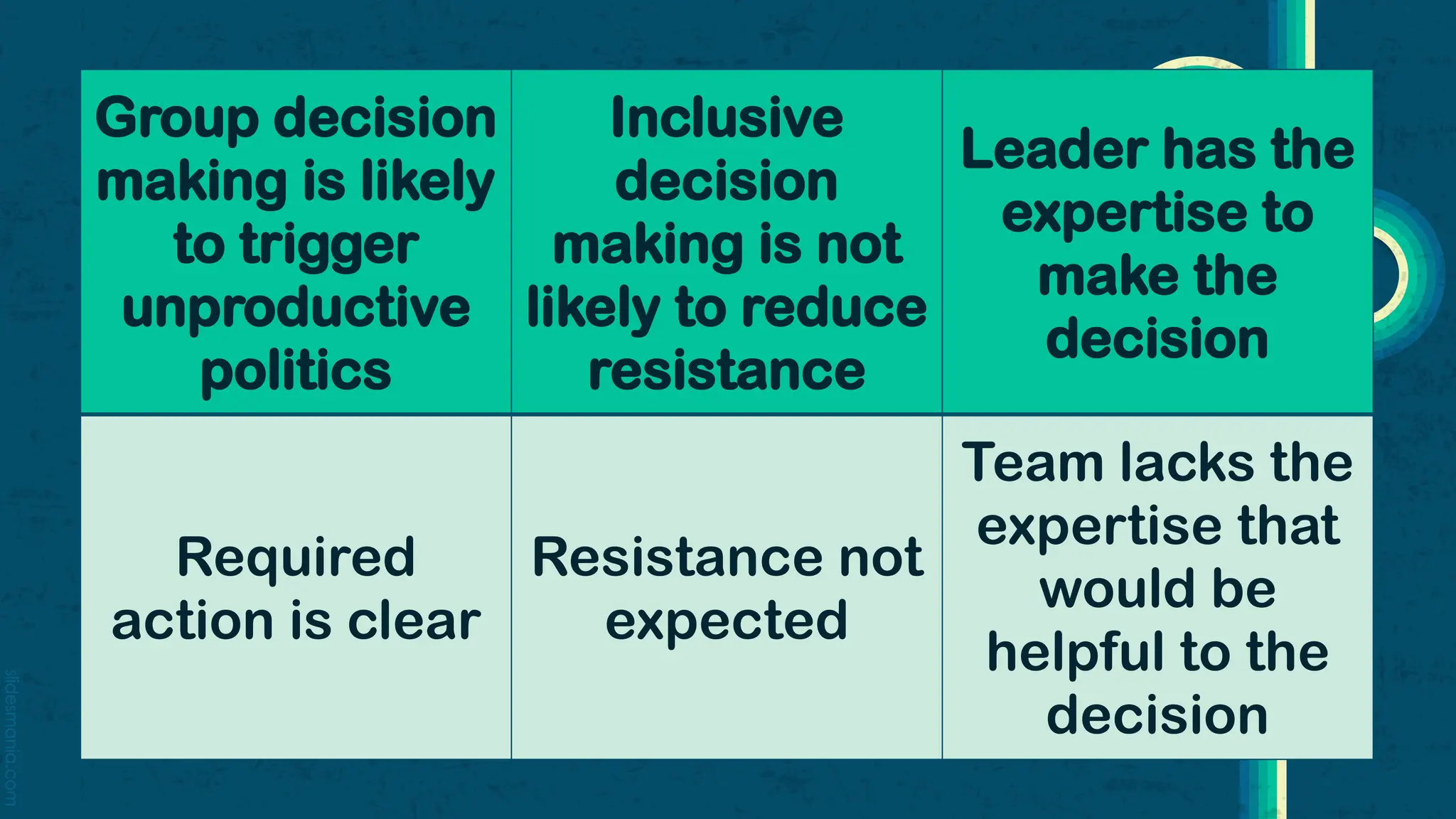
Group decision
making is likely
to trigger
unproductive
politics
Inclusive
decision
making is not
likely to reduce
resistance
Leader has the
expertise to
make the
decision
Required
action is clear
Resistance not
expected
Team lacks the
expertise that
would be
helpful to the
decision
slidesmania.com
2. INDIVIDUAL
CONSULTATION
The leader consults individual members of the
group to make a decision. The decision is made
by the leader who may or may not use the input
collected. For example, a software architect who
makes design decisions by consulting various
technology specialists. The specialists don't have
the overall view required to make architectural
decisions but are helpful in understanding
aspects of the problem. This may work out
where:
slidesmania.com
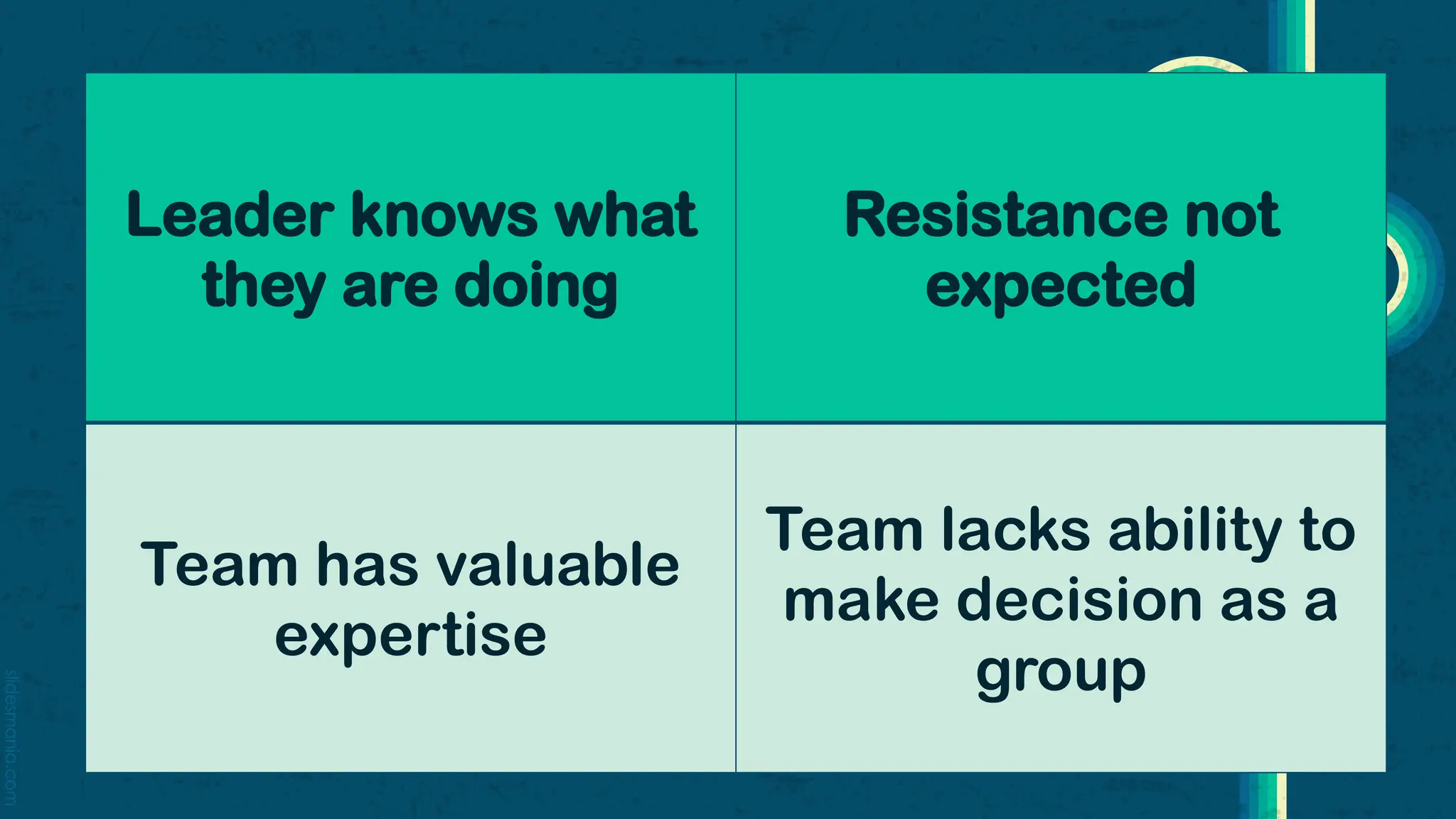
Leader knows what
they are doing
Resistance not
expected
Team has valuable
expertise
Team lacks ability to
make decision as a
group
slidesmania.com
3. GROUP CONSULTATION
The leader makes the decision but consults the entire
team. This is done where the team has valuable
expertise and the problem is complex enough to
benefit from various perspectives and debate.
Alternatively, group consultation may be chosen to
reduce anticipated resistance to the decision. Teams
that feel consulted are less likely to offer resistance.
For example, a restaurant manager who is considering
extending the restaurant's hours who collects feedback
about this plan from staff, particularly regarding if they
are willing to work extended shifts. This can make
sense where any of these conditions apply:
slidesmania.com
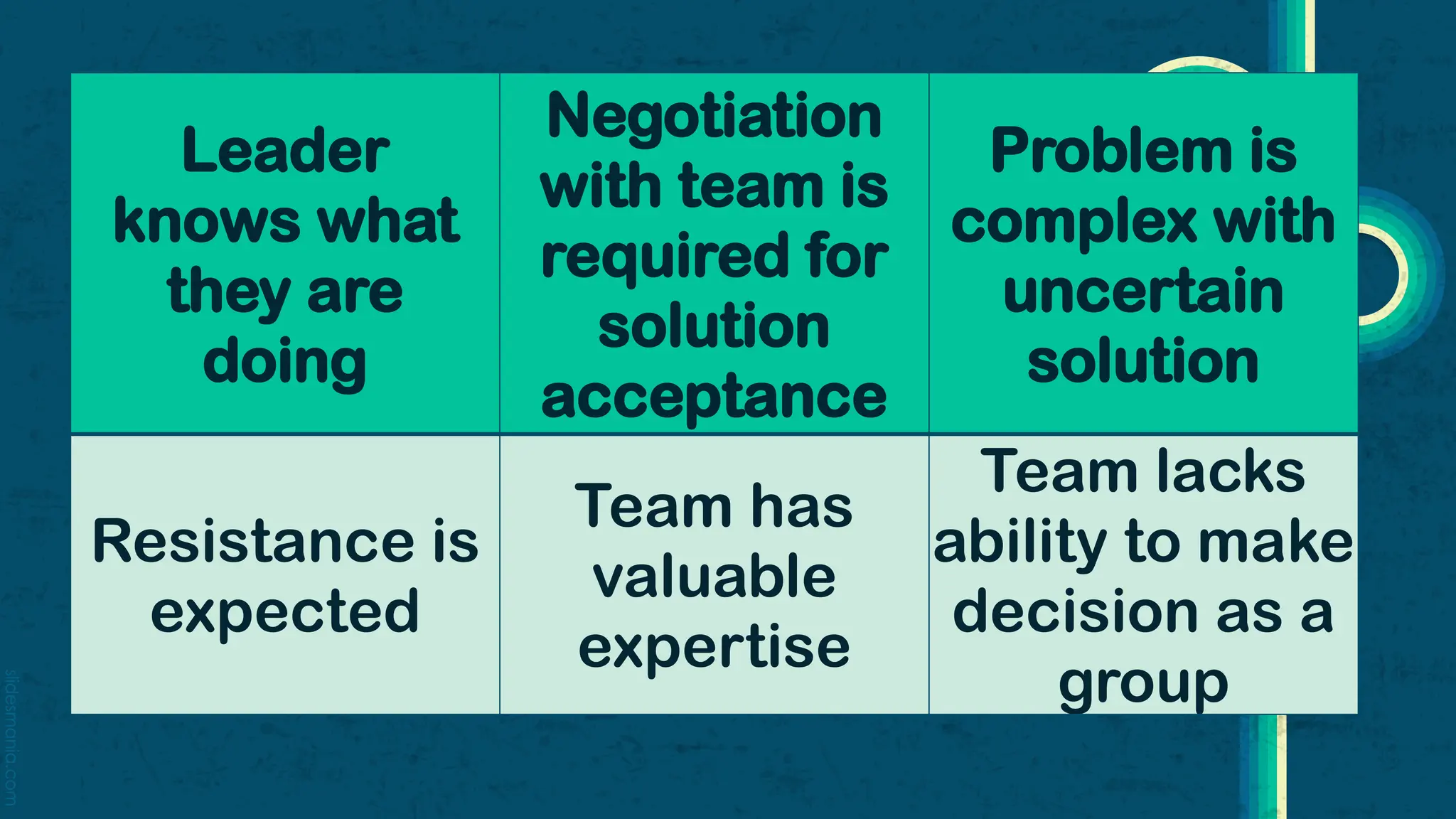
Leader
knows what
they are
doing
Negotiation
with team is
required for
solution
acceptance
Problem is
complex with
uncertain
solution
Resistance is
expected
Team has
valuable
expertise
Team lacks
ability to make
decision as a
group
slidesmania.com
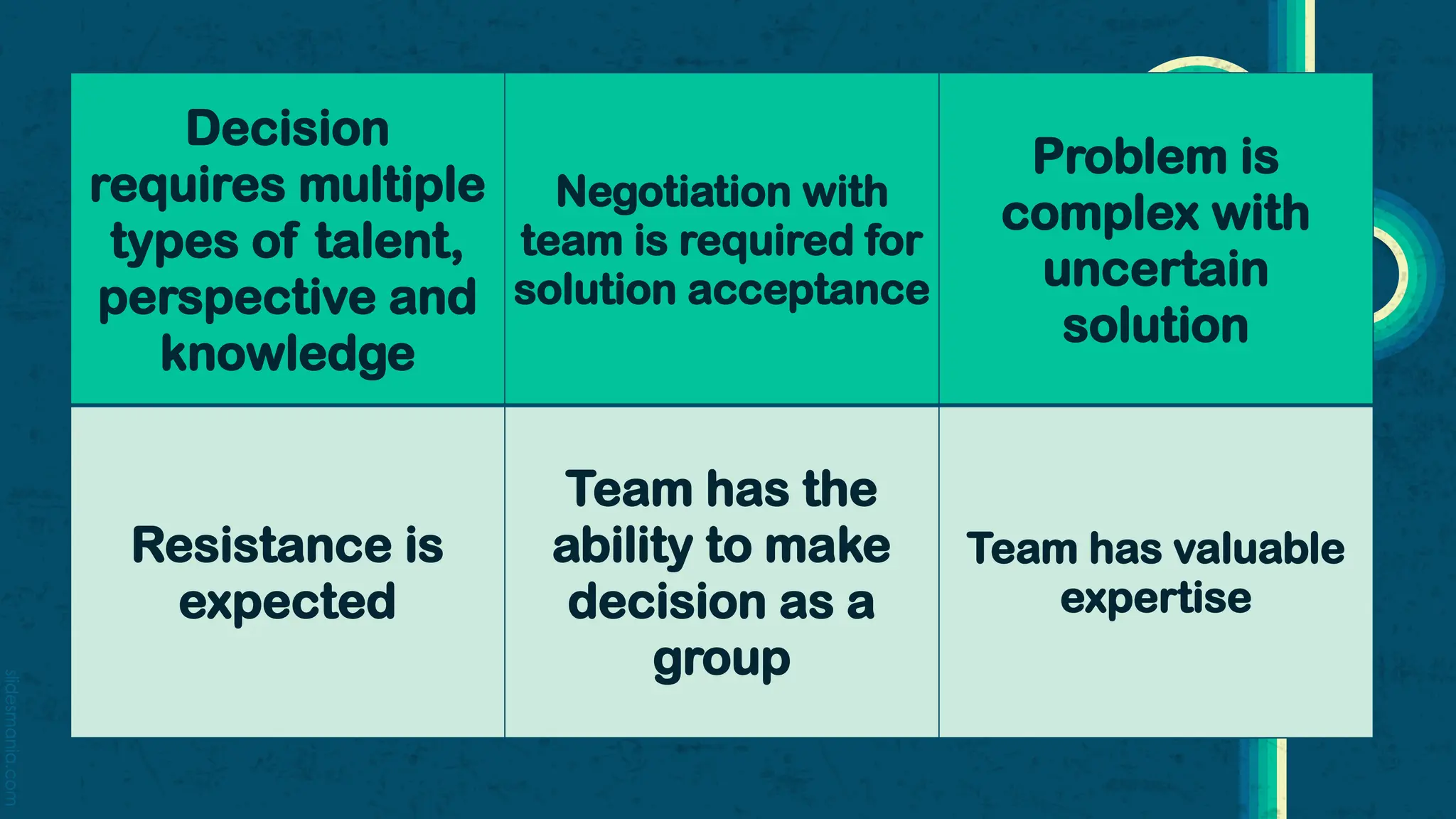
4. FACILITATION
The leader allows a group to make the
decision but facilitates the process.
This may include making the decision
if the group is unable to reach
consensus. For example, a CEO who
asks their executive team to decide on
a disaster recovery strategy.
slidesmania.com
Decision
requires multiple
types of talent,
perspective and
knowledge
Negotiation with
team is required for
solution acceptance
Problem is
complex with
uncertain
solution
Resistance is
expected
Team has the
ability to make
decision as a
group
Team has valuable
expertise
slidesmania.com
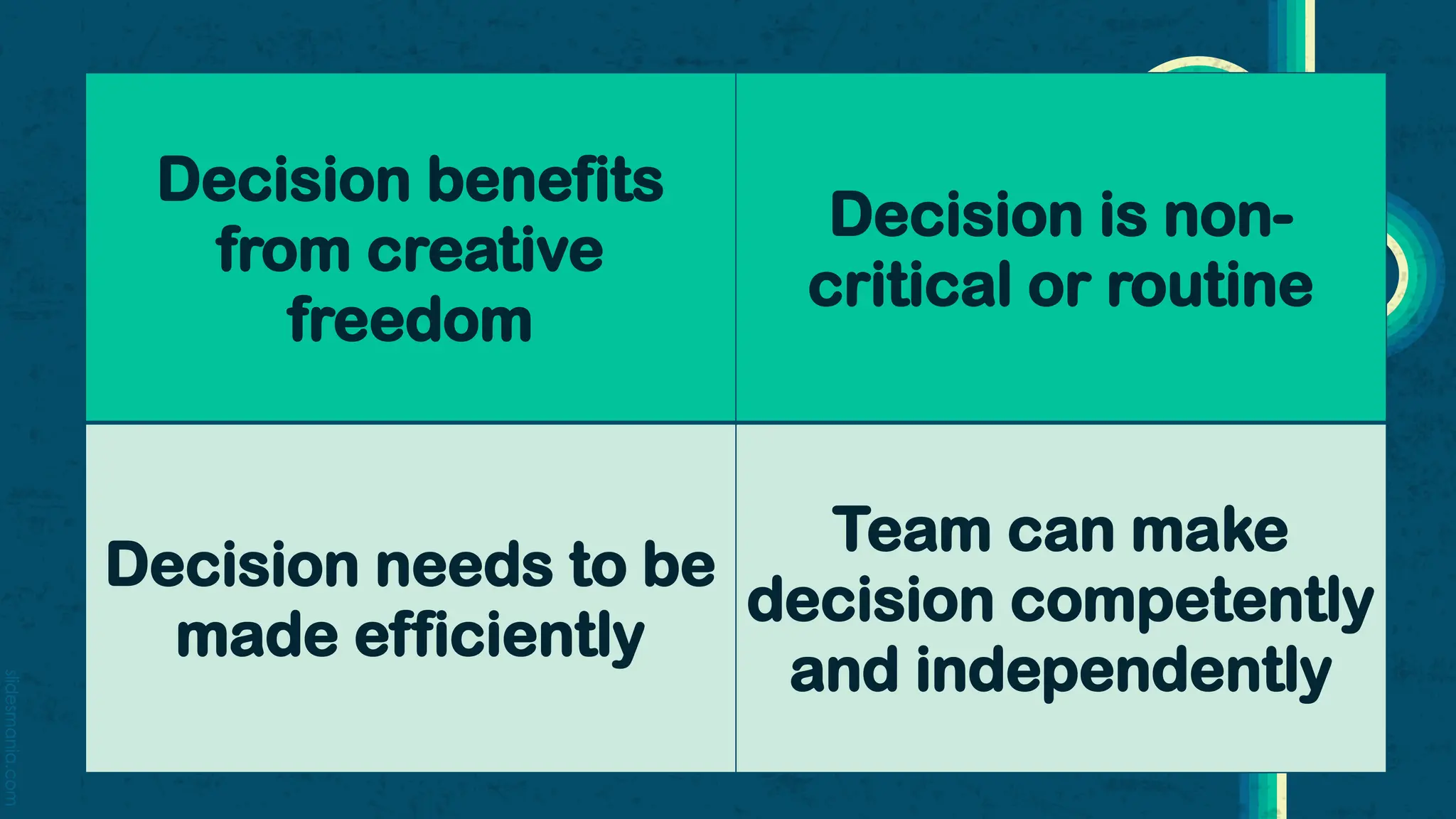
5. DELEGATION
The leader delegates the
decision to an individual or
group. The leader may or may
not review the decision or
override the decision if it is
perceived as unsatisfactory.
slidesmania.com
Decision benefits
from creative
freedom
Decision is non-
critical or routine
Decision needs to be
made efficiently
Team can make
decision competently
and independently
slidesmania.com
THE DESCRIPTIVE DECISION
THEORY
Descriptive decision theory is
concerned with describing
observed behaviors often under
the assumption that those
making decisions are behaving
under some consistent rules.
slidesmania.com
THE PRESCRIPTIVE
DECISION THEORY
Prescriptive decision theory is concerned with
predictions about behavior that positive
decision theory produces to allow for further
tests of the kind of decision-making that
occurs in practice. In recent decades, there has
also been increasing interest in "behavioral
decision theory", contributing to a re-
evaluation of what useful decision-making
requires.
slidesmania.com
TYPES OF DECISIONS
1.CHOICE UNDER UNCERTAINTY
2.INTERTEMPORAL CHOICE
3.INTERACTION OF DECISION
MAKERS
4.COMPLEX DECISIONS
slidesmania.com
1. CHOICE UNDER UNCERTAINTY
The area of choice under uncertainty represents the heart of
decision theory. Known from the 17th century (Blaise
Pascal invoked it in his famous wager, which is contained in his
Pensées, published in 1670), the idea of expected value is that,
when faced with a number of actions, each of which could give rise
to more than one possible outcome with different probabilities, the
rational procedure is to identify all possible outcomes, determine
their values (positive or negative) and the probabilities that will
result from each course of action, and multiply the two to give an
"expected value", or the average expectation for an outcome; the
action to be chosen should be the one that gives rise to the highest
total expected value.
slidesmania.com
2. INTERTEMPORAL CHOICE
Intertemporal choice is concerned with the
kind of choice where different actions lead
to outcomes that are realized at different
stages over time. It is also described as cost-
benefit decision making since it involves the
choices between rewards that vary
according to magnitude and time of arrival.
slidesmania.com
3. INTERACTION OF DECISION MAKERS
Some decisions are difficult because of the
need to take into account how other people
in the situation will respond to the decision
that is taken. The analysis of such social
decisions is often treated under decision
theory, though it involves mathematical
methods.
slidesmania.com
4. COMPLEX DECISIONS
Other areas of decision theory are concerned
with decisions that are difficult simply because of
their complexity, or the complexity of the
organization that has to make them. Individuals
making decisions are limited in resources (i.e.
time and intelligence) and are therefore bounded
rational; the issue is thus, more than the deviation
between real and optimal behavior, the difficulty
of determining the optimal behavior in the first
place.
slidesmania.com
Descriptive theory
tends to be more
useful in deciding
what people will do
and how they will act,
while normative
theory focuses on
people’s optimal
behavior.
Understanding both is
essential in
understanding key
components of
economics, and
making sense of our
slidesmania.com
Thank you!
Do you have any questions?
slidesmania.com
Editable Icons.

Presentation Decision-Making-Theory.pptx

  • 1.
  • 2.
    slidesmania.com Hello! I’m… Here iswhere you introduce yourself. You can add your name, title and a little background. Right click the image and replace it with your own.
  • 3.
    slidesmania.com At the endof the discussion, participants will be able to: 1.Define Decision Making, Decision Making Theory or Theory of Rational Choice. 2.Compare and contrast Normative, Descriptive and Prescriptive Decision Theories. 3.Identify and define types of decisions.
  • 4.
    slidesmania.com DECISION MAKING THEORY ●It was first addressed by Herbert Simon in 1948 on his book about Administrative Behavior: “A Study of Decision-Making Process in Administrative Organization. ● Decision Making is usually defined as a process or sequence of activities involving stages of problem recognition, search of information, the definition of alternatives and selection of an actor of one from two or more alternatives consistent with the ranked. ● Decision theory or the theory of rational choice is a branch of probability, economics, and analytic philosophy that uses the tools of expected utility and probability to model how individuals should behave rationally under uncertainty preferences.
  • 5.
  • 6.
    slidesmania.com THE NORMATIVE DECISION THEORY Normativedecision theory is concerned with identification of optimal decisions where optimality is often determined by considering an ideal decision maker who is able to calculate with perfect accuracy and is in some sense fully rational.
  • 7.
    slidesmania.com EXAMPLES OF NORMATIVE DECISIONMAKING 1. Leader Decision 2. Individual Consultation 3. Group Consultation 4. Facilitation 5. Delegation
  • 8.
    slidesmania.com 1. LEADER DECISION Theleader makes the decision and announces it to the group. They may gather information from the group but don't consult the group regarding the decision itself. For example, an IT manager who decides a legacy technology needs to be phased out without consulting the team. A leader decision may be optimal in the following situations:
  • 9.
    slidesmania.com Group decision making islikely to trigger unproductive politics Inclusive decision making is not likely to reduce resistance Leader has the expertise to make the decision Required action is clear Resistance not expected Team lacks the expertise that would be helpful to the decision
  • 10.
    slidesmania.com 2. INDIVIDUAL CONSULTATION The leaderconsults individual members of the group to make a decision. The decision is made by the leader who may or may not use the input collected. For example, a software architect who makes design decisions by consulting various technology specialists. The specialists don't have the overall view required to make architectural decisions but are helpful in understanding aspects of the problem. This may work out where:
  • 11.
    slidesmania.com Leader knows what theyare doing Resistance not expected Team has valuable expertise Team lacks ability to make decision as a group
  • 12.
    slidesmania.com 3. GROUP CONSULTATION Theleader makes the decision but consults the entire team. This is done where the team has valuable expertise and the problem is complex enough to benefit from various perspectives and debate. Alternatively, group consultation may be chosen to reduce anticipated resistance to the decision. Teams that feel consulted are less likely to offer resistance. For example, a restaurant manager who is considering extending the restaurant's hours who collects feedback about this plan from staff, particularly regarding if they are willing to work extended shifts. This can make sense where any of these conditions apply:
  • 13.
    slidesmania.com Leader knows what they are doing Negotiation withteam is required for solution acceptance Problem is complex with uncertain solution Resistance is expected Team has valuable expertise Team lacks ability to make decision as a group
  • 14.
    slidesmania.com 4. FACILITATION The leaderallows a group to make the decision but facilitates the process. This may include making the decision if the group is unable to reach consensus. For example, a CEO who asks their executive team to decide on a disaster recovery strategy.
  • 15.
    slidesmania.com Decision requires multiple types oftalent, perspective and knowledge Negotiation with team is required for solution acceptance Problem is complex with uncertain solution Resistance is expected Team has the ability to make decision as a group Team has valuable expertise
  • 16.
    slidesmania.com 5. DELEGATION The leaderdelegates the decision to an individual or group. The leader may or may not review the decision or override the decision if it is perceived as unsatisfactory.
  • 17.
    slidesmania.com Decision benefits from creative freedom Decisionis non- critical or routine Decision needs to be made efficiently Team can make decision competently and independently
  • 18.
    slidesmania.com THE DESCRIPTIVE DECISION THEORY Descriptivedecision theory is concerned with describing observed behaviors often under the assumption that those making decisions are behaving under some consistent rules.
  • 19.
    slidesmania.com THE PRESCRIPTIVE DECISION THEORY Prescriptivedecision theory is concerned with predictions about behavior that positive decision theory produces to allow for further tests of the kind of decision-making that occurs in practice. In recent decades, there has also been increasing interest in "behavioral decision theory", contributing to a re- evaluation of what useful decision-making requires.
  • 20.
    slidesmania.com TYPES OF DECISIONS 1.CHOICEUNDER UNCERTAINTY 2.INTERTEMPORAL CHOICE 3.INTERACTION OF DECISION MAKERS 4.COMPLEX DECISIONS
  • 21.
    slidesmania.com 1. CHOICE UNDERUNCERTAINTY The area of choice under uncertainty represents the heart of decision theory. Known from the 17th century (Blaise Pascal invoked it in his famous wager, which is contained in his Pensées, published in 1670), the idea of expected value is that, when faced with a number of actions, each of which could give rise to more than one possible outcome with different probabilities, the rational procedure is to identify all possible outcomes, determine their values (positive or negative) and the probabilities that will result from each course of action, and multiply the two to give an "expected value", or the average expectation for an outcome; the action to be chosen should be the one that gives rise to the highest total expected value.
  • 22.
    slidesmania.com 2. INTERTEMPORAL CHOICE Intertemporalchoice is concerned with the kind of choice where different actions lead to outcomes that are realized at different stages over time. It is also described as cost- benefit decision making since it involves the choices between rewards that vary according to magnitude and time of arrival.
  • 23.
    slidesmania.com 3. INTERACTION OFDECISION MAKERS Some decisions are difficult because of the need to take into account how other people in the situation will respond to the decision that is taken. The analysis of such social decisions is often treated under decision theory, though it involves mathematical methods.
  • 24.
    slidesmania.com 4. COMPLEX DECISIONS Otherareas of decision theory are concerned with decisions that are difficult simply because of their complexity, or the complexity of the organization that has to make them. Individuals making decisions are limited in resources (i.e. time and intelligence) and are therefore bounded rational; the issue is thus, more than the deviation between real and optimal behavior, the difficulty of determining the optimal behavior in the first place.
  • 25.
    slidesmania.com Descriptive theory tends tobe more useful in deciding what people will do and how they will act, while normative theory focuses on people’s optimal behavior. Understanding both is essential in understanding key components of economics, and making sense of our
  • 26.
  • 27.