Measures for the prevention
of Cross contamination,
cleaning and sanitizing and
Personal Hygiene.
Submitted by :shojo raj 1st msc ft&Qa
Mount royal college, suryanelli, munnar
1.Cross contamination
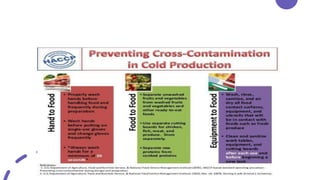
• Cross-contamination is the unintentional transfer of microorganisms,
chemical contaminants (including allergens) or any foreign substance from
food, person, or object to another food product.Cross-contamination is how
bacteria can spread. It occurs when juices from raw meats or germs from
unclean objects touch cooked or ready-to-eat foods. By following a few
simple steps as you shop, store, cook, and transport foods, you can
greatly reduce your risk of food poisoning.
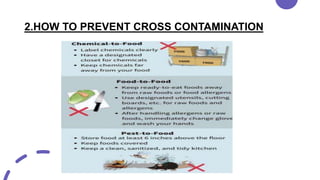
2.HOW TO PREVENT CROSS CONTAMINATION
3.PERSONAL HYGIENE
• Personal hygiene is how you care for your body. This practice includes
bathing, washing your hands, brushing your teeth, and more. Every day,
you come into contact with millions of outside germs and viruses. They can
linger on your body, and in some cases, they may make you sick.Personal
hygiene are the behaviours that must be practised in daily life, starting
from morning to sleep time to protect our health. To protect health, body,
hair, mouth and teeth must be cleaned regularly and clothes must be
washed frequently. Personal hygiene is intimately involved with health.
BENEFITS OF PERSONAL HYGIENE
• It protects you from infections or diseases that could weaken your immune
system.
• It prevents you from spreading the infection to your loved ones and people
you interact with daily.
• It helps maintain your skin’s pH levels, making it healthy and glowing over
time.
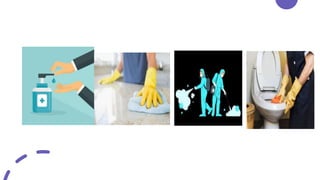
3.CLEANING AND SANITATION
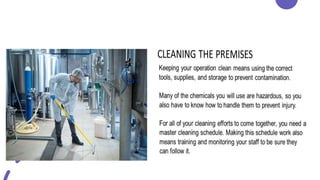
• The objective of cleaning and sanitizing food contact surfaces is to remove
food (nutrients) that bacteria need to grow, and to kill those bacteria that
are present. It is important that the clean, sanitized equipment and
surfaces drain dry and are stored dry so as to prevent bacteria
growth.Thermal Sanitization involves the use of hot water or steam for a
specified temperature and contact time. Chemical Sanitization involves the
use of an approved chemical sanitizer at a specified concentration and
contact time.
4.Sanitation
• Basic sanitation is defined as having access to facilities for the safe disposal of
human waste (feces and urine), as well as having the ability to maintain hygienic
conditions, through services such as garbage collection, industrial/hazardous
waste management, and wastewater treatment and disposal.Proper sanitation
promotes health, improves the quality of the environment and thus, the quality of
life in a community. Sanitation refers to the safe collection, transportation,
treatment and disposal of human wastes.
DIFFERENT TYPES OF SANITATION
1. Basic sanitation.
2. Container-based sanitation.
3. Community-based sanitation.
4. Community-led total sanitation.
5. Dry sanitation.
6. Ecological sanitation.
7. Emergency sanitation.
8. Environmental sanitation.
THANK YOU🙌🏻

Presentation cross contamination.pptx

  • 1.
    Measures for theprevention of Cross contamination, cleaning and sanitizing and Personal Hygiene. Submitted by :shojo raj 1st msc ft&Qa Mount royal college, suryanelli, munnar
  • 2.
    1.Cross contamination • Cross-contaminationis the unintentional transfer of microorganisms, chemical contaminants (including allergens) or any foreign substance from food, person, or object to another food product.Cross-contamination is how bacteria can spread. It occurs when juices from raw meats or germs from unclean objects touch cooked or ready-to-eat foods. By following a few simple steps as you shop, store, cook, and transport foods, you can greatly reduce your risk of food poisoning.
  • 4.
    2.HOW TO PREVENTCROSS CONTAMINATION
  • 5.
    3.PERSONAL HYGIENE • Personalhygiene is how you care for your body. This practice includes bathing, washing your hands, brushing your teeth, and more. Every day, you come into contact with millions of outside germs and viruses. They can linger on your body, and in some cases, they may make you sick.Personal hygiene are the behaviours that must be practised in daily life, starting from morning to sleep time to protect our health. To protect health, body, hair, mouth and teeth must be cleaned regularly and clothes must be washed frequently. Personal hygiene is intimately involved with health.
  • 6.
    BENEFITS OF PERSONALHYGIENE • It protects you from infections or diseases that could weaken your immune system. • It prevents you from spreading the infection to your loved ones and people you interact with daily. • It helps maintain your skin’s pH levels, making it healthy and glowing over time.
  • 8.
    3.CLEANING AND SANITATION •The objective of cleaning and sanitizing food contact surfaces is to remove food (nutrients) that bacteria need to grow, and to kill those bacteria that are present. It is important that the clean, sanitized equipment and surfaces drain dry and are stored dry so as to prevent bacteria growth.Thermal Sanitization involves the use of hot water or steam for a specified temperature and contact time. Chemical Sanitization involves the use of an approved chemical sanitizer at a specified concentration and contact time.
  • 10.
    4.Sanitation • Basic sanitationis defined as having access to facilities for the safe disposal of human waste (feces and urine), as well as having the ability to maintain hygienic conditions, through services such as garbage collection, industrial/hazardous waste management, and wastewater treatment and disposal.Proper sanitation promotes health, improves the quality of the environment and thus, the quality of life in a community. Sanitation refers to the safe collection, transportation, treatment and disposal of human wastes.
  • 11.
    DIFFERENT TYPES OFSANITATION 1. Basic sanitation. 2. Container-based sanitation. 3. Community-based sanitation. 4. Community-led total sanitation. 5. Dry sanitation. 6. Ecological sanitation. 7. Emergency sanitation. 8. Environmental sanitation.
  • 13.