MCL-SCL PHA Blend films for Cardiovascular Tissue
Engineering
By
ANUBHAV SARKAR
Cardiovascular tissue engineering
• Cardiovascular diseases (CVD) – leading cause of death; myocardial infarction is the main
cause of CVDs (Bagdadi, 2013)
•
• Cardiac therapies in existence but requires additional improvement to control progression
of disease
•
• WHY CARDIOVASCULAR TISSUE ENGINEERING?
• Lack of organ donors
• Post-operative complications (sepsis, infection, organ rejection)
• Promising alternative method
•
• Synthetic materials used so far
• PLA (polylactic acid)
• PCL (polycaprolactone)
• PGA (polyglycolic acid)
• PLGA (polylactic-glycolic acid)
•
•
An ideal biomaterial should have 5 characteristics:
• biocompatible in nature,
• should have similar mechanical properties to the host tissue,
• should have appropriate size and shape to organise cells and repair at
implant site,
• chemistry of the material’s surface should allow cell attachment,
differentiation and proliferation
• the composition of the material should allow biodegradation for tissue
regeneration.
Properties of an “Ideal biomaterial” for tissue engineering scaffold
Polyhydroxyalkanoates
• Polyhydroxyalkanoates (PHAs) are bacteria-synthesized intracellularly
accumulated polyesters, produced by both gram positive and gram negative
bacteria in a limiting environment in the presence of excess carbon. (Basnett,
2014)
•
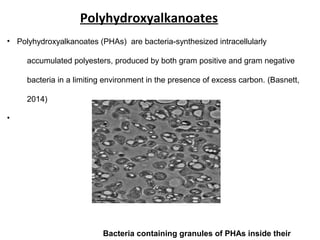
Bacteria containing granules of PHAs inside their
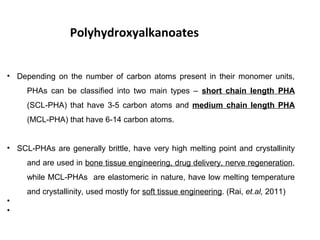
• Depending on the number of carbon atoms present in their monomer units,
PHAs can be classified into two main types – short chain length PHA
(SCL-PHA) that have 3-5 carbon atoms and medium chain length PHA
(MCL-PHA) that have 6-14 carbon atoms.
• SCL-PHAs are generally brittle, have very high melting point and crystallinity
and are used in bone tissue engineering, drug delivery, nerve regeneration,
while MCL-PHAs are elastomeric in nature, have low melting temperature
and crystallinity, used mostly for soft tissue engineering. (Rai, et.al, 2011)
•
•
Polyhydroxyalkanoates
Aims of the Project
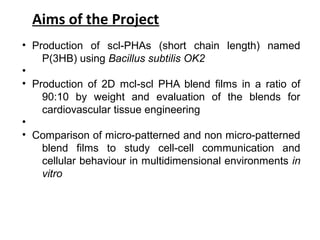
• Production of scl-PHAs (short chain length) named
P(3HB) using Bacillus subtilis OK2
•
• Production of 2D mcl-scl PHA blend films in a ratio of
90:10 by weight and evaluation of the blends for
cardiovascular tissue engineering
•
• Comparison of micro-patterned and non micro-patterned
blend films to study cell-cell communication and
cellular behaviour in multidimensional environments in
vitro
Production of P(3HB) using Bacillus subtilis OK2
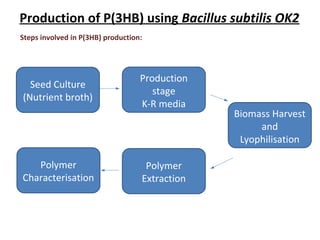
Steps involved in P(3HB) production:
Polymer
Characterisation
Seed Culture
(Nutrient broth)
Production
stage
K-R media
Biomass Harvest
and
Lyophilisation
Polymer
Extraction
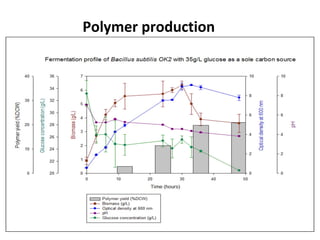
Polymer production
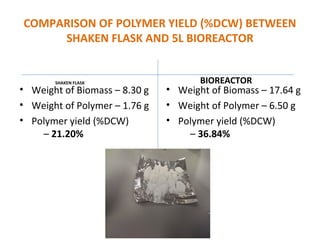
COMPARISON OF POLYMER YIELD (%DCW) BETWEEN
SHAKEN FLASK AND 5L BIOREACTOR
SHAKEN FLASK
• Weight of Biomass – 8.30 g
• Weight of Polymer – 1.76 g
• Polymer yield (%DCW)
– 21.20%
• Weight of Biomass – 17.64 g
• Weight of Polymer – 6.50 g
• Polymer yield (%DCW)
– 36.84%
BIOREACTOR
POLYMER CHARACTERISATION
• FTIR ( Fourier Transform Infrared
Spectroscopy).
• GC-MS (Gas Chromatography – Mass
spectroscopy)
• Thermal properties of the were measured
by DSC (Differential Scanning
Calorimetry).
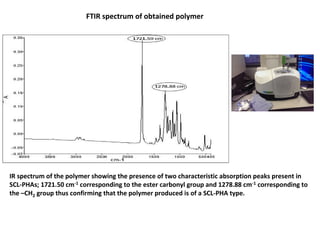
IR spectrum of the polymer showing the presence of two characteristic absorption peaks present in
SCL-PHAs; 1721.50 cm-1 corresponding to the ester carbonyl group and 1278.88 cm-1 corresponding to
the –CH2 group thus confirming that the polymer produced is of a SCL-PHA type.
FTIR spectrum of obtained polymer
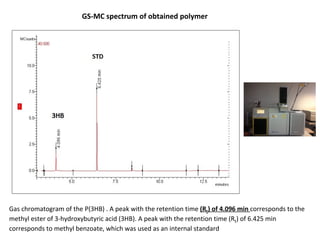
Gas chromatogram of the P(3HB) . A peak with the retention time (Rt) of 4.096 min corresponds to the
methyl ester of 3-hydroxybutyric acid (3HB). A peak with the retention time (Rt) of 6.425 min
corresponds to methyl benzoate, which was used as an internal standard
GS-MC spectrum of obtained polymer
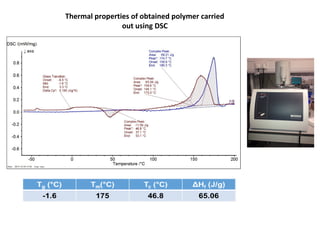
Thermal properties of obtained polymer carried
out using DSC
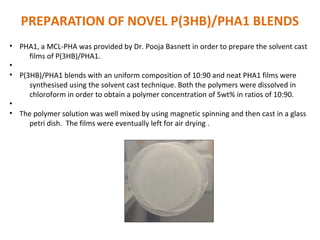
PREPARATION OF NOVEL P(3HB)/PHA1 BLENDS
• PHA1, a MCL-PHA was provided by Dr. Pooja Basnett in order to prepare the solvent cast
films of P(3HB)/PHA1.
•
• P(3HB)/PHA1 blends with an uniform composition of 10:90 and neat PHA1 films were
synthesised using the solvent cast technique. Both the polymers were dissolved in
chloroform in order to obtain a polymer concentration of 5wt% in ratios of 10:90.
•
• The polymer solution was well mixed by using magnetic spinning and then cast in a glass
petri dish. The films were eventually left for air drying .
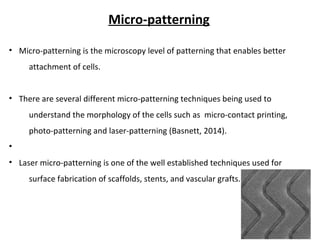
Micro-patterning
• Micro-patterning is the microscopy level of patterning that enables better
attachment of cells.
• There are several different micro-patterning techniques being used to
understand the morphology of the cells such as micro-contact printing,
photo-patterning and laser-patterning (Basnett, 2014).
•
• Laser micro-patterning is one of the well established techniques used for
surface fabrication of scaffolds, stents, and vascular grafts.
- DSC
- Tensile test
- SEM (Scanning Electron
Microscopy) image of surface
topography
P(3HB)/PHA 10:90 POLYMER BLEND
CHARACTERISATION
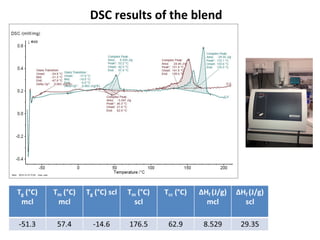
DSC results of the blend
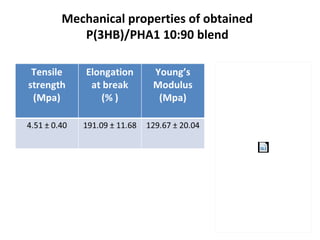
Mechanical properties of obtained
P(3HB)/PHA1 10:90 blend
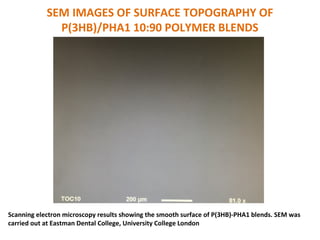
SEM IMAGES OF SURFACE TOPOGRAPHY OF
P(3HB)/PHA1 10:90 POLYMER BLENDS
Scanning electron microscopy results showing the smooth surface of P(3HB)-PHA1 blends. SEM was
carried out at Eastman Dental College, University College London
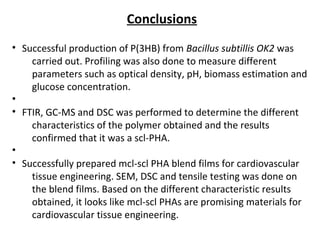
Conclusions
• Successful production of P(3HB) from Bacillus subtillis OK2 was
carried out. Profiling was also done to measure different
parameters such as optical density, pH, biomass estimation and
glucose concentration.
•
• FTIR, GC-MS and DSC was performed to determine the different
characteristics of the polymer obtained and the results
confirmed that it was a scl-PHA.
•
• Successfully prepared mcl-scl PHA blend films for cardiovascular
tissue engineering. SEM, DSC and tensile testing was done on
the blend films. Based on the different characteristic results
obtained, it looks like mcl-scl PHAs are promising materials for
cardiovascular tissue engineering.
• Micropatterning work on P(3HB)/PHA1 10:90 blend films
at Tekniker, Spain
• Biocompatibility study using mouse myoblasts (C2C12)
cell line on blend films with and without patterning –
MTT assay
•
• SEM imaging of the scaffold with seeded cells
•
• Complete characterisation of the blend films – surface
roughness analysis, static wettability studies (water
contact angle)
Future Work
Acknowledgements
• Prof. Ipsita Roy
•
• Dr. Pooja Basnett
•
• Dr. Rinat Nigmatulin
•
• Barbara Lukasiewicz
•
• All members of C7.01, University of Westminster
•
Thank you

Dissertation presentation - Mcl-Scl PHA blend films for Cardiovascular Tissue Engineering

  • 1.
    MCL-SCL PHA Blendfilms for Cardiovascular Tissue Engineering By ANUBHAV SARKAR
  • 2.
    Cardiovascular tissue engineering •Cardiovascular diseases (CVD) – leading cause of death; myocardial infarction is the main cause of CVDs (Bagdadi, 2013) • • Cardiac therapies in existence but requires additional improvement to control progression of disease • • WHY CARDIOVASCULAR TISSUE ENGINEERING? • Lack of organ donors • Post-operative complications (sepsis, infection, organ rejection) • Promising alternative method • • Synthetic materials used so far • PLA (polylactic acid) • PCL (polycaprolactone) • PGA (polyglycolic acid) • PLGA (polylactic-glycolic acid) • •
  • 3.
    An ideal biomaterialshould have 5 characteristics: • biocompatible in nature, • should have similar mechanical properties to the host tissue, • should have appropriate size and shape to organise cells and repair at implant site, • chemistry of the material’s surface should allow cell attachment, differentiation and proliferation • the composition of the material should allow biodegradation for tissue regeneration. Properties of an “Ideal biomaterial” for tissue engineering scaffold
  • 4.
    Polyhydroxyalkanoates • Polyhydroxyalkanoates (PHAs)are bacteria-synthesized intracellularly accumulated polyesters, produced by both gram positive and gram negative bacteria in a limiting environment in the presence of excess carbon. (Basnett, 2014) • Bacteria containing granules of PHAs inside their
  • 5.
    • Depending onthe number of carbon atoms present in their monomer units, PHAs can be classified into two main types – short chain length PHA (SCL-PHA) that have 3-5 carbon atoms and medium chain length PHA (MCL-PHA) that have 6-14 carbon atoms. • SCL-PHAs are generally brittle, have very high melting point and crystallinity and are used in bone tissue engineering, drug delivery, nerve regeneration, while MCL-PHAs are elastomeric in nature, have low melting temperature and crystallinity, used mostly for soft tissue engineering. (Rai, et.al, 2011) • • Polyhydroxyalkanoates
  • 6.
    Aims of theProject • Production of scl-PHAs (short chain length) named P(3HB) using Bacillus subtilis OK2 • • Production of 2D mcl-scl PHA blend films in a ratio of 90:10 by weight and evaluation of the blends for cardiovascular tissue engineering • • Comparison of micro-patterned and non micro-patterned blend films to study cell-cell communication and cellular behaviour in multidimensional environments in vitro
  • 7.
    Production of P(3HB)using Bacillus subtilis OK2 Steps involved in P(3HB) production: Polymer Characterisation Seed Culture (Nutrient broth) Production stage K-R media Biomass Harvest and Lyophilisation Polymer Extraction
  • 8.
  • 9.
    COMPARISON OF POLYMERYIELD (%DCW) BETWEEN SHAKEN FLASK AND 5L BIOREACTOR SHAKEN FLASK • Weight of Biomass – 8.30 g • Weight of Polymer – 1.76 g • Polymer yield (%DCW) – 21.20% • Weight of Biomass – 17.64 g • Weight of Polymer – 6.50 g • Polymer yield (%DCW) – 36.84% BIOREACTOR
  • 10.
    POLYMER CHARACTERISATION • FTIR( Fourier Transform Infrared Spectroscopy). • GC-MS (Gas Chromatography – Mass spectroscopy) • Thermal properties of the were measured by DSC (Differential Scanning Calorimetry).
  • 11.
    IR spectrum ofthe polymer showing the presence of two characteristic absorption peaks present in SCL-PHAs; 1721.50 cm-1 corresponding to the ester carbonyl group and 1278.88 cm-1 corresponding to the –CH2 group thus confirming that the polymer produced is of a SCL-PHA type. FTIR spectrum of obtained polymer
  • 12.
    Gas chromatogram ofthe P(3HB) . A peak with the retention time (Rt) of 4.096 min corresponds to the methyl ester of 3-hydroxybutyric acid (3HB). A peak with the retention time (Rt) of 6.425 min corresponds to methyl benzoate, which was used as an internal standard GS-MC spectrum of obtained polymer
  • 13.
    Thermal properties ofobtained polymer carried out using DSC
  • 14.
    PREPARATION OF NOVELP(3HB)/PHA1 BLENDS • PHA1, a MCL-PHA was provided by Dr. Pooja Basnett in order to prepare the solvent cast films of P(3HB)/PHA1. • • P(3HB)/PHA1 blends with an uniform composition of 10:90 and neat PHA1 films were synthesised using the solvent cast technique. Both the polymers were dissolved in chloroform in order to obtain a polymer concentration of 5wt% in ratios of 10:90. • • The polymer solution was well mixed by using magnetic spinning and then cast in a glass petri dish. The films were eventually left for air drying .
  • 15.
    Micro-patterning • Micro-patterning isthe microscopy level of patterning that enables better attachment of cells. • There are several different micro-patterning techniques being used to understand the morphology of the cells such as micro-contact printing, photo-patterning and laser-patterning (Basnett, 2014). • • Laser micro-patterning is one of the well established techniques used for surface fabrication of scaffolds, stents, and vascular grafts.
  • 16.
    - DSC - Tensiletest - SEM (Scanning Electron Microscopy) image of surface topography P(3HB)/PHA 10:90 POLYMER BLEND CHARACTERISATION
  • 17.
    DSC results ofthe blend
  • 18.
    Mechanical properties ofobtained P(3HB)/PHA1 10:90 blend
  • 19.
    SEM IMAGES OFSURFACE TOPOGRAPHY OF P(3HB)/PHA1 10:90 POLYMER BLENDS Scanning electron microscopy results showing the smooth surface of P(3HB)-PHA1 blends. SEM was carried out at Eastman Dental College, University College London
  • 20.
    Conclusions • Successful productionof P(3HB) from Bacillus subtillis OK2 was carried out. Profiling was also done to measure different parameters such as optical density, pH, biomass estimation and glucose concentration. • • FTIR, GC-MS and DSC was performed to determine the different characteristics of the polymer obtained and the results confirmed that it was a scl-PHA. • • Successfully prepared mcl-scl PHA blend films for cardiovascular tissue engineering. SEM, DSC and tensile testing was done on the blend films. Based on the different characteristic results obtained, it looks like mcl-scl PHAs are promising materials for cardiovascular tissue engineering.
  • 21.
    • Micropatterning workon P(3HB)/PHA1 10:90 blend films at Tekniker, Spain • Biocompatibility study using mouse myoblasts (C2C12) cell line on blend films with and without patterning – MTT assay • • SEM imaging of the scaffold with seeded cells • • Complete characterisation of the blend films – surface roughness analysis, static wettability studies (water contact angle) Future Work
  • 22.
    Acknowledgements • Prof. IpsitaRoy • • Dr. Pooja Basnett • • Dr. Rinat Nigmatulin • • Barbara Lukasiewicz • • All members of C7.01, University of Westminster •
  • 23.