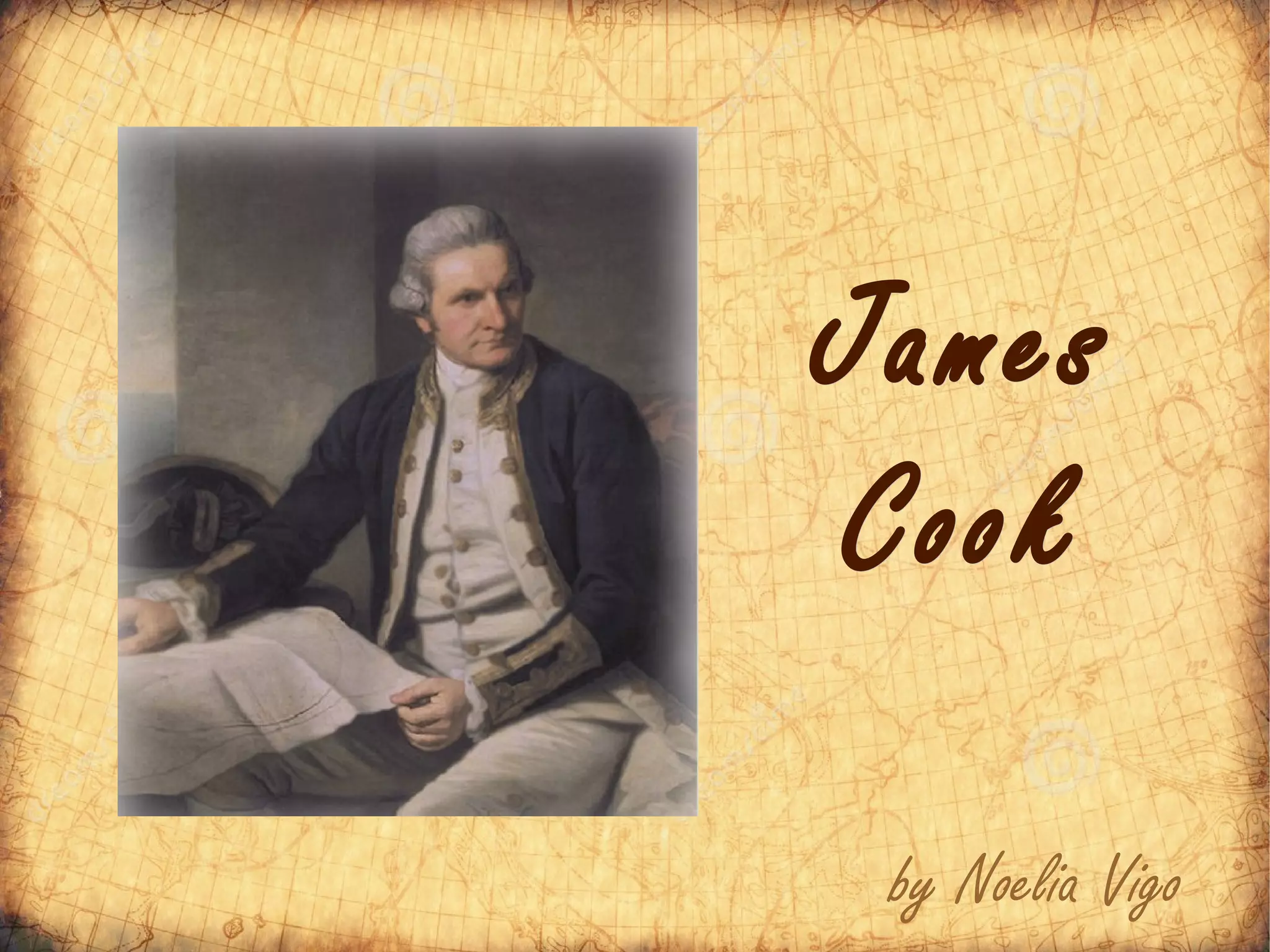
James
Cook
by Noelia Vigo
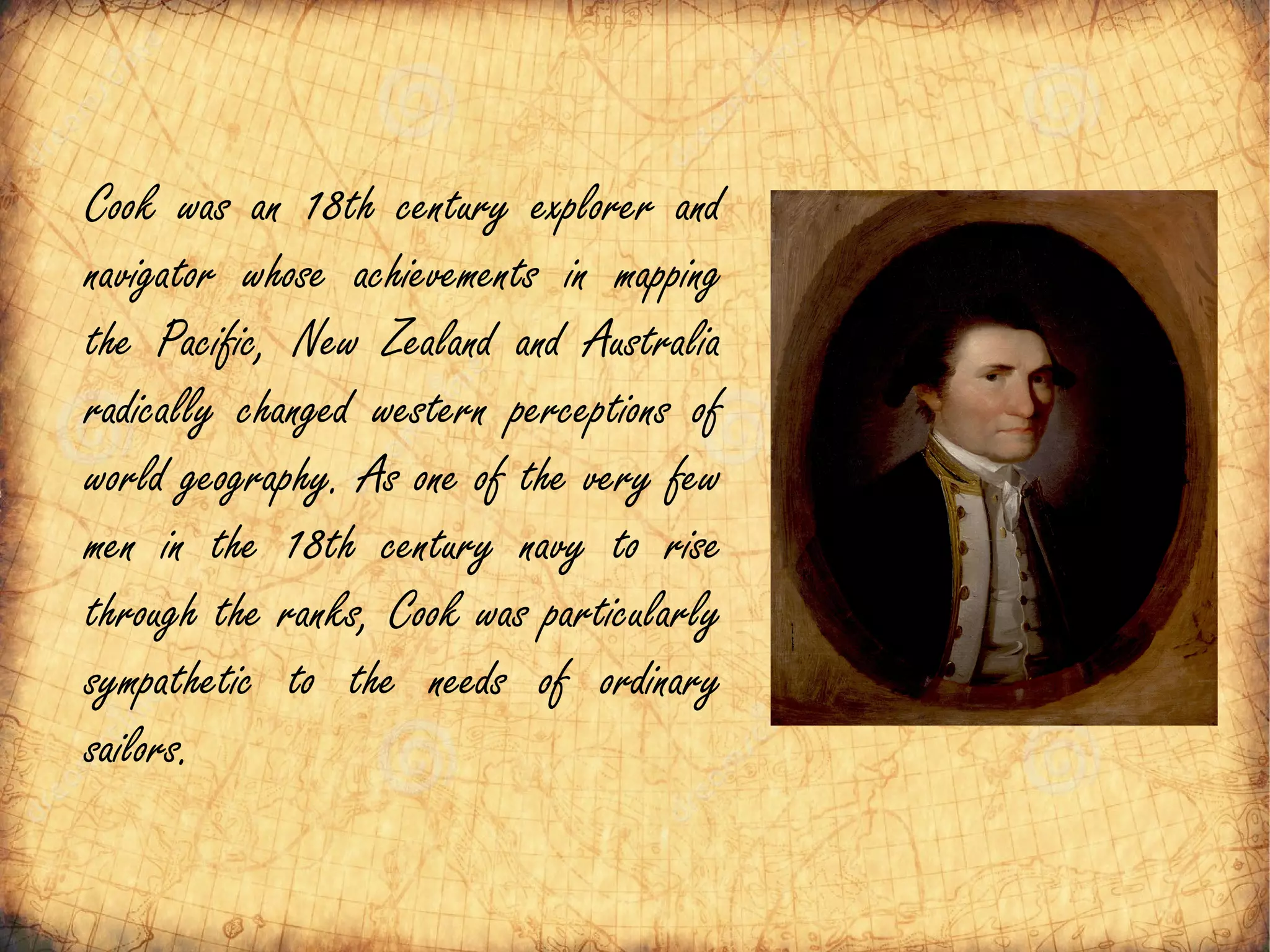
Cook was an 18th century explorer and
navigator whose achievements in mapping
the Pacific, New Zealand and Australia
radically changed western perceptions of
world geography. As one of the very few
men in the 18th century navy to rise
through the ranks, Cook was particularly
sympathetic to the needs of ordinary
sailors.
James Cook was born on 27 October 1728 in a small village near
Middlesbrough in Yorkshire. His father was a farm worker. At the age of
17, Cook moved to the coast, settling in Whitby and finding work with a
coal merchant. In 1755, Cook enlisted in the Royal Navy, serving in
North America where he learnt to survey and chart coastal waters.
In 1769, the planet Venus was due to pass in front of the Sun, a rare
event visible only in the southern hemisphere. The British government decided
to send an expedition to observe the phenomenon. A more secret motive was to
search for the fabled southern continent. Cook was chosen as commander of
the Whitby-built HMS Endeavour. Those on board included astronomer
Charles Green and botanist Joseph Banks.
Endeavour arrived in Tahiti in April 1769 where Green was able to observe the
transit of Venus. Endeavour continued on to New Zealand, and then sailed along
the length of Australia's eastern coast, which had never before been seen by
Europeans. Cook claimed it for Britain and named it New South Wales. Cook
and his crew then returned home, arriving in July 1771.
In 1772, not satisfied by his previous exploits, Cook set out on a second voyage
to look for the southern continent. His two ships sailed close to the Antarctic
coast but were forced to turn back by the cold. They then visited New Zealand
and Tahiti, returning to England in 1775.
Cook's third voyage was to find the North-West Passage that was believed to
link the Atlantic and Pacific oceans. Unable to find the fabled route, Cook took
his two ships south and explored the island of Hawaii. Relations with the
islanders were soured after the theft of a ship's boat. On 14 February Cook tried
to take the local leader hostage. There was a scuffle and Cook was stabbed and
killed.
Voyages
Reference
http://www.bbc.co.uk/history/historic_figures/cook_captain_james.shtml
http://commons.wikimedia.org/wiki/File:Captainjamescookportrait.jpg
http://commons.wikimedia.org/wiki/File:James_Cook_by_John_Webber.jpg
Reference
http://www.bbc.co.uk/history/historic_figures/cook_captain_james.shtml
http://commons.wikimedia.org/wiki/File:Captainjamescookportrait.jpg
http://commons.wikimedia.org/wiki/File:James_Cook_by_John_Webber.jpg

Presentation about James Cook

  • 1.
  • 2.
    Cook was an18th century explorer and navigator whose achievements in mapping the Pacific, New Zealand and Australia radically changed western perceptions of world geography. As one of the very few men in the 18th century navy to rise through the ranks, Cook was particularly sympathetic to the needs of ordinary sailors.
  • 3.
    James Cook wasborn on 27 October 1728 in a small village near Middlesbrough in Yorkshire. His father was a farm worker. At the age of 17, Cook moved to the coast, settling in Whitby and finding work with a coal merchant. In 1755, Cook enlisted in the Royal Navy, serving in North America where he learnt to survey and chart coastal waters. In 1769, the planet Venus was due to pass in front of the Sun, a rare event visible only in the southern hemisphere. The British government decided to send an expedition to observe the phenomenon. A more secret motive was to search for the fabled southern continent. Cook was chosen as commander of the Whitby-built HMS Endeavour. Those on board included astronomer Charles Green and botanist Joseph Banks.
  • 4.
    Endeavour arrived inTahiti in April 1769 where Green was able to observe the transit of Venus. Endeavour continued on to New Zealand, and then sailed along the length of Australia's eastern coast, which had never before been seen by Europeans. Cook claimed it for Britain and named it New South Wales. Cook and his crew then returned home, arriving in July 1771. In 1772, not satisfied by his previous exploits, Cook set out on a second voyage to look for the southern continent. His two ships sailed close to the Antarctic coast but were forced to turn back by the cold. They then visited New Zealand and Tahiti, returning to England in 1775. Cook's third voyage was to find the North-West Passage that was believed to link the Atlantic and Pacific oceans. Unable to find the fabled route, Cook took his two ships south and explored the island of Hawaii. Relations with the islanders were soured after the theft of a ship's boat. On 14 February Cook tried to take the local leader hostage. There was a scuffle and Cook was stabbed and killed.
  • 5.
  • 6.
  • 7.