By
 Zahraa Esmat Sayed Mahmoud Ali

      Under Supervision of


Prof.Dr.Mona Khalil Abdel_Kader.
         Professor of nutrition
Nutrition and Food Science Deprtment.
      Faculty of Home Economic.
          Helwan University.


Prof.Dr.Rawia Rizk Abd El Ghany.
         Professor of nutrition
Nutrition and Food Science Deprtment.
      Faculty of Home Economic.
          Helwan University
Introduction

  Diabetes mellitus were described 3000 years ago
by the ancient Egyptians. In the 2nd Century AD,
Aretaeus gave an excellent description of diabetes.

  Thomas Willis in the 17th Century detected the
sweet test of urine. Mathew in the 18th Century
showed that the sugar in urine comes from the
blood.
Minkowski and Von Mering discovered that
disease of the pancreas is responsible for
diabetes to develop in the 19th century.

  In the 19th century treatment of diabetes
was confined to food regulation which
reduced urination but did not prevent
wasting and complications.
They convinced
themselves that they
had discovered the
active pancreatic
hormone which
normalizes the blood
sugar.
The first person to be
treated with insulin
was Leonard
Thompson (1908-
1935). The first
injection was in 11
January 1922
Definition of diabetes
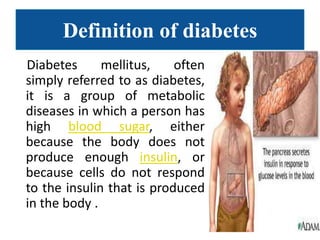
Diabetes      mellitus,    often
simply referred to as diabetes,
it is a group of metabolic
diseases in which a person has
high blood sugar, either
because the body does not
produce enough insulin, or
because cells do not respond
to the insulin that is produced
in the body .
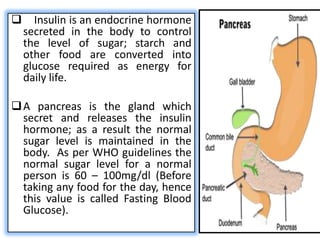
     Insulin is an endocrine hormone
    secreted in the body to control
    the level of sugar; starch and
    other food are converted into
    glucose required as energy for
    daily life.

 A pancreas is the gland which
  secret and releases the insulin
  hormone; as a result the normal
  sugar level is maintained in the
  body. As per WHO guidelines the
  normal sugar level for a normal
  person is 60 – 100mg/dl (Before
  taking any food for the day, hence
  this value is called Fasting Blood
  Glucose).
Classifications of diabetes
Impaired fasting
      glucose (IFG):
Commonly known as pre-
diabetes refers to a condition in
which the fasting blood glucose
level is consistently elevated
above what is considered normal
levels; however, it is not high
enough to be diagnosed as
diabetes mellitus.
Impaired glucose tolerance (IGT):

•It is a pre-diabetic state
of hyperglycemia that is
associated with insulin
resistance and increased risk
of cardiovascular pathology.

•IGT may precede type 2
diabetes mellitus by many
years. It is also a risk factor
for mortality.
Type 1 Diabetes:


Type 1 diabetes mellitus is
characterized by loss of the insulin
producing beta cells of the islets of
langerhans in the pancreas leading to
insulin deficiency.

Individuals with type 1 diabetes are
usually dependent on exogenous
insulin and are at risk for
ketoacidosis.
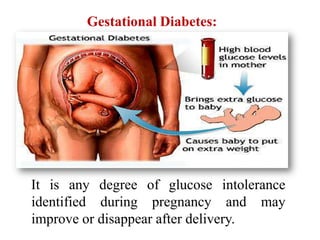
Gestational Diabetes:


It is any degree of glucose intolerance
identified during pregnancy and may
improve or disappear after delivery.
Type 2 Diabetes
 It is caused by insulin resistance
 with a relative, but not absolute,
 deficiency of insulin.

 The etiology of type 2 diabetes
  is uncertain.
 Individuals with type 2 diabetes
  are not prone to ketoacidosis and
  may be asymptomatic.
 It commonly detected after 40
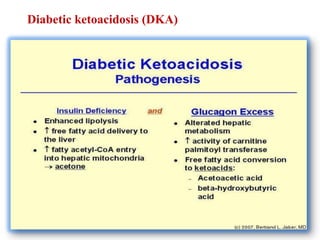
Diabetic ketoacidosis (DKA)
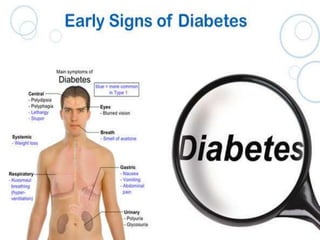
Signs and symptoms of diabetes
Complications of diabetes
Diagnosis of diabetes
Treatment of diabetes
Basic educational requirements
The person with diabetes should acquire adequate knowledge
and skills in the following:

Individual therapy targets.
Individual nutritional requirements and meal planning.
Type and extent of exercise and physical activity.
Interaction of food intake and physical activity with oral
hypoglycaemic drugs/insulin.
Improvements in lifestyle, for example harmful effects of
smoking, obesity and alcohol intake.
Self-monitoring and significance of results and actions to be taken
How to cope with emergencies (illness, hypoglycaemia)
How to avoid complications and detect them at an early stage, e.g.
how to take care of the feet.
Monitoring Glycaemic control

Glycaemic control should always
be monitored. The absence of
symptoms alone should not be
taken as an indicator of good
control.

Self-monitoring      should    be
encouraged.

Methods and frequency of
monitoring depend on the type of
treatment, the local facilities
available, and therapy targets set.
A number of factors influence glycemic responses
 to foods, including:
 the amount of carbohydrate.
 type of sugar (glucose, fructose, sucrose, lactose).
 nature of the starch (amylose, amylopectin, resistant
 starch), cooking and food processing (degree of starch
 gelantinization, particle size, cellular form).
 food form, as well as other food components (fat and
 natural substances that slow digestion—lectins,
 phytates, tannins, and starch-protein and starch-lipid
 combinations).
Guidelines for a healthy diet Healthy eating is an important
part of your plan to help manage your diabetes.
   The list below from the American Diabetes Association
            offers some healthy eating guidelines:
         Fruits and vegetables
 Most fruits, like apples, oranges,
 bananas, and grapes, are fine to eat.
 Let your health care team know if
 you have any fruit allergies so they
 can leave those fruits out of your
 meal plan.
 Make sure you eat no starchy
 vegetables, such as lettuce, spinach,
 tomatoes, and broccoli.
Whole grains
Whole grains are grains that have
not been processed, so they are
healthier for you.
Choose brown rice or whole wheat
pasta as healthier options.

            Lean meat
These are cuts of meat that contain
less fat. When you eat beef or pork,
choose cuts that end in ―loin,‖ such as
sirloin or tenderloin.
When you eat chicken or turkey,
remove the skin before cooking.
Fish and seafood
Fish and seafood are nutritious and
are healthier for you than red meat.
Eat them 2 or 3 times a week. Do
not eat seafood, however, if you are
allergic to it.
               Dairy
Choose skim milk and nonfat or
low-fat yogurt and cheese.

Small amounts of saturated fats
        and cholesterol
When cooking, use liquid oils instead
of solid fats like butter, shortening, or
lard. If you are trying to lose weight,
limit the amount of fat you eat.
Water
Drink lots of water—it’s the healthiest thing
to drink when you’re thirsty. If you want a
little variety, try calorie-free drinks. Stay
away from regular soda, fruit juice, and any
other drinks that contain sugar.
Exercise
Some of the benefits of exercise are:

 Increased muscle tone/improved appearance
 Improved circulation
 Lowered blood pressure
 Decreased feelings of stress and tension
 Lowered level of ―bad‖ (LDL) blood cholesterol
 Increased level of ―good‖ (HDL) blood
cholesterol
 Decreased blood sugar
Decreased risk of osteoporosis
Easier weight loss
 Improved insulin sensitivity.
Pharmacological treatment
          phpp
Oral Pharmacological Treatment of
                Type 2 Diabetes
 Pharmacological therapy is recommended after 6-12 weeks
  if an individualized meal plan, activity, and weight loss trial
  (if needed) have failed to control blood glucose (BG). If the
  BG remains above 126 mg/dl fasting and over 200 mg/dl 1-
  2 hours postprandial, pharmacological treatment should be
  initiated.
There are currently 8 classifications of oral therapy for type 2
diabetes :
• Sulfonylureas
• Meglitinides
• D-Phenylalanine Derivatives
• Bile Acid Sequestrant
• Biguanides
• Thiazolidinediones
• Alpha Glucosidase
Inhibitors
• DPP-4 Inhibitors
Clinical assessment:

 Signs and symptoms of diabetes.
 Risk factors of cardiovascular diseases, such as smoking,
  hypertension, obesity, hyperlipidaemia and family history.
 Symptoms of cardiovascular complications including angina
  and heart failure.
 Visual symptoms.
 Symptoms of neuropathic complications such as numbness,
  pain, muscle weakness, gastrointestinal symptoms including
  diarrhoea, impotence and bladder dysfunction.
 Drug history.
 past history
 Gestational history.
 Blood pressure
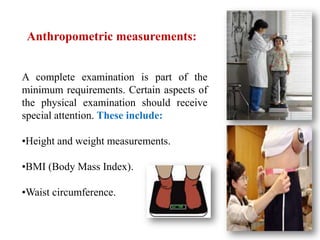
Anthropometric measurements:


A complete examination is part of the
minimum requirements. Certain aspects of
the physical examination should receive
special attention. These include:

•Height and weight measurements.

•BMI (Body Mass Index).

•Waist circumference.
Dietary assessment should include:
Diet history.
24 hours (recall or record).
Food frequency.
Laboratory assessment should include:
A blood glucose measurement as a minimum requirement to
confirm the diagnosis
Urine examination for ketones, protein and glucose
Serum creatinine measurement in all hypertensive patients and
those with proteinuria
Electrocardiography and measurement of total serum
cholesterol and triglycerides in high-risk individuals
HBAIC measurement and quantitative measurement of urine
protein as optional investigations that may be performed as part
of the initial assessment where facilities and resources allow.
RECOMMENDATIONS
Attain and maintain optimal metabolic outcomes including:

   •Blood glucose levels in the normal range or as close to
   normal as is safely possible to prevent or reduce the risk
   for complications of diabetes.

   •A lipid and lipoprotein profile that reduces the risk for
   macrovascular disease.

   •Blood pressure levels that reduce the risk for vascular
   disease.
Prevent and treat the chronic complications of diabetes. Modify
nutrient intake and lifestyle as appropriate for the prevention and
treatment of obesity, dyslipidemia, cardiovascular disease,
hypertension, and nephropathy.

Improve health through healthy food choices and physical
activity.


Address individual nutritional needs taking into consideration
personal and cultural preferences and lifestyle while respecting
the individual’s wishes and willingness to change.
Less than 10% of energy intake should be derived from
saturated fats. Some individuals (i.e., persons with LDL
cholesterol ≥100 mg/dl) may benefit from lowering saturated fat
intake to <7% of energy intake .

To lower LDL cholesterol, energy derived from saturated fat can
be reduced if weight loss is desirable or replaced with either
carbohydrate or monounsaturated fat when weight loss is not a
goal.

For persons with diabetes, especially those not in optimal
glucose control, the protein requirement may be greater than the
Recommended Dietary Allowance, but not greater than usual
intake.
 Carbohydrate and monounsaturated fat together should provide
  60–70% of energy intake. However, the metabolic profile and
  need for weight loss should be considered when determining the
  monounsaturated fat content of the diet.


 The long-term effects of diets high in protein and low in
 carbohydrate are unknown. Although such diets may produce
 short-term weight loss and improved glycemia, it has not been
 established that weight loss is maintained long-term. The long-
 term effect of such diets on plasma LDL cholesterol is also a
 concern.
Presentation a bout diabetes

Presentation a bout diabetes

  • 2.
    By Zahraa EsmatSayed Mahmoud Ali Under Supervision of Prof.Dr.Mona Khalil Abdel_Kader. Professor of nutrition Nutrition and Food Science Deprtment. Faculty of Home Economic. Helwan University. Prof.Dr.Rawia Rizk Abd El Ghany. Professor of nutrition Nutrition and Food Science Deprtment. Faculty of Home Economic. Helwan University
  • 3.
    Introduction Diabetesmellitus were described 3000 years ago by the ancient Egyptians. In the 2nd Century AD, Aretaeus gave an excellent description of diabetes. Thomas Willis in the 17th Century detected the sweet test of urine. Mathew in the 18th Century showed that the sugar in urine comes from the blood.
  • 4.
    Minkowski and VonMering discovered that disease of the pancreas is responsible for diabetes to develop in the 19th century. In the 19th century treatment of diabetes was confined to food regulation which reduced urination but did not prevent wasting and complications.
  • 5.
    They convinced themselves thatthey had discovered the active pancreatic hormone which normalizes the blood sugar.
  • 6.
    The first personto be treated with insulin was Leonard Thompson (1908- 1935). The first injection was in 11 January 1922
  • 7.
    Definition of diabetes Diabetes mellitus, often simply referred to as diabetes, it is a group of metabolic diseases in which a person has high blood sugar, either because the body does not produce enough insulin, or because cells do not respond to the insulin that is produced in the body .
  • 8.
    Insulin is an endocrine hormone secreted in the body to control the level of sugar; starch and other food are converted into glucose required as energy for daily life.  A pancreas is the gland which secret and releases the insulin hormone; as a result the normal sugar level is maintained in the body. As per WHO guidelines the normal sugar level for a normal person is 60 – 100mg/dl (Before taking any food for the day, hence this value is called Fasting Blood Glucose).
  • 9.
  • 10.
    Impaired fasting glucose (IFG): Commonly known as pre- diabetes refers to a condition in which the fasting blood glucose level is consistently elevated above what is considered normal levels; however, it is not high enough to be diagnosed as diabetes mellitus.
  • 11.
    Impaired glucose tolerance(IGT): •It is a pre-diabetic state of hyperglycemia that is associated with insulin resistance and increased risk of cardiovascular pathology. •IGT may precede type 2 diabetes mellitus by many years. It is also a risk factor for mortality.
  • 12.
    Type 1 Diabetes: Type1 diabetes mellitus is characterized by loss of the insulin producing beta cells of the islets of langerhans in the pancreas leading to insulin deficiency. Individuals with type 1 diabetes are usually dependent on exogenous insulin and are at risk for ketoacidosis.
  • 13.
    Gestational Diabetes: It isany degree of glucose intolerance identified during pregnancy and may improve or disappear after delivery.
  • 14.
    Type 2 Diabetes It is caused by insulin resistance with a relative, but not absolute, deficiency of insulin.  The etiology of type 2 diabetes is uncertain.  Individuals with type 2 diabetes are not prone to ketoacidosis and may be asymptomatic.  It commonly detected after 40
  • 15.
  • 16.
    Signs and symptomsof diabetes
  • 18.
  • 20.
  • 24.
  • 26.
    Basic educational requirements Theperson with diabetes should acquire adequate knowledge and skills in the following: Individual therapy targets. Individual nutritional requirements and meal planning. Type and extent of exercise and physical activity. Interaction of food intake and physical activity with oral hypoglycaemic drugs/insulin. Improvements in lifestyle, for example harmful effects of smoking, obesity and alcohol intake. Self-monitoring and significance of results and actions to be taken How to cope with emergencies (illness, hypoglycaemia) How to avoid complications and detect them at an early stage, e.g. how to take care of the feet.
  • 28.
    Monitoring Glycaemic control Glycaemiccontrol should always be monitored. The absence of symptoms alone should not be taken as an indicator of good control. Self-monitoring should be encouraged. Methods and frequency of monitoring depend on the type of treatment, the local facilities available, and therapy targets set.
  • 29.
    A number offactors influence glycemic responses to foods, including:  the amount of carbohydrate.  type of sugar (glucose, fructose, sucrose, lactose).  nature of the starch (amylose, amylopectin, resistant starch), cooking and food processing (degree of starch gelantinization, particle size, cellular form).  food form, as well as other food components (fat and natural substances that slow digestion—lectins, phytates, tannins, and starch-protein and starch-lipid combinations).
  • 30.
    Guidelines for ahealthy diet Healthy eating is an important part of your plan to help manage your diabetes. The list below from the American Diabetes Association offers some healthy eating guidelines: Fruits and vegetables Most fruits, like apples, oranges, bananas, and grapes, are fine to eat. Let your health care team know if you have any fruit allergies so they can leave those fruits out of your meal plan. Make sure you eat no starchy vegetables, such as lettuce, spinach, tomatoes, and broccoli.

  • 31.
    Whole grains Whole grainsare grains that have not been processed, so they are healthier for you. Choose brown rice or whole wheat pasta as healthier options. Lean meat These are cuts of meat that contain less fat. When you eat beef or pork, choose cuts that end in ―loin,‖ such as sirloin or tenderloin. When you eat chicken or turkey, remove the skin before cooking.
  • 32.
    Fish and seafood Fishand seafood are nutritious and are healthier for you than red meat. Eat them 2 or 3 times a week. Do not eat seafood, however, if you are allergic to it. Dairy Choose skim milk and nonfat or low-fat yogurt and cheese. Small amounts of saturated fats and cholesterol When cooking, use liquid oils instead of solid fats like butter, shortening, or lard. If you are trying to lose weight, limit the amount of fat you eat.
  • 33.
    Water Drink lots ofwater—it’s the healthiest thing to drink when you’re thirsty. If you want a little variety, try calorie-free drinks. Stay away from regular soda, fruit juice, and any other drinks that contain sugar.
  • 34.
  • 35.
    Some of thebenefits of exercise are:  Increased muscle tone/improved appearance  Improved circulation  Lowered blood pressure  Decreased feelings of stress and tension  Lowered level of ―bad‖ (LDL) blood cholesterol  Increased level of ―good‖ (HDL) blood cholesterol  Decreased blood sugar Decreased risk of osteoporosis Easier weight loss  Improved insulin sensitivity.
  • 36.
  • 37.
    Oral Pharmacological Treatmentof Type 2 Diabetes  Pharmacological therapy is recommended after 6-12 weeks if an individualized meal plan, activity, and weight loss trial (if needed) have failed to control blood glucose (BG). If the BG remains above 126 mg/dl fasting and over 200 mg/dl 1- 2 hours postprandial, pharmacological treatment should be initiated. There are currently 8 classifications of oral therapy for type 2 diabetes : • Sulfonylureas • Meglitinides • D-Phenylalanine Derivatives • Bile Acid Sequestrant
  • 38.
    • Biguanides • Thiazolidinediones •Alpha Glucosidase Inhibitors • DPP-4 Inhibitors
  • 40.
    Clinical assessment:  Signsand symptoms of diabetes.  Risk factors of cardiovascular diseases, such as smoking, hypertension, obesity, hyperlipidaemia and family history.  Symptoms of cardiovascular complications including angina and heart failure.  Visual symptoms.  Symptoms of neuropathic complications such as numbness, pain, muscle weakness, gastrointestinal symptoms including diarrhoea, impotence and bladder dysfunction.  Drug history.  past history  Gestational history.  Blood pressure
  • 41.
    Anthropometric measurements: A completeexamination is part of the minimum requirements. Certain aspects of the physical examination should receive special attention. These include: •Height and weight measurements. •BMI (Body Mass Index). •Waist circumference.
  • 42.
    Dietary assessment shouldinclude: Diet history. 24 hours (recall or record). Food frequency. Laboratory assessment should include: A blood glucose measurement as a minimum requirement to confirm the diagnosis Urine examination for ketones, protein and glucose Serum creatinine measurement in all hypertensive patients and those with proteinuria Electrocardiography and measurement of total serum cholesterol and triglycerides in high-risk individuals HBAIC measurement and quantitative measurement of urine protein as optional investigations that may be performed as part of the initial assessment where facilities and resources allow.
  • 43.
    RECOMMENDATIONS Attain and maintainoptimal metabolic outcomes including: •Blood glucose levels in the normal range or as close to normal as is safely possible to prevent or reduce the risk for complications of diabetes. •A lipid and lipoprotein profile that reduces the risk for macrovascular disease. •Blood pressure levels that reduce the risk for vascular disease.
  • 44.
    Prevent and treatthe chronic complications of diabetes. Modify nutrient intake and lifestyle as appropriate for the prevention and treatment of obesity, dyslipidemia, cardiovascular disease, hypertension, and nephropathy. Improve health through healthy food choices and physical activity. Address individual nutritional needs taking into consideration personal and cultural preferences and lifestyle while respecting the individual’s wishes and willingness to change.
  • 45.
    Less than 10%of energy intake should be derived from saturated fats. Some individuals (i.e., persons with LDL cholesterol ≥100 mg/dl) may benefit from lowering saturated fat intake to <7% of energy intake . To lower LDL cholesterol, energy derived from saturated fat can be reduced if weight loss is desirable or replaced with either carbohydrate or monounsaturated fat when weight loss is not a goal. For persons with diabetes, especially those not in optimal glucose control, the protein requirement may be greater than the Recommended Dietary Allowance, but not greater than usual intake.
  • 46.
     Carbohydrate andmonounsaturated fat together should provide 60–70% of energy intake. However, the metabolic profile and need for weight loss should be considered when determining the monounsaturated fat content of the diet. The long-term effects of diets high in protein and low in carbohydrate are unknown. Although such diets may produce short-term weight loss and improved glycemia, it has not been established that weight loss is maintained long-term. The long- term effect of such diets on plasma LDL cholesterol is also a concern.