Gender/Sex in Printed Media
Morla Kraus
University of Southern Maine
CMS 480
Introduction:
• Gender/Sex in Printed Media
• Important to understand how men and women are portrayed in
printed media
• Gaining knowledge will help us to better understand how men and
women are gendered and sexed in printed media
Background and Research Process
• The following slides will discuss:
• What is gender/sex?
• What is gender identity?
• Characteristics of masculinity and femininity
• Relevance of Social Learning Theory
• Sexualization of Women in the Media
• Male and Female Images
• Survey of Co-Workers
Gender/Sex
• Sex is determined biologically
• Gender refers to cultural designations of feminine and
masculine
• Since gender is socially prescribed rather than biologically
determined people identify with varying degrees of masculinity
and femininity
• Focusing on gender instead of sex will keep from
overgeneralizing women’s and men’s identities
Gender Identity
• Identity refers to how people see themselves individually
and as members or a group, also how others see them as
individuals and members of groups
• Gender identity is learned as we grow from a variety of
sources: parents, school, books, peer pressure, the media
• There is an overwhelming power to conform to the gender
models we see. By the time children start school they have
learned how to be masculine or feminine as culture defines
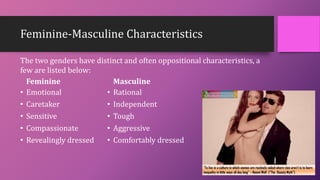
Feminine-Masculine Characteristics
Feminine
• Emotional
• Caretaker
• Sensitive
• Compassionate
• Revealingly dressed
Masculine
• Rational
• Independent
• Tough
• Aggressive
• Comfortably dressed
The two genders have distinct and often oppositional characteristics, a
few are listed below:
Social Learning Theory
• This theory discusses the importance of observing and
modeling behaviors, attitudes and emotional reactions of
others.
• Observing others gives people an idea of how behaviors are
performed.
• Spans both cognitive and behavioral framework
• Research of Social Learning Theory discusses that social
learning situations are present in advertisements, depending
on the component involved such as attention or motivation,
behavior shown in the ad is the result of purchasing the
product advertised (Culatta)
Sexualization of Women
• a person’s value comes only from his or her sexual appeal or
behavior, to the exclusion of other characteristics;
• a person is held to a standard that equates physical
attractiveness (narrowly defined) with being sexy;
• a person is sexually objectified— that is, made into a thing
for others’ sexual use, rather than seen as a person with the
capacity for independent action and decision making; and/
or
• sexuality is inappropriately imposed upon a person.
(DeFrancisco, et al.)
Male and Female Images
• In newspapers, magazines, advertising and comic books
women are likely to be shown:
• In the home, performing chores such as laundry or cooking, as sex
objects for men, victims who cannot protect themselves or as
recipients of harassment or sexual assault
• Men are likely to be shown as:
• Economic and political figures in society, competitive, independent,
emotionally detached and aggressive (Graydon & Varrell)
Co-Worker Survey
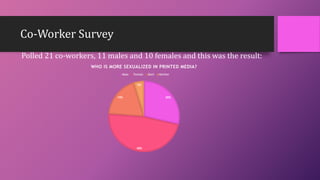
Polled 21 co-workers, 11 males and 10 females and this was the result:
28%
48%
19%
5%
WHO IS MORE SEXUALIZED IN PRINTED MEDIA?
Male Female Both Neither
Co-Worker Survey (cont.)
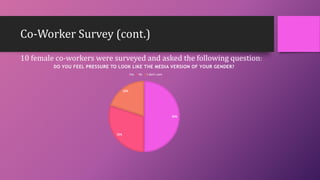
10 female co-workers were surveyed and asked the following question:
50%
30%
20%
DO YOU FEEL PRESSURE TO LOOK LIKE THE MEDIA VERSION OF YOUR GENDER?
Yes No I don't care
Co-Worker Survey (cont.)
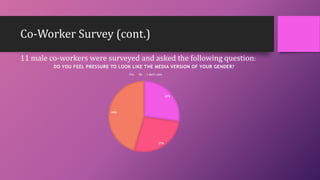
27%
27%
46%
DO YOU FEEL PRESSURE TO LOOK LIKE THE MEDIA VERSION OF YOUR GENDER?
Yes No I don't care
11 male co-workers were surveyed and asked the following question:
Co-Worker Survey (Cont.)
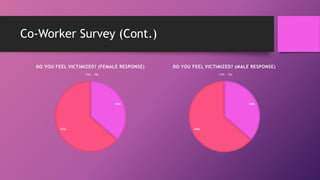
36%
64%
DO YOU FEEL VICTIMIZED? (FEMALE RESPONSE)
Yes No
36%
64%
DO YOU FEEL VICTIMIZED? (MALE RESPONSE)
Yes No
Analysis and Conclusion/Discussion
• The next slides will reveal:
• Discoveries within research
• Comparing other research
• What questions remain?
• What could be a future research project?
Discoveries within Research
• Women are known to be more image conscious than men
and the discoveries within the research confirmed that
• Women feel more pressure to look like how they are
perceived in the media
• Men can also feel pressure to conform to the media versions
of themselves, however less likely
• The survey showed that women feel more victimized than
men
Comparing Other Research
• Culatta’s Social Learning Theory postulates that behaviors are learned
and modeled after someone who is like ourselves
• Grayson & Varrell postulate that female and male images are separate
things.
• Women are victimized, recipients of sexual harassment, perform daily household
chores
• Men are independent, public figures or aggressive
• Social Learning Theory is evident in the surveys taken that behaviors
are modeled after another person, which is shown in people thinking
they should be like their printed media selves
• The surveys also show that women feel more victimized than men
What questions remain?
• How can we change the perspective that everyone should
look a particular way?
• As women, is there a way to improve the image that we are
victims?
• Are all men competitive and aggressive? If so, can women
also be competitive and aggressive?
Future Research Project
• In order to better understand the effects printed media has on an
individuals’ self-esteem there should be a way to determine how to
give a person a healthy self-confidence that will benefit each gender to
prevent stereotypes
• This would be helpful to promote healthy body images for both males and
females and to allow females to feel less like victims
• This could also help make people feel less likely to conform to one gender over
another
References
• Culatta, R. (n.d.). Social Learning Theory (Albert Bandura). Retrieved
April 26, 2016, from
http://www.instructionaldesign.org/theories/social-learning.html
• DeFrancisco, Victoria Pruin; Palczewski, Catherine Helen; McGeough,
Danielle (2013-08-28). Gender in Communication: A Critical
Introduction. SAGE Publications.
• Graydon, S., & Varrell, E. (n.d.). Gender Issues In The Media. Retrieved
April 28, 2016, from
http://www.etfo.ca/Resources/ForTeachers/Documents/Gender
Issues in The Media.aspx

Presentation

  • 1.
    Gender/Sex in PrintedMedia Morla Kraus University of Southern Maine CMS 480
  • 2.
    Introduction: • Gender/Sex inPrinted Media • Important to understand how men and women are portrayed in printed media • Gaining knowledge will help us to better understand how men and women are gendered and sexed in printed media
  • 3.
    Background and ResearchProcess • The following slides will discuss: • What is gender/sex? • What is gender identity? • Characteristics of masculinity and femininity • Relevance of Social Learning Theory • Sexualization of Women in the Media • Male and Female Images • Survey of Co-Workers
  • 4.
    Gender/Sex • Sex isdetermined biologically • Gender refers to cultural designations of feminine and masculine • Since gender is socially prescribed rather than biologically determined people identify with varying degrees of masculinity and femininity • Focusing on gender instead of sex will keep from overgeneralizing women’s and men’s identities
  • 5.
    Gender Identity • Identityrefers to how people see themselves individually and as members or a group, also how others see them as individuals and members of groups • Gender identity is learned as we grow from a variety of sources: parents, school, books, peer pressure, the media • There is an overwhelming power to conform to the gender models we see. By the time children start school they have learned how to be masculine or feminine as culture defines
  • 6.
    Feminine-Masculine Characteristics Feminine • Emotional •Caretaker • Sensitive • Compassionate • Revealingly dressed Masculine • Rational • Independent • Tough • Aggressive • Comfortably dressed The two genders have distinct and often oppositional characteristics, a few are listed below:
  • 7.
    Social Learning Theory •This theory discusses the importance of observing and modeling behaviors, attitudes and emotional reactions of others. • Observing others gives people an idea of how behaviors are performed. • Spans both cognitive and behavioral framework • Research of Social Learning Theory discusses that social learning situations are present in advertisements, depending on the component involved such as attention or motivation, behavior shown in the ad is the result of purchasing the product advertised (Culatta)
  • 8.
    Sexualization of Women •a person’s value comes only from his or her sexual appeal or behavior, to the exclusion of other characteristics; • a person is held to a standard that equates physical attractiveness (narrowly defined) with being sexy; • a person is sexually objectified— that is, made into a thing for others’ sexual use, rather than seen as a person with the capacity for independent action and decision making; and/ or • sexuality is inappropriately imposed upon a person. (DeFrancisco, et al.)
  • 9.
    Male and FemaleImages • In newspapers, magazines, advertising and comic books women are likely to be shown: • In the home, performing chores such as laundry or cooking, as sex objects for men, victims who cannot protect themselves or as recipients of harassment or sexual assault • Men are likely to be shown as: • Economic and political figures in society, competitive, independent, emotionally detached and aggressive (Graydon & Varrell)
  • 10.
    Co-Worker Survey Polled 21co-workers, 11 males and 10 females and this was the result: 28% 48% 19% 5% WHO IS MORE SEXUALIZED IN PRINTED MEDIA? Male Female Both Neither
  • 11.
    Co-Worker Survey (cont.) 10female co-workers were surveyed and asked the following question: 50% 30% 20% DO YOU FEEL PRESSURE TO LOOK LIKE THE MEDIA VERSION OF YOUR GENDER? Yes No I don't care
  • 12.
    Co-Worker Survey (cont.) 27% 27% 46% DOYOU FEEL PRESSURE TO LOOK LIKE THE MEDIA VERSION OF YOUR GENDER? Yes No I don't care 11 male co-workers were surveyed and asked the following question:
  • 13.
    Co-Worker Survey (Cont.) 36% 64% DOYOU FEEL VICTIMIZED? (FEMALE RESPONSE) Yes No 36% 64% DO YOU FEEL VICTIMIZED? (MALE RESPONSE) Yes No
  • 14.
    Analysis and Conclusion/Discussion •The next slides will reveal: • Discoveries within research • Comparing other research • What questions remain? • What could be a future research project?
  • 15.
    Discoveries within Research •Women are known to be more image conscious than men and the discoveries within the research confirmed that • Women feel more pressure to look like how they are perceived in the media • Men can also feel pressure to conform to the media versions of themselves, however less likely • The survey showed that women feel more victimized than men
  • 16.
    Comparing Other Research •Culatta’s Social Learning Theory postulates that behaviors are learned and modeled after someone who is like ourselves • Grayson & Varrell postulate that female and male images are separate things. • Women are victimized, recipients of sexual harassment, perform daily household chores • Men are independent, public figures or aggressive • Social Learning Theory is evident in the surveys taken that behaviors are modeled after another person, which is shown in people thinking they should be like their printed media selves • The surveys also show that women feel more victimized than men
  • 17.
    What questions remain? •How can we change the perspective that everyone should look a particular way? • As women, is there a way to improve the image that we are victims? • Are all men competitive and aggressive? If so, can women also be competitive and aggressive?
  • 18.
    Future Research Project •In order to better understand the effects printed media has on an individuals’ self-esteem there should be a way to determine how to give a person a healthy self-confidence that will benefit each gender to prevent stereotypes • This would be helpful to promote healthy body images for both males and females and to allow females to feel less like victims • This could also help make people feel less likely to conform to one gender over another
  • 19.
    References • Culatta, R.(n.d.). Social Learning Theory (Albert Bandura). Retrieved April 26, 2016, from http://www.instructionaldesign.org/theories/social-learning.html • DeFrancisco, Victoria Pruin; Palczewski, Catherine Helen; McGeough, Danielle (2013-08-28). Gender in Communication: A Critical Introduction. SAGE Publications. • Graydon, S., & Varrell, E. (n.d.). Gender Issues In The Media. Retrieved April 28, 2016, from http://www.etfo.ca/Resources/ForTeachers/Documents/Gender Issues in The Media.aspx