D.V. Madhusudan Rao
Associate Professor-Management
Avinash Degree College
Kukatpally, HYDERABAD
CBCS GENDER SENSITIZATION COURSE
[Awareness Enhancement Course Curriculum]
EDUCATE, AGITATE, ORGANIZE – Babasaheb Dr. Ambedkar
GENDER SENSITIZATION COURSE
After studying these chapters, you should be able to:
OBJECTIVES:
• Gender mainstreaming,
removing margins,
merging centres
• To create a gender Equality
mindset among young
graduates
• To aim for cooperation
and collaboration among
genders instead of conflict
and confrontation
LEARNING OUTCOMES:
• Respect for other genders,
not suspicion or superiority /
inferiority
• Accepting gender
differences as positives
rather than deterrents
• Contemporizing traditional
gender stereotypes to fit the
21st century ethos
Questions on GS
12/03/2017 3
• Why ?
• What?
• How?
Emerging Issues
• Why GS now???
– More and more exposure to gender imbalances
in all aspects of life
– Questioning previous stereotypes and
attempting to replace gender negatives with
positives
– Attempt to educate the next generation to move
towards a gender neutral society where parity is
a given not a prize to be won by fighting.
12/03/2017 4
Emerging Issues
What ???
• Correcting the patriarchal inclinations of male centrality by
ensuring women’s participation in public spheres
• Accepting other orientations beyond male /female
• Treating people as HUMAN rather than male/female/LGBT etc
How???
– Catch them young—GS in schools and colleges
– Experiential learning by observation of and inference from
gender roles and interactions
– Investing thought in bringing about gender balance- bringing all
genders into the mainstream
– Adopting models from public/private discourses which celebrate
gender parity 12/03/2017 5
Emerging Issues
• Increasing communication channels have enhanced
awareness about the evils of fixed gender roles and
expectations of the past.
• Moving towards more women centric perspectives—
examples: wrestling no longer male bastion; many CEOs
are women; Imphal IMA market all women’s business
enterprise; science, politics etc. no longer male preserves.
• Gender and language—’Man’ replaced by ‘human’
being/person; chairman/spokesman etc. replaced by
chairperson/spokesperson; actor/poet etc. to represent
both men and women; ‘he’ representing an entire class of
human beings replaced by ‘s/he’ etc.
12/03/2017 6
Challenges
• Gender interactions at home; in the neighborhood, community,
society, educational institutions, workplace, national and global
perspectives determine the gender attitudes and behavior of
children
• Assumptions: male superiority/female inferiority/transgender
unacceptability need to be addressed
• Mindset: prejudices, fossils of tradition, modernity as a
misnomer, aggression/power equation, familial and social
expectations, peer pressure etc. play a role in gender typing of
individuals
• Misuse of frames, rigid patterns of behavior and attitudes,
criminalization of some to promote others have to be corrected
12/03/2017 7
Possible Correctives
• Ensure equal representation of all genders in all
spheres of activity
• Ensure dignity of all genders, mutual respect and
acceptance
• Cultivate team spirit among genders where different
abilities are considered as strengths and not weaknesses
• Formulate socially acceptable gender norms and
values
12/03/2017 8
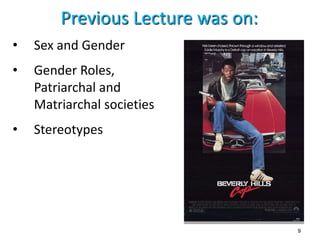
Previous Lecture was on:
• Sex and Gender
• Gender Roles,
Patriarchal and
Matriarchal societies
• Stereotypes
9
Gender roles and stereotypes
•Gender role is the behaviors, attitudes values, beliefs
and so on that a particular cultural group considers
appropriate for males and females on the basis of their
biological sex. Gender roles and expectations are
learned.
•A gender stereotype is a product of a subjective
perception built with an aim of confirming a society in
which women have a lower status than men. The
consequences of these gender stereotypes are gender
inequality, the continuous reproduction of gender
inequalities and gender based violence.
12/03/2017 10
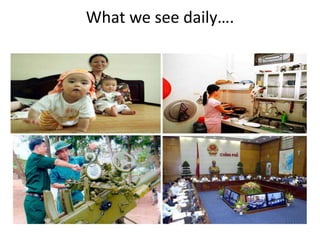
What we see daily….
Prejudices or become specific Actions?
In some families:
•Girls can’t pursue higher education/ should not be
invested in girl’s education such as for boys
•Boys shouldn’t do housework- they are very tiny and
worthless jobs
•Girls can not inherit; Females forced to eat what’s left?
In some workplaces:
•Male workers should take the heavy and hazardous
jobs (according to the list of prohibited female workers)
•Can’t recruit female workers who have little children/
or give those women lower wage
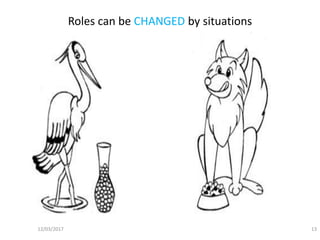
Roles can be CHANGED by situations
12/03/2017 13
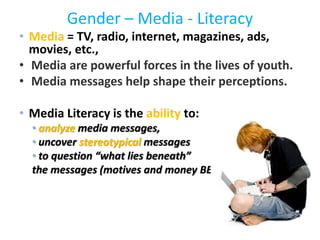
Gender – Media - Literacy
• Media = TV, radio, internet, magazines, ads,
movies, etc.,
• Media are powerful forces in the lives of youth.
• Media messages help shape their perceptions.
• Media Literacy is the ability to:
• analyze media messages,
• uncover stereotypical messages
• to question “what lies beneath”
the messages (motives and money BEHIND the media)
Facts about Media
• Depending on the source, it is
reported that teenagers see between
200 - 1,000 ads a day (tv, movies,
clothing, internet, etc.)
• http://www.youtube.com/watch?v=G
gUE4BeWM-g&feature=related
• We put BLIND TRUST in the media and
allow others to dictate when we will
ultimately believe is the STANDARD for
acceptability.
• We allow media to tell us what is beauty,
what we should look like, what labels we
should buy.
•Why?
Media’s Use
• Media uses stereotypes to sell products or
for comedic value. (Cleaning products
aimed at women, Tech and Talk using
Indian-Americans)
• Stereotypes allow a particular group to be
superior, powerful, and in control while
degrading other groups using slurs,
comedy, or insults to make them weak or
inferior.
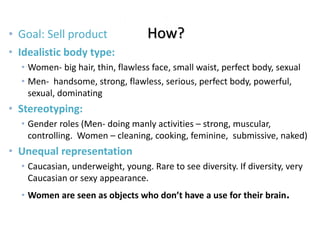
Advertising• Goal: Sell product How?
• Idealistic body type:
• Women- big hair, thin, flawless face, small waist, perfect body, sexual
• Men- handsome, strong, flawless, serious, perfect body, powerful,
sexual, dominating
• Stereotyping:
• Gender roles (Men- doing manly activities – strong, muscular,
controlling. Women – cleaning, cooking, feminine, submissive, naked)
• Unequal representation
• Caucasian, underweight, young. Rare to see diversity. If diversity, very
Caucasian or sexy appearance.
• Women are seen as objects who don’t have a use for their brain.
Gender Inequality and Women’s
Empowerment
2005-06 National Family Health Survey
(NFHS-3) India 2005-2006
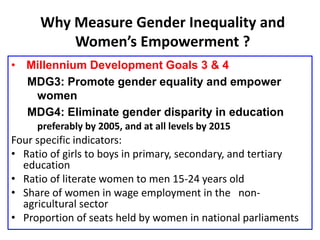
Why Measure Gender Inequality and
Women’s Empowerment ?
• Millennium Development Goals 3 & 4
MDG3: Promote gender equality and empower
women
MDG4: Eliminate gender disparity in education
preferably by 2005, and at all levels by 2015
Four specific indicators:
• Ratio of girls to boys in primary, secondary, and tertiary
education
• Ratio of literate women to men 15-24 years old
• Share of women in wage employment in the non-
agricultural sector
• Proportion of seats held by women in national parliaments
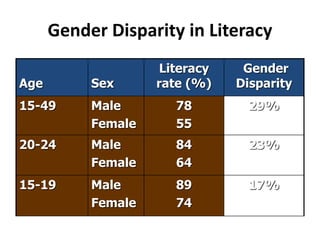
Gender Disparity in Literacy
Age Sex
Literacy
rate (%)
Gender
Disparity
15-49 Male
Female
78
55
29%
20-24 Male
Female
84
64
23%
15-19 Male
Female
89
74
17%
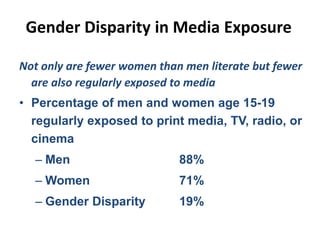
Gender Disparity in Media Exposure
Not only are fewer women than men literate but fewer
are also regularly exposed to media
• Percentage of men and women age 15-19
regularly exposed to print media, TV, radio, or
cinema
– Men 88%
– Women 71%
– Gender Disparity 19%
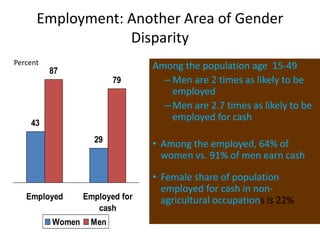
Employment: Another Area of Gender
Disparity
43
29
87
79
Employed Employed for
cash
Women Men
Among the population age 15-49
– Men are 2 times as likely to be
employed
– Men are 2.7 times as likely to be
employed for cash
• Among the employed, 64% of
women vs. 91% of men earn cash
• Female share of population
employed for cash in non-
agricultural occupations is 22%
Percent
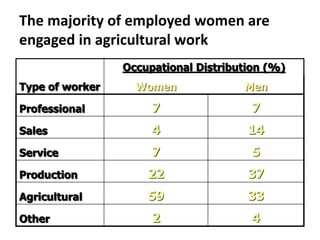
The majority of employed women are
engaged in agricultural work
Type of worker
Occupational Distribution (%)
Women Men
Professional 7 7
Sales 4 14
Service 7 5
Production 22 37
Agricultural 59 33
Other 2 4
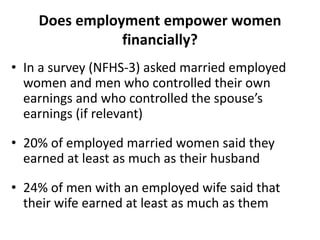
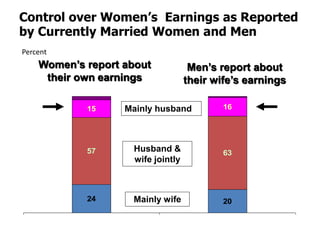
Does employment empower women
financially?
• In a survey (NFHS-3) asked married employed
women and men who controlled their own
earnings and who controlled the spouse’s
earnings (if relevant)
• 20% of employed married women said they
earned at least as much as their husband
• 24% of men with an employed wife said that
their wife earned at least as much as them
Control over Women’s Earnings as Reported
by Currently Married Women and Men
24 20
57 63
1615
Women’s report about
their own earnings
Men’s report about
their wife’s earnings
Mainly wife
Husband &
wife jointly
Mainly husband
Percent
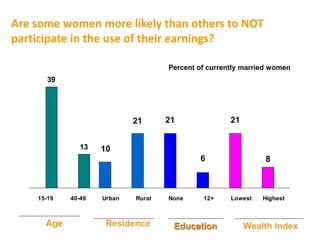
Are some women more likely than others to NOT
participate in the use of their earnings?
8
39
13 10
21 21
6
21
15-19 40-49 Urban Rural None 12+ Lowest Highest
Percent of currently married women
Residence Wealth IndexEducationAge
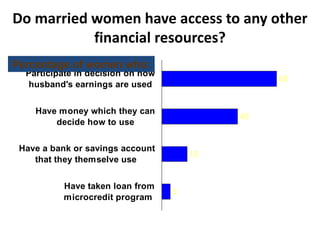
Do married women have access to any other
financial resources?
68
45
15
5
Participate in decision on how
husband's earnings are used
Have money which they can
decide how to use
Have a bank or savings account
that they themselve use
Have taken loan from
microcredit program
Percentage of women who:
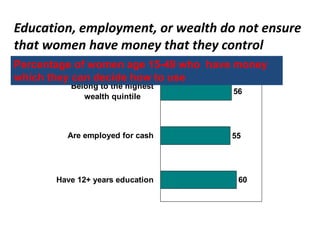
Education, employment, or wealth do not ensure
that women have money that they control
60
55
56
Have 12+ years education
Are employed for cash
Belong to the highest
wealth quintile
Percentage of women age 15-49 who have money
which they can decide how to use
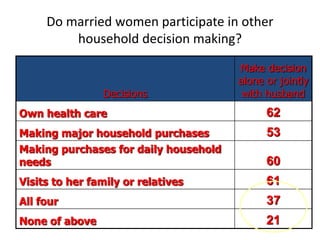
Do married women participate in other
household decision making?
Decisions
Make decision
alone or jointly
with husband
Own health care 62
Making major household purchases 53
Making purchases for daily household
needs 60
Visits to her family or relatives 61
All four 37
None of above 21
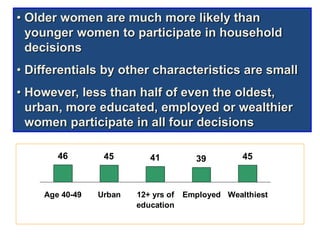
46 45 41 39 45
Age 40-49 Urban 12+ yrs of
education
Employed Wealthiest
• Older women are much more likely than
younger women to participate in household
decisions
• Differentials by other characteristics are small
• However, less than half of even the oldest,
urban, more educated, employed or wealthier
women participate in all four decisions
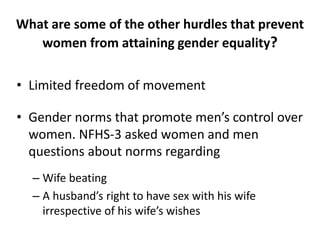
What are some of the other hurdles that prevent
women from attaining gender equality?
• Limited freedom of movement
• Gender norms that promote men’s control over
women. NFHS-3 asked women and men
questions about norms regarding
– Wife beating
– A husband’s right to have sex with his wife
irrespective of his wife’s wishes
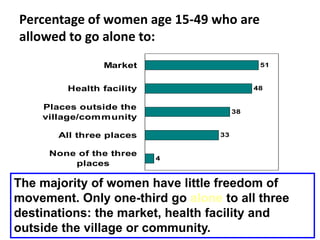
Percentage of women age 15-49 who are
allowed to go alone to:
51
48
38
33
4
Market
Health facility
Places outside the
village/community
All three places
None of the three
places
The majority of women have little freedom of
movement. Only one-third go alone to all three
destinations: the market, health facility and
outside the village or community.
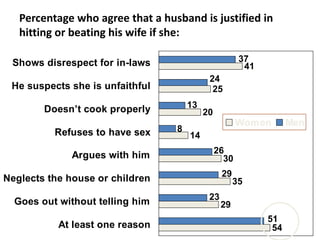
Percentage who agree that a husband is justified in
hitting or beating his wife if she:
54
29
35
30
14
20
25
41
37
24
13
8
26
29
23
51
At least one reason
Goes out without telling him
Neglects the house or children
Argues with him
Refuses to have sex
Doesn’t cook properly
He suspects she is unfaithful
Shows disrespect for in-laws
Women Men
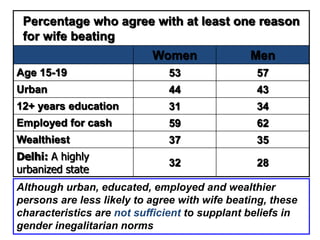
Percentage who agree with at least one reason
for wife beating
Women Men
Age 15-19 53 57
Urban 44 43
12+ years education 31 34
Employed for cash 59 62
Wealthiest 37 35
Delhi: A highly
urbanized state
32 28
Although urban, educated, employed and wealthier
persons are less likely to agree with wife beating, these
characteristics are not sufficient to supplant beliefs in
gender inegalitarian norms
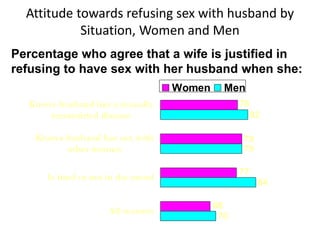
Attitude towards refusing sex with husband by
Situation, Women and Men
79
82
79
84
70
78
68
77
Knows husband has a sexually
transmitted disease
Knows husband has sex with
other women
Is tired or not in the mood
All reasons
Women Men
Percentage who agree that a wife is justified in
refusing to have sex with her husband when she:
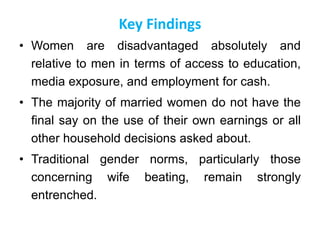
Key Findings
• Women are disadvantaged absolutely and
relative to men in terms of access to education,
media exposure, and employment for cash.
• The majority of married women do not have the
final say on the use of their own earnings or all
other household decisions asked about.
• Traditional gender norms, particularly those
concerning wife beating, remain strongly
entrenched.
Women in the Media Workforce
 40% women journalists world-wide.
(International Federation of journalists June, 2001)
 3% - 5% of editors, heads of departments or directors.
 Asia : 21% of women are represented in the media
workforce but this varies very much from country to
country.
Nepal 6%
Japan 8%
India 12%.
On the bright side, in Thailand, 50% of all the
journalists are women. (IWMF, 2000)
Women in Media
From these figures we can easily say,
mainstream media is controlled by men
mostly coming from the upper class.
Since in today's globalised world, majority of
the mainstream media networks are
owned by less than ten global media
conglomerate, we can also say that majority
are owned by white men.
Media and Gender
• The manner in which different genders—their
roles and interactions—are depicted on TV, in
films, novels, advertisements, newspapers,
magazines, etc.
• Social media’s role in creating gender divide /
gender neutrality
• The impact of these representations on public
perception, formation of attitudes and
expectations, conditioning of impressionable
minds.
12/03/2017 41
Gender bias in Media
Globalisation, Opening of markets and the
commodification of women
•Change in the structure of Indian media -
increase in advertising, revenue, cut throat
competition between multinational companies
and the direct targeting on women & children as
consumers through T.V. programmes.
•Gender bias in print and visual media
•Misrepresentation of women
12/03/2017 42
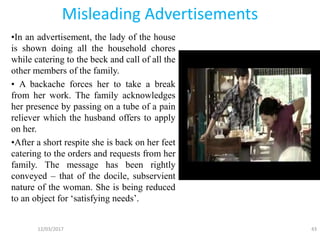
Misleading Advertisements
•In an advertisement, the lady of the house
is shown doing all the household chores
while catering to the beck and call of all the
other members of the family.
• A backache forces her to take a break
from her work. The family acknowledges
her presence by passing on a tube of a pain
reliever which the husband offers to apply
on her.
•After a short respite she is back on her feet
catering to the orders and requests from her
family. The message has been rightly
conveyed – that of the docile, subservient
nature of the woman. She is being reduced
to an object for ‘satisfying needs’.
12/03/2017 43
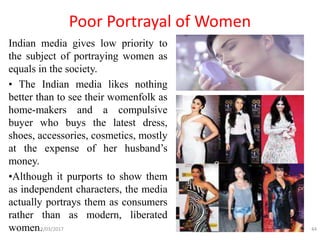
Poor Portrayal of Women
Indian media gives low priority to
the subject of portraying women as
equals in the society.
• The Indian media likes nothing
better than to see their womenfolk as
home-makers and a compulsive
buyer who buys the latest dress,
shoes, accessories, cosmetics, mostly
at the expense of her husband’s
money.
•Although it purports to show them
as independent characters, the media
actually portrays them as consumers
rather than as modern, liberated
women.12/03/2017 44
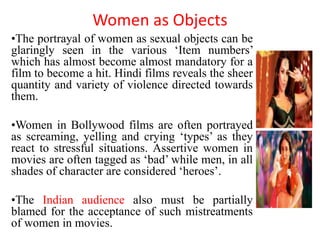
Women as Objects
•The portrayal of women as sexual objects can be
glaringly seen in the various ‘Item numbers’
which has almost become almost mandatory for a
film to become a hit. Hindi films reveals the sheer
quantity and variety of violence directed towards
them.
•Women in Bollywood films are often portrayed
as screaming, yelling and crying ‘types’ as they
react to stressful situations. Assertive women in
movies are often tagged as ‘bad’ while men, in all
shades of character are considered ‘heroes’.
•The Indian audience also must be partially
blamed for the acceptance of such mistreatments
of women in movies.
Differential treatment of Women
•Even in interviews, there is differential treatment for women. Men
giving interviews are often made to elaborate on their work and
their marital status or their dress sense remains irrelevant.
•Women achievers on the other hand are subject to irrelevant and
distasteful queries - details of her looks, her private life and such
trivia as her fondness for beautiful sarees, her decision to stay single
or otherwise is scrutinized.
•According to the media, a successful woman somehow is a
feminist. When Phoolan Devi was once interviewed, she was first
shown serving food to her husband.
•Men give most of opinion on exit polls during elections. They were
also the ones whose opinions mattered the most on the issue of
reservation of seats for women in Panchayats. Women, whose future
they were deciding, sat as silent spectators.
Differential treatment of Women
•Media influences the social image and the self-image of
women. Media affects the choices they make, what they eat
and what they wear. It influences their behavioral attitude,
their learning process, and ultimately what they become.
•Media has clearly discouraged the emergence of a new
confident, assertive woman. Such differential media
treatment increases their isolation, disempowers them,
weakens them. They remain unheard, unrepresented and
‘incommunicable.’
•The portrayal of woman in the print media is quite degrading
more often than not depicting her as commercial commodity.
It is necessary that public should be motivated and sensitized
to the issue of criminalization, politicization, and
commercialization of women vis-à-vis their projection in the
media in a healthy manner.
12/03/2017 47
Media to do away with Stereotyping
•Advertisements, they say reflects the prevailing trends
in the society.
• A UNESCO report lists the words women are
described in the media: ‘the glamorous sex kitten, the
sainted mother, the devious witch, the hard-faced
corporate and political climber.’
•The report of 2009, fears that given the current rate at
which stereotyping of women take place, it would take
another 75 years to achieve gender equality in the
media!
•Gender sensitization of the Indian has to be made on a
priority basis. Mere reporting of facts and figures would
not help in bridging gender differences. It should play a
proactive role in inculcating gender sensitivity and
ensure that women are not depicted in poor light.12/03/2017 48
Agents of Gender Socialization
• Parents play a huge role
– Parents compliment daughters on their beauty,
encourage them to be gentle, etc.
– Whereas parents ‘roughhouse’ with boys and
discourage them from crying, etc.
• Parents buy gender specific toys
• Parents expose daughters to feminine
activities and expose boys to masculine
activities
(Martin & Fabes, 2000)
Agents of Gender Socialization
Chores
• Daughters help with dinner, clean the house, do
the dishes, babysit
• Boys take out trash, mow the lawn
Activities
• Parents enroll girls in ballet, cooking class
• Boys are enrolled in more sports
• Parents are more likely to “roughhouse” with
boys
Gender Equality
• no discrimination in opportunities and in access,
control and use of resources, on the basis of a
person’s sex
• is not equal to women and girls
• about social relations between W/M
• means that W/G and M/B have equal conditions
for realizing their full potential and for
contributing to and benefitting from economic,
social, cultural and political development
Importance of gender equality
• Everyone has human rights
• Poverty is a gender issue, 70% of world’s poor are
women and girls
• If half the population has restricted or limited access to
relevant learning opportunities, a community’s social
and economic development will be limited
• Necessary for sustainable human development (gender
equality linked with poverty reduction)
• W/M are both drivers of social and economic
development
• Commitments involves obligations (i.e. CEDAW)
Importance of gender equality
According to statistics from the World Bank,
women usually reinvest 90% of their income in
their families and communities compared to men
who reinvest just about 30% to 40% of their
income.
Right of Equality is a Fundamental right.
• Equality for all citizens irrespective of gender,
caste, religion or race forms – as per Constitution
BUT India is still a society with a strong
preference for sons.
Challenges in promoting gender
equality
• Changing socio-cultural values, beliefs and
attitudes takes time and often meets with
resistance
• Resistance because there is difficulty seeing
that a problem exists
• Change is required at the individual,
community, institutional and societal levels
• Existing power structures must change
Different approaches to pursuing
gender equality
• Women in Development (WID) developed in 70s
• Objective to design actions and policies to
integrate women into development
• Gender and Development (GAD) developed in
80s
• Objective to remove social, economic and
political inequalities between W/M
• Most agencies are adopting the gender and
development approach
Gender Mainstreaming – How to do?
Gender mainstreaming is a process of ensuring
W/M have equal access and control over
resources, development benefits and decision-
making
• Not about only women taking action
• Not about only women benefiting from it
How? Gender Mainstreaming
• “Mainstreaming a gender perspective is the process of
assessing the implications for women and men of any
planned action, including legislation, policies or programmes,
in all areas and at all levels. It is a strategy for making
women's as well as men's concerns and experiences an
integral dimension of the design, implementation, monitoring
and evaluation of policies and programmes in all political,
economic and societal spheres so that women and men benefit
equally and inequality is not perpetuated. The ultimate goal
is to achieve gender equality.” – UN ECOSOC 1997
Gender mainstreaming
• Gender neutral means not recognizing that
gender is an influencing factor in social
outcomes
• Gender-responsive means being responsive to
the different needs of both M/B and W/G, as
well as actively trying to bring about more
equitable gender relations in a given context
How? Gender Mainstreaming
• Assessment and strategy
• Gender mainstreaming does not replace the need
for targeted, women-specific policies and
programmes or positive legation
• Gender Analysis is the assessment
• Gender Planning is the strategy
• Gender Planning refers to the process of planning
developmental programs and projects that are
gender-responsive and which take into account
the impact of differing gender roles and gender
needs of W/M in a community/sector
Gender Analysis
• Tool for collecting and processing information
about gender
• Provides data disaggregated by sex
• Looks at gender roles
• To ensure W/M benefit from resources and
development (policies/programmes)
• Anticipate and avoid negative impacts
Gender Planning
• Gender Planning involves selecting
appropriate approaches to address not only
W/M practical needs, but also identifies entry
points for challenging unequal relations (i.e.
strategic needs) and to enhance gender-
responsiveness of policy dialogue
Gender Needs
• W/M have different gender roles and gender needs
• Classified practical or strategic needs
• Practical Gender Needs (PGN): needs women identify
in their socially accepted roles
• PGN do not challenge gender divisions of labour or
women’s subordinate position in society
• PGN are a response to immediate and perceived
necessity, within a specific context
• PGN are practical in nature and often concern
inadequacies in living conditions, i.e. water provision,
education, health care and employment
Gender Needs
• Strategic Gender Needs (SGN): needs women
identify because of their subordinate position in
society
• SGN vary according to the context (gender
division of labour, power and control)
• Meeting SGN help women achieve greater
equality and change existing roles, thereby
challenging women’s subordinate position
• SGN are more long term and less visible than PGN
• SGN examples: legal rights, domestic violence,
equal wages, women’s control over their bodies
Basic points to
reflect on...
A Global View:
Women around the World
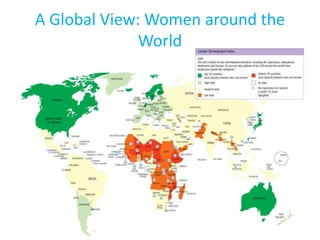
• The Gender Development Index (GDI) is used
to rank countries
– Its indicators include life expectancy, educational
attainment, income, and “intentional commitment
to equality principles and policies”.
– Top Ten countries are United States, Canada,
Australia, Japan, Iceland, the Scandinavian
countries, the Netherlands, and Belgium.
– Bottom Ten countries are in Africa, including
Ethiopia, Niger, and Sierra Leone.
A Global View:
Women around the World
• The Gender Development Index (GDI) is used
to rank countries
– Its indicators include life expectancy, educational
attainment, income, and “intentional commitment
to equality principles and policies”.
– Top Ten countries are United States, Canada,
Australia, Japan, Iceland, the Scandinavian
countries, the Netherlands, and Belgium.
– Bottom Ten countries are in Africa, including
Ethiopia, Niger, and Sierra Leone.
A Global View: Women around the
World
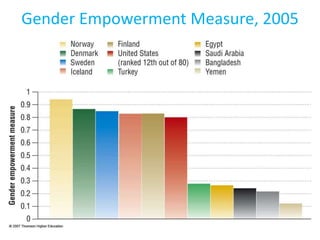
Gender Empowerment Measure, 2005
Strategies to Promote Gender Equity
1. Confront discrimination and be an advocate
for women coaches and administrators
2. Be an advocate of fair and open employment
practices
3. Keep data on gender equity
4. Learn and educate others about the history
of discrimination in sports and how to
identify discrimination
(continued)
Strategies to Promote Gender Equity
5. Inform media of unfair and discriminatory
policies
6. Package women’s sports as revenue
producers
7. Recruit women athletes into coaching
8. Use women’s hiring networks
9. Create a supportive climate for women in
your organization
Girls and Women
As Agents of Change
Sport participation can empower women but
• This does not occur automatically
• Personal empowerment is not necessarily
associated with an awareness of the need for
gender transformation in society as a whole
• Elite athletes seldom are active agents of change
when it comes to gender ideology
Why Elite Athletes Seldom Challenge Traditional
Gender Ideology
1. Women athletes often fear being tagged as
ungrateful, “man-haters,” or “lesbians”
2. Corporation-driven “celebrity-feminism” focuses
on individualism and consumption, not everyday
struggles related to gender
3. “Empowerment discourses” in sports often are
tied to fitness and heterosexual attractiveness
4. Women athletes have little control or political
voice in sports or society at large
Boys and Men
As Agents of Change
Gender equity also is a men’s issue:
• Equity involves creating options for men to
play sports that are not based exclusively on
a power and performance model
• Equity emphasizes relationships based on
cooperation rather than conquest and
domination
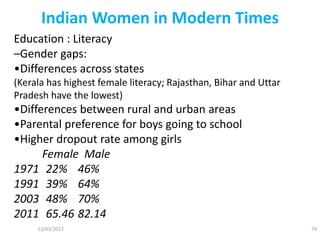
Indian Women in Modern Times
12/03/2017 74
Education : Literacy
–Gender gaps:
•Differences across states
(Kerala has highest female literacy; Rajasthan, Bihar and Uttar
Pradesh have the lowest)
•Differences between rural and urban areas
•Parental preference for boys going to school
•Higher dropout rate among girls
Female Male
1971 22% 46%
1991 39% 64%
2003 48% 70%
2011 65.46 82.14
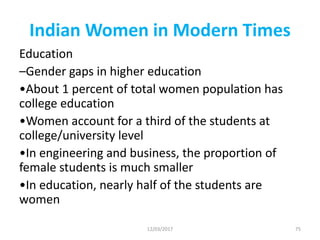
Indian Women in Modern Times
Education
–Gender gaps in higher education
•About 1 percent of total women population has
college education
•Women account for a third of the students at
college/university level
•In engineering and business, the proportion of
female students is much smaller
•In education, nearly half of the students are
women
12/03/2017 75
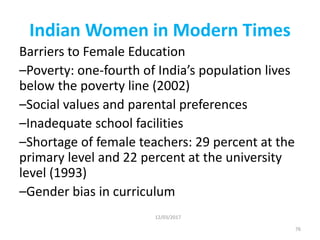
Indian Women in Modern Times
Barriers to Female Education
–Poverty: one-fourth of India’s population lives
below the poverty line (2002)
–Social values and parental preferences
–Inadequate school facilities
–Shortage of female teachers: 29 percent at the
primary level and 22 percent at the university
level (1993)
–Gender bias in curriculum
12/03/2017
76
Indian Women in Modern Times
Employment
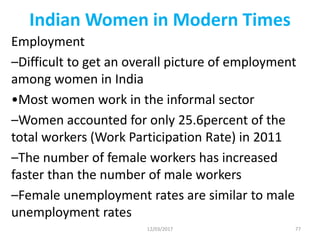
–Difficult to get an overall picture of employment
among women in India
•Most women work in the informal sector
–Women accounted for only 25.6percent of the
total workers (Work Participation Rate) in 2011
–The number of female workers has increased
faster than the number of male workers
–Female unemployment rates are similar to male
unemployment rates
12/03/2017 77
Indian Women in Modern Times
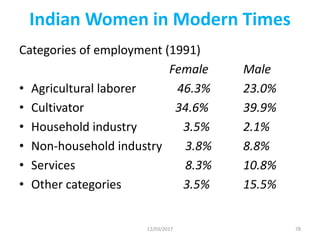
Categories of employment (1991)
Female Male
• Agricultural laborer 46.3% 23.0%
• Cultivator 34.6% 39.9%
• Household industry 3.5% 2.1%
• Non-household industry 3.8% 8.8%
• Services 8.3% 10.8%
• Other categories 3.5% 15.5%
12/03/2017 78
Gender Justice – Constitutional and Legal Perspectives
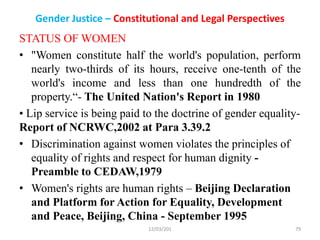
STATUS OF WOMEN
• "Women constitute half the world's population, perform
nearly two-thirds of its hours, receive one-tenth of the
world's income and less than one hundredth of the
property.“- The United Nation's Report in 1980
• Lip service is being paid to the doctrine of gender equality-
Report of NCRWC,2002 at Para 3.39.2
• Discrimination against women violates the principles of
equality of rights and respect for human dignity -
Preamble to CEDAW,1979
• Women's rights are human rights – Beijing Declaration
and Platform for Action for Equality, Development
and Peace, Beijing, China - September 1995
12/03/201 79
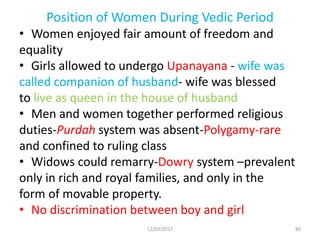
Position of Women During Vedic Period
• Women enjoyed fair amount of freedom and
equality
• Girls allowed to undergo Upanayana - wife was
called companion of husband- wife was blessed
to live as queen in the house of husband
• Men and women together performed religious
duties-Purdah system was absent-Polygamy-rare
and confined to ruling class
• Widows could remarry-Dowry system –prevalent
only in rich and royal families, and only in the
form of movable property.
• No discrimination between boy and girl
12/03/2017 80
Position of Women During Post-Vedic Period
• W/m suffered setback due to restrictions put on them
law givers like Manu (Manu Smriti is said to have been
composed between 200 B.C. – 100 A.D)
• Man’s authority increased-Education of women was
neglected
• UPANAYANA (initiation into Vedic studies)-confined
to boys alone and denied to w/m and Sudras-
Marriageable age – lowered to 9/10 years
• Net Result : subservience of women to men &
unnecessary protectionism (replacement of equality by
protection)
12/03/2017 81
Position of Women During Medieval Period
• Further degradation in position of w/m due to
invasion by Alexander and Huns
• Movement of w/m outside –restricted for security
reasons resulting in denial of opportunities in
community affairs
• Women – became chattels, uneducated and devoid
of any status
• Emergence of many social evils like sati, child
marriages, female infanticide, dowry, polygamy,
Devadasi system
12/03/2017 82
Position of W/m in British Period
• Positive impact on socio-cultural life of India and living
patterns of Hindu society
• English language – provided gateway to ideology of liberalism
• 19th century social reform movement- aimed at eradication of
evils like sati, ill treatment of widows, ban on widow remarriage,
polygamy, child marriage, denial of property rights and
education to women
• 20th century nationalist movement – drew large number of
women to political activity & generated strength and confidence
among women which helped them organize and fight for their
cause
• Recognition that law is an instrument for empowerment of
women 12/03/2017 83
Enactment of Progressive Legislation and
Empowerment of women
• The Hindu Widow Remarriage Act -passed in 1856 in
British India prohibiting enforced widowhood practiced
mainly among Brahmans and a few other castes such
as Rajputs, Banias and Kayasthas.
• The IPC,1860 –294,375,494.495, 497 & 504
• the Child Marriage Restraint Act ,1929 (repealed) and
replaced by the Child Marriage Prohibition Act 2006.
The Hindu Women’s Right to Properties Act 1937-Under
this Act, the widow of a deceased coparcener of a
Mithakshara undivided family will have the same interest
which her husband had while he was alive.
• The Dissolution of Muslim Marriage Act,1939
12/03/2017 84
International Conventions Rel.to Women
• The Convention on the Elimination of All Forms
of Discrimination against Women
(CEDAW),adopted in 1979 by the UN.
• It defines discrimination against women as "...any
distinction, exclusion or restriction made on
the basis of sex which has the effect or purpose
of impairing or nullifying the recognition,
enjoyment or exercise by women, irrespective
of their marital status, on a basis of equality of
men and women, of human rights and
fundamental freedoms in the political,
economic, social, cultural, civil or any other
field."
12/03/2017 85
Constitution of India & Empowerment of Women
• Preamble – Equality of status and opportunity
• Fundamental Rights – Right to Equality & right
against Exploitation etc (Art.14,15,16,23, &
25)
• DPSP- Maternity benefit & Equal pay for equal
work [Art.39(d),42,44]
• Fundamental Duties [Art.51-A(e)] – Duty to
denounce practices derogatory to the status
of women
• Reservation of Seats in Local self government
(Art.243-D & 243-T)
12/03/2017 86
Post Constitutional Laws & Protective Discrimination
• Personal Laws - Codification of Hindu law, Muslim law partly,
amendment to Christian laws
• Labour Laws
• Criminal Laws – S.304-B (Dowry death) & 498-A,IPC (Cruelty
and Harassment by Husband)
• Evidence law- Section 113A - Presumption as to abetment of
suicide by a married woman, Section 113B - Presumption as to
dowry death, Section 114A - Presumption as to absence of
consent in certain prosecutions for rape Repeal of Sec.155(4)
(w.e.f. 31-12-2002).
• Special Laws – rel. to dowry prohibition, domestic violence,
abolition of Devadasi system, & Sati
• Protective Laws- The Preconception and Prenatal Diagnostic
Technique (Prohibition of Sex Selection) Act 1994
12/03/2017 87
Some Important Laws to Protect Women in
India –A Glance
• The Protection of Women from Domestic Violence
Act,2005
• The Dowry Prohibition Act, 1961 (28 of 1961)
• The Commission of Sati (Prevention) Act, 1987 (3 of ‘88)
• The Immoral Traffic (Prevention) Act, 1956
• The Code of Criminal Procedure, 1973
• The Indian Penal Code, 1860
• The Hindu Marriage Act, 1955 (28 of 1989)
• The Medical Termination of Pregnancy Test, 1971 (34 of
1971)
• The Indian Succession Act, 1925 (39 of 1925)
• The Guardians and Wards Act, 1860 (8 of 1890)
12/03/2017 88
Some Important Laws to Protect Women in
India –A Glance
• The Hindu Adoptions and Maintenance Act, 1956
• The Preconception and Prenatal Diagnostic Technique
(Prohibition of Sex Selection) Act 1994
• The Hindu Succession Act, 1956
• The Christian Marriage Act, 1872 (15 of 1872)
• The National Commission for Women Act, 1990 (20 of 1990)
• The Bonded Labour System (Abolition) Act, 1976
• The Equal Remuneration Act, 1976
• The Family Courts Act, 1984
• The Foreign Marriage Act, 1969 (33 of 1969)
• The Contract Labour (Regulation and Abolition) Act, 1979
• The Indian Divorce Act, 1969 (4 of 1969)
• The Sexual Harassment of Women at Workplace (Prevention,
Prohibition and Redressal) Act, 2013
12/03/2017 89
Discrimination against women in Property matters
• From nothing to something to everything
• Pre-constitutional position of Hindu women
• Stridhana & Women’s Estate
• Limited Ownership of women
• Position under the HSA,1956-S.14 and its
impact
• A.P. (1985)and other State amendments
• Central amendment in 2005 to the Hindu
Succession Act,1956
12/03/2017 90
Gender Justice through Law-
Future Agenda
• The Protection of Women against Sexual
Harassment at Workplace ..Act
• The Womens’ Reservation Bill 2010 (since
passed in RS)
• A Special Law to punish Honour Killings
• A Special law to punish Acid Attackers (taken
care by 2013 Crl.Law.Amendment-See Sec.326-
A and B)
• Reforms in Rape Law (Crl.Law Am.,2013)
12/03/2017 91
Recent Judgments on Gender and Third Gender
• NAZ Foundation (Delhi HC-2009)-“We declare that Section
377 IPC, insofar it criminalises consensual sexual acts of
adults in private, is violative of Articles 21, 14 and 15 of the
Constitution…”
• Suresh Kumar Koushal v. NAZ Foundation (2013,SC)-
“…that Section 377 IPC does not suffer from the vice of
unconstitutionality and the declaration made by the Division
Bench of the High court is legally unsustainable…”
• National Legal Services Authority v. Union of India (2014,SC)
.. ” Hijras, Eunuchs, apart from binary gender, be treated as
“thirdgender” for the purpose of safeguarding their rights under
Part III of our Constitution and the laws made by the Parliament
and the State Legislature..”
12/03/2017 92
Sexual Harassment of Women
• Sexual harassment at workplace - evil , still rampant in Indian
society results in violation of the fundamental rights of a woman to
equality under Articles 14 and 15 of the Constitution of India and her
right to life and to live with dignity under Article 21 of the Constitution
and right to practice any profession or to carry on any occupation,
trade or business which includes a right to a safe environment free
from sexual harassment
• Vishakha v. State of Rajasthan [AIR 1997 SC 3011]- Its Impact
• “Gender equality includes protection from sexual harassment and
right to work with dignity, which is a universally recognised basic
human right. The common minimum requirement of this right has
received global acceptance. The international conventions and
norms are, therefore, are of great significance in the formulation
of the guidelines to achieve this purpose.”
12/03/2017 93
Sexual Harassment under IPC 1860
• Section 294 - whoever to the annoyance of others-a)
Does any obscene act in any public place, or b)Sings,
recites or utters any obscene song, ballad or words,
in or near any public place, Shall be punished with
imprisonment of either description for a term which
may extend to three months, or with fine, or with
both
• Section 354 - Assault or criminal force to woman with
intent to outrage her modesty.—Whoever assaults or
uses criminal force to any woman, intending to outrage or
knowing it to be likely that he will thereby outrage her
modesty, shall be punished with imprisonment of either
description for a term which may extend to two years, or
with fine, or with both.
• Section 509 - Word, gesture or act intended to insult
the modesty of a woman - (max-three years impr.)
12/03/2017 94
Sec.354-A: Sexual harassment
• A man committing any of the following acts—i) physical
contact and advances involving unwelcome and explicit
sexual overtures; or ii) a demand or request for sexual
favours; or iii) showing pornography against the will of a
woman; or iv) making sexually coloured remarks, shall be
guilty of the offence of sexual harassment.
• Any man who commits the offence specified in clause (i) or
clause (ii) or clause (iii) of sub-section (1) shall be punished
with rigorous imprisonment for a term which may extend to
three years, or with fine, or with both. Any man who commits
the offence specified in Clause (iv) of sub-section (1) shall be
punished with imprisonment of either description for a term
which may extend to one year, or with fine, or with both.
12/03/2017 95
Assault or use of criminal force to woman with intent to Disrobe
(Sec.354-B)
• Any man who assaults or uses criminal force
to any woman or abets such act with the
intention of disrobing or compelling her to be
naked, shall be punished with imprisonment
of either description for a term which shall not
be less than three years but which may extend
to seven years, and shall also be liable to fine.
12/03/2017 96
Voyeurism [Sec.354C]
• Any man who watches, or captures the image of a woman engaging in a private act in
circumstances where she would usually have the expectation of not being observed
either by the perpetrator or by any other person at the behest of the perpetrator or
disseminates such image shall be punished on first conviction with imprisonment of
either description for a term which shall not be less than one year, but which may
extend to three years, and shall also be liable to fine, and be punished on a second or
subsequent conviction, with imprisonment of either description for a term
which shall not be less than three years, but which may extend to seven years, and shall
also be liable to fine.
• Explanation 1.— For the purpose of this section, "private act" includes an act of
watching carried out in a place which, in the circumstances, would reasonably be
expected to provide privacy and where the victim's genitals, posterior or breasts are
exposed or covered only in underwear; or the
victim is using a lavatory; or the victim is doing a sexual act that is not of a kind
ordinarily done in public.
• Explanation 2.— Where the victim consents to the capture of the images or any act,
but not to their dissemination to third persons and where such image or act is
disseminated, such dissemination shall be considered an offence under this section.
12/03/2017 97
Stalking (S.354-D)
Any man who—
i. follows a woman and contacts, or attempts. to contact such woman to foster personal
interaction repeatedly despite a clear indication of disinterest by such woman; or
• ii. monitors the use by a woman of the internet, email or any other form of electronic
communication, commits the offence of stalking: Provided that such conduct shall not
amount to stalking if the man who pursued it proves that—
• i. it was pursued for the purpose of preventing or detecting crime and the man accused
of stalking bad been entrusted with the responsibility of prevention and detection of
crime by the State; or
• ii. it was pursued under any law or to comply with any condition or requirement
imposed by any person under any law; or
• iii. in the particular circumstances such conduct was reasonable and justified.
• 2. Whoever commits the offence of stalking shall be punished on first conviction with
imprisonment of either description for a term which may extend to three years, and
shall also be liable to fine; and be punished on a second or subsequent conviction, with
imprisonment of either description for a term which may extend to five years, and shall
also be liable to fine.'.
12/03/2017 98
Section 66A of the IT (Amendment) Act, 2008
• prohibits the sending of offensive messages though a
communication device (i.e. through an online medium).
• The types of information this covers are offensive
messages of a menacing character, or a message that the
sender knows to be false but is sent for the purpose of
‘causing annoyance, inconvenience, danger, obstruction,
insult, injury, criminal intimidation, enmity, hatred, or ill
will.’
• If booked under Section 66A, one could face up to 3
years of imprisonment along with a fine.
• Struck down as violative of Article 19(1)(a) in 2015
Shreya Singhal and Ors. vs Union of India
12/03/2017 99
Dignity of Women and Constitution of India
• Preamble – “Equality of Status and Opportunity” & “to promote among
them all fraternity assuring the dignity of the individual”
• Right to Equality -Art.14
• Prohibition of Discrimination on ground of sex -Art.15(1) &(2)
• Spl. Provisions for w/m and children-Art.15(3)
• Prohibition of Discrimination in Public employment on ground of sex -
Art.16(1) &(2)
• Art.21: right to life and personal liberty
• Article 42 - “The State shall make provision for securing just and humane
conditions of work and for maternity relief.”
• Art.51A: It shall be the duty of every citizen of India -
(e) to promote harmony and the spirit of common brotherhood amongst all
the people of India transcending religious, linguistic and regional or sectional
diversities; to renounce practices derogatory to the dignity of women;
(f) to value and preserve the rich heritage of our composite culture;
12/03/2017 100
Recap
•Gender sensitization refers to the modification
of behaviour by raising awareness of gender
equality concerns. By this society will progress.
• It helps them determine which assumptions in
matters of gender are valid and which are
stereotyped generalizations.
12/03/2017 101

Media gender ppt (short)

  • 1.
    D.V. Madhusudan Rao AssociateProfessor-Management Avinash Degree College Kukatpally, HYDERABAD CBCS GENDER SENSITIZATION COURSE [Awareness Enhancement Course Curriculum] EDUCATE, AGITATE, ORGANIZE – Babasaheb Dr. Ambedkar
  • 2.
    GENDER SENSITIZATION COURSE Afterstudying these chapters, you should be able to: OBJECTIVES: • Gender mainstreaming, removing margins, merging centres • To create a gender Equality mindset among young graduates • To aim for cooperation and collaboration among genders instead of conflict and confrontation LEARNING OUTCOMES: • Respect for other genders, not suspicion or superiority / inferiority • Accepting gender differences as positives rather than deterrents • Contemporizing traditional gender stereotypes to fit the 21st century ethos
  • 3.
    Questions on GS 12/03/20173 • Why ? • What? • How?
  • 4.
    Emerging Issues • WhyGS now??? – More and more exposure to gender imbalances in all aspects of life – Questioning previous stereotypes and attempting to replace gender negatives with positives – Attempt to educate the next generation to move towards a gender neutral society where parity is a given not a prize to be won by fighting. 12/03/2017 4
  • 5.
    Emerging Issues What ??? •Correcting the patriarchal inclinations of male centrality by ensuring women’s participation in public spheres • Accepting other orientations beyond male /female • Treating people as HUMAN rather than male/female/LGBT etc How??? – Catch them young—GS in schools and colleges – Experiential learning by observation of and inference from gender roles and interactions – Investing thought in bringing about gender balance- bringing all genders into the mainstream – Adopting models from public/private discourses which celebrate gender parity 12/03/2017 5
  • 6.
    Emerging Issues • Increasingcommunication channels have enhanced awareness about the evils of fixed gender roles and expectations of the past. • Moving towards more women centric perspectives— examples: wrestling no longer male bastion; many CEOs are women; Imphal IMA market all women’s business enterprise; science, politics etc. no longer male preserves. • Gender and language—’Man’ replaced by ‘human’ being/person; chairman/spokesman etc. replaced by chairperson/spokesperson; actor/poet etc. to represent both men and women; ‘he’ representing an entire class of human beings replaced by ‘s/he’ etc. 12/03/2017 6
  • 7.
    Challenges • Gender interactionsat home; in the neighborhood, community, society, educational institutions, workplace, national and global perspectives determine the gender attitudes and behavior of children • Assumptions: male superiority/female inferiority/transgender unacceptability need to be addressed • Mindset: prejudices, fossils of tradition, modernity as a misnomer, aggression/power equation, familial and social expectations, peer pressure etc. play a role in gender typing of individuals • Misuse of frames, rigid patterns of behavior and attitudes, criminalization of some to promote others have to be corrected 12/03/2017 7
  • 8.
    Possible Correctives • Ensureequal representation of all genders in all spheres of activity • Ensure dignity of all genders, mutual respect and acceptance • Cultivate team spirit among genders where different abilities are considered as strengths and not weaknesses • Formulate socially acceptable gender norms and values 12/03/2017 8
  • 9.
    Previous Lecture wason: • Sex and Gender • Gender Roles, Patriarchal and Matriarchal societies • Stereotypes 9
  • 10.
    Gender roles andstereotypes •Gender role is the behaviors, attitudes values, beliefs and so on that a particular cultural group considers appropriate for males and females on the basis of their biological sex. Gender roles and expectations are learned. •A gender stereotype is a product of a subjective perception built with an aim of confirming a society in which women have a lower status than men. The consequences of these gender stereotypes are gender inequality, the continuous reproduction of gender inequalities and gender based violence. 12/03/2017 10
  • 11.
    What we seedaily….
  • 12.
    Prejudices or becomespecific Actions? In some families: •Girls can’t pursue higher education/ should not be invested in girl’s education such as for boys •Boys shouldn’t do housework- they are very tiny and worthless jobs •Girls can not inherit; Females forced to eat what’s left? In some workplaces: •Male workers should take the heavy and hazardous jobs (according to the list of prohibited female workers) •Can’t recruit female workers who have little children/ or give those women lower wage
  • 13.
    Roles can beCHANGED by situations 12/03/2017 13
  • 14.
    Gender – Media- Literacy • Media = TV, radio, internet, magazines, ads, movies, etc., • Media are powerful forces in the lives of youth. • Media messages help shape their perceptions. • Media Literacy is the ability to: • analyze media messages, • uncover stereotypical messages • to question “what lies beneath” the messages (motives and money BEHIND the media)
  • 15.
    Facts about Media •Depending on the source, it is reported that teenagers see between 200 - 1,000 ads a day (tv, movies, clothing, internet, etc.) • http://www.youtube.com/watch?v=G gUE4BeWM-g&feature=related
  • 16.
    • We putBLIND TRUST in the media and allow others to dictate when we will ultimately believe is the STANDARD for acceptability. • We allow media to tell us what is beauty, what we should look like, what labels we should buy. •Why?
  • 17.
    Media’s Use • Mediauses stereotypes to sell products or for comedic value. (Cleaning products aimed at women, Tech and Talk using Indian-Americans) • Stereotypes allow a particular group to be superior, powerful, and in control while degrading other groups using slurs, comedy, or insults to make them weak or inferior.
  • 18.
    Advertising• Goal: Sellproduct How? • Idealistic body type: • Women- big hair, thin, flawless face, small waist, perfect body, sexual • Men- handsome, strong, flawless, serious, perfect body, powerful, sexual, dominating • Stereotyping: • Gender roles (Men- doing manly activities – strong, muscular, controlling. Women – cleaning, cooking, feminine, submissive, naked) • Unequal representation • Caucasian, underweight, young. Rare to see diversity. If diversity, very Caucasian or sexy appearance. • Women are seen as objects who don’t have a use for their brain.
  • 19.
    Gender Inequality andWomen’s Empowerment 2005-06 National Family Health Survey (NFHS-3) India 2005-2006
  • 20.
    Why Measure GenderInequality and Women’s Empowerment ? • Millennium Development Goals 3 & 4 MDG3: Promote gender equality and empower women MDG4: Eliminate gender disparity in education preferably by 2005, and at all levels by 2015 Four specific indicators: • Ratio of girls to boys in primary, secondary, and tertiary education • Ratio of literate women to men 15-24 years old • Share of women in wage employment in the non- agricultural sector • Proportion of seats held by women in national parliaments
  • 21.
    Gender Disparity inLiteracy Age Sex Literacy rate (%) Gender Disparity 15-49 Male Female 78 55 29% 20-24 Male Female 84 64 23% 15-19 Male Female 89 74 17%
  • 22.
    Gender Disparity inMedia Exposure Not only are fewer women than men literate but fewer are also regularly exposed to media • Percentage of men and women age 15-19 regularly exposed to print media, TV, radio, or cinema – Men 88% – Women 71% – Gender Disparity 19%
  • 23.
    Employment: Another Areaof Gender Disparity 43 29 87 79 Employed Employed for cash Women Men Among the population age 15-49 – Men are 2 times as likely to be employed – Men are 2.7 times as likely to be employed for cash • Among the employed, 64% of women vs. 91% of men earn cash • Female share of population employed for cash in non- agricultural occupations is 22% Percent
  • 24.
    The majority ofemployed women are engaged in agricultural work Type of worker Occupational Distribution (%) Women Men Professional 7 7 Sales 4 14 Service 7 5 Production 22 37 Agricultural 59 33 Other 2 4
  • 25.
    Does employment empowerwomen financially? • In a survey (NFHS-3) asked married employed women and men who controlled their own earnings and who controlled the spouse’s earnings (if relevant) • 20% of employed married women said they earned at least as much as their husband • 24% of men with an employed wife said that their wife earned at least as much as them
  • 26.
    Control over Women’sEarnings as Reported by Currently Married Women and Men 24 20 57 63 1615 Women’s report about their own earnings Men’s report about their wife’s earnings Mainly wife Husband & wife jointly Mainly husband Percent
  • 27.
    Are some womenmore likely than others to NOT participate in the use of their earnings? 8 39 13 10 21 21 6 21 15-19 40-49 Urban Rural None 12+ Lowest Highest Percent of currently married women Residence Wealth IndexEducationAge
  • 28.
    Do married womenhave access to any other financial resources? 68 45 15 5 Participate in decision on how husband's earnings are used Have money which they can decide how to use Have a bank or savings account that they themselve use Have taken loan from microcredit program Percentage of women who:
  • 29.
    Education, employment, orwealth do not ensure that women have money that they control 60 55 56 Have 12+ years education Are employed for cash Belong to the highest wealth quintile Percentage of women age 15-49 who have money which they can decide how to use
  • 30.
    Do married womenparticipate in other household decision making? Decisions Make decision alone or jointly with husband Own health care 62 Making major household purchases 53 Making purchases for daily household needs 60 Visits to her family or relatives 61 All four 37 None of above 21
  • 31.
    46 45 4139 45 Age 40-49 Urban 12+ yrs of education Employed Wealthiest • Older women are much more likely than younger women to participate in household decisions • Differentials by other characteristics are small • However, less than half of even the oldest, urban, more educated, employed or wealthier women participate in all four decisions
  • 32.
    What are someof the other hurdles that prevent women from attaining gender equality? • Limited freedom of movement • Gender norms that promote men’s control over women. NFHS-3 asked women and men questions about norms regarding – Wife beating – A husband’s right to have sex with his wife irrespective of his wife’s wishes
  • 33.
    Percentage of womenage 15-49 who are allowed to go alone to: 51 48 38 33 4 Market Health facility Places outside the village/community All three places None of the three places The majority of women have little freedom of movement. Only one-third go alone to all three destinations: the market, health facility and outside the village or community.
  • 34.
    Percentage who agreethat a husband is justified in hitting or beating his wife if she: 54 29 35 30 14 20 25 41 37 24 13 8 26 29 23 51 At least one reason Goes out without telling him Neglects the house or children Argues with him Refuses to have sex Doesn’t cook properly He suspects she is unfaithful Shows disrespect for in-laws Women Men
  • 35.
    Percentage who agreewith at least one reason for wife beating Women Men Age 15-19 53 57 Urban 44 43 12+ years education 31 34 Employed for cash 59 62 Wealthiest 37 35 Delhi: A highly urbanized state 32 28 Although urban, educated, employed and wealthier persons are less likely to agree with wife beating, these characteristics are not sufficient to supplant beliefs in gender inegalitarian norms
  • 36.
    Attitude towards refusingsex with husband by Situation, Women and Men 79 82 79 84 70 78 68 77 Knows husband has a sexually transmitted disease Knows husband has sex with other women Is tired or not in the mood All reasons Women Men Percentage who agree that a wife is justified in refusing to have sex with her husband when she:
  • 37.
    Key Findings • Womenare disadvantaged absolutely and relative to men in terms of access to education, media exposure, and employment for cash. • The majority of married women do not have the final say on the use of their own earnings or all other household decisions asked about. • Traditional gender norms, particularly those concerning wife beating, remain strongly entrenched.
  • 38.
    Women in theMedia Workforce  40% women journalists world-wide. (International Federation of journalists June, 2001)  3% - 5% of editors, heads of departments or directors.  Asia : 21% of women are represented in the media workforce but this varies very much from country to country. Nepal 6% Japan 8% India 12%. On the bright side, in Thailand, 50% of all the journalists are women. (IWMF, 2000)
  • 39.
    Women in Media Fromthese figures we can easily say, mainstream media is controlled by men mostly coming from the upper class. Since in today's globalised world, majority of the mainstream media networks are owned by less than ten global media conglomerate, we can also say that majority are owned by white men.
  • 40.
    Media and Gender •The manner in which different genders—their roles and interactions—are depicted on TV, in films, novels, advertisements, newspapers, magazines, etc. • Social media’s role in creating gender divide / gender neutrality • The impact of these representations on public perception, formation of attitudes and expectations, conditioning of impressionable minds. 12/03/2017 41
  • 41.
    Gender bias inMedia Globalisation, Opening of markets and the commodification of women •Change in the structure of Indian media - increase in advertising, revenue, cut throat competition between multinational companies and the direct targeting on women & children as consumers through T.V. programmes. •Gender bias in print and visual media •Misrepresentation of women 12/03/2017 42
  • 42.
    Misleading Advertisements •In anadvertisement, the lady of the house is shown doing all the household chores while catering to the beck and call of all the other members of the family. • A backache forces her to take a break from her work. The family acknowledges her presence by passing on a tube of a pain reliever which the husband offers to apply on her. •After a short respite she is back on her feet catering to the orders and requests from her family. The message has been rightly conveyed – that of the docile, subservient nature of the woman. She is being reduced to an object for ‘satisfying needs’. 12/03/2017 43
  • 43.
    Poor Portrayal ofWomen Indian media gives low priority to the subject of portraying women as equals in the society. • The Indian media likes nothing better than to see their womenfolk as home-makers and a compulsive buyer who buys the latest dress, shoes, accessories, cosmetics, mostly at the expense of her husband’s money. •Although it purports to show them as independent characters, the media actually portrays them as consumers rather than as modern, liberated women.12/03/2017 44
  • 44.
    Women as Objects •Theportrayal of women as sexual objects can be glaringly seen in the various ‘Item numbers’ which has almost become almost mandatory for a film to become a hit. Hindi films reveals the sheer quantity and variety of violence directed towards them. •Women in Bollywood films are often portrayed as screaming, yelling and crying ‘types’ as they react to stressful situations. Assertive women in movies are often tagged as ‘bad’ while men, in all shades of character are considered ‘heroes’. •The Indian audience also must be partially blamed for the acceptance of such mistreatments of women in movies.
  • 45.
    Differential treatment ofWomen •Even in interviews, there is differential treatment for women. Men giving interviews are often made to elaborate on their work and their marital status or their dress sense remains irrelevant. •Women achievers on the other hand are subject to irrelevant and distasteful queries - details of her looks, her private life and such trivia as her fondness for beautiful sarees, her decision to stay single or otherwise is scrutinized. •According to the media, a successful woman somehow is a feminist. When Phoolan Devi was once interviewed, she was first shown serving food to her husband. •Men give most of opinion on exit polls during elections. They were also the ones whose opinions mattered the most on the issue of reservation of seats for women in Panchayats. Women, whose future they were deciding, sat as silent spectators.
  • 46.
    Differential treatment ofWomen •Media influences the social image and the self-image of women. Media affects the choices they make, what they eat and what they wear. It influences their behavioral attitude, their learning process, and ultimately what they become. •Media has clearly discouraged the emergence of a new confident, assertive woman. Such differential media treatment increases their isolation, disempowers them, weakens them. They remain unheard, unrepresented and ‘incommunicable.’ •The portrayal of woman in the print media is quite degrading more often than not depicting her as commercial commodity. It is necessary that public should be motivated and sensitized to the issue of criminalization, politicization, and commercialization of women vis-à-vis their projection in the media in a healthy manner. 12/03/2017 47
  • 47.
    Media to doaway with Stereotyping •Advertisements, they say reflects the prevailing trends in the society. • A UNESCO report lists the words women are described in the media: ‘the glamorous sex kitten, the sainted mother, the devious witch, the hard-faced corporate and political climber.’ •The report of 2009, fears that given the current rate at which stereotyping of women take place, it would take another 75 years to achieve gender equality in the media! •Gender sensitization of the Indian has to be made on a priority basis. Mere reporting of facts and figures would not help in bridging gender differences. It should play a proactive role in inculcating gender sensitivity and ensure that women are not depicted in poor light.12/03/2017 48
  • 48.
    Agents of GenderSocialization • Parents play a huge role – Parents compliment daughters on their beauty, encourage them to be gentle, etc. – Whereas parents ‘roughhouse’ with boys and discourage them from crying, etc. • Parents buy gender specific toys • Parents expose daughters to feminine activities and expose boys to masculine activities (Martin & Fabes, 2000)
  • 49.
    Agents of GenderSocialization Chores • Daughters help with dinner, clean the house, do the dishes, babysit • Boys take out trash, mow the lawn Activities • Parents enroll girls in ballet, cooking class • Boys are enrolled in more sports • Parents are more likely to “roughhouse” with boys
  • 50.
    Gender Equality • nodiscrimination in opportunities and in access, control and use of resources, on the basis of a person’s sex • is not equal to women and girls • about social relations between W/M • means that W/G and M/B have equal conditions for realizing their full potential and for contributing to and benefitting from economic, social, cultural and political development
  • 51.
    Importance of genderequality • Everyone has human rights • Poverty is a gender issue, 70% of world’s poor are women and girls • If half the population has restricted or limited access to relevant learning opportunities, a community’s social and economic development will be limited • Necessary for sustainable human development (gender equality linked with poverty reduction) • W/M are both drivers of social and economic development • Commitments involves obligations (i.e. CEDAW)
  • 52.
    Importance of genderequality According to statistics from the World Bank, women usually reinvest 90% of their income in their families and communities compared to men who reinvest just about 30% to 40% of their income. Right of Equality is a Fundamental right. • Equality for all citizens irrespective of gender, caste, religion or race forms – as per Constitution BUT India is still a society with a strong preference for sons.
  • 53.
    Challenges in promotinggender equality • Changing socio-cultural values, beliefs and attitudes takes time and often meets with resistance • Resistance because there is difficulty seeing that a problem exists • Change is required at the individual, community, institutional and societal levels • Existing power structures must change
  • 54.
    Different approaches topursuing gender equality • Women in Development (WID) developed in 70s • Objective to design actions and policies to integrate women into development • Gender and Development (GAD) developed in 80s • Objective to remove social, economic and political inequalities between W/M • Most agencies are adopting the gender and development approach
  • 55.
    Gender Mainstreaming –How to do? Gender mainstreaming is a process of ensuring W/M have equal access and control over resources, development benefits and decision- making • Not about only women taking action • Not about only women benefiting from it
  • 56.
    How? Gender Mainstreaming •“Mainstreaming a gender perspective is the process of assessing the implications for women and men of any planned action, including legislation, policies or programmes, in all areas and at all levels. It is a strategy for making women's as well as men's concerns and experiences an integral dimension of the design, implementation, monitoring and evaluation of policies and programmes in all political, economic and societal spheres so that women and men benefit equally and inequality is not perpetuated. The ultimate goal is to achieve gender equality.” – UN ECOSOC 1997
  • 57.
    Gender mainstreaming • Genderneutral means not recognizing that gender is an influencing factor in social outcomes • Gender-responsive means being responsive to the different needs of both M/B and W/G, as well as actively trying to bring about more equitable gender relations in a given context
  • 58.
    How? Gender Mainstreaming •Assessment and strategy • Gender mainstreaming does not replace the need for targeted, women-specific policies and programmes or positive legation • Gender Analysis is the assessment • Gender Planning is the strategy • Gender Planning refers to the process of planning developmental programs and projects that are gender-responsive and which take into account the impact of differing gender roles and gender needs of W/M in a community/sector
  • 59.
    Gender Analysis • Toolfor collecting and processing information about gender • Provides data disaggregated by sex • Looks at gender roles • To ensure W/M benefit from resources and development (policies/programmes) • Anticipate and avoid negative impacts
  • 60.
    Gender Planning • GenderPlanning involves selecting appropriate approaches to address not only W/M practical needs, but also identifies entry points for challenging unequal relations (i.e. strategic needs) and to enhance gender- responsiveness of policy dialogue
  • 61.
    Gender Needs • W/Mhave different gender roles and gender needs • Classified practical or strategic needs • Practical Gender Needs (PGN): needs women identify in their socially accepted roles • PGN do not challenge gender divisions of labour or women’s subordinate position in society • PGN are a response to immediate and perceived necessity, within a specific context • PGN are practical in nature and often concern inadequacies in living conditions, i.e. water provision, education, health care and employment
  • 62.
    Gender Needs • StrategicGender Needs (SGN): needs women identify because of their subordinate position in society • SGN vary according to the context (gender division of labour, power and control) • Meeting SGN help women achieve greater equality and change existing roles, thereby challenging women’s subordinate position • SGN are more long term and less visible than PGN • SGN examples: legal rights, domestic violence, equal wages, women’s control over their bodies
  • 63.
  • 64.
    A Global View: Womenaround the World • The Gender Development Index (GDI) is used to rank countries – Its indicators include life expectancy, educational attainment, income, and “intentional commitment to equality principles and policies”. – Top Ten countries are United States, Canada, Australia, Japan, Iceland, the Scandinavian countries, the Netherlands, and Belgium. – Bottom Ten countries are in Africa, including Ethiopia, Niger, and Sierra Leone.
  • 65.
    A Global View: Womenaround the World • The Gender Development Index (GDI) is used to rank countries – Its indicators include life expectancy, educational attainment, income, and “intentional commitment to equality principles and policies”. – Top Ten countries are United States, Canada, Australia, Japan, Iceland, the Scandinavian countries, the Netherlands, and Belgium. – Bottom Ten countries are in Africa, including Ethiopia, Niger, and Sierra Leone.
  • 66.
    A Global View:Women around the World
  • 67.
  • 68.
    Strategies to PromoteGender Equity 1. Confront discrimination and be an advocate for women coaches and administrators 2. Be an advocate of fair and open employment practices 3. Keep data on gender equity 4. Learn and educate others about the history of discrimination in sports and how to identify discrimination (continued)
  • 69.
    Strategies to PromoteGender Equity 5. Inform media of unfair and discriminatory policies 6. Package women’s sports as revenue producers 7. Recruit women athletes into coaching 8. Use women’s hiring networks 9. Create a supportive climate for women in your organization
  • 70.
    Girls and Women AsAgents of Change Sport participation can empower women but • This does not occur automatically • Personal empowerment is not necessarily associated with an awareness of the need for gender transformation in society as a whole • Elite athletes seldom are active agents of change when it comes to gender ideology
  • 71.
    Why Elite AthletesSeldom Challenge Traditional Gender Ideology 1. Women athletes often fear being tagged as ungrateful, “man-haters,” or “lesbians” 2. Corporation-driven “celebrity-feminism” focuses on individualism and consumption, not everyday struggles related to gender 3. “Empowerment discourses” in sports often are tied to fitness and heterosexual attractiveness 4. Women athletes have little control or political voice in sports or society at large
  • 72.
    Boys and Men AsAgents of Change Gender equity also is a men’s issue: • Equity involves creating options for men to play sports that are not based exclusively on a power and performance model • Equity emphasizes relationships based on cooperation rather than conquest and domination
  • 73.
    Indian Women inModern Times 12/03/2017 74 Education : Literacy –Gender gaps: •Differences across states (Kerala has highest female literacy; Rajasthan, Bihar and Uttar Pradesh have the lowest) •Differences between rural and urban areas •Parental preference for boys going to school •Higher dropout rate among girls Female Male 1971 22% 46% 1991 39% 64% 2003 48% 70% 2011 65.46 82.14
  • 74.
    Indian Women inModern Times Education –Gender gaps in higher education •About 1 percent of total women population has college education •Women account for a third of the students at college/university level •In engineering and business, the proportion of female students is much smaller •In education, nearly half of the students are women 12/03/2017 75
  • 75.
    Indian Women inModern Times Barriers to Female Education –Poverty: one-fourth of India’s population lives below the poverty line (2002) –Social values and parental preferences –Inadequate school facilities –Shortage of female teachers: 29 percent at the primary level and 22 percent at the university level (1993) –Gender bias in curriculum 12/03/2017 76
  • 76.
    Indian Women inModern Times Employment –Difficult to get an overall picture of employment among women in India •Most women work in the informal sector –Women accounted for only 25.6percent of the total workers (Work Participation Rate) in 2011 –The number of female workers has increased faster than the number of male workers –Female unemployment rates are similar to male unemployment rates 12/03/2017 77
  • 77.
    Indian Women inModern Times Categories of employment (1991) Female Male • Agricultural laborer 46.3% 23.0% • Cultivator 34.6% 39.9% • Household industry 3.5% 2.1% • Non-household industry 3.8% 8.8% • Services 8.3% 10.8% • Other categories 3.5% 15.5% 12/03/2017 78
  • 78.
    Gender Justice –Constitutional and Legal Perspectives STATUS OF WOMEN • "Women constitute half the world's population, perform nearly two-thirds of its hours, receive one-tenth of the world's income and less than one hundredth of the property.“- The United Nation's Report in 1980 • Lip service is being paid to the doctrine of gender equality- Report of NCRWC,2002 at Para 3.39.2 • Discrimination against women violates the principles of equality of rights and respect for human dignity - Preamble to CEDAW,1979 • Women's rights are human rights – Beijing Declaration and Platform for Action for Equality, Development and Peace, Beijing, China - September 1995 12/03/201 79
  • 79.
    Position of WomenDuring Vedic Period • Women enjoyed fair amount of freedom and equality • Girls allowed to undergo Upanayana - wife was called companion of husband- wife was blessed to live as queen in the house of husband • Men and women together performed religious duties-Purdah system was absent-Polygamy-rare and confined to ruling class • Widows could remarry-Dowry system –prevalent only in rich and royal families, and only in the form of movable property. • No discrimination between boy and girl 12/03/2017 80
  • 80.
    Position of WomenDuring Post-Vedic Period • W/m suffered setback due to restrictions put on them law givers like Manu (Manu Smriti is said to have been composed between 200 B.C. – 100 A.D) • Man’s authority increased-Education of women was neglected • UPANAYANA (initiation into Vedic studies)-confined to boys alone and denied to w/m and Sudras- Marriageable age – lowered to 9/10 years • Net Result : subservience of women to men & unnecessary protectionism (replacement of equality by protection) 12/03/2017 81
  • 81.
    Position of WomenDuring Medieval Period • Further degradation in position of w/m due to invasion by Alexander and Huns • Movement of w/m outside –restricted for security reasons resulting in denial of opportunities in community affairs • Women – became chattels, uneducated and devoid of any status • Emergence of many social evils like sati, child marriages, female infanticide, dowry, polygamy, Devadasi system 12/03/2017 82
  • 82.
    Position of W/min British Period • Positive impact on socio-cultural life of India and living patterns of Hindu society • English language – provided gateway to ideology of liberalism • 19th century social reform movement- aimed at eradication of evils like sati, ill treatment of widows, ban on widow remarriage, polygamy, child marriage, denial of property rights and education to women • 20th century nationalist movement – drew large number of women to political activity & generated strength and confidence among women which helped them organize and fight for their cause • Recognition that law is an instrument for empowerment of women 12/03/2017 83
  • 83.
    Enactment of ProgressiveLegislation and Empowerment of women • The Hindu Widow Remarriage Act -passed in 1856 in British India prohibiting enforced widowhood practiced mainly among Brahmans and a few other castes such as Rajputs, Banias and Kayasthas. • The IPC,1860 –294,375,494.495, 497 & 504 • the Child Marriage Restraint Act ,1929 (repealed) and replaced by the Child Marriage Prohibition Act 2006. The Hindu Women’s Right to Properties Act 1937-Under this Act, the widow of a deceased coparcener of a Mithakshara undivided family will have the same interest which her husband had while he was alive. • The Dissolution of Muslim Marriage Act,1939 12/03/2017 84
  • 84.
    International Conventions Rel.toWomen • The Convention on the Elimination of All Forms of Discrimination against Women (CEDAW),adopted in 1979 by the UN. • It defines discrimination against women as "...any distinction, exclusion or restriction made on the basis of sex which has the effect or purpose of impairing or nullifying the recognition, enjoyment or exercise by women, irrespective of their marital status, on a basis of equality of men and women, of human rights and fundamental freedoms in the political, economic, social, cultural, civil or any other field." 12/03/2017 85
  • 85.
    Constitution of India& Empowerment of Women • Preamble – Equality of status and opportunity • Fundamental Rights – Right to Equality & right against Exploitation etc (Art.14,15,16,23, & 25) • DPSP- Maternity benefit & Equal pay for equal work [Art.39(d),42,44] • Fundamental Duties [Art.51-A(e)] – Duty to denounce practices derogatory to the status of women • Reservation of Seats in Local self government (Art.243-D & 243-T) 12/03/2017 86
  • 86.
    Post Constitutional Laws& Protective Discrimination • Personal Laws - Codification of Hindu law, Muslim law partly, amendment to Christian laws • Labour Laws • Criminal Laws – S.304-B (Dowry death) & 498-A,IPC (Cruelty and Harassment by Husband) • Evidence law- Section 113A - Presumption as to abetment of suicide by a married woman, Section 113B - Presumption as to dowry death, Section 114A - Presumption as to absence of consent in certain prosecutions for rape Repeal of Sec.155(4) (w.e.f. 31-12-2002). • Special Laws – rel. to dowry prohibition, domestic violence, abolition of Devadasi system, & Sati • Protective Laws- The Preconception and Prenatal Diagnostic Technique (Prohibition of Sex Selection) Act 1994 12/03/2017 87
  • 87.
    Some Important Lawsto Protect Women in India –A Glance • The Protection of Women from Domestic Violence Act,2005 • The Dowry Prohibition Act, 1961 (28 of 1961) • The Commission of Sati (Prevention) Act, 1987 (3 of ‘88) • The Immoral Traffic (Prevention) Act, 1956 • The Code of Criminal Procedure, 1973 • The Indian Penal Code, 1860 • The Hindu Marriage Act, 1955 (28 of 1989) • The Medical Termination of Pregnancy Test, 1971 (34 of 1971) • The Indian Succession Act, 1925 (39 of 1925) • The Guardians and Wards Act, 1860 (8 of 1890) 12/03/2017 88
  • 88.
    Some Important Lawsto Protect Women in India –A Glance • The Hindu Adoptions and Maintenance Act, 1956 • The Preconception and Prenatal Diagnostic Technique (Prohibition of Sex Selection) Act 1994 • The Hindu Succession Act, 1956 • The Christian Marriage Act, 1872 (15 of 1872) • The National Commission for Women Act, 1990 (20 of 1990) • The Bonded Labour System (Abolition) Act, 1976 • The Equal Remuneration Act, 1976 • The Family Courts Act, 1984 • The Foreign Marriage Act, 1969 (33 of 1969) • The Contract Labour (Regulation and Abolition) Act, 1979 • The Indian Divorce Act, 1969 (4 of 1969) • The Sexual Harassment of Women at Workplace (Prevention, Prohibition and Redressal) Act, 2013 12/03/2017 89
  • 89.
    Discrimination against womenin Property matters • From nothing to something to everything • Pre-constitutional position of Hindu women • Stridhana & Women’s Estate • Limited Ownership of women • Position under the HSA,1956-S.14 and its impact • A.P. (1985)and other State amendments • Central amendment in 2005 to the Hindu Succession Act,1956 12/03/2017 90
  • 90.
    Gender Justice throughLaw- Future Agenda • The Protection of Women against Sexual Harassment at Workplace ..Act • The Womens’ Reservation Bill 2010 (since passed in RS) • A Special Law to punish Honour Killings • A Special law to punish Acid Attackers (taken care by 2013 Crl.Law.Amendment-See Sec.326- A and B) • Reforms in Rape Law (Crl.Law Am.,2013) 12/03/2017 91
  • 91.
    Recent Judgments onGender and Third Gender • NAZ Foundation (Delhi HC-2009)-“We declare that Section 377 IPC, insofar it criminalises consensual sexual acts of adults in private, is violative of Articles 21, 14 and 15 of the Constitution…” • Suresh Kumar Koushal v. NAZ Foundation (2013,SC)- “…that Section 377 IPC does not suffer from the vice of unconstitutionality and the declaration made by the Division Bench of the High court is legally unsustainable…” • National Legal Services Authority v. Union of India (2014,SC) .. ” Hijras, Eunuchs, apart from binary gender, be treated as “thirdgender” for the purpose of safeguarding their rights under Part III of our Constitution and the laws made by the Parliament and the State Legislature..” 12/03/2017 92
  • 92.
    Sexual Harassment ofWomen • Sexual harassment at workplace - evil , still rampant in Indian society results in violation of the fundamental rights of a woman to equality under Articles 14 and 15 of the Constitution of India and her right to life and to live with dignity under Article 21 of the Constitution and right to practice any profession or to carry on any occupation, trade or business which includes a right to a safe environment free from sexual harassment • Vishakha v. State of Rajasthan [AIR 1997 SC 3011]- Its Impact • “Gender equality includes protection from sexual harassment and right to work with dignity, which is a universally recognised basic human right. The common minimum requirement of this right has received global acceptance. The international conventions and norms are, therefore, are of great significance in the formulation of the guidelines to achieve this purpose.” 12/03/2017 93
  • 93.
    Sexual Harassment underIPC 1860 • Section 294 - whoever to the annoyance of others-a) Does any obscene act in any public place, or b)Sings, recites or utters any obscene song, ballad or words, in or near any public place, Shall be punished with imprisonment of either description for a term which may extend to three months, or with fine, or with both • Section 354 - Assault or criminal force to woman with intent to outrage her modesty.—Whoever assaults or uses criminal force to any woman, intending to outrage or knowing it to be likely that he will thereby outrage her modesty, shall be punished with imprisonment of either description for a term which may extend to two years, or with fine, or with both. • Section 509 - Word, gesture or act intended to insult the modesty of a woman - (max-three years impr.) 12/03/2017 94
  • 94.
    Sec.354-A: Sexual harassment •A man committing any of the following acts—i) physical contact and advances involving unwelcome and explicit sexual overtures; or ii) a demand or request for sexual favours; or iii) showing pornography against the will of a woman; or iv) making sexually coloured remarks, shall be guilty of the offence of sexual harassment. • Any man who commits the offence specified in clause (i) or clause (ii) or clause (iii) of sub-section (1) shall be punished with rigorous imprisonment for a term which may extend to three years, or with fine, or with both. Any man who commits the offence specified in Clause (iv) of sub-section (1) shall be punished with imprisonment of either description for a term which may extend to one year, or with fine, or with both. 12/03/2017 95
  • 95.
    Assault or useof criminal force to woman with intent to Disrobe (Sec.354-B) • Any man who assaults or uses criminal force to any woman or abets such act with the intention of disrobing or compelling her to be naked, shall be punished with imprisonment of either description for a term which shall not be less than three years but which may extend to seven years, and shall also be liable to fine. 12/03/2017 96
  • 96.
    Voyeurism [Sec.354C] • Anyman who watches, or captures the image of a woman engaging in a private act in circumstances where she would usually have the expectation of not being observed either by the perpetrator or by any other person at the behest of the perpetrator or disseminates such image shall be punished on first conviction with imprisonment of either description for a term which shall not be less than one year, but which may extend to three years, and shall also be liable to fine, and be punished on a second or subsequent conviction, with imprisonment of either description for a term which shall not be less than three years, but which may extend to seven years, and shall also be liable to fine. • Explanation 1.— For the purpose of this section, "private act" includes an act of watching carried out in a place which, in the circumstances, would reasonably be expected to provide privacy and where the victim's genitals, posterior or breasts are exposed or covered only in underwear; or the victim is using a lavatory; or the victim is doing a sexual act that is not of a kind ordinarily done in public. • Explanation 2.— Where the victim consents to the capture of the images or any act, but not to their dissemination to third persons and where such image or act is disseminated, such dissemination shall be considered an offence under this section. 12/03/2017 97
  • 97.
    Stalking (S.354-D) Any manwho— i. follows a woman and contacts, or attempts. to contact such woman to foster personal interaction repeatedly despite a clear indication of disinterest by such woman; or • ii. monitors the use by a woman of the internet, email or any other form of electronic communication, commits the offence of stalking: Provided that such conduct shall not amount to stalking if the man who pursued it proves that— • i. it was pursued for the purpose of preventing or detecting crime and the man accused of stalking bad been entrusted with the responsibility of prevention and detection of crime by the State; or • ii. it was pursued under any law or to comply with any condition or requirement imposed by any person under any law; or • iii. in the particular circumstances such conduct was reasonable and justified. • 2. Whoever commits the offence of stalking shall be punished on first conviction with imprisonment of either description for a term which may extend to three years, and shall also be liable to fine; and be punished on a second or subsequent conviction, with imprisonment of either description for a term which may extend to five years, and shall also be liable to fine.'. 12/03/2017 98
  • 98.
    Section 66A ofthe IT (Amendment) Act, 2008 • prohibits the sending of offensive messages though a communication device (i.e. through an online medium). • The types of information this covers are offensive messages of a menacing character, or a message that the sender knows to be false but is sent for the purpose of ‘causing annoyance, inconvenience, danger, obstruction, insult, injury, criminal intimidation, enmity, hatred, or ill will.’ • If booked under Section 66A, one could face up to 3 years of imprisonment along with a fine. • Struck down as violative of Article 19(1)(a) in 2015 Shreya Singhal and Ors. vs Union of India 12/03/2017 99
  • 99.
    Dignity of Womenand Constitution of India • Preamble – “Equality of Status and Opportunity” & “to promote among them all fraternity assuring the dignity of the individual” • Right to Equality -Art.14 • Prohibition of Discrimination on ground of sex -Art.15(1) &(2) • Spl. Provisions for w/m and children-Art.15(3) • Prohibition of Discrimination in Public employment on ground of sex - Art.16(1) &(2) • Art.21: right to life and personal liberty • Article 42 - “The State shall make provision for securing just and humane conditions of work and for maternity relief.” • Art.51A: It shall be the duty of every citizen of India - (e) to promote harmony and the spirit of common brotherhood amongst all the people of India transcending religious, linguistic and regional or sectional diversities; to renounce practices derogatory to the dignity of women; (f) to value and preserve the rich heritage of our composite culture; 12/03/2017 100
  • 100.
    Recap •Gender sensitization refersto the modification of behaviour by raising awareness of gender equality concerns. By this society will progress. • It helps them determine which assumptions in matters of gender are valid and which are stereotyped generalizations. 12/03/2017 101